Start with the roaster workflow
A custom canvas zipper portfolio for a coffee roaster is a working business tool, not only a branded pouch. It may be used for wholesale onboarding kits, cupping lab worksheets, account manager visits, distributor meetings, cafe training sessions, or event document packs. Each use case puts different stress on the zipper, pocket layout, logo, and packing method.
A slim folder for a new cafe account may only need to hold paperwork and origin cards. A sales rep portfolio may carry a tablet, price list, pens, wholesale forms, and sample notes several days a week. A cupping lab folder may be opened flat on tables where water, grounds, and repeated handling are normal. A training kit may be shipped to multiple cafe locations and stored in the back office before use.
Procurement buyers should describe that job before approving the bag shape. The brief should state who uses the portfolio, what it carries, how often it opens, how it is transported, and how polished it needs to look in front of wholesale customers. That information changes the pattern, zipper length, corner radius, lining, reinforcement, carton density, and logo method.
- Identify the user: account manager, trainer, distributor, wholesale customer, cafe team, event attendee, or internal staff.
- Identify the use: onboarding documents, cupping sheets, training forms, tablet presentation, price list storage, or gift-with-purchase program.
- Define handling: daily field use, occasional meeting use, lab use, courier shipping, warehouse storage, or trade show distribution.
- Set presentation level: internal utility, wholesale account kit, premium partner gift, or retail-ready accessory.
Translate contents into fit requirements
Most portfolio failures begin with vague capacity language. Phrases such as fits documents or includes tablet pocket are not enough for production. A portfolio can look large from the outside and still fail once seam allowance, lining, binding, foam, pocket depth, and zipper tape reduce the usable interior space.
List the actual contents and quantities. For paper, state A4, US letter, half-letter, card size, or custom insert dimensions. For tablets, provide the device dimensions with case thickness if users keep cases on. For cafe training packs, include whether papers are loose, stapled, spiral-bound, laminated, or placed in folders. Thickness matters because a zipper portfolio is tested at the closure edge, not only at the flat panel.
The purchase spec should include finished closed size, open size, pocket opening, usable internal depth, and maximum loaded thickness. State whether dimensions are measured empty, loaded, after pressing, or after cooling. For many document portfolios, a finished-size tolerance of +/-5 mm is practical. For a fitted tablet sleeve, +/-3 mm may be needed if the construction and fabric stability allow it.
- Loaded capacity example: 20 A4 sheets, one 10 inch tablet, two pens, eight origin cards, and one notebook.
- Dimension example: closed finished size 260 x 340 mm, measured empty after pressing, tolerance +/-5 mm.
- Thickness example: closes around 18 mm approved load without corner flare, zipper wave, or visible panel strain.
- Pocket example: A4 sheets slide in without curling lower corners or catching on internal binding.
Compare canvas choices before sampling
Canvas weight is important, but weight alone does not predict performance. A tightly woven 14 oz canvas can hold shape better than a heavier loose-weave fabric. Loose weave can stretch during cutting and sewing, creating panel twist, zipper wave, uneven pocket openings, and inconsistent finished dimensions.
For durable B2B portfolios, 14 oz to 16 oz cotton canvas, roughly 475 to 540 GSM, is a strong starting range. A 12 oz canvas, about 400 GSM, may work for short-term promotional folders or lightweight document kits, but it should not be approved for heavy field use without loaded testing. Buyers should request GSM confirmation because ounce naming can vary by supplier, finish, and region.
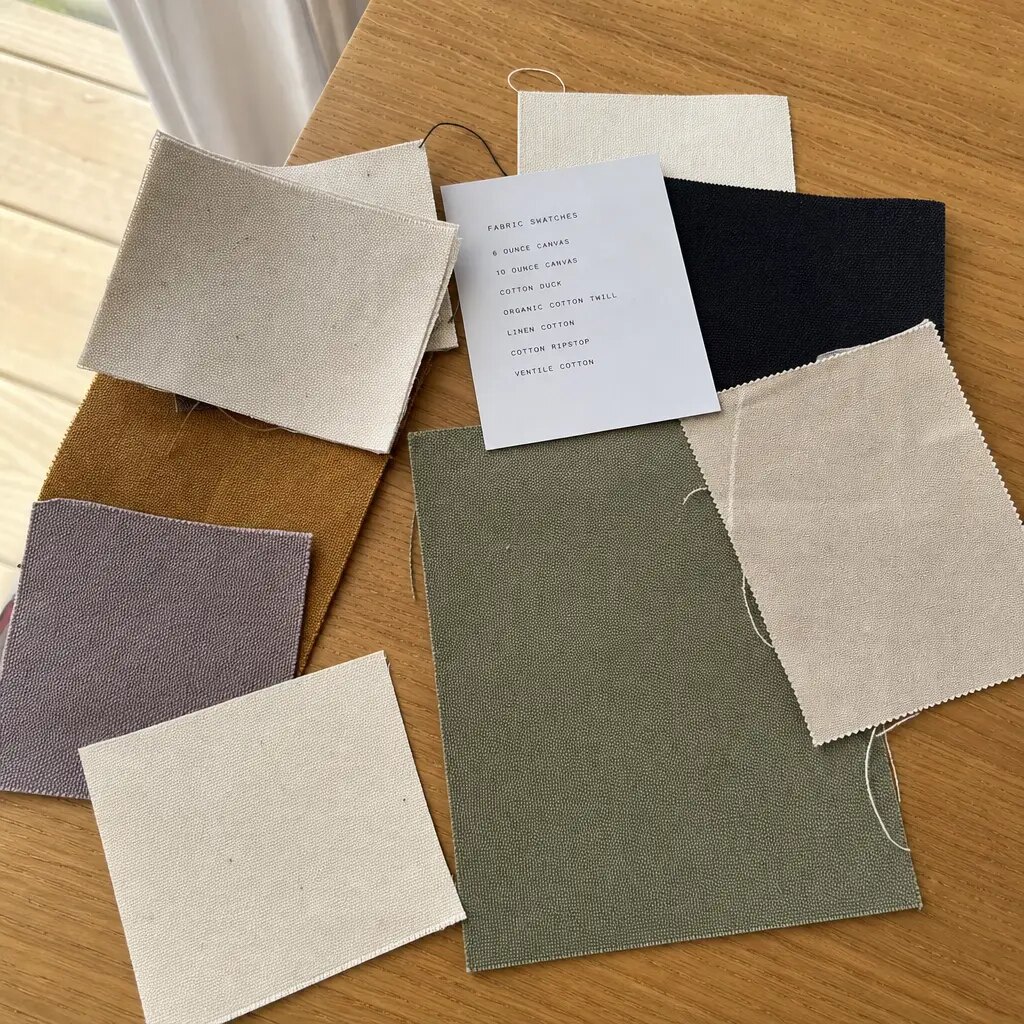
Finish affects stability and logo results. Raw canvas can feel crisp and photograph cleanly, but may change with humidity or pressing. Washed or pre-shrunk canvas may offer a softer hand and better dimensional control, yet can reduce print sharpness on textured surfaces. Natural canvas may show seed flecks and shade movement; dark canvas may show lint, fold whitening, and abrasion. Approve physical swatches, not screen images.
- Request canvas GSM range, ounce name, weave description, finish, shrinkage expectation, and color standard.
- For natural canvas, define acceptable slubs, seed flecks, and shade movement before production.
- For black or dark canvas, check lint, fold whitening, logo contrast, and pressure marks after packed compression.
- For repeat orders, require written approval before fabric weight, finish, or dye source changes.
Specify zipper construction in detail
The zipper is the main moving part and the first feature users judge. For most custom canvas zipper portfolios, a size 5 nylon coil zipper is the safest default because it bends smoothly around rounded corners, keeps weight reasonable, and performs well with repeated opening. A size 8 nylon coil zipper can suit larger or thicker portfolios, but it adds bulk. Metal zippers can look premium, yet they are less forgiving around tight curves and can mark contents or nearby units during packing.
Slider quality should be specified with the same care as zipper type. A weak slider may wobble, drag, or lose lock tension even when the coil looks fine. If the portfolio is carried vertically or filled with loose paperwork, an auto-lock slider is usually worth considering. Pullers should be checked for grip, sharp edges, plating consistency, and whether they leave pressure marks on printed panels.
Corner geometry deserves early review. Tight corner radius, uneven seam allowance, stacked bulk from lining and reinforcement, or poorly handled zipper tape can create drag. During sampling, open and close the portfolio slowly and quickly, empty and loaded. Note the exact point where resistance appears, then adjust radius, tape handling, or internal bulk before approving production.
- Default option: size 5 nylon coil zipper with stable slider, approved tape color, and smooth corner travel.
- Upgrade option: size 8 nylon coil zipper for larger or thicker kits after packed-mark testing.
- Premium-look option: metal zipper only after corner, puller, abrasion, and carton pressure checks.
- Reject samples with zipper wave, coil separation, misaligned stops, slider wobble, sharp puller edges, or forced closure.
Build the interior around coffee work
Interior design should support the roaster's workflow without making the product too thick. A wholesale onboarding kit may need a document pocket, origin card slot, and business card pocket. A cupping lab portfolio may need quick access to forms and a pen loop that does not press into the opposite panel. An account manager field portfolio may need a tablet sleeve, price list pocket, and divider for contracts or cafe training sheets.
Simple construction is often more reliable than overbuilt construction. A lined document pocket may be enough for many roaster programs. Extra foam, heavy dividers, elastic grids, and multiple layered pockets can make the portfolio difficult to close when loaded. Every added feature creates another seam, stress point, and inspection item.
Reinforcement should be placed where the product actually takes load: zipper ends, pocket mouths, spine fold, corner turns, tablet sleeve anchors, handle bases, and elastic holder ends. Hidden reinforcement patches can improve strength without changing the exterior appearance. Bartacks should be neat and consistent, with thread color approved against the product's presentation standard.
- Useful interiors include document pocket, tablet sleeve, pen loop, card pocket, divider panel, small insert pocket, or removable sheet sleeve.
- Avoid placing pen loops or hard card pockets where they press into the logo panel during packing.
- Test pocket access with real fingers and real documents, not only by visual inspection.
- Use hidden reinforcement or bartacks at stress points instead of adding bulk everywhere.
Treat the logo as a durability item
Coffee roaster portfolios are often used in customer-facing settings, so logo quality affects perceived brand value. Screen print is efficient for bold one-color or two-color artwork on flat canvas panels. It is less suitable near fold lines, zipper seams, corner curves, or areas that receive puller pressure. Ink compatibility, curing time, fabric texture, and packing contact all influence durability.
Woven labels, sewn patches, and deboss patches are usually stronger choices when long-term abrasion matters. Embroidery can work for small logos but may distort the panel if the fabric is not stabilized. Heat transfer can deliver crisp detail, but textured canvas can expose edge lifting or a plastic feel if adhesive compatibility is poor.
Logo placement should be measured, not judged by eye. Set distance from panel edges, folds, zipper seams, and stitch lines. For many front-panel applications, a logo skew or offset tolerance of +/-2 mm to +/-3 mm is practical, depending on logo size and fabric behavior. Require a strike-off or pre-production sample before bulk printing, then test rub resistance and packing contact.
- Use screen print for simple large artwork on flat panel zones away from folds and seams.
- Use woven labels, sewn patches, or deboss patches for premium kits and repeated field handling.
- Require 50 dry rubs and 20 damp rubs on the approved logo sample with no obvious lift, crack, or transfer.
- Confirm ink curing time before packing to reduce blocking, tackiness, and print transfer.
Use measurable durability tests
A durability testing checklist for custom canvas zipper portfolios for coffee roasters should be specific enough to create pass or fail decisions. The goal is not to claim laboratory certification unless formal lab testing is ordered. The goal is to catch weak construction before bulk production and before portfolios reach sales reps, trainers, or wholesale customers.
Start with the pre-production sample made from intended bulk materials. Load it with the approved contents and maximum thickness. Zip it closed without forcing the puller, then leave it closed overnight for at least 12 hours. After resting, inspect corner flare, zipper wave, panel distortion, pocket strain, and whether the portfolio still lies reasonably flat. A practical pass condition is no visible seam opening, no zipper separation, no corner flare that prevents flat stacking, and finished dimensions still within the agreed tolerance.
Cycle the zipper before approval. For sample review, require at least 300 open-close cycles on the same sample if the product is intended for field or training use; 100 cycles may be acceptable for a light promotional program. Reject if the zipper snags repeatedly, separates, loses slider control, exposes sharp edges, or requires force at corner turns. Add a seam pull check by applying firm manual tension at pocket mouths, zipper ends, and handle bases; reject broken stitches, seam opening, or fabric tearing. For logos, combine dry rubs, damp rubs, and packed compression checks.
- Loaded overnight test: approved contents plus maximum thickness, closed for at least 12 hours, with no forced slider use or seam opening.
- Zipper cycle test: 300 cycles for field-use samples, or 100 cycles for light promotional samples, with no repeated snagging or coil separation.
- Dimensional check: after loaded rest, closed size should remain within agreed tolerance, commonly +/-5 mm for document formats.
- Logo rub check: 50 dry rubs and 20 damp rubs with no obvious color lift, cracking, peeling, or transfer.
- Packing compression check: 24 hours packed as planned, then inspect puller marks, print transfer, fold whitening, odor, and corner crushing.
Make QC procurement-ready
Quality control should turn expectations into measurable inspection rules. A good-looking approved sample is not enough unless the factory and inspector know which defects are critical, major, or minor. For larger orders, buyers commonly use a recognized AQL sampling plan, often General Inspection Level II, with AQL 0.0 for critical defects, 2.5 for major defects, and 4.0 for minor defects. The exact plan should be agreed before production.
Critical defects should include unsafe sharp pullers, mold or strong odor, wrong logo, wrong material, non-functioning zipper, missing components, and unusable size. Major defects should include zipper jamming, failed loaded closure, seam opening under light tension, pocket fit failure, severe shade mismatch, raw seam exposure, obvious front-panel pressure marks, or logo skew beyond tolerance. Minor defects may include short thread tails, slight approved canvas slubs, small removable lint, or minor shade movement inside the approved standard.
Inspection should include functional checks, not only visual checks. Measure closed size, open size, pocket size, logo placement, stitch density, and zipper alignment. A practical stitch density target for heavy canvas may be 7 to 9 stitches per inch unless the approved sample uses another standard. Zipper drag should be low enough that the slider moves with normal hand force and no repeated catching at the corners. Shade should be compared against an approved swatch under consistent light, with panels, pockets, binding, and zipper tape reviewed together.
- Use agreed AQL levels and defect classes before bulk production starts.
- Measure logo skew, finished size, pocket fit, stitch density, zipper function, and shade variance during inspection.
- Keep one approved production reference sample for factory, buyer, and inspector alignment.
- Inspect packed goods for carton marks, puller pressure, print transfer, carton labels, odor, and moisture risk.
Protect the portfolios in packing
Packing can damage a well-made canvas portfolio. Zipper pulls, metal badges, raised patches, and thick seam areas can press into neighboring units during freight. Dark canvas can show fold whitening and lint. Fresh print can transfer when packed before curing. A carton designed only to maximize quantity can create avoidable claims.
Unit packing should match the finish and hardware. Many B2B programs can use one piece per recycled polybag, paper sleeve, or tissue wrap, then flat packing in export cartons. If the product has a raised patch, metal puller, metal badge, or high-contrast print, add interleaving or adjust orientation. Pullers should face consistently and should not sit directly against printed logo areas.
Carton instructions should include piece count, carton dimensions, gross weight limit, inner protection if needed, and carton markings. A practical carton weight is important because over-heavy cartons can crush lower layers and make warehouse handling harder. If portfolios will be stored before cafe training or wholesale launches, request clean cartons, odor control, and basic moisture protection because canvas can absorb smells from storage environments.
- Approve unit protection: recycled polybag, paper sleeve, tissue wrap, or interleaving based on logo and hardware risk.
- Define puller orientation so zipper pulls do not press into printed panels or soft canvas surfaces.
- Confirm carton quantity, carton dimensions, estimated gross weight, and carton markings before shipment.
- Review packed-carton photos or a packed shipping sample before releasing bulk goods.
Specification comparison for buyers
| Option | Best use | Typical buying advantage | Risk and test to confirm |
|---|---|---|---|
| 12 oz cotton canvas, about 400 GSM | Light promotional folders, event giveaways, short-term document kits | Lower cost, lighter cartons, easier folding, less bulky when packed flat | May collapse at corners or distort near zipper. Test with full paper load and require finished size change within +/-5 mm after overnight loading. |
| 14 oz cotton canvas, about 475 GSM | Wholesale onboarding kits, cafe training folders, account manager portfolios | Good balance of structure, sewing efficiency, weight, and daily handling durability | Still depends on weave density. Check panel twist, zipper wave, and shade consistency across front, back, binding, and pocket parts. |
| 16 oz cotton canvas, about 540 GSM | Premium wholesale kits, field sales use, distributor meetings, heavier inserts | Stiffer hand, stronger perceived value, better shape when filled with documents and tablet | More seam bulk at corners. Test zipper closure around approved maximum load without drag above agreed threshold. |
| Size 5 nylon coil zipper | Most slim or medium document portfolios | Smooth around rounded corners, lighter, practical for repeated opening | Require 300 sample cycles before approval and reject snagging, coil separation, slider wobble, or corner drag. |
| Size 8 nylon coil zipper | Larger portfolios or thicker training kits | Stronger visual scale and more tolerance for heavy contents | Adds bulk and may look oversized. Confirm carton pressure marks and zipper edge profile after packed compression. |
| Metal zipper | Premium look for limited programs where aesthetics lead | Distinctive appearance and heavier handfeel | Less forgiving around curves and can mark contents. Test corner radius, puller pressure, sharp edges, and carton abrasion. |
| Screen printed logo | Bold 1 to 2 color roaster marks on flat panels | Efficient for larger artwork and repeat orders | Keep clear of folds and zipper seams. Require 50 dry rubs and 20 damp rubs with no obvious color lift, cracking, or transfer. |
| Woven label or sewn patch | Premium kits, long-use sales portfolios, understated branding | Better abrasion resistance and less risk than large surface print | Check label skew within +/-2 mm, edge lifting, stitch consistency, and whether patch thickness leaves carton impressions. |
| Simple lined document interior | Cupping forms, price lists, account paperwork, training sheets | Useful organization without excessive thickness | Test A4 or US letter fit with 20 sheets and confirm sheets do not curl, catch binding, or force zipper closure. |
Buyer checklist before sampling
- Define the portfolio use case: wholesale onboarding kit, cupping lab folder, account manager field portfolio, cafe training pack, distributor document set, or event sample kit.
- List real contents with quantities: A4 or US letter sheets, cupping forms, tablet model or dimensions, pens, cards, notebooks, catalogs, price lists, certificates, and inserts.
- State closed size, open size, internal pocket size, maximum loaded thickness, and whether measurements are taken empty, filled, or after pressing.
- Specify canvas by GSM range, ounce name, weave character, finish, color standard, and acceptable shrinkage or dimensional change after handling.
- Choose zipper type, chain size, tape color, slider type, puller finish, corner radius expectation, and whether an auto-lock slider is required.
- Define reinforcement at zipper ends, corner turns, spine fold, pocket openings, tablet sleeve anchors, handle bases, and elastic holder ends.
- Set measurable workmanship targets: stitch density, seam allowance, logo placement tolerance, zipper drag limit, shade variance, and acceptable thread-tail length.
- Confirm logo method, artwork size, color reference, placement clearance from folds or seams, and rub-test requirement before bulk production.
- Require material swatches, trim samples, decoration strike-off, pre-production sample, packed sample, and approved production reference sample.
- Write carton rules: unit protection, zipper pull orientation, interleaving if needed, carton quantity, gross weight limit, carton markings, and packed-carton photo approval.
Factory quote questions to send
- What exact outer canvas is included in the quote: GSM range, ounce name, weave type if known, finish, color source, shrinkage expectation, and fabric weight tolerance?
- What are the side-by-side price effects for 12 oz, 14 oz, and 16 oz canvas using the same size, lining, zipper, logo, packing, and order quantity?
- What zipper options are being priced: size 5 nylon coil, size 8 nylon coil, or metal zipper, and what slider grade, tape width, auto-lock function, puller shape, and finish are included?
- How will the zipper path be constructed around corners, including corner radius, seam allowance, tape handling, end stops, and reinforcement at the zipper ends?
- Which lining, pockets, tablet sleeve, pen loops, divider panels, padding, elastic holders, or insert sleeves are included, and which are optional cost additions?
- What stitch density, thread type, bartack locations, hidden reinforcement patches, binding method, and seam allowance will production follow?
- Which logo method is included, how many colors and locations are priced, what placement tolerance is offered, and what rub or adhesion checks can be performed before shipment?
- What sample stages are available, what each sample proves, what materials may be substituted during early sampling, and which sample becomes the bulk production standard?
- What MOQ applies by fabric color, zipper color, logo artwork, hardware finish, and size, and can multiple roaster colorways share one production run?
- What inspection plan is included or supported: AQL level, sample quantity, functional zipper checks, loaded fit checks, logo checks, carton checks, and defect classification?
Quality-control points to confirm
- Use a recognized AQL plan when order size justifies it, commonly General Inspection Level II with AQL 0.0 for critical defects, 2.5 for major defects, and 4.0 for minor defects unless the buyer sets another standard.
- Classify critical defects as non-functioning zipper, unsafe sharp edge, wrong logo, wrong material, mold or strong odor, missing component, severe contamination, or unusable size.
- Classify major defects as zipper snagging, seam opening, failed loaded closure, pocket fit failure, logo skew over tolerance, severe shade mismatch, obvious front-panel pressure marks, or raw seam exposure.
- Classify minor defects as small removable lint, short thread tails within agreed limit, slight approved canvas slubs, minor shade movement within standard, or tiny stitch irregularities outside high-visibility zones.
- Measure finished closed and open dimensions against the approved sample; a common tolerance for document portfolios is +/-5 mm, while fitted tablet sleeves may need +/-3 mm if construction allows.
- Check logo placement for skew and offset; for many front-panel marks, use +/-2 mm to +/-3 mm tolerance depending on logo size, fabric texture, and sewing construction.
- Check stitch density against the approved spec, commonly 7 to 9 stitches per inch for heavy canvas unless the factory standard differs and is approved in writing.
- Test zipper function on inspected units with repeated open-close pulls; reject units with coil separation, missing teeth, slider wobble, sharp puller edges, misaligned stops, or drag that requires force.
- Use a loaded fit check with approved contents and maximum thickness; the portfolio should close without forced pulling, corner flare, panel warping, or zipper tape distortion.
- Check logo durability with dry and damp rubs on sampled units or retained samples; reject obvious color lift, cracking, peeling, adhesive failure, or transfer onto protective packing.