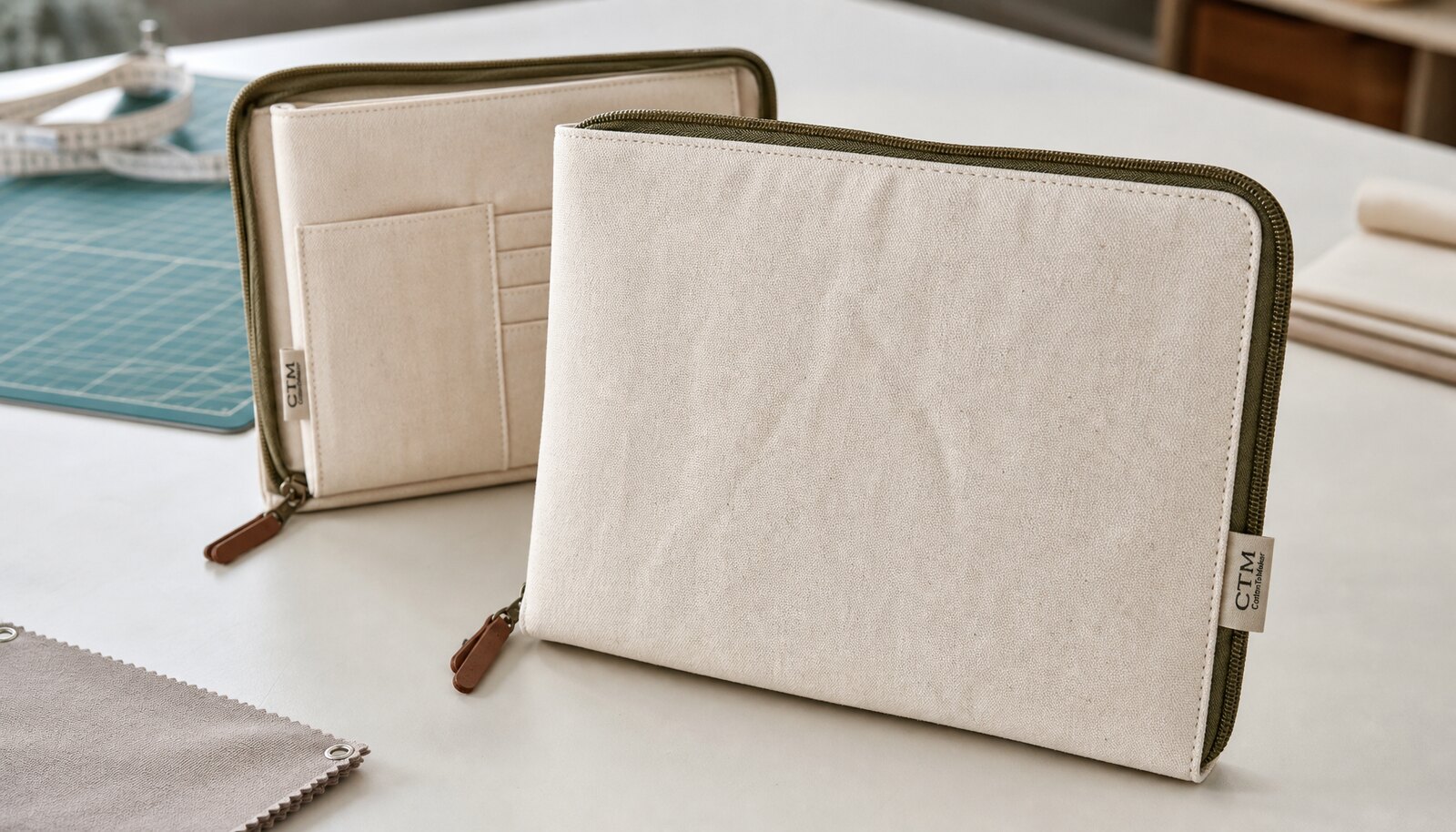
What Buyers Are Really Trying to Control
A canvas zipper portfolio for a gift shop is a small item, but the procurement risk is not small. It has to look presentable on a shelf, feel substantial in the hand, and survive repeated customer handling without the zipper dragging or the face panel collapsing. Buyers usually do not lose money on one catastrophic failure. They lose margin through lots of minor misses: a soft body that looks cheap, a logo that lands slightly off-center, a zipper color that shifts from sample to bulk, or packing that arrives wrinkled and hard to display.
That is why a procurement checklist matters more than a vague sourcing brief. If the supplier is only quoting a generic 'custom canvas pouch,' the factory can fill in details in whatever way is easiest for production. If you want the item to work for a gift shop, you need the right kind of specificity: shelf appearance, retail packing, repeatability across seasons, and a clear signoff path for the sample and bulk run. Those are the controls that protect the buyer after the invoice is paid.
The keyword phrase may be long, but the buying intent is simple: find a supplier who can make a custom canvas zipper portfolio that is saleable, consistent, and documented well enough to reorder without re-litigating every detail. That means focusing on construction, quote assumptions, packaging, and compliance documents together instead of treating them as separate conversations.
- Shelf appeal is part of product quality in gift retail.
- One weak assumption in the quote can erase the apparent price advantage.
- The sample must prove more than appearance; it must prove repeatable build details.
- The best RFQ is the one that removes guesswork before bulk cutting starts.
Lock the Product Spec Before You Ask for Price
Start with the physical build. Do not ask for a quote until you know the finished size, gusset depth, internal structure, and the type of canvas body you want. For a document-style portfolio, many buyers land somewhere in the 10 oz to 14 oz canvas range depending on how structured they want the piece to feel. Treat that range as a buying heuristic, not a law: lighter canvas can work for soft promotional items, while heavier canvas is often better when the piece is expected to sit upright, carry paper stock, or feel more premium in hand.
Size drives almost everything else. If you want an A4 or letter-size portfolio, specify the finished width and height and then add the gusset depth you actually need for the contents. A 20-30 mm gusset may be enough for paper sets, stationery bundles, or travel documents, but the right depth depends on what is going inside. The moment you add a card slot, pen loop, divider, or lining, you need to decide whether those features are functional requirements or merchandising details. Each extra detail increases sewing time and inspection burden, so do not add them casually.
The practical aim is to make the factory quote the same product you think you are buying. Put the size, canvas construction, zipper spec, decoration method, and interior features in writing before the first price lands. If you do that, you can compare suppliers on real manufacturing differences instead of on sales language.
- State finished width, height, and gusset depth in the RFQ.
- Describe the canvas as a specific material and weight target, not just 'thick' or 'premium'.
- Decide whether the interior is unlined, partially lined, or fully lined.
- Name any extra features only if they are required for use or retail presentation.
Compare Supplier Routes as Commercial Choices, Not Just Names
A direct factory, a trading company, and a workshop with outsourced finishing can all sell custom canvas zipper portfolios, but the commercial risk is different in each case. A direct sewing factory usually gives buyers more control over trim sourcing, sample-to-bulk matching, and first-line defect handling. That matters when your order must repeat across seasons or when the zipper, puller, and logo placement need to be exact. The tradeoff is that you may have to do more of the detail work yourself, especially on packing and export paperwork.
Trading companies can be useful when you are buying several product groups at once or when you need someone to coordinate with multiple factories. The risk is that the buyer may not see the actual sewing line or the real source of the fabric and trims. If you use this route, ask who owns quality decisions when something changes. A workshop or print-led supplier can work well for small runs or art-led retail programs, but only if the decoration method, sewing partner, and handoff standard are written down.
The comparison should be made on four commercial questions: who controls material purchase, who signs off the sample, who owns the defect decision, and who is responsible if bulk differs from the approved sample. That is the real procurement difference. Price alone will not tell you whether the supplier route matches your program.
Use the table above as a route screen, then narrow it by MOQ, lead time, and document discipline. If two supplier types are both affordable, choose the one that can prove the build rather than the one that only promises it.
- Ask who buys the fabric, zipper, and puller.
- Ask who approves the pre-production sample in writing.
- Ask who makes the defect decision if bulk differs from the sealed sample.
- Ask for factory photos, not just a product page, if you are buying at scale.
Build the Quote So Hidden Costs Show Up
A useful quote separates the parts of the order that can change the price. At minimum, you want the supplier to break out the fabric assumption, zipper assumption, decoration method, packing method, testing or document cost if any, and the logistics term. Without that structure, two quotes can look close while one quietly excludes branded pullers, retail packing, or carton labeling. For a gift shop buyer, those omissions matter because the product does not arrive as a bare sewing job; it arrives as a sellable unit.
MOQ is rarely just about how many finished pieces you want. It often follows fabric purchase lots, print setup, zipper color availability, and packing labor. A supplier may quote a lower MOQ if standard canvas and standard zippers are already in stock, but a custom dye lot, custom puller, or printed lining can force a larger commitment. That is normal manufacturing logic, not necessarily a red flag. What matters is whether the supplier names those drivers up front.
Ask for quote tiers at several quantities, such as 500, 1,000, and 3,000 pieces, so you can see where the curve changes. Also ask the supplier to state what is excluded. That one step often reveals the real price difference faster than a long sales call. If the factory cannot explain the quote structure clearly, the bulk order will probably be just as hard to manage.
For repeat orders, keep one master RFQ sheet and do not let later purchases drift from it. Most procurement problems start when the second order is quoted from memory instead of from the approved spec.
- Separate unit price from tooling, sample fees, decoration setup, and packing charges.
- Ask whether each logo color or decoration version changes the price.
- Request the logistics term used in the quote, such as EXW or FOB, so you can compare landed cost properly.
- Make the supplier list all excluded items in writing.
Choose Branding That Holds Up in a Gift Shop
Decoration choice should be based on handling, visibility, and cleaning tolerance, not only on brand preference. Screen print is usually the simplest route when the logo is clean, the coverage area is moderate, and the buyer wants a lower-cost retail item. Woven labels, stitched side tabs, and embroidered patches can create a stronger perceived value, but they add sewing steps and can stiffen the panel. Debossed or patch-style branding can be useful when the design needs to look restrained and survive repeated touch.
The safe rule is to choose a method that still reads well after the product has been handled. Fine text is risky on coarse canvas because it can fill in, blur, or crack visually. If your logo depends on thin lines, tiny type, or delicate spacing, ask the supplier for a sample on the exact canvas rather than assuming the artwork will transfer cleanly. The texture of the substrate matters.
Put the decoration into the tech pack with measurable instructions: placement from the top edge or centerline, finished artwork size, color reference, and acceptable variation. If the supplier says the logo will be 'close enough,' ask them to restate that as a measurable location. Buyers should not accept decoration by feel. Once production starts, exact placement is much easier to control than to repair.
For gift shop assortments, the best branding is often the one that looks good from arm’s length, survives daily handling, and does not force an expensive rework if a reorder is made six months later.
- Use screen print for simple logos and lower coverage.
- Use woven labels or stitched patches when shelf presence matters more than the lowest unit price.
- Avoid tiny text and thin line art on textured canvas.
- Approve decoration on the actual fabric, not on paper only.
Use Sampling to Prove Construction, Not Just Appearance
The sample stage should answer one question: can this supplier repeat the item in bulk without drifting? A photo is not enough. Ask for a physical prototype, review it against the tech pack, and then seal a gold sample once you approve it. That sealed sample should stay attached to the purchase order or be referenced in a way both sides can access later. It becomes the benchmark for bulk acceptance.
Test the build, not just the look. Open and close the zipper several times to check movement, end stops, and fabric snagging. Load the portfolio with the kind of contents it will actually hold and see whether the gusset collapses, the corners distort, or the zipper line buckles. Compare pocket depth, seam placement, lining coverage, and logo position to the approved drawing. If the sample is printed or patched, inspect the real substrate; a print strike-off on plain material does not prove the same result on canvas.
If your product has a decorative lining, custom puller, or special reinforcement, make sure those items are present in the sample. Many bulk problems come from a sample that was assembled with extra care or a different trim lot than the production order. The sample should prove the exact build you expect the line to repeat. Anything less is a sales sample, not a control sample.
Before bulk cutting starts, confirm that the supplier understands which sample is the master reference. If there are revisions, keep them documented. The risk is not that the sample is imperfect; it is that the factory and the buyer are each comparing bulk to a different version of 'approved.'
- Use a physical sample, not only a photo approval.
- Seal one gold sample and reference it on the PO or tech pack.
- Test zipper movement, pocket fit, and loaded shape.
- Do not approve print or patch quality from a substrate that is different from the bulk fabric.
Write Compliance and Document Requests in Plain Language
Many buyers ask for a 'compliance-focused supplier' without saying what that means. That is too vague to be useful. For procurement, compliance should be translated into named documents and batch-level proof. If you need export paperwork, ask for the commercial invoice, packing list, and carton marks format in advance. If your channel requires material or chemical screening, ask the supplier which test report is available, which standard it references, which batch it applies to, and whether the report date matches the production lot.
Do not accept a general statement that 'all materials are compliant.' Ask for the actual file name, issue date, and the exact style or colorway it covers. A report for one color of canvas does not automatically cover another dye lot. If the supplier relies on a third-party lab, request the lab report and verify that the article description, supplier name, and test scope match the order. If you need restricted-substance screening or retailer paperwork, the supplier should be able to tell you exactly which document they can provide and when it will be issued.
Traceability should also be concrete. Ask how the factory links the raw canvas lot, zipper lot, and finished carton to the order number. A practical traceability system might be as simple as batch labels on material rolls, a production record, and carton photos at final packing. You do not need a fancy system; you need a system that lets the supplier answer, after shipment, which batch made the goods and which goods were packed into which carton.
For gift shop programs, compliance is not only about passing a lab test. It is about being able to prove what was made, from what, and under which approved batch assumptions if a retailer asks for backup later.
- Ask for exact document names, not generic compliance language.
- Verify that test files match the style, colorway, and batch you are buying.
- Request batch linkage for canvas, zipper, and finished cartons.
- Make the supplier explain who signs off if documents and samples disagree.
Specify Packing for Retail Reality, Not Only Transport
Packing should protect both transit and presentation. A zipper portfolio can arrive in perfect sewn condition and still disappoint a store team if it is crushed, creased, or packed in a way that makes the face panel look tired. If the item needs shape, ask for a thin insert board or tissue support. If it will be sold directly on shelf, define the retail wrapper, barcode placement, hangtag attachment, and the fold line so the front panel lands cleanly.
The packing spec should also prevent warehouse confusion. State whether each unit is individually polybagged, whether the bag must remain flat, and whether the barcode goes on the bag, the polybag, or the master carton. Then set carton rules: pieces per carton, inner pack count if any, carton dimensions, and gross weight. Those details help you estimate freight, check receiving capacity, and avoid surprises when a shipment arrives with more volume than expected.
If you sell mixed assortments, define the mix ratio in writing. Do not let the factory improvise color splits or artwork combinations just to finish the carton count. In retail, those small packing shortcuts become inventory mismatches. If your supply chain needs shelf-ready cartons, say so. If your store team repacks items before display, say that too. The packaging choice should fit the channel, not only the truck.
A good packing spec makes the factory’s job easier because the standard is clear. It also makes your receiving team faster because they know exactly how the product should arrive.
- Require a packing spec that includes insert, wrap, label, and carton mark.
- Ask for carton dimensions before comparing freight quotes.
- Set the unit count per carton and inner pack count in writing.
- Define mixed-SKU rules and color ratios before production starts.
Plan Lead Time Around the Slowest Step in the Chain
Lead time is often misunderstood as sewing time. In reality, a custom canvas zipper portfolio can stall at fabric booking, zipper sourcing, decoration setup, sample approval, inspection scheduling, or carton preparation. A supplier that quotes only the sewing window is not giving you the real schedule. If your gift shop launch date is fixed, you need a step-by-step timeline that shows when each gate happens and who owns the next action.
The slowest step is usually the one that changes the product face or hand-feel. Custom-dyed canvas, specialty zipper pullers, printed lining, and stitched patches can all stretch the schedule because they require a separate setup or supplier. That is why repeat programs are easier than first orders: once the artwork, material, and trim choices are locked, the reorder becomes a sourcing exercise instead of a design exercise. For seasonal retail, that difference matters.
Ask the supplier to name the checkpoints explicitly: sample day, revision day if needed, material booking, cutting, production, in-line check, final inspection, packing, and shipment handoff. If the supplier cannot break the lead time into stages, the quote is probably optimistic. A reliable factory should be able to say where the time sits, not just when the order might finish.
If you need a launch date, build a buffer around sample approval and material sourcing. That is where orders tend to move, and that is where the hidden delay usually appears.
- Treat sample approval as a schedule gate.
- Reserve extra time for custom canvas, custom pullers, and printed components.
- Ask for a dated milestone schedule, not only one delivery date.
- Make sure the quoted lead time includes inspection and packing.
Compare Landed Cost, Not Just the Factory Quote
The cheapest ex-works price is not always the best procurement outcome. Canvas zipper portfolios are lightweight, but they can become expensive if the factory packs them badly, uses oversized cartons, or leaves out retail packaging that your team later has to add by hand. For a fair comparison, align the quotes on the same size, the same canvas spec, the same zipper spec, the same branding method, and the same packing method. Only then can you see the real difference between suppliers.
It also helps to compare the quote against the physical carton data. Ask for carton dimensions, gross weight, and pieces per carton. Those numbers affect freight cost and warehouse handling. A supplier with a slightly higher unit price may still be cheaper overall if the packing is efficient and the retail work is already included. That is especially true when the buyer must process thousands of units through receiving, barcoding, or store replenishment.
Use one master RFQ sheet for every supplier and every reorder. Include the dimension sketch, fabric assumption, zipper assumption, decoration method, packing rules, target MOQ, and any document requirements. If two prices still differ materially after that, the gap usually points to material grade, labor standard, or omitted work rather than a mysterious discount. Procurement gets easier when the spec is precise enough that the quote cannot hide much.
For this category, the commercial win is not the lowest headline number. It is the quote that matches the actual item you can receive, inspect, warehouse, and sell without surprise work later.
- Compare quotes on the same build, not on the same product name.
- Request carton dimensions and gross weight with every offer.
- Include all packing and retail-prep items in the RFQ.
- Keep one master sheet so reorders do not drift from the approved version.
Specification comparison for buyers
| Supplier option | What to verify | Commercial advantage | Buyer risk to control |
|---|---|---|---|
| Direct sewing factory | zipper source record, production-line zipper test photos, approved trim card, cutting marker photos, and final open-carton count | Better sample-to-bulk control and faster production feedback | May be weaker on export paperwork or branded packing unless checked early |
| Trading company | Factory name, production photos, trim-source proof, and who owns QC decisions | Can coordinate small mixed orders and extra services | Markup can hide real factory capability and slow defect decisions |
| Specialized bag workshop | zipper gauge, zipper tape width, puller finish, binding tape, corner reinforcement, seam allowance, and document-size tolerance | More practical for detailed construction, trims, and repeat programs | Capacity may be limited during peak seasons |
| Low-price general supplier | 300D-600D polyester, 10-12 oz canvas, or recycled PET with backing stiffness matched to document weight | Useful for simple promotional runs with loose specs | Material downgrades, weak packing, and vague inspection scope can erase savings |
| Retail-ready supplier | flat packing, insert board if needed, SKU bundles, carton weight limit, moisture protection, and barcode visibility | Can handle labels, SKU separation, carton marks, and receiving rules | Higher unit cost must be compared against reduced warehouse work |
| Compliance-focused supplier | Fabric records, labeling review, test plan, and production traceability | Safer for retail programs and repeat brand orders | Documentation claims need evidence, not only sales language |
| Local sample room plus bulk factory | Signed sample, bulk factory handoff, first-piece photos, and deviation owner | Good for complex branding before large production | Sample room quality may not match bulk line unless handoff is controlled |
Buyer checklist before sampling
- Write the finished size, gusset depth, and intended contents before requesting any price.
- State the canvas construction in practical terms: fabric type, target weight, weave feel, and whether you want a softer or firmer body.
- Name the zipper type, size, tape color, puller finish, and whether the puller is standard or custom branded.
- Define logo method, placement, artwork size, and one approved color reference; do not rely on a verbal description.
- Specify inside features clearly: lining, pocket count, card slots, pen loops, elastic, reinforcement tape, or divider panels.
- Set packing rules: insert board, tissue, polybag, barcode label, hangtag, carton marks, and carton count per SKU.
- Ask for quote tiers at several quantities so you can see how MOQ, setup, and packing affect the unit price.
- Require a physical pre-production sample and one sealed gold sample that both sides agree to use for bulk comparison.
- Ask for the exact supplier documents you will receive before shipment: commercial invoice, packing list, inspection record, and batch-related test files if applicable.
- If the bag will sell through a chain or export channel, verify whether any retailer, country, or material-specific compliance requirements apply before release.
Factory quote questions to send
- What is the exact fabric specification included in the quote, including material type, target weight, and finish?
- Is the zipper standard stock or custom, and what brand, size, tape color, puller finish, and stop type are assumed?
- Which decoration method is included, how many setup steps are priced, and what artwork size and placement are assumed?
- What is the MOQ by colorway, artwork version, and packing configuration?
- What is included in sampling: prototype, revision sample, courier cost, and whether sample fees are credited against bulk?
- Which packing items are included: insert board, tissue, polybag, barcode sticker, hangtag, carton label, and master carton mark?
- What are the lead times for material booking, sample approval, cutting, sewing, inspection, and packing?
- Which documents can you provide with the exact batch: inspection record, carton count photo set, invoice, packing list, and any available test or material files?
- Who owns QC decisions if the sample, bulk, and packing do not fully match?
- What is excluded from the unit price so I can compare quotes on the same basis?
Quality-control points to confirm
- Fabric matches the agreed spec on type, finish, and target weight, with no obvious thin spots, holes, broken weave, or uneven dye shade within a lot.
- Finished width, height, and gusset depth remain within the agreed tolerance of the sealed sample and tech pack.
- Zipper moves smoothly from end to end, closes without snagging, and has secure stops or end finishing appropriate to the design.
- Seam lines are even and secure around the zipper area, corners, gusset folds, and any pocket or reinforcement point.
- Logo placement matches the approved artwork position, size, and orientation; registration, stitch alignment, or print placement should not drift visibly from the gold sample.
- Inside construction matches the tech pack exactly: pocket count, pocket depth, lining, divider placement, reinforcement, and any binding tape are correct.
- Packing is consistent: right insert, right folding method, correct polybag or retail wrap, accurate barcode placement, and correct carton count per SKU.
- Cartons are marked correctly and packed to the agreed quantity, with no mixed SKU errors unless a written mix ratio was approved.
- If you use sampling or bulk inspection reports, make sure they identify the exact style code, colorway, date, and batch rather than a generic bag description.
- If your buyer program uses an inspection standard, align the acceptance plan before production starts and write the major/minor defect definitions into the PO; do not rely on a verbal 'factory standard'.