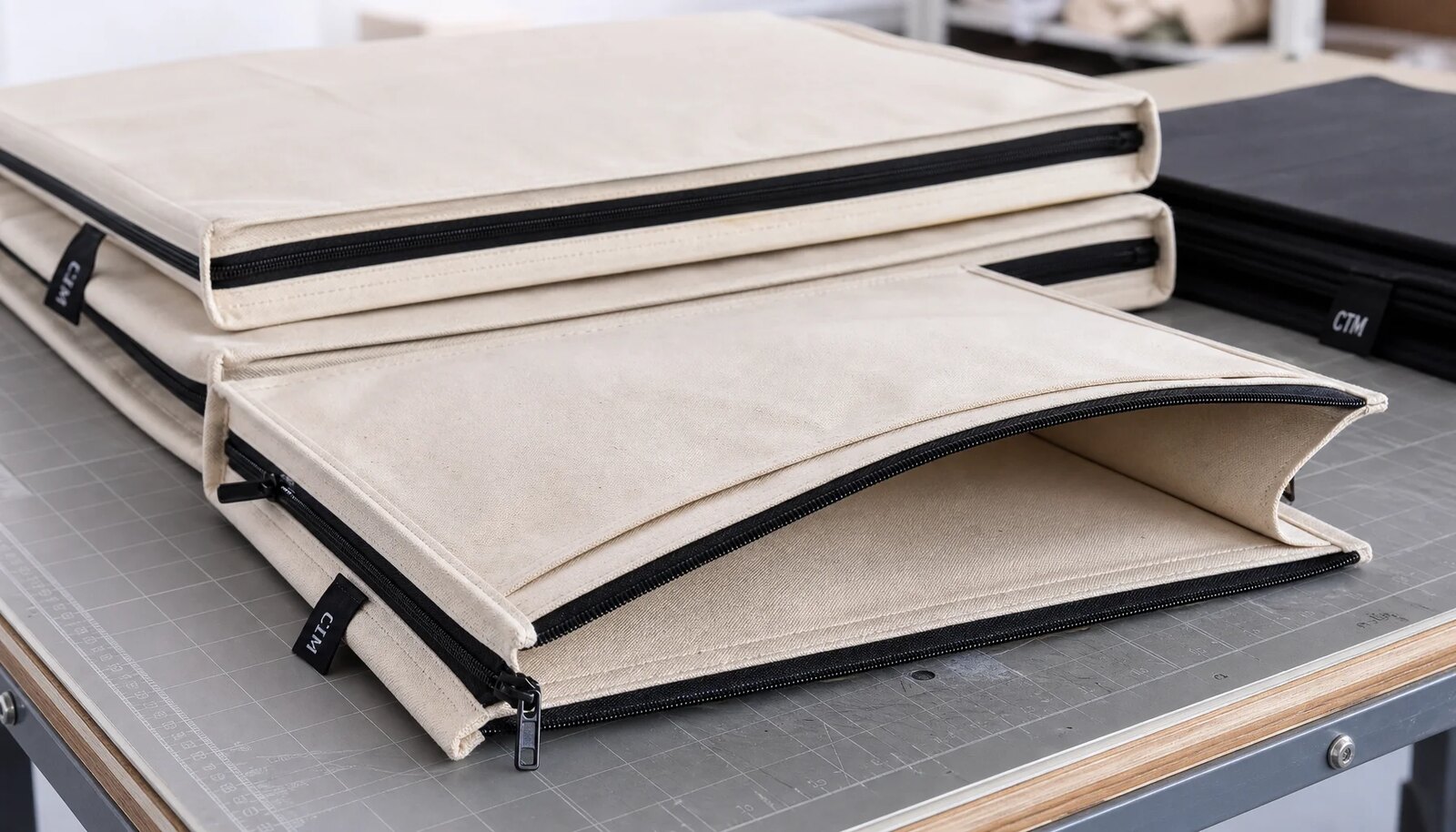
Buying Problem: Product Approval Is Not Carton Approval
Custom canvas zipper portfolios shipping carton planning for craft fairs should start before the purchase order, not after bulk sewing. The portfolio may look simple on a product sheet: flat canvas body, zipper closure, printed logo, and carton packing. In practice, the order must survive fabric cutting, printing, sewing, export packing, freight, warehouse receiving, local sorting, booth allocation, and repeated event handling.
The main procurement failure is approving the product but leaving the carton plan undefined. A good sample can still ship in cartons that are too heavy for a small event crew, too tall for booth storage, mixed by artwork version, or packed tightly enough to curl zipper corners. For craft fairs, the carton is part of the user experience because staff often count, split, and move units under time pressure.
A stronger RFQ connects the product specification to the packing method from the first supplier quote. Buyers should request carton dimensions, pieces per carton, gross weight, net weight, board strength, total carton count, total CBM, inner bundle rules, and label format before comparing prices. This makes the quote more useful for landed-cost comparison and reduces last-minute repacking.
- Treat carton planning as part of product engineering, not a warehouse afterthought.
- Request carton data by SKU, artwork version, and packing version before supplier selection.
- Check whether cartons can be lifted, opened, counted, and split by the receiving team.
- Approve carton labels before production packing, especially for multi-location events.
- Use a first-carton confirmation when the order has a fixed craft fair delivery date.
Start With the Real Contents
The safest specification begins with what goes inside the portfolio. Craft fair portfolios may hold exhibitor maps, sponsor sheets, price lists, catalogs, artist statements, postcards, contracts, badges, receipt books, or retail presentation inserts. A few sheets slide in easily; a thick glossy catalog stack changes the usable space, zipper stress, and carton stack shape.
Finished outside size and usable inside size should be written separately. A portfolio can pass an outside measurement check but fail in use because zipper tape, binding, seam allowance, and canvas thickness reduce the opening. For A4 or letter-size document kits, 15-25 mm of internal clearance on width and height can be a starting point for buyer testing, but the final allowance should be approved with the real content stack.
Ask the supplier to sample with the same loading method planned for the event. If staff will insert a pre-assembled kit, test that process. If the portfolio must remain flat after loading, say so. Bulging portfolios may still be usable, but they stack less efficiently and may reduce the final pieces per carton.
- List every insert, including hangtags, barcodes, badges, retail sleeves, and sponsor cards.
- Provide the largest document size and total stack thickness in the RFQ.
- Specify outside dimensions and target usable inside dimensions as separate requirements.
- Test the sample with real contents and the planned loading direction.
- Decide whether slight bulging is acceptable or whether the loaded portfolio must remain flat.
Canvas Weight, Finish, and Buyer Verification
Canvas choice affects handfeel, sewing, print performance, carton count, gross weight, and freight cost. For many flat canvas zipper portfolios, 12 oz to 14 oz cotton canvas offers a practical balance of structure and handling. Lighter canvas can reduce cost but may wrinkle or collapse more easily. Heavier canvas, such as 16 oz, can feel more premium but increases corner bulk, sewing resistance, and carton weight.
Do not compare quotes that only say canvas. Ask for both oz and GSM where possible, and confirm whether the weight is before or after finishing. The same product name can hide meaningful differences in fabric weight, yarn, weave, coating, washing, or dyeing. Bulk fabric should be matched against the approved sample or an approved lab dip, with tolerance stated clearly enough for inspection.
Finish choice also changes the buying process. Natural unwashed canvas is usually simpler to approve than dyed or washed canvas. Dyed canvas needs color approval and shade-lot control. Washed canvas may feel softer but can shrink, twist, or vary more in dimension. If color is central to the brand, build the lab dip and shade review into the schedule instead of treating it as a minor pre-production detail.
- Use 10-12 oz canvas only when low cost and lighter handling are more important than structure.
- Use 12-14 oz canvas when the order needs a balanced document portfolio for event distribution.
- Use 16 oz canvas only after checking zipper corner bulk and packed carton weight.
- For dyed canvas, approve lab dips and state shade tolerance before bulk fabric booking.
- For washed canvas, approve the sample after the same wash process planned for production.
Zipper and Sewing Details That Affect Handling
The zipper is the main functional component, so it should not be quoted as factory standard. For many flat canvas business portfolios, a No. 5 nylon coil zipper is a practical option because it bends around soft corners, keeps weight reasonable, and suits repeated opening during event setup. Buyers should still verify the exact zipper gauge, tape width, tape color, slider material, slider finish, puller shape, opening direction, and end stop method.
Sewing construction decides whether the zipper works smoothly after the portfolio is loaded. Narrow seam allowance can let canvas fibers fray toward the coil. A tight corner radius can make the slider drag. Too much stitch density on heavy canvas may create waviness or perforation. A large puller may press into printed panels when units are stacked inside a carton.
During sample approval, test the zipper with the real content stack. Open and close it repeatedly, check the corners, and inspect whether loose threads or seam allowance catch in the coil. Twenty manual cycles is a useful buyer check for sample review and inspection spot checks, but the PO should also reference the factory's zipper quality standard and approved sample.
- Define zipper gauge, tape width, tape color, slider finish, puller shape, and opening direction.
- Ask the factory to recommend a corner radius that keeps slider travel smooth.
- Require secure finishing, backstitching, or bar-tacking at zipper start and end points.
- Check whether pullers leave pressure marks on printed panels during stacked packing.
- Use the approved sample as the sewing and zipper reference for bulk inspection.
Logo Method and Artwork Controls
Decoration is the most visible buying decision, but it can also create packing and quality risk. Screen printing is often efficient for one to three solid colors, repeat event logos, and sponsor marks. Heat transfer can handle detailed artwork or gradients, but it needs adhesion and rub checks. Embroidery can look premium, yet it may pucker flat panels and add thickness that affects carton stacking.
Artwork placement should be measured from finished portfolio edges, not cut panel edges. Sewing, turning, binding, and zipper installation can shift the final visual position. A logo placed too close to a zipper corner can look uneven after assembly. A large ink block can stiffen the canvas, show scuffs, or transfer if packed before curing.
A useful artwork instruction includes file format, print size, number of colors, color reference, placement from finished edges, and acceptable tolerance. For multi-sponsor or multi-city craft fair orders, every artwork version should appear in the SKU matrix so screen changes, setup charges, sorting labor, inner labels, and carton labels can be quoted accurately.
- Use screen print for bold, limited-color artwork where cost and speed matter.
- Use heat transfer only after checking adhesion, handfeel, edge lift, and rub resistance.
- Use woven side labels for repeat identity with less risk of large print scuffing.
- Keep critical artwork away from zipper corners, seams, and pressure points.
- Require curing confirmation and a light dry rub check before packing.
MOQ and SKU Matrix Discipline
MOQ for canvas zipper portfolios is rarely one simple number. It is shaped by fabric procurement, dye lot, zipper color, cutting efficiency, print setup, label production, packing format, and carton segregation. A buyer may see 3,000 total units as one order, while the factory sees ten artwork versions, several label changes, and multiple destination splits.
The most efficient procurement strategy is to standardize the body. One size, one canvas color, one zipper color, and one construction can support multiple artwork versions with less production risk. If small groups need different identities, varying the print, insert card, or carton label may be easier than changing fabric color, zipper tape, or pocket structure.
MOQ should also be tied to packing. Two artwork versions may share the same unit price but require separate inner bundles, separate carton labels, separate destination codes, and separate inspection checks. If mixed cartons are allowed, the exact mix must be written into a packing matrix. For event-dated orders, single-version cartons are usually safer unless the receiving team is prepared to sort.
- Build a SKU matrix covering size, canvas color, zipper color, artwork, label, packing method, quantity, and destination.
- Keep one common body size where possible, then vary artwork instead of construction.
- Treat each fabric color as a separate lot with its own MOQ and shade control.
- Ask whether short artwork runs carry screen, transfer, sorting, or label charges.
- Confirm whether cartons must be single-version or may contain a controlled mix.
Carton Plan, CBM, and a Simple Calculation
Carton planning should happen before bulk cutting because the design determines how efficiently units pack. Finished size, canvas stiffness, zipper thickness, puller shape, print position, individual bags, and carton board strength all affect pieces per carton. A range such as 50-100 pieces per carton may be useful for early discussion, but the final quantity should come from trial packing finished samples.
The best carton is not always the one with the highest piece count. A tightly packed carton can reduce CBM on paper while causing curled zipper corners, pressure marks, crushed edges, or cartons that are too heavy for local crews. Buyers should define a maximum acceptable gross weight based on the actual receiving environment: warehouse dock, retail back room, fairground storage, or booth team.
Ask the supplier to provide carton dimensions in centimeters, pieces per carton, carton count, net weight, gross weight, and total CBM by SKU. A simple CBM check helps compare quotes. If one carton is 60 x 40 x 30 cm, carton CBM is 0.60 x 0.40 x 0.30 = 0.072 CBM. If it holds 80 portfolios, 1,000 units require 12.5 cartons, so the estimated CBM is about 0.90 CBM before pallet or rounding assumptions. The buyer should verify the supplier's final calculation because carton count, palletization, and freight billing rules can change the landed result.
- Validate pieces per carton by trial packing finished samples.
- Set a maximum carton gross weight that event teams can lift safely and repeatedly.
- Use inner bundles when cartons will be split by booth, sponsor, city, or retailer.
- Use individual bags only when presentation or print protection justifies the added cost and CBM.
- Require carton labels with SKU, artwork version, quantity, carton number, destination code, PO reference, and gross weight.
Sampling and Approval Gates
Sampling should separate construction approval from decoration approval. A plain construction sample made with the intended canvas weight, zipper gauge, seam type, finished size, and inside structure lets the buyer check content fit, zipper travel, corner shape, handfeel, and preliminary carton stacking before final print tools are prepared.
The decorated pre-production sample should use final artwork, print size, logo position, zipper color, label, and packing method. Review it physically when possible. Canvas texture, print handfeel, ink curing, zipper drag, odor, and carton pressure cannot be judged reliably from a photo. The approved sample should be identified clearly and kept as the reference for production and inspection.
For fixed craft fair dates, add a first-carton gate. The factory packs one carton using the approved method, weighs it, photographs product orientation, inner bundles, label content, and sealing method, then confirms before the full lot is sealed. This catches count, label, and packing errors while they are still easy to correct.
- Approve a plain construction sample when fit, zipper function, or material handfeel is uncertain.
- Measure outside size and usable inside size separately on the sample.
- Load the sample with real documents and confirm easy insertion without forcing corners.
- Approve one decorated pre-production sample as the bulk QC reference.
- Request first-carton photos and gross weight before full packing begins.
QC, Lead Time, and Landed-Cost Data
Quality control should be written before bulk production. A general instruction such as good quality is not enough. The inspection plan should define finished dimensions, usable inside size, zipper function, stitch quality, seam security, print placement, print curing, fabric defects, odor, loose threads, packing method, carton count, and carton label accuracy.
Acceptance tolerances should match the product purpose and approved construction. Plus or minus 5 mm on outside size can be a practical verification reference for many flat document portfolios, while print placement may need a tighter range depending on artwork size. Usable inside size should be tested against the approved content stack. Serious defects should include wrong artwork, wrong destination label, non-functioning zipper, mildew odor, severe stains, and open seams.
Lead time should include more than bulk sewing. RFQ clarification, artwork review, lab dips, fabric booking, trim sourcing, sample making, sample shipping, buyer review, production correction, panel printing, curing, sewing, trimming, inspection, packing, carton marking, export handover, customs clearance, warehouse receiving, and local craft fair distribution all affect the delivery date.
A procurement-ready quote should include unit price, sample charges, setup charges, fabric specification, finished size, usable inside size, zipper specification, print method, MOQ, bulk lead time, packing method, pieces per carton, carton dimensions, net weight, gross weight, carton count, total CBM, Incoterm, and destination split. This turns supplier comparison from a unit-price exercise into a landed-cost and execution-risk decision.
- Measure outside size, usable inside size, zipper opening length, and logo placement during inspection.
- Check open seams, skipped stitches, loose threads, raw edges, and zipper-end reinforcement.
- Inspect carton labels, count per carton, inner bundles, destination codes, carton number sequence, and gross weight.
- Start the production clock from final sample approval, final artwork approval, deposit, and material readiness as agreed.
- Compare suppliers using unit price plus CBM per 1,000 pieces, gross weight per carton, and packing accuracy risk.
Specification comparison for buyers
| Option | When it works best | Buyer checks before approval | Procurement trade-off |
|---|---|---|---|
| Natural 12-14 oz canvas body | General craft fair document kits, sponsor packs, artist welcome folders, and event admin portfolios where structure and cost must balance | Verify actual oz and GSM, handfeel, wrinkle level, usable inside size, and carton gross weight with a loaded sample | Usually simpler than dyed or washed canvas, but natural shade variation and fabric slubs still need approval standards |
| Heavier 16 oz canvas body | Premium presentation kits or retail-facing portfolios where a more substantial handfeel is important | Check zipper corner bulk, needle holes, seam waviness, packed carton weight, and whether staff can lift cartons repeatedly | Improves perceived substance but may reduce pieces per carton and increase sewing time, freight weight, and corner stiffness |
| Dyed or washed canvas body | Brand-color programs, lifestyle merchandise, or assortments where the fabric color is part of the selling point | Require lab dip or color standard, shrinkage review, shade-lot control, and confirmation of whether lots must be packed separately | Creates stronger color identity but adds approval steps, possible MOQ pressure, and more dimensional variation risk |
| Screen-printed logo | One to three solid colors, repeat orders, event marks, sponsor logos, and cost-sensitive branded packaging | Approve print size, placement from finished edges, color reference, curing time, dry rub result, and packing protection | Efficient for bold branding, but large ink areas can stiffen canvas, scuff, or transfer if packed too soon |
| Heat-transfer artwork | Detailed artwork, gradients, small text, or full-color event graphics that screen print cannot reproduce cleanly | Check adhesion, edge lift, handfeel, rub resistance, heat marks, and whether stacked packing presses transfers into opposite panels | Supports more complex graphics but can cost more and may need closer durability checks |
| Counted inner bundles | Warehouse or craft fair teams need fast carton splitting by booth, city, sponsor, retailer, or artist group | Confirm bundle quantity, bundle label, orientation, moisture protection, and whether bundles match the destination allocation plan | Faster receiving and allocation, but adds packing instructions and inspection points |
| Individual polybags | Retail presentation, white canvas protection, high-rub prints, or orders that will be handled by several distribution points | Check bag size, suffocation warnings if applicable, added CBM, trapped moisture risk, and whether zipper pulls mark print areas | Protects units but adds cost, plastic volume, labor, and possible carton count changes |
| Single-version cartons | Multi-artwork or multi-destination orders where sorting accuracy matters more than maximum carton efficiency | Require carton label format, carton number sequence, SKU code, artwork version, quantity, PO reference, and destination code | Reduces mixing errors but may create partially filled cartons for small versions |
| Mixed cartons with inner labels | Small artwork runs where single-version cartons would create too many cartons or poor cube use | Require a written packing matrix, inner labels, carton content list, and inspection against the approved mix plan | Can improve carton efficiency but increases receiving risk if labels or counts are unclear |
Buyer checklist before sampling
- Define the exact content stack: largest document size, total thickness, insert cards, badges, hangtags, barcodes, retail sleeves, and loading direction.
- Specify finished outside dimensions and target usable inside dimensions as separate fields; verify both with a loaded sample before approving bulk production.
- State canvas weight in both oz and GSM where possible, plus weave or handfeel reference, finish, color standard, shrinkage expectation, and bulk matching requirement.
- Confirm zipper gauge, tape width, tape color, slider material, slider finish, puller shape, opening direction, end stop method, and reinforcement at zipper start and end.
- Define seam type, seam allowance target, binding or turned-edge method, stitch density reference, thread color, and whether any raw edges are acceptable inside the portfolio.
- Provide artwork files with print size, placement from finished edges, color references, number of colors, print method, and acceptable placement and color tolerance.
- Separate RFQ lines by size, fabric color, zipper color, artwork version, label version, packing version, destination allocation, and Incoterm.
- Ask for carton length, width, height, board strength, pieces per carton, inner bundle count, net weight, gross weight, total cartons, total CBM, and pallet assumptions if used.
- Approve a physical sample loaded with real craft fair contents, not only an empty sample, flat photo, or digital mockup.
- Define QC criteria for dimensions, usable inside size, zipper cycling, seam security, skipped stitches, stains, shade variation, print curing, print rub, odor, loose threads, carton labels, and carton deformation.
Factory quote questions to send
- What exact canvas specification is included: oz, GSM, weave description if available, finish, shrinkage expectation, color standard, fabric width, and whether the quoted weight is before or after finishing?
- Is the fabric greige, natural, bleached, dyed, pigment dyed, or washed, and does that choice change MOQ, lab dip timing, shade tolerance, bulk lead time, or packing segregation?
- What finished outside size and usable inside size are you quoting, and what seam allowance, zipper tape width, or binding width reduces the internal opening?
- Which zipper is included: nylon coil size, tape width, slider material, slider finish, puller shape, end stop method, tape color standard, and replacement policy for defective zipper rolls?
- What sewing construction is quoted at the zipper ends, corners, and side seams, and what stitch density do you recommend for the selected canvas weight?
- What thread type and color are included, and will the thread be colorfast enough for dyed canvas or humid transit conditions?
- What print method is included, how many colors or films are assumed, and are screen, plate, transfer, artwork adjustment, or setup charges listed separately?
- What print placement tolerance, color tolerance, curing time, and rub test method do you use before packing printed canvas panels or finished portfolios?
- What is the minimum order quantity by body size, canvas color, zipper color, artwork version, woven label version, packing version, and destination allocation?
- Can you quote a shared body design with multiple artwork versions, and what extra cost applies for screen changes, sorting, inner bundle labels, carton labels, or short print runs?
Quality-control points to confirm
- Finished outside size should be controlled to the tolerance agreed in the PO; plus or minus 5 mm can be used as a buyer verification reference for many flat document portfolios, but tighter or looser tolerance should match the construction.
- Measure width, height, zipper opening length, and usable internal space because a correct outside size can still fail when the zipper tape, seam allowance, or binding reduces the opening.
- Zipper should open and close smoothly during sample approval and inspection spot checks; 20 manual cycles is a practical buyer verification point, not a substitute for the factory's own zipper quality standard.
- Zipper start, end, and corner areas should be reinforced, bar-tacked, backstitched, or securely finished as approved so repeated pulling does not open the seam or loosen zipper tape.
- Main seam allowance should be even and secure, with no skipped stitches, broken threads, open seams, exposed sharp thread ends, loose binding, or unintended raw edges.
- Stitch density should match the approved sample; 7-9 stitches per inch is a common inspection reference for medium-heavy canvas, but the final standard should be confirmed on the sample construction.
- Print placement should be measured from finished portfolio edges, not cut panel edges, because sewing, turning, and zipper installation can shift the final visual position.
- Screen print or transfer should be fully cured, non-tacky, and resistant to light dry rubbing before packing to reduce ink transfer, blocking, and carton pressure marks.
- Fabric panels should be free from oil stains, mildew odor, water marks, heavy creasing, serious shade variation, and large slubs or yarn defects through the logo area.
- Individual bags, tissue, or inner bundles should not trap moisture, bend the portfolio, press zipper pulls into print areas, or create avoidable plastic volume that changes carton count.