Start With the Bakery Job, Not the Bag Name
Custom canvas zipper portfolios for artisan bakeries are easy to underestimate. They look like a simple flat pouch, but in procurement terms they sit between a document wallet, a branded sales kit, and a lightweight business bag. A bakery may use them for wholesale price lists, catering menus, franchise onboarding documents, product specification cards, event sampling literature, training sheets, or seasonal gift program inserts. The buying target is not just “a canvas portfolio with our logo.” It is a portfolio that protects paper, opens smoothly, presents the bakery brand consistently, and arrives in cartons that do not crush, waste cube, or mark the finished goods.
The strongest RFQs begin with the use case. A retail buyer presentation kit may need a structured handfeel, clean logo placement, a business card pocket, and a zipper that feels smooth in a meeting. A distributor document pouch may need cost control, stable carton count, barcode-ready packing, and reliable warehouse receiving. A franchise onboarding folder may need more capacity for contracts, menus, training pages, and card slots. A customer-facing gift set component may put more weight on tidy unit presentation and sleeve material.
This definition keeps suppliers from quoting different products under the same label. One factory may assume unlined 10 oz canvas, a basic zipper, and bulk packing. Another may quote 12 oz lined canvas, a woven label, protected puller, individual sleeve, and five-ply export carton. Both can call the item a custom canvas zipper portfolio, but the cost, quality, and shipping result will be very different. State the functional role, insert load, expected handling, branding level, inspection standard, and shipping route before asking for a final unit price.
- Name the use case: wholesale sales kit, catering menu holder, franchise folder, gift set component, event folder, or distributor document pouch.
- List the real insert set by size, count, and thickness instead of writing “fits documents.”
- State the desired handfeel: soft pouch, semi-structured document case, or premium presentation portfolio.
- Separate mandatory function from optional upgrades so suppliers can quote base and add-on costs clearly.
- Identify the receiving point: bakery office, importer warehouse, franchise location, event venue, distributor DC, or 3PL warehouse.
Turn Brand Intent Into Factory Language
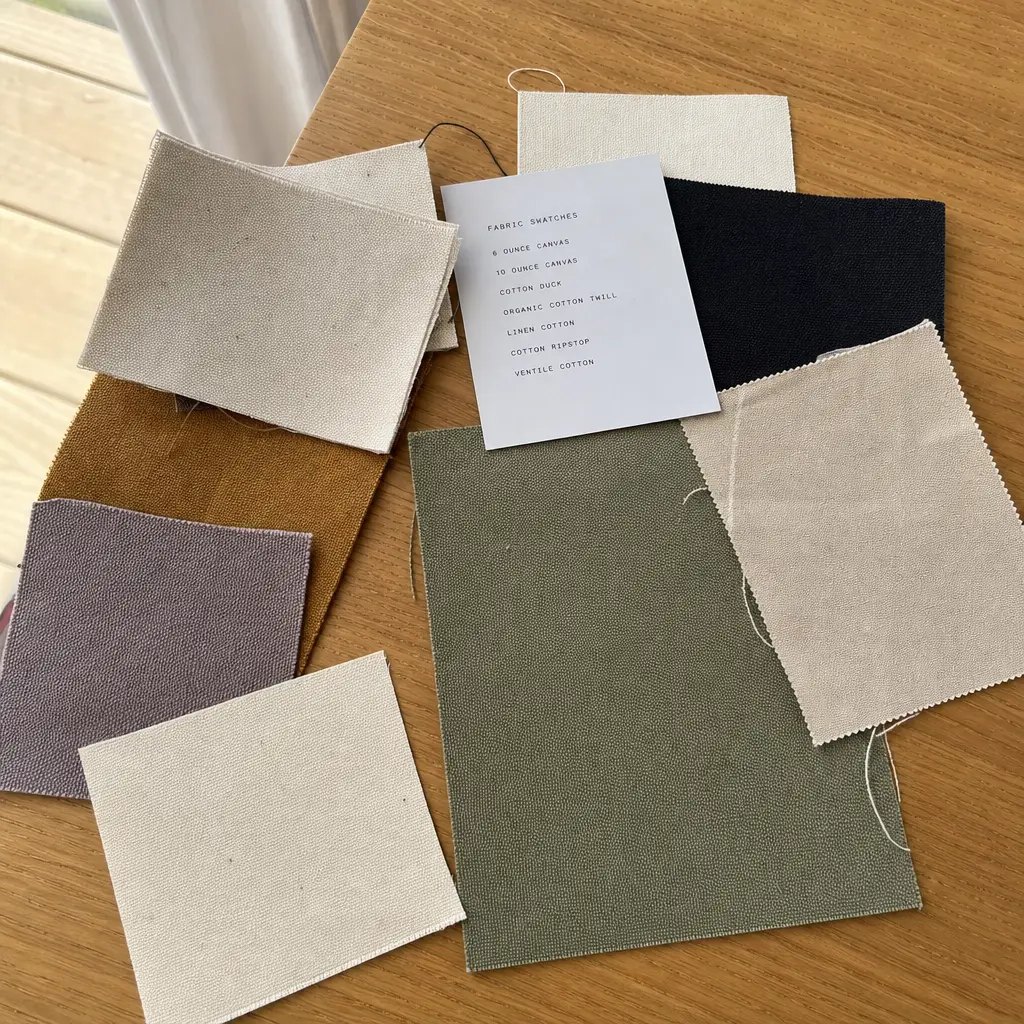
Artisan bakery branding often leans on warm neutrals, quiet typography, natural fibers, and a handmade tone. Canvas supports that look, but it is not a perfectly uniform surface. Natural cotton canvas can include seed flecks, slubs, yarn variation, small shade shifts, and texture changes from roll to roll. Those traits may be exactly what a bakery wants for a flour-sack feel. They can also make pale ink look uneven or make two production lots look mismatched. That is why buyers should approve physical standards for shade and surface character, not only a digital mockup.
The brief should translate brand words into production instructions. “Natural and craft” may mean unbleached cotton canvas, a dark one-color screen print, natural or tone-on-tone zipper tape, and a small woven side label. “Premium buyer presentation” may mean 12 oz dyed canvas, lining, clean bound seams, a business card pocket, and a metal-finish puller. If the bakery wants to communicate lower-plastic or recycled content, ask for material details and packing options that can be documented. Broad words such as eco, green, biodegradable, or sustainable are not enough for a purchase order.
Bakery-adjacent use also raises cleanliness expectations. The portfolio is not food-contact packaging, but it may be opened near sample boxes, gift assembly tables, bakery offices, or retail buyer meetings where food is present. Mildew odor, oily marks, loose debris, or uncured ink smell will damage confidence even if the sewing is technically acceptable. Put the expectation in writing: goods must be clean, dry, odor-free under normal inspection, and packed to reduce moisture and dirt exposure during transit.
- Approve physical fabric swatches for shade, texture, and visible cotton character.
- Define whether slubs, seed flecks, and shade variation are acceptable brand features or defects beyond a limit.
- Convert design preferences into material, zipper, label, print, lining, and packing instructions.
- Avoid sustainability claims unless the supplier can document material content or packing details.
- Include odor, cleanliness, moisture, and dirt control in the product brief for bakery-related handling.
Specify Canvas Weight, Finish, and Lining
Common canvas body fabrics for zipper portfolios include 10 oz, 12 oz, and 14 oz cotton canvas. The ounce number is helpful, but it is not exact across mills. GSM varies by yarn, weave, finishing, coating, and washing. As a practical sourcing range, 10 oz canvas often sits around 300-340 GSM, 12 oz around 380-420 GSM, and 14 oz around 450-480 GSM. Treat these as starting points, then confirm the nominated fabric with the supplier and record the allowed tolerance before cutting.
For many bakery document portfolios, 12 oz canvas is the safest first specification. It gives more structure than 10 oz without the same seam bulk, needle stress, and carton weight that can come with 14 oz. A 10 oz version can work for light inserts, short campaigns, and budget-driven event folders, but it may wrinkle more easily in cartons and show the outline of the papers inside. A 14 oz version can feel substantial and premium, yet it may make zipper corners thicker, sewing slower, and packed cartons heavier. If artwork sits near a seam or curve, heavier fabric can also make placement variation more noticeable.
Finish and lining change both the look and the risk profile. Natural greige canvas is often easier to source, though shade variation is wider. Bleached canvas gives a cleaner ground for printing, but dirt shows quickly. Dyed canvas can match a bakery color palette, yet custom dyeing may add MOQ, lab dips, longer approval time, and stronger lot-control requirements. Washed canvas feels softer but can create more size and shade variation. Lining makes the interior cleaner and hides seams, but it adds cutting, sewing, thickness, and inspection points. Ask suppliers to quote lined and unlined versions separately so the comparison stays fair.
- Use 10 oz canvas for lightweight inserts, shorter promotions, or strict cost targets.
- Use 12 oz canvas for balanced structure, reliable sewing, and reasonable carton density.
- Use 14 oz canvas only when premium handfeel justifies heavier cartons and bulkier zipper corners.
- Request GSM, composition, finishing route, and fabric-weight tolerance in the quotation.
- Quote lining as a separate option with lining fabric, seam finish, color, and added thickness identified.
Control Size and Internal Capacity
Size problems usually happen because drawings show outside dimensions while users care about usable space. A portfolio described as A4 or US letter size can still fail if zipper tape, seam allowance, lining, binding, pockets, and corner radius shrink the opening. The safer procurement method is to provide the largest insert size and require a minimum internal usable width and height after sewing. For flat paper, 10-15 mm clearance around the largest insert is a practical starting point. Laminated menus, folded catalogs, or thick document bundles may need more.
Corner shape matters more than it appears on a flat spec sheet. Square corners maximize rectangular area, but they can be harder to sew cleanly with a zipper. Rounded corners often help the zipper travel more smoothly, but they reduce usable paper space near the corners. If the bakery wants business card slots, gift card pockets, coupon pockets, recipe card storage, or a pen loop, place those features away from the zipper path and away from the main document stack. A simple interior layout often performs better than a crowded one.
Test the pre-production sample with the actual bakery insert set. Do not approve capacity with blank office paper if the final load is laminated menus, a product catalog, or a franchise packet. Load the sample, close the zipper, leave it zipped, then check for paper curl, corner strain, panel bowing, zipper catching, and pressure on pockets or cards. If the sample is tight, adjust the pattern before bulk production. Adding 8-10 mm during sample approval is far easier than accepting a shipment that cannot hold the documents it was bought to protect.
- State outside target size and minimum internal usable size as separate specification lines.
- Include insert thickness, document count, and whether laminated, folded, or coated materials are used.
- Allow 10-15 mm clearance around flat paper after seam allowance and zipper tape.
- Keep pockets, card slots, and pen loops clear of the zipper curve and main paper stack.
- Approve capacity only after testing a physical sample with real bakery inserts.
Choose Branding That Survives Real Canvas
Screen printing is usually the most practical decoration for custom canvas zipper portfolios when the artwork is a solid bakery wordmark, monogram, badge, or one-color illustration. It offers controlled cost and repeatable placement, but textured cotton changes how ink behaves. Natural flecks can interrupt fine lines. Open weave can soften edges. Ink color may shift visually between natural, bleached, dyed, and washed canvas. A strike-off on the nominated canvas is not an extra formality; it is the point where artwork meets the real material.
Other branding methods can fit different positioning. A woven side label is durable and understated, and it avoids some print coverage issues on slubby canvas. A cotton label reinforces a natural look, but edge fray, color, and sewing alignment need approval. A leather or PU patch can lift the perceived value, yet it adds material MOQ, tooling, sewing thickness, and pressure-mark risk inside cartons. Embroidery gives texture but can pucker lighter canvas and reduce flatness. Heat transfer can hold fine detail, though film edge, handfeel, adhesion, and wash or rub behavior should be tested on the actual fabric.
Artwork instructions should read like production data, not like a mood board. Provide vector artwork, color references, finished print size, edge distances, orientation, and placement tolerance. For many portfolio programs, plus or minus 3 mm to 5 mm is a realistic print placement range, depending on artwork size and construction. Keep critical artwork away from zipper curves, seams, folds, and pocket edges. Approve the decoration first on flat fabric, then confirm it on the finished portfolio because sewing can shift the perceived center.
- Use screen print for solid logos, simple slogans, and predictable production cost.
- Use woven or cotton labels when subtle, durable brand identification is preferred.
- Use patches only after confirming material, MOQ, tooling, sewing thickness, and pressure-mark risk.
- Provide vector artwork with color reference, print size, edge distances, and placement tolerance.
- Approve decoration on actual canvas and then confirm it on the finished pre-production sample.
Engineer the Zipper and Sewing Details
The zipper is a small component with a large effect on daily usability. It also affects packed thickness. For canvas portfolios, a No. 5 nylon coil zipper is often a practical default because it bends around corners better than many metal zippers, keeps weight controlled, and is less likely to scratch neighboring units. Metal zippers can look premium, but they are less forgiving on curves and may create pressure marks during carton compression. Resin zippers can be durable, though they may look bulky unless the design is intentionally rugged.
A complete quote should name the zipper size, tape width, tape color, slider type, puller material, puller finish, end stops, and reinforcement method. Narrow or unstable tape may wave after sewing, especially with heavier canvas. A weak slider may feel rough after limited use. Oversized pullers can look good in a sample photo but dent canvas panels, press into printed areas, and increase carton cube. If the bakery wants a branded puller, separate the tooling cost, MOQ, metal finish, approval sample, and lead time from the base portfolio price.
Sewing quality is what makes the item feel business-grade rather than disposable. Corners, zipper ends, label attachments, pocket openings, and pen loops need reinforcement. Stitch length should be consistent, thread color should match the approved sample, and loose threads should be trimmed. During sample and pre-shipment checks, open and close the zipper several times through the full path, especially through corners and end stops. In a buyer meeting, rough zipper movement, crooked seams, skipped stitches, and thread nests are visible failures.
- Specify No. 5 nylon coil zipper unless the design clearly requires metal or resin.
- Confirm zipper tape width, slider quality, puller size, puller finish, and end-stop construction.
- Require reinforcement at zipper ends, corners, label attachments, pocket openings, and pen loops.
- Avoid oversized pullers when printed panels or tight carton packing increase pressure-mark risk.
- Include full zipper open-close testing in pre-shipment inspection, especially through corners.
Build Quotes You Can Actually Compare
MOQ is created by components and setup, not only by sewing quantity. Fabric sourcing, custom dyeing, zipper tape color, screen printing, woven labels, patches, branded pullers, lining, unit packing, and carton marks can each create a separate minimum. A first order is easier to source when it uses stock natural canvas, one zipper color, one size, one artwork version, and one packing method. Add three canvas colors, regional logos, custom pullers, and different carton marks, and the order becomes several smaller production lots.
Cost comparison should be line-by-line. A 12 oz lined portfolio with a woven label, internal pocket, paper sleeve, and five-ply carton is not comparable to a 10 oz unlined portfolio with bulk packing. Ask each supplier to quote the same base specification, then price optional upgrades separately: lining, card pocket, pen loop, patch, woven label, branded puller, individual sleeve, interleaving paper, stronger carton, palletization, or barcode labels. This shows which features add real value and which only add cost or complexity.
Define quantity tolerance before production starts. Custom textile production can lose units during printing, sewing, trimming, and final inspection. Some factories quote with overage or shortage tolerance; others quote exact quantity and price the risk into the order. For bakery launches, franchise kits, or seasonal campaigns, shortage can hurt more than a modest unit-cost increase. State whether the buyer accepts overage, shortage, or exact shipped quantity only, and explain how extra approved units will be invoiced.
- Keep the first order simple: one size, one body color, one zipper color, one artwork version, and one packing method.
- Ask for MOQ by component, including fabric, zipper, label, patch, puller, print color, and carton mark.
- Request separate prices for lining, pockets, patches, labels, pullers, sleeves, interleaving, and stronger cartons.
- Compare quotes by finished specification, sample stage, packing method, carton data, lead time, and payment terms.
- Define overage and shortage tolerance before production starts.
Approve Samples in Practical Stages
A rough prototype is useful for reviewing shape, capacity, and general construction, but it should not become the bulk approval sample by accident. The production-approved sample should use the nominated canvas, final zipper, final puller, final thread, final print method, final artwork, final label or patch, final pocket layout, final lining decision, and intended unit packing. If any of those items change after approval, decide whether a revised sample or component re-approval is required.
Sample comments should be measurable. Instead of writing “too small,” state that internal width must increase by 8 mm after sewing. Instead of “logo not balanced,” state that the print should move 12 mm toward the zipper side or sit 35 mm from the bottom seam. Instead of “zipper feels cheap,” specify zipper type, slider finish, smoother pull action, or a replacement sample. Photos help, but annotated drawings and updated spec sheets reduce confusion between sales, sampling, purchasing, and sewing teams.
Approve packing during sampling, not after mass production. A portfolio can look perfect as a loose sample and still fail when 30 pieces are compressed in a carton. Ask for a packed-carton trial when carton planning affects landed cost or damage risk. At minimum, require photos of unit packing, carton layout, carton dimensions, gross weight, net weight, and pieces per carton. The factory should keep one signed approved sample, and the buyer or inspection team should keep another reference for final inspection.
- Use a prototype for early review, but approve bulk from a pre-production sample using final materials.
- Load the sample with real bakery inserts and check zipper strain, paper curl, bowing, and corner pressure.
- Write sample comments with measurements, component names, placement distances, and color references.
- Approve unit packing and carton packing before mass production when freight or deformation risk matters.
- Keep signed reference samples with the factory and buyer-side inspection team.
Plan Cartons Before Landed Cost Is Final
Shipping carton planning is both a cost issue and a quality issue for custom canvas zipper portfolios. The product appears flat, but zipper pullers, seams, pockets, lining, labels, and patches create uneven thickness. If too many pieces are packed into one master carton, corners can deform, pullers can press into canvas, and printed panels can show pressure marks. If too few pieces are packed, the buyer pays to ship air through poor cube utilization and higher dimensional freight. A planning range of 20-40 pieces per master carton is useful, but the final count should come from a packed-carton test.
Ask for carton data before comparing landed cost. Buyers need pieces per carton, carton length, width, height, net weight, gross weight, and cubic meters. The basic CBM formula is length times width times height in meters. For air or courier freight, dimensional weight rules may make low-density cartons more expensive than expected. For sea freight, carton cube affects container utilization and LCL charges. For warehouse receiving, carton count, carton marks, barcode placement, and maximum carton weight affect labor and error rates.
Packing should protect the product without adding unnecessary bulk. Unit sleeves reduce dust and abrasion. Interleaving paper can prevent pullers, patches, or labels from marking the next unit. Alternating orientation can balance thickness inside the carton. Moisture protection may be needed for sea freight or humid storage, but damp goods should never be sealed into packaging. Five-ply export cartons are usually safer for LCL, sea freight, or long warehouse dwell time than light domestic cartons. Carton marks should show PO number, item code, description, quantity, carton number, gross weight, net weight, dimensions, and destination mark if required.
- Request packed carton dimensions, pieces per carton, net weight, gross weight, and CBM before confirming landed cost.
- Use 20-40 pieces per carton only as an initial model; approve the final count after a physical packing trial.
- Protect printed panels from pullers, patches, metal parts, and zipper heads with orientation control or interleaving.
- Specify five-ply export cartons for sea freight, LCL, humid storage, or multiple warehouse touches.
- Confirm carton marks, barcode labels, carton numbering, pallet pattern, and maximum handling weight before shipment.
Set Inspection Criteria Before Production
Quality control for bakery canvas zipper portfolios should combine textile inspection, bag construction inspection, decoration inspection, and packing inspection. Buyers often focus on logo accuracy, but failures can come from rough zippers, open seams, stains, odor, poor internal fit, wrong carton count, or crushed packing. The purchase order should define critical, major, and minor defects before production starts. Critical or major defects may include wrong artwork, broken zipper, unsafe sharp hardware, mildew odor, severe stains, incorrect size that prevents insert fit, or carton packing that deforms the product.
If a third-party inspection company is used, agree on the sampling plan and AQL level before the order begins. Many consumer soft-goods inspections use general inspection levels and AQL limits agreed between buyer and supplier; the exact level should match order value, brand risk, and defect tolerance. The checklist should include fabric weight, shade standard, outside size, internal usable size, insert fit, zipper open-close test, seam strength, print placement, print cure, label orientation, pocket construction, odor, stains, unit packing, carton marks, and carton dimensions. Tools should include a ruler or tape, scale, approved sample, approved artwork, and insert-fit template if needed.
Carton inspection deserves its own section in the report. Inspectors should open cartons from different parts of the lot, not only the top layer. They should confirm carton count, carton dimensions, gross weight, carton marks, packing orientation, puller protection, and visible carton damage. If goods are packed under compression, inspectors should remove units and check whether pressure marks recover after a short rest. For artisan bakeries, the first impression may happen when a retail buyer, franchisee, distributor, or event team opens the carton. Inspection should protect that moment.
- Classify wrong artwork, broken zipper, unsafe hardware, severe stain, mildew odor, and unusable internal size as high-severity defects.
- Measure both outside dimensions and internal usable dimensions against the approved sample and written spec.
- Test zipper function through full opening and closing, including corners, end stops, and puller attachment.
- Check print color, coverage, placement, cure, rubbing, and transfer risk against the approved strike-off.
- Verify carton count, carton marks, gross weight, carton strength, packing orientation, and unit packing before shipment release.
Specification comparison for buyers
| Spec decision | Recommended option | When it fits | Buyer risk to check |
|---|---|---|---|
| Canvas body weight | 12 oz cotton canvas, usually about 380-420 GSM before sewing; ask the mill or supplier to state tolerance in writing | Best midpoint for bakery wholesale kits, catering menu packs, franchise onboarding folders, trade show document sets, and seasonal gift literature | Underweight canvas may collapse or wrinkle; overweight canvas can create bulky zipper corners, slower sewing, higher carton weight, and higher freight cost |
| Fabric finish | Natural, bleached, dyed, or washed canvas with a signed shade standard and clear limit for slubs, seed flecks, and surface variation | Useful when bakery branding depends on a flour-sack, craft, natural, or premium handmade look | Natural canvas changes by lot; if shade drift is not controlled, the same logo ink can appear different from carton to carton |
| Finished size | Specify outside size and minimum internal usable size; allow 10-15 mm clearance around A4, US letter, menus, or catalogs after sewing | Required for price lists, product sheets, distributor contracts, franchise documents, catering menus, and buyer presentation inserts | Quotes often list outside dimensions only; zipper tape, lining, pockets, binding, and rounded corners can reduce the real paper fit |
| Zipper construction | No. 5 nylon coil zipper with stable tape, smooth slider, reinforced ends, and approved puller size | Good balance for repeated meetings, curved portfolio corners, moderate cost, and lower scratching risk than metal teeth | Weak zipper tape can wave after sewing; large metal pullers may dent canvas, mark printed panels, or increase packed thickness |
| Branding method | Screen print for solid logos; woven side label, cotton label, or sewn patch for quieter premium branding | Fits artisan bakeries that want durable identification without making the portfolio feel disposable | Fine line drawings, small serif type, gradients, and flour-dust illustrations must be strike-off tested on the actual canvas |
| Internal layout | One main document compartment, one business card pocket, and an optional pen loop only if needed | Keeps sewing cost, thickness, and QC complexity controlled while still supporting sales meetings and onboarding kits | Too many pockets increase thickness variation, reduce usable capacity, slow inspection, and create pressure marks in cartons |
| Unit packing | One piece per protective sleeve, recycled polybag, paper wrap, or glassine-style sleeve; keep pullers away from printed faces | Useful for importer warehouses, bakery head offices, franchise kits, distributor receiving, and gift assembly | Over-tight sleeves can crease corners; unprotected pullers, patches, or labels can mark the next unit under compression |
| Carton quantity | Model 20-40 pieces per master carton first, then confirm with a packed-carton trial and gross-weight target | Practical starting range for flat canvas portfolios before final cube, unit packing, and hardware thickness are known | Under-filled cartons raise dimensional freight cost; over-filled cartons deform corners, transfer ink, and compress zipper pullers |
| Carton strength | Five-ply export carton for sea freight, LCL consolidation, humid storage, or multiple warehouse touches | Important for bakery importers, franchise rollouts, consolidated freight, and distribution through 3PL warehouses | Weak cartons crush on lower pallet layers; request board grade, carton dimensions, sealing method, stacking layout, and drop-test expectation |
Buyer checklist before sampling
- Define the business use: retail buyer presentation kit, catering menu holder, franchise onboarding pack, wholesale distributor document pouch, gift set component, trade show folder, or event sampling portfolio.
- State the exact insert set by size, count, and thickness: A4 sheets, US letter sheets, folded menus, laminated menus, catalogs, contracts, recipe cards, price lists, coupons, gift cards, and business cards.
- Specify outside dimensions and minimum internal usable dimensions separately; include 10-15 mm clearance around the largest insert after sewing, lining, zipper tape, and corner radius.
- Choose canvas weight by application: 10 oz for light short-term document sets, 12 oz for structured business portfolios, and 14 oz only when premium handfeel justifies extra bulk, sewing difficulty, and freight weight.
- Define the fabric route clearly: natural greige, bleached, dyed, washed, recycled cotton blend, lined, or unlined; each affects shade variation, shrinkage, MOQ, sample timing, and production control.
- Approve a physical fabric standard that shows acceptable shade, slubs, seed flecks, surface texture, and wrinkles; do not rely only on a digital mockup.
- Limit the first RFQ to one body color, one zipper color, one finished size, one artwork version, one lining decision, and one packing method unless the forecast supports separate production lots.
- Provide artwork in vector format with Pantone, CMYK, or physical color reference, minimum line thickness, print dimensions, and logo position measured from fixed portfolio edges.
- Require a print strike-off or decoration sample on the actual nominated canvas before bulk approval; paper proofs and screen images are not enough for textured cotton.
- Specify zipper details: nylon coil or other type, zipper size, tape color, slider finish, puller shape, puller protection, end-stop method, and reinforcement at zipper ends.
Factory quote questions to send
- What canvas ounce weight and GSM are included in the quoted price, and what mill tolerance applies to fabric weight before cutting?
- Is the material natural, bleached, dyed, washed, recycled blend, coated, or lined, and can you provide a physical swatch from the intended production source?
- What shrinkage tolerance, shade tolerance, and visible slub or seed-fleck standard will be used for the approved fabric lot?
- What are the proposed outside dimensions and minimum internal usable dimensions after seam allowance, zipper tape, lining, pockets, binding, and corner radius?
- Can you test the sample with our largest insert size and total insert thickness, and will you confirm whether papers clear the zipper path?
- What zipper type, size, tape width, slider grade, puller material, puller finish, and end-stop method are included in the base quote?
- Which branding method is quoted: screen print, heat transfer, woven label, cotton label, leather patch, PU patch, embroidery, debossing, branded puller, or a combination?
- What are the setup costs for screens, labels, patches, puller tooling, artwork adjustment, sample making, color matching, and export carton marks?
- What is the MOQ by finished size, fabric color, zipper color, print color, label version, patch version, puller version, and carton mark version?
- What sample stages are included: material swatch, artwork strike-off, prototype, revised sample, pre-production sample, and packed carton trial?
Quality-control points to confirm
- Fabric weight should match the approved swatch and purchase order tolerance; for many canvas programs, plus or minus 5 percent is a practical starting point unless the mill standard states otherwise.
- Finished outside dimensions should remain within the approved tolerance, commonly plus or minus 5 mm for small portfolios and plus or minus 8 mm for larger formats when not otherwise specified.
- Internal usable size must meet the required insert fit after sewing; reject or classify as major any unit that cannot hold the approved bakery document set without curling or zipper interference.
- Natural canvas shade, slubs, seed flecks, wrinkles, and surface variation should match the signed reference standard and avoid obvious panel-to-panel mismatch on the same unit.
- Zipper must open and close smoothly through the full path, including corners and end stops, without skipped teeth, broken sliders, waviness, loose tape ends, sharp edges, or excessive pull force.
- Zipper ends, corners, pocket openings, label attachments, and stress points should be reinforced and free from open seams, thread nests, skipped stitches, loose bartacks, and needle holes outside the stitch line.
- Print placement should stay within the approved tolerance, commonly plus or minus 3 mm to 5 mm depending on artwork size and sewing method; confirm the exact tolerance before production.
- Printed areas should show acceptable color, coverage, edge sharpness, cure, and handfeel, with no pinholes beyond standard, ink bleeding, ghosting, tackiness, rubbing, or transfer to the opposite panel.
- Labels, patches, branded pullers, and hardware should match approved size, color, orientation, material, and attachment strength, with no crooked sewing or sharp exposed edges.
- Canvas panels should be free from oil stains, mildew odor, heavy dirt, severe creasing, water marks, rust marks, loose debris, and contamination visible at normal inspection distance.