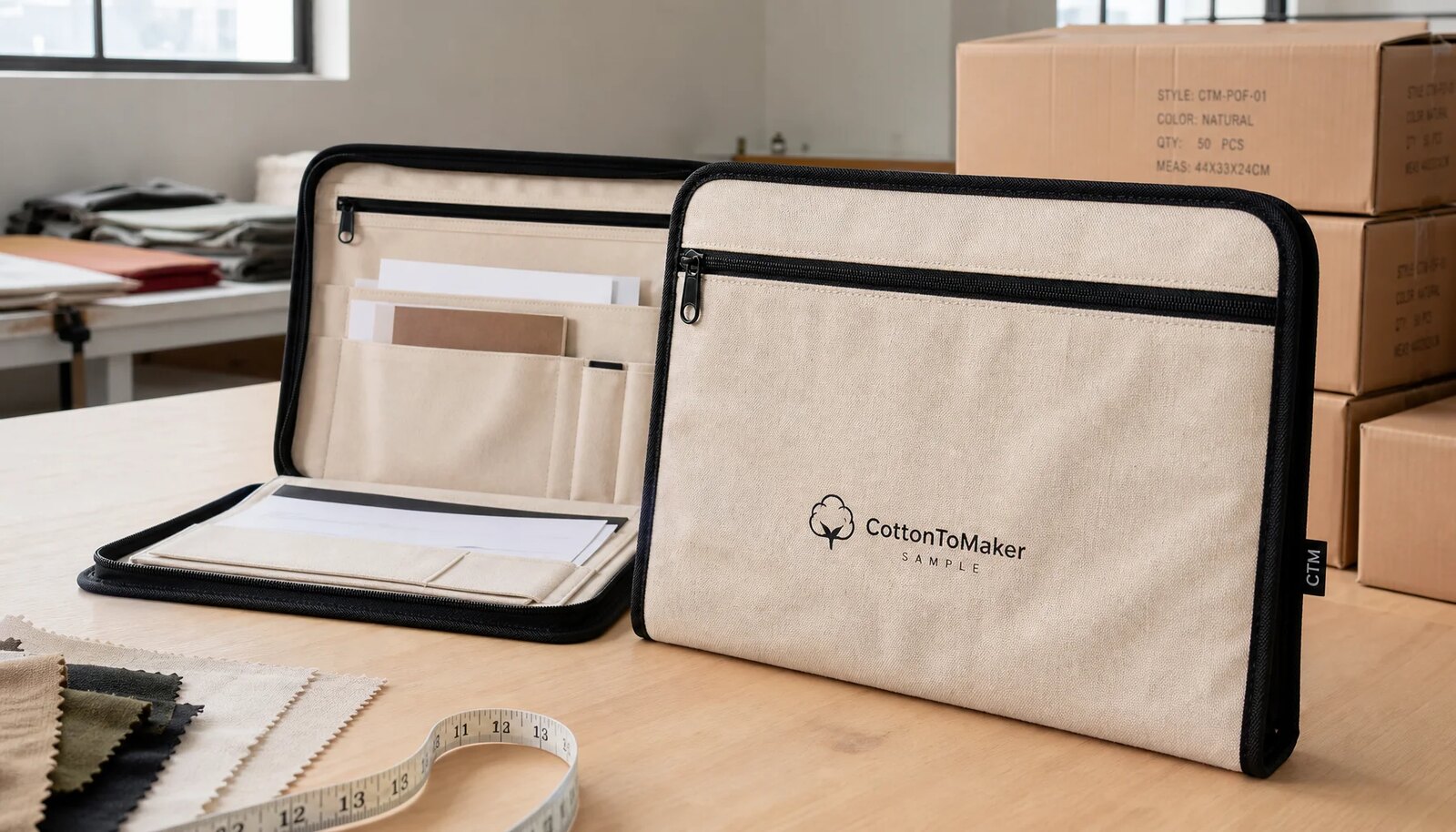
Start with the real shipping problem
Custom canvas zipper portfolios sit between a soft bag and a rigid document case. They usually include a canvas shell, lining, zipper tape, puller, binding, interior pockets, and sometimes recycled board or foam. That mixed structure is why carton planning deserves attention before the bulk order is booked. A vague instruction such as eco-friendly packing or standard export carton leaves too much room for supplier interpretation.
For eco apparel brands, the goal is rarely just a lower packing cost. Buyers want lower plastic use, clean presentation, dependable arrival, and a carton format their warehouse can handle. Those goals can conflict. Removing individual sleeves may reduce packaging material, but natural canvas can pick up dust, and a dark zipper pull can mark the next unit when portfolios are packed tightly for a long route.
A useful carton packing plan connects product structure, transit mode, and receiving requirements. It tells the factory how many pieces to pack, how to orient zipper pulls, what surface protection to use, what carton strength is required, and which defects should stop shipment. That is the difference between a quote that looks neat on paper and a program that survives production, freight, and warehouse handling.
- Common transit defects: zipper pressure marks, print rub, dust on natural canvas, corner crush, board edge marks, panel warp, and carton bulge
- Packing decisions should be approved with the product sample, not left until the final packing day
- The best carton count is the one that protects the approved shape while meeting freight and warehouse limits
- Eco packing should be judged by damage-free delivered units, not only by reduced material per unit
Define the portfolio build before carton math
Carton quantity depends on the real product profile. A flat A4 portfolio in 12 oz canvas with one document pocket may pack cleanly at a higher count. A structured version with 14 oz canvas, RPET lining, a tablet sleeve, pen loop, zipper puller, and 1.5 mm recycled board may need fewer pieces per carton to avoid pressure marks. If two suppliers quote the same outer size but different internal construction, their carton counts are not comparable.
Start the RFQ with the closed size, open size, intended contents, and maximum packed thickness. For many B2B apparel programs, the portfolio is used for onboarding kits, sales presentations, fabric swatches, line sheets, or retail partner documents. Those contents change the way the product behaves. A portfolio that looks flat when empty may bow when loaded with a catalog or swatch cards.
A practical material range is 12 oz to 14 oz canvas for the outer shell. The lower end suits soft document carriers and cost-sensitive programs. The higher end suits brand presentations where structure matters, but it adds weight and carton volume. If reinforcement is used, selective board on front and back panels is usually easier to pack than reinforcement that runs into corners or stitch lines.
- Request finished fabric weight after dyeing or washing, not only greige fabric weight
- Record packed thickness on the approved sample with final lining, zipper, trim, label, and interior features
- Ask whether board or foam is included in the quoted price and where it sits inside the shell
- Do not use the appearance sample carton count if bulk will add hangtags, inserts, retail labels, or thicker lining
Choose materials that behave well in transit
Canvas shade, print method, zipper selection, and reinforcement all influence the carton plan. Natural canvas is attractive for eco apparel brands, but it shows dust and compression lines more readily than darker fabrics. Dark dyed canvas can create its own risk if dye fixation or print cure is weak. When flat units sit face to face, a small curing shortcut can become visible print transfer across many pieces.
For zipper portfolios, #5 nylon coil is often a sensible default because it runs smoothly around curves and has less hard local pressure than many metal zipper options. Metal zippers can look premium, but the puller and teeth should be reviewed as pressure points during stacked packing. If the brand wants a metal puller on a natural canvas body, request a packed stack check instead of approving it only from a beauty photo.
Decoration needs the same practical review. Screen print is efficient for one or two solid colors on canvas, while heat transfer may be better for small detailed logos. Embroidery, woven patches, and rubber patches add texture and can press into adjacent units. None of these choices is wrong, but each one changes the protection required inside the carton.
- For large solid logos, ask for print cure timing and dry rub review before packing
- For natural canvas, require clean cutting tables, clean packing tables, and carton liners if sleeves are reduced
- For metal or oversized pullers, check stacked pressure on the panel directly below the puller
- For board reinforcement, set edge clearance so board does not crack or telegraph at stitched corners
- For patches or embroidery, confirm whether interleaf or lower carton count is needed
Match carton strategy to freight and receiving rules
The carton plan should start with route and receiving limits. A small air shipment to one office has a different risk profile from a palletized sea freight order moving through a 3PL and retail distribution center. If your warehouse limits manual cartons to 12 to 15 kg gross weight, give that number to the factory before quotation. Otherwise the supplier may chase a high piece count that looks efficient but creates overweight handling problems.
For many canvas zipper portfolios, 20 to 40 pieces per master carton is a common planning range, but it should not be treated as a universal rule. The right count depends on closed size, product thickness, board use, puller size, unit sleeve, and route. A soft portfolio can tolerate more compression than a structured one. A portfolio with a large front print or light canvas may need more separation between units.
Zipper orientation is a small detail with real impact. If every puller faces the same carton side, the stack can bulge, and pressure concentrates along one edge. Alternating zipper head direction by layer or by a fixed unit count spreads thickness more evenly. The factory should show this in a packed carton photo, not just state it in the quote.
- State maximum carton gross weight and outer dimensions based on your 3PL, courier, or DC rules
- Ask for packed CBM because freight impact cannot be judged from unit price alone
- Confirm pallet pattern, stack height, and whether cartons may be double-stacked in storage
- Use lower carton pressure for sea freight, humid routes, long storage, structured builds, and light canvas
- Require the same packing method in the PP approval that will be used in bulk
Compare plastic-reduced options honestly
Many eco apparel brands ask suppliers to remove polybags, but the better question is which protection level is appropriate for this product, route, and fabric. A recycled polybag is still the most reliable option for long sea freight when the canvas is light, the print is dark, or the product has a metal puller. It protects against dust, surface rub, and some moisture exposure.
Glassine sleeves, paper wraps, and interleaf systems can reduce plastic, but they are not one-for-one substitutes. They can crease, shift, absorb humidity, or provide less abrasion resistance. If the route is controlled and the portfolio is dark, minimally printed, or used for internal B2B distribution, these options may work well. If the product is retail-facing, natural canvas, or printed with a large solid logo, test before committing.
A balanced RFQ asks for two routes: a lower-plastic route and a lower-risk route. Compare them by unit packing cost, carton count, packed CBM, expected damage exposure, and brand requirements. This gives procurement a defensible tradeoff instead of a yes-or-no debate about polybags.
- Lower-risk route: recycled polybag, clean flat stack, alternating zipper direction, strong export carton
- Lower-plastic route: glassine sleeve or paper wrap, interleaf, clean carton liner, lower stack pressure
- No-sleeve route: use only when fabric, logo, transit time, and buyer tolerance support it
- If removing sleeves, define acceptable dust marks, rub marks, and minor creases before bulk starts
- For humid sea freight, discuss desiccant, carton storage, and container loading conditions
Use sampling to prove packed behavior
A portfolio sample on a table proves appearance, not shipment behavior. For this category, sample approval should include a packed view. Ask the supplier to stack 10 to 20 units in the proposed orientation and photograph the top, side, zipper edge, and carton cross-section. For larger orders, request one trial master carton with actual piece count, sleeve type, carton dimensions, and gross weight.
The packed sample review should look for pressure marks, zipper dents, board telegraphing, print transfer, corner shape, and whether the carton closes without forcing. If a supplier has to press down hard to seal the carton, that is a warning sign. A carton can look efficient when it leaves the factory and still arrive with warped panels after weeks under pallet pressure.
Use the final production materials for this check. A sample made without final board, lining, hangtags, barcode labels, or retail inserts will understate thickness. If the buyer intends to load documents into the portfolio before distribution, measure the loaded shape as well. The carton plan should be based on the thickest real configuration, not the neatest empty sample.
- Request photos of the approved sample empty, loaded, stacked, sleeved, and inside the carton
- Measure unit net weight and packed thickness after all trims, labels, and inserts are included
- Check the product again after 24 hours under light stacked pressure if structure or print risk is high
- Approve zipper pull direction, interleaf placement, sleeve material, and carton count together
- Keep the packed sample data in the PO or tech pack so bulk packing cannot drift
Make quote comparison less template-driven
A useful quote for custom canvas zipper portfolios should separate the portfolio cost from the packing assumptions. If the supplier gives only one FOB unit price, procurement cannot see whether the price includes recycled sleeves, carton labels, stronger board, palletization, alternating stack labor, or basic loose packing. Two quotes with the same unit price may carry different landed costs and different claim exposure.
Ask suppliers to quote a standard route and an alternate route. For example, one quote can use recycled polybags and a lower-risk carton count for ocean freight. Another can use glassine sleeves or interleaf with a lower-plastic goal. The side-by-side comparison should include carton count, carton dimensions, packed CBM, gross weight, material cost, added labor, and any MOQ change.
MOQ needs context. Stock canvas and standard export packing may be workable around 500 to 1000 pieces at some factories. Custom dyed canvas, branded lining, custom molded pullers, special sleeves, or retailer-specific carton printing can push efficient production closer to 1500 pieces or more. The supplier should explain which part drives the MOQ so the buyer can decide whether to simplify the product, increase volume, or pay a setup charge.
- Request EXW or FOB price plus a packing cost breakdown where possible
- Ask whether cartons are stock size, custom size, blank, or custom printed
- Compare packed CBM and carton gross weight across suppliers, not only pieces per carton
- Confirm whether barcode labels, carton marks, warnings, palletization, and desiccant are included
- Ask what changes if the order uses stock fabric, custom dyed fabric, or nominated eco packaging
Set QC checks that match real failure modes
Standard workmanship inspection is not enough for structured canvas zipper portfolios. A unit can pass visual review and still fail the buyer if the zipper catches under load, the board edge shows through the front panel, or the print transfers during stacked packing. QC should include both product checks and carton checks.
For product inspection, measure closed size, open size, panel squareness, zipper alignment, binding width, stitch consistency, print placement, and functional pocket loading. Test zipper movement across corners, because that is where low-grade coils and tight sewing often fail. For reinforced portfolios, press and bend the panel lightly to see whether board shifts, cracks, or creates a visible line on the canvas.
For packing inspection, verify piece count, sleeve or interleaf placement, zipper pull direction, carton dimensions, gross weight, carton marks, and seal quality. If cartons were packed and stored before loading, pull samples from top, middle, and bottom pallet positions. Compression damage often appears where cartons carry load, not in the easiest carton selected for inspection.
- Treat zipper failure, print transfer, severe panel warp, carton bulge, and wrong carton marks as major defects
- Define allowable shade variation and dust marking for natural canvas before production
- Check printed panels after stacked contact, not only immediately after printing
- Confirm carton board grade and gross weight against the approved packing spec
- Require rework instructions for loose threads, exposed raw edges, crooked binding, and incorrect pack count
Tie numeric limits to your route
Numeric defaults are useful only when they are tied to a real scenario. A 12 to 15 kg carton limit is defensible when it comes from a 3PL manual handling rule or retail DC requirement. A 20 to 40 piece carton range makes sense only after the product thickness, sleeve type, and route are known. A 5-ply export carton may be suitable for many sea freight programs, but the buyer should still ask for board grade, ECT or burst rating, and stacking guidance.
Instead of copying generic thresholds into the PO, write the reason behind each one. If cartons will be couriered to regional sales teams, lower gross weight and smaller cartons may matter more than maximum ocean freight efficiency. If goods will be palletized and stored for weeks, compression resistance and stable stacking become more important. If the portfolio has a thick metal puller, zipper orientation may be a requirement rather than a preference.
The supplier does not need to perform a laboratory test for every small order, but they should provide enough evidence for the risk level. For a repeat stock-fabric order, packed photos and inspection data may be sufficient. For a first order with custom print, natural canvas, and reduced plastic packing, ask for a trial carton and post-compression review.
- Use 12 to 15 kg gross carton weight only when it matches your warehouse or courier handling rule
- Use lower piece counts for structured builds, board reinforcement, large pullers, natural canvas, or long sea freight
- Ask for ECT or burst rating when cartons will be palletized, double-stacked, or exposed to long ocean transit
- Require trial packing when changing sleeve material, carton count, zipper puller, print method, or reinforcement
- Record the reason for carton limits so future reorders do not drift back to factory defaults
Build a landed-cost view before PO release
The cheapest FOB price is not always the lowest delivered cost. Canvas zipper portfolios are bulky compared with simple pouches, and small changes in thickness can shift packed CBM. A supplier that saves on sleeves or cartons may create more inspection work, repacking, dust cleaning, or claims. A supplier that uses a slightly lower piece count may look more expensive at first but arrive cleaner and flatter.
Build the comparison with unit price, packing material cost, carton count, packed CBM, carton gross weight, estimated freight, import duty basis, warehouse handling, and expected damage allowance. Keep the freight assumptions the same across suppliers. If one quote includes recycled sleeves and barcode labels while another assumes no sleeve and blank cartons, normalize the comparison before choosing.
For eco apparel brands, the strongest carton packing plan is usually not the most elaborate one. It is the plan that matches product structure, brand packaging goals, route risk, and receiving limits with clear evidence. Ask for the data before bulk production, confirm it during sample approval, and inspect it before shipment. That keeps the conversation grounded in delivered value rather than repeated RFQ language.
- Compare suppliers on FOB price, packed CBM, carton count, damage risk, and receiving fit
- Add handling cost if your warehouse charges for overweight cartons, relabeling, or repacking
- Use the same freight mode and destination assumptions for every quote
- Keep one cost-down packing route and one lower-risk packing route in the sourcing file
- Approve the carton plan in writing before production materials are fully committed
Specification comparison for buyers
| Packing or supplier route | Best fit | What changes in cost and risk | Evidence to request before approval |
|---|---|---|---|
| Stock canvas, recycled polybag, standard 5-ply export carton | First order, moderate MOQ, sea freight, light canvas colors, or large front print where surface protection matters | Usually the most predictable route. Material cost is higher than no-bag packing, but dust, print rub, zipper scratch, and moisture exposure are easier to control. | Packed carton photo, bag material spec, carton size and gross weight, pieces per carton, zipper orientation method, and carton board grade. |
| Stock canvas, glassine sleeve or paper wrap, clean-carton control | Eco apparel programs that want lower plastic and ship through controlled routes with limited storage time | Reduces plastic use but raises dependence on clean tables, dry cartons, careful stacking, and lower friction between units. Not ideal for high-rub dark prints unless tested. | Sleeve sample, rub check after stacked compression, carton cleanliness procedure, humidity handling notes, and approval photos after 24 hours packed. |
| No individual sleeve, interleaf every layer or every 5 to 10 units | Internal B2B kits, darker canvas, minimal decoration, air freight, or local distribution where the buyer accepts more handling exposure | Lowest packing material cost, but it can shift cost into inspection, dust cleaning, returns, or repacking. It is weak for natural canvas and high-contrast screen prints. | Trial stack photos, surface inspection after compression, interleaf material spec, defect limit for dust and transfer, and confirmation that carton liners are used. |
| Lower carton count with looser flat stack | Structured portfolios with board, tablets, swatch cards, thick pullers, or retail presentation requirements | Uses more cartons and CBM, but reduces zipper pressure, corner warp, board telegraphing, and carton bulge. Often better for ocean freight or DC handling rules. | Side-view packed carton photo, packed thickness measurement, carton gross weight, pallet pattern, and inspection results from top, middle, and bottom cartons. |
| Higher carton count with tight compression | Cost-down route for soft portfolios without board, light inserts, small logo, and short transit time | May reduce carton material and sometimes CBM, but can create panel memory, zipper dents, crushed corners, and uneven carton shape if the product is too structured. | Compression check on a trial carton, zipper pull orientation plan, reject threshold for warped panels, and confirmation that cartons remain flat under pallet stacking. |
| Retail-ready inner packs plus master carton | Retail launches, event kits, co-branded apparel programs, or portfolios that must arrive shelf-clean | Adds packaging labor, label control, and sometimes MOQ pressure. Improves presentation and unpacking speed but can increase packed volume. | Inner pack dieline or sleeve sample, barcode placement, carton marks, pack-out photos, scan test if barcodes are used, and packing-line QC checklist. |
| Factory direct FOB quote with basic packing included | Experienced buyers with their own freight control and clear carton limits | Can be efficient, but only if the quote separates bag cost from packing assumptions. Basic packing language often hides carton grade, sleeve type, and labor shortcuts. | FOB price, packed CBM, net and gross weight, carton grade, unit packing material, and whether palletization or carton labels are included. |
| Supplier-managed eco packaging route | Brands that nominate recycled, FSC-style, or plastic-reduced packaging and need supplier coordination | Better brand alignment, but approvals and packaging lead time can become the schedule constraint. MOQ may rise if sleeves, labels, or cartons are custom made. | Packaging supplier source, lead time, minimum order, compliance documentation if required, arrival date at factory, and contingency if packaging is delayed. |
Buyer checklist before sampling
- Define closed size, open size, packed thickness, and intended contents such as A4, US letter, tablet, notebook, catalog, or swatch cards.
- Specify finished outer canvas weight after dyeing or washing, including acceptable lot tolerance and whether the fabric is natural, piece-dyed, washed, or yarn-dyed.
- Confirm lining route: RPET for wipe-clean consistency, cotton for a lower-plastic material story, or no lining only if structure and abrasion risk are acceptable.
- State zipper size, coil or metal type, tape color, puller finish, lock requirement, and whether the puller creates a packing pressure point.
- List every interior feature that affects thickness, including document pockets, pen loops, elastic straps, card slots, tablet sleeves, ring binders, and board reinforcement.
- Approve decoration by exact location, size, color count, print method, cure requirement, and rub standard on the actual canvas color.
- Choose the unit pack route: recycled polybag, glassine sleeve, paper wrap, interleaf system, retail inner pack, or no-sleeve controlled packing.
- Give the supplier your carton constraints: maximum gross weight, maximum carton dimensions, pallet overhang rule, barcode location, and warehouse or courier limits.
- Require carton data in the quote: pieces per carton, master carton size, packed CBM, net weight, gross weight, carton grade, and carton mark format.
- Ask for sample photos showing empty shape, loaded shape, zipper alignment, binding corners, front print, packed stack, and carton cross-section.
Factory quote questions to send
- Is the quoted canvas stock fabric, custom dyed fabric, or custom woven fabric, and what MOQ applies to each option?
- What is the finished fabric GSM or oz after dyeing, washing, and finishing, and what lot tolerance do you allow?
- Which zipper is included in the price: coil or metal, size, tape width, puller type, puller finish, and source class?
- Does the portfolio include board, foam, or other reinforcement, and how far is it placed from stitch lines and zipper corners?
- What exact packing route is quoted: recycled polybag, glassine sleeve, paper wrap, interleaf, retail inner pack, or no individual sleeve?
- What are the master carton dimensions, pieces per carton, carton gross weight, net unit weight, packed CBM, and carton board grade?
- Do you alternate zipper head direction by layer or stack, and how do you prevent puller pressure marks on adjacent units?
- Can you quote two packing plans: one cost-down option and one lower-risk option for sea freight or DC handling?
- What print method is included, how many colors are included, and is a strike-off or print panel approval included before bulk?
- How long does printed canvas cure before packing, and what dry or wet rubbing checks do you perform on the production fabric?
Quality-control points to confirm
- Check finished dimensions closed and open against the approved spec, including zipper edge width, body height, corner shape, and packed thickness.
- Verify canvas GSM, shade, handfeel, and shrinkage behavior before cutting, especially when the quote uses custom dye or washed fabric.
- Inspect zipper function across corners and long straight runs, including puller alignment, skipped stitches near the zipper tape, and catching under light load.
- Review screen print or transfer quality for registration, cure, dry rub, wet rub where relevant, and transfer onto adjacent units after stacked contact.
- Check binding width, seam allowance, corner turning, loose threads, exposed raw edges, and whether thick areas are forcing panel distortion.
- Load-test pockets and compartments using the intended contents so the buyer can see shape behavior before packed carton approval.
- Inspect board or foam placement for edge clearance, shifting, cracking, and telegraphing through canvas after compression.
- Confirm unit packing material, sleeve size, fold method, interleaf placement, zipper pull direction, piece count, and carton filling pattern.
- Check carton board grade, carton dimensions, gross weight, label location, PO marks, barcodes, country-of-origin wording, and seal quality before shipment.
- Pull cartons from different pallet positions if goods are stored before loading, because compression problems often appear in lower or middle cartons first.