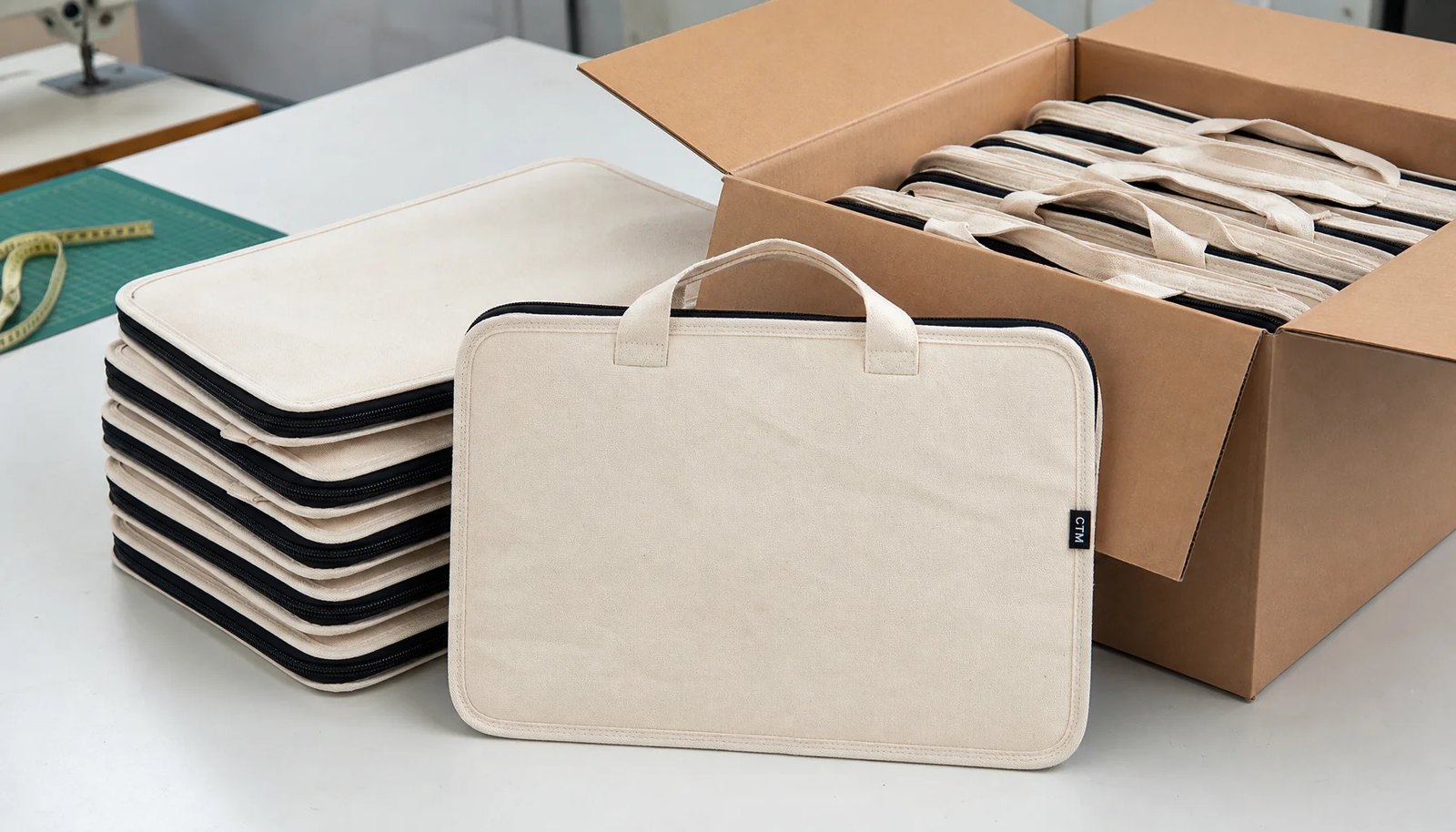
Why the Carton Plan Belongs in the RFQ
Custom canvas zipper portfolios look straightforward on a desk. They become less simple when 2,000 pieces reach a bookstore dock two days before orientation. A low unit price will not help if cartons arrive with crushed corners, mixed logos, unscannable barcodes, or retail pieces that need to be opened, sorted, and repacked before they can be sold. For university bookstore buyers, the carton packing plan is part of the sourcing specification, not a warehouse afterthought.
Academic calendars leave little room for recovery. Orientation, back-to-school, admissions events, alumni weekends, homecoming, and graduation all have fixed dates. If a packing issue appears after sewing, the correction may change pieces per carton, carton count, gross weight, freight cube, pallet build, routing labels, and receiving paperwork. That can slow shipment release even when the product itself is acceptable.
The practical move is to connect product construction and packing in the first RFQ. Fabric weight changes stack height. Puller size creates pressure points. Internal pockets add thickness. Barcode bags add handling time. Insert cards, hangtags, and tissue all affect carton fill. A strong carton packing plan for custom canvas zipper portfolios for university bookstores should be confirmed with the approved sample, photographed, and written into the purchase order before bulk packing starts.
- Quote carton quantity, carton dimensions, net weight, gross weight, carton cube, and carton marks as part of the product specification.
- Ask for a packing trial before bulk packing, especially for multi-logo, multi-color, or multi-campus bookstore programs.
- Use separate packing rules for retail shelf sale, online fulfillment, orientation kits, and bulk event distribution if the same portfolio serves more than one channel.
- Include routing guide requirements, barcode rules, country-of-origin wording, and receiving limits in the RFQ so suppliers price the same operational requirement.
Baseline Specification for a Bookstore Portfolio
A useful baseline is a flat canvas document portfolio made from 12 oz cotton canvas, typically around 380-420 GSM, with a No. 5 nylon coil zipper, one internal flat pocket, one pen loop, and a clear retail polybag with barcode label. This is not the only workable build. It is a practical reference point that lets procurement teams compare supplier quotes without guessing what each factory assumed.
The finished size should be written in exact dimensions. Letter paper is 216 x 279 mm, and A4 paper is 210 x 297 mm, but the portfolio needs more room than the paper itself. Allowing 20-30 mm clearance on width and height usually gives better insertion, cleaner seams, room for pocket thickness, and space for a barcode bag. If the item will hold a notebook, course packet, tablet sleeve, coupon sheet, or orientation insert, name that content in the specification and test it inside the sample.
Vague wording creates mismatched quotes. A request for a canvas zipper portfolio with school logo can produce three very different products at three very different prices. The RFQ should define fabric, canvas treatment, shade, size tolerance, zipper, puller, interior layout, reinforcement, logo method, label, individual packing, carton quantity, carton marks, inspection method, and approval sequence. Once those details are visible, a buyer can tell whether a cheaper quote is real efficiency or simply a weaker specification.
- Budget version: 10 oz canvas, standard zipper, simple one-color print, minimal pocketing, and basic clear bag for event use.
- Standard retail version: 12 oz canvas, No. 5 zipper, flat pocket, pen loop, approved logo strike-off, barcode bag, and tested export carton.
- Premium version: 14 oz canvas or structured panels, custom puller, woven label or patch, insert card, stronger carton, and tighter cosmetic inspection.
- Size control: state finished width, height, usable pocket opening, zipper opening, packed thickness, and tolerance for each critical dimension.
- Approval file: keep the final tech sheet, artwork file, strike-off, sealed sample, packing photos, barcode proof, and carton mark proof together.
Canvas Weight, Shrinkage, and Shade Control
Canvas drives the handfeel, print result, sewing behavior, carton quantity, and freight cost. A 10 oz cotton canvas can work for budget campus events, but it may feel soft when empty and may wrinkle more visibly. A 12 oz canvas is often the safer bookstore retail standard because it has enough body without becoming difficult to sew or pack. A 14 oz canvas can create a premium feel, but it also adds seam bulk, needle resistance, zipper pressure, and carton cube.
Ask for both oz and GSM. Suppliers may use either system, and the same casual phrase can hide different weights. For a 12 oz canvas, a practical commercial range is often about 380-420 GSM. The purchase order should state the accepted range or tolerance, commonly ±5% unless the buyer and supplier agree otherwise. Without that written range, a lighter fabric may still be described loosely as 12 oz canvas.
Shrinkage deserves attention before cutting, not after the first inspection report. Zipper portfolios have long straight edges, so unstable fabric can twist panels, create wavy zipper lines, and push finished dimensions outside tolerance. Ask whether the canvas is washed, pre-shrunk, sanforized, or otherwise stabilized. Review shrinkage data in warp and weft, approve a bulk fabric swatch before cutting, and keep that swatch for incoming inspection and repeat orders.
Shade control can be just as important as weight. Natural canvas varies with cotton source, yarn, and finishing. Dyed canvas needs lab dip approval before bulk fabric purchase. Exact long-term repeat shade matching on cotton canvas is difficult, but clear swatches, Pantone references, and written visual limits reduce avoidable disputes.
- State canvas weight in oz and GSM, such as 12 oz and 380-420 GSM, instead of using only descriptive terms like heavy canvas.
- Ask whether fabric is loomstate, washed, pre-shrunk, sanforized, bleached, dyed, or finished after weaving.
- Approve shade, slub level, odor, handfeel, thickness, and print clarity before cutting, not only after the sewn sample is finished.
- Inspect light canvas for oil marks, water stains, dark fibers, mildew smell, pencil marks, crease lines, and dirty handling.
- Keep one approved bulk swatch with PO number, SKU, supplier name, approval date, and reorder notes.
Logo Method, Licensing, and Artwork Limits
University bookstore portfolios often carry official marks: school names, department names, mascots, alumni graphics, athletic marks, or licensed logos. Decoration has to satisfy brand standards and production limits at the same time. Screen printing is usually the best default for one to three solid school colors because it is cost-effective, repeatable, and suited to canvas. Heat transfer can handle gradients, photo-style artwork, and fine detail, but it should be checked for edge lift, cracking, surface feel, and adhesion after bending.
Canvas does not behave like coated paper. The texture can break fine lines, fill small letters, and shift the appearance of Pantone colors. A digital mockup helps people discuss size and placement, but it cannot prove what the logo will look like on actual canvas. For official marks, mascots, thin lines, small type, multi-color graphics, or dark ink on natural canvas, require an actual-fabric strike-off before bulk production.
Licensing can become a schedule risk if it is treated casually. The RFQ should state who approves artwork: the bookstore buyer, university licensing office, department stakeholder, distributor, or brand owner. It should also say when approval is required: before sampling, before bulk production, or before shipment release. Late artwork approval can disrupt the calendar as much as a failed pre-production sample.
- Send vector artwork with Pantone references, final print size, logo orientation, and placement measured from a fixed seam, binding edge, zipper edge, or corner.
- Ask the factory to confirm minimum line width and smallest readable text height for the selected canvas and decoration process.
- Use a strike-off on production canvas for official marks; do not approve bulk production from a digital mockup alone.
- For heat transfer, test bending, rubbing, edge lift, cracking, and adhesion on the final canvas weight.
- State logo placement tolerance, commonly a few millimeters for flat goods, and define whether tolerance is measured from top edge, side edge, seam, or zipper line.
Zipper, Puller, and Sewing Construction
The zipper is one of the highest-risk components on a canvas portfolio. Students may overfill the case, pull the slider at an angle, or use the item daily through a semester. A No. 5 nylon coil zipper is a practical default for flat document portfolios because it is flexible, economical, and compatible with canvas sewing. A No. 8 zipper may be useful for oversized, gusseted, or heavily loaded designs, but it adds bulk and is not always necessary for standard bookstore portfolios.
The puller also needs to be specified. A standard metal puller is simple and economical. A fabric loop can improve grip and match the canvas look. A rubber or custom logo puller can make a premium SKU feel more finished, but it may add tooling cost, lead time, and pressure marks inside cartons. Large pullers should be tested in the final carton layout, because repeated pressure in one location can dent panels or mark printed surfaces.
Good sewing is easy to recognize on flat goods because long seams leave few places to hide poor tension. Zipper ends, pocket corners, handles, side loops, and pen loops should use the approved reinforcement method, such as bar tacks or back stitching. Thread color, stitch length, seam allowance, binding width, and trimming standard should be locked on the pre-production sample so the bulk order does not drift from the intended retail appearance.
- Specify zipper size, coil or tooth type, tape color, slider finish, puller style, puller direction, zipper opening length, and end-stop construction.
- Check zipper function with the intended contents inside the portfolio, not only when the sample is empty and flat.
- Require reinforcement at zipper ends, pocket corners, pen loop ends, handle attachments, and any stress point that students will pull or load.
- Inspect for skipped stitches, loose thread tails, uneven stitch tension, raw edges, twisted binding, and inconsistent corner shape.
- During packing trials, alternate puller direction if needed so all zipper pulls do not press into the same spot in the carton.
Interior Layout Without Excess Bulk
Interior organization can raise perceived value, but it is not free. Every added pocket increases sewing time, stack height, zipper strain, and carton cube. For most university bookstore programs, one flat internal document pocket and one pen loop provide enough function without making the portfolio bulky. More complex organizer panels should be reserved for a premium retail SKU or a clear department requirement.
Every divider, card slot, mesh pocket, elastic band, padded sleeve, or notebook insert changes the packing plan. A carton trial based on an empty portfolio may look fine, then fail once the buyer adds welcome sheets, coupons, maps, course packets, or notebooks. The specification should state whether the portfolio is sold empty, packed as a kit, or used as a department handout with inserts.
Pocket dimensions should be functional, not just attractive in a sample photo. A pocket that looks correct but has a narrow opening may frustrate users and create returns. Procurement should specify usable pocket opening width, pocket depth, pen loop diameter, and whether the pocket needs to hold loose letter paper, A4 paper, a notebook, or a named insert.
- Use one flat document pocket and one pen loop as the default bookstore layout for cost, function, and carton efficiency.
- Add dividers or tablet sleeves only after confirming target retail price, expected load, and carton cube impact.
- Include all inserts, maps, coupons, notebooks, or welcome sheets in the packed-sample test if the item is sold as a kit.
- Avoid foam padding unless the portfolio is positioned as a device sleeve rather than a document organizer.
- Write usable pocket dimensions and opening width so the factory does not create a pocket that is hard to use.
MOQ, Price Breaks, and Quote Comparison
MOQ depends on fabric purchasing, dyeing, zipper sourcing, decoration setup, cutting efficiency, and packing versions. A natural canvas portfolio with standard black zipper and one-color screen print can usually support lower MOQ than a dyed canvas portfolio with custom zipper tape, custom logo puller, woven patch, multiple print positions, and special retail packaging. Buyers launching a new bookstore SKU can often reduce risk by keeping base materials standard while customizing the school mark.
A useful quote separates the cost drivers. Ask suppliers to break out fabric weight, zipper specification, decoration method, setup charges, sewing complexity, label or patch cost, sample fee, individual packing, carton material, carton quantity, carton dimensions, inland freight, inspection cost, and routing-label work. That detail makes competing quotes easier to compare and shows whether a low price comes from lighter fabric, smaller zipper, missing reinforcement, simpler packing, or excluded barcode work.
Price breaks should be weighed against academic timing and inventory risk. A larger order may reduce unit cost, but it can also create obsolete inventory if the logo is event-specific, a department name changes, or the bookstore refreshes branding. A distributor serving several campuses may combine volume on the same base construction while separating logo versions, barcodes, and carton marks.
- Ask MOQ by logo, fabric color, zipper color, puller type, decoration method, packing version, and carton mark version.
- Request price breaks at practical quantities, such as 500, 1,000, 2,500, and 5,000 pieces, if those volumes match demand.
- Compare landed cost using carton cube, gross weight, duty assumptions, freight mode, and receiving labor, not only FOB unit price.
- Flag quotes that omit GSM, zipper size, packing trial, barcode responsibility, carton grade, or inspection criteria.
- For first launches, reduce variables by using standard canvas, standard zipper tape, simple print, clear barcode bag, and SKU-specific carton marks.
Carton Quantity, Layout, and Pallet Planning
Final carton quantity should come from an approved packed sample, not a catalog estimate. Measure the finished portfolio after the real components are included: canvas, zipper, puller, internal pocket, label, print, polybag, barcode label, hangtag, insert card, and tissue if used. Then test layouts such as flat stacking, alternating zipper direction, opposite-end bundling, or inner cartons.
For many flat custom canvas zipper portfolios, 20 to 40 pieces per export carton is a practical trial range. The right number depends on finished size, fabric weight, puller thickness, pocket layout, inserts, and receiving weight limits. A 20-piece carton may protect the product but use more cube. A 40-piece carton may improve freight efficiency but cause pressure marks or carton bulge. Testing 20, 30, and 40 pieces gives procurement real evidence before the packing plan is locked.
Carton strength should match the route. Five-ply export cartons are generally more appropriate for international freight, distributor transfers, and long inland trucking than light domestic cartons. The RFQ should ask for carton dimensions, net weight, gross weight, carton cube, ply count, flute, and bursting or edge-crush specification if the buyer's logistics team requires it. If goods are palletized, carton dimensions should also support stable stacking and visible labels.
- Run packing trials at 20, 30, and 40 pieces per carton, then inspect corner shape, zipper pressure, print scuffing, carton bulge, and handling weight.
- Record carton length, width, height, net weight, gross weight, cube, pieces per carton, cartons per SKU, and pallet quantity if palletized.
- Use interleaving or tissue only when needed to prevent scuffing, print transfer, or puller pressure; avoid adding materials without testing their cube impact.
- Keep zipper pulls from stacking in one vertical column if they create dents or pressure marks on adjacent portfolios.
- Confirm any bookstore, distributor, or university central receiving limits for carton weight, label side, pallet height, and SKU separation.
Barcode, Carton Marks, and Receiving Accuracy
Individual packing is where retail presentation meets warehouse execution. A clear polybag with a scannable barcode label is often the simplest bookstore-ready format. OPP, CPP, PE, or recycled polybag materials may be acceptable, but the bag needs to be clear enough for identification and stable enough for scanning. For light canvas or heavy ink coverage, tissue or interleaving may be needed to prevent scuffing and ink transfer.
Approve barcodes on the final packed item, not only from a PDF proof. A digital file will not reveal glare, wrinkles, low contrast, label curl, or curved placement on a filled bag. The label should include the correct SKU, barcode, description if required, color or logo version, and country-of-origin wording if the buyer requires it on the unit. For online bookstore fulfillment, the label has to support pick-and-pack accuracy as well as shelf scanning.
Carton marks should match the receiving workflow. A bookstore or distributor may require PO number, SKU, style name, color, logo version, quantity, carton number, gross weight, country of origin, destination department, routing label, or ASN reference. These details should be approved before mass packing. Relabeling finished cartons is slow, error-prone, and expensive, especially when several campus or department versions look similar.
- Test barcode scanning on the final polybag material with the actual label size, placement, and portfolio inside.
- Place unit labels consistently so receiving teams do not need to open every bag or rotate items to find the scan point.
- Use SKU-specific carton marks for each logo, color, campus, department, or barcode version unless mixed cartons are approved in writing.
- If mixed cartons are unavoidable, require an inner pack map, visible separation, carton-level mixed-SKU label, and exact quantity by SKU.
- Approve carton mark artwork before bulk packing, including PO, SKU, quantity, carton number, gross weight, country of origin, and destination information if required.
Sample Approval and Production QC
The approved sample should represent production materials and packing. A development sample made with substitute fabric, a temporary zipper, or a simulated logo can help early discussion, but it should not release bulk cutting. The pre-production sample should use the actual canvas weight, zipper, pocket layout, decoration method, individual bag, barcode label, and proposed carton packing method.
Sample approval should test function and packing, not only appearance. Insert the intended paper stack or kit contents. Check pocket usability. Open and close the zipper repeatedly. Inspect stitch tension. Measure logo placement. Rub the print surface. Scan the barcode. Review the packed carton. If the puller presses into the logo or carton corners bulge, fix the problem before production starts.
A clear approval sequence prevents disputes. Approve fabric and shade first. Approve the decoration strike-off second. Approve the complete pre-production sample third. Approve the packing trial fourth. Then release bulk cutting and production. The buyer should keep one sealed approval sample, and the factory should keep a matching reference sample on the production floor for line QC and final inspection.
- Label approval samples with PO, SKU, date, fabric weight, zipper spec, logo version, packing version, and approval status.
- Measure finished body size, pocket depth, zipper opening, logo position, packed thickness, and barcode placement on the approved sample.
- Use written inspection criteria for critical defects, major defects, minor defects, AQL level if applicable, and reinspection responsibility.
- Inspect packed goods for carton count, carton marks, barcode scanning, SKU separation, pressure marks, corner crushing, and gross weight accuracy.
- Do not approve mass production from a digital mockup, showroom sample, substitute canvas, or promise that details will be corrected during bulk sewing.
Specification comparison for buyers
| Spec decision | Recommended option | When it fits | Buyer risk to check |
|---|---|---|---|
| Canvas body fabric | 12 oz cotton canvas, typically 380-420 GSM, with commercial GSM tolerance stated at ±5% unless otherwise agreed | Most university bookstore retail, admissions, orientation, alumni, and department resale programs that need a firm handfeel and a repeatable print base | If fabric is quoted only as cotton canvas, suppliers may substitute lighter cloth; require oz, GSM range, shrinkage method, shade approval, and defect limits before cutting |
| Finished portfolio size | Letter or A4 document fit plus 20-30 mm clearance on width and height; write exact finished dimensions and ±5 mm main-body tolerance | Bookstore shelf sales, online bookstore fulfillment, campus orientation kits, and conference packet programs | A portfolio sized only to flat paper may fail once a notebook, insert card, pen, barcode bag, or internal pocket seam allowance is added |
| Zipper construction | No. 5 nylon coil zipper with specified tape color, slider finish, puller type, reinforced stops, and bar-tacked or back-stitched ends | Balanced durability and cost for flat canvas document portfolios used by students and campus departments | Low-cost zippers may pass sample review but fail in bulk; inspect smooth running, slider fit, stop security, tape alignment, and end stitching |
| Decoration method | Screen print for one to three solid school colors; heat transfer for gradients or full-color artwork; woven label or patch for premium SKUs | Official university marks, bookstore private-label programs, department names, alumni graphics, and orientation designs | Canvas texture can close small lettering and distort fine strokes; require actual-fabric strike-off, minimum line width, Pantone reference, and placement tolerance |
| Interior organization | One flat internal document pocket plus one pen loop as the standard layout; add dividers only for premium positioning | Keeps the portfolio useful while controlling sewing time, thickness, zipper stress, and carton cube | Too many pockets increase labor, stack height, and zipper strain; include all inserts in the packing trial if the portfolio is sold as a kit |
| Individual retail packing | One portfolio per clear OPP, CPP, PE, or recycled polybag with barcode label; add tissue or interleaf for light canvas or heavy ink coverage | Bookstore receiving, distributor scanning, online fulfillment, mixed-SKU storage, and shelf-ready retail handling | Loose bulk packing lowers material cost but raises scuffing, barcode, mixed-SKU, and repacking risk; test barcode scan on the final bag surface |
| Export carton quantity | Trial 20, 30, and 40 pieces per carton; final quantity based on packed sample thickness, carton bulge, corner protection, and gross weight | Most flat canvas zipper portfolios moving by ocean, air, consolidator, distributor, or university central receiving | Overpacking can cause bent corners, zipper pressure marks, crushed pullers, and receiving rejection; underpacking wastes freight cube |
| Carton construction | Five-ply export carton for international freight and distributor transfer; specify carton size, flute, gross weight, and carton marks | Orders passing through forwarders, consolidators, campus central receiving, or third-party bookstore distributors | Weak cartons crush at corners; oversized cartons collapse when palletized; missing SKU marks slow receiving and may trigger chargebacks |
| Carton label and SKU separation | Carton marks by PO, SKU, color, logo, quantity, carton number, gross weight, country of origin, and destination if required | Multi-campus, multi-department, licensed-logo, and distributor programs where receiving accuracy matters | Mixed logos or colors in one carton create picking errors unless a written mixed-carton rule and inner separation method are approved |
Buyer checklist before sampling
- Define the sales route before quoting: bookstore shelf retail, online bookstore fulfillment, orientation kit, admissions event, alumni gift, department resale, or distributor replenishment. Each route changes barcode, carton label, and packing requirements.
- Write finished width, height, gusset or thickness, zipper opening length, pocket depth, pen loop size, handle or side-loop dimensions, and allowed tolerances. Do not rely on letter size or A4 size as the full product specification.
- Specify canvas in both oz and GSM, for example 12 oz and 380-420 GSM, and require GSM tolerance, shrinkage method, handfeel, shade, slub level, and bulk fabric approval before cutting.
- Confirm whether fabric is natural, bleached, dyed, washed, sanforized, or otherwise stabilized. Ask for shrinkage results in warp and weft and retain an approved fabric swatch for inspection.
- Choose zipper size, tape material, tape color, slider type, puller style, puller finish, zipper direction, end stop method, and reinforcement stitching before approving the pre-production sample.
- Send artwork as vector files with Pantone references, final print size, placement measured from fixed seams, minimum line width, smallest readable text size, and approval responsibility for licensed university marks.
- Request an actual-fabric decoration strike-off for official marks, thin lines, small text, mascot art, or multi-color logos before bulk production.
- Decide whether each portfolio is packed empty, with a notebook, with a welcome sheet, with coupons, or with a campus map. Include those contents in the packed-sample thickness test.
- Set carton quantity only after measuring the approved portfolio with zipper, puller, pocket, logo, polybag, barcode label, hangtag, insert card, and tissue or interleaf if used.
- Require a packing trial photo or short video showing fold direction, zipper pull position, individual bag, barcode placement, inner pack if used, carton fill, carton closure, and carton mark.
Factory quote questions to send
- What exact canvas weight are you quoting in oz and GSM, what GSM tolerance applies, and will the bulk fabric be natural, dyed, washed, pre-shrunk, sanforized, or otherwise stabilized before cutting?
- What shrinkage test results do you expect in warp and weft, and will you provide a bulk fabric swatch for buyer approval before cutting starts?
- What finished size tolerance will you apply to the main body, zipper opening, pocket opening, pocket depth, pen loop, handle, side loop, and packed thickness?
- Which zipper size, coil or tooth type, tape material, tape color, slider type, puller style, puller finish, zipper direction, and end reinforcement are included in the quoted unit price?
- What stitch length, thread type, thread color, seam allowance, binding width, bar-tack locations, and back-stitching standard are included in your production method?
- Is the decoration screen print, heat transfer, embroidery, woven label, patch, or another method, and how many logo colors, print positions, screens, or setup charges are included?
- Can you make a logo strike-off on the actual production canvas, and what tolerance do you use for Pantone matching on natural or dyed cotton canvas?
- What minimum line width, smallest text height, and print placement tolerance do you recommend for this canvas texture and logo size?
- What is the MOQ per logo, fabric color, zipper color, puller type, packing version, and carton mark version, and what price breaks apply at higher quantities?
- What sample fee, pre-production sample lead time, courier time, and revision cost apply if size, zipper, pocket, print color, barcode, or packing layout is not approved?
Quality-control points to confirm
- Fabric GSM should remain within the written commercial range, commonly ±5% unless the purchase agreement states a tighter or wider tolerance.
- Bulk canvas should be checked before cutting for shade variation, slub level, dark yarn contamination, oil marks, water stains, mildew odor, crease lines, roll-end defects, and inconsistent finishing.
- Shrinkage should be reviewed before cutting. If the fabric is not stabilized, the buyer should expect greater risk of panel distortion, wavy zipper lines, and finished-size variation.
- Finished size tolerance should be written by dimension. Many flat portfolio programs use about ±5 mm on main body width and height, with separate tolerances for pocket depth and zipper opening.
- Document fit should be tested with the intended contents, such as letter paper, A4 paper, notebook, insert card, coupon sheet, orientation map, or thin course packet.
- Zipper operation should be checked through repeated manual pulls. Reject catching sliders, twisted tape, missing teeth or coil damage, loose stops, skipped stitching, and end seam tearing.
- Zipper end reinforcement, handle attachment, pen loop, pocket corners, divider ends, and side loops should show bar tacks, back stitching, or the approved reinforcement method.
- Print position should be measured from fixed seams, zipper edge, binding edge, or a defined corner. Do not judge placement only by visual centering after sewing.
- Print color should be compared to the approved strike-off under consistent lighting, recognizing that cotton canvas can make exact Pantone matching less precise than coated paper.
- Print surface should pass reasonable rub, tape, bend, and scratch checks based on the selected process and the buyer's expected retail handling conditions.