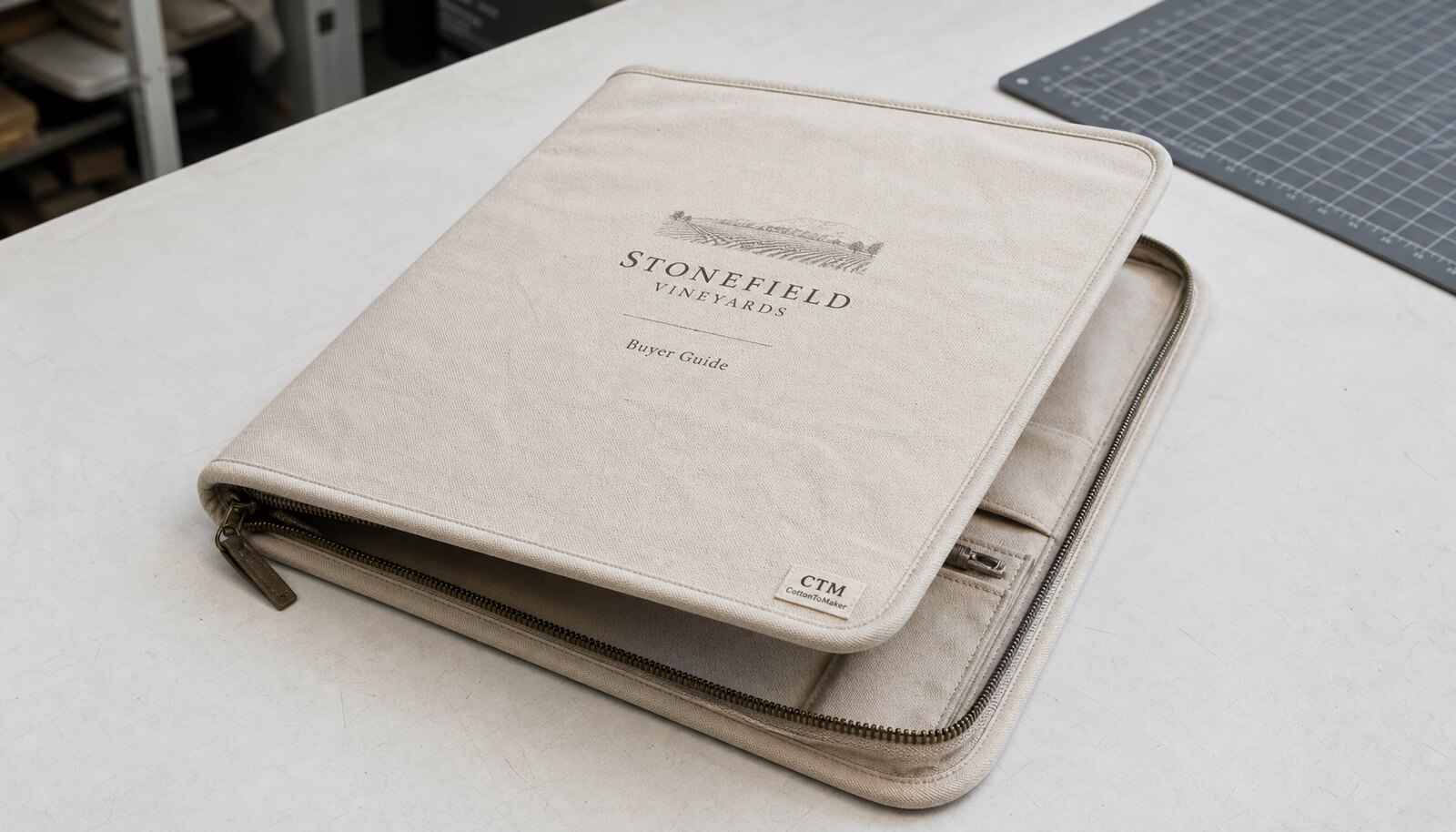
Why Winery Buyers Need a Better Spec Than a Generic Portfolio
Boutique wineries usually buy zipper portfolios for a practical reason, not for style alone. The item has to hold tasting notes, order forms, event materials, club inserts, or a media packet, and it has to look tidy when a customer or trade buyer opens it. That means the portfolio is part document carrier, part presentation tool, and part brand signal. If the spec is too light, the portfolio looks cheap and sags with paper inside. If it is too heavy or overbuilt, the unit cost jumps and the item feels bulky for everyday use.
For that reason, the right buying question is not whether the product is a canvas portfolio. It is which canvas weight, zipper grade, trim package, and decoration method will work for the winery's real use case. A tasting room handout has a different durability requirement from a retail resale item or a staff presentation kit. The best RFQs call that out clearly so factories quote the same target, not their own interpretation of it.
- Map the product to one main use case before you ask for pricing.
- Do not compare quotes until the finished size, canvas weight, and zipper type are fixed.
- Treat the portfolio as a presentation item first and a bag second.
Start With the Use Case, Then Lock the Format
The format drives nearly every cost and quality decision. Most winery buyers end up choosing between a slim document portfolio, a slightly deeper organizer with one or two inner pockets, or a padded presentation case that can hold a tablet, notepad, and printed materials together. Each version changes the sewing time, material count, and carton efficiency. A supplier that quotes all three from a vague request usually gives you a number that is too optimistic on one of them.
Write the intended contents into the RFQ. If the portfolio needs to hold A4 sheets, legal-size inserts, folded brochures, or an iPad sleeve, the factory needs those dimensions up front. If the winery team only needs a clean document carrier, keep the build simple and avoid padding or extra compartments that add cost without changing usability.
- State the paper size or device size that must fit inside.
- Decide whether the portfolio needs a gusset or can stay flat.
- Use one finished format for the first order unless the sales program truly needs variations.
Fabric, Lining, and Zipper Choices That Move the Quote
Canvas weight is the first price lever. For this product, 12 oz cotton canvas is the most useful default because it balances handfeel, body, and cost. It is sturdy enough to hold papers without collapsing, but it does not become stiff like a heavy tote fabric. A 10 oz version can work for lighter presentation use or tight budgets, while 14 oz is better when the buyer wants a more structured feel, higher abrasion resistance, or a premium retail presentation. Ask for the GSM, not just the fabric name, because different suppliers use different terminology for the same nominal weight.
The zipper matters more than many buyers expect. A #5 nylon coil zipper with an auto-lock slider is usually the safest commercial choice for this type of portfolio. It runs smoothly, tolerates frequent opening, and is easier to color match than bulkier hardware. If the portfolio is oversized or packed with heavier inserts, a #8 zipper may be more appropriate, but that should be a deliberate decision because it affects both cost and appearance. Lining is another common variable: unlined is fine for simple document use, while a light lining or pocketing improves perceived value and hides raw seam construction.
- Ask for fabric weight in GSM and confirm whether the cloth is washed or raw.
- Match zipper size to the actual content load, not to a vague idea of durability.
- Only add lining or padding when the use case justifies the extra material and sewing time.
Decoration Choices: What Looks Good and What Survives Production
For winery buyers, decoration should be simple enough to repeat cleanly. A one-color screen print on the front panel is usually the most cost-efficient option when the logo is flat and the brand wants a clear, direct presentation. Woven labels also work well on canvas portfolios when the buyer wants a more textile-like finish and lower visual risk than a large print field. If the artwork is multi-color or has fine details, ask whether the factory can keep registration tight on the chosen canvas weight before you commit to the art size.
The mistake to avoid is approving a decoration method that looks good on a mockup but is difficult to reproduce consistently on real cloth. Heat transfer can be useful for short runs or complex art, but the buyer should verify edge durability and color stability. Embroidery can work on a panel or label patch, but it is not always the best choice for a flat portfolio because dense stitching can distort the panel or interfere with the zipper alignment. In every case, the logo location should be defined in millimeters, not just centered or placed on the front.
- Use one decoration method for the first production run unless you have a clear reason to mix methods.
- Specify logo size and placement in millimeters.
- Approve print on the actual canvas weight, not on a paper proof alone.
How to Compare MOQ, Unit Price, and Setup Logic
MOQ is rarely just one number. For this kind of portfolio, factories often set different minimums for artwork, fabric color, zipper color, and packaging. A buyer can see a low unit price and still end up paying more if the order needs separate setup for every variation. The cleanest way to buy is to standardize the first order: one fabric color, one artwork version, one zipper color, and one packing format. That gives you the best baseline for both cost and future reorder planning.
If the winery wants to test the market, ask for a quote ladder rather than a single figure. Good factories can usually show how the price changes at different volume bands, and that is more useful than a generic unit price. The point is not to negotiate blindly on price. It is to understand which variables actually drive cost so you know where the quote is flexible and where it is not.
- Separate quote lines for fabric, sewing, printing, zipper, lining, and packing.
- Treat mixed artwork or mixed trim as a cost multiplier, not a minor change.
- Ask for price breaks by quantity band so you can plan reorder economics.
Supplier Route Comparison: Direct Factory or Intermediary
The supplier route affects more than price. A direct cut-and-sew factory with in-house printing usually gives the best control over spec consistency, especially if you expect repeats or need to manage a long program of winery events and seasonal promotions. The tradeoff is that the buyer has to write a better RFQ and be more disciplined about sample approval, because fewer middle layers means fewer people translating the spec for you. If the factory is truly doing the cutting, sewing, and decoration themselves, the quote is usually easier to audit line by line.
A trading company or sourcing agent can be useful when the buyer needs broader category support or does not have time to manage factory communication. The risk is that the actual production site may change, which can affect consistency between orders. That does not make the route wrong, but it does mean the buyer should ask who owns each step, what is outsourced, and how the sample connects to the bulk order. For a product like a canvas zipper portfolio, spec drift usually shows up first in zipper quality, print sharpness, and pocket alignment.
- Choose direct factory when repeatability and cost control matter most.
- Use an intermediary only when the extra coordination value is real.
- Always identify the actual production site before approving bulk.
What to Put in the RFQ So Quotes Are Comparable
A useful RFQ does not need to be long, but it must be precise. Start with finished size, canvas weight, lining status, zipper type, decoration method, and intended contents. Then add artwork file type, logo dimensions, packing requirements, and the expected delivery term. If you skip these fields, each supplier will fill the gaps differently and the quotes will not be comparable. The result is a spreadsheet that looks organized but hides major spec differences.
The most important RFQ detail is the acceptance basis. Tell the supplier what sample you will approve, what tolerance you will allow, and what counts as a defect. If you do not define that before the quote, the supplier may assume a looser standard than your team expects. Good quote data also includes forecast context: one-time order, seasonal order, or rolling reorder. That changes how a factory thinks about fabric purchasing and line scheduling.
- Include finished dimensions, artwork dimensions, and pocket dimensions separately.
- State whether the product is for retail, wholesale, internal use, or event distribution.
- Define packing and inspection expectations before the first quote is issued.
Sample Approval: The Step That Prevents the Expensive Mistakes
A pre-production sample should be treated as a contract reference, not a courtesy sample. It needs to use the final fabric, final zipper, final decoration method, and final packing approach. If the factory swaps in a similar-looking zipper or a slightly different cloth weight, the sample is no longer a true approval basis. For a canvas zipper portfolio, small changes in fabric body or zipper tape color can make the finished product look noticeably different in retail or tasting room use.
Inspect the sample with a ruler and a checklist, not casually. Check the logo position, stitch line straightness, zipper run, pocket depth, seam finishes, and any exposed raw edges. If the portfolio needs to carry printed inserts, place the actual paper inside during sample review so you can see how the item behaves in real use. Photograph the approved sample and keep those photos with the production file. That gives both sides the same visual reference if a dispute appears later.
- Never approve bulk from a digital rendering alone.
- Use the final sample to confirm fit with real inserts or cards.
- Archive photos of the approved sample alongside the tech pack.
Packing, Cartons, and Retail Readiness
Packing is not a small detail if the buyer is shipping to a warehouse, a distributor, or a fulfillment center. Flat polybag packing is usually the most efficient route for wholesale, but the buyer should still define whether each portfolio gets an individual bag, a barcode sticker, an insert card, or a desiccant packet. For a winery retail channel, presentation matters, so the outer appearance of the packed unit may need to be cleaner than a standard bulk textile shipment. The warehouse side also needs consistent carton labels, carton counts, and gross weight targets so receiving does not become a manual sorting exercise.
Carton planning should be based on the finished portfolio size, not just a generic quantity per carton. If the product is too tightly packed, corner crush and zipper deformation become more likely in transit. If cartons are too large, freight efficiency drops and cartons can collapse under stack pressure. The right balance is a carton that protects the product, stays within the warehouse handling limit, and does not create unnecessary air freight cost or pallet waste.
- Specify individual polybagging or bulk packing explicitly.
- Set a carton count that protects the zipper and edge shape.
- Confirm outer marks, barcode placement, and carton gross weight limits.
Lead Time, Schedule Risk, and Landed-Cost Reality
For this kind of item, realistic scheduling usually has three stages: sample development, bulk production, and transport. Sample approval can be fast when the art and structure are simple, but the buyer should still leave room for revision if the first sample reveals a problem with zipper alignment, logo size, or pocket fit. Bulk lead time depends on the fabric availability, decoration complexity, and whether the factory needs to source custom zipper colors or labels. Seasonal pressure matters too; if you are close to a major holiday, trade event, or Chinese factory shutdown period, the schedule can stretch even when the factory is otherwise capable.
Landed cost is where many buyers misread a quote. The lowest unit price can become the highest total cost if sample fees, carton upgrades, decoration setup, freight, and duties are not included in the comparison. Ask for a line-item quote so you can compare true landed cost rather than only ex-factory unit price. A well-structured quote usually separates product cost, decoration, packing, test or sample fees, and shipping assumptions. That is the only way to compare two suppliers on equal ground.
- Request ex-factory and landed-cost views if your buying team needs both.
- Treat sample lead time and bulk lead time as separate schedule items.
- Do not compare unit price alone when packing or freight assumptions differ.
Specification comparison for buyers
| Spec decision | Recommended option | When it fits | Buyer risk to check |
|---|---|---|---|
| Supplier route | Direct cut-and-sew factory with in-house printing | You want repeat orders, stable specs, and fewer handoffs between sewing and decoration | Confirm who cuts, prints, sews, inspects, and signs the final sample |
| Supplier route | Trading company with a fixed factory network | You need one contact for multiple items or do not have time to manage several factories | Check whether the actual factory changes by order size and whether markup is hidden |
| Fabric weight | 12 oz washed canvas as the base quote, with 14 oz as a premium or structured option | Most boutique winery portfolios that hold tasting notes, order forms, menus, or media kits | Ask for GSM, shrinkage range, and whether the quote assumes raw or prewashed cloth |
| Zipper hardware | #5 nylon coil with auto-lock slider | Standard portfolio use where smooth opening matters more than heavy-duty load bearing | Check zipper color match, tape width, and whether the slider jams at the corner turn |
| Decoration route | One-color screen print or woven label on the front panel | When the logo is flat, repeatable, and needs a clean retail or event look | Confirm ink opacity, registration tolerance, and abrasion resistance on the selected canvas |
| Interior build | Light lining with one document pocket and one card or pen slot | When the portfolio carries paper inserts and should feel more finished than a bare shell | Check pocket depth, stitch reinforcement, and whether the lining changes the quote materially |
| MOQ strategy | One colorway, one artwork position, one zipper color for the first order | When you want the lowest setup burden and cleanest comparison across suppliers | Watch for hidden setup fees on mixed artwork, mixed trims, or small split runs |
| Packing route | Flat polybag with export master carton | Wholesale shipment to a warehouse, distributor, or fulfillment center | Confirm bag thickness, carton count, carton test target, and outer mark requirements |
Buyer checklist before sampling
- Define the actual use case: tasting room packets, club paperwork, trade show materials, staff presentation kits, or retail resale.
- Lock finished size in millimeters, including zipper seam allowance, gusset, and any pocket depth.
- Choose the canvas weight before decoration, usually 12 oz for general use or 14 oz if the portfolio needs more body.
- Specify the zipper size, slider type, pull style, and preferred tape color, not just the word zipper.
- Select one decoration method for the first order and state the logo size, location, and color count.
- Decide whether the portfolio is lined, unlined, or lightly structured, and whether it needs internal pockets or pen loops.
- Ask for a pre-production sample made with the final fabric, final zipper, final print method, and final packing.
- Request line-item pricing for fabric, sewing, printing, zipper, lining, packing, and sample fees.
- Confirm carton quantity, carton dimensions, gross weight target, and pallet or warehouse requirements if relevant.
- Set the acceptance standard in writing, including defect tolerance, color tolerance, and label placement tolerance.
Factory quote questions to send
- What is the exact finished size of the portfolio, and does the quote include seam allowance and gusset depth?
- What canvas weight and construction did you quote, and is it raw, washed, or pre-shrunk?
- Which zipper brand, size, and slider type are included, and can you show the hardware specification?
- What decoration method is quoted, and is the price for one color, one location, or multiple placements?
- Is the quoted MOQ based on one artwork, one fabric color, one zipper color, or the full product combination?
- Does the unit price include lining, pocketing, and reinforcement stitching, or are those separate add-ons?
- What is the sample fee, what does it cover, and is it refundable against bulk production?
- What is the lead time after sample approval, and what events can push it out?
- What packing is included in the quote, including polybag, insert card, barcode, and carton marks?
- Which parts of production are in-house, and which steps are outsourced to another factory?
Quality-control points to confirm
- Measure the finished size against the approved tech pack and allow only the agreed tolerance on length, height, and gusset.
- Check canvas weight, handfeel, and weave consistency against the approved reference sample, not against a screen image.
- Run the zipper several times on multiple samples and reject any unit with snagging, uneven teeth alignment, or weak slider tension.
- Inspect logo placement, color, and edge sharpness under normal light and compare it with the approved artwork proof.
- Confirm that stress points at the zipper ends, pocket openings, and handle or edge reinforcements use the agreed stitch density.
- Open random samples to verify internal cleanliness, loose threads, lining alignment, and pocket depth.
- Check polybag count, carton count, carton label accuracy, and outer carton condition before shipment release.
- Use a written AQL or equivalent inspection rule for bulk, and make the defect categories clear before production starts.