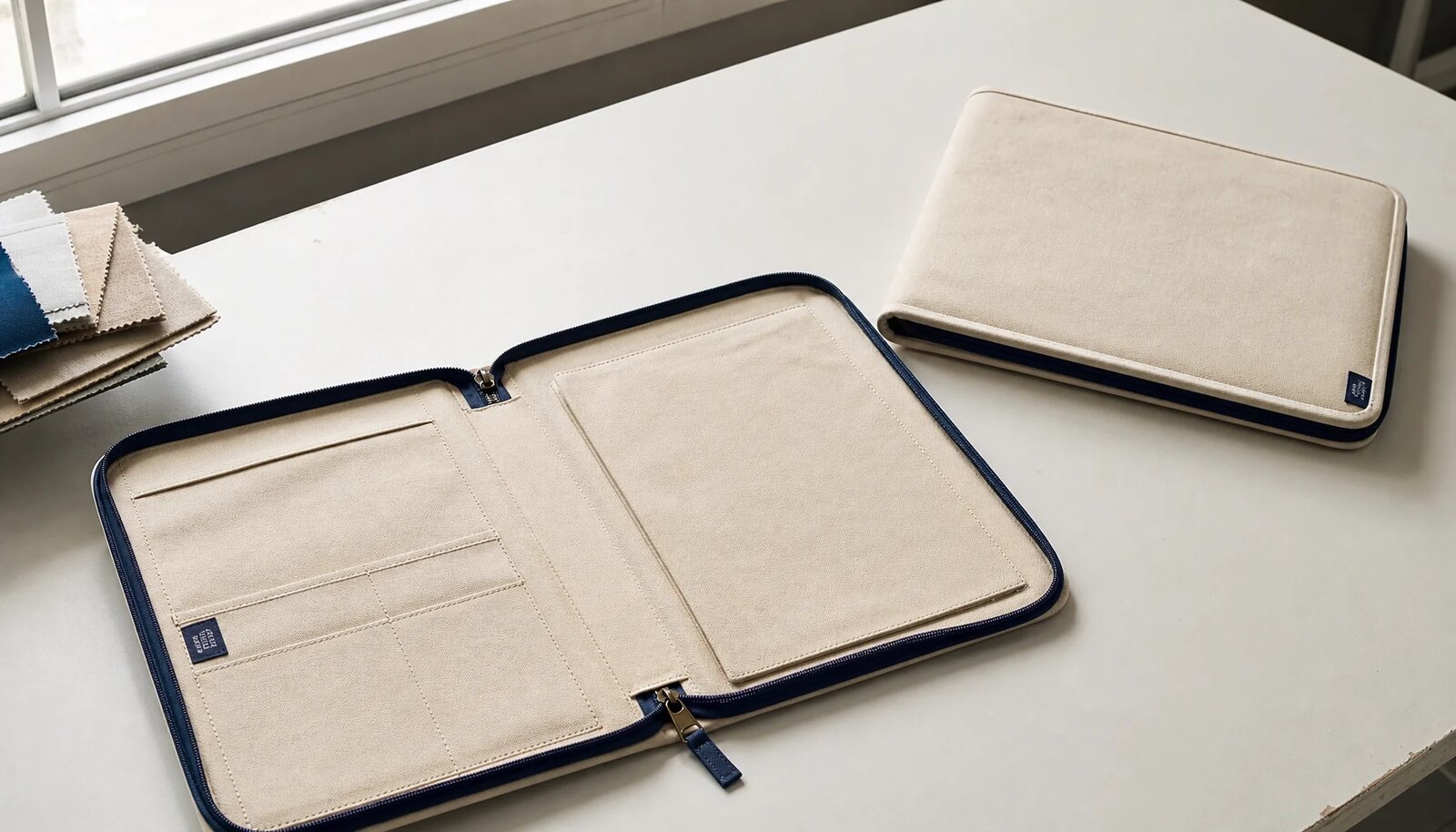
Start with the use case, not the decoration
A custom canvas zipper portfolio can fail even when the logo looks good. Farmers market vendors use these pieces as working organizers, so the product gets opened all day, stuffed into totes, set on damp tables, and handled with greasy or wet hands. If you only buy for appearance, you miss the actual failure points: zipper drag, weak corners, loose print, and fabric that looks tired after a short selling season.
For procurement teams, the first job is to define the contents and the stress profile. Is the portfolio carrying receipts, permits, order forms, recipe cards, a small tablet, or a POS device? That answer drives the size, gusset depth, inner pockets, and closure style more than the artwork does. A good factory quote starts with the real use case and only then moves to branding.
Define the buying brief around the working environment, not just the display shelf.
Keep the spec focused on one core portfolio size unless there is a clear reason to split sizes.
Decide whether the product needs a hand strap, a wrist loop, or only a flat pouch format.
Write down the maximum item thickness the zipper must close without strain.
- Set the internal clearance around the largest item, not the smallest one.
- Confirm whether the buyer wants a soft organizer or a structured document case.
- Require a sample loaded with the actual contents before approving the shape.
Choose canvas weight for real field use
Canvas weight is one of the easiest places to buy the wrong product. For zipper portfolios, 8 oz canvas can work for light promotional use, but it usually feels thin once the bag is packed daily. A more balanced standard is often 10 oz, roughly 340 GSM, because it gives enough body for print clarity and better edge stability without turning the portfolio into a stiff board. For heavier carry or a premium retail feel, 12 oz, roughly 400 to 410 GSM, is safer.
The right answer also depends on whether the fabric is raw, washed, or coated. Raw canvas can look cleaner on a quote sheet, but it may shrink or distort after cutting and sewing if the mill control is weak. A light wash or pre-shrink step can improve consistency. Coating adds spill resistance, but it changes hand feel and can affect print adhesion, so it should be quoted deliberately rather than treated as a default upgrade.
Ask the factory to state GSM, weave type, and any wash or coating process in writing.
Request a cut-size tolerance because heavy canvas can shrink differently across lots.
If the portfolio needs a premium finish, compare body fabric with lining rather than overbuilding the shell.
Use a fabric swatch and a production swatch, not only a catalog photo.
- 8 oz is usually entry-level; 10 oz is the most practical middle ground; 12 oz is for heavier use or premium retail positioning.
- Pre-shrink or wash treatment matters if repeat orders must match the first run.
- If the quote omits GSM, the fabric is not specified tightly enough for bulk buying.
Pick the branding method that survives handling
The logo treatment should match the way the portfolio will be sold and used. Screen print is usually the cleanest and most economical option for one- or two-color logos on canvas, especially when the mark is bold and flat. It gives good visibility, but it needs correct ink choice, curing, and artwork control. If the design has fine lines or multiple colors, the supplier may push heat transfer, which can look sharp on day one but may not age as well under constant rubbing or folding.
For a brand that wants longer service life, a woven label, sewn patch, or side label is often more durable than a large printed block. Embroidery can work, but it adds stitch density and can pull the fabric if the canvas is too light. The best route depends on the logo, not the supplier's favorite method. A good quote should show the print size, placement, number of colors, and whether the logo sits on the front panel, corner, or side label.
Match the decoration method to the logo geometry, not to the supplier's default machine setup.
Require Pantone references or a clear color standard if the logo has brand-critical colors.
If the buyer wants a premium retail look, compare a printed front mark with a sewn side label.
For repeated restocks, keep the artwork simple so future runs are easier to match.
- Screen print is usually best for flat, bold logos and lower unit cost.
- Heat transfer fits complex art but needs extra testing for cracking and edge lift.
- Woven or sewn labels often survive market handling better than large printed fills.
Set zipper, stitching, and trim thresholds
A zipper portfolio lives or dies on the hardware. For a standard canvas document case, a nylon coil zipper in size #5 is usually the practical starting point because it balances smooth opening with modest bulk. If the portfolio is thick, overloaded, or expected to get rough daily use, a larger zipper may be safer. The supplier should name the zipper type, tape color, puller finish, and whether the slider is auto-lock or non-lock. Vague wording like 'good quality zipper' is not a spec.
Stitch quality matters just as much. Ask for even stitch spacing, reinforced stress points, and bartacks at the ends of the zipper run and handle attachment points if any are present. The thread should not cut into the canvas or leave excess lint. For practical acceptance, the zipper should travel smoothly through repeated open-close cycles, and the panel should stay flat instead of rippling around the zipper line.
Request seam allowance and stitch density in the tech pack so the factory cannot improvise.
If the product includes pockets, define pocket depth and whether the top edge is bound or turned.
Check zipper tape color against the body fabric under daylight, not just under warehouse lighting.
Tie any metal trim to rust resistance if the market route includes humidity or outdoor use.
- Use #5 nylon coil for most standard portfolios; move up only if thickness or use frequency justifies it.
- Require bartacks or reinforced end stops at high-stress points.
- Reject any sample with zipper snagging, wave distortion, or uneven seam tension.
Approve the sample like a production part
A sample is only useful if it represents the factory's real production method. Before you approve anything, confirm whether the sample is a hand-made prototype or a pre-production sample from the actual line. A hand-made sample can be useful for shape and design, but it may not prove stitch behavior, trim sourcing, or print alignment. The approval package should include the final artwork file, fabric swatch, zipper spec, and a signed sample note so the production team cannot reinterpret the brief later.
Inspect the sample under the same conditions the customer will see it. Measure the finished size, open and close the zipper several times, load it with the intended contents, and compare the logo position against the approved proof. Look for corner softness, print bleed, puckering around the zipper, and any warping caused by heavy decoration. If the first sample misses the target, revise the spec before bulk material is booked, not after.
Use a golden sample and keep one with signatures, measurements, and date stamps.
If possible, approve a sample that already uses the bulk zipper and bulk canvas lot.
Document any allowed variation in writing, especially on shade, placement, or label position.
Treat the sample as the production standard, not as a design conversation piece.
- Check the bag loaded and unloaded; some defects only appear when the portfolio is filled.
- Record size, logo placement, and zipper performance on the approval sheet.
- Do not release bulk if the factory still has open questions about trims or art files.
Specify packing that protects retail margin
Packing is not a minor detail once products move through distribution or direct-to-store delivery. A zipper portfolio that arrives scuffed, warped, or damp can still be technically functional but hard to sell. For wholesale, individual polybags with a simple insert card or barcode sticker often make receiving easier, while master cartons should be sized to avoid crushing the product flat. If you sell retail-ready goods, ask for a packing method that keeps the portfolio clean without adding unnecessary labor.
The carton spec should include count per carton, carton dimensions, gross weight target, and carton markings. If the route is humid, add desiccant only if it is necessary and approved, because extra inserts can add labor and cost. If the portfolio has printed surfaces, make sure the print does not rub against a hard insert or against another unit in the carton. Packing errors create claims that look like product defects, so the packing spec has to be as precise as the bag spec.
Ask whether the factory can do barcode application in-house or whether that work is outsourced.
If the buyer wants shelf-ready retail, define hangtag, belly band, or polybag header requirements early.
Keep the inner pack simple unless the product is a premium gift item.
Confirm whether carton marks will show SKU, color, quantity, and buyer PO number.
- Use unit protection that prevents rub marks, zipper pressure, and moisture pickup.
- Avoid overpacking that distorts the canvas and leaves permanent fold lines.
- Match packing count to warehouse handling, not to the factory's easiest packing speed.
Read quotes line by line, not as a total
A quote for custom canvas zipper portfolios is only comparable when every line item is visible. The base unit price should separate the bag body, zipper, decoration, packing, and any setup charge. If the supplier only gives one lump sum, you cannot see where the cost actually lives or how the price will move when you change a zipper color, logo color count, or carton spec. That becomes a problem when you need a reorder or a second brand color.
Good quote data also tells you how the price changes with MOQ. Some suppliers have a low headline price but make it expensive to split by colorway or print color. Others are more flexible on unit price but charge heavily for sample or art setup. The buyer should compare the full landed cost path, not only the ex-factory number. Include freight assumptions, duty, domestic delivery, and expected rework risk in the comparison sheet.
Ask for a line-item quote that separates the body fabric, zipper, print, label, packing, and carton charge.
Request a clear MOQ by colorway and by decoration method instead of one vague total minimum.
If setup charges apply, write them down so the reorder math is not distorted later.
Treat freight and import charges as part of the sourcing decision, not an afterthought.
- A cheap unit price can hide costly packing, setup, or low-flexibility terms.
- Always compare the same spec across suppliers before judging price.
- Use a quote worksheet that shows total landed cost, not just factory price.
Compare sourcing routes before you compare price
The best supplier for a custom portfolio is not always the cheapest one. A direct cut-and-sew factory usually gives you better control over fabric, stitch standard, and trim consistency, but it requires a clearer spec and more buyer discipline. A trading company can simplify communication and bundle several product types, but you may lose visibility into which factory actually makes the sample and whether the bulk run uses the same line. Local decorators are useful for very small or fast-turn programs, yet they often have less control over bag construction and long-run repeatability.
A practical buying approach is to choose the sourcing route based on risk. If you need repeat replenishment, product consistency, and enough volume to justify a real tech pack, go direct to the factory. If the order is experimental, low volume, or part of a mixed category program, a trader or hybrid source may be acceptable, but only with stronger sample and QC controls. Your supplier evidence should include real production photos, trim source confirmation, and a clear statement of which steps are done in-house and which are subcontracted.
Ask who cuts, who prints, who sews, and who packs the order.
Request recent production photos of the same or a very similar portfolio, not unrelated bag types.
If the supplier outsources printing or labeling, document who carries the defect responsibility.
Use the same evaluation sheet across sourcing routes so the comparison stays fair.
- Direct factory: best for repeat orders and spec control.
- Trading company: useful for multi-category buying, but spec visibility is weaker.
- Local decorator: fast for small runs, but less reliable for complex construction or scale.
Control lead time and inspection before bulk release
Lead time needs to be split into steps: sampling, sample approval, material booking, production, finishing, and carton release. For a straightforward canvas portfolio, sample development may take around 7 to 14 days, while bulk production often needs 30 to 45 days after approval, depending on fabric stock, trim availability, and seasonality. If the order includes custom-dyed fabric, special zipper colors, or new packaging, the timeline can stretch. The buyer should ask the supplier to state each stage separately so hidden delays do not get buried inside one vague estimate.
Inspection should happen before the goods leave the factory, not after the shipment arrives. A pre-shipment inspection should cover dimensions, stitch quality, zipper function, logo placement, packing count, and carton condition. Agree on what counts as a major defect and what tolerance is acceptable for minor variation. For a portfolio used in retail or market settings, a missed stitch or a crooked logo may not break the product physically, but it can still damage sell-through. The order is safe only when the production standard is locked and the inspection plan matches the risk.
Build in a time buffer for art approval and material procurement, especially around peak season.
If the launch date is fixed, ask the factory to reserve fabric and zipper inventory before bulk approval.
Tie shipment release to passed inspection and final artwork sign-off.
Keep one inspection sample and one sealed master sample in your internal file.
- Separate sample time from bulk time in the schedule.
- Define defect thresholds for stitch, print, zipper, and packing before production starts.
- Never rely on verbal approval when the order has custom art or custom trim.
Specification comparison for buyers
| Spec decision | Recommended option | When it fits | Buyer risk to check |
|---|---|---|---|
| Pattern ownership | Direct cut-and-sew factory with a signed tech pack and golden sample | You expect repeat orders, seasonal color changes, or multiple SKUs | Risk of silent pattern drift if revisions live only in email or chat |
| Fabric source | Mill-booked 8 to 12 oz canvas with lot tracking | You need shade consistency across replenishment runs and retail displays | Risk of mixed-lot color variation if the supplier buys cloth spot by spot |
| Branding method | Screen print for solid logos, woven label for long-term identity | You want a clean front panel and a logo that survives heavy handling | Risk of cracking, peeling, or logo placement drift if artwork control is weak |
| Zipper route | Factory-matched nylon coil zipper, usually size #5 for standard use | The portfolio is opened daily and must glide smoothly without bulk | Risk of snagging, broken pulls, or mismatch between zipper color and body fabric |
| MOQ strategy | Split order by colorway, not by every tiny trim change | You need one core model but want a few market-friendly variants | Risk of MOQ inflation when every detail becomes a separate production line |
| Packing route | Individual polybag plus master carton with barcode and carton marks | You sell wholesale or need clean receiving at a distribution center | Risk of scuffing, moisture, mixed counts, and carton-level labeling errors |
| QC route | Inline check plus pre-shipment inspection against a signed sample | You are sourcing from a first-time supplier or a new production line | Risk of shipping the first acceptable sample instead of the full run standard |
| Lead-time buffer | Plan for sample approval first, then bulk production after fabric and trim booking | You have a fixed launch date or market season window | Risk of missing the selling season if approvals move after material booking |
| Landed-cost control | Compare EXW, FOB, freight, duty, and domestic delivery in one worksheet | You need a real supplier comparison instead of a headline unit price | Risk of choosing the cheapest quote and losing margin in freight, packaging, or rework |
Buyer checklist before sampling
- Finished size matches the documents or inserts the buyer will actually carry.
- Canvas weight is stated in oz and GSM, with an acceptable shade range.
- Zipper size, tape color, and puller finish are written into the tech pack.
- Logo method, size, and placement are fixed with a signed artwork proof.
- Sample approval includes fabric swatch, zipper action, and stitch quality.
- Packing spec covers polybag type, carton count, and carton markings.
- MOQ is clear by color, print color, and trim color, not just total pcs.
- Lead time is broken into sample, material booking, production, and packing.
- Quote shows whether sampling, screens, embroidery setup, or carton charges are included.
- Inspection standard defines acceptable dimension tolerance and defect limits.
Factory quote questions to send
- What is the exact canvas weight in GSM, and is it raw, washed, or pre-shrunk?
- Which zipper size and zipper tape supplier will you use, and can you match the body color?
- What printing method is quoted, how many colors are included, and what are the setup charges?
- What is the MOQ by colorway, print color, and trim color if I keep the same body spec?
- What is the sample timeline, and is the pre-production sample made on the same line as bulk goods?
- What packing is included: individual polybag, insert card, barcode sticker, and master carton spec?
- What are the internal dimensions, stitch allowance, and logo placement tolerance on the final product?
- What are the Incoterms, lead time after sample approval, and the change-order rules if trim or art changes?
Quality-control points to confirm
- Fabric weight should stay within the agreed GSM range and feel consistent across panels and lots.
- Logo placement should stay within a small measured tolerance and not drift from panel to panel.
- Stitching should be even, with no skipped stitches, loose threads, or broken bartacks at stress points.
- Zipper should run smoothly through repeated open-close cycles without snagging, waviness, or tooth misalignment.
- Corners and edges should stay square, with no twisting, puckering, or panel distortion after sewing.
- Color should match the approved swatch under daylight and should not show obvious panel-to-panel shade jumps.
- Finished dimensions should stay within the agreed tolerance for width, height, and gusset depth.
- Packaging should match the packing list exactly, with no mixed counts, missing labels, or crushed cartons.
- Print or embroidery should be clean at close range, with no cracking, bleeding, puckering, or skipped threads.
- Final cartons should be dry, odor-free, and strong enough for stacked transit without collapse.