Start with the buying job, not the product name
A custom canvas zipper portfolio is easy to describe loosely and hard to buy consistently. For a tech startup, the same item might be used in a new-hire welcome kit, a developer conference giveaway, an investor meeting folder, a sales enablement pack, or a customer onboarding box. Those situations look similar in a product photo, but they carry different cost limits, presentation standards, and failure risks. A portfolio handed to employees at a one-day internal launch can be simpler than one presented to enterprise prospects or shipped inside a premium welcome kit.
The best procurement brief starts with the contents and the handling path. Will the portfolio hold A4 or letter documents, stickers, access cards, notepads, charging cables, a thin booklet, or a contract pack? Will it be handed out at an event, packed into a fulfillment box, or stored in a warehouse for several months? The answers decide the size, canvas weight, zipper quality, interior layout, and packing method more reliably than a generic style reference.
This also keeps the sourcing conversation from becoming repetitive. Instead of asking every supplier for “best price on custom canvas zipper portfolios,” the buyer can say: “We need a 1,000-unit onboarding portfolio that holds a welcome letter, notebook, badge card, and two inserts; one-color logo; clean but not luxury finish; carton-packed for fulfillment.” That level of detail lets factories quote the same product and explain tradeoffs clearly.
- For onboarding kits, prioritize consistent size, clean logo placement, and efficient packing.
- For sales or investor meetings, prioritize hand feel, zipper smoothness, and presentation quality.
- For trade shows, prioritize price, speed, and simple decoration that survives handling.
- For resale or customer gifting, prioritize tighter inspection, cleaner interiors, and reorder consistency.
Planning price ranges and their limits
Bulk pricing is useful only when buyers understand what the range assumes. The following ranges are planning bands for a simple canvas zipper portfolio using standard canvas, a standard nylon coil zipper, one logo position, basic export packing, and no unusual compliance or retail packaging requirements. They are not market guarantees. Actual quotes can move outside these bands because cotton prices, exchange rates, labor availability, decoration method, order timing, and factory load all change.
For early budgeting, a 300 to 500 unit order may plan around $2.20 to $4.50 per piece ex-works for a straightforward build. At 1,000 units, a similar specification may plan around $1.70 to $3.40 per piece ex-works. At 3,000 units, a clean and efficient design may plan around $1.35 to $2.80 per piece ex-works. These figures are best used to flag outliers and frame internal budgets, not to pressure a supplier before the spec is locked.
A low quote should trigger questions, not automatic approval. It may reflect a smart production plan, in-stock material, efficient sewing, or a lighter specification. It may also exclude packing, setup charges, sample cost, inspection, stronger zipper tape, or stable fabric sourcing. A higher quote may include better material control or a more realistic lead time. Procurement should compare quotes by received cost and risk, not by the first unit price shown in an email.
- Use price bands for budgeting and outlier detection, not as promised market rates.
- Ask suppliers to state the assumptions behind each tier so the range becomes comparable.
- Separate sample, setup, packing, inspection, and freight from the recurring unit cost.
- Recheck pricing after sample approval if the final sample differs from the first RFQ spec.
Where the cost really moves
At startup quantities, price is often driven by setup, labor, and production handling more than by canvas alone. A logo screen, woven label setup, custom puller, or revised pattern can add fixed cost that spreads heavily across a 300 or 500 unit order. Once volume rises, that setup burden falls, and material purchasing and sewing efficiency matter more. This is why a quote at one quantity rarely tells the whole story.
The four most common cost drivers are fabric, zipper and hardware, decoration, and sewing complexity. Fabric cost rises with weight, finish, dye control, and wastage. Zipper cost rises with non-stock tape colors, puller finishes, custom pullers, and stronger end stops. Decoration cost changes with color count, print area, label type, and whether the work is in-house. Sewing cost increases with lining, pockets, reinforcements, tight corners, and thick seam intersections.
A practical buyer scenario makes the tradeoff clearer. If the portfolio is for a developer event and holds only paper inserts, a 12 oz canvas, one-color screen print, standard zipper, and bulk carton pack may be the right value point. If it is for enterprise customer onboarding, a 14 oz canvas, smoother zipper pull, lined interior, woven label, and individual packing may be worth the added cost because the recipient experience matters more. Procurement should decide which features protect the business goal and which features only add complexity.
- Simplify pockets and lining before cutting zipper quality if function matters.
- Choose standard zipper tape colors when schedule is tight.
- Avoid custom pullers unless the order size justifies tooling, approval, and lead time.
- Model landed cost per usable unit, not only quoted ex-works unit price.
Spec example for a first order
A sample specification helps prevent vague quoting. For a balanced first order, a startup might request a letter-size canvas zipper portfolio in 14 oz cotton canvas, natural or dyed color, size 5 nylon coil zipper, one main compartment, one flat internal pocket, one-color screen print or woven label, and standard export carton packing. That is specific enough for factories to quote consistently while still leaving room to optimize construction.
If the budget is tighter, remove the lining first, keep the interior simple, and use one logo position. If the item needs to feel more premium, improve the zipper pull, add a cleaner interior finish, and use a controlled canvas finish before adding decorative extras. Buyers often add pockets, labels, and custom hardware too early, then remove them after the quote is too high. A better route is to define the base version and list optional upgrades separately.
The spec should also state what is not required. If the portfolio does not need laptop protection, do not imply padding. If it is not retail packaged, do not ask for retail-level inserts or barcodes unless the warehouse needs them. If the artwork is simple, do not request multiple decoration options unless the supplier sees a technical issue. Clear exclusions reduce quoting time and keep the factory focused on the version the buyer can actually approve.
- Base spec: 12 oz to 14 oz canvas, size 5 nylon zipper, one compartment, one logo position.
- Upgrade spec: 14 oz to 16 oz canvas, cleaner interior, stronger puller, individual packing.
- Avoid specifying padding unless the portfolio must protect electronics.
- List optional features as alternates so finance can see the cost impact.
Canvas, zipper, and interior choices
Canvas weight should be chosen for the product’s job. A 12 oz to 13 oz fabric works well when the portfolio mainly carries documents and needs to stay cost-efficient. A 14 oz to 16 oz fabric gives more structure and stronger presentation, but it can create thicker seams and reduce carton density. Heavier fabric is not automatically better; it must still sew cleanly around corners and zipper ends.
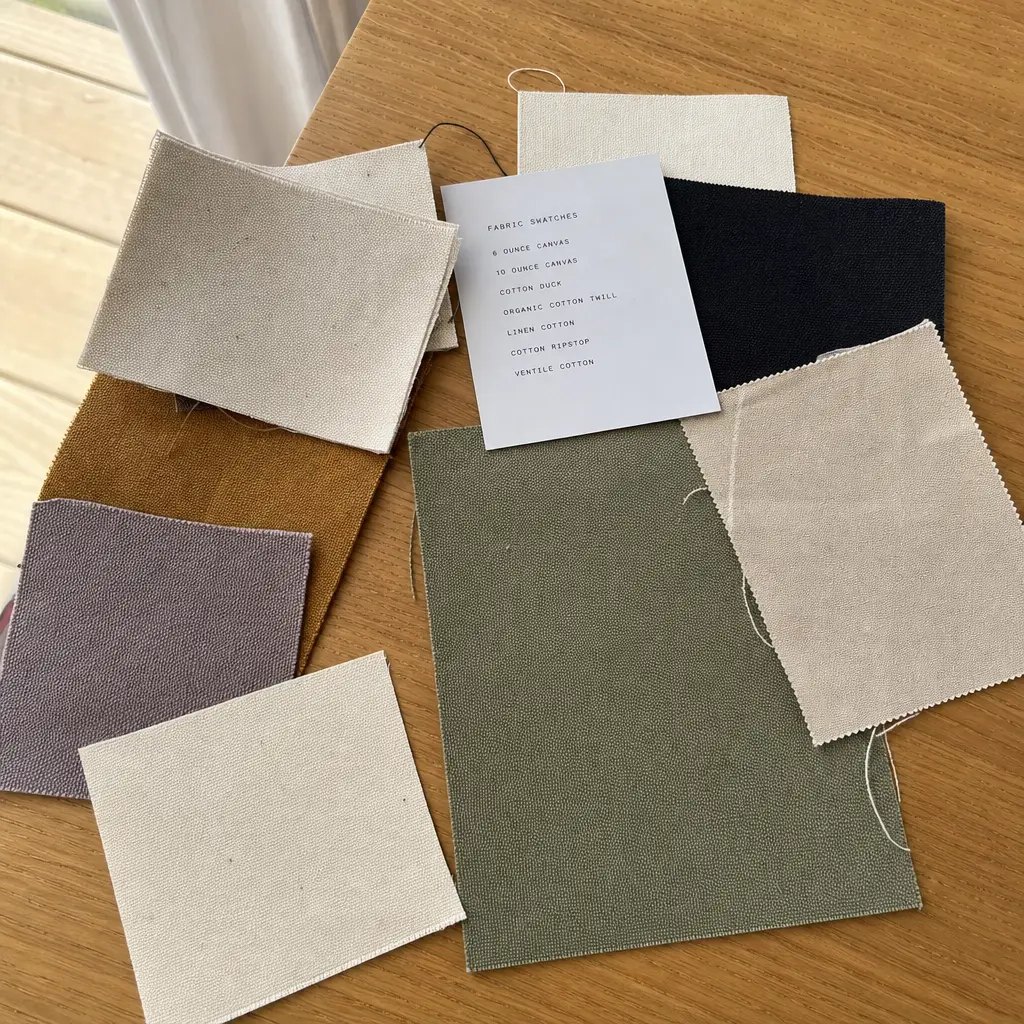
Finish affects consistency. Raw canvas can be acceptable for a rugged, natural look, but shade, shrink behavior, and hand feel may vary more. Washed or pre-shrunk canvas can improve repeatability and reduce surprises during humid shipping or storage. If the startup expects a reorder, the buyer should ask whether the same fabric lot can be held or whether the supplier can match shade and finish from a later batch.
The zipper should not be treated as a minor trim. For this product category, a standard size 5 nylon coil zipper is often a practical balance of smooth movement, low weight, and manageable cost. Buyers should still specify tape color, puller style, puller finish, and end stop. Interior design should stay simple unless the added organization is meaningful. One pocket or pen loop is usually easier to control than multiple pockets that create alignment and stitch consistency issues.
- Choose 12 oz to 13 oz for light document carry and stronger carton efficiency.
- Choose 14 oz to 16 oz for better shape retention and gift-facing presentation.
- Specify zipper tape color, puller finish, and end stop before sampling.
- Limit interior features when speed, price, and repeatability are the priorities.
Decoration choices that do not fight the fabric
Decoration should match the artwork and the canvas texture. Screen printing is usually the most economical and repeatable option for a simple one-color logo with solid shapes. It is easy to inspect and efficient in bulk. The risk is fine detail: small type, thin lines, gradients, and tight registration can lose sharpness on textured canvas.
Woven labels, sewn patches, and heat transfers can solve different problems. A woven label preserves small text and multi-color marks better than direct printing in some cases, but it changes the look from printed branding to trim branding. Heat transfer can support detail but must be tested for adhesion, edge lift, and hand feel on the chosen canvas. Embroidery may look premium, yet it adds thickness and can distort the surface if the design is dense or the placement crosses a high-stress area.
The approval process should include artwork scale, placement, and durability. Placement should be measured from seams, not estimated by eye. For example, the spec might state that the logo center is 90 mm from the left seam and 55 mm from the top seam, with a tolerance agreed after sample review. Durability checks can be simple: rub the print by hand, flex the decorated area, stack the portfolio, and confirm the logo still looks acceptable after handling.
- Use screen print for bold one-color startup logos and cost-sensitive orders.
- Use woven labels when small text, detail, or reorder consistency matters.
- Use embroidery only where thickness and texture support the design.
- Approve logo size and placement on a physical sample, not only on a digital mockup.
MOQ, lead time, and reorder planning
MOQ is not just a minimum number; it is a signal about the production setup. A supplier willing to make 200 pieces may be using stock materials and manual handling, which can be useful for a pilot but expensive per unit. A supplier quoting sharply at 3,000 units may be optimized for longer cutting and sewing runs but less flexible on changes. Neither route is wrong. The buyer needs to know where the order sits on the supplier’s efficiency curve.
For tech startup programs, tier pricing at 300, 500, 1,000, and 3,000 units is more useful than one MOQ. A 300-unit run may fit an investor event or pilot onboarding program. A 500-unit run may support a conference or departmental rollout. A 1,000-unit run may justify cleaner setup and better material purchasing. A 3,000-unit run may be appropriate when the item will be used across multiple offices, events, or customer programs.
Lead time should be separated into sample development, material purchase, bulk production, inspection, and shipping. A common problem is that buyers approve the product design but change logo placement, zipper color, or packing after the sample. Those changes can reset parts of the schedule. Reorder planning should also be discussed early. Ask whether screens, labels, patterns, and zipper specifications can be reused and how long materials can be matched.
- Ask for tier pricing before negotiating; the price curve shows where savings are real.
- Confirm whether setup charges repeat on reorder or only apply to the first run.
- Hold one approved sample and one digital spec version as the reorder reference.
- Avoid late changes to zipper color, logo method, or packing if the event date is fixed.
Regional sourcing tradeoffs
Sourcing region affects material options, communication, freight timing, and factory control. China remains a strong option for canvas zipper portfolios when buyers need broad material access, mature bag-making supply chains, multiple decoration routes, and flexible sample development. The buyer’s task is to control the spec carefully and confirm whether sewing, printing, and packing are in-house or subcontracted.
Vietnam can be a good fit for sewing-focused programs where repeatability and workmanship matter, although some suppliers may have narrower trim or decoration options than the largest Chinese clusters. India can be attractive for textile depth and cotton-based materials, but buyers should check zipper consistency, finishing control, and export packing closely for this product type. Nearshore routes such as Mexico or other closer-market options may reduce transit time and improve communication, but they may not always offer the lowest unit cost or the same trim variety.
The better comparison is not country versus country; it is supply chain capability versus order requirement. For a time-sensitive conference order, faster shipping and simpler communication may justify a higher unit price. For a recurring onboarding program, material repeatability and a lower stable unit cost may matter more. Buyers should ask where the canvas is sourced, where the zipper is sourced, where decoration happens, and who owns final inspection.
- China: strong option for broad materials, trim choices, and integrated production routes.
- Vietnam: strong candidate for sewing quality when material variety is not extreme.
- India: useful textile base, with finishing and zipper consistency needing careful verification.
- Nearshore: useful for speed and communication, but verify cost, capacity, and material access.
Quote package and commercial comparison
A useful quote should look like a compact production plan. It should include product dimensions, canvas weight and finish, zipper specification, decoration method, logo size, sample cost, setup fees, tier pricing, packing method, carton count, lead time, payment terms, and trade term. If any of these are missing, the buyer may be comparing different products without realizing it.
The quote should also state what would change the price. A second logo position, custom zipper pull, dyed-to-match zipper tape, lining, individual polybag, custom insert, or lower carton count may each affect cost. Asking for these alternates early prevents re-quoting loops. It also helps finance understand why the cheapest version and the approved version are not always the same.
For commercial comparison, build a simple side-by-side view: ex-works unit cost, setup amortized per unit, packing cost, estimated freight per unit, inspection cost, and expected usable quantity after defects. This does not need to be complex. The goal is to compare received value. If Supplier A is cheaper but uses bulky packing, vague zipper specs, and no clear inspection plan, Supplier B may be lower risk even at a higher factory price.
- Require tier pricing and setup charges in the same quote.
- Ask suppliers to list exclusions instead of assuming they are included.
- Compare carton dimensions and gross weight before estimating freight.
- Choose the supplier with the clearest assumptions, not only the lowest opening price.
Sample approval and QC without arbitrary rules
Quality control works best when it is tied to the buyer’s real risk. For a conference giveaway, the key risks may be wrong logo placement, visible stains, broken zippers, and late delivery. For an executive gift, the risk list expands to hand feel, seam neatness, color consistency, and interior finish. For resale, carton labeling and count accuracy may be just as important as the product itself. The inspection plan should match the channel.
A pre-production sample should use the final materials or clearly state any substitutes. It should be checked filled and empty. Open and close the zipper repeatedly, look for catching at corners, check whether the portfolio lies flat, and see if the zipper line waves after contents are inserted. Measure dimensions and logo placement from fixed seams. Inspect stitching at zipper ends and pocket joins because these areas carry stress and often reveal weak production control.
For final inspection, use agreed defect categories. Broken zipper, wrong artwork, wrong material, open seam, severe stain, and short carton count should be major issues. Loose thread ends, minor dust, or slight natural canvas variation may be minor issues depending on the approved standard. AQL 2.5 for major defects and 4.0 for minor defects is a common starting point in consumer goods, but it should be treated as a buyer-selected baseline, not a universal rule. If the item is high-visibility or retail-facing, the buyer may choose tighter limits.
- Test samples in the same loaded and packed condition expected in real use.
- Define major and minor defects before production begins.
- Keep tolerances realistic for canvas, which can shift more than synthetic sheet materials.
- Release shipment only after product photos, defect notes, carton photos, and count records are reviewed.
Specification comparison for buyers
| Decision area | Practical option | Tradeoff for buyers | Cost or lead-time impact |
|---|---|---|---|
| Canvas weight | 12 oz to 13 oz for lighter document kits; 14 oz to 16 oz for stronger shape and a more substantial hand feel | Lighter canvas packs flatter and costs less; heavier canvas looks better for gifting but can create bulkier seams | Heavier canvas can add material cost, slow sewing, and reduce carton density |
| Fabric finish | Raw canvas for rugged low-cost use; pre-shrunk or washed canvas when repeatability and presentation matter | Raw canvas may vary more by lot; washed or controlled canvas gives a cleaner feel and fewer reorder surprises | Washed or pre-shrunk fabric may add cost and sourcing time but reduces shrink and hand-feel disputes |
| Zipper choice | Size 5 nylon coil zipper with specified tape color, puller finish, and end stop | Nylon coil is usually smoother and lighter than metal for this product type; metal looks premium but adds weight and scratch risk | Custom pullers or non-stock colors can add setup cost and several days to sourcing |
| Decoration method | Screen print for simple one-color logos; woven label or heat transfer for fine detail; embroidery only where thickness is acceptable | Screen print is economical but weaker for small type on coarse canvas; labels preserve detail but change the design language | Extra logo positions, multi-color work, or custom labels usually add setup fees and approval time |
| Interior build | Single compartment for cost control; add one divider, pocket, or pen loop only if it supports the use case | Each feature improves utility but adds stitching operations and more points to inspect | A lined or multi-pocket build can move the item into a higher labor tier |
| MOQ strategy | Request tiers at 300, 500, 1,000, and 3,000 units instead of one minimum order number | Shows whether the supplier is efficient at pilot quantities or only at larger runs | Low MOQ may carry higher setup-per-unit cost; larger tiers usually improve labor and material purchasing efficiency |
| Packing plan | Bulk pack for internal use; individual polybag and controlled carton count for distribution or resale | Bulk pack reduces waste and cost; individual packing improves warehouse handling and presentation | Individual bags, desiccants, carton labels, and lower carton counts can raise landed cost |
| Supplier route | Direct factory for tighter production visibility; trading partner only if they manage decoration, QC, and export clearly | Direct factory can improve version control; trading partner may simplify communication but can hide production details | Subcontracted printing or sewing can add handoff time and make issue ownership less clear |
| Inspection level | Pre-production sample plus in-line or final inspection using agreed AQL and functional checks | More inspection adds discipline; too many arbitrary checks can slow release without improving outcomes | Inspection cost is usually small compared with rework, but late inspections can delay shipment if issues are found |
Buyer checklist before sampling
- Define what the portfolio must carry: documents only, laptop-adjacent accessories, onboarding inserts, investor handouts, or retail packaging materials.
- State the target use case: internal onboarding, conference giveaway, sales kit, executive gift, or resale item, because each supports a different quality ceiling.
- Lock canvas weight, finish, zipper size, lining, interior layout, logo method, and packing before comparing quotes.
- Ask for tier pricing at 300, 500, 1,000, and 3,000 units, with setup charges shown separately from recurring unit cost.
- Treat any price range as a planning estimate until the supplier confirms material source, decoration method, labor assumptions, and packing density.
- Request a pre-production sample made with the same canvas, zipper, thread, decoration method, and approximate packing style intended for bulk.
- Measure logo placement from fixed seams and state a tolerance that fits the artwork size rather than relying on “centered” wording.
- Specify inspection criteria for zipper travel, seam consistency, print quality, loose threads, stains, carton count, and packing protection.
- Compare ex-works, FOB, and estimated landed cost, especially when cartons are bulky or the order ships close to an event date.
- Confirm whether the supplier can repeat the same fabric shade, zipper tape color, puller finish, and logo method for reorders.
Factory quote questions to send
- What exact canvas weight are you quoting in oz and GSM, and what tolerance should we expect in bulk?
- Is the canvas raw, washed, enzyme-washed, dyed to order, or pre-shrunk, and can the same material be repeated for reorders?
- Which zipper size, tape width, puller material, puller finish, and end-stop construction are included?
- Is decoration handled in-house or by a subcontractor, and how does that affect sampling, QC, and lead time?
- What price can you quote at 300, 500, 1,000, and 3,000 units, and which setup charges are one-time versus repeated?
- What changes would move the quote into a higher price tier, such as lining, second logo position, custom zipper pull, or individual packing?
- Will the pre-production sample use the same fabric, zipper, thread, print ink or label, and sewing pattern as bulk production?
- What are your standard inspection checkpoints for zipper function, seam strength, print registration, stains, loose threads, and carton count?
- What carton size, units per carton, gross weight, moisture protection, and carton marking are included in the quoted packing?
- Which materials are in stock, which must be purchased to order, and what are the lead-time risks if we approve changes after sampling?
Quality-control points to confirm
- Write the fabric specification in oz and GSM, including whether the value is nominal or measured after washing or finishing.
- Tie the approved sample to a PO number, revision date, material list, logo artwork file, and packing instruction.
- Set seam allowance and stitch-density expectations on the spec sheet, but allow the factory to confirm what is appropriate for its equipment and construction method.
- Check zipper travel on sampled units with repeated full open-close cycles, focusing on catching, skipped teeth, twisted tape, loose pullers, and weak end stops.
- Inspect filled samples, not only flat samples, because zipper puckering and corner distortion often appear after the portfolio holds real contents.
- Measure finished dimensions, logo location, and pocket placement from fixed seam references using tolerances that match the product size and fabric behavior.
- Use an agreed AQL plan for final inspection; AQL 2.5 major and 4.0 minor is a common consumer-goods starting point, but buyers should adjust by risk and channel.
- Classify defects before production: broken zipper, wrong logo, open seam, severe stain, and wrong carton count should not be treated the same as a small loose thread.
- Review carton packing for compression, moisture exposure, zipper-pull protection, count accuracy, barcode or label placement, and warehouse receiving needs.
- Ask the supplier to record inspection findings with photos of representative defects and packed cartons before shipment release.