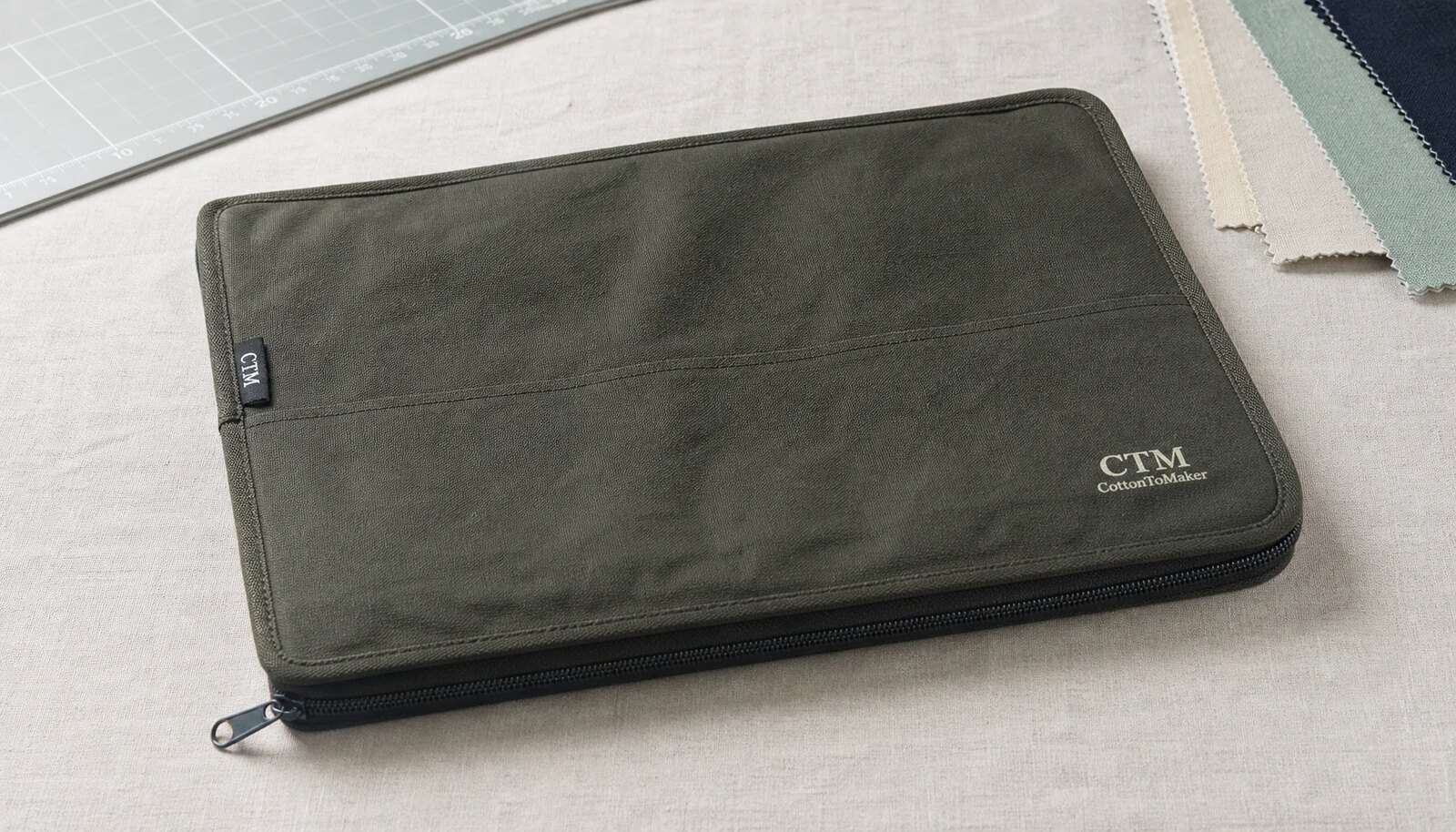
Start With the Event Job, Not the Product Name
A custom canvas zipper portfolio can be a registration gift, a sponsor handout, a staff credential carrier, an executive meeting folder, a sales kit, or a reusable document bag. Those products may share a name in a catalog, but they do not carry the same procurement risk. A flat agenda holder can be simple. A portfolio that carries a booklet, badge packet, cable, pen, and tablet needs more structure, a smoother zipper path, and a better controlled internal layout.
Event planners also have to think beyond the item itself. The portfolio may be packed at the factory, handled by a forwarder, received by a warehouse, opened by a kit assembler, moved to a hotel dock, stacked behind registration, and handed out in a rush. Dust on natural canvas, weak zipper pullers, missing carton labels, or mixed sponsor versions become operational problems. The sourcing brief should treat the portfolio as part of the event delivery system, not as an isolated promotional product.
The first step is a short use statement. Identify who receives the portfolio, what it must hold, whether it should look sponsor-forward or reusable, how long it should last, and where it will be distributed. A supplier can quote more accurately when the brief says the item must hold a 210 mm x 297 mm A4 booklet plus a 10 mm agenda stack than when it simply says zipper portfolio. That is where a custom canvas zipper portfolios bulk pricing plan for event planners becomes comparable instead of guesswork.
- Define the exact event use before requesting bulk pricing.
- Separate one-day giveaway needs from reusable meeting portfolio needs.
- Tell suppliers what the item must carry, including document size and thickness.
- Use the event journey to decide packing, carton strength, cleanliness, and labeling standards.
Build the RFQ Around Measurable Specifications
A sourcing-ready RFQ should read like a production brief. At minimum, include finished outside size, usable internal size, canvas weight, finish, zipper type, zipper color, logo method, logo placement, inside features, packing method, quantity, delivery destination, required delivery date, and inspection expectations. When these details are missing, each supplier fills the blanks differently. The cheapest quote may simply be a smaller, lighter, less controlled product.
Finished size needs special attention. Buyers often ask for A4 or US letter size without saying whether that means outside dimensions or document capacity. A zipper opening, seam allowance, lining, and rounded corner can reduce usable space by several millimeters on each side. For sewn canvas portfolios, a typical size tolerance may be around +/-5 mm, but the usable opening still has to fit the intended documents. If the item must hold a tablet, send the tablet dimensions with case thickness.
Keep the base specification separate from optional upgrades. A base line might be 13 oz natural canvas, No. 5 black nylon coil zipper, one-color screen print, bound seams, individual polybag, and export carton. Alternates might include cotton lining, inner document sleeve, pen loop, woven side label, recycled polybag, or custom zipper pull. This structure lets procurement see which choices move the unit price instead of burying every upgrade in one blended number.
- State outside size and usable inside size separately.
- Use millimeters or inches consistently and include tolerances.
- List base requirements and optional alternates in different lines.
- Ask every supplier to quote the same base spec before comparing prices.
- Attach artwork, packing rules, and delivery terms to the RFQ, not after quote approval.
Choose Canvas Weight, Finish, and Shade Control
Fabric is one of the biggest cost and quality drivers. It affects material price, cutting yield, sewing difficulty, carton weight, freight, and the buyer's first impression. For most business event portfolios, 12 oz to 14 oz canvas is a practical middle range, roughly 340 to 475 GSM depending on weave, finish, and supplier conversion method. It has enough body for documents and branding without making every carton unnecessarily heavy. A 10 oz canvas can work for budget programs, but large flat portfolios may feel soft or wrinkle faster.
Ounce and GSM figures help, but they are not the whole fabric story. A tightly woven 12 oz canvas can feel firmer than a looser heavier fabric. Washed canvas feels softer and more casual. Bleached or dyed canvas can look cleaner for corporate branding but requires closer shade control. Natural canvas is popular for a lower-dye look, yet it varies by cotton lot and finishing route. Procurement should name the finish, not just the color.
For color-sensitive events, approve a fabric swatch before the sewn sample and a bulk fabric cutting sample before production cutting. For dyed canvas, use Pantone as a target but define acceptance visually against the approved textile swatch, because fabric dyeing will not match coated-paper printing exactly. For natural canvas, agree on an acceptable shade range. A practical RFQ can ask for fabric weight within +/-5% and shade reasonably consistent with the signed swatch under standard daylight viewing.
- Use 12 oz to 14 oz canvas for most professional event portfolios.
- Ask for both oz and GSM where the supplier can provide them.
- Name the finish: natural, bleached, dyed, washed, brushed, coated, or recycled-content blend.
- Approve fabric shade before bulk cutting, especially for repeat events.
- Remember that heavier canvas can increase sewing time, carton weight, CBM, and freight.
Treat the Zipper as a Working Component
The zipper is the part attendees touch most often. It should not be treated as a minor trim. For most flat canvas portfolios, a No. 5 nylon coil zipper is a practical default because it is flexible, widely available, and suitable for document bags. A No. 3 zipper may look slimmer but can feel weak on larger portfolios. Metal zippers can look premium, but they add weight, may scratch paper edges, and usually cost more. Resin zippers can be too bulky for a slim business portfolio.
The RFQ should specify zipper tape color, coil or tooth color, slider finish, puller shape, zipper length, and how the zipper ends are secured. A color-matched zipper gives a cleaner look. A contrast zipper can work, but it should be an intentional design choice. Pullers can be plain metal, painted metal, cord, fabric tab, branded pull, or custom molded pull. Branded pullers often create separate tooling, MOQ, and lead-time issues, so they need to be quoted separately.
Sample testing should imitate real use. Put the intended agenda, booklet, or document stack inside the portfolio, then open and close the zipper repeatedly. Check whether it catches at the corners, whether the puller is easy to grip, whether the zipper tape waves, and whether the zipper stop reduces the usable opening too much. In bulk inspection, zipper operation should be checked functionally, not only visually. A zipper that fails at registration turns a useful event item into a service problem.
- Use No. 5 nylon coil zipper for most canvas event portfolios.
- Specify zipper size, tape color, coil color, slider, puller, and end-stop construction.
- Test the sample with real inserts inside the portfolio.
- Check zipper ends, corner travel, puller strength, and opening width.
- Ask whether the zipper is stock, custom sourced, or subject to separate MOQ.
Match Construction to the Contents
Construction choices should be tied to the job the portfolio has to do. A simple flat portfolio with bound seams may be enough for agendas, forms, and sponsor sheets. A lined version can feel cleaner and protect papers from raw canvas fibers, but it adds material, sewing time, and inspection points. A document sleeve, inner pocket, pen loop, or card slot can improve usability. Poorly placed, those same features can interfere with the zipper path or reduce the usable document area.
Gusset depth is another practical decision. A flat portfolio is cheaper, stacks tightly, and ships efficiently. A light gusset of 10 mm to 25 mm may be useful when the item must hold a thicker booklet pack or small accessories, but it changes the silhouette and sewing complexity. If the event kit includes a lanyard, charger, notebook, or multiple brochures, send a real packing list and approximate thickness so the supplier can advise whether flat construction is realistic.
Seam quality should be visible in the approved sample. Check binding width, corner shape, stitch density, back-tacking, and whether the portfolio lies flat after sewing. For business events, crooked topstitching on the front panel is noticeable because portfolios are often handed out in stacks. If the design includes lining or pockets, inspect the inside as closely as the outside. Attendees will feel rough backing, bulky seams, and poorly placed pocket edges during use.
- Use flat construction for document-only programs and better carton efficiency.
- Add lining when the inside finish matters or printed materials need protection.
- Add gusset only when the contents require thickness capacity.
- Confirm pocket and pen loop placement with real documents inserted.
- Approve seam binding, stitch density, corner shape, and flatness on the production sample.
Pick Decoration With Cost and Defect Risk in Mind
Decoration is often where the quote changes fastest. Screen print is usually the strongest bulk pricing option for simple one-color or two-color logos on flat canvas panels. It is efficient, repeatable, and easy to inspect when artwork is sized appropriately. Still, canvas texture can break fine lines, and heavy ink coverage can stiffen the panel or show press marks. Ask the printer for minimum line thickness and minimum text height before approving sponsor artwork.
Embroidery can feel more premium, but it is not automatically the better choice. Dense embroidery on soft canvas may pucker the panel, distort the square shape, or create rough backing inside the portfolio. It works best for compact marks, simple wordmarks, and restrained branding. Woven labels, cotton labels, side tabs, zipper pull tags, and small patches are useful when the organizer wants the item to remain attractive after the event instead of feeling like a disposable sponsor billboard.
Logo placement should be measured from fixed references: left seam, bottom seam, zipper line, or centerline based on finished size. Common placement tolerance may be around +/-3 mm to +/-5 mm, but it must be written. For screen print, approve a strike-off or printed panel. For embroidery, approve stitch density, thread color, backing finish, and puckering level. For labels, approve label size, fold type, stitch position, and colorfastness expectations. Artwork approval is not the same as production approval.
- Use screen print for simple logos and the strongest bulk pricing control.
- Use embroidery for compact premium marks, not large dense artwork on soft canvas.
- Use woven labels or side labels when long-term reuse matters.
- Measure logo placement from seams or zipper lines, not by eye.
- Approve the actual decoration method before bulk production starts.
Plan MOQ Around Versions, Not Total Quantity
MOQ is usually driven by real production constraints: fabric dye lots, zipper purchasing quantities, label weaving minimums, print setup, cutting efficiency, sample-room work, and sewing line scheduling. A buyer may see 1,000 pieces as one order. A factory may see two canvas colors, three sponsor logos, two packing labels, and four destinations. That can become multiple small production runs with separate setup time and higher per-unit cost.
The cleanest way to reduce MOQ pressure is to simplify the first order. Use one canvas color, one zipper color, one lining, one decoration method, and as few artwork versions as possible. If sponsors need visibility, consider a shared event logo on the portfolio and sponsor recognition on an insert card, paper band, or carton-level kit label. This keeps the physical product useful while allowing event-specific messaging.
Sampling economics should be handled directly. A sewn logo sample may cost much more than the final unit price because it requires individual material handling, pattern work, sample sewing, artwork setup, and courier shipment. Ask whether the sample fee can be credited after bulk order confirmation, but do not skip the sample to save money. The sample proves zipper travel, fabric hand, construction, logo scale, and document fit before the factory buys and cuts bulk fabric.
- Ask MOQ separately for body color, zipper color, lining, logo version, label, puller, and packing version.
- Reduce versions before pushing for a lower unit price.
- Use insert cards or packaging labels when sponsor-by-sponsor product decoration would fragment the order.
- Treat sample cost as risk control, not just an extra charge.
- Confirm whether sample fees are credited after PO release.
Compare Bulk Pricing as Landed Cost
A useful bulk pricing plan does not stop at the factory unit price. The cost stack includes fabric, zipper and trims, cutting, sewing, decoration setup, decoration running cost, sample charge, packing, export cartons, inspection, freight, duty if applicable, domestic delivery, warehouse handling, and possible relabeling. Two suppliers can quote the same unit price but produce different landed costs because one includes individual polybags and carton labels while another assumes loose bulk packing.
Request quantity breaks that match real event volumes, such as 500, 1,000, 2,500, and 5,000 pieces if those tiers are plausible. Extremely high tiers are less useful if the program will never reach them. Ask suppliers to show price impact for clear alternates: 12 oz versus 14 oz canvas, screen print versus woven label, flat versus lined, standard zipper pull versus custom puller, individual polybag versus bulk pack. This creates a decision table procurement can use.
Delivery basis matters as much as the product price. Ex-factory, FOB, CIF, DDP, and delivered-to-warehouse quotes include different responsibilities. Event planners often need reliability more than the lowest factory-gate number. If comparing a factory quote with a local distributor quote, separate what each party handles: production, decoration control, freight, customs, warehousing, carton labeling, and last-mile venue delivery. Use landed cost per usable delivered unit for the final comparison.
- Compare product, setup, packing, inspection, freight, duty, and delivery together.
- Request realistic quantity breaks tied to actual event volumes.
- Make each supplier quote the same delivery basis or clearly state exclusions.
- Ask for upgrade and downgrade alternates as separate line items.
- Evaluate cost per usable delivered unit, not only factory unit price.
Set Packing Rules for Event Logistics
Packing is a procurement decision. Individual polybagging protects canvas from dust, rubbing, and moisture during transit, and it makes unit counting easier during kit assembly. It also adds material, labor, waste, and carton volume. If the event has sustainability requirements, ask for recycled polybags, paper bands, tissue wrap, bulk pack with divider sheets, or carton liners. The right option depends on cleanliness needs, kit assembly process, and disposal rules at the venue.
Carton configuration should be confirmed before bulk packing begins. Request units per carton, carton dimensions, gross weight, net weight, and estimated CBM. A carton that is too heavy may be difficult for event crews to move safely. A carton that is too large can crush, waste pallet space, or increase handling fees. For many event teams, predictable carton labeling and manageable carton weight are more valuable than squeezing a few extra units into each carton.
Labeling becomes critical when one order ships to multiple venues, cities, sponsors, or kit builders. Each carton should show item name, PO number, color, logo version, quantity, carton number, and destination if required. If the order has multiple artwork versions, separate them by carton unless the mixed-carton plan is intentional and documented. Receiving teams should not have to open every carton to discover which version is inside.
- Choose individual polybag, recycled polybag, tissue wrap, paper band, or bulk pack based on the event workflow.
- Approve carton dimensions, units per carton, gross weight, net weight, and CBM before shipment.
- Avoid cartons that are too heavy for normal hotel dock or event crew handling.
- Use clear carton labels for PO number, color, logo version, quantity, and destination.
- Separate artwork versions by carton unless mixed cartons are deliberately planned.
Lock QC Standards Before Production Starts
Quality control is strongest when the standard is written before production starts. The approved sample should become the reference for fabric hand, shade, finished size, usable opening, zipper feel, stitch quality, logo placement, and packing. Keep one signed sample with the buyer and one with the factory. If third-party inspection is planned, give the inspector the spec sheet, approved sample photos, defect list, packing rules, and measurement method.
For canvas zipper portfolios, critical or major defects include wrong logo, wrong color, zipper failure, missing puller, open seam, severe stain, strong odor, incorrect usable size, broken stitch at a stress point, and carton assortment errors that affect event distribution. Minor defects may include a small loose thread, minor slub, or slight shade character within the approved range. The goal is not to reject natural fabric variation. The goal is to prevent functional and event-facing failures.
A practical inspection covers measurement, function, appearance, decoration, and packing. Measure outside size and usable opening. Insert the intended document size. Run the zipper several times. Check logo placement from fixed references. Inspect print curing, embroidery puckering, label stitching, stains, odor, loose threads, and panel distortion. Then verify carton count, version labels, carton strength, and destination markings. If the same defect appears repeatedly, ask for root cause and rework before shipment release.
- Use a signed approval sample as the inspection reference.
- Define critical, major, and minor defects in writing.
- Inspect zipper function, document fit, decoration, stitching, and packing.
- Measure usable opening, not only outside dimensions.
- Require carton count, label accuracy, and version separation in final QC.
Specification comparison for buyers
| Spec decision | Recommended option | When it fits | Buyer risk to check |
|---|---|---|---|
| Supplier route | Direct factory or accountable vendor managing sewing, decoration coordination, sampling, packing, and final inspection responsibility | Repeat conferences, multi-city events, staff kits, association meetings, sponsor packs, and fixed-date programs | If sewing, printing, zipper sourcing, and packing are split across subcontractors, responsibility for defects can become unclear after goods are finished |
| Finished size | Quote outside size and usable inside size separately; a common finished size tolerance for sewn canvas goods is about +/-5 mm unless tighter control is agreed | A4, US letter, legal pad, booklet, tablet, catalog, credential pack, or meeting agenda programs | Outside dimensions can pass inspection while the zipper opening, lining seam, or corner bulk makes the usable space too small |
| Fabric weight | 12 oz to 14 oz canvas, roughly 340 to 475 GSM depending on weave, finish, and supplier conversion method | Most business event portfolios needing structure, a clean logo surface, and reasonable freight weight | A low-cost quote may use 8 oz to 10 oz canvas that wrinkles, collapses at corners, shows contents, or feels too casual |
| Canvas finish | Natural, bleached, dyed, washed, brushed, recycled-content blend, or lightly coated canvas named in the RFQ and quote | Brand-sensitive meetings, premium registration kits, executive folders, and repeat annual events | Natural canvas shade varies by lot; dyed canvas can shift between lab dip, sample, and bulk unless color tolerance and viewing conditions are written |
| Zipper specification | No. 5 nylon coil zipper for most flat portfolios, with tape color, coil color, slider finish, puller style, and zipper end finish defined | Document cases, badge packs, agenda portfolios, sponsor kits, and repeated event use | Cheap or undersized zippers may snag, split, wave along the seam, lose pullers, or reduce the usable opening |
| Construction level | Flat bound portfolio as base; add lining, document sleeve, inner pocket, pen loop, card slot, light padding, or gusset only when needed | Budget handouts through premium meeting kits, depending on what the item must carry | Each pocket, lining panel, or gusset adds sewing time, measurement points, and more chances for distortion around the zipper |
| Decoration method | Screen print for simple one- or two-color marks; embroidery, woven label, patch, or pull tag for restrained premium branding | Sponsor logos, association marks, staff portfolios, VIP kits, and reusable post-event business bags | Fine text may fill in during screen print; dense embroidery can pucker canvas; labels and patches can add separate MOQ and setup charges |
| Logo placement | Measured from fixed seam, edge, or zipper references, with common placement tolerance around +/-3 mm to +/-5 mm if agreed in writing | Programs where stacked handouts must look consistent at registration or in pre-packed kits | Visual centering by eye can lead to crooked or inconsistent logos, especially after sewing and zipper installation |
| MOQ strategy | Use one body color, one zipper spec, one decoration method, and limited artwork versions for the first order | Pilot events, first-time factory qualification, tight timelines, and buyers comparing suppliers | Splitting one order by city, sponsor, department, color, or packing version may create separate MOQs, setup fees, and approval cycles |
Buyer checklist before sampling
- Confirm the exact use case: attendee registration gift, sponsor pack, staff credential carrier, executive meeting folder, sales kit, reusable post-event document bag, or pre-packed conference kit.
- Define finished outside size and usable inside size separately, including whether the portfolio must fit A4, US letter, legal pad, brochures, badges, forms, catalogs, or a specific tablet model with case.
- State the canvas weight in oz and GSM where possible, and identify the finish: natural, bleached, dyed, washed, brushed, lightly coated, organic cotton, recycled-content cotton blend, or conventional cotton canvas.
- Set an agreed fabric tolerance, such as canvas weight within +/-5% if the supplier can support it, and require bulk fabric shade to match the approved swatch within an agreed visual range.
- Specify zipper type, nominal zipper size, zipper length, tape color, coil or tooth color, slider material, puller shape, puller finish, and whether the puller is plain or branded.
- Define construction details: lining, seam binding, document sleeve, card slot, pen loop, inner divider, gusset depth, padding, reinforced corners, bartacks, stitch color, and seam allowance expectations.
- Provide artwork as vector files with logo size, Pantone references, thread colors, label artwork, placement measurements from seams, number of colors, and approval tolerances for position and color.
- Ask each supplier to separate sample charge, mold or setup charges, screen or embroidery setup, label setup, unit price, packing cost, inspection cost, export carton cost, and freight or delivery terms.
- Request MOQ by body color, zipper color, lining color, logo version, label design, puller design, packaging version, and shipment destination so split orders do not create surprise minimums.
- Require a sewn pre-production sample with the intended zipper, canvas, decoration, lining, and packing approach before bulk starts; use photos only as supporting evidence, not final construction approval.
Factory quote questions to send
- What exact canvas weight, GSM, weave, finish, fiber content, and color standard are included in this quote, and will bulk fabric be purchased from the same approved source as the sample?
- What weight tolerance do you use for this canvas, and can you provide fabric inspection records or roll weight checks before cutting bulk production?
- Is the zipper No. 3, No. 5, or another size; is it nylon coil, resin, or metal; and what slider, puller, tape color, and end-stop construction are included?
- What finished outside size tolerance and usable inside opening tolerance do you apply, and do you measure both after the zipper and lining are installed?
- Which decoration methods are done in-house and which are subcontracted: screen print, heat transfer, embroidery, woven label, cotton label, PU patch, leather patch, rubber patch, or zipper pull tag?
- What setup charges apply by decoration method, how many colors are included, what is the maximum printable area, and what line thickness or minimum text height do you recommend on canvas?
- What is the MOQ per canvas color, zipper color, lining color, thread color, logo version, woven label design, custom puller, packaging configuration, and shipment destination?
- If we order 1,000 pieces split across two colors and three sponsor logos, will this be priced as one order or as six smaller production runs?
- What is included in the packing price: individual polybag, recycled polybag, tissue paper, paper band, insert card, silica gel, barcode sticker, inner carton, master carton, export carton, or retail carton?
- Can you provide carton dimensions, units per carton, gross weight, net weight, estimated CBM, and recommended pallet configuration before PO approval?
Quality-control points to confirm
- Bulk canvas weight is checked against the approved specification within the written tolerance, and fabric shade is compared with the approved swatch under consistent lighting before cutting.
- Finished outside size and usable inside size are measured after sewing and zipper installation, with special attention to whether documents slide in without catching on zipper stops, lining seams, or corner bulk.
- The zipper opens and closes smoothly across the full length at least three times during inspection without snagging, splitting, exposed tape, missing teeth, wavy installation, or a puller that bends during normal use.
- Zipper ends, corner joins, seam binding, pocket mouths, pen loops, and stress points are reinforced cleanly with no skipped stitches, loose back-tacking, open seams, or raw edges that can unravel.
- Stitch density is consistent with the approved sample, topstitching is straight on visible faces, and thread color matches the signed specification or approved sample.
- Logo placement is measured from fixed seam, edge, or zipper references, not estimated by eye, and the inspection tolerance covers both horizontal and vertical position.
- Screen print has no bleeding, pinholes, broken fine lines, color contamination, heavy press marks, tacky ink, poor curing, cracking after light flexing, or transfer marks from stacked packing.
- Embroidery, labels, patches, and pull tags sit flat without puckering canvas, distorting the panel, exposing rough backing, or interfering with document insertion.
- Panels are cut square and the finished portfolio lies flat without twisting, diagonal tension, lopsided corners, rippling along the zipper, or uneven binding width.
- Interior pockets, document sleeves, card slots, and pen holders are aligned consistently and do not block zipper travel or reduce the usable document area below the buyer's requirement.