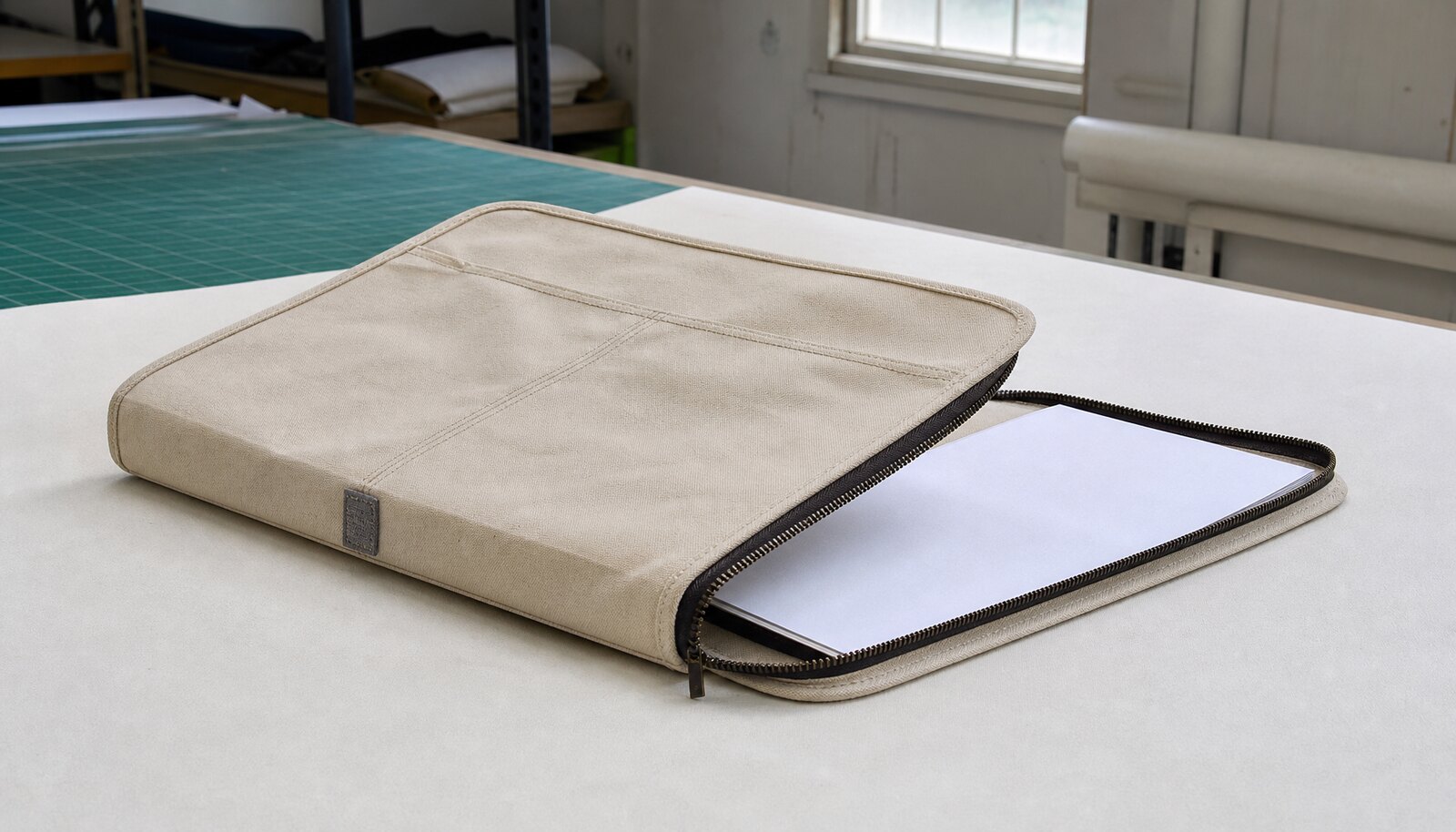
Why this product needs a buyer guide, not just an RFQ template
Custom canvas zipper portfolios for boutique wineries sit between presentation packaging and reusable brand equipment. They may hold tasting sheets, order forms, launch inserts, vineyard maps, or club information, so the purchase is judged as much by appearance and handling as by unit price. That is why procurement teams need a pricing guide, not a generic sourcing checklist.
The headline quote rarely tells the full story. Two suppliers can offer the same size and logo count, yet one builds with heavier canvas, a smoother zipper, cleaner trim, and better packing. The other may be cheaper only because it assumes lighter fabric, a stock puller, looser tolerances, or simpler carton prep. If those assumptions are not written down, the comparison is not useful.
For boutique wineries, timing matters as much as cost. The portfolio may be used for harvest-season events, cellar-door refreshes, distributor meetings, or trade tastings. A low price that arrives late, or arrives with visible defects, is not a saving. A good bulk pricing plan aligns the spec, the reorder path, and the shipping window so the item can be used as intended.
- Treat the portfolio as a branded presentation tool, not a generic zipper pouch.
- Compare the complete commercial offer, including setup, packing, sampling, and freight exposure.
- Tie the price discussion to the season or event window that actually matters to the winery.
Lock the size and insert fit before comparing prices
Size is the first spec that changes the economics. If the portfolio must hold A4 sheets, letter-size pages, folded tasting menus, or custom inserts, the finished dimensions determine fabric yield, zipper length, seam allowance, and carton cube. A supplier cannot price responsibly if the brief only says standard document size.
The cleanest way to avoid back-and-forth is to define three measurements: the insert size, the finished outer size, and the usable zipper opening. That keeps the item functional without making it bulky or hard to close. If the portfolio is meant to hold thick paper stock or a small brochure set, the buyer should also define whether the product needs a spine, gusset, or extra depth.
A simple line drawing is worth more than a descriptive paragraph. It gives the factory a reference for seam allowance, print area, and the amount of coverage the logo can safely use. It also reduces the risk that a later artwork change makes the insert fit differently from the approved sample.
- State the insert size first, then the finished size, then the zipper opening.
- If the insert pack is branded, send a physical sample or a precise dieline.
- Do not let the quote stay flexible on size if the item is client-facing or event-facing.
Canvas weight, weave, and finish are the main price levers
Canvas weight is usually the biggest material driver after size. For this category, 10 oz canvas is the lightest practical option and can work for price-sensitive promo orders. It is less structured and may show the weave more clearly under a large print. 12 oz canvas is the most balanced choice for most boutique winery programs because it feels substantial without pushing freight or sewing cost too high. 16 oz canvas supports a heavier hand feel and a more premium presentation, but it adds cost and can make the portfolio less flexible in packing.
Weight alone does not define the material. Weave density, finish, dye method, and coating can make two fabrics behave differently even when the ounce count looks similar. A tighter weave often prints more cleanly and looks more polished. A more open weave can suit a rustic brand story, but it can also expose more surface variation and make small text less crisp.
If the winery uses the portfolio for repeated handling, ask the supplier how the fabric behaves after folding and how consistent the shade is between rolls. Reorder consistency matters here. A natural-looking product is only useful if the next batch still matches the first batch well enough to sit next to it in the tasting room or at a trade event.
- 10 oz is usually a cost-first choice for limited-use or event-driven orders.
- 12 oz is the best default for most boutique winery branding programs.
- 16 oz is worth paying for when structure, durability, or a premium hand feel matters more than freight savings.
Zippers, pullers, and small hardware choices can move the quote
The zipper often looks like a minor detail, but it is a meaningful cost and risk item. For a canvas portfolio, a nylon coil zipper is usually the best balance of function, appearance, and price. It runs smoothly, handles repeated use well, and does not add unnecessary weight. Metal zippers can feel more premium in some designs, but they raise cost and can be less forgiving if the design needs a soft, flat profile.
Pullers deserve more attention than they usually get. A standard puller is fine for many B2B uses, while a branded puller or woven tab may improve presentation but also increases tooling or sourcing complexity. For a boutique winery, that upgrade only makes sense if the puller is actually visible and useful in the hand. Otherwise, the money is usually better spent on cleaner seam finishing, stronger zipper tape, or better pack-out.
Ask specifically about stop type, corner construction, and whether the zipper is cut to length or pulled from stock. Problems usually show up at the ends, not in the middle. If the supplier cannot explain how the corners are reinforced, the sample may look fine while the production run shows weak spots.
- Nylon coil is usually the default choice for smooth function and predictable pricing.
- Branded pullers are a presentation upgrade, not a free value-add.
- Corner reinforcement and zipper anchoring matter more than decorative hardware if the product is reused often.
What realistic bulk pricing bands look like
Procurement teams get better decisions when they ask for pricing bands, not a single number. For a straightforward custom canvas zipper portfolio with one-color logo print, standard nylon zipper, and basic packing, a 500-piece order often prices in a broader and less efficient range because setup is spread across fewer units. At 1,000 pieces, the unit price usually settles into a more usable operating range. At 3,000 pieces or above, the economics usually improve again because labor and setup are absorbed more efficiently.
For planning purposes, a typical 12 oz build with a simple logo can often be benchmarked around $3.20-$5.60 per unit at 1,000 pcs ex-factory, depending on fabric source, zipper choice, and packing. Heavier canvas, more complex branding, or upgraded packing can add roughly $0.35-$1.20 per unit. Those numbers are planning bands, not market promises, but they are far more useful than a quote that hides the spec behind a single low opening price.
Sample costs deserve the same attention. A rough prototype may be inexpensive, while a true pre-production sample with final fabric, final zipper, and final print can cost more. That fee is often worth paying because it prevents a full run from being built around the wrong canvas hand feel, the wrong zipper color, or a logo placement that looks too aggressive on the finished product.
- Request pricing at 500, 1,000, and 3,000 pcs or the nearest real breakpoints.
- Separate the bulk unit price from setup, sample, packing, and freight assumptions.
- Use the sample to validate the final materials, not to approve a downgraded substitute.
MOQ and lead time should be negotiated together
MOQ is usually a reflection of how the factory sources fabric, sets up printing, and schedules sewing lines. A custom portfolio with a standard zipper and simple print can often start at a lower MOQ than one with a branded puller, special lining, or nonstandard packing. That does not mean the lower MOQ is always the better commercial choice. Sometimes the first tier is technically available, but the unit price is still too high to support a reasonable rollout.
Lead time should be broken into stages: sampling, material readiness, production, inspection, and shipment. If the supplier gives only one total number, procurement loses visibility into where delay risk sits. That matters for boutique wineries, where the item may be tied to a launch date or event calendar. A quote that depends on rush buying fabric or switching zipper color halfway through production is not a stable supply plan.
For repeat programs, ask the factory what happens on reorder. Some suppliers will hold the spec and materials for a limited time, while others will re-quote if the order returns after a few months. That is a key commercial point, because a low first-order unit price can become less attractive if every reorder is treated as a fresh development job.
- Treat MOQ as a cost signal, not just a minimum quantity.
- Ask for lead time by stage, not just one total number.
- Clarify whether the spec and price are protected for reorders or only for the first run.
Factory-direct, trading company, or stock base: choose the model that fits the program
The right sourcing model depends on the buyer's needs. Direct factory sourcing is usually strongest when the spec is stable, the order will repeat, and the buyer wants visibility into material and labor assumptions. That route makes it easier to control the cost structure and to keep the next order consistent with the first one.
Trading companies can be useful for consolidated programs, especially when a winery is buying more than one item at once and wants a single point of contact. The tradeoff is that the price often carries another margin layer and the buyer needs to understand who actually makes the product and who signs off on quality. If the supplier cannot answer that clearly, the procurement team is taking on avoidable coordination risk.
A stock base with custom branding can work when speed matters more than exact brand fit. It is weaker for a premium winery presentation piece because the base color, zipper shade, or fit may not align with the brand direction. In other words, a stock item can reduce lead time, but it often reduces control. For a client-facing product, that tradeoff should be deliberate rather than accidental.
- Factory-direct is usually best for repeatable specs and clearer cost control.
- Trading routes can simplify coordination, but QC ownership must be explicit.
- Stock-base customization is fastest, but it is usually the least precise fit for a premium brand program.
Use landed cost, not just ex-factory price
The useful procurement number is landed cost. That means the quote plus sample expense, packing, carton cost, freight, duty if applicable, brokerage, and any planned inspection or rework allowance. A factory quote that is 5%-10% cheaper can become more expensive once the carton cube is larger, the packing is less efficient, or the defect rate creates sorting work on arrival.
For a flat item like a zipper portfolio, carton dimensions matter more than many buyers expect. A few millimeters in carton height can change how many cartons fit on a pallet or in a container. That directly affects freight and receiving cost. If the supplier cannot state carton size and gross weight, the freight estimate is not mature enough for a real comparison.
A simple planning example helps. If a 1,000-piece order lands at $4.10 ex-factory, and packing, freight allocation, and duty add another $0.70-$1.20 depending on lane and mode, the real cost is closer to $4.80-$5.30 before domestic handling. That is the number the procurement team should compare against alternatives, not the factory's opening line alone.
- Ask for carton dimensions and gross weight before finalizing the order.
- Include freight, duty, packing, and inspection in the decision.
- Compare landed cost per usable piece, not only ex-factory price per unit.
QC details that matter on winery-facing presentation products
Quality control should focus on the defects that people actually notice. For this category, size accuracy, zipper function, print placement, seam finish, and surface cleanliness matter most. A portfolio that looks fine in a warehouse but snags at the zipper corner or shows crooked logo placement will be noticed immediately by the customer or distributor who receives it.
Set measurable tolerances before production starts. Many buyers use plus or minus 3-5 mm on key dimensions, plus or minus 2 mm on centered print placement, and an agreed standard for zipper smoothness and seam appearance. If the insert is rigid or tightly fitted, tighten those numbers. The point is not to create perfectionism. It is to remove ambiguity when a sample passes in one person's judgment and fails in another's.
Ask the factory how it inspects zipper travel, stitch quality, and packing accuracy. A good plan includes visual inspection, zipper open-close testing, and carton count verification before seal-up. If the item is going to a tasting room or handed to customers directly, cleanliness is part of quality. Loose thread tails, smudges, and frayed edges should be treated as defects, not warehouse noise.
- Use a written AQL or defect standard before mass production begins.
- Check zipper function, corner reinforcement, and print placement on approved samples and production lots.
- Treat cleanliness, thread trimming, and carton accuracy as part of brand presentation quality.
Specification comparison for buyers
| Sourcing option | Typical MOQ | Indicative ex-factory price band | Best use case | Tradeoff to check before quoting |
|---|---|---|---|---|
| Direct factory, standard spec | 500-1,000 pcs | About $3.20-$5.60 at 1,000 pcs for 12 oz canvas, one-color print, standard nylon zipper | Repeat orders and buyers who want the clearest cost breakdown | Spec gaps can hide allowances for size, zipper, packing, or printing |
| Direct factory, premium finish | 1,000-3,000 pcs | Often $0.35-$1.20 more per unit than the standard spec when using heavier canvas, branded pullers, or upgraded packing | Boutique winery sets that need a stronger presentation value | Confirm exactly which upgrades are included and which are charged separately |
| Trading company, consolidated order | 300-1,000 pcs mixed across SKUs | Usually 8%-20% above a comparable factory-direct quote | Multi-item winery programs or buyers who need one shipment for several products | Verify who owns QC and whether the factory specification can change without notice |
| Stock base item + logo add-on | 100-300 pcs | Can look inexpensive at first, but often becomes costlier than custom after revisions and freight are added | Fast event packs and short-notice promotions | Watch for canvas shade mismatch, zipper color mismatch, and size fit issues |
| Pilot sample run | 30-100 pcs | Often 2x-4x the bulk unit cost | New supplier validation or design testing before a larger order | Make sure the sample uses the same fabric and zipper grade as the final build |
| Higher-volume tiered program | 3,000+ pcs | Usually the best unit economics, sometimes $0.40-$1.00 lower than the 1,000-piece tier depending on spec | Stable winery programs with repeat replenishment | Check whether the price is locked for reorders or tied to a short validity window |
Buyer checklist before sampling
- Confirm finished dimensions in millimeters and the exact insert size it must fit, such as A4, letter, tasting sheets, or a custom menu.
- Specify canvas weight, weave, finish, and color, including whether the look should be natural, bleached, dyed, or coated.
- Lock the zipper spec: coil, metal, or reverse coil; tape color; puller style; and whether branding is required on the puller or tab.
- State the print method, artwork version, minimum text size, logo placement, and exact color reference if brand matching matters.
- Ask for separate lines for unit price, setup fee, sample fee, packing cost, and any export or inland handling charges.
- Request pricing at three volume points, usually 500, 1,000, and 3,000 pcs, or the nearest true factory breakpoints.
- Approve the pre-production sample against the final fabric, zipper, thread, print, and packing method before bulk starts.
- Set measurable tolerances for size, print shift, zipper travel, and stitch alignment before production is released.
- Confirm carton pack count, carton dimensions, gross weight, SKU labels, and whether barcodes or hangtags are required.
- Define the inspection method, acceptance level, and sign-off owner before shipment so the order is not debated after goods arrive.
Factory quote questions to send
- What canvas weight, weave density, and finished fabric width are you pricing, and is that weight pre-finish or post-finish?
- What zipper type is included in the base quote, and is the puller a standard stock puller or a custom item?
- What does the sample fee cover, and is it credited back after order placement or billed separately?
- Can you quote at 500, 1,000, and 3,000 pcs so we can see the cost curve instead of only the opening price?
- Does the quoted unit price include printing, sewing, reinforcement, packing, and carton marking, or are any of those extra?
- Will the pre-production sample use the same fabric roll, zipper batch, thread color, and print method as mass production?
- What finished-size tolerance do you hold for length and width, and how do you measure it on soft goods?
- What inspection standard do you use for zipper function, seam quality, print placement, and carton count accuracy?
- What are the carton dimensions, pieces per carton, gross weight, and estimated cube for freight planning?
- If we reorder later, which parts of the spec are fixed and which may change because of material availability or price updates?
Quality-control points to confirm
- Use a defined inspection level such as AQL 2.5 for major defects and AQL 4.0 for minor defects if that fits your risk profile, and put it in writing before production.
- Check finished dimensions against the approved spec. For flat portfolios, many buyers set a tolerance of plus or minus 3-5 mm on critical edges, tighter if the insert is rigid.
- Inspect zipper travel from both ends and through the corners. A good sample should open and close smoothly, without snagging, gapping, or uneven tape tension.
- Look at the zipper ends and side seams where stress concentrates. Bar-tacks or reinforced stitches should be present where the zipper is anchored.
- Review print placement against the approved proof. A practical target is no visible drift into seams or folds and no obvious centerline shift on the front panel.
- Check stitch quality on visible faces and load points. Loose thread tails, skipped stitches, puckering, and uneven stitch length should be counted as defects, not cosmetic noise.
- Confirm cleanliness under strong light. Canvas should arrive free of oil marks, frayed fibers, and ink smudges, because these are easy to see in a tasting room.
- Verify carton labels, piece counts, and SKU separation before seal-up. Mixed packs cost more to sort than they save during production.