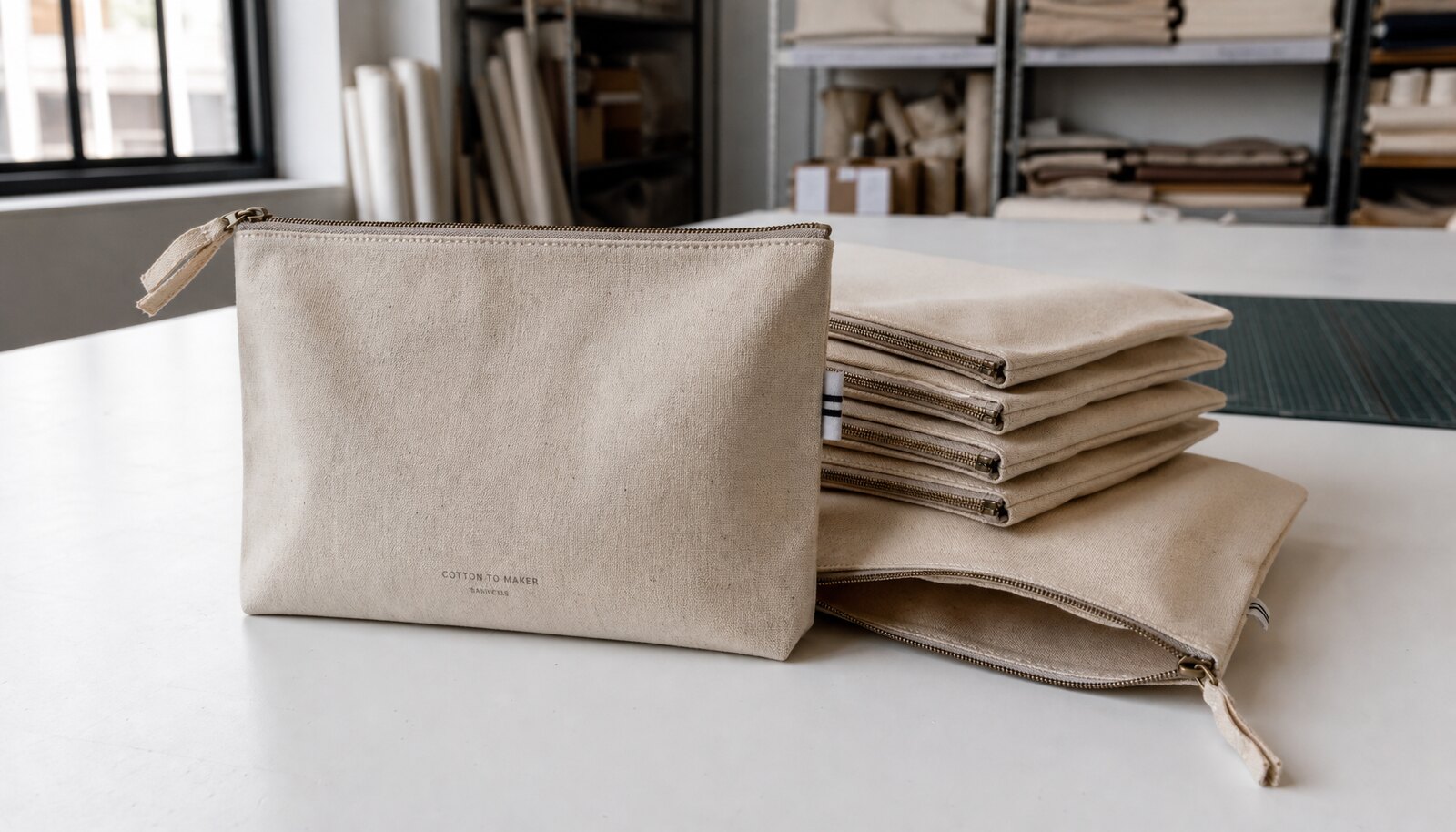
Why Custom Canvas Zipper Bags Go Wrong at Quote Stage
Custom canvas zipper bags are often treated as a simple pouch order, but the quote can change quickly when the brief is too loose. If one supplier is pricing 8 oz natural canvas, a standard nylon zipper, one-color print, and flat bulk packing while another is pricing 12 oz fabric, branded pullers, lining, and retail-ready individual packs, the numbers are not comparable. Buyers lose time when they ask for a price before the product is defined at the level the factory actually needs.
The first sourcing mistake is assuming the bag is only a sewn shell. In practice, the zipper, top opening, decoration method, carton pack, and final use channel all affect cost and quality. A pouch for cosmetics, stationery, or a travel kit has a different risk profile from a giveaway bag or a warehouse accessory. The right brief depends on whether the buying priority is shelf appearance, shipping efficiency, print clarity, or repeated daily use.
A better RFQ starts by identifying what success looks like in the buyer's channel. If the bag will be sold retail, the zipper and print need to look clean in photos and on shelf. If the bag will ship as part of a kit, the priority may be predictable packing density and low damage risk. If it is for a promotional campaign, the lowest total landed cost may matter more than premium finishing. That is why the first job is not quote collection. It is spec discipline.
- State the use case: retail, giveaway, kit packaging, travel, or document storage.
- Fix the finished size, not just the flat cut size.
- Specify whether the bag must stand up, hold shape, or pack flat.
- Decide whether the zipper is a functional security feature or mainly a dust cover.
Build the Base Spec Before You Ask for a Price
The most useful sourcing document for custom canvas zipper bags is a simple, measurable spec. Start with finished size, zipper opening length, gusset depth, and seam allowance. Those four details do more to stabilize pricing than broad descriptions such as large, medium, or premium. A buyer should also state whether the bag is unlined or lined, because lining changes sewing time, material usage, and the look of the inside finish.
If the bag is intended to carry heavier contents, reinforce the top edge and the zipper ends in the spec. If the bag is only for light items, avoid overbuilding it. Over-specifying a light-use pouch can raise cost without improving the buying outcome. Under-specifying a retail or travel bag does the opposite: the bag may look cheap, twist at the zipper, or fail after ordinary handling. The key is to define the product around its real use, not around a vague category name.
It helps to lock the drawing before sampling begins. Even a one-centimeter shift in width can change the zipper appearance, the way the bag folds, and the amount of material waste. A buyer does not need engineering jargon to control this. The buyer just needs a clear finished measurement table and a sample approval trail.
- Use finished dimensions, zipper opening length, and gusset depth in the RFQ.
- State whether the bag is lined, unlined, or partially lined.
- Define seam allowance so the factory does not guess.
- Add reinforcement points if the bag will see frequent opening, closing, or heavier fill.
Fabric Weight, Finish, and Lot Control
Canvas weight changes the whole product. Around 8 oz or 270-300 GSM, the bag is lighter, softer, and generally cheaper, but it can wrinkle more easily and show the shape of the contents. Around 10-12 oz or roughly 340-400 GSM, the bag usually feels more substantial, keeps its shape better, and gives a safer base for print appearance. Above that range, the bag can feel sturdier, but it also becomes bulkier, heavier in freight, and harder to sew neatly at the zipper line.
Weight alone is not the whole story. Buyers should also ask about weave density, surface finish, color treatment, and whether the fabric is washed or pre-shrunk. Natural canvas is often the easiest commercial baseline, but it may show fiber variation and slightly change print appearance. Bleached, dyed, or washed canvas can lift presentation, but it also increases the need for lot control because shade and handfeel may vary from one roll to the next.
If shape stability matters, ask the supplier to quote shrinkage expectations after the treatment the bag will actually receive. For example, if the bag will be steamed, washed, or heavily pressed, the acceptable dimensional change should be defined in the RFQ, not left to memory. A practical buyer target is to set a clear post-process tolerance before production starts, then reject samples that drift outside it.
- 8 oz canvas works for light promotional use and low-cost bulk programs.
- 10-12 oz canvas is the safest all-around starting point for retail or gifting.
- Ask for fabric roll width and yield because both affect waste and unit price.
- If shrinkage matters, set a post-treatment tolerance before the factory cuts bulk.
Zipper and Stitching Choices That Decide Whether the Bag Feels Cheap
The zipper is the part of the bag most likely to expose poor workmanship. A nylon coil zipper is usually the most practical default because it runs smoothly and tolerates the flex of canvas better than a stiff metal zipper. For smaller pouches, many buyers use a #3 coil zipper; for heavier use or wider openings, a #5 coil zipper is often the safer choice. Metal zippers can give a more rigid look, but they also raise the risk of alignment issues if the bag is not sewn carefully.
The puller matters more than many buyers expect. A standard puller is fine for low-cost programs, but a custom or branded puller can lift the product visually without redesigning the bag. What matters is that the puller does not scratch the print, snag on the body, or create a weak point at the zipper stop. If the pull tab is visible in product photography, include it in the quote and sample approval. Otherwise, the factory may substitute a generic part that changes the look of the bag.
Stitching is the second major risk area. A useful buyer target for many canvas zipper bags is 7-9 stitches per cm on load-bearing seams, with bartacks or reinforcement stitches at the zipper ends and corners. Too loose, and the seam can look sloppy or open under stress. Too tight, and the fabric can pucker around the zipper line. The sample should show clean transitions where the top edge meets the zipper tape, because that is where many defects first appear.
- Use nylon coil zippers when smooth operation and sewing tolerance matter.
- Choose #3 or #5 zipper size based on load, opening width, and desired feel.
- Specify puller style and branding if the zipper is visible in retail presentation.
- Require reinforcement at zipper ends and other stress points.
Decoration Method Should Match Artwork, Order Size, and Risk
For most custom canvas zipper bags, screen print is still the most efficient option when the artwork is simple and repeat orders are likely. It handles logos, short text, and bold shapes well, and once the setup is absorbed, the unit cost is usually easy to manage. The catch is that the artwork and print area must be defined clearly. A one-color logo at 8 cm wide is not the same job as a full-panel graphic, even if the base bag is identical.
Transfer methods are more flexible when the artwork has gradients, multiple colors, or fine detail that would be expensive to screen print. They are also useful when the buyer is testing a launch before committing to a large run. The tradeoff is that the print sits on top of the fabric rather than becoming part of it, so buyers should ask for rub-resistance confirmation and inspect how the decoration feels after folding and packing.
Embroidery can work well on heavier canvas, especially when the mark is small and the buyer wants a more tactile look. It is not the right choice for large filled graphics or thin, soft fabric where the stitches can distort the body. The right decoration method is the one that fits the artwork, the fabric weight, and the quantity profile. If the supplier is pushing one method for every order, the buyer should ask why.
- Use screen print for simple logos and repeatable programs.
- Use transfer print for multi-color or short-run launch artwork.
- Use embroidery only when the fabric weight and artwork size make sense.
- State one-side or two-side decoration, because both change cost and distortion risk.
How Supplier Type Changes the Quote and the Risk Profile
Direct factories usually give the clearest view of material, sewing, and packing cost. They are strongest when the buyer wants to lock the spec and repeat the same bag over multiple seasons or replenishment cycles. They are weaker when the brief is still moving, because every change to fabric, zipper, print, or packing can affect both schedule and price. A direct factory quote is only useful if the factory truly owns the steps that matter.
Trading companies and sourcing agents can help when a team is buying several product types at once or when internal procurement bandwidth is limited. The advantage is coordination. The downside is that process ownership can become blurred if a defect appears in sewing or decoration. That is why the buyer should ask exactly who is buying the fabric, who is buying the zipper, who is setting up the print, and who is signing off final inspection. If the answer is vague, the quote is not yet operational.
Local decorators using imported blank bags can be efficient for very small domestic runs or urgent replenishment. This route can work well if the blank bag quality is already proven and the decoration method is simple. The risk is batch variation in the blank goods. A procurement team should compare at least one physical blank sample before approving volume, otherwise the decoration vendor may be blamed for a problem that started with the base bag.
- Direct factory: best for repeat runs and tighter spec control.
- Trading company: best for multi-item programs and lighter buying teams.
- Local decorator: best for short lead time and very small launch quantities.
- Always ask who owns fabric purchase, zipper purchase, print setup, and final packing.
Write the RFQ So the Supplier Can Quote the Same Product Twice
A strong RFQ for custom canvas zipper bags is specific enough that two factories can quote the same item without improvising. The quote should separate the base bag, decoration, trim, packing, sample cost, and any extra charges for labels or hangtags. If all of those pieces are wrapped into one line item, the buyer cannot tell whether one supplier is truly cheaper or simply leaving out work that will be added later.
The buyer should also ask for MOQ by size, color, print variation, and zipper color. Many orders are not limited by the total quantity. They are limited by how many variants can be handled in one run without excess waste. A supplier may accept a total order of 5,000 units but still need a minimum of 1,000 per color or 500 per artwork version. That is normal. What matters is that the rules are stated early so there is no surprise later.
A useful quote comparison is not a spreadsheet of unit prices alone. It is a side-by-side view of materials, setup, packing, and lead time on a consistent basis. The buyer should ask whether the quote assumes FOB, EXW, or another trade term, and whether the price is still valid after artwork approval. Without that context, a lower number can hide a higher total landed cost.
- Ask for line items: base bag, decoration, trim, packing, sample, and extra labels.
- Request MOQ by size, color, print version, and zipper color.
- Confirm whether the price is FOB, EXW, or another Incoterm.
- Make the supplier state what is included before you compare the number.
Sample Approval Should Prove the Construction, Not Just the Look
A pre-production sample is only useful if it is made from the same materials and method that will run in bulk. A prettier sample made from better fabric, a cleaner zipper, or a friendlier print setup can create false confidence. The sample should use the same canvas weight, the same zipper type, the same decoration method, and the same packing format you intend to buy. If the supplier wants to present a seal sample, use it to freeze the construction details before the bulk order starts.
Inspection should be practical. Open and close the zipper repeatedly. Check the top edge for puckering. Measure finished dimensions after the sample settles. Compare print placement against the approved artwork. If the bag will be packed flat, make sure the zipper pull does not mark the fabric during folding. For retail programs, it is worth testing how the bag looks in the carton and after unpacking, because a clean sample can still arrive visually damaged if the pack method is wrong.
Buyers should write tolerance into the approval step. For many small pouches, a finished size tolerance of plus or minus 5 mm is a reasonable starting point. For larger bags, plus or minus 10 mm may be enough if the use case allows it. Print placement tolerance of about 3 mm is often practical for small logos. The exact numbers are a buyer decision, but the point is to set them before bulk starts.
- Approve the exact fabric, zipper, print method, and packing used in bulk.
- Check dimensions after the sample has settled, not while it is still being handled.
- Use a simple zipper cycle test and a print rub check on the approved material.
- Freeze the sample with signed photos, measurements, or a retained seal sample.
QC Thresholds Buyers Can Actually Use
For custom canvas zipper bags, quality control works best when the buyer distinguishes critical, major, and minor defects before inspection starts. Critical defects are the ones that make the bag unusable or unfit for acceptance: wrong artwork, broken zipper, missing closure, contamination that cannot be cleaned, or a size error that makes the bag functionally wrong. For these, the practical threshold is zero tolerance.
Major defects are the problems that affect appearance, performance, or retail acceptance even if the bag still technically opens and closes. Examples include open stitches, visible seam puckering, crooked zipper alignment, and print placement that falls outside the agreed tolerance. Minor defects are cosmetic issues that do not affect use, such as small thread tails or slight fold marks, provided they stay within an agreed limit. Many buyers use an AQL standard for shipment inspection, but the exact number is less important than defining what each defect class means for this product.
The sample should also be tested for repeat use. A zipper that works once in a sample room can fail after a few dozen cycles if the tape is misaligned or the stop is weak. Buyers do not need a lab to catch that. A simple functional test, a dimension check, and a visual review against the signed sample will catch most issues early. If the supplier resists giving the inspection checklist, that is a sign the quote needs more discipline.
- Set critical defects to zero tolerance.
- Define major defects with examples before inspection starts.
- Use a practical dimension tolerance: commonly plus or minus 5 mm for smaller bags and plus or minus 10 mm for larger bags.
- Check zipper function, seam integrity, and print placement on the actual bulk fabric.
- Keep the approved sample in the inspection file for reference.
Packing, Cartons, and Warehouse Handling
Packing is not a cosmetic afterthought. It changes cost, freight volume, and the chance of damage on arrival. Flat bulk packing is usually the most efficient choice for wholesale and distribution programs because it minimizes carton volume. Individual polybags make sense when the product is retail-facing, needs moisture protection, or must arrive clean and scuff-free. The right answer depends on where the bag goes after it leaves the factory.
The carton spec should be part of the quote. Buyers should ask for units per carton, carton dimensions, gross weight, and whether the carton is export-rated or just suitable for local handling. For warehouse handling, many teams try to keep gross carton weight in a practical range, often under 15-18 kg, so manual handling stays manageable. If the bag is printed, the pack method should also prevent print-to-print abrasion. That issue is easy to miss and expensive to fix later.
If the product will go through a fulfillment center, include barcode labels, SKU labels, carton marks, and any inner-pack requirement in the RFQ. A low factory price can disappear once relabeling or repacking is added in the destination market. It is cheaper to decide packing in advance than to ask a warehouse to solve it after receipt.
- Choose bulk pack for wholesale efficiency and individual polybag for retail protection.
- Ask for carton size, carton count, and gross weight before freight planning.
- Keep carton weight in a handling-friendly range if your destination requires manual movement.
- Specify barcode, SKU label, and carton mark requirements in the RFQ, not after production starts.
Specification comparison for buyers
| Spec decision | Recommended option | When it fits | Buyer risk to check |
|---|---|---|---|
| Supplier route | Direct factory with cutting, sewing, printing, and packing under one roof | Repeat orders, tighter schedule control, and programs with several size or color runs | Confirm which steps are actually in-house; print, zipper sourcing, or final packing are often outsourced |
| Supplier route | Trading company or sourcing agent | Small procurement teams, mixed-category buying, or when one contact needs to manage several items | Margin may be embedded in the price and process ownership can be unclear if defects appear mid-run |
| Supplier route | Local decorator using imported blank bags | Short domestic replenishment runs or very small launch quantities | Compare blank quality, zipper consistency, and decoration durability across batches before you approve volume |
| Fabric weight | 8 oz canvas, roughly 270-300 GSM | Light promotional use and cost-sensitive bulk orders | The bag can feel soft, wrinkle easily, and show contents under lighter colors |
| Fabric weight | 10-12 oz canvas, roughly 340-400 GSM | Retail, gift sets, travel kits, and programs that need a more substantial handfeel | Ask for the actual mill spec and a finished sample, because weave density and finish affect appearance as much as GSM |
| Zipper grade | #3 nylon coil zipper | Smaller pouches and low- to medium-load contents | Check whether the puller is standard or branded and whether the zipper tracks smoothly after repeated use |
| Zipper grade | #5 nylon coil zipper | Heavier contents, wider openings, or higher-cycle use | Confirm the tape width, zipper stop method, and sewing allowance so the top edge does not pucker |
| Stitching density | 7-9 stitches per cm on load-bearing seams | Most canvas zipper bags where balance between strength and appearance matters | Ask for a sample seam close-up; uneven density often shows up around corners and zipper ends |
| Decoration method | 1-2 color screen print | Simple logos, text, and repeatable programs with stable artwork | Watch for registration drift, ink cracking on folds, and color shift on natural canvas |
Buyer checklist before sampling
- Lock the finished size, seam allowance, zipper opening length, and gusset depth before asking for pricing.
- State the canvas weight in GSM or oz, plus whether the fabric is natural, bleached, dyed, washed, or pre-shrunk.
- Define the logo method, number of colors, print area, and whether decoration is on one side or both sides.
- Specify the zipper type, zipper size, puller style, tape color, and whether the puller needs branding.
- Set the packing standard: bulk pack, polybag, barcode label, insert card, or retail-ready carton pack.
- Request a pre-production sample or seal sample and sign off only after it matches the approved artwork and construction.
- Ask for carton count, carton size, gross weight, and whether cartons are export-rated for the route you will use.
- Compare quotes on the same basis: fabric, zipper, print, packing, sample charge, and lead time.
- If the bag will be handled by retailers or fulfillment centers, include carton marks, SKU labels, and any inner-pack requirement in the RFQ.
- Write down your tolerance limits before sampling, not after you see a near match.
Factory quote questions to send
- What exact canvas weight, weave density, and fabric finish are included in the price?
- Which zipper grade is quoted, and is the puller standard, custom, or branded?
- How many print colors, print positions, and print setup charges are included?
- Is the quote based on a finished sample, a tech pack, or a simple reference photo?
- What are the MOQ breaks by size, color, print variation, and zipper color?
- Does the price include sewing labels, woven tags, hangtags, or barcode stickers?
- What is the sample lead time, bulk lead time, and what events can extend it?
- Which packing format and carton spec are included, and what costs extra?
- What is the stated tolerance for size, print placement, and zipper opening length?
- Who owns cutting, sewing, printing, inspection, and final packing if parts of the work are subcontracted?
Quality-control points to confirm
- Finished dimensions should stay within the agreed tolerance, commonly plus or minus 5 mm for small pouches and plus or minus 10 mm for larger bags, unless the product brief says otherwise.
- The zipper should open and close smoothly through at least 10 full cycles on the sample without snagging, tooth separation, or puller misalignment.
- Stitching should be straight, even, and free of skipped stitches, loose thread tails, and puckering around the zipper ends and corners.
- A practical stitch-density target for many canvas zipper bags is 7-9 stitches per cm on load-bearing seams, with reinforcement at stress points if the bag carries heavier contents.
- Print placement should match the approved artwork within a buyer-set tolerance, often around 3 mm for small logos and a little more for larger graphics.
- Print should be checked for color density, edge sharpness, and rub resistance on the actual canvas weight that will run in bulk.
- Critical defects should be zero tolerance: wrong size beyond spec, wrong artwork, broken zipper, missing closure, or contamination that cannot be cleaned.
- Major defects should be counted against an agreed AQL or buyer-specific limit: crooked seams, open stitches, visible puckering, or zipper tape that is not aligned.
- The first bulk pieces should be compared directly against the signed sample before the full run continues.
- Packing should match the agreed unit count, label format, and carton mark, with no mixed SKUs or unprotected printed surfaces rubbing together.