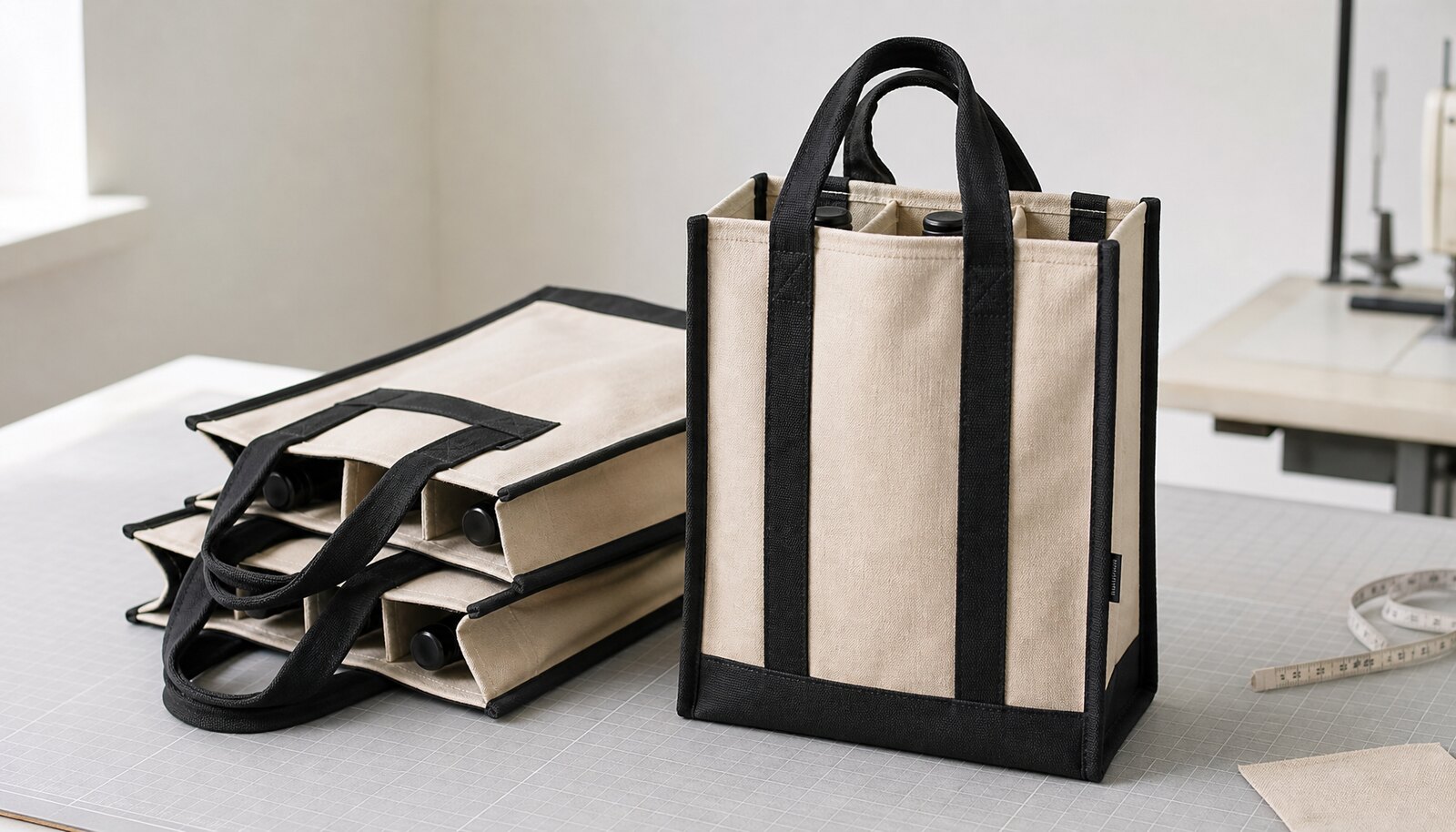
Why boutique wineries need a stricter buying spec than a simple tote order
A canvas wine carrier looks straightforward until you buy it wholesale. For boutique wineries, this product sits at the intersection of merchandising, gifting, and practical bottle transport. That means the normal tote-bag buying shortcuts do not work well. A carrier that is fine for a farmers market may look underbuilt beside a premium bottle, and a bag that photographs well can still be awkward at the tasting bar if the opening is too tight or the handles feel flimsy.
The commercial risk is not only breakage. It is also presentation. A wine carrier often shows up in a retail stack, near POS, in a gift bundle, or as a club pickup accessory. If it folds badly, wrinkles too much, or prints unevenly, it can make the whole offer feel less considered. That is why procurement should start with the end use: is the bag a branded retail item, a club pickup accessory, a tasting-room upsell, or a packout helper for members? Each use case changes the right spec.
For a boutique winery, the buying checklist for custom canvas wine carriers wholesale should be built around four questions: what bottle does it hold, what brand story does it need to tell, what channel will sell it, and what kind of handling will it survive. Once those are answered, the supplier can quote a real product instead of a generic canvas pouch with a logo. That makes price comparisons far more meaningful, especially when you are ordering for a seasonal launch or planning repeat orders across multiple releases.
The biggest mistake is buying from a product photo. Product photos rarely show the seam allowance, the handle reinforcements, the carton configuration, or how the carrier behaves once it is loaded. Buyers who manage this well usually start with the bottle, then define the channel, then ask for a sample built for the same use case. That sequence keeps the conversation practical and reduces the chance of overpaying for decoration while missing the things customers actually touch.
If your winery sells across more than one channel, you may need more than one spec. A tasting-room retail carrier can prioritize shelf appeal and logo clarity, while a wine club pickup version can prioritize strength and handling. The point of a better wholesale checklist is not to make the product more complicated than it needs to be. It is to make the decisions visible before you place a PO, when changes are still cheap.
Good buyers also remember that canvas is a soft good, so natural variation is normal. The goal is not perfection in the boxy, rigid sense. The goal is repeatability: same bottle fit, same decoration placement, same handle build, and the same look when the customer picks it up off the shelf. That is what separates a custom bag that supports the brand from one that just carries glass.
- Treat the carrier as a branded packaging product, not just a tote.
- Define the channel first: tasting room, wine club, gift shop, distributor packout, or event merch.
- Use the bottle itself as the sizing reference, not a standard bag template.
- Separate what must be exact from what can vary slightly, such as shade or minor wrinkling.
Build the spec around the bottle you actually sell
Bottle fit is the most important technical decision because it influences everything else: body width, gusset shape, divider spacing, and handle loading. Wineries often carry more than one bottle shape, and the problem is not the label size but the bottle profile. A standard Bordeaux bottle may fit comfortably while a wider sparkling bottle or a heavy Burgundy bottle needs extra clearance. If you source from a generic product page, you can easily end up with a carrier that technically matches the bottle count but feels wrong in use.
For procurement, list the largest bottle diameter you expect to pack, plus the maximum height. If you sell a mix of still, sparkling, and specialty bottles, define whether the carrier must accommodate all of them or only a specific SKU family. If the carrier is for a single bottle, allow enough headroom so the neck does not strain the top opening. If it is for two bottles, the divider must be positioned to prevent bottles from knocking together when the bag swings. For four-bottle carriers, the internal structure and handle attachment matter even more because the load is no longer symbolic; it becomes a real carry item.
A useful rule is to ask for the internal usable space after sewing, not just the cut size before assembly. A supplier can cut generous fabric pieces and still end up with a tight opening once seams, hems, and reinforcement are added. If the bag must fit a sparkling bottle, ask the factory to test it with that exact shape rather than a generic wine bottle sample. Many fit problems show up only at the collar or shoulder, where the bottle profile widens.
For buyers comparing two or three suppliers, ask each one to state the internal clearance they are using and whether the bag is designed to carry one bottle upright, two bottles side by side, or a split-bundle format for club pickup. That small request exposes whether the supplier understands the actual use case or is only quoting to a nameplate bottle count. It is also a good way to compare apples to apples when one factory uses a slimmer cavity and another uses more generous space.
If your program includes different bottle families, consider whether you really need one universal carrier. One universal size can simplify inventory, but it often forces compromises in fit or appearance. In many boutique winery programs, it is better to have one single-bottle carrier for premium still wine and one 2-bottle or sparkling-compatible version for special releases. That keeps the product honest and avoids a bag that looks oversized for one SKU and cramped for another.
- Measure your widest bottle, not your average bottle.
- Confirm whether the bottle should sit upright, slightly recessed, or flush with the top edge.
- Ask the supplier to state internal clearance after sewing, not only cut size before assembly.
- Do not assume a bottle count equals a correct fit; check shoulder width and neck clearance too.
Choose canvas weight based on function, shelf presentation, and freight cube
Canvas weight is one of the easiest decisions to oversimplify. In wholesale buying, the goal is not to choose the thickest fabric; it is to choose the lightest build that still performs the job well and supports the brand presentation. A 10 oz canvas may be acceptable for lower-cost retail use, but it can look limp if the carrier needs to stand on a shelf. A 12 oz canvas is usually the best starting point for boutique wineries because it offers a stronger body without becoming overly heavy. A 14 oz canvas can create a premium feel and more structure, but it also increases sewing effort, carton weight, and freight cost.
The right weight depends on what the bag must do. If the carrier is mainly a gift add-on that leaves the tasting room with one bottle, structure is less important than finish quality and logo clarity. If it sits in a gift shop stack, you want enough body that the bag does not collapse into a flat rectangle the moment a shopper picks it up. If you are planning a club-release or holiday use, a heavier canvas can justify itself because the bag becomes part of the gift experience. The key procurement point is to ask the supplier to quote at two or three weights on the same request so you can see the real price delta instead of guessing from a sample that may not reflect the final build.
There is also a shipping angle. Heavier canvas increases unit weight and can reduce carton efficiency. Over a large replenishment order, the difference between 10 oz and 14 oz can matter more in freight and handling than in the factory quote. If your program is run on tight seasonal windows, the best choice may be the one that balances shelf presence and landed cost rather than the one that simply feels most premium in hand.
Fabric finish matters too. Natural canvas, bleached canvas, and dyed canvas all print differently and show wear differently. Natural canvas can feel artisanal, but it may show oil marks or color variation more readily. Dyed canvas can deliver a tighter brand look, but it may require a better color tolerance and more attention to wash fastness or dye transfer. If you are buying for retail, ask the supplier which fabric finish they actually stock rather than assuming all canvas is the same. Stock availability can be the difference between a 3-week sample and a 7-week delay.
One more shop-floor detail: the fold. Heavier canvas can bulk up quickly when it is folded and packed. That does not only affect freight; it affects how neatly the carrier opens after unpacking. If the bag has to spring into shape on shelf, ask the factory how they pack and whether creasing is likely around the handle base or divider fold. A carrier that arrives bent into a tight carton may need time to relax before it looks right in the tasting room.
For most boutique programs, the practical hierarchy is simple: fit first, structure second, freight third. Buyers often start with the hand-feel of the fabric, but the better question is whether the bag holds its shape, stacks cleanly, and matches the channel. That is how you avoid paying for weight that never turns into value.
- 10 oz: useful for lightweight promo carriers or low-price gift add-ons.
- 12 oz: strongest default for most boutique winery wholesale programs.
- 14 oz: good for premium presentation, but confirm freight and folding impact before approving it.
- Ask about fabric finish and color availability, not only weight.
- Check whether the packed fold will affect shelf recovery after opening.
Handle construction is a load-bearing decision, not a cosmetic one
Handles are where otherwise decent wine carriers fail in use. Buyers often focus on the print and the fabric, then discover the handle construction is too weak for repeated bottle loading. That matters in a winery because the carrier may be picked up at the bar, carried to a car, stored in a gift bag, or reused later for another purchase. Even if a single-bottle carrier does not seem heavy, the repetitive grip motion can expose weak stitches quickly.
When you compare supplier options, ask what kind of handle construction is included. Self-fabric handles create a clean, unified look and can work well on lighter carriers, but they need proper reinforcement at the attachment points. Cotton webbing handles are usually better if the bag is intended for frequent use or if the winery expects heavier bottles, because the webbing spreads the load more reliably. Some suppliers use short handles, some use longer over-the-shoulder styles, and some use reinforced loop handles. Those are not interchangeable. The drop length affects how the customer carries the bottle, how the bag hangs in a display, and how much strain is put on the attachment seam.
For procurement, define handle material, width, length, and reinforcement method in the RFQ. Ask whether the factory uses bar-tacks, box stitches, or another reinforcement pattern. Also ask where the stress points sit: if the handle is sewn too close to a raw edge or if the reinforcement is too small, you will see wear sooner. The cheapest quote is not useful if the bag is likely to deform or fail after a short run of use. For boutique wineries, handle quality is one of the clearest signals of whether the product feels retail-ready or disposable.
The shop-floor detail to watch is how the handle is sewn into the body. On a good sample, the attachment should look even from unit to unit, with no wandering stitch line or uneven reinforcement size. On poor samples, one handle may be pulled slightly longer than the other, or the bar-tacks may sit at different heights. That kind of inconsistency may not break the bag immediately, but it does show up in shelf presentation and can make the product look cheap beside a premium bottle. Ask the factory for a photo of the handle attachment before production if your artwork or bottle weight makes the bag more demanding than a standard promo carrier.
If the carrier is meant for heavier sparkling bottles or 2-bottle club packs, it is worth asking for a simple load test method. A practical factory test is to hang the loaded sample for a short interval and inspect whether the handle stitches stretch, the body twists, or the upper seam opens. You do not need lab language to judge the result. You just need a method that matches how the bag will be used at the tasting bar, in a gift box, or by a customer walking from the shop to a parking lot.
- Specify handle width and drop length, not just "reinforced handles."
- Use cotton webbing when load performance matters more than a fully matching fabric look.
- Require box-X or bar-tack reinforcement at the handle attachment points.
- Ask for a simple loaded-hang test on the sample if the bottle is heavy.
Decoration should match the winery’s brand tone and the production method
Decoration on a wine carrier should do two things well: stay readable and stay consistent. Canvas is friendly to branding, but it does not behave like a smooth gift box. If the logo is too detailed, too small, or placed on a seam, the result can look compressed. That is why many boutique wineries end up with a one-color screen print or a woven label rather than a complicated multi-color decoration. A simple treatment often looks more premium in practice because it prints cleanly and repeats reliably on replenishment orders.
The right decoration method depends on the brand tone. A clean screen print works well for winery logos, varietal names, seasonal release marks, and simple line graphics. A woven side label or stitched patch can give a more understated, retail-friendly look if the winery wants the carrier to feel like a piece of merchandise rather than a promotional bag. Embroidery can work, but it should be reserved for artwork that remains legible in stitch form; small text and fine gradients are common problems. If the supplier is quoting embroidery, ask whether the artwork has been digitized and whether the stitch density is appropriate for the canvas weight.
Make sure the print area is stated in the quote. One supplier may include only a small front mark while another assumes a larger centered print. Those are not equivalent products. For a wholesale buying checklist, the most useful question is not "Can you print my logo?" but "Can you reproduce this logo at the exact size, placement, and color consistency we need for a second order six months later?" That question helps you select suppliers who understand repeatability, not just first-run sampling.
If the carrier will be sold in a retail setting, ask how the decoration holds up to shelf handling and folding. A bag that looks great in a photo can still lose impact if the print cracks at the crease, the label curls at the edge, or the embroidery puckers the panel. That is why the sample should be handled, folded, and re-opened before approval. A logo that survives one flat photo but fails after normal store handling is not good decoration; it is only good marketing imagery.
Color matching is another place where simple rules help. If your winery uses a specific brand red, black, or metallic accent, tell the supplier whether you need a visual match or a closer production match. On textured canvas, exact color appearance can shift slightly with light and weave. Buyers should focus on consistency across the run and consistency across reorders, not on a promise that every thread will look identical under every bulb. The more exact the brand requirement, the more useful it is to request a side-by-side strike-off or proof before production.
- Keep logos simple enough to print clearly on textured canvas.
- State print area, placement, and one-color or multi-color limit before sampling.
- Choose embroidery only if the artwork will still read cleanly at the intended size.
- Test the decoration after folding and re-opening the carrier.
- Confirm whether the supplier can repeat the same placement on reorders.
Use the RFQ to expose hidden cost drivers before you compare suppliers
Many wine-carrier quotes look comparable on paper until you understand what is actually included. A useful procurement RFQ should separate the bag body, handle construction, divider or lining, print method, sample fee, and packing format. If a supplier gives only one lump-sum number, you cannot tell whether the price is low because the bag is simple or because the quote excludes the things you care about. This is where wholesale buyers often get trapped: the quote looks attractive, then the first sample reveals extra charges for artwork, setup, color matching, or carton packing.
To keep the comparison honest, send each supplier the same spec sheet. That means same bottle count, same fabric weight, same handle build, same decoration method, and same packing format. Then request the quote in a clear structure: unit price, sample cost, setup or tooling charge, packing cost, and incoterm. If you need a direct comparison between supplier options, ask them to quote the same carrier at 10 oz, 12 oz, and 14 oz, and in the same color family. That exposes where the pricing actually changes and helps you see whether a cheaper quote is simply under-spec'd.
For boutique wineries, MOQ is often less important than spec discipline. A low MOQ can be useful for testing a new seasonal item, but the real cost can still be high if every customization triggers a separate setup charge. When a supplier seems unusually flexible on quantity, check whether they are using stock fabric, stock handles, or a simplified print method to make the MOQ work. That may be fine for a test run, but you need to know it before you place the PO.
This is where quote comparisons get more useful when you push beyond the headline unit price. Ask one supplier what happens if the carrier uses a woven label instead of print. Ask another what happens if the divider is removed. Compare the delta. If one supplier adds a surprisingly large charge for what should be a small change, that may be a sign of a trader chain, a subcontracted process, or a quote that was padded to absorb risk. The answer is not always to reject the offer. Sometimes the answer is just to understand what you are really buying.
A clean RFQ also prevents the most common procurement misunderstanding: assuming that a low MOQ means low complexity. In practice, simple stock builds can sometimes be ordered in small runs, while custom handles, dyed fabric, or a complex insert can push the MOQ much higher. Put the custom elements in the RFQ one by one and ask the supplier to identify which element drives the minimum. That makes your internal decision easier if you need to balance budget, launch timing, and brand standards.
- Ask for a line-item quote instead of a single unit price.
- Compare all suppliers on one exact spec sheet to avoid false savings.
- Check whether low MOQ depends on stock materials or simplified decoration.
- Request price deltas for the features you may add or remove later.
Compare sourcing routes by control, speed, and repeat-order reliability
There is no single best sourcing route for every winery. Direct factory sourcing gives the strongest control over bag construction, but it requires a clear spec and active follow-through. That is usually the best route for a custom program that may be reordered or expanded later. A trading company can be useful if you need someone to coordinate several items at once or if your internal team wants a simpler communication layer, but you should expect less visibility into who actually makes the bag and what margins sit in the chain. A stock distributor or domestic reseller can be the fastest way to fill a gap, yet you may give up control over fabric weight, handle style, print placement, and packaging.
For boutique wineries, the right route often depends on the purpose of the carrier. If the bag is tied to a long-running tasting-room retail program or wine club merchandise, direct factory sourcing usually makes more sense because you want repeatability. If the bag is for a single holiday push or a short run tied to a seasonal release, a faster route may justify a slightly higher price. The key is to know what you are optimizing: speed, exact customization, or repeatability.
A useful supplier-selection heuristic is this: the more your buyer needs the bag to perform like a brand asset, the more you should demand factory-level transparency. Ask who owns the artwork, where the fabric is sourced, whether the production is in-house or subcontracted, and what photos they can provide of a similar build. A supplier who answers precisely is usually easier to manage after the first order than one who only says they can do "custom logo bags" without details.
The practical decision rule is simple. If you need an exact carrier for the same bottle and the same shelf program next season, go as close to factory-level control as possible. If you need speed and are willing to accept a standard build, a stock distributor may be sufficient. If you need a middle path, a trader can help, but only if they are transparent about the underlying factory and can support reorders without changing materials. Buyers should also ask whether a supplier can hold the same fabric roll or print setup for a repeat order. That question matters more than the difference between two cents on the first quote.
Red flags are easy to spot if you know what to look for. Be cautious if a supplier will not identify the factory, cannot explain the stitch reinforcement, or gives a different answer every time you ask about MOQ. Be cautious if the product photo looks polished but the sample arrives with different handles or a different lining. Be cautious if a reseller promises custom work at stock-bag speed without clarifying what is actually being customized. These are not automatic deal-breakers, but they are signals that the quote may not be as stable as it appears.
- Direct factory: best control and best long-term reordering path.
- Trading company: useful for coordination, but verify who actually produces the goods.
- Stock reseller: fastest, but least flexible on exact build and packaging.
- Ask whether the factory can hold the same materials and print setup for reorders.
- Watch for vague answers about who makes the bag and which details are actually custom.
Sample approval should test fit, finish, and actual handling, not just appearance
A sample is only valuable if it tests the things that will matter in real use. In wine carriers, that means fit, carrying comfort, opening shape, print quality, seam quality, and how the bag behaves when loaded. A flat product photo or a digital mockup cannot tell you whether a bottle will scrape the opening or whether the handles will distort once a full bottle is inside. For first orders, insist on a physical pre-production sample whenever possible. If timing is tight, at minimum request a measured sample or detailed production photos before authorizing bulk production.
Test the sample with the exact bottle profile you plan to sell. Use a filled bottle, not an empty one. Place it in and remove it several times. Check whether the opening holds its shape and whether the bottle sits straight. If the carrier is multi-bottle, load it fully and lift it by the handle for a few minutes so any stitching weakness reveals itself. If the product is meant for shelf sale, place it upright and see whether it collapses or keeps enough structure to look intentional. The sample is the moment to find these problems, because changing them after production begins is what creates delay and cost creep.
This is also the right time to verify the brand details. Under normal daylight, check the logo placement, the print edge quality, and whether the color still looks like your approved artwork. On canvas, small alignment shifts may be acceptable if they are outside the logo zone, but anything that changes brand readability should be rejected. If the supplier says the sample is "close enough," ask them to correct it before you approve the bulk run. Sample approval should be stricter than production acceptance, not looser.
A good sample review should be simple enough to repeat internally. Many buyers use a short checklist: fit, handle, print, seam, odor, and carton pack. That keeps the review from becoming subjective. One person may care more about the hand-feel, another about the print, but the final approval should always be based on whether the bag can do the job in your channel. If the carrier is for a tasting-room counter, the sample should be tested at the counter. If it is for an e-commerce bundle, it should be packed the way the warehouse will actually ship it.
One practical tip from the shop floor: ask the factory to show the sample after a folding cycle. Some carriers look excellent when fresh out of sewing but develop sharp creases, handle twists, or warped panels after they are folded to carton size. That matters because buyers often approve the front view, not the packed condition. A bag that arrives in a twisted fold may still be functional, but it can look tired on arrival if the packing process was not considered early.
- Use the exact bottle you sell for sample testing.
- Load the carrier and hold it for several minutes to expose handle issues.
- Approve only after confirming print placement, bottle fit, and shelf appearance.
- Review the sample after folding, because packed condition affects shelf appearance.
QC should define defect limits, not just general expectations
Quality control gets much more effective when it stops sounding like a slogan and starts sounding like an inspection sheet. For custom canvas wine carriers, the most useful QC points are the ones tied to function: size, handle security, seam integrity, decoration accuracy, odor, and carton correctness. Soft goods naturally vary a little, so your QC threshold should distinguish between normal fabric behavior and true defects. A minor wrinkle in the canvas may be acceptable. A crooked logo, loose handle stitch, or divider collapse is not.
A practical standard starts with dimensions. Soft canvas carriers do not need hard-box precision, but the finished bag should still match the approved sample closely enough to preserve bottle fit and retail consistency. If the variation causes the bottle to rattle, sit at an angle, or fail to fit at all, the bag should be rejected. Handles should be checked by visual inspection and by load simulation on a sample basis. Stitching should show no skipped sections, broken threads, open seam ends, or uneven bar-tacks. If there is embroidery or a patch, check that the logo does not pucker or tilt the panel.
A useful pass/fail rule for buyers is this: if a defect would be obvious to a customer standing at the tasting counter or on a gift shelf, it should not pass QC. That includes smeared print, odors, oil marks, crushed handles, wrong carton counts, or barcode labels that do not scan. Put these rules in the PO or inspection brief so the factory and the inspector are judging the same standard. On first orders, request photo evidence of inline and final inspection so you can confirm the supplier actually looked at the right failure points.
Operationally, the cleanest way to manage QC is to separate checks into three layers: in-process, final product, and packed carton. In-process inspection catches stitch and print problems before a full lot is built. Final product inspection checks fit, handles, decoration, and odor on finished units. Packed carton inspection checks count, marks, barcode, and stacking strength. If your supplier only checks the final box count, that is not enough for a custom program. Ask what happens if one handle batch fails, one print screen is off, or one carton gets overfilled. You want the answer before the shipment leaves the factory.
A practical sampling plan is better than vague certainty. For a small boutique run, inspect a representative sample from each production lot rather than trusting one perfect photo. For larger replenishment orders, use an agreed AQL or a documented internal sample size. If you do not have your own standard, ask the factory what sample size they use for visual, functional, and carton checks. Then decide whether that level is acceptable for a winery product that will be seen by customers at close range. The goal is not to turn soft goods into aerospace parts. The goal is to prevent avoidable customer-facing defects.
- Reject any bag that cannot safely hold the intended bottle without forcing the seams.
- Reject if print is off-color, mispositioned, blurred, or unreadable at normal shelf distance.
- Reject if handles, seams, or divider points show structural weakness or unfinished stitching.
- Reject carton errors that would break warehouse receiving or distributor packout.
- Ask for an in-process, final, and packed-carton QC plan instead of a single end-of-line check.
Packing format can change the economics of the order more than the bag itself
For wine carriers, freight and packing often matter as much as factory price because the product is relatively bulky for its value. A carrier that looks inexpensive at the unit price can become much less attractive once you add folded volume, carton cube, outer packaging, and local delivery. This is especially true if you ask for retail-ready presentation with individual sleeves, hangtags, or barcode labels. Those touches can improve shelf appeal, but they also increase labor and carton size.
When you compare suppliers, ask for packing details in writing. You need pieces per carton, carton dimensions, gross weight, net weight, and whether the bags are folded flat or semi-formed. If the handle construction is substantial, carton fit becomes more delicate because the handles can wrinkle or crush if packed too tightly. If the winery plans to send the bags to a distributor, warehouse, or e-commerce fulfillment center, the packing method must suit that downstream process. A retail bag packed for a tasting-room display may not be the best choice for a warehouse receiving line.
From a landed-cost standpoint, the decision is not just bulk versus retail-ready. It is also whether the retail value created by better presentation is worth the added freight cube and handling cost. For a premium winery gift channel, it often is. For a large replenishment order to a warehouse, flat bulk packing is usually the smarter route. The right answer depends on the channel, so the quote should make that tradeoff visible instead of hiding it in a vague packing line.
A buyer should also ask how cartons are reinforced. Thin cartons may save a little cost but create a hidden risk in transit, especially if the carrier has thicker handles or a divider that creates pressure points. Ask whether the carton corners are reinforced, whether inner bags are used, and whether the factory has a preferred stacking limit. The carton is not just a shipping detail; it is part of the product protection system. If the carrier arrives crushed or smells stale because the carton was overpacked, the retail value drops immediately.
If you are comparing two offers, one of the easiest ways to spot a false saving is to compare freight cube, not just unit price. A lightly packed carrier with extra air in the carton can cost more in shipping than a slightly more expensive unit packed efficiently. That is why a good quote should include packing dimensions and a clear indication of how many cartons will fit on a pallet or in a master shipment. Buyers who watch this closely often save more on logistics than they do by negotiating a few cents off the product itself.
- Request carton dimensions and piece count before freight booking.
- Choose retail-ready packing only when the channel can support the added cost.
- Make sure folds, labels, and handle shape will survive warehouse handling.
- Compare freight cube, not just unit price.
- Ask whether carton reinforcement is included or optional.
Specification comparison for buyers
| Spec decision | Good default for boutique wineries | Cost impact | Lead-time impact | QC risk to check |
|---|---|---|---|---|
| Fabric weight | 12 oz canvas | Moderate base price; often the best balance of structure and freight | Usually no major delay if stock fabric is available | Light fabric can sag; heavy fabric can wrinkle and raise carton weight |
| Bottle capacity | Single-bottle or 2-bottle | Lower unit cost and lower freight than 4-bottle formats | Faster to sample and easier to approve | Wrong cavity size causes fit failure or bottle contact |
| Decoration method | 1-color screen print or woven label | Lowest setup burden among custom options | Usually quicker than embroidery or multi-location decoration | Poor registration, blur, or small text loss on canvas |
| Handle construction | Cotton webbing with box-X or bar-tack reinforcement | Slightly higher sewing cost than simple self-fabric handles | May add sewing time if reinforcement is heavy | Handle pullout, twist, or uneven stitch density |
| Structure / insert | Simple divider or light board insert only when needed | Adds material and assembly cost | Can lengthen sample approval if fit is tight | Divider collapse, bottle-to-bottle contact, or carton crushing |
| Packing format | Flat bulk pack for replenishment; retail sleeve only for display programs | Retail packing raises labor and carton cube | Retail-ready packing often adds handling steps | Crushed handles, labels coming loose, carton overfill |
| Supplier route | Direct factory for custom runs | Lowest long-run cost when specs are stable | Can be longer if samples need revisions | Outsourced production without disclosure, inconsistent repeat orders |
| MOQ logic | Ask for MOQ by fabric, print method, and handle style | Complex customization raises minimums faster than order volume alone | More complex builds usually extend sampling and approval | Supplier quotes a low MOQ but adds surcharges later |
| Landed-cost focus | Compare EXW/FOB plus freight, duty, domestic delivery, and repacking | Prevents false low-price comparisons | Freight booking can become the schedule driver | A cheap unit price can be the most expensive landed cost |
Buyer checklist before sampling
- Define the bottle profile first: exact bottle type, maximum diameter, height, and whether you need single-bottle, 2-bottle, or 4-bottle capacity.
- Set finished bag dimensions around the largest bottle you expect to pack, not around a generic tote template.
- Specify whether the carrier must fit still wine, sparkling wine, or both; bottle shape matters more than label size.
- Choose canvas weight based on use case: tasting-room retail, gift shop shelf display, wine club pickup, or event gifting.
- State handle material, handle width, handle drop, and reinforcement method in writing; avoid vague terms like “strong handles.”
- Decide whether you need a divider, lining, or board insert, and state the purpose: separation, shape retention, or extra protection.
- Provide vector artwork, print area, Pantone references, allowed color count, and exact logo placement.
- Confirm whether the carrier must stand upright on a shelf or only function as a carry item.
- Clarify packing requirements: bulk fold, sleeve, hangtag, barcode label, polybag, master carton marks, and carton quantity.
- Ask for a physical pre-production sample or stitched photo sample and approve it with the same bottle you will sell.
Factory quote questions to send
- Can you quote the same carrier at 10 oz, 12 oz, and 14 oz canvas so we can compare structure and total cost on one spec sheet?
- What exact bottle sizes did you use when you estimated the dimensions, and what internal clearance do you recommend for our bottle profile?
- Is the handle price based on self-fabric, cotton webbing, or another material, and what reinforcement do you use at the stress point?
- Does your price include screen setup, woven label tooling, embroidery digitizing, or patch application, or are those separate charges?
- What is the MOQ for the base build, and how does MOQ change if we add lining, a divider, custom color dyeing, or a second print location?
- Can you provide a full carton spec including pieces per carton, carton dimensions, gross weight, and recommended stacking limit?
- What is your sample lead time, and do you provide a physical pre-production sample or only a digital proof and photo sample?
- Which QC checks do you perform before shipment, and can you share your defect criteria or AQL standard?
- Are your quoted prices EXW, FOB, or CIF, and what costs are excluded from the quote?
- If we need mixed sizes or mixed colors within the same order, how does that affect cost, lead time, and packing?
Quality-control points to confirm
- Use a practical dimensional tolerance for soft canvas goods: for most boutique winery carriers, body height and width should stay within about ±0.5 in of the approved spec unless the design intentionally relies on a relaxed shape. Reject if the variation changes bottle fit or retail appearance.
- Check bottle fit with the actual bottle type. The bottle should slide in without forcing the seams and should not rattle excessively inside the carrier. Reject if the opening is too tight for normal retail handling or if a standard bottle sits noticeably crooked.
- Inspect handle attachment using a pull-and-hold test on a sample unit. Handles should not twist, gape, or separate under steady hand load. Reject if stitches skip, bar-tacks are incomplete, or reinforcement is visibly uneven.
- For single-bottle carriers, the bag should hold the bottle securely without excessive side swing. For 2-bottle or 4-bottle carriers, the divider must keep bottles from touching during a normal carry motion. Reject if glass-to-glass contact is possible under ordinary use.
- Set a stitch-quality threshold in the inspection brief: no open seams, no skipped stitch runs longer than about 1/2 in, and no loose thread bundles at stress points. Short trim-only loose threads may pass if they do not affect use or appearance.
- Require the print to match the approved proof closely enough that the logo looks intentional at shelf distance. Reject visible misregistration, blur, smudging, pinholes, ghosting, or off-color ink that would be obvious to a shopper standing at the counter.
- If using embroidery, inspect for puckering, broken threads, loose thread tails, and logo distortion. Small text should remain readable. Reject if the stitch pulls the canvas enough to warp the logo or the panel.
- Check seams and hems for skipped stitches, unraveling ends, seam slippage, or raw edges that will fray further after folding and retail handling. A few loose threads can be trimmed; open seams should be rejected.
- Inspect canvas for oil spots, mildew odor, dye transfer, discoloration, needle damage, and inconsistent texture. Reject if defects are visible in normal retail lighting or likely to trigger customer complaints.
- If a woven label, side patch, or brand tag is used, verify placement, orientation, and flat stitching. Reject labels that curl, tilt, or show poor edge finishing.