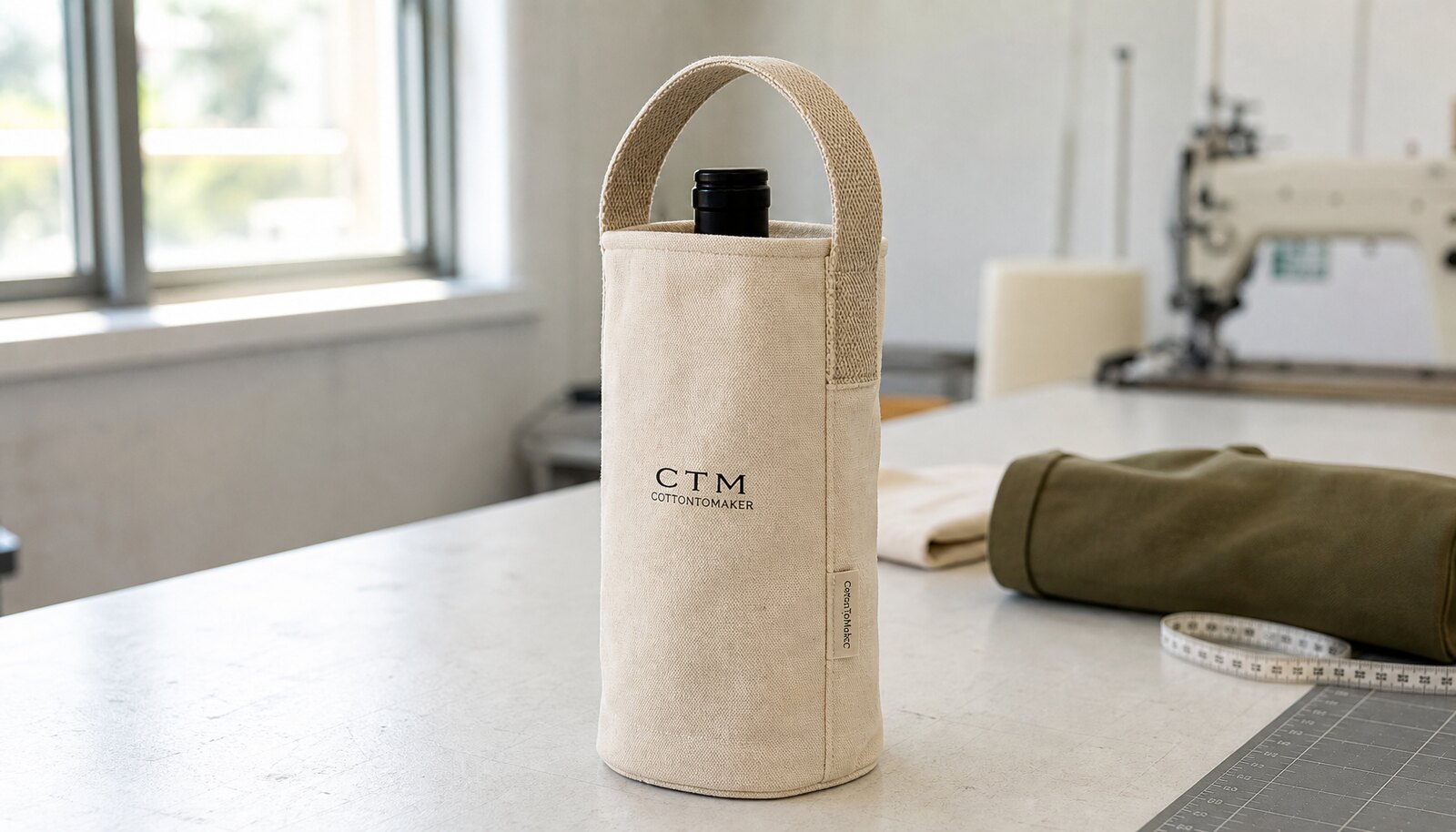
Why a small carrier needs a serious spec
A custom canvas wine carrier looks simple until a full bottle goes into it. Then every shortcut becomes visible. The handle carries real weight. The base has to sit flat. The front panel must hold a logo without twisting or wrinkling. The fabric needs to arrive clean, odor-free, and presentable enough for a client, employee, event guest, distributor, or retail buyer to receive as a gift.
For procurement teams, the largest risk is rarely that a supplier cannot sew a basic bag. The risk is that several suppliers quote different products while using similar words. One quote may assume 10 oz cotton canvas and bulk packing. Another may include 14 oz canvas, bar-tacked handles, a reinforced base, individual polybags, and carton marks. Both may be called a custom canvas wine carrier. The price gap is not meaningful until the construction gap is visible.
A good supplier compliance checklist does not need to be theatrical. It needs to be specific. It should connect the RFQ, sample approval, purchase order, production photos, packing plan, and final inspection standard. When those documents describe the same product, buyers can compare suppliers fairly and push fewer surprises into the last week before shipment.
- Treat the carrier as a load-bearing gift package, not only a decorated fabric item.
- Quote fabric, bottle fit, handle construction, branding, packing, and inspection criteria as one controlled specification.
- Ask for evidence: fit photos, stitch close-ups, material records, strike-offs, packing photos, and inspection examples.
- Keep one named spec revision across quotation, approved sample, PO, production, and QC.
Start with the bottle and the handoff
The first sourcing question is not the logo method. It is the bottle. A standard 750 ml Bordeaux bottle is usually narrower and straighter than many Burgundy bottles. Champagne and sparkling wine bottles are wider, heavier, and more demanding on the base. Riesling bottles can be taller and slimmer. A 1.5 L magnum changes nearly every proportion. If the carrier is expected to handle a mixed assortment, the pattern should be built around the largest practical height and diameter while still keeping smaller bottles from looking loose.
Ask the gift owner or beverage partner for dimensions in millimeters. Height, maximum diameter, shoulder profile, closure height, and label visibility all matter. A bag that looks perfect on a flat table can fail during pack-out if the opening is too tight or the bottle rubs the print on insertion. Fulfillment teams notice this immediately because every extra push or twist slows assembly.
Distribution route also changes the spec. A carrier sent in bulk to a gift assembler needs easy counting, low wrinkling, and predictable carton counts. A retail or distributor program may need barcode labels, SKU separation, inner cartons, country-of-origin review, and carton marks. A direct corporate gift may place more emphasis on clean individual presentation, odor control, and avoiding visible handling marks. The same wine carrier can move through very different routes, so define the route before asking suppliers for price.
- Identify the bottle format: Bordeaux, Burgundy, Riesling, champagne, sparkling wine, half bottle, magnum, olive oil, or mixed sizes.
- State where the bag will be filled: factory, gift packer, warehouse, retail store, distributor, or internal team.
- Provide reference bottle dimensions or send a physical bottle when fit is critical.
- Confirm whether the bottle should be fully covered, partly visible, or easy to remove for presentation.
- Tell the supplier whether the carrier will be shipped empty, filled, flat-packed, upright, or retail-ready.
Put dimensions where judgment cannot drift
Soft goods need tolerance, but they still need targets. A useful wine carrier spec should list finished height, front width, side gusset, bottom gusset, opening width, handle drop, and logo position. For many canvas bottle carriers, plus or minus 5 mm is practical for finished dimensions. Logo placement may need plus or minus 3 mm to 5 mm, depending on artwork size, sewing variation, and whether the front panel stretches when filled.
Do not rely on cutting dimensions alone. Canvas thickness, seam allowance, folding, binding, washing, and pressing can all change the final size. Finished measurements are what the buyer, warehouse, recipient, and inspector experience. If the bag must pass a specific bottle clearance, specify whether measurements are taken flat, filled, or both.
Shape deserves its own line in the specification. A flat-fold carrier saves freight space and is easier to store, but it may not stand upright when empty. A boxed base improves presentation but increases carton volume. A base board can make the gift feel more structured, yet it may affect recyclability, cost, and packing method. If the carrier must stand on a banquet table before bottles are inserted, say so. If it only needs to stand after filling, that is a different product.
- Use millimeters for finished height, width, gusset, opening width, bottom size, handle drop, and logo placement.
- Define whether measurements are taken flat, filled with the reference bottle, or both.
- Measure handle drop from the top edge to the inner top of the handle loop.
- Measure logo placement from fixed points such as top edge, side seam, bottom seam, or centerline.
- Add an annotated photo or simple drawing when several stakeholders need to approve the same layout.
Choose canvas for performance, not just feel
Canvas weight is one of the easiest places for a quote to become misleading. Many corporate gifting buyers choose 12 oz to 16 oz cotton canvas, roughly 340 to 450 GSM, when they want a substantial handfeel and better structure. Lighter fabric can be suitable for high-volume promotional programs, but it should be a conscious decision, not a hidden downgrade. Heavier fabric can improve presentation and stability, while also increasing cost, sewing difficulty, carton weight, and freight volume.
Ask whether the fabric weight is stated before or after washing, dyeing, coating, or finishing. A 12 oz natural canvas and a 12 oz washed canvas may not behave the same way. Natural canvas can show cottonseed flecks, slubs, and shade variation. Some brands like that honest texture. Others see it as dirty or inconsistent. Bleached or dyed canvas may look cleaner, but it brings color-control questions, lot variation, and sometimes higher MOQ.
Material claims need discipline. If a supplier describes the carrier as cotton, recycled cotton, organic cotton, or a cotton-polyester blend, ask what evidence supports that wording. Documentation should be acceptable for the buyer's market and tied to the production lot when claims are used in sales or retail copy. Vague terms such as eco-friendly or sustainable can create more risk than value if no one can prove what they mean.
- For a premium corporate gift, consider 12 oz to 16 oz canvas, approximately 340 to 450 GSM, subject to bottle weight and design.
- For cost-sensitive promotions, approve lighter fabric only after reviewing strength, stiffness, opacity, and presentation.
- Approve a physical swatch for color, handfeel, odor, surface texture, and acceptable natural flecks.
- State whether the fabric is natural, bleached, dyed, washed, laminated, coated, brushed, unwashed, or pre-shrunk.
- Review support documents before using recycled, organic, certified, biodegradable, or similar marketing claims.
Engineer the parts that carry weight
The handle is not a styling detail. It is the main load-bearing component. Cotton webbing is common because it is durable, familiar, and repeatable. Self-fabric handles can look refined but may need added stitching or interfacing. Rope or cord handles can suit certain gift styles, although the attachment method needs close review. Procurement should specify handle material, width, color, drop, attachment area, stitch pattern, and reinforcement.
For one-bottle carriers, webbing widths such as 25 mm, 30 mm, or 38 mm are common choices, depending on the look and weight. Handle drop often falls around 100 mm to 150 mm, but the right number depends on the carrier height and how the recipient will carry it. A very short drop can make the bag awkward to hold. A very long drop can make the bottle swing or look unbalanced.
The base carries concentrated weight, especially with champagne, sparkling wine, or wider bottles. A simple bottom seam may work for a narrow promotional carrier. A shaped bottom gusset, reinforced canvas layer, separate base panel, padded base, or base board may be better for premium gifting. For two-bottle styles, dividers should be specified clearly. A loose divider that collapses during filling does not provide the same protection as a fixed divider sewn into the base and side seams.
- Specify handle material, webbing width, handle drop, color, and whether the trim is stock or dyed-to-match.
- Define reinforcement at every handle attachment point: box stitch, box-X stitch, bar-tack, backstitch, or approved equivalent.
- Check that webbing ends are folded, sealed, bound, or otherwise finished to reduce fraying.
- Define bottom construction: simple seam, boxed base, reinforced canvas layer, base board, padded base, or separate bottom panel.
- For two-bottle carriers, define divider height, attachment points, padding, and whether bottles may touch while carried.
Match the logo method to the artwork
Branding can turn a straightforward carrier into a production problem. Screen printing is usually efficient for bold one-color or few-color artwork on relatively flat panels. It can be economical for repeat orders, but textured canvas may show tiny ink gaps on fine lines. Heat transfer can reproduce more detail and color, yet buyers should check handfeel, edge visibility, adhesion, scorch marks, and curing. Embroidery can feel premium on a small mark, but dense stitching can pucker lighter fabric or distort thin typography.
Woven labels, side labels, leather patches, and hangtags are worth considering when a small brand detail needs to repeat across several gift items. They can also reduce printing complexity on textured or dark fabrics. Each method has its own MOQ, setup charge, lead time, and defect profile. A clean quote separates these costs instead of burying them inside one unit price.
Digital mockups help with layout, but they do not prove production color. Ink, thread, transfer film, and label yarns all behave differently on natural, dyed, washed, or coated canvas. For brand-sensitive programs, approve a strike-off, ink drawdown, embroidered sample, woven label sample, or full pre-production sample using the final fabric. Then record logo size, placement, color reference, and acceptable tolerance in the PO.
- Use screen print for bold marks, solid colors, and repeat programs where setup cost can be spread across volume.
- Use heat transfer for detailed or multi-color artwork after approving adhesion, handfeel, edge appearance, and heat marks.
- Use embroidery for smaller premium marks on fabric that can support stitch density without puckering.
- Use woven labels or side labels when repeatability, small detail, or multi-product consistency matters.
- List artwork version, logo size, print colors, thread colors, placement points, and placement tolerance in the order file.
Compare suppliers by evidence, not charm
Supplier type should match the risk of the order. A direct sewing factory may be the best fit when construction, sample-to-bulk consistency, and fast rework decisions matter. A trading company can be useful when the wine carrier is part of a larger gift kit and someone must coordinate several items. A specialized bag workshop may understand gussets, handles, dividers, and soft-goods tolerances better than a general promotional supplier. A retail-ready supplier may cost more but can prevent receiving issues downstream.
Ask for evidence related to this product, not broad claims. Useful proof includes photos of similar wine or bottle bags, handle reinforcement close-ups, base construction, print-room setup, trimming and packing areas, in-line QC records, carton photos, and final inspection examples. If printing, embroidery, label sewing, or packing is subcontracted, ask who controls timing, quality decisions, and rework approval. Subcontracting is common; unclear responsibility is the problem.
The comparison table should be used before negotiation, not after a price has already become emotionally anchored. If one supplier is strong on sewing but weak on compliance paperwork, and another is average on sewing but strong on retail packing, the better choice depends on the channel. The goal is not to find the lowest quote in isolation. The goal is to buy the correct product with fewer avoidable corrections.
- Ask who owns QC decisions and who pays for rework if bulk production misses the approved spec.
- Request photos of cutting, sewing, logo application, trimming, packing, carton sealing, and finished cartons.
- Confirm which processes are in-house and which are outsourced.
- Check whether the supplier has handled similar bottle weight and shape, not only similar bag appearance.
- Ask each supplier to quote against the same named spec revision and sample requirement.
Approve samples like the product will be used
A wine carrier sample should be tested as a working item. Insert the exact bottle or a reference bottle with matching dimensions. Lift it by the handle several times. Place it on a flat surface. Look at the logo while the bottle is inside, because fabric tension can change placement and shape. Check the inside seams, handle attachment, thread trimming, odor, stains, print surface, and whether the bottle slides in without force.
For corporate gifting orders, two approved samples are often useful. One can be sealed as the golden sample for inspection reference. The other can circulate among marketing, procurement, fulfillment, warehouse, and stakeholders who need to check handling. If bulk production later changes fabric batch, thread, webbing, ink, label, carton count, or packing method, the sealed sample gives both buyer and supplier a neutral reference point.
Sample approval should include packing when packing is part of the order. A carrier can be beautifully sewn and still fail the receiving process if hangtags are attached in the wrong place, barcode labels cover the logo, polybags are too tight, cartons are overloaded, or inner cartons do not match the packing list. Approve one complete pack-out before mass production, including carton marks, item codes, and barcode readability.
- Confirm the sample uses quoted fabric weight and finish, not available showroom stock.
- Measure finished dimensions and compare every measurement with the written specification.
- Check handle drop, stitch pattern, bar-tack location, seam allowance, base shape, and reinforcement.
- Review the logo with the bottle inserted and the carrier standing naturally.
- Smell the sample and reject mildew, oil, dye, glue, smoke, or strong chemical odor outside the agreed standard.
- Approve hangtag placement, insert card, barcode label, carton count, carton marks, and inner packing before bulk production.
Keep compliance practical and traceable
Compliance requirements should fit the sales channel. An internal employee gift may need a signed sample, final inspection photos, packing list, and standard commercial documents. A retailer, distributor, or regulated sales channel may need more: carton labels, barcode verification, country-of-origin review, fiber-content labeling, restricted-substance declarations, retailer forms, or third-party test reports. Put these requirements into the RFQ so suppliers quote the real work.
Traceability becomes more important when material or sustainability claims are used. If the carrier is sold as organic cotton, recycled cotton, certified cotton, or another claim-bearing material, the supporting records should connect to the actual production lot. A generic certificate from an unrelated mill or expired document may not be enough. If testing is required, define the test method, sample quantity, passing requirement, timing, and who pays for failures or retesting.
Version control is part of compliance. Artwork, labels, insert cards, carton marks, and barcode files should be approved as final files with revision dates. Mixed versions create warehouse disputes and brand problems even when the sewing is acceptable. Keep the checklist short enough to use on a busy order, but complete enough to stop receiving failures before goods leave the factory.
- Request fabric composition records when fiber content, sustainability claims, or retailer requirements matter.
- Review country of origin, SKU, barcode, item code, carton label, and packing-list requirements before production.
- Define whether third-party testing or inspection is required, who books it, and when it must happen.
- Ask for a production-lot link between fabric records, finished goods, packing list, and shipment documents.
- Do not approve unsupported words such as organic, recycled, biodegradable, eco-friendly, certified, or compostable without acceptable evidence.
Build a QC plan the factory can execute
A useful QC plan turns expectations into checks an inspector can see, measure, and photograph. For custom canvas wine carriers, inspection should cover dimensions, fabric, stitching, handle reinforcement, bottle fit, base stability, logo placement, logo appearance, odor, stains, trimming, packing, and carton marks. The plan should also define critical, major, and minor defects. A broken handle, wrong logo, wrong fabric, strong mildew odor, mixed SKU, or unsafe sharp accessory deserves more weight than a small thread tail.
Many buyers use ANSI/ASQ Z1.4 or a similar AQL-based sampling plan for final inspection. Whatever system is used, agree on sampling level and acceptance quality limits before production starts. Gift-ready orders usually need stricter control for visible stains, odor, logo defects, and packing mistakes than low-cost giveaways. Even if the factory performs internal QC, reserve time for buyer-side or third-party inspection before shipment.
Inspection should simulate normal use. Remove units from cartons. Insert the reference bottle. Lift the carrier. View the logo from a normal handoff distance. Check whether the base sits flat and whether the handle feels secure. Inspectors should measure actual units, not only review production photos. Carton checks matter too: inner count, master count, item code, color, artwork version, PO number, barcode, gross weight, and carton marks should match the approved packing plan.
- Define sample size, defect categories, acceptance criteria, and reinspection rules before production starts.
- Measure height, front width, gusset, opening width, bottom size, handle drop, and logo placement on randomly selected units.
- Classify handle detachment, wrong material, wrong logo, severe odor, mildew, unsafe trim, and mixed SKU as serious defects.
- Check print for cracking, bleeding, ghosting, pinholes, registration drift, transfer edges, scorch marks, and curing problems.
- Verify cartons against approved count, gross weight, carton marks, barcode labels, packing list, and shipping documents.
- Build time into the schedule for correction, replacement, relabeling, repacking, or reinspection if the first check fails.
Specification comparison for buyers
| Supplier option | What to verify | Commercial advantage | Buyer risk to control |
|---|---|---|---|
| Direct sewing factory | fit-test photos with reference bottle, bottom reinforcement close-up, handle load proof, and final carton photo set | Better sample-to-bulk control and faster production feedback | May be weaker on export paperwork or branded packing unless checked early |
| Trading company | Factory name, production photos, trim-source proof, and who owns QC decisions | Can coordinate small mixed orders and extra services | Markup can hide real factory capability and slow defect decisions |
| Specialized bag workshop | bottle fit, bottom reinforcement, handle or cord strength, divider option, seam allowance, and upright stability | More practical for detailed construction, trims, and repeat programs | Capacity may be limited during peak seasons |
| Low-price general supplier | cotton canvas, jute, felt, nonwoven, or laminated paper sized to bottle diameter, weight, and condensation risk | Useful for simple promotional runs with loose specs | Material downgrades, weak packing, and vague inspection scope can erase savings |
| Retail-ready supplier | upright or flat packing, bottle-protection insert, carton count, moisture control, and retail display orientation | Can handle labels, SKU separation, carton marks, and receiving rules | Higher unit cost must be compared against reduced warehouse work |
| Compliance-focused supplier | Fabric records, labeling review, test plan, and production traceability | Safer for retail programs and repeat brand orders | Documentation claims need evidence, not only sales language |
| Local sample room plus bulk factory | Signed sample, bulk factory handoff, first-piece photos, and deviation owner | Good for complex branding before large production | Sample room quality may not match bulk line unless handoff is controlled |
Buyer checklist before sampling
- Confirm the exact bottle format before quoting: standard 750 ml Bordeaux, Burgundy, Riesling, champagne or sparkling wine, 375 ml half bottle, 1.5 L magnum, olive oil bottle, or a mixed assortment.
- Provide bottle dimensions in millimeters, including height, maximum diameter, shoulder shape, punt or base shape if relevant, closure height, and whether the foil, neck label, or main label must remain visible.
- Define finished bag dimensions in millimeters: height, front width, side gusset, bottom gusset, opening width, handle drop, and finished tolerance, commonly plus or minus 5 mm for soft goods unless a tighter tolerance is agreed.
- Lock fabric composition and weight, such as 100% cotton canvas at 12 oz to 16 oz, approximately 340 to 450 GSM, or another specified blend, and state whether the stated weight is before or after washing, dyeing, coating, or finishing.
- Specify finish and appearance: natural, bleached, dyed, washed, laminated, brushed, unwashed, or pre-shrunk, with approved swatch, color standard, shrinkage expectation, odor requirement, and acceptance level for cottonseed flecks or slubs.
- Decide structure requirement: flat-fold for shipping, upright only when filled, upright when empty, base board, padded base, bottle divider, top binding, drawcord, snap, button, ribbon tie, or open-top style.
- Specify handle construction: cotton webbing, self-fabric handle, rope handle, or cord; webbing width; handle drop; stitch box size; bar-tack requirement; thread type; seam allowance; and reinforcement points.
- Approve logo method by artwork type: screen print, heat transfer, embroidery, woven label, leather patch, hangtag, side label, or multiple placements, with logo size, position, color reference, and placement tolerance.
- Define packaging clearly: bulk pack, individual polybag, recycled paper band, tissue wrap, hangtag, insert card, barcode sticker, inner carton, master carton, retail-ready orientation, moisture control, and carton-mark format.
- Request a pre-production sample made with the final quoted fabric, handle, logo method, accessories, and packing format, not a similar showroom sample or substitute stock material.
Factory quote questions to send
- What exact fabric composition, yarn count or weave description if available, canvas weight in oz and GSM, fabric width, shrinkage expectation, finish, and color are included in this quote?
- Is the quoted fabric natural, bleached, dyed, washed, laminated, recycled-content, organic, or conventional cotton, and what documentation can support any material claim?
- Which bottle size did you use to build the pattern, and can you provide a filled-bag photo set using our target bottle dimensions before we approve the sample?
- What finished dimensions and tolerances are included for height, front width, side gusset, bottom gusset, opening width, handle drop, logo placement, and carton count?
- What handle material, webbing width, stitch pattern, bar-tack locations, thread type, seam allowance, and reinforcement method are included in the quoted construction?
- Is the base reinforced with additional canvas, a separate bottom panel, a board, heavier stitching, padding, or no reinforcement, and how does each option affect price and carton volume?
- Which logo method is included, how many colors are covered, what maximum artwork size is quoted, and what setup charge applies per color, side, screen, plate, embroidery program, transfer sheet, or label run?
- How will print color be controlled: Pantone reference, physical swatch, ink drawdown, strike-off, approved production sample, or supplier standard ink only?
- What is your MOQ by fabric color, artwork version, logo method, trim color, and packing style, and how does the unit price change at 500, 1,000, 3,000, 5,000, and 10,000 pieces?
- Are woven labels, side labels, hangtags, barcode labels, insert cards, inner cartons, moisture-control materials, or retail-ready packing included, optional, or excluded from the unit price?
Quality-control points to confirm
- Fabric weight should be verified against the approved range, such as 12 oz plus or minus 5% if agreed, or compared to the sealed sample when roll weighing is not practical at final inspection.
- Fabric color should be checked under consistent lighting against the approved swatch or golden sample, especially for natural canvas, dyed canvas, washed canvas, and repeat orders from a new fabric lot.
- Finished dimensions should be measured on a defined sample size, including height, front width, side gusset, bottom gusset, opening width, and handle drop, with tolerance stated in millimeters.
- Bottle fit should be verified with the approved bottle dimensions or a reference bottle, with photos from front, side, base, top opening, and lifted-handle views.
- Handle attachment points should be even, tight, and reinforced with the agreed stitch box, backstitch, or bar-tack; skipped stitches, loose thread bundles, fraying webbing ends, and off-angle handles should be classified.
- Base seams and gussets should support the filled bottle without twisting, excessive bulging, weak corners, or a lean that makes the filled carrier look unstable on a flat surface.
- Print placement should be measured from agreed reference points, such as top edge, side seam, or bag centerline, with placement tolerance commonly set at plus or minus 3 mm to 5 mm depending on artwork and sewing variation.
- Print appearance should show no cracking, bleeding, severe pinholes, ghosting, registration drift, scorch marks, adhesive residue, excessive ink buildup, or visible transfer-edge marks outside the approved sample standard.
- Print color should be checked after drying or curing against the approved strike-off or sample, not only immediately after printing while ink appearance may still change.
- Embroidery should be checked for thread color, density, registration, backing residue, puckering, loose thread ends, and whether the logo distorts when the bottle is inserted.