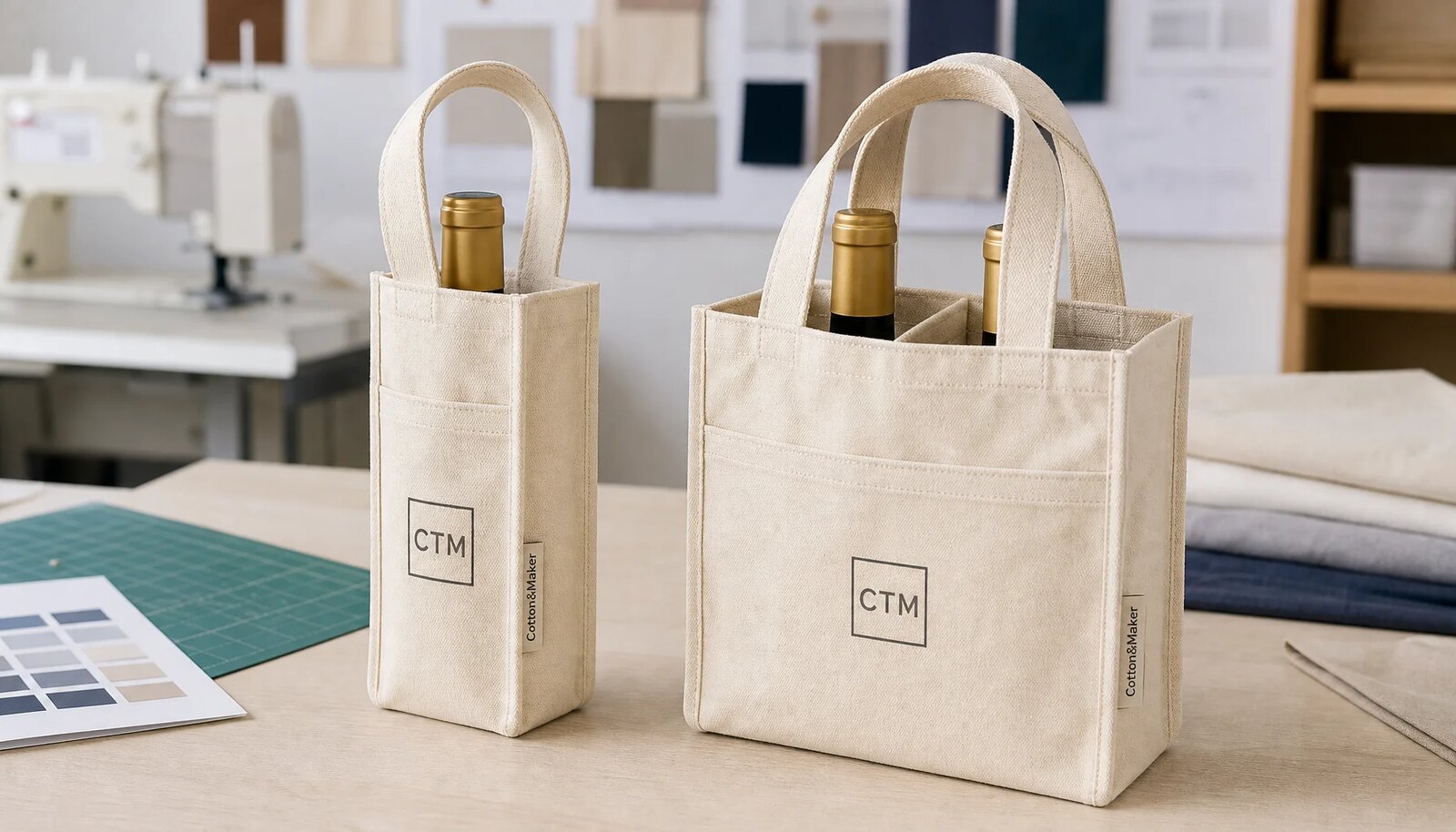
Why Hotel Retail Buyers Need A Real Compliance Checklist
A custom canvas wine carrier is easy to underestimate. In a catalog photo, it is a small soft-goods item with handles and a logo. In hotel retail, it has to do more. It may hold a bottle sold in a lobby shop, carry a wine-pairing gift from a restaurant, package a resort welcome amenity, support a holiday program, or sit on a shelf beside premium food and beverage products. It passes through receiving, storage, display, guest handling, and sometimes off-property travel. If the base tilts, the handle stretches, the divider folds, or the print scuffs before the guest sees it, the carrier has failed both as packaging and as brand presentation.
For procurement teams, supplier compliance means repeatable execution, not a pleasant promise that the supplier can make bags. The purchasing file should show the approved specification, fabric swatch, decorated sample, bottle-fit record, carton plan, inspection checklist, and change-control rule. Those documents matter even more when a hotel group repeats the order six months later, adds a second property logo, or asks a distributor to receive split SKUs.
The quote comparison is where many programs drift. One supplier may quote 10 oz natural cotton canvas, one-color screen print, standard handles, and bulk packing. Another may include 12 oz dyed canvas, reinforced handles, sewn-in dividers, woven labels, hangtags, SKU labels, stronger cartons, and inspection support. The unit prices are not comparable until the construction and service scope are normalized.
A compliance checklist gives the buyer a calm way to press for details. It asks what material is being used, how the bottle fit is proven, how the handle is reinforced, how the print is controlled, what documents support claims, and how finished goods will arrive at the hotel retail operation.
- Treat the carrier as both retail packaging and a reusable soft-good item.
- Normalize quotes by fabric weight, dimensions, reinforcement, divider method, logo process, packing, carton data, and inspection scope.
- Ask suppliers to list exclusions such as setup charges, sample fees, testing, special labels, carton printing, and shipment splits.
- Keep a signed pre-production sample, sealed fabric swatch, decorated approval sample, and approved carton photo.
- Require written approval before any change to material, ink, trim, subcontractor, construction, artwork, or packing.
Start With Bottle Fit, Not The Logo
Bottle geometry should lead the sourcing process. A bag that fits a standard 750 ml Bordeaux bottle may be tight around a Burgundy bottle, too short for a tall slim bottle, too narrow for sparkling wine, or too loose for a minibar gift set. Hotel programs also change bottle brands by property, season, restaurant partner, or event menu. The buyer should decide whether the carrier is made for one exact bottle or for a controlled range of bottle sizes.
The RFQ should include bottle diameter, total height, shoulder width, closure height, filled weight, and label position. Label visibility sounds like a small detail until the product reaches the shelf. If the wine label must remain visible above the carrier, the finished height should be lower. If the carrier is used mainly for guest carry-out, the height, base, and handle balance should reduce glass movement and keep the bottle stable.
Single-bottle canvas wine carriers often sit around 10 to 12 cm wide, 8 to 10 cm deep, and 35 to 38 cm high, but those dimensions are starting points, not universal standards. Two-bottle versions need more than a wider body. They need a divider that prevents bottle shoulders from striking and a base that does not sag under filled weight. Four-bottle and six-bottle versions need a more formal divider map, stronger bottom planning, and packing that prevents the internal structure from being crushed before display.
Sample approval should include real bottle testing. Ask the supplier to photograph the sample from the front, side, top, and base with the intended bottle inserted. For mixed hotel assortments, test the largest bottle, smallest bottle, heaviest bottle, and most fragile presentation item. A clean empty sample is useful, but it does not prove the carrier works when the program changes from still wine to sparkling wine or adds a second gift item.
- Provide bottle diameter, total height, shoulder shape, closure type, filled weight, and label visibility needs in the RFQ.
- State whether the carrier must stand upright empty, stand upright filled, hang from a display peg, or ship folded.
- For two-bottle carriers, specify sewn-in divider, removable divider, padded divider, or full compartment construction.
- Set divider height by bottle shoulder position, not by appearance alone.
- Require bottle-fit photos and written confirmation before bulk cutting.
Specify Canvas Weight, GSM, And Finish Precisely
Canvas should be described in measurable terms. Suppliers may use ounces, GSM, or words such as heavy canvas, but those words do not protect the buyer unless the specification is clear. A 10 oz cotton canvas is often practical for simple wine carriers where foldability, price, and promotional use matter. A 12 oz canvas, often around 340 to 400 GSM depending on the source, gives a more substantial hand feel and stronger shelf presence. It also increases sewing bulk, carton volume, material cost, needle requirements, and sometimes MOQ.
Natural cotton canvas is common in hotel retail because it fits resort, vineyard, boutique, wellness, and gift-shop aesthetics. It usually works well with one-color screen printing and small woven labels. Dyed canvas can support stronger brand alignment, but it introduces dye-lot control, color fastness questions, and longer material lead time. Washed canvas feels softer but may reduce dimensional consistency and print sharpness. Stiffened canvas may stand better on shelf, yet it can crease when packed tightly.
Recycled cotton, organic cotton, and other sustainability claims need evidence. A supplier saying eco canvas is not enough if the hotel group, retailer, or importer will make a consumer-facing claim. Ask for documents tied to the actual material and production scope, then decide how the claim will appear on a label, hangtag, product page, or internal procurement record. If the claim is only internal, record that too. Ambiguity creates risk later.
Bulk fabric should be checked against the approved swatch for weight, shade, weave appearance, hand feel, odor, stains, and surface defects. Natural canvas may show small seed specks if agreed in advance. Oil marks, mildew odor, water stains, heavy slubs, and inconsistent weave should be treated as defects. For dyed fabric, set the shade tolerance and lighting conditions before production starts.
- Use 280 to 320 GSM for lighter promotional carriers where foldability and price are priorities.
- Use 340 to 400 GSM for hotel retail carriers needing more structure and stronger perceived value.
- Confirm heavier canvas only after checking seam bulk, needle size, folding method, carton volume, and freight impact.
- Define fabric as natural, bleached, dyed, washed, pre-shrunk, recycled, organic, blended, laminated, coated, or treated.
- Set fabric-weight tolerance, commonly ±5% unless the buyer requires a narrower range.
Construction Details That Quietly Change Cost
The largest cost differences are often hidden in the sewing. A low quote may use narrower handle tape, fewer stitches, no bartacks, a shallow seam bite, a loose divider, weaker bottom corners, or thinner thread. These choices may not be obvious in a spreadsheet. They become obvious when a guest carries two bottles through a lobby or when retail staff fills carriers all day during a seasonal promotion.
Handle construction deserves close attention because it is the main load point. Guests may carry bottles from a shop to a room, restaurant, event space, parking area, or airport transfer. For hand-carry use, handle drop may be around 12 to 18 cm depending on size and balance. Shoulder-carry designs need longer drops and different reinforcement. Self-fabric handles can look refined, but they require careful seam control. Cotton webbing is more consistent when inserted and stitched correctly. Rope or cord handles need pull-out testing and a comfort check.
The divider and base decide whether the carrier protects bottles or merely separates them visually. A low divider can allow bottle shoulders to hit. A loose divider may fold when staff packs the bag. A stiff divider can slow insertion or distort the body. For two-bottle carriers, specify divider height, number of fabric layers, seam attachment, and whether the divider reaches the base. For multi-bottle carriers, include a simple divider diagram.
Stitching affects durability and retail appearance. Ask the supplier to declare seam allowance, stitch density, thread type, reinforcement points, and raw-edge control. Medium canvas often uses around 7 to 9 stitches per inch, though the right setting depends on fabric thickness, thread, and seam bulk. Decorative topstitching should look straight because the product sits in front of guests. Load seams should be judged more strictly than purely decorative seams.
- Specify handle width, handle drop, material, stitch pattern, seam insertion depth, and reinforcement method.
- Use box stitch, cross-stitch, bartack, or equivalent reinforcement at load points.
- Define seam allowance and raw-edge finish to reduce fraying inside the carrier.
- Specify divider height, attachment points, fabric layers, and whether bottles may touch at shoulder or base.
- Use filled-bottle load testing and repeated carry checks instead of relying only on supplier statements.
Logo Method, Artwork Limits, And Placement Control
Screen printing is common for custom canvas wine carriers because it is practical for hotel logos, vineyard marks, event artwork, and resort gift-shop branding. One-color screen print on natural canvas is often the best cost-to-durability balance. Multi-color screen print, heat transfer, embroidery, woven labels, printed cotton labels, leather patches, debossed patches, hangtags, and paper belly bands can all work, but each method changes setup cost, MOQ, lead time, inspection criteria, and rework options.
Artwork approval should be technical, not only visual. The logo has to land in the right position after sewing, hold color within tolerance, and resist normal rubbing in cartons and store handling. Fine lines, small serif text, gradients, thin borders, and large solid ink areas may perform poorly on coarse canvas. Dark fabric may need an underbase or a different ink system. A capable supplier should flag these limits before the buyer approves the sample budget.
Placement should be measured from finished edges and finished seams. Cut-panel measurements are unreliable because sewing, gussets, handle insertion, and pressing can shift the visual center. The spec should show print width, print height, distance from top edge, distance from side seam, distance from bottom seam if relevant, and acceptable placement tolerance. A practical range may be ±0.5 cm for small labels and ±1.0 cm for larger front prints, when agreed before production.
Premium hotel retail programs may choose quieter branding. A woven side label, printed cotton label, small patch, or hangtag can feel more retail-ready than a large promotional front logo. Small trims still need control: label size, content, color, edge finish, stitch line, placement, and whether the label is caught securely in the seam.
- For simple hotel logos, start with one-color water-based or pigment screen print on natural canvas.
- For premium retail, compare woven labels, cotton labels, embroidery, patches, and hangtags against large front printing.
- For dark fabric, test ink opacity, curing, rub resistance, and contrast before bulk approval.
- Approve artwork by size, Pantone or thread reference, minimum line width, and distance from finished seams.
- Require a print strike-off or decorated pre-production sample before bulk printing.
Supplier Evidence And Compliance Documents
Supplier evidence should connect to the order in front of you. A polished company profile is not enough. Ask for photos of similar bottle bag production, fabric purchase records, print-room capability, sewing-line capacity, inline QC sheets, sample measurement reports, carton examples, and inspection checklists. If the supplier cannot explain how handle reinforcement is checked or how the divider is attached, the quote is not ready for a hotel retail program.
Factory visibility matters because a wine carrier can involve cutting, printing, embroidery, label making, sewing, trimming, inspection, and packing. Subcontracting is not automatically a problem. Many good suppliers use outside print or label partners. The buyer simply needs to know who performs each step, who controls quality, and who pays for correction if a subcontracted process fails.
Documentation depends on destination market, buyer policy, and product claims. A standard cotton canvas carrier may need a material declaration, supplier qualification record, and restricted substance testing if required by the buyer or importer. Organic, recycled, fair labor, low-impact dye, or similar claims require stronger records tied to the actual material, facility, or process. A certificate that does not cover the relevant scope is weak evidence.
Evidence should also show quality-system behavior. A capable supplier can explain how samples are retained, how measurements are recorded, how defects are classified, and how production status is reported. A small specialized workshop may be acceptable if its process control is clear. A larger supplier can still be risky when responsibility is vague and documents are generic.
- Request production factory name, address, export entity, and subcontracted processes before order confirmation.
- Ask for recent wine carrier or bottle bag photos, not only general tote bag photos.
- Confirm whether tests apply to fabric, finished bag, ink, trims, fiber claim, or restricted substances.
- Tie material declarations, certificates, and test reports to the purchase order or fabric lot where possible.
- Require written notice before any approved component, subcontractor, construction, or packing change.
MOQ, Cost Drivers, And Quote Normalization
MOQ is rarely one simple number. Custom canvas wine carriers may have separate minimums for greige fabric, dyed fabric, printing setup, embroidery, woven labels, leather patches, hangtags, belly bands, carton printing, and final assembly. Natural canvas with a one-color print usually supports a lower MOQ than custom-dyed canvas, embroidery, woven labels, or special retail packaging. If a hotel group needs several property logos, the body may share one MOQ while each artwork version carries its own setup charge.
Cost drivers should be visible so procurement can make deliberate tradeoffs. Heavier canvas may improve shelf presence. A woven side label may matter more than an inside label. Individual polybags can reduce dust, but they may conflict with plastic-reduction goals and add labor. A sewn-in divider may justify cost for two-bottle gifting, while a removable insert may simplify packing but feel less finished. The goal is not always the lowest price. It is knowing what the price includes.
A complete quote should separate base bag cost, decoration cost, setup charge, sample fee, packing cost, testing cost, documentation fee, export carton cost, inland handling, and shipment split cost. Ask for carton dimensions, carton quantity, gross weight, net weight, and estimated cubic meter volume. Freight and warehouse handling can change the landed-cost comparison, especially for stiff or multi-bottle carriers.
Multi-property hotel retail programs can control cost by standardizing the body and varying only decoration. Keep the same fabric, size, handle, divider, thread, and packing. Change the logo, woven label, hangtag, or carton mark by property. That reduces sampling work, fabric MOQ pressure, inspection variation, and production confusion.
- Separate base bag, decoration, sample, setup, packing, testing, documentation, carton, and inland handling costs.
- Ask for MOQ by bag body, fabric color, logo version, label type, packing style, and shipment split.
- Quote one-bottle, two-bottle, four-bottle, and six-bottle versions separately because dividers and reinforcement change labor.
- Compare 10 oz and 12 oz canvas only when size, handle, divider, logo, and packing are identical.
- For hotel groups, standardize the carrier body and vary only property logo, label, hangtag, or carton mark when possible.
Sample Approval With Measurable Criteria
The pre-production sample is the strongest control point before bulk cutting. It should use actual bulk fabric, actual logo method, final thread, final handle construction, final divider, final trim, and proposed packing when timing allows. A photo-only sample is not enough because hand feel, divider stiffness, handle comfort, print texture, odor, insertion ease, and packing deformation cannot be judged accurately from images.
Sample comments should be measurable. Instead of asking the supplier to make it stronger, specify the change: increase handle width to 3 cm, add bartacks at the four handle ends, raise divider height to 22 cm, move the logo down 1.5 cm from the finished top edge, reduce handle drop by 2 cm, or change stitch color to the approved beige thread. If the bottle type changes after approval, ask the supplier to reconfirm size, cost, and lead time before cutting fabric.
Sample approval should cover visual, functional, and packing checks. Visual checks include fabric shade, logo placement, print sharpness, label alignment, stitch straightness, shape, stains, and retail appearance. Functional checks include bottle fit, upright stability, handle comfort, load strength, divider separation, insertion speed, and whether the carrier keeps its shape after folding and display. Packing checks confirm whether the selling face creases or handles twist.
After approval, the supplier should retain one signed reference sample, and the buyer should keep one when possible. Bulk production should begin with a first-piece check or first-piece photo set. If differences appear, the supplier should pause and request written approval or issue a correction plan. Known deviations should not move into full production without buyer approval.
- Use actual filled bottles or weighted equivalents for sample fit and carry tests.
- Measure finished width, height, gusset, handle drop, divider height, and logo placement against the spec sheet.
- Rub the printed panel against another carrier or carton surface to simulate transit abrasion.
- Check whether the sample remains presentable after folding, packing, unpacking, filling, and display.
- Approve a revised sample or written correction sheet before bulk production proceeds.
Packing For Hotel Retail Distribution
Packing can turn a well-made wine carrier into poor retail stock. Canvas can crease, printed panels can rub, handles can twist, dividers can flatten, hangtags can bend, and belly bands can tear. Bulk packing is economical, but it should protect the selling face. Individual polybags reduce dust and moisture exposure, though they may conflict with hotel sustainability policies. Paper sleeves, belly bands, hangtags, and UPC labels improve retail handling but add labor, material cost, and carton planning.
The packing plan should be quoted before order placement because it affects landed cost and receiving efficiency. A carton packed too loosely wastes freight and allows abrasion. A carton packed too tightly may compress the carrier, deform the base, or crease the decorated panel. Two-bottle and six-bottle carriers need special attention because dividers can develop permanent folds when packed under pressure.
SKU control is part of compliance for hotel groups and distributors. Different property logos, fabric colors, bottle counts, seasonal artwork, and retail labels should not be mixed in the same carton unless the receiving process allows it. Inner cartons or counted bundles can reduce receiving errors. Carton marks should include item number, PO number, logo version, color, quantity, gross weight, net weight, carton number, and destination information required by the buyer.
Moisture and odor control are important for cotton canvas. Goods should not be packed damp, stored near strong odors, or sealed before print-room odor has dissipated. Silica gel may be useful in some shipments, but the buyer should confirm destination and internal-policy requirements. The supplier should photograph packed units and master cartons before shipment so procurement can verify the final presentation.
- Define units per bundle, bundles per carton, carton dimensions, gross weight, net weight, and carton numbering.
- Protect printed faces from direct abrasion during transport.
- Confirm no bag, polybag, paper sleeve, belly band, hangtag, UPC label, inner carton, or shelf-ready carton.
- Use SKU separation rules for hotel logos, fabric colors, bottle counts, and retail label versions.
- Review carton strength, compression risk, moisture risk, odor, and display deformation before shipment.
Inspection Plan, AQL, And Defect Rules
Inspection should be agreed before production, not negotiated after defects appear. For custom canvas wine carriers, inspection should cover material, dimensions, construction, artwork, function, cleanliness, packing, carton marks, and SKU separation. Buyers should define the sampling standard, AQL level, measurement tolerance, defect categories, and reference sample before deposit or sample approval. If the supplier uses an internal inspection plan, ask how it aligns with buyer or third-party expectations.
Defect classification keeps decisions objective. Critical defects may include unsafe sharp objects, severe mold, incorrect material claim, or handle failure under the agreed load check. Major defects may include wrong size outside tolerance, weak handle stitching, missing divider, wrong logo, severe print scuffing, obvious stains, wrong packing, mixed SKU cartons, or unreadable carton marks. Minor defects may include short loose threads, slight stitch waviness, minor shade variation within tolerance, or removable dust marks.
Functional inspection is essential because a wine carrier can look acceptable while failing in use. Inspectors should fill random units with actual bottles or weighted substitutes, check handle comfort, verify that bottles do not strike each other, test upright stability, and confirm the divider remains in place. Pull units from different cartons because early, middle, and late production can differ in stitching, print shade, or packing pressure.
Inspection photos should support a commercial decision. A useful report includes handle reinforcement close-ups, divider seams, bottom corners, print details, labels, measurement photos, defect examples, carton marks, and packed carton views. If defects are found, the supplier should provide a written rework plan and reinspection evidence before shipment release.
- Set AQL level, inspection date, sample size, measurement tolerance, and defect categories before production.
- Classify critical, major, and minor defects for fabric, stitching, logo, bottle fit, cleanliness, packing, and carton marks.
- Require random bottle-fit and load checks using actual bottles or weighted equivalents.
- Measure logo placement from finished seams and finished edges.
- Ask for rework photos and reinspection approval when defects affect retail appearance or carrying function.
Specification comparison for buyers
| Supplier option | What to verify | Commercial advantage | Buyer risk to control |
|---|---|---|---|
| Direct sewing factory | fit-test photos with reference bottle, bottom reinforcement close-up, handle load proof, and final carton photo set | Better sample-to-bulk control and faster production feedback | May be weaker on export paperwork or branded packing unless checked early |
| Trading company | Factory name, production photos, trim-source proof, and who owns QC decisions | Can coordinate small mixed orders and extra services | Markup can hide real factory capability and slow defect decisions |
| Specialized bag workshop | bottle fit, bottom reinforcement, handle or cord strength, divider option, seam allowance, and upright stability | More practical for detailed construction, trims, and repeat programs | Capacity may be limited during peak seasons |
| Low-price general supplier | cotton canvas, jute, felt, nonwoven, or laminated paper sized to bottle diameter, weight, and condensation risk | Useful for simple promotional runs with loose specs | Material downgrades, weak packing, and vague inspection scope can erase savings |
| Retail-ready supplier | upright or flat packing, bottle-protection insert, carton count, moisture control, and retail display orientation | Can handle labels, SKU separation, carton marks, and receiving rules | Higher unit cost must be compared against reduced warehouse work |
| Compliance-focused supplier | Fabric records, labeling review, test plan, and production traceability | Safer for retail programs and repeat brand orders | Documentation claims need evidence, not only sales language |
| Local sample room plus bulk factory | Signed sample, bulk factory handoff, first-piece photos, and deviation owner | Good for complex branding before large production | Sample room quality may not match bulk line unless handoff is controlled |
Buyer checklist before sampling
- Define the bottle use case before pricing: 750 ml Bordeaux, Burgundy, Champagne or sparkling wine, tall slim bottle, olive oil, minibar gift set, two-bottle retail pack, or mixed hotel assortment.
- Provide bottle dimensions and filled weight: diameter, total height, shoulder width, closure height, label position, and whether the label must remain visible above the carrier.
- State finished bag dimensions with tolerances: width, gusset or base depth, total height, usable internal height, handle drop, divider height, and print position from finished seams.
- Specify fabric by composition and measurable weight, such as 10 oz cotton canvas, 12 oz recycled cotton canvas, 320 GSM dyed cotton, or certified organic cotton where claims require documents.
- Require fabric finish disclosure: natural, bleached, dyed, washed, unwashed, pre-shrunk, stiffened, laminated, coated, water-repellent, or recycled blend, because each affects shrinkage, odor, hand feel, and print result.
- Set construction minimums: handle width, handle drop, handle material, box stitch or bartack reinforcement, seam allowance, stitch density, bottom reinforcement, divider attachment, and raw-edge control.
- Confirm decoration method and limits: screen print, heat transfer, embroidery, woven label, printed cotton label, leather patch, debossed patch, hangtag, or belly band, including setup charges and artwork constraints.
- Approve artwork in measurable terms: print size, distance from finished top edge, distance from side seam, Pantone or thread reference, label size, placement tolerance, and accepted print defects.
- Request a physical pre-production sample using actual bulk fabric, actual logo method, final thread, final divider, final handle construction, and proposed retail or bulk packing.
- Define acceptance criteria for fabric weight, finished size, seam strength, stitch density, loose threads, stains, odor, print adhesion, print registration, color tolerance, carton marks, and SKU separation.
Factory quote questions to send
- Which factory will cut, sew, print, inspect, and pack the canvas wine carriers, and which processes will be subcontracted?
- Have you produced wine carriers, bottle totes, or multi-bottle bags with similar filled weight and divider construction, and can you share current sample-room or production photos?
- What fabric composition, fabric weight, yarn or weave description, finish, shrinkage expectation, and color fastness level are included in the quoted unit price?
- Is the quoted fabric natural, bleached, dyed, washed, recycled, organic, blended, laminated, coated, or treated, and what documents can be tied to this specific PO?
- What is the MOQ for the bag body, each fabric color, each logo design, each label or trim, each packing style, and each shipment split?
- Can you quote 10 oz and 12 oz canvas using the same finished dimensions, handle reinforcement, divider construction, logo method, packing, and carton quantity so cost comparison is fair?
- What handle material, handle width, handle drop, stitch pattern, seam insertion depth, and reinforcement are included, and what load test can be performed for one-bottle and two-bottle versions?
- How is the divider made: sewn-in panel, removable insert, full compartment divider, padded divider, folded canvas partition, or separate paperboard insert?
- Which decoration methods are available for our artwork, and what are the setup charges, print area limits, minimum line width, Pantone tolerance, ink type, curing method, and rub-test method?
- How will you control logo placement after sewing, and will measurements be taken from the finished seam and finished edge rather than the cut panel?
Quality-control points to confirm
- Fabric weight should be verified from a measured cut sample and compared with the approved specification; agree a tolerance such as ±5% unless the buyer requires tighter control for retail consistency.
- Finished size should be measured flat at width, total height, gusset or base depth, handle drop, divider height, and print position; typical soft-goods tolerance may be ±0.5 cm for small dimensions and ±1.0 cm for larger dimensions when agreed in advance.
- Bottle fit should be checked with the actual bottle type or a weighted equivalent, including insertion ease, label visibility, upright stability, shoulder clearance, closure clearance, and whether bottles contact each other.
- Handle strength should be reviewed at the handle ends and load-bearing seams; inspectors should check box stitches, bartacks, skipped stitches, thread breaks, seam bite, and whether handle tape is securely caught inside the seam.
- A practical load check should use the intended filled-bottle weight plus a safety margin agreed with the buyer; record load weight, duration, and whether stitching, handles, or bottom seams deform.
- Seam strength should be reviewed at side seams, bottom gusset corners, divider seams, label insertion points, patch seams, and pocket seams that may pull when the carrier is filled.
- Stitch density should match the approved standard, commonly around 7 to 9 stitches per inch for medium canvas, while heavier canvas may require adjusted needle, thread, and seam handling.
- Print adhesion should be checked by dry rub, light scratch, tape pull if suitable for the ink system, and packed-bag rubbing simulation because bottles and carriers rub during handling and transit.
- Logo placement should be measured from finished edges and seams, not only from cut panels, because sewing, gussets, and handle placement can shift the visual center line.
- Color should be compared under consistent lighting against the approved fabric swatch, Pantone reference, print strike-off, woven label sample, or signed pre-production sample.