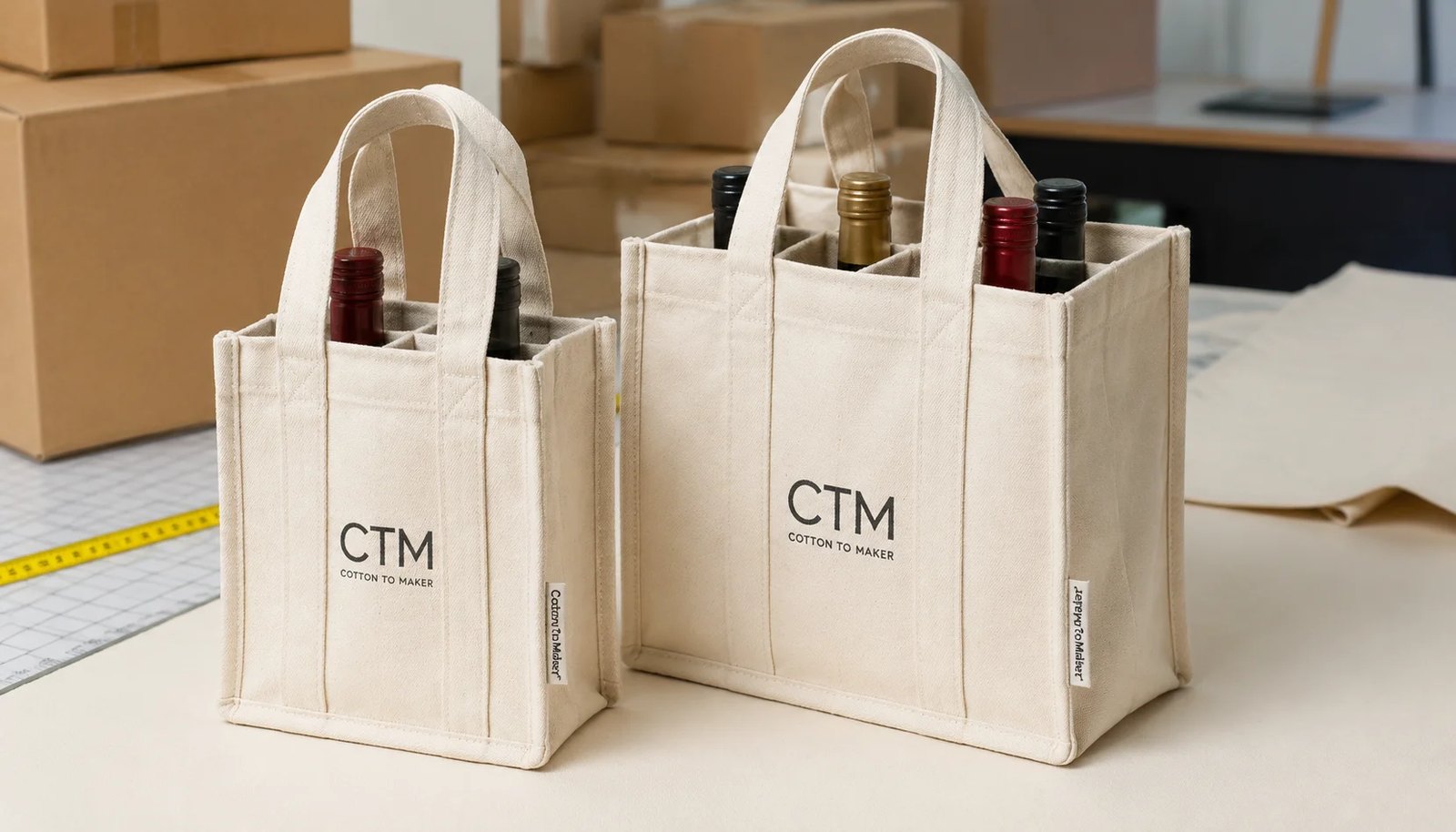
Why Carton Planning Belongs In The Bag RFQ
For custom canvas wine carriers, the shipping carton should be defined at the same time as the bag specification. Natural grocers often manage seasonal gifting, beverage promotions, local winery tie-ins, and mixed-store allocation through distribution centers that care about carton weight, SKU visibility, and rapid put-away. If the bag is acceptable but the carton arrives overweight, poorly labeled, or too weak for stacking, the operational cost quickly exceeds any savings won on unit price.
This is why B2B buyers should treat custom canvas wine carriers shipping carton planning for natural grocers as one sourcing package rather than two separate decisions. A carrier made for glass bottles is not a simple tote. Divider bulk, handle orientation, bottle fit, and print placement all affect how the product folds, how many pieces fit in one export carton, and whether store teams receive clean, usable stock.
Many RFQs still ask only for bag dimensions, fabric weight, and logo method. That leaves suppliers to make their own assumptions about packed quantity, carton ply, whether dividers are compressed, and whether mixed SKUs can share one carton. In practice, those assumptions are rarely equal across factories, which makes quote comparisons misleading. One supplier may look cheaper simply because the export carton is underspecified.
A stronger RFQ helps procurement compare landed value rather than headline FOB price. It also reduces disputes later, because carton dimensions, gross weight, and packing logic have been agreed before bulk cutting starts. This is especially important if your warehouse has carton handling limits, retailer compliance labeling rules, or sustainability policies that discourage unnecessary plastic inners.
The buying goal is straightforward: specify the carrier in the form that will actually move through freight, receiving, storage, and store allocation. When carton planning is built into the first quote round, suppliers are forced to price the real packaging requirement instead of the easiest assumption.
- Include packed quantity per carton, not only unit price.
- Require carton dimensions and gross weight for each bag size.
- Separate 1-bottle, 2-bottle, 4-bottle, and 6-bottle carriers in the packing plan.
- Make the supplier state whether carriers are flat-packed, folded, or nested.
- Use your warehouse receiving limit for maximum carton weight before approving the quote.
Start With Bottle Geometry, Not Bag Artwork
The most common sourcing mistake is beginning with logo layout before confirming bottle geometry. For wine carriers, the actual bottle profile controls the usable compartment width, divider height, base dimensions, side gusset depth, and the strain placed on the handles. A bag that looks proportionate in artwork can still fail in use if the store’s bottle mix is wider, taller, or heavier than the factory assumed.
Natural grocers often sell more than standard 750 ml wine. A single program may include Bordeaux bottles, Burgundy bottles, sparkling wine, cider, kombucha in glass, olive oil, or vinegar. These categories create real differences in shoulder shape, neck height, and body diameter. If the carrier must accept the largest bottle in the assortment, procurement should send those measurements up front rather than rely on the supplier’s generic wine bottle template.
For multi-bottle carriers, spacing matters as much as outer dimensions. If seam allowance is not considered, the nominal bag width may appear sufficient on paper but result in compartments that pinch at the shoulder. If divider height is too low, bottles may touch each other near the shoulder or neck during lifting. If it is too high, loading can become awkward and retail presentation may suffer.
A better RFQ names the maximum bottle diameter, overall height, and any known outlier bottle shapes that must fit. Buyers should also state whether the fit should be snug for transport or slightly more forgiving for general in-store use. That guidance affects how the supplier patterns the base and how tightly the dividers are sewn.
Sample review should include real loading, not visual review only. A flat sample can hide issues such as twisting dividers, bottle lean, handle imbalance, and pressure points near the top seam. Procurement, merchandising, and operations should ideally review the same loaded sample so both branding and handling concerns are addressed before approval.
When stores use carriers for gift sets or mixed-bottle upsell, fit consistency becomes even more important. A loose compartment may not break the bag, but it can create a poor customer experience, noisy bottle movement, and a lower-quality impression at checkout.
- Provide maximum bottle diameter, height, and shoulder shape used in your retail program.
- Define whether the carrier must hold standard 750 ml bottles only or also sparkling bottles.
- For 4-bottle and 6-bottle carriers, confirm compartment spacing after seam allowance is included.
- Set divider height high enough to prevent glass contact at the widest bottle shoulder.
- Do not approve a flat sample until it has been loaded with filled bottles or weight-equivalent dummies.
Fabric Weight Choices And Carton Impact
For most natural grocer programs, 10 oz to 12 oz cotton canvas is the practical range for custom wine carriers. It offers enough body to support filled bottles, show a clean retail silhouette, and accept one-color branding without becoming excessively heavy in export packing. In GSM terms, this usually falls around 280 to 340 GSM, but buyers should confirm actual fabric test standards because quoted conversions can vary by supplier.
Lighter canvas may reduce unit cost and cube, but it often shifts risk into use. An 8 oz fabric can appear acceptable for a one-bottle giveaway bag, yet the same weight may sag badly in a 4-bottle carrier, especially if the divider system is soft. If the bag loses shape under load, the customer notices immediately and the product may feel promotional rather than reusable.
Heavier fabric is not always the answer. Moving from 10 oz to 14 oz raises more than material cost. It increases cut-part bulk, sewing resistance, folded thickness, carton weight, and often the number of cartons required for the same order quantity. On larger carriers, heavier fabric can also create sharper fold memory if packed too tightly, which may affect appearance at retail launch.
Natural grocers also need to decide what “natural canvas” means for brand use. Greige or unbleached cotton may include seed flecks, small shade variation, and a more organic visual character. That can support a natural merchandising story, but brand teams should confirm whether those irregularities are acceptable on the front panel. Bleached or washed finishes produce a cleaner base for print, yet they add processing steps and can affect cost and lead time.
Shrinkage and hand-feel should not be assumed. If the canvas is washed or pre-shrunk, the supplier should specify that in the quote. Otherwise, the approved sample may feel softer than the production lot or finished dimensions may drift slightly after material finishing. This matters most when bottle fit tolerance is already tight.
From a shipping standpoint, fabric weight should be reviewed together with carton count. Procurement should ask not just, “Which fabric is stronger?” but also, “What does this fabric choice do to gross carton weight, packed quantity, and CBM per 1,000 units?” That is the more accurate B2B question.
- 8 oz canvas: lower cost, lighter cartons, but weaker structure for multi-bottle formats.
- 10 oz canvas: common for 1-bottle and 2-bottle carriers with moderate reuse expectations.
- 12 oz canvas: stronger hand-feel for 4-bottle carriers and gift packaging.
- 14 oz and above: premium feel, higher freight weight, slower sewing, and higher needle break risk.
- Natural unbleached canvas can show seed flecks; define whether that is acceptable for your brand.
Divider Construction Changes The Packing Plan
Dividers determine whether the product is a true wine carrier or simply a tote with bottle imagery. For natural grocers, the divider choice should follow the intended retail use. If the carrier is sold as a reusable accessory, sewn-in dividers usually offer better presentation, easier customer use, and a more durable structure over repeated trips. If the carrier is part of a holiday bundle or promotional packaging, removable inserts may control cost and improve packing efficiency.
Sewn-in canvas dividers increase sewing labor and internal bulk, but they create a finished interior that does not rely on store assembly. They also reduce the risk of inserts being misplaced between warehouse and shelf. However, buyers should check that the divider top edge is stable and that each compartment stays aligned when bottles are loaded. Poor divider attachment can cause one compartment to collapse inward and transfer bottle weight unevenly across the bag body.
Removable cardboard inserts can work well for lower-cost programs, but only if the insert specification is clear. Thickness, board type, fold score location, and flute direction all affect whether the insert holds shape or buckles under weight. A generic “cardboard divider” line item is not enough for a firm quote or inspection standard. Buyers should also decide whether inserts ship pre-inserted, loose inside the bag, or packed separately for later assembly.
Divider height deserves more attention than it usually receives. A divider that separates bottles only at the base offers limited protection if the bottle shoulder remains exposed and free to knock against adjacent glass. For many wine and specialty oil formats, the divider should rise high enough to separate the body and lower shoulder area, not just create base compartments.
This construction choice directly affects carton planning. Sewn dividers resist compression and can reduce units per carton because the product has more internal structure. Loose inserts may allow flatter packing but introduce another handling step and a new accuracy risk if cartons are opened and repacked at the warehouse. Buyers should model which cost they prefer: higher freight cube or more downstream labor.
If your program includes multiple sizes, define divider construction by SKU instead of assuming one answer fits all. A one-bottle carrier may not need internal structure at all, while a four-bottle or six-bottle format usually does.
- Sewn-in dividers should be checked for alignment after the bag is lifted with weight.
- Divider height should cover the bottle body and lower shoulder area, not only the base.
- Cardboard inserts need flute direction and thickness specified so they do not buckle.
- Removable inserts should be packed in a way that prevents bending before store assembly.
- For carton planning, sewn dividers increase product bulk and may reduce units per carton.
Handle Reinforcement And Load Safety For Multi-Bottle Formats
Handle failure is one of the highest-risk defects in wine carriers because it affects both product safety and customer trust. A custom canvas carrier may look well made on a sample table, yet the real test is whether the handle joint holds when several glass bottles are lifted repeatedly. This becomes critical for 4-bottle and 6-bottle formats, where total filled weight rises quickly and seam stress concentrates at the upper side panels.
Procurement should avoid vague terms such as reinforced handles unless the reinforcement method is defined. Useful quote language includes handle width, folded or unfolded webbing style, box-stitch or cross-stitch pattern, seam allowance, stitch density, and whether an extra patch is inserted at the stress point. Without those details, suppliers may price very different constructions under the same marketing description.
Handle length should match the store use case. Short handles can stabilize the load for hand carry, while longer shoulder-length handles may look more lifestyle-oriented but increase sway when bottles are moving. For grocery checkout and quick customer transport, many buyers prefer controlled hand-carry geometry over fashion-oriented strap length. That decision should be intentional because it changes both usability and load behavior.
Testing should reflect actual filled conditions. A handle that survives a brief static lift may still fail after repeated carrying, setting down, and lifting again. Buyers do not always need formal laboratory testing, but they should at least define a practical pull or load simulation standard before production. The factory should know the target filled weight for each SKU and inspect against that expectation.
Reinforcement details can also affect appearance. Dense backstitching, visible box patterns, or added support patches may be acceptable on a rugged natural canvas carrier, but they should still be reviewed on the approved sample to ensure they align with the brand’s retail look. In many cases, the best procurement result is not the hidden reinforcement, but reinforcement that is both structurally effective and visually tidy.
From a carton-planning perspective, handle orientation matters too. If handles are folded inconsistently inside the carton, they can imprint the print panel or cause uneven stacking. Request packed photos so you can see whether the factory is controlling handle lay-flat direction before sealing cartons.
- Specify handle width and finished length for each SKU, not one general standard.
- Define reinforcement type such as cross-stitch, box-stitch, or patch-supported attachment.
- Set a filled-load simulation requirement based on intended bottle count and weight.
- Review handle comfort and swing behavior on loaded samples, not flat samples.
- Ask for carton packing photos to confirm handles are folded consistently and do not mark the print panel.
Print Method, Branding Accuracy, And Natural Canvas Limitations
For most natural grocer wine carrier programs, one-color screen printing is the most practical branding method. It balances cost control, reorder consistency, and acceptable coverage on textured cotton canvas. It also fits the visual style of many grocery private labels, regional winery programs, and sustainability-led promotions where a simple mark often performs better than heavy graphic coverage.
Natural canvas introduces its own print variables. The surface is not as smooth as coated paper or synthetic fabric, so small text, reverse lines, and thin details can soften. If the canvas includes natural flecks or visible weave irregularity, ink opacity may vary slightly across the panel. That does not necessarily mean poor quality, but it does mean procurement should approve a print strike-off on the actual fabric base rather than approving color from digital artwork alone.
Large ink areas should be reviewed carefully. Heavy coverage can stiffen the front panel, make folding less neat, and sometimes create cracking on highly flexed surfaces over time. For reusable wine carriers, this matters because the product is expected to be handled repeatedly. A cleaner single-color mark often gives a better long-term result than trying to force poster-style graphics onto cotton canvas.
Heat transfer can be useful when artwork requires finer detail or multiple colors in a small area, but buyers should test adhesion, edge behavior, and hand-feel. On a natural reusable product, transfer films may feel less aligned with the organic material story. Embroidery can create a premium mark for boutique or gift positioning, but it increases cost and may distort lighter fabrics if the logo area is too large.
Woven labels are often a good secondary branding tool, especially if the front panel should remain understated. If used, buyers should specify fold type, label dimensions, seam placement, and color count. A label placed too close to the bottom seam or side gusset can appear inconsistent across production.
The key procurement discipline is to define branding in measurable terms: artwork size, print area, print placement tolerance, color reference if needed, and acceptable variation. Those details reduce subjective disputes at final inspection and make repeat orders more stable.
- Screen print: best for bold logos, simple graphics, and repeatable bulk production.
- Heat transfer: useful for fine detail, but test adhesion and hand-feel on cotton canvas.
- Embroidery: premium, slower, and better for small marks than large filled artwork.
- Woven side label: good for subtle branding, but define label size, fold type, and seam position.
- Set print placement tolerance, commonly within 5 mm, before production starts.
MOQ Logic And Cost Planning For Mixed Wine Carrier Programs
Minimum order quantity should be discussed in relation to the actual production variables behind it. In custom canvas wine carriers, MOQ is shaped by fabric sourcing, whether the base is natural or dyed, print screen setup, divider complexity, and how many separate SKUs the factory must cut and pack. Buyers who understand these cost drivers can usually structure a cleaner first order and reduce unnecessary setup waste.
A common mistake is to request one blended program price across multiple sizes without giving quantity by SKU. That creates room for assumptions and usually hides the fact that a 6-bottle carrier uses much more fabric, sewing time, and carton space than a 1-bottle format. It is better to quote each SKU separately, then ask where common materials can create savings across the program.
If all sizes share the same natural canvas base and the same one-color artwork style, the factory may be able to consolidate material booking and streamline printing. If each size also carries a different artwork version or custom dyed trim, setup costs rise quickly. Procurement should decide early whether the commercial value of multiple variations outweighs the complexity added to QC, packing, and store allocation.
For pilot programs or regional trials, the lowest-risk commercial path is often natural canvas, simple print, and a limited number of sizes. That keeps MOQ more manageable and gives the buyer real use data before expanding to more premium finishes. Once sales or operational performance is proven, upgrades such as heavier fabric, custom labels, or expanded size range can be justified more confidently.
Buyers should also think about MOQ together with receiving logic. Too many low-volume SKUs may satisfy marketing preference but create fragmented warehouse stock, slower counting, and a higher chance of carton-label errors. If the carrier program supports checkout convenience rather than a formal merchandised collection, fewer stronger SKUs can be the better procurement outcome.
The most useful quote sheet asks suppliers not only for MOQ, but also for what conditions change it: dyed fabric, extra print colors, inserts, woven labels, or separate carton marks. That gives the buyer leverage to simplify without guessing.
- State order quantity by SKU and artwork, not only total program volume.
- Ask whether fabric can be purchased in one lot for all carrier sizes.
- Expect higher MOQ when using custom dyed canvas or special trim colors.
- For small test orders, consider natural canvas and one-color print to reduce setup pressure.
- Avoid mixing too many logo versions unless store allocation justifies the extra handling.
Carton Count, Weight, Cube, And Receiving Efficiency
Carton planning should balance four realities: the product must arrive in sellable condition, cartons must be safe for warehouse handling, freight cube must remain reasonable, and receiving teams must identify SKUs quickly. For custom canvas wine carriers, these factors are strongly linked because the product is soft but internally structured. Dividers, handles, and print panels all respond differently to compression.
Packed quantity per carton should never be set by convenience alone. If too many units are forced into one carton, front panels can crease, divider tops can deform, and the carton may bulge enough to fail under stacking pressure. If too few units are packed, cube rises and landed cost worsens. The right balance depends on carrier size, divider type, fabric weight, and whether any individual or grouped inner protection is used.
Gross carton weight matters just as much as unit count. Warehouses often have preferred lift ranges for manual handling, and parcel or LTL channels may apply surcharges for overweight cartons. A buyer may initially resist a higher carton count, but if that lower packed weight reduces damage, improves labor safety, and speeds receiving, it can still be the better commercial choice.
Carton board grade should be matched to the packed product, not chosen as a default. Light one-bottle carriers may travel safely in 3-ply cartons if the packing density is moderate and stack height is controlled. Bulkier 4-bottle and 6-bottle carriers more often justify 5-ply corrugated because the cartons become larger, heavier, and more exposed to compression during palletization and long-haul transit.
SKU separation is also a practical issue. Mixed-size cartons may seem space-efficient, but they slow receiving and increase picking mistakes. For natural grocers with multiple store destinations, one SKU per carton with clear external marking is usually the cleaner approach. If assortments are unavoidable, the carton map should be documented and approved before packing.
Buyers should request estimated CBM per 1,000 units for each SKU. That single metric helps compare suppliers more honestly than unit price alone because it reveals the freight consequence of fabric choice, divider design, and packing density. In B2B procurement, carton logic is not a secondary detail; it is part of total landed cost.
- Set a maximum carton gross weight that matches your warehouse or parcel handling rules.
- Request carton dimensions in centimeters and inches if your receiving system uses both.
- Require packed photos showing how dividers and handles sit inside the carton.
- Use 5-ply cartons for bulky or heavy multi-bottle carriers unless testing proves 3-ply is enough.
- Compare suppliers by unit price plus CBM, not unit price alone.
Sample Approval, Inspection Standards, And Production QC
A wine carrier should be approved as a functional packaging product, not just as a sewn textile. That means the sample review process needs to cover loaded fit, carrying performance, divider behavior, print appearance, and packed presentation. If approval is based only on a flat courier sample or factory photos, the buyer is likely to miss the issues that matter most in actual grocery use.
The most reliable sequence is a construction sample first, then a print strike-off, then a pre-production sample made from the intended bulk materials and sewing method. The construction sample confirms dimensions and compartment logic. The strike-off confirms how the artwork behaves on the chosen canvas. The pre-production sample ties those decisions together and becomes the reference for final inspection.
Inspection criteria should be practical and measurable. Buyers should define acceptable dimensional tolerances, visible defect standards on the front panel, print placement tolerance, handle reinforcement expectations, and carton compliance checks. For multi-bottle carriers, a filled-load test should be part of sample approval and again part of factory in-line or final QC. If the supplier uses substitute test bottles, those should match the approved dimensions.
Carton inspection should not be skipped because the product itself is soft. QC should confirm carton count, gross weight, dimensions, tape security, carton marks, and whether the packed product shows compression after normal stacking simulation. Random carton opening at final inspection is useful for verifying SKU separation, insert placement, and label accuracy.
A sealed reference sample is important for repeatability. One should remain with the supplier and one with the buyer. This becomes especially valuable if the program reorders seasonally, because staff may change on either side and memory-based approval creates avoidable disputes. The sealed sample anchors fabric hand-feel, print look, and construction details.
For procurement teams working with third-party inspectors, the inspection brief should include bottle-fit testing and packed-carton review. Without those points, an otherwise competent textile inspection may still miss the highest operational risks of a wine carrier order.
- Load-test the sample with real filled bottles or equivalent weight.
- Measure finished size after the bag is loaded, because soft canvas can distort.
- Check print position after the carrier is filled, not only when flat.
- Review handle comfort and clearance for store staff carrying multiple bottles.
- Approve carton packing sample if the order includes several sizes or dividers.
Lead Time Risks, Fair Quote Comparison, And Questions Buyers Should Ask
Natural grocer programs often work backward from seasonal events, gifting windows, or promotional resets, so lead time should be broken down by stage rather than accepted as one headline number. A factory may quote 30 production days, but that may not include sample courier time, artwork revision rounds, fabric booking, strike-off approval, final inspection scheduling, or vessel cutoff. Procurement should ask when the clock starts and what assumptions are built into the quote.
The biggest schedule risks are usually late specification changes, custom dyed fabric, high-season sewing capacity, and packing details left undecided until the end. Carton marks and barcode labels sound minor, yet errors there can delay receiving or trigger relabeling work at destination. For that reason, outer carton text and SKU identification should be approved before bulk packing begins, not afterward.
Fair supplier comparison also requires structured quote data. Unit price alone cannot show whether one supplier assumed lighter canvas, lower stitch density, or weaker cartons. Buyers should compare fabric weight, divider construction, handle reinforcement, print method, sample stage, carton specification, packed quantity, gross weight, CBM, and any separate setup charges. Only then does price become comparable.
A useful RFQ template for custom canvas wine carriers shipping carton planning for natural grocers should leave little room for guesswork. It should include bottle dimensions, intended SKU mix, fabric target, branding method, sustainability preferences on inner packing, warehouse carton weight limits, and destination market. The more precise the RFQ, the more accurate the quote and the less likely a supplier will need to protect itself with broad assumptions.
During quote review, buyers should listen carefully to what the supplier says is not included. Those exclusions often reveal where risk sits: print screens, polybags, insert assembly, carton upgrades, or inspection support. Strong procurement work is not just collecting prices. It is uncovering those hidden assumptions early enough to compare suppliers on a true like-for-like basis.
Before placing the PO, confirm one last time that the approved sample, quote, and packing plan all describe the same product. Many preventable problems arise because the sample reflects one configuration while the commercial order reflects another.
- Freeze artwork before fabric cutting whenever print placement depends on panel size.
- Add time for print strike-off approval if brand color matching matters.
- Confirm whether production days start after deposit, artwork approval, or sample approval.
- Build extra time for factory peak season before holidays and major retail promotions.
- Approve carton marks, SKU labels, and pallet plan before final packing begins.
Specification comparison for buyers
| Spec decision | Recommended option | When it fits | Buyer risk to check |
|---|---|---|---|
| Canvas weight | 10 oz to 12 oz cotton canvas, roughly 280-340 GSM | Good balance for natural grocer wine departments needing structure without making freight weight excessive | Below 8 oz may sag around glass bottles; above 14 oz can raise carton weight and sewing cost without enough retail benefit |
| Bottle format | Separate SKUs for 1-bottle, 2-bottle, 4-bottle, and 6-bottle carriers | Useful when stores sell mixed wine, cider, olive oil, or gift bundles in different quantities | One universal carrier often creates loose bottle fit, carton voids, and higher damage risk during parcel or LTL handling |
| Divider construction | Sewn-in canvas dividers or removable cardboard inserts depending on reuse goal | Sewn dividers suit reusable premium carriers; inserts suit lower-cost promotions and simpler packing | Thin dividers can twist during loading; unclear divider height can allow bottle necks to knock together |
| Print method | One-color screen print for most natural grocer branding; heat transfer only for small detailed logos | Screen print works well on cotton texture, supports reorder consistency, and keeps unit cost stable | Heavy ink coverage on coarse canvas may crack or feel stiff; logo artwork must be approved at actual print size |
| Handle reinforcement | Cross-stitch or box-stitch at handle joints with minimum 2.5 cm seam allowance | Important for 4-bottle and 6-bottle carriers where filled weight is high | Decorative stitching alone is not enough; buyers should define pull-test acceptance before production |
| Inner packing | Flat-packed by carrier type with dividers protected from compression | Best for ocean freight cartons, DC receiving, and store allocation by SKU | Over-tight packing can crease front panels and deform dividers; mixed SKUs in one carton slow receiving |
| Export carton grade | 5-ply corrugated carton for heavier 4-bottle and 6-bottle carriers; 3-ply only for light 1-bottle units | Reduces crushed corners and carton collapse during pallet stacking | Carton choice is often omitted from quotes, causing suppliers to compare bag price while hiding packing weakness |
| Carton count | Plan carton quantity by packed weight and cube, not only by bag count | Keeps cartons liftable for warehouse teams and avoids overweight parcel surcharges | A high carton count looks inefficient, but overweight cartons create more damage, claims, and repacking labor |
Buyer checklist before sampling
- Define bottle count by SKU: 1-bottle, 2-bottle, 4-bottle, or 6-bottle, with actual bottle diameter and height used in stores.
- State fabric weight in oz or GSM and require the supplier to quote the same standard across all options.
- Specify whether canvas must be natural unbleached, dyed, washed, or pre-shrunk, because this affects color, shrinkage, and printing.
- Confirm divider type, divider height, divider thickness, and whether the divider is sewn, removable, or folded from the same fabric.
- Set handle length, handle width, reinforcement stitch type, and filled-load test requirement for each wine carrier size.
- Provide print artwork at final size and define ink color, print placement tolerance, and acceptable registration variation.
- Require pre-production sample approval with filled-bottle fit testing, not only flat product photos.
- Request carton dimensions, carton gross weight, packed quantity per carton, and carton material grade in the quotation.
- Separate retail inner packing needs from export packing needs so the supplier does not add unnecessary polybags or omit needed carton protection.
- Confirm lead time by stage: sample, material booking, printing, sewing, inspection, packing, and vessel or truck handover.
Factory quote questions to send
- What canvas weight in GSM and oz are you quoting, and is the fabric greige, bleached, dyed, washed, or pre-shrunk?
- What bottle dimensions did you use to calculate carrier size, divider spacing, and carton packing?
- Will the dividers be sewn-in canvas, removable cardboard, or another construction, and what is the finished divider height?
- What stitch density, seam allowance, and handle reinforcement method are included in the quoted unit price?
- Which print method is included, what is the maximum print area, and are screen setup charges or color change charges separate?
- What is the MOQ for each size and each print artwork, and can sizes share fabric or print screens to reduce setup waste?
- What are the carton dimensions, carton gross weight, packed quantity, carton ply, and estimated CBM per 1,000 units?
- How will samples be approved: proto sample, print strike-off, pre-production sample, or sealed reference sample?
- What in-line and final inspection points will be recorded before packing, and can photos of carton drop condition or pallet loading be provided?
- What lead time applies after sample approval and deposit, and what risks could extend the schedule during fabric dyeing, printing, or peak-season sewing?
Quality-control points to confirm
- Finished carrier dimensions within agreed tolerance, commonly plus or minus 5 mm for panel width and bottle compartments unless a tighter retail fit is required.
- Canvas weight verified against approved sample, with no substitution to lighter fabric without written buyer approval.
- Bottle compartment fit tested using the buyer's largest approved bottle size, including shoulder and neck clearance.
- Handle pull strength tested by filled-weight simulation for the intended bottle count, with no seam tearing, skipped stitches, or handle elongation.
- Divider alignment checked so bottles remain separated when the carrier is lifted, placed down, and lightly shaken.
- Print color, placement, opacity, and hand-feel compared against approved strike-off under consistent lighting.
- Visible defects limited on the front panel: oil marks, slubs, stains, needle holes, and loose threads must meet the signed defect standard.
- Carton packed quantity, carton weight, carton dimensions, and carton marks match the purchase order and warehouse receiving plan.
- Export cartons show no over-bulging, weak tape closure, loose void space, or crushed product after normal stacking simulation.
- Random cartons opened at final inspection to verify SKU separation, polybag use if specified, and barcode or carton label accuracy.