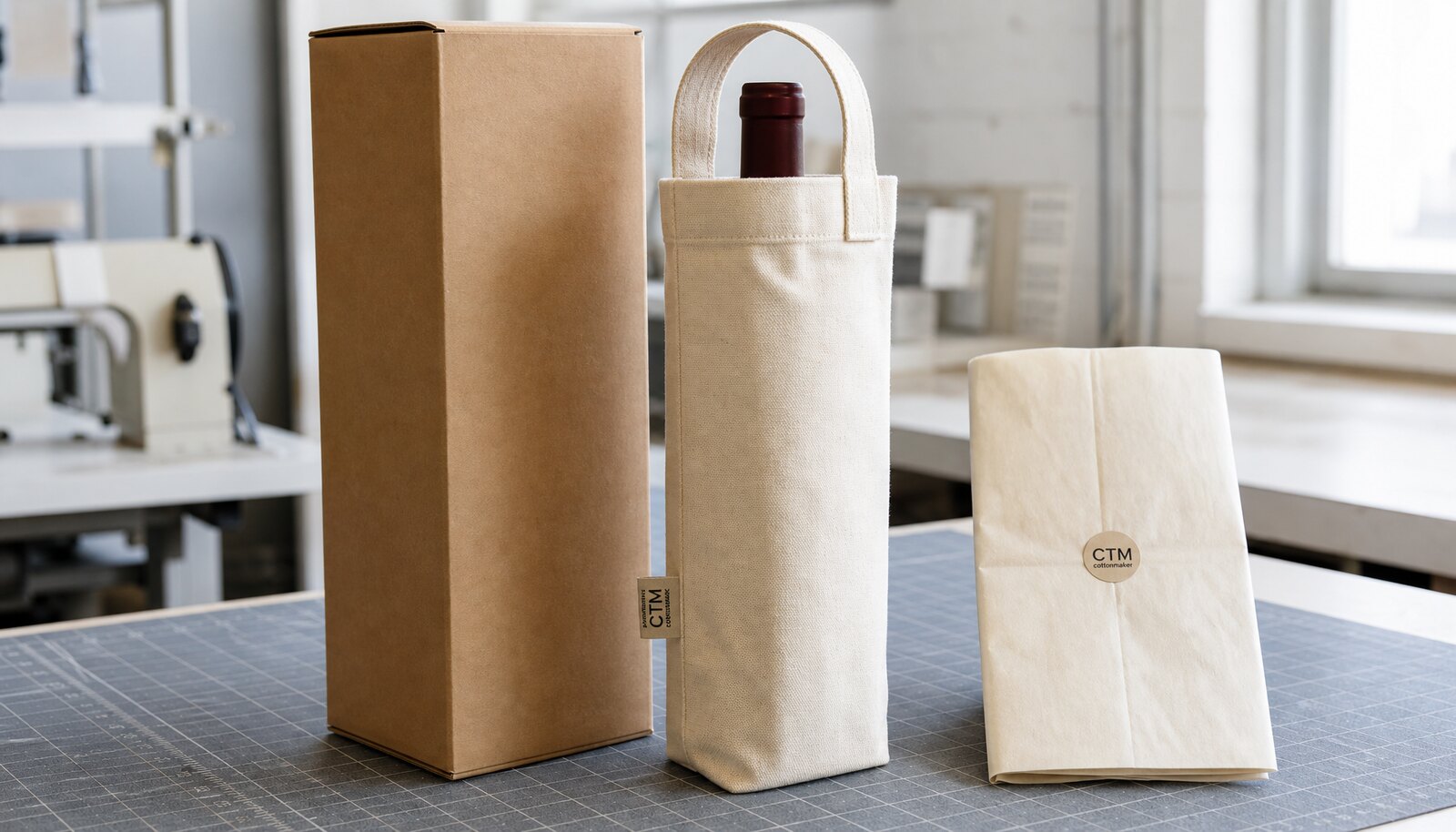
1) Begin with the receiving scenario, not the bag pattern
For custom canvas wine carriers, the first sourcing decision is not the print method or even the canvas weight. It is where the carton lands, who opens it, and what condition they expect to see. Gift shops often receive cartons through a back room, a distribution center, or a small receiving dock with limited labor. If the packed carrier arrives wrinkled, over-compressed, or short-packed, the buyer sees a quality issue even if the sewing is technically fine. That is why carton planning belongs in the spec from the start rather than at the end of the order.
Treat the carrier and the master carton as one product system. The fold direction, logo placement, inner wrap, carton fill, and carton size all influence the finished result. A carrier that looks elegant flat can become bulky once handles, side seams, and reinforcement are folded into the pack. When the pack-out is designed properly, the receiving team gets cartons that are easy to count, the store gets shelf-ready presentation, and freight stays predictable.
A good rule for procurement is simple: the unit you buy is not only the bag, it is the bag plus the packing method plus the carton spec. If those three elements are not locked together, a small saving on the carrier can disappear into freight, damage, or labor later. For gift-shop assortments, that tradeoff usually does not pay back.
- State the receiving channel first: store DC, direct-to-store, or import warehouse.
- Set the fold so the logo never sits on the sharpest crease line.
- Keep a target gross carton weight that warehouse staff can handle safely and consistently.
2) Choose canvas weight by measured GSM and how the cloth behaves after sewing
Canvas labels are often used loosely. A supplier may call something “12oz” when the buyer really needs the measured GSM, the finished handfeel, and the way the cloth behaves after cutting, sewing, and packing. For many gift shop programs, 12oz canvas is the practical starting point because it gives enough body without creating a carton that becomes bulky or expensive to ship. If the assortment is meant to read more premium, or if you need better shape retention on display, 14oz can be the better choice.
Do not evaluate cloth by name only. Ask the factory for the actual GSM and, if possible, a swatch from the same dye lot or a production-grade lot close to the one that will be used. If the canvas is raw or lightly finished, ask whether pre-shrink control has been applied. Shrinkage matters because even a small change in width or length can move the print position, alter the fold, and create carton fit problems after steaming, transport, or humidity change.
The right weight depends on the sale story. A promotional gift-shop bag can use lighter 12oz canvas and still look clean. A premium holiday set or branded reusable carrier may justify 14oz because the buyer wants a stiffer, more substantial feel. Ask the factory to quote both the nominal fabric weight and the expected finished behavior after sewing and packing. That is more useful than a vague claim of “good quality.”
- 12oz canvas is usually the best balance of structure, packability, and cost.
- 14oz canvas is better for premium presentation and shape retention.
- Always request measured GSM plus a production-grade swatch, not only a catalog photo.
3) Build the print spec around textured canvas, not flat-art assumptions
On canvas wine carriers, the artwork rarely behaves the way it does on paper or smooth polyester. Textured weave can soften small text, change edge sharpness, and make thin lines disappear after printing. Screen print is usually the most practical option for one or two spot colors because it is durable, repeatable, and cost-efficient. It also gives the buyer a more stable unit cost for repeat programs. If the logo is intricate, a detailed crest, or includes fine copy, verify whether the art remains legible at actual size on the real substrate.
Heat transfer is useful when detail matters more than long-term abrasion resistance, but it should be tested for fold marks, rub performance, and edge durability. Embroidery has premium appeal, yet it adds thickness and can create a raised area that affects folding and carton stacking. That does not make embroidery wrong. It simply means the buyer should know exactly what that choice does to the pack-out and freight cube. A raised logo can also leave compression marks if the carrier is packed too tightly.
A better print specification includes more than color count. State the logo size, placement relative to the top hem or fold line, minimum line thickness, acceptable registration tolerance, and whether the print must stay clear of seam bulk. If possible, request a folded sample rather than only a flat one. That single step catches many production issues before they become a shipment claim.
- Use screen printing for simple logos and stable repeat orders.
- Reserve heat transfer for artwork that truly needs fine detail.
- Treat embroidery as a premium option that must pass folding and carton-fit checks.
4) Put stitching, seam allowance, and reinforcement into the RFQ
A canvas wine carrier may look straightforward, but procurement risk is usually hiding in the seams. Do not accept generic language such as “strong stitching” or “reinforced bottom” without a measurable description. Ask the supplier to state the seam allowance, stitch density, and reinforcement method used at the handle anchors, bottom panel, and mouth opening. If the factory cannot name those details, it may not control them consistently in production.
For a custom gift-shop program, a practical RFQ asks for seam allowance in millimeters, stitch count per inch or per 3 cm, and the exact reinforcement patch or bartack structure at each stress point. The finished sample should be checked at the handle base and bottom fold because those are the failure points most likely to show up during retail handling. A bag that survives sitting on a shelf may still fail after repeated customer touch, bottle insertion, or carton compression.
The same logic applies to the opening and side seams. If the mouth opens too loosely, the carrier can look soft and lose its gift-ready shape. If the side seams are too tight or the allowance is inconsistent, the bag may twist after folding. The best suppliers are usually comfortable showing a close-up sample photo of the seam, the inside finish, and the reinforcement method before bulk production starts.
- Ask for seam allowance in mm and stitch density in a measurable format.
- Check handle anchors, bottom fold, and side seams as separate stress zones.
- Require a close-up seam photo before approving bulk production.
5) Compare suppliers on the packed unit, not just the bag price
The most useful supplier comparison is not a price list. It is a matrix that shows how each source handles fabric spec, print logic, carton planning, and sample discipline. If one factory gives a low unit price but cannot confirm carton dimensions, and another is slightly higher but provides pack-out photos and test references, the lower quote may not be the better procurement choice. Gift-shop programs are sensitive to shelf appearance and inbound condition, so quote discipline matters as much as headline price.
The comparison table below is the kind of field set buyers should request or build internally. It makes the hidden variables visible: fabric GSM, pack quantity, carton dimensions, and the cost impact of each choice. That gives procurement a way to compare landed cost instead of only ex-works price. It also helps prevent the common situation where the cheapest source creates the most expensive carton, the heaviest freight charge, or the highest receiving risk.
When suppliers respond to the same fields, the differences become easier to spot. Some factories are strong at sewing but weak on pack engineering. Others can manage cartons well but struggle with print consistency. A buyer who sees those tradeoffs early can choose the right source for the channel rather than discovering the gap after the PO is placed.
- Compare landed cost fields, not just ex-works price.
- Require each supplier to quote the packed unit, not only the carrier.
- Use the same spec revision across all quotes so the numbers are truly comparable.
6) Make sample approval prove the whole workflow
A meaningful sample is more than a finished bag. It should prove the fabric, print, stitching, fold behavior, carton fit, and labeling flow. For custom canvas wine carriers shipping to gift shops, the pre-production sample should use final artwork, final fabric choice, final label placement, and the real packing method intended for mass production. If the sample is approved in a different fold direction or with a different inner wrap, it cannot be trusted as a production reference.
The sample review should include both flat inspection and packed inspection. Look at print sharpness on textured canvas, logo position after folding, seam symmetry, and the way the carrier sits inside the carton. Ask the factory to send a pack-out photo showing one finished unit and a full carton view with the count visible. This sounds basic, but it catches a surprising number of packing mistakes before bulk shipping begins.
If the program matters to a holiday shelf or a promotional launch, compare the sample photos against the physical sample and against the spec sheet side by side. Buyers should also verify that sample photos are from the actual approved sample, not a different style or older revision. That is one of the simplest ways to avoid spec drift between approval and production.
- Approve the sample in the same fold direction used for production packing.
- Check the logo after fold, not only on a flat decorated piece.
- Require a pack-out photo and carton dimension note with every approval sample.
7) Treat MOQ as a function of setup, fabric lots, and assortment strategy
MOQ is rarely arbitrary. On canvas wine carriers, it is usually tied to fabric lot usage, print setup time, and the factory’s ability to keep the line efficient. A single spot-color logo on natural canvas is often easier to run than multiple seasonal artwork versions on dyed cloth. That is why the minimum order may change when you split colors, switch artwork, or ask for different labels. Expect that variation and ask for the logic behind it instead of treating it as a negotiation failure.
For gift shops, the better question is not “What is the lowest MOQ?” but “What MOQ still fits my sell-through and storage plan?” If the item is seasonal, a smaller run with a slightly higher unit cost can be better than overbuying and taking markdown risk. If the style is a core bestseller, the buyer may want a larger starting quantity in exchange for a better price break and a more stable reorder path. Ask the supplier to quote both the minimum and a realistic reorder tier so you can see the price curve.
Also ask how MOQ changes when you add a barcode sticker, hangtag, side label, or retail-ready wrap. Those extras can change packing time and labor cost more than the carrier itself. The quote should separate product cost from packaging labor so you can decide whether the retail presentation justifies the spend.
- One artwork version is usually cheaper than multiple seasonal versions.
- Natural canvas often gives more flexibility than custom dyed canvas.
- Request a price break at reorder quantity, not only at the first order.
8) Plan the shipping carton with real carton math, not a guess
This is the part that is most often underdeveloped in sourcing discussions. The carrier itself may be well made, but the carton plan can still fail if the packed thickness, fill material, and gross weight were never calculated against a real carton. A good carton plan starts with the finished folded carrier dimensions, then adds whatever inner wrap is used, then arrives at a master carton size that protects the product without wasting cube.
Here is a practical example buyers can adapt. Assume the carrier folds to about 27 cm high by 14 cm wide by 1.5 cm thick. If you pack 50 units flat with tissue or interleaf, the internal carton thickness must allow roughly 75 cm of stacked thickness plus a small amount of headroom for closure and light compression. Depending on fold direction and seam bulk, that may point to a carton around 55 x 35 x 33 cm internal or a nearby equivalent. The exact dimensions should be adjusted after a packed sample is measured, not before. The point of the example is to show the logic: unit thickness drives carton depth, carton depth drives cube, and cube drives freight.
The carton spec should also include board grade, closure method, carton marks, and whether the packed weight stays within safe handling limits. If the cartons will be stacked in transit, ask for a compression or stacking reference. If they will travel by ocean, ask whether the factory has a carton test method they use for similar goods. Even when a supplier cannot provide a formal lab report, they should still be able to explain how carton integrity is verified before shipment.
- Calculate carton depth from the folded unit thickness plus wrap and headroom.
- Measure the packed sample before finalizing carton dimensions.
- Confirm board grade, closure method, and safe handling weight on the quote.
9) Define QC with pass/fail thresholds, not only visual approval
Quality control for custom canvas wine carriers should be specific enough that the factory understands what passes and what fails. Visual review alone is not enough. Define tolerance on finished dimensions, stitch density, seam allowance, and print placement. If the program uses a branded logo, ask for a fold-and-rub test on the sample so the team can see whether the print cracks, smears, or loses edge clarity after handling. This is especially important on textured canvas, where small text can disappear quickly if the printing is too fine.
For a more rigorous QC plan, request the factory’s reference method for seam strength, colorfastness, odor, and carton compression. You do not need to invent a complex lab program for every order, but you should know what standard the factory uses and whether they can show a test report or at least a method reference. That matters because procurement teams need a way to compare one supplier’s claims with another’s. A promise of “good QC” is not actionable; a stated test method is.
A practical receiving checklist should include first-carton inspection, middle-carton spot checks, and last-carton inspection. Compare the first and last cartons for color, odor, print position, and thread quality. If the supplier cannot keep those consistent, the issue is not only cosmetic; it indicates process drift. For gift shop buyers, consistency across the whole run is part of the commercial product, not a bonus feature.
- Set tolerance ranges for dimensions, print position, and stitch density.
- Use a fold-and-rub test on the approved sample before bulk start.
- Inspect first carton, middle cartons, and last carton for consistency drift.
10) Verify factory capability before PO release
A capable factory should be able to show more than a catalog and a price list. Verify whether the supplier can actually make the style, pack it the way they claim, and maintain the carton dimensions they quote. Ask for sample-room photos, close-up construction photos of a similar item, and evidence that the factory has handled similar fabric weight and packaging complexity. If the factory sends a carton dimension on the quotation, ask whether that dimension was measured from a packed sample or estimated from the flat bag spec. That one question often separates a disciplined supplier from a rough guess.
The supplier should also be willing to explain how they audit carton specs before PO. For example: carton proof review, packed-sample confirmation, and final carton marking verification before mass packing. Buyers should request that carton specs be locked in writing once the sample is approved. If the supplier later wants to change carton size, quantity per carton, or closure method, the buyer should require a revised quote or written approval so the landed-cost math remains valid.
Another useful verification step is comparing sample photos against production references. Ask whether the sample photo was taken from the exact approved sample or from a similar product. That helps you detect misleading image reuse. Also ask for any available test reports or at least the test names used for colorfastness, odor, seam strength, and carton compression. The point is not to overwhelm the factory; it is to confirm they can support the claims they are making before your PO commits inventory dollars.
- Ask whether carton dimensions were measured from a packed sample or estimated from the flat pattern.
- Request sample-room photos and construction close-ups for similar products.
- Require written signoff on any post-sample carton or packing change.
Specification comparison for buyers
| Spec decision | Procurement field to lock | Recommended range or choice | When it fits | Buyer risk to check |
|---|---|---|---|---|
| Fabric weight | Measured GSM and finished ounce weight | 12oz canvas, roughly 350-410 GSM; 14oz canvas, roughly 430-500 GSM | 12oz for most retail gift shop assortments; 14oz for a firmer premium feel or better shape retention | Mill-to-mill variation can make the same nominal ounce weight feel different; verify by swatch and weighed sample |
| Fabric finish | Pre-shrink status, wash appearance, and dye lot control | Natural or dyed canvas with controlled shrinkage and consistent lot color | Brands that need clean retail presentation and reorder consistency | Uncontrolled shrinkage can shift print placement, change dimensions, and create carton fit issues |
| Print method | Color count, minimum line thickness, rub resistance target | Screen print for 1-2 spot colors; heat transfer for detailed art; embroidery only for premium positioning | Simple logos, seasonal gift sets, and repeat orders with stable artwork | Fine text and gradients may fill in on textured canvas; embroidery can create fold bulk |
| Carrier structure | Seam allowance, stitch density, and reinforcement points | Bottom seam allowance around 8-10 mm with reinforced handle and stress points | Single-bottle sleeves and retail display products | Weak seams or shallow reinforcement can fail in handling and carton stacking |
| Carton pack style | Flat-pack thickness, tissue/interleaf, and master carton quantity | Flat-packed with tissue or interleaf; packed qty set to control cube and weight | Imports, DC-bound shipments, and gift shop replenishment | Over-compression can crease prints; under-packing wastes cube and raises freight |
| Carton dimensions | Finished folded size, clearance, and gross weight | Quoted from the actual packed unit, not the flat bag size | Any order shipping by ocean, air, or mixed warehouse distribution | If the carton spec is guessed, freight and receiving issues follow |
| MOQ route | MOQ by color, artwork, and fabric lot | One approved sample plus production MOQ tied to artwork complexity | Seasonal runs and reorderable core designs | Low MOQs can hide setup charges; high MOQs can create excess stock |
| Supplier type | Factory identity, testing access, and carton engineering capability | Direct manufacturer with sample room, QC process, and pack-out support | Buyers who need spec control and repeatability | Trading routes may not control the actual factory or carton dimensions |
| Compliance focus | Colorfastness, odor, seam strength, and carton compression | Request test references and method details before PO | Retail channels with receiving standards | Missing test data can trigger holds, chargebacks, or rework |
Buyer checklist before sampling
- Lock the bottle size range first: standard 750 ml, Burgundy, champagne, or mixed bottle fit changes the carrier width, depth, and carton count.
- Approve fabric weight by measured swatch, not by marketing name alone: request GSM, finished ounce weight, and a production-grade sample from the same or nearest lot.
- Specify the logo constraints in writing: color count, minimum line thickness, edge distance from fold lines, and acceptable registration tolerance.
- Define reinforcement details: seam allowance, stitch density, handle attachment, and bottom reinforcement should be stated before sampling.
- Set pack-out rules before sample approval: flat pack or stuffed pack, tissue or interleaf, inner polybag or paper wrap, and master carton quantity all affect freight and presentation.
- Request a pre-production sample with real artwork placement, actual folding method, and the final carton size before bulk production starts.
- Confirm carton performance before PO release: carton dimensions, board grade, stacking or compression target, carton markings, and pallet pattern if applicable.
- Ask for first-carton and last-carton QC photos during production so you can compare consistency across the run.
- Verify the factory can show test reports or at least test-method references for seam strength, colorfastness, odor, and carton compression.
- Match the quote to the exact packed unit: carrier spec, inner wrap, carton count, gross weight target, and destination receiving requirement should all be on the same revision.
Factory quote questions to send
- What canvas GSM and finished ounce weight do you quote, and is the fabric pre-shrunk or raw? Please state the tolerance range, not just the nominal number.
- Can you send a measured fabric swatch photo with scale reference and a note on dye lot or batch consistency?
- What print method do you recommend for my artwork, and what are the setup charge, color limit, and minimum line thickness you can hold on canvas?
- What are the seam allowance, stitch density, and reinforcement details on the carrier? Please show where the handle and bottom are stress-tested.
- What exact folded dimensions, carton dimensions, quantity per carton, and gross weight do you plan for this style?
- Can you provide a sample pack-out photo showing the finished carrier, tissue or interleaf, carton fill, and carton closure method?
- What is your MOQ by color, by artwork version, and by fabric lot, and how does the unit price change if we split designs?
- What is the lead time for sample approval, bulk production, carton proof approval, and shipment booking? Please separate each stage.
- What QC checkpoints do you include for stitch strength, print registration, odor, dimensions, and carton integrity?
- Can you share any available test reports or test-method references for colorfastness, seam strength, compression, or odor control?
Quality-control points to confirm
- Finished carrier dimensions within the agreed tolerance so it fits the intended bottle type after folding and packing.
- Canvas weight verified against the approved swatch by measured GSM or finished ounce weight, not by description alone.
- Seam allowance visible and consistent, with stitch density matched to the approved sample and no loose threads at stress points.
- Handle attachments and bottom reinforcement intact after a basic pull check and a 10-cycle open/close handling check on samples.
- Print position aligned to the fold plan, with no obvious cracking after fold-and-rub testing on the approved sample.
- Color consistency checked against the approved reference under daylight-equivalent light, with no obvious shade drift between sample and bulk lots.
- Odor check performed on first-carton and last-carton inspections; no strong chemical smell, oil stain, or mildew note accepted.
- Carton size matches the packed sample and carton board grade is documented; carton closure must hold without bulging or crushing.
- Carton compression or stacking method confirmed by the supplier’s stated test approach or equivalent packaging reference before shipment.
- Packed unit count per carton matches the carton plan, and gross weight stays within the booking range for the chosen freight mode.