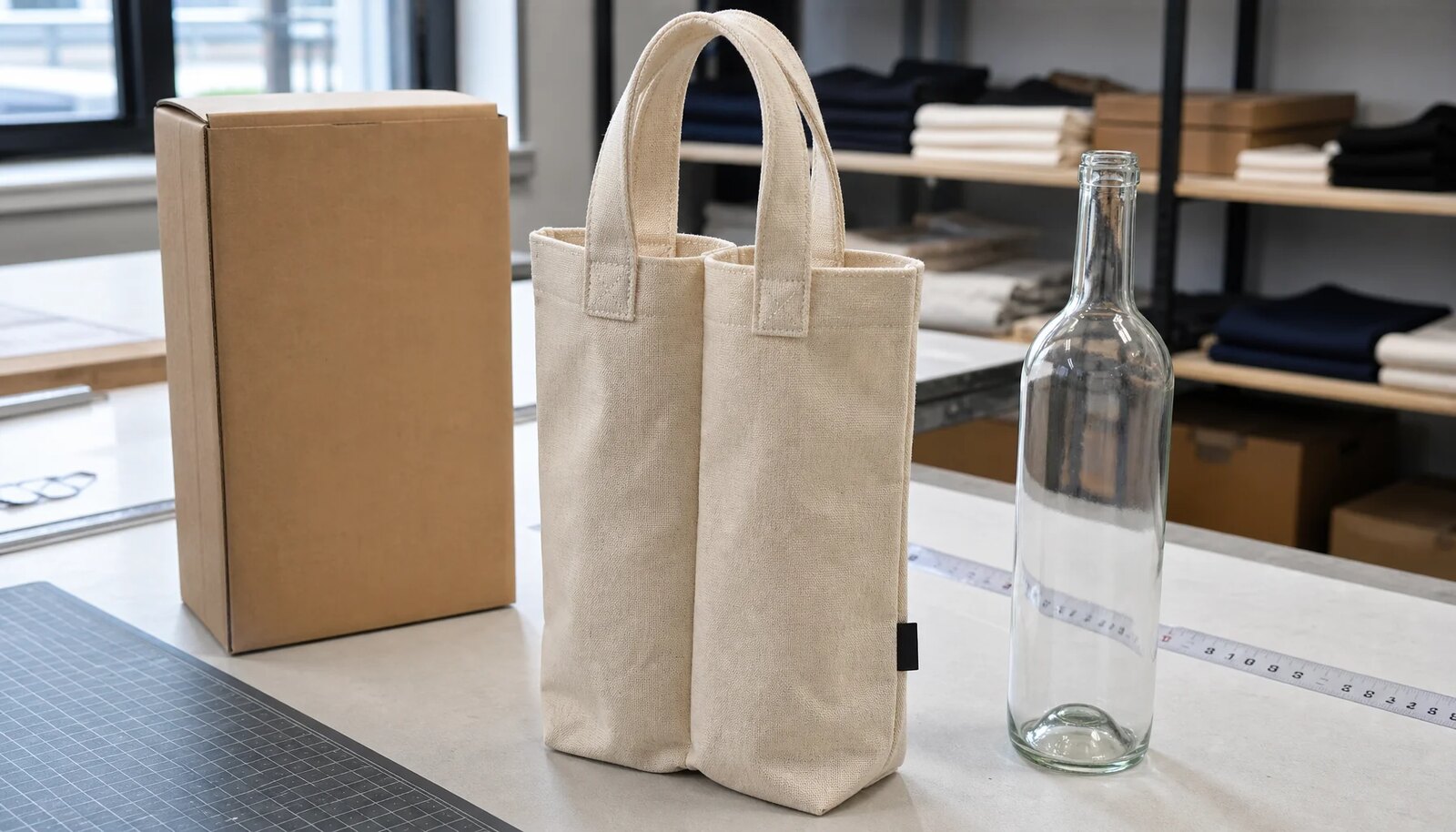
Start With The Event Delivery Problem
For event planners, the real issue is not only how the canvas wine carrier looks on a shelf. It is how the goods arrive, how fast staff can count them, and whether the order survives venue handling without repacking. A carrier that ships well in one carton format can become expensive the moment the carton size is wrong, the bundle count is unstable, or the labels are unclear. If the event team is receiving 800 units across three venues, even a small mistake in pack count can create a labor problem that costs more than the product margin.
That is why carton planning belongs at the same stage as fabric selection and logo approval. Before you request a final quote, lock the bottle count per carrier, the destination type, the receiving window, and the way the event team will distribute stock. If the supplier knows the goods are going to a hotel loading dock, a winery, or a conference venue, the carton plan changes. Ask for a finished product size, folded size, inner pack count, master carton size, and carton weight in the first quote round, not after the bulk order is already approved.
- Define the actual delivery point: warehouse, venue, or kitting partner.
- Match carton count to how staff will unload and stage the order.
- Treat carton size as a freight decision, not just a packing detail.
Choose Fabric Weight For The Use Case
Most custom canvas wine carriers fall into three practical weight bands. Around 10 oz or 340 GSM is light and economical, and it works when the carrier is mainly promotional and not expected to hold shape on its own. Around 12 oz or 400-420 GSM is the safest middle ground for most event programs because it gives enough body for bottle protection without creating excessive bulk. Around 14 oz or 470 GSM and above starts to make sense when the buyer wants a premium feel, a long reusable life, or a more structured carrier with a bottom insert or divider.
The wrong weight changes the carton plan as much as it changes the hand feel. Light canvas packs flatter, but it can look limp if the bottle insert or divider is heavy. Heavy canvas looks stronger, but it increases folded thickness, raises CBM, and may force fewer units per carton. If the carrier has a stitched divider, bottom board, or lining, include those in the weight calculation because they alter compression and fold memory. For importers and brand buyers, the safest rule is to specify the fabric weight as a range and then approve the exact mill swatch before bulk cutting starts.
- 10 oz or 340 GSM for simple promo use and tight freight budgets.
- 12 oz or 400-420 GSM for the most balanced event and retail programs.
- 14 oz or 470 GSM plus for premium reuse, structure, and heavier inserts.
Build The Carton Math Before You Quote Freight
The carton plan should start with the folded carrier size, not the shipping carton size. Ask the factory to measure the carrier after folding, including the thickest point where seams, handles, or dividers stack together. Once you have that number, the factory can propose a unit count per inner pack and per master carton without guessing. For example, a two-bottle carrier that folds to roughly 31 x 23 x 3 cm may pack 24 pieces per export carton if the carton is sized around 64 x 34 x 38 cm. That kind of line item matters because freight is charged on volume, not only on count.
A quote that only lists unit price is not enough for an event order. Ask for the gross weight, carton dimensions, cartons per pallet if applicable, and total CBM by style and color. If the carrier is going by air, folded thickness becomes a cost driver immediately; if it is going by sea, carton stacking and pallet height matter more. As a buyer, you want a quote that makes it obvious whether the factory is packing efficiently or simply stuffing cartons until they fail. Good carton math prevents both damage and surprise freight charges.
- Use the folded size to determine pack count, then back into the carton size.
- Request gross weight and CBM per carton, not only total piece count.
- If possible, get two pack options so you can compare freight efficiency.
Compare Sourcing Routes, Not Just Suppliers
The best sourcing route depends on how much control you need over packing and how many hands will touch the order before it reaches the event. A direct factory is usually the cleanest choice when the buyer wants a fixed carton plan, stable branding, and repeat orders. A trading company can be useful when the event kit includes more than one product type and someone has to consolidate different factories into one shipment. A local kitter is practical when the event program needs final assembly close to the venue, but that convenience comes with extra handling and another point where quantities can drift.
The comparison table below is meant to stop suppliers from quoting only the product and ignoring the shipping structure. Buyers often focus on the carrier spec and forget that the carton route changes cost, lead time, and damage risk. For example, a heavier canvas can be a smart product choice, but if the cartons are too large or the supplier is packing mixed SKUs, the freight bill can erase the value of the spec upgrade. The right supplier is the one who can prove the order will ship in a controlled, repeatable format.
- Use a direct factory when the carton plan must be repeatable across events.
- Use a trading company when multiple SKUs need one shipment and one paperwork set.
- Use local kitting when the final pack-out must happen near the venue.
Lock Print And Construction Details That Survive Packing
For canvas wine carriers, screen print is usually the most straightforward logo method because it is durable, readable, and predictable in production. A woven label works well when the buyer wants quieter branding and does not want ink coverage on the body of the carrier. Embroidery can look premium, but it also adds bulk and can affect fold height if it is placed in the wrong spot. Heat transfer is fine for short runs or complex art, but it is the least forgiving when the carrier will be folded, stacked, and rubbed against carton walls during transit.
The construction details matter just as much as the logo. Handles should have reinforcement where the load transfers into the body, and bottle dividers should be stitched so they do not curl after folding. If the carrier includes a bottom board or side insert, tell the factory whether those pieces stay inside the carrier during shipment or are packed separately. A buyer should ask for a sew map or construction sketch when the style is new. That document makes it easier to catch problems like a logo crossing a seam, a handle stitch line interfering with the fold, or an insert that adds more thickness than the carton plan allows.
- Use screen print for most event logos unless the art forces another method.
- Place embroidery or thick patches away from the main fold line.
- Ask for a sew map when dividers, boards, or liners change the fold profile.
Set QC Thresholds In Writing
Quality control for event orders should be written as a shipping-ready standard, not a generic garment inspection note. The factory should know the acceptable dimension tolerance, the seam quality target, the allowable shade variation, and the allowed level of print misregistration. If the order is for a conference gift or winery event, even a small defect rate can become visible because the same style is stacked in large quantities and handled in front of guests. A sloppy handle stitch or a misaligned logo is not a minor issue when the product is part of a branded event experience.
For practical control, make the sample do the same work the bulk order will do. Load the carrier with the actual bottle size, close it, fold it, and place it into the proposed carton. Then stack the cartons the way the venue or warehouse will stack them. If the carton crushes, the carrier springs open, or the print rubs against the carton wall, the design is not ready. That is a packaging failure, not a cosmetic one. The QC list in this article should be copied into the PO or pro forma so the factory knows what is actually being accepted.
- Inspect dimensions, stitching, print alignment, and odor on the first article.
- Test the carrier with the real bottle or insert, not a dummy object.
- Treat carton crush, stack stability, and rub resistance as acceptance criteria.
Approving Samples Without Burning Time
A sample should answer three questions at once: does the carrier fit the bottle, does it look right with the logo, and does it pack efficiently? Too many buyers approve a flat artwork proof and then discover later that the folded carrier is too thick, the handle gap is wrong, or the logo sits on a crease. Ask for a pre-production sample whenever the style is new or the carton plan changes. If the schedule is tight, at minimum get a photo sample with actual material swatches, thread color, and a measured carton spec attached to it.
The sample approval step should be tied to the event use case. If the carrier is for a tasting room giveaway, the check can be lighter. If it is for a corporate gala or hospitality kit, the standard should be stricter because the product will be seen in public and likely reused. Test the opening width, bottle retention, fold memory, and how quickly a packer can close the carton without forcing the product. A good sample process catches issues before bulk cutting. A rushed approval usually creates repacking, and repacking is where event budgets get burned.
- Approve on real bottles, not just artwork and fabric swatches.
- Use photo samples only if the geometry and materials are already proven.
- Tie final approval to both appearance and pack-out speed.
Packing Rules That Reduce Venue Mistakes
Packing instructions should be specific enough that a second factory could follow them without interpretation. Tell the supplier whether each carrier needs an individual polybag, tissue wrap, or no individual wrap at all. For many event orders, a clean master carton is better than over-packaging because the goods are moving from a carton directly into a venue or kitting line. But if the canvas surface is light-colored, a simple protectant layer may prevent scuffs from carton friction. The decision should be deliberate, not automatic.
Labeling is where event shipments either stay organized or become a labor problem. Each carton should show style, color, quantity, and destination name in a format the receiving team can read quickly. If there are multiple venues, the carton mark should identify which boxes belong to which site or room block. If the order contains retail units and event stock, keep them separated at the carton level so the receiving team does not open the wrong box. Good packing does not just protect the carrier; it cuts receiving time and reduces the chance that a venue team sorts the order incorrectly.
- Decide on individual wrap only if the surface or finish needs protection.
- Mark each carton with style, color, quantity, and destination code.
- Keep venue-specific cartons separate from retail or sample stock.
Read A Factory Quote The Right Way
A useful factory quote for custom canvas wine carriers should include more than the unit price and a lead time estimate. It should show fabric weight, logo method, dimensions, carton count, gross weight, CBM, sample cost logic, and the packing standard the factory used to calculate the quote. If those details are missing, the buyer is not comparing like with like. Two quotes can look close on price and still produce very different landed costs because one factory packs 24 units per carton while another packs 36, or because one uses a thick insert that doubles the volume.
When you compare quotes, ask yourself whether the low number comes from a real production advantage or from hidden assumptions. A cheaper quote may omit carton printing, understate the fabric weight, or ignore the extra time needed for sample approval. The right way to compare is to convert each offer into landed cost by route, including freight, import handling, and any kitting or rework. If your event order is large enough, it is worth requesting two packing options from the same factory so you can compare a dense export pack against a more retail-friendly pack. That gives you a real basis for the sourcing decision instead of a speculative one.
- Do not compare unit price without carton size, gross weight, and CBM.
- Ask for at least one alternative pack-out if freight cost is critical.
- Compare total landed cost to the venue or warehouse, not only factory EXW.
Specification comparison for buyers
| Spec decision | Recommended option | When it fits | Buyer risk to check |
|---|---|---|---|
| Direct factory export packing | Use the sewing factory to pack, label, and cartonize final goods | Best for repeat event programs, stable artwork, and one destination lane | Small factories may quote product only and ignore carton strength or pallet rules |
| Trading company consolidation | Use a consolidator when the order includes multiple SKUs or vendors | Useful when the event kit needs carriers, bottles sleeves, inserts, and other items in one shipment | Packing lists can drift between factory and consolidator if carton control is weak |
| Local kitting after import | Ship bulk carriers to a domestic kitting partner for final assembly | Fits last-mile venue delivery, mixed inserts, and changing attendee counts | Double handling increases scuffing and can create late repack costs |
| 12 oz / 400-420 GSM canvas | Standard weight for most canvas wine carriers | Works for 2-bottle and many 4-bottle event programs without excessive bulk | If the cloth is too limp, the carrier collapses and carton count becomes unstable |
| 14 oz / 470+ GSM canvas | Heavier canvas for premium retail and reusable gift sets | Best when structure, hand feel, and long reuse matter more than freight efficiency | Bulkier fabric increases CBM and can make fold lines harder to close in cartons |
| Screen print with one or two colors | Use for clean logos, event names, and larger brand marks | Best for mid-volume runs with strong contrast and predictable placement | Ink can crack or smear if the print crosses a heavy fold or seam |
| Woven label or embroidered patch | Use for understated branding and premium positioning | Fits buyers who want a subtle logo that survives repeated handling | Extra thickness can interfere with folding and reduce units per carton |
| Flat-fold master carton with fixed unit count | Standardize one pack count per carton, then tune carton dimensions around it | Best for export, venue receiving, and easy inventory counts | Underfilled cartons crush, while overfilled cartons split seams or distort dimensions |
Buyer checklist before sampling
- Confirm bottle size, bottle count per carrier, and whether the carrier must accept standard 750 ml, magnum, or mixed bottle diameters.
- Lock fabric weight in oz and GSM, plus any lining, insert board, or divider requirement before asking for pricing.
- Approve the logo method, logo position, and color tolerance against the exact artwork file and a real fabric swatch.
- Request finished dimensions, folded dimensions, units per inner pack, units per master carton, carton size, gross weight, and total CBM.
- Specify whether cartons go to a warehouse, event venue, or kitting partner, because delivery rules change stacking and labeling needs.
- Ask for a pre-production sample, then test it with the actual bottle type and any gift insert planned for the event.
- Set carton marks, barcode format, and venue routing labels in the PO so the factory does not invent its own marking system.
- State the acceptable defect level for stains, loose stitching, misprints, and broken handles before bulk starts.
Factory quote questions to send
- What exact fabric weight are you quoting, in oz and GSM, and is the cloth prewashed or raw?
- How are the handles constructed, and what stitch pattern or reinforcement is used at the stress points?
- What is the finished folded size, the master carton size, the units per carton, the gross weight, and the CBM per carton?
- Which logo method is included in the quote, and where is the logo placed relative to the fold line or seam?
- What is your MOQ per color and per print color, and does carton printing have a separate minimum?
- Can you provide a pre-production sample or photo sample with the actual fabric, trim, and print method?
- What are the sample lead time, bulk lead time, and any extra time needed for carton printing or special packing?
- What inspection standard do you use for seam strength, print quality, and carton drop or compression testing?
Quality-control points to confirm
- Finished dimensions should stay within an agreed tolerance, typically around plus or minus 3 mm on key measurements.
- Fabric weight should match the quoted oz or GSM range, not just a marketing description like heavy canvas.
- Handle stitching and bartacks should be even, tight, and free from skipped stitches at the load points.
- Logo placement should stay within the approved artwork position and should not cross a fold unless that was explicitly approved.
- Print should resist light rubbing after folding and packing, with no obvious transfer, cracking, or smearing.
- The carrier should fit the target bottle or insert without forcing the seam open or deforming the base.
- Carton compression should be strong enough for stacked export or venue storage without crushing the contents.
- Each master carton should match the packing list, carton mark, and SKU code exactly, with no mixed counts unless approved.