1. Put carton planning into the RFQ, not the final email
A custom canvas wine carrier is not just a small sewn bag with a logo on it. For a coffee roaster, it may be retail packaging, gift packaging, delivery packaging, and branded merchandise at the same time. The sourcing decision touches bottle fit, shelf appearance, print durability, carton compression, warehouse receiving, and freight cube. If the carton plan is treated as an afterthought, a low unit price can turn into extra labor at the destination.
The problem usually shows up after shipment. Gussets arrive flattened. Mouth openings bend inward. Handles twist. Printed panels rub against neighboring bags. Staff then have to sort, reshape, steam, repack, or quietly use the worst pieces for non-retail purposes. Those recovery costs rarely appear in the original quote comparison, but they are real procurement costs.
Coffee roaster programs are often tied to fixed dates: holiday gift sets, bottled cold brew launches, winery collaborations, subscription add-ons, corporate gifting, tasting room retail, and limited seasonal bundles. A delayed or messy receiving process can disrupt the launch calendar. That is why pieces per inner polybag, pieces per master carton, carton dimensions, gross weight, folding direction, and shipping mark layout should be requested at RFQ stage.
For B2B buyers, the target is not simply the cheapest ex-works bag. The stronger target is a repeatable specification that can be sampled, inspected, shipped, received, stored, and reordered without surprises. The carton plan belongs in that specification because it affects landed cost and product condition.
- Request carton dimensions, gross weight, inner packing, and master carton count with the first quotation.
- Treat folding direction, carton count, and inner polybag quantity as controlled specifications.
- Do not approve only a loose table sample; review the bag after folding and light compression.
- Compare suppliers on the same packing basis before accepting the lowest unit price.
- Keep approved packing photos in the PO file for inspection and reorders.
2. Start with the bottle, then design the carrier around it
Many RFQs begin with a reference photo and an artwork file. That is a weak starting point for bottle carriers. A 750 ml Bordeaux bottle, Burgundy bottle, sparkling wine bottle, square syrup bottle, glass cold brew bottle, concentrate bottle, and coffee liqueur bottle can all behave differently inside the same canvas bag. Height, maximum body diameter, base diameter, shoulder slope, cap width, and total filled weight all matter.
The specification should also say whether the carrier holds only a bottle or a full gift set. A bottle plus a 250 g coffee pouch, tasting card, corkscrew, chocolate bar, small jar, retail insert, or hangtag changes the gusset, usable width, bottom stability, and carton bulk. If the destination team will assemble the set, the empty carrier needs to arrive easy to open and quick to load. If the bag will be sold empty as merchandise, folded shape and top-edge presentation may be more important.
Loaded weight deserves a clear number. A single filled glass bottle can be roughly 1.2-1.6 kg depending on the bottle and contents. A two-bottle gift set can exceed 2.5-3.0 kg before accessories are added. These loads are manageable, but they concentrate stress at the handle joins, side seams, bottom corners, and any divider. Without a target load, a factory may quote a promotional sleeve rather than a true retail gift carrier.
When fit is critical, send the actual bottle or a dimensionally matched dummy to the supplier. Dimensioned photos help, but they cannot fully show shoulder shape, glass base radius, cap protrusion, or loading friction. A real fit test prevents many sample-round arguments.
- Provide bottle height, maximum body diameter, base diameter, shoulder shape, cap or cork diameter, and filled weight.
- State whether the bag holds one bottle, two bottles, or a bottle plus coffee pouch or accessory.
- Clarify whether the carrier must stand upright when empty, when loaded, or not at all.
- List tissue paper, divider, insert card, hangtag, barcode label, and retail display needs.
- Approve fit using the actual bottle or a dimensionally accurate dummy for important launches.
3. Specify internal usable dimensions, not just lay-flat size
Lay-flat dimensions can be deceptive. Canvas thickness, seam allowance, top hems, boxed bottoms, folded side gussets, and reinforcement stitching all reduce the space the bottle can actually use. This matters more for rigid glass than for soft goods. A pouch can squeeze into a tight bag; a bottle cannot.
A strong procurement spec separates three ideas: finished external dimensions, finished internal usable dimensions, and cutting dimensions before sewing. Buyers usually do not need to manage cutting dimensions, but they do need to approve the internal width, internal height, and finished gusset depth. For a boxed-bottom wine carrier, ask the factory to measure the opened bag, not only the flattened bag.
The top opening needs its own check. A folded hem can narrow the mouth. Heavy canvas may pull inward after sewing. Sometimes the body of the carrier is wide enough, but the bottle shoulder catches at the opening and slows loading. That becomes a real labor issue when a roaster is assembling hundreds or thousands of gift sets.
Set tolerances before inspection. For sewn cotton canvas, +/- 5 mm may be workable for simple dimensions or logo placement. For heavier canvas, gussets, or hand-fed sewing operations, +/- 10 mm may be more realistic. The important point is to define measurement points and methods before production. Otherwise, one side may say the bag fits while the other rejects it for looking strained.
- Specify internal usable width, internal height to the top edge, and finished gusset depth.
- Ask for measurement photos with the bag opened, not only laid flat on a table.
- Define where dimensions will be measured during inspection.
- Check whether the top hem reduces the practical loading width.
- Include a loaded fit photo in the approved sample record.
4. Choose canvas weight with GSM, structure, and carton bulk in mind
Canvas is often quoted in ounces, but procurement teams should ask for GSM as well. In textile sourcing, oz commonly refers to fabric weight per square yard, and finishing can change handfeel and measured weight. For many single-bottle custom canvas wine carriers, 12 oz to 14 oz cotton canvas is a practical starting range, often approximately 340-475 GSM depending on the mill and finishing. It usually gives enough structure for retail presentation without creating excessive seam bulk.
A 10 oz canvas can be acceptable for lighter promotional programs, empty merchandise bags, or low-load sleeves. It should still be tested with the real bottle. Lighter canvas may wrinkle faster, show fold memory after carton compression, distort around the shoulder, and put more visible strain on the side seam.
Heavier canvas, such as 16 oz and above, can feel more premium. It is not automatically the better procurement choice. Thick fabric slows sewing, builds bulk at handle joins and gusset corners, lowers the number of pieces that can be safely packed per carton, and increases gross weight. If the bags ship to multiple warehouses or pass through a 3PL, those carton and freight effects matter.
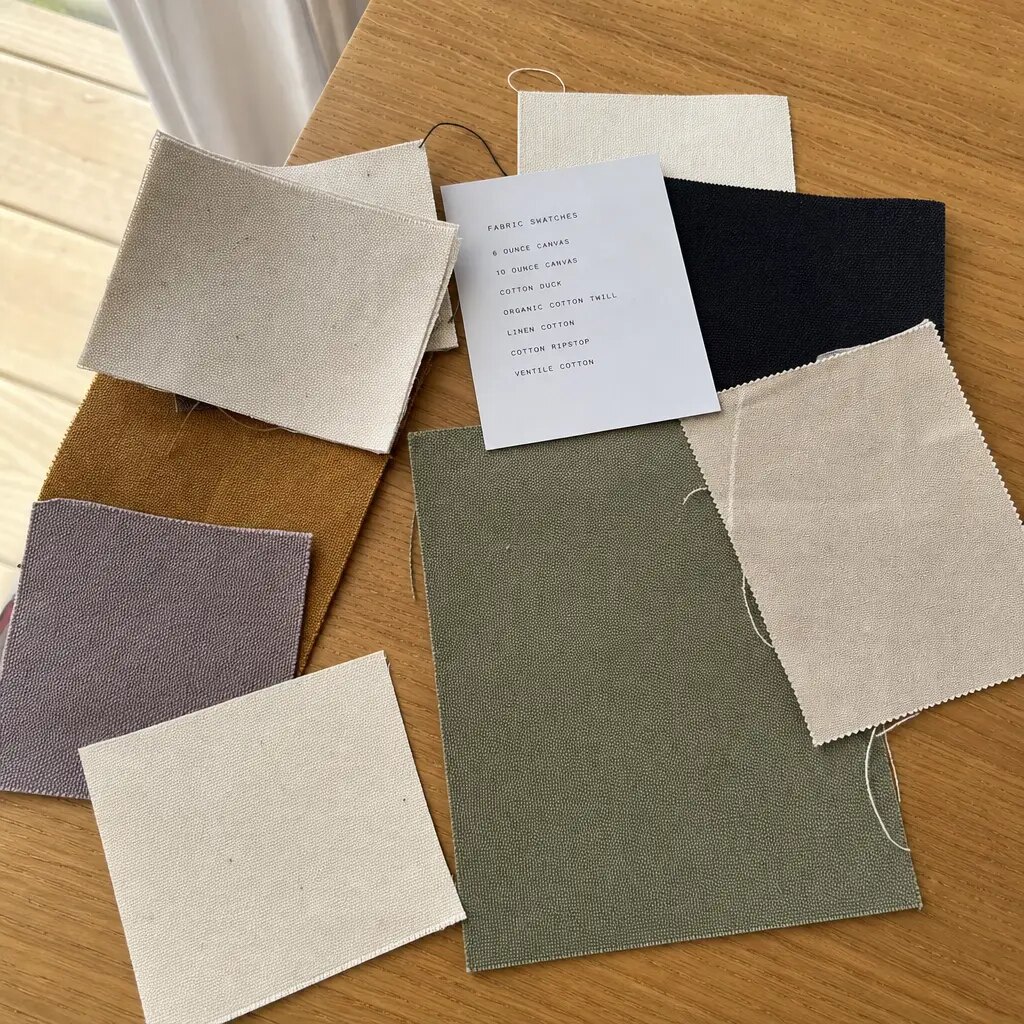
Color adds another layer. Natural canvas is usually easier to source and more forgiving in shade variation. Black, navy, burgundy, dark green, and custom dyed canvas can look more premium, but they require shade approval and print opacity checks. Dark fabric often needs a white underbase for light or bright logos, which adds cost and creates a thicker ink feel.
- Request both oz and GSM, plus fabric composition and finishing status.
- Use 12 oz to 14 oz canvas as a common starting point for retail bottle carriers.
- Test 10 oz canvas under load and after carton compression before using it for glass bottles.
- Expect 16 oz+ canvas to affect seam bulk, carton weight, and freight efficiency.
- Approve shade and print opacity on the final fabric, especially for dark canvas.
5. Write construction details that actually carry the load
A quote that says “canvas wine bag with logo” leaves too much open to interpretation. Bottle carriers concentrate force at predictable points: handle joins, side seams, bottom corners, and the divider if there is one. These areas should be described clearly so every supplier prices the same product and inspectors know what to examine.
Bottom construction is a major decision. A boxed bottom with a finished gusset commonly in the 8-10 cm range works for many standard bottle programs, though the correct depth depends on bottle diameter and accessories. A flat bottom may be cheaper and easier to fold, but it often gives weaker retail presentation. A removable or sewn-in base insert can add structure; it also adds cost, material control, assembly steps, and packing bulk. Many programs do not need an insert if the canvas weight and boxed construction are right.
Handles should be measurable. Common hand-carry widths are around 25-30 mm. Handle drop should match use; long shoulder handles are often unnecessary for bottle carriers and can make folding awkward. Insertion depth matters because shallow handles can pull out under load. Reinforcement should be named as box-X stitching, bar-tack, or another approved pattern rather than left to factory habit.
Two-bottle carriers need extra attention. A floating divider may cost less but can shift during loading. A divider sewn into the side seams is more stable, but it adds sewing steps and alignment risk. Decide whether the divider is mainly for protection, presentation, or organization, then test with both bottles loaded and the bag lifted by the handles.
- Define boxed bottom, flat bottom, side gusset, and whether a base insert is required.
- Specify handle material, width, drop, insertion depth, thread color, and reinforcement pattern.
- Request inside and outside photos of handle joins on the approved sample.
- For two-bottle styles, define divider attachment points and run a loaded balance check.
- Inspect top hem quality because uneven openings are visible in retail display.
6. Plan logo printing for canvas texture, folds, and curing
Screen printing is usually the practical choice for simple one-color or two-color coffee roaster logos on canvas wine carriers. It is cost-efficient at bulk quantities and works well on cotton canvas when the artwork is not too fine. Still, canvas is textured. It is not label stock. Fine lines, tiny type, tight registration, and large solid ink blocks may not look exactly like the digital brand file.
Heat transfer or digital printing can be useful for gradients, detailed illustrations, full-color artwork, or low quantities. These methods can look sharp on a flat sample, but they still need testing under the final folding and packing method. Transfers may crease, lift, or mark if packed too tightly. Digital prints may be sensitive to abrasion depending on ink system and pretreatment. Screen prints can also crack or show stress if a large solid area sits directly on a hard fold.
Color control should be realistic. Pantone references are helpful, but final appearance depends on canvas shade, ink absorption, fabric texture, underbase, and curing. Natural canvas may shift the perceived logo color. Dark canvas often needs a white underbase for opacity. That extra pass can increase cost and make the print feel thicker.
Print QC should include the packed condition, not only a flat strike-off. Ask the supplier to fold the printed sample in the proposed direction, keep it under light compression for 24-48 hours, and reopen it for photos. This simple check can reveal transfer, cracking, crease sensitivity, or logo placement conflicts before mass production begins.
- Use screen print for simple logos and repeat bulk orders.
- Use heat transfer or digital print only after checking fold, rub, and compression behavior.
- Confirm artwork size, Pantone target, underbase, ink type, curing method, and placement tolerance.
- Avoid placing large solid logos directly on the hardest fold line when possible.
- Approve a print strike-off on the final fabric color, not only a digital proof.
7. Compare quotes by the full procurement package
MOQ and price depend on more than bag size. Fabric color, fabric availability, construction complexity, print setup, labels, hangtags, and packing all influence the quote. A natural canvas single-bottle carrier with a one-color logo is easier to price than a custom dyed two-bottle carrier with divider, woven label, barcode sticker, individual polybag, and special carton plan.
Ask suppliers to separate cost lines where possible. The unit bag price is only one part of the purchasing package. Other lines may include sample fee, screen charge, print strike-off, lab dip, custom dye surcharge, woven label, hangtag, barcode label, individual polybag, stronger export carton, palletization, inland transport, and inspection support. When suppliers bundle these differently, the lowest unit price may not be the lowest landed cost.
Packing assumptions often explain price differences. One supplier may quote 100 pieces per carton with tight compression. Another may quote 60 pieces per carton with better shape protection and lower print abrasion risk. The first number looks cheaper until freight booking, carton bulging, warehouse labor, or retail presentation issues are considered.
Repeatability matters for roasters planning seasonal or recurring programs. If the product sells through, can the same fabric shade and weight be sourced again? Can the supplier keep the same carton dimensions and pieces per carton so warehouse slotting remains stable? Ask before the first order, not after the reorder becomes urgent.
- Compare quotes using the same fabric weight, color, construction, print method, and packing count.
- Clarify whether MOQ applies by style, artwork, fabric color, label, or total order quantity.
- Separate screen, sample, lab dip, label, packing, and carton upgrade charges.
- Ask whether carton data is estimated or based on an actual packed sample.
- Confirm whether repeat orders can keep the same fabric, print, and carton specification.
8. Build a carton plan that protects shape and controls freight data
A good export carton plan balances shape protection, manual handling, and freight efficiency. For many canvas bottle carriers, 10-20 pieces per inner polybag and 50-100 pieces per master carton is a practical planning range. The final count depends on finished dimensions, canvas weight, handle bulk, gusset structure, print size, and whether the carrier holds one bottle or two.
Carton weight should be discussed with the buyer’s warehouse or 3PL. Many operations prefer cartons that can be handled manually without strain, often keeping gross weight in a practical range such as under 15-20 kg unless equipment or local rules allow more. A heavier carton may reduce carton count but slow receiving, increase damage risk, or conflict with retailer handling requirements.
Folding method is just as important as carton count. Handles should be placed consistently. Printed faces should not rub heavily against each other unless the ink has passed abrasion checks. Boxed bottoms should not be crushed into sharp folds if the bag must stand neatly at retail. If the logo is sensitive, the plan may need alternating orientation, tissue interleaving, or a lower carton count. Those choices add cost, so decide them before mass production.
Carton board should match the route. A standard 5-ply corrugated export carton is common, while 7-ply or a defined board grade may be justified for long transit, heavy stacking, mixed-SKU pallets, or shipments moving through several warehouses. If the forwarder, retailer, or warehouse has requirements, specify edge crush, burst strength, label placement, maximum carton size, or maximum weight instead of relying on the vague phrase “export carton.”
- Define pieces per inner polybag, pieces per carton, fold sequence, and stack orientation.
- Set target gross carton weight and maximum carton dimensions if your warehouse requires them.
- Use actual packed carton dimensions for freight booking, not estimates from another bag style.
- Specify 5-ply or 7-ply carton requirements based on route and stacking risk.
- Approve shipping marks, SKU labels, barcode labels, carton count, and seal method before shipment.
9. Approve samples loose, loaded, and packed
A loose pre-production sample is necessary, but it is not enough. Custom canvas wine carriers are functional retail packaging items. They must fit the bottle, carry the load, show the brand cleanly, and survive shipping compression. Sample approval should include three references: the loose bag, the loaded bag, and the packed-condition setup.
The loose sample confirms canvas weight, fabric shade, handfeel, sewing, top hem, gusset shape, handle construction, divider, label, and print. Measure it using the same method planned for inspection. If the order is based on internal usable dimensions, ask the supplier to show measurement photos with the bag opened.
The loaded sample confirms function. Ask for insertion and removal photos or a short video using the actual bottle or dummy. The bag should not strain at the mouth, twist when carried, bulge heavily at the side seams, or lean in a way that looks unstable on shelf. If the final set includes a coffee pouch or accessory, test the complete set rather than the bottle alone.
The packed-condition sample confirms the shipping assumptions. The supplier should show fold sequence, inner polybag quantity, stack orientation, carton fill, carton sealing, carton dimensions, and gross weight. If a physical packed sample is not practical before mass production, detailed packing photos are still valuable. They become the reference when inspection opens cartons before shipment.
- Approve one loose sample for fabric, size, sewing, handles, divider, and print.
- Approve one loaded fit reference using the intended bottle or dummy.
- Run a basic hand-carry and standing test with the target contents.
- Review the printed panel after 24-48 hours of folded compression.
- Keep packing photos in the PO file so inspectors can compare production cartons.
10. Make QC criteria measurable and inspection-ready
Quality control works best when the acceptance criteria are measurable. For custom canvas wine carriers, the main inspection areas are finished dimensions, internal fit, handle symmetry, reinforcement stitching, seam integrity, bottom shape, print placement, ink curing, shade consistency, divider alignment, and carton packing. Put these points into the purchase order or quality file before production starts.
Dimension checks should include width, height, gusset, handle drop, and logo position. If the buyer specified internal usable dimensions, the inspector should also conduct a fit check with the intended bottle or dummy. A bag can measure correctly when flat and still become strained during loading; that should be treated as a functional issue, not a minor cosmetic comment.
Stitching inspection should focus on stress points. Handle joins should match the approved reinforcement pattern and show no skipped stitches, broken threads, or loose ends. Side seams and bottom gusset corners should be clean, closed, and strong enough for the target load. If the product is retail-facing, top hems and visible seam finishing matter because customers will notice uneven sewing immediately.
Print QC should cover placement, opacity, color, curing, and rub transfer. On textured canvas, tiny pinholes may be commercially unavoidable, but smearing, major misregistration, wrong placement, under-cured ink, or transfer to adjacent bags should be rejectable if outside the agreed standard. Inspectors should open random cartons and check printed surfaces after packing, not only samples pulled from the top of a stack.
Carton QC is part of product quality. Verify pieces per inner polybag, pieces per carton, carton dimensions, gross weight, board condition, sealing, shipping marks, and barcode labels. If the carton plan differs from the approved data, freight cost and receiving efficiency may be affected even when the bags themselves look acceptable.
- Use agreed tolerances for dimensions, handle drop, logo placement, and shade.
- Inspect with the actual bottle or dummy when fit is a critical function.
- Check handle reinforcement, bottom seams, side seams, divider attachment, and top hem.
- Open random cartons to inspect print condition after folding and compression.
- Record carton dimensions, gross weight, count, labels, and packing photos before shipment.
Specification comparison for buyers
| Spec decision | Recommended option | When it fits | Buyer risk to check |
|---|---|---|---|
| Canvas weight | 12 oz to 14 oz cotton canvas, approximately 340-475 GSM depending on how the mill defines ounces and finishing | Good commercial range for single 750 ml wine bottles, glass cold brew bottles, syrup bottles, coffee liqueur collaborations, and retail gift carriers requiring moderate structure | Do not compare oz only; ask for measured GSM, fabric composition, shrinkage/finishing status, and whether the fabric is greige, natural, dyed, or washed |
| Budget canvas option | 10 oz canvas, usually about 280-340 GSM | Can work for light promotional programs, empty merchandise bags, or low-load bottle sleeves where price and freight cube are the main priorities | May collapse more easily, show fold memory, distort around the bottle shoulder, and stress at the side seam when cartons are compressed |
| Premium canvas option | 16 oz canvas and above, often 475+ GSM | Useful for premium retail merchandise, higher perceived value, or programs where a structured handfeel is required | Bulkier seams, slower sewing, heavier export cartons, higher freight weight, and lower pieces per carton can offset the unit-price story |
| Finished sizing method | Specify internal usable width, internal height to top opening, and finished gusset after sewing | Required when the carrier must fit a specific 750 ml bottle, cold brew bottle, syrup bottle, concentrate bottle, or bottle plus 250 g coffee pouch | Lay-flat dimensions can be misleading because seam allowance, canvas thickness, boxed bottom construction, and top hem draw-in reduce usable space |
| Single or two-bottle format | Single-bottle carrier as default; two-bottle carrier only with a defined divider, load target, and carton compression check | Fits roaster holiday bundles, tasting room retail, wine-and-coffee collaborations, corporate gifts, and gift-with-purchase programs | Two-bottle styles increase seam load, divider variation, carton cube, handle stress, and print alignment risk; confirm divider attachment and balance under load |
| Bottom construction | Boxed bottom with a finished gusset commonly in the 8-10 cm range for many standard bottle programs | Helps the carrier stand when loaded and can support a bottle plus card, opener, pouch, or small accessory | A flat-bottom assumption may create unstable presentation; confirm finished gusset depth, corner sewing, and loaded standing photos |
| Handle construction | Self-fabric or cotton webbing handles, commonly 25-30 mm wide, with box-X stitching or bar-tack reinforcement | Suitable for hand-carry retail use where the carrier must feel sturdy without creating excessive packing bulk | Low-cost quotes may reduce insertion depth, use narrow tape, skip reinforcement, or create uneven handle drops; specify the construction exactly |
| Print method | Screen print for simple 1-2 color logos; heat transfer or digital print only when artwork detail, gradients, or low quantity require it | Screen printing is usually practical for coffee roaster branding on cotton canvas at bulk order quantities | Large solid ink areas can crack or scuff on folds; dark canvas may need a white underbase; confirm curing, rub resistance, and print placement tolerance |
| Inner packing | 10-20 pieces per inner polybag with an approved fold direction; use print-to-print protection only when needed | Keeps counting efficient and reduces random creasing during sea freight, air freight, and 3PL handling | Bulk loose compression can cause deep creases, warped mouths, twisted handles, print abrasion, and inaccurate carton counts |
Buyer checklist before sampling
- Define the exact contents: 750 ml wine bottle, bottled cold brew, syrup bottle, concentrate bottle, coffee liqueur, olive oil collaboration bottle, or mixed roaster gift set.
- Provide bottle height, maximum body diameter, base diameter, shoulder shape notes, cap/cork diameter, and target loaded weight; send a physical bottle or dimensionally matched dummy for fit testing when possible.
- Specify whether the carrier must hold one bottle, two bottles, or a bottle plus a 250 g coffee pouch, insert card, opener, chocolate bar, jar, or retail hangtag.
- State finished internal usable dimensions after sewing, not only lay-flat bag size, cutting size, or dimensions copied from a reference photo.
- Specify canvas in both oz and GSM, fabric composition, yarn/finish expectations where relevant, and whether the quote is for natural, bleached, stock dyed, black stock, or custom dyed canvas.
- Confirm whether the bag will be washed; most bottle carriers are not garment washed, but fabric finishing and shrinkage still affect size, handfeel, shade, and print adhesion.
- List handle material, width, finished drop, insertion depth, reinforcement stitch pattern, thread color, and whether handles must fold inward or outward for packing.
- Define bottom construction: boxed gusset, flat bottom, folded side gusset, inserted base support, or no support; request finished gusset depth and a loaded standing photo.
- Approve the print method based on artwork size, color count, canvas shade, fold exposure, ink handfeel, underbase needs, and rub-transfer risk.
- Provide Pantone or brand color references, but agree on a practical tolerance for textured cotton canvas and dark dyed fabric.
Factory quote questions to send
- What canvas weight are you quoting in both GSM and oz, and is the fabric 100% cotton, cotton-poly, recycled cotton blend, or another composition?
- Is the quoted fabric natural stock canvas, bleached canvas, stock dyed canvas, black stock canvas, or custom dyed fabric? If custom dyed, what is the dyeing MOQ and lab dip timeline?
- Is the quoted bag size based on finished internal dimensions, finished external lay-flat dimensions, or cutting dimensions before sewing?
- What bottle dimensions and maximum loaded weight is your quoted construction intended to support? Please state the test bottle or dummy size used.
- What is included in the handle construction: material, width, finished length, handle drop, insertion depth, reinforcement stitch type, and thread specification?
- Will the bottom be boxed, side-gusseted, flat, or reinforced with an insert, and what is the finished internal gusset depth after sewing?
- For a two-bottle carrier, is the divider floating, fixed at the base, sewn into side seams, removable, or fully integrated into the lining/construction?
- Which print method is quoted, and what artwork size, color count, ink type, curing process, underbase requirement, and placement tolerance does the price assume?
- For dark canvas, does the quote include a white underbase or extra print pass to reach acceptable opacity? If not, what opacity should we expect?
- What Pantone or color tolerance can you realistically control on textured canvas, and can you provide a strike-off on the final fabric?
Quality-control points to confirm
- Finished bag width, height, and gusset should remain within the agreed tolerance, commonly +/- 5 mm for simple dimensions and up to +/- 10 mm for heavier canvas, gusseted construction, or hand-fed sewing, unless the buyer specifies otherwise.
- Internal usable dimensions should be checked with the intended bottle or dimensionally matched dummy, not only measured flat with a ruler.
- Bag opening should allow the specified bottle to enter and exit without seam strain, excessive friction, distorted top hem, or scuffing of the print.
- Handle pair length should be visually matched and measured within the agreed tolerance, commonly +/- 5 mm to +/- 10 mm depending on construction, so loaded bags do not hang unevenly.
- Handle insertion depth and reinforcement stitching must match the approved sample; box-X, bar-tack, or specified reinforcement must be complete, clean, and free of skipped stitches.
- Side seams, bottom seams, gusset corners, and divider seams should show no open seams, broken stitches, loose thread nests, severe puckering, or raw-edge fraying outside the approved finish.
- A basic load check should be performed using the target loaded weight or test bottle; the bag should be lifted by the handles without seam popping, handle slippage, or visible tearing.
- Printed logo placement should follow approved artwork position tolerance, commonly +/- 3 mm to +/- 5 mm for simple prints, and remain readable after the approved folding method.
- Ink surface should be checked for smudge, under-curing, cracking on fold lines, unacceptable pinholes, poor opacity, and rub transfer against adjacent bags.
- Canvas shade should match the approved swatch or lab dip within the agreed commercial tolerance, especially for black, navy, dark green, burgundy, or custom dyed bags.