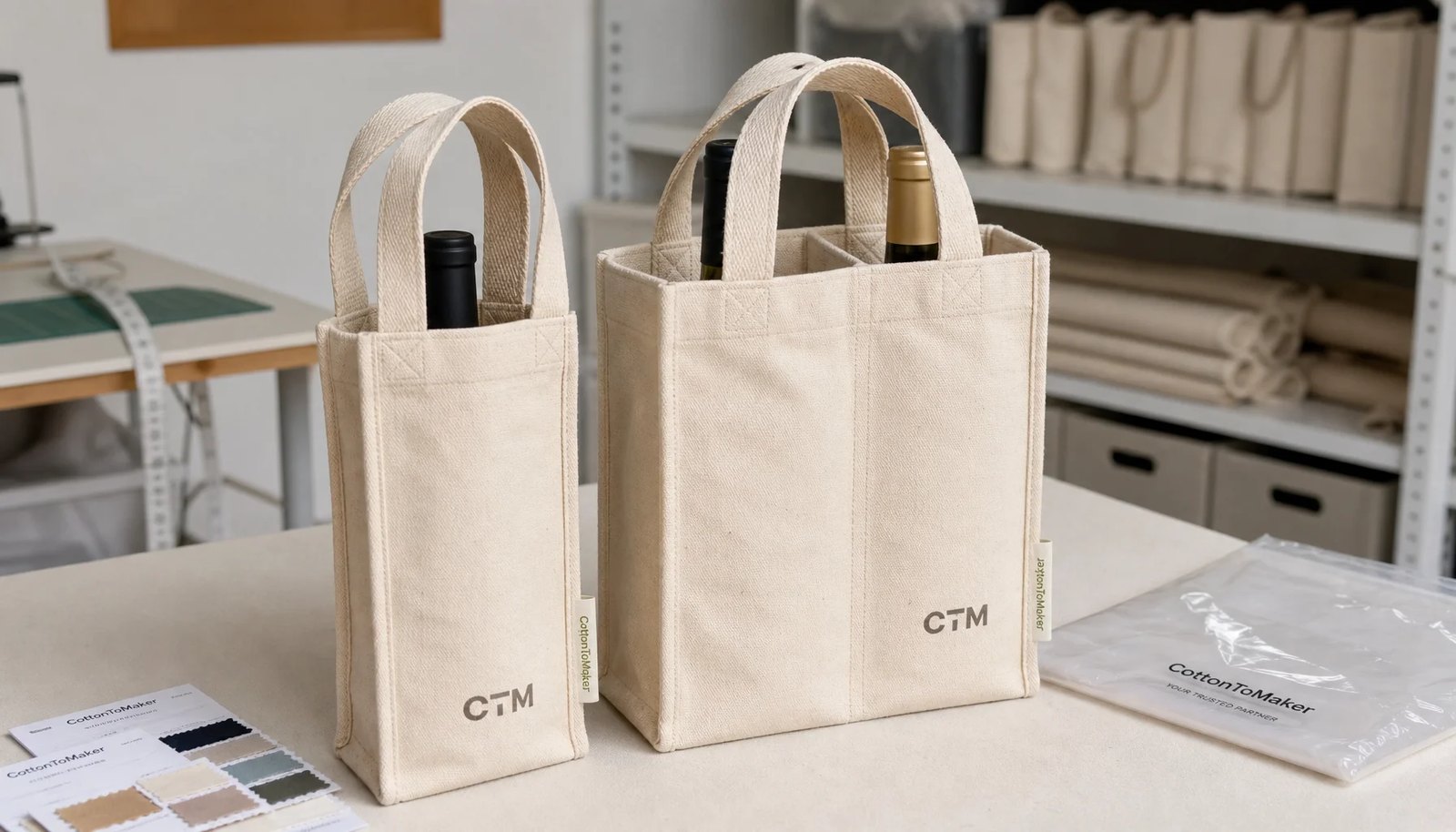
The RFQ Problem University Bookstores Need to Solve
A custom canvas wine carrier looks simple until the buyer tries to quote it across several suppliers. One factory may price an 8 oz cotton bag with a basic handle, another may quote 12 oz canvas with divider stitching, and a trading company may include upgraded packing without showing it clearly. The numbers may look close, but the products are not comparable. For a university bookstore, the wrong RFQ can create weak handles, tight bottle fit, poor logo color, carton creasing, and a retail item that feels cheaper than the campus brand.
The clearest RFQ starts by defining the buying use. A wine carrier used as alumni event packaging does not need the same finish as a premium bookstore retail item. A two-bottle donor gift carrier needs a different divider, handle reinforcement, and carton plan than a single-bottle holiday add-on. Procurement teams should write the RFQ around function first, then branding, then packing and logistics. That order helps suppliers price the real product instead of filling in missing details with their cheapest assumptions.
- Define the use case: retail sale, event giveaway, gift packaging, alumni program, distributor resale, or ecommerce add-on.
- State bottle assumptions: standard 750 ml wine bottle, tall slim bottle, sparkling bottle, or mixed product range.
- Separate each SKU: single-bottle, two-bottle, natural canvas, dyed canvas, printed front, printed two sides, or with hangtag.
- Require suppliers to quote the same material, dimensions, print method, packing, and trade term before comparing unit prices.
Core Product Specification That Belongs in the RFQ
The RFQ should include finished size, fabric weight, handle construction, divider style, print placement, and packing method. Avoid broad wording such as custom canvas wine bag with logo. That description gives suppliers too much freedom, and each supplier will make a different cost-saving choice. A factory quoting honestly needs bottle dimensions, target load, artwork complexity, and expected finish level to calculate fabric yield, sewing labor, print setup, and rejection risk.
For most bookstore programs, a practical starting point is 10 oz to 12 oz cotton canvas, roughly 280 to 340 GSM. Lighter 6 oz to 8 oz fabric may work for low-cost promotional sleeves, but it often feels thin when holding a glass bottle and can wrinkle heavily after packing. Heavier 14 oz canvas can look premium but increases unit cost, folding bulk, carton volume, and sewing difficulty around gussets and dividers. If the carrier is intended for a shelf display, the structure should stand reasonably upright; if it ships flat as packaging, a softer construction may be acceptable.
- Finished dimensions should include height, width, side gusset, bottom gusset, opening size, and handle drop.
- Fabric should be listed in oz and GSM, with color such as natural, bleached white, black, navy, or custom dyed.
- Handle details should include self-fabric or webbing, width, length, stitching pattern, and stress-point reinforcement.
- Divider details should state fixed divider, removable divider, padded divider, or no divider.
- Branding should include logo size, print color count, print side, print position, and artwork file type.
Fabric Weight, Handfeel, and Shrinkage Tradeoffs
Canvas weight is one of the largest quote variables. A supplier quoting 8 oz cotton canvas may be much cheaper than a supplier quoting 12 oz, but the finished product may not match the buyer's retail expectation. University bookstore buyers often want a carrier that feels durable enough to sit beside mugs, apparel, glassware, and gift items. In that setting, thin canvas can make the item look like temporary packaging rather than merchandise.
Shrinkage is another issue when printing and bottle fit both matter. Natural cotton canvas may shrink during washing or finishing, and even unwashed fabric can vary between lots. If the bag is not meant to be washed, the concern is less about consumer laundry and more about stable cutting, sewing, and print placement. For tight bottle openings or multi-bottle carriers, a few millimeters matter. A pre-shrunk fabric or an approved production fabric lot reduces risk, but it can increase cost and lead time.
- Use 6 oz to 8 oz only when the carrier is mainly a low-cost sleeve or short-use giveaway.
- Use 10 oz to 12 oz for most bookstore retail and alumni gift applications.
- Use 14 oz only when premium handfeel is worth higher fabric cost, slower sewing, and larger carton volume.
- Request fabric swatches from the same fabric source planned for production, not only a generic showroom swatch.
- For dyed canvas, define shade tolerance and decide whether a lab dip is required before bulk fabric booking.
Bottle Fit and Construction Details That Prevent Returns
Bottle fit should be tested with the bottles the bookstore or partner program expects to use. Standard 750 ml wine bottles are not all the same shape. Burgundy bottles are wider through the shoulder, sparkling bottles can be larger and heavier, and some campus gift programs include cider, olive oil, or specialty beverage bottles. If the RFQ only says wine bottle carrier, the factory may use a narrow template that fits one bottle type but fails another.
The base and divider construction matter as much as the outside panel size. A two-bottle carrier should keep bottles from knocking together, and the divider must be sewn strongly enough that it does not tear away when bottles are inserted quickly at checkout. The bottom seam should handle weight without distorting the printed front panel. A clean-looking sample with empty bottles is not enough; the sample needs to be filled-load tested and handled the way a customer or store associate will use it.
- Provide bottle diameter, bottle height, shoulder shape, and filled weight if available.
- Set a minimum opening that allows easy insertion without scraping the print or bending the divider.
- For two-bottle carriers, require a divider height that keeps bottles separated through normal carrying movement.
- Specify bottom gusset width so the carrier can stand or at least hold shape on a retail shelf.
- Include a practical carry test using filled bottles for several minutes, not only a quick photo with empty bottles.
Print Method and Campus Brand Color Control
Screen printing is usually the most practical method for canvas wine carriers with solid university logos, mascot marks, or bookstore branding. It handles one to three solid colors well and keeps cost predictable for repeat orders. Heat transfer can be useful for gradients, small details, or full-color artwork, but buyers should test adhesion and edge feel on canvas. Embroidery can look premium, but it adds cost, can distort lighter fabric, and may not suit fine licensing marks.
University branding often has stricter approval requirements than ordinary promotional goods. If the logo color is a school color, a rough red or blue is not acceptable. The RFQ should include Pantone references, artwork files, print size, and placement measurement. A digital mockup is useful for layout but not enough for approval because ink absorbs differently on natural canvas, dyed canvas, and heavier textured fabric. A physical strike-off or pre-production sample protects both buyer and factory.
- Use screen print for solid logos, short wording, bookstore names, and most repeat programs.
- Use heat transfer when artwork has gradients, photographic detail, or too many spot colors for economical screen printing.
- Use embroidery for premium small-batch gifting only after testing fabric puckering and back-side finishing.
- Define print placement by distance from top edge, side seam, bottom seam, or panel center.
- Approve a real print strike-off when logo color, ink coverage, or fabric texture could affect brand acceptance.
MOQ Logic and Quote Breaks That Make Sense
MOQ depends on fabric availability, print setup, cutting efficiency, and whether the supplier is producing a standard construction or a new custom pattern. For a simple natural canvas single-bottle carrier with one-color screen print, many factories can consider a lower MOQ than for a custom dyed two-bottle carrier with divider, hangtag, barcode label, and special packing. The buyer should not treat MOQ as only a negotiation number; it is tied to how many operations must be set up before production becomes efficient.
A strong RFQ asks for price breaks at several quantities instead of only one target quantity. This helps procurement compare whether buying more actually improves landed cost or only fills the warehouse. For bookstore teams, a first order may need conservative volume while repeat orders can be larger once retail sell-through is known. If suppliers offer a very low MOQ, check what they changed: fabric weight, stock color, print size, packing, inspection level, or delivery schedule.
- Request price at realistic tiers such as 300, 500, 1,000, and 2,000 pieces when the program may repeat.
- Separate sample charge, print setup, unit cost, packing upgrade, and local export cost.
- Ask whether the MOQ changes for natural canvas, black canvas, custom dyed canvas, and two-sided printing.
- Confirm whether low MOQ production uses leftover fabric lots that may not match future repeat orders.
- For licensed university marks, build in time and cost for extra approval samples instead of forcing bulk production too early.
Sample Approval Should Be Treated as a Production Contract
The approved sample is not only a visual reference. It should become the production control standard for fabric, size, stitching, logo color, handle strength, divider construction, and packing. A common mistake is approving a sample photo while leaving fabric weight, print tolerance, and seam reinforcement undefined. When bulk goods arrive with lighter fabric or a shifted logo, the supplier may argue that the written order did not specify those details.
For bookstore buyers, the best sample file includes physical sample approval, measurements, close-up photos, print color reference, and a short written tolerance sheet. If the sample is handmade, the factory should identify which details may change in bulk production and which will not. Handmade samples can look slightly different from mass production because cutting dies, sewing guides, and print screens are finalized later. That is acceptable only when the buyer knows what will be standardized.
- Measure the sample and record finished width, height, gusset, handle drop, divider height, and print position.
- Photograph stress points such as handle attachments, divider seams, bottom corners, and binding edges.
- Keep an approved fabric swatch and signed print strike-off with the purchase order file.
- Mark whether the sample is salesman sample, pre-production sample, or sealed approval sample.
- Require written approval before changing fabric lot, print ink, handle material, divider method, or packing fold.
Packing, Carton Planning, and Bookstore Receiving Needs
Packing affects landed cost, retail readiness, and defect rate. Canvas wine carriers can crease if folded hard across the printed panel, especially when heavy cartons are stacked during ocean shipment or warehouse storage. Individual polybags may protect against dust and moisture, but they add cost and may not fit the bookstore's sustainability preference. Tissue paper or simple paper banding can reduce friction for premium retail sets, while bulk packing may be enough for event distribution.
The RFQ should request carton data early because carton volume influences freight cost. A heavier canvas or padded divider can make the product look better but may increase cubic meters enough to change shipping economics. For university bookstore receiving teams, cartons should not be too heavy, SKU labels should be clear, and mixed-SKU cartons should be avoided unless the buyer specifically requests assortment packing. If the product will be sold online, barcode labels, hangtags, or inner pack counts may matter more than the lowest packing cost.
- Define whether each carrier is flat folded, lightly stuffed, paper banded, individually polybagged, or packed in inner cartons.
- Keep carton weight practical for bookstore staff and distributor warehouses, especially for two-bottle canvas carriers.
- Request carton size, pieces per carton, net weight, gross weight, and estimated CBM before freight booking.
- Protect printed panels from hard fold lines by approving the folding method during sampling.
- State carton label requirements, SKU names, purchase order number, barcode, country of origin marking, and case pack.
Lead Time Risks From Artwork to Shipment
The production timeline starts before sewing. Artwork checking, licensing approval, fabric sourcing, lab dips, sample making, print strike-off, and packing confirmation can take longer than bulk sewing. A supplier may quote 25 days production, but that may only count after sample approval and deposit. For university bookstores tied to football season, commencement, alumni weekend, holiday gifting, or donor events, that difference can decide whether the product arrives on time.
Buyers should build a milestone schedule into the RFQ. The factory can then identify which dates are realistic and where approvals must move quickly. Custom dyed fabric, complex artwork, two-sided printing, hangtags, barcode labels, and distributor routing all add schedule risk. Air shipment can rescue a late program but can destroy margin on bulky canvas goods. It is better to lock the approval path early than to depend on premium freight at the end.
- Artwork review and proofing should be scheduled before sample production, not during bulk production.
- Fabric booking should wait for final fabric approval when shade or GSM is critical.
- Pre-production sample approval should happen before bulk cutting for new constructions or licensed artwork.
- Inline inspection should occur early enough to correct sewing or print issues before all units are finished.
- Final inspection should be completed before balance payment or shipment release when possible.
- Shipping handoff should include carton list, commercial invoice, packing list, and any required routing labels.
How to Compare Quotes Without Buying the Wrong Bag
A low unit price is useful only when the quote covers the same product. Procurement teams should build a quote comparison sheet with material, size, print, construction, packing, MOQ, sample cost, lead time, trade term, and inspection responsibility. This exposes hidden differences quickly. One quote may be lower because it excludes print setup, uses lighter fabric, packs in oversized cartons, or assumes no divider. Another may be higher but include better reinforcement, stable fabric sourcing, and clearer QC support.
Landed cost should also be considered before purchase order release. Canvas is bulky compared with small accessories, so carton volume can influence freight more than expected. A two-bottle carrier in heavy canvas may cost more to ship per piece than a buyer assumes from unit price alone. For importers and distributors, the better decision is often the quote with the most controlled specification and predictable repeatability, not the cheapest first sample.
- Compare fabric by oz, GSM, weave, color, and whether it is stock or custom sourced.
- Compare construction by handle type, divider style, reinforcement, seam finish, and bottom stability.
- Compare branding by print method, number of colors, setup charge, strike-off cost, and color tolerance.
- Compare packing by fold method, individual packaging, carton size, carton weight, and labeling.
- Compare supplier capability by sample clarity, QC process, communication speed, and willingness to document tolerances.
- Compare commercial terms by MOQ, price breaks, payment terms, trade term, lead time, and remake responsibility.
Specification comparison for buyers
| Spec decision | Recommended option | When it fits | Buyer risk to check |
|---|---|---|---|
| Fabric weight | 10 oz to 12 oz cotton canvas, about 280-340 GSM, pre-shrunk when tight size control matters | Good balance for university bookstore retail, alumni gifts, and moderate bottle weight without making the carrier feel stiff | Quotes using only the word canvas may hide 6 oz or 8 oz fabric; request oz and GSM plus fabric swatch before sample approval |
| Bottle capacity | Single-bottle and two-bottle versions with separate dielines and load testing | Single-bottle bags fit event giveaways; two-bottle carriers fit gift sets, wine club bundles, and campus-branded retail displays | A two-bottle carrier needs a divider and stronger handle stitching; do not price it as a simple scaled-up tote |
| Handle construction | Self-fabric handles or cotton webbing with box-X reinforcement and bar tack at stress points | Best for stores that expect customers to carry filled glass bottles from checkout to parking or shipping desk | Thin tape handles can look cheaper and may fail during load testing; specify handle width, length, and reinforcement |
| Print method | Screen print for solid school logos; heat transfer only for complex gradients; embroidery only for premium limited runs | Screen print gives reliable unit cost for bookstore repeat orders and clear marks on natural canvas | University marks often have strict color standards; request Pantone references, print tolerance, and a strike-off before bulk |
| Inside divider | Stitched canvas divider or padded removable divider depending on retail price point | A fixed divider controls bottle movement for standard wine bottles; padded dividers fit gift packaging and higher-margin sets | Divider height and attachment points affect bottle stability; verify with actual bottle dimensions, not only supplier template photos |
| MOQ logic | 300-500 pieces for simple screen print stock fabric; 800-1,000+ pieces for custom dyed canvas or multiple sizes | Useful when bookstore buyers need seasonal launch quantities without overcommitting inventory | Low MOQ quotes may use available fabric lots with shade variation; define whether repeat orders must match the first run |
| Packing method | Folded flat with tissue or paper insert, individual polybag optional, carton weight kept under practical warehouse limits | Works for bookstore back rooms, ecommerce pick-pack, and distributor forwarding warehouses | Over-compressed packing can crease printed panels; request carton dimensions, pieces per carton, and crease prevention method |
| Supplier route | Direct factory for controlled specs and repeat programs; trading company only when consolidating many campus items | Direct factory suits branded wine carriers with repeat artwork; consolidators help if the order ships with totes, pouches, and apparel | Compare quote ownership: who controls fabric sourcing, sampling, inline QC, and remake responsibility if handles or logo colors fail |
Buyer checklist before sampling
- Define bottle type, bottle diameter, height, and target filled load before asking for price.
- Specify fabric in both ounces and GSM, not only as cotton canvas.
- Decide whether the carrier is retail merchandise, event packaging, donor gift packaging, or ecommerce gift wrap.
- Send university logo artwork in vector format and include Pantone color references or licensed brand guidelines.
- State the print position, maximum print size, number of colors, and whether the logo can sit over seam allowances.
- Require a pre-production sample or print strike-off before bulk cutting if brand color approval is important.
- Include handle length, handle width, reinforcement method, and minimum load test requirement.
- Clarify whether dividers are fixed, removable, padded, or not required.
- Request packing details including folding method, individual bagging, carton quantity, carton size, and gross weight.
- Ask suppliers to separate mold, sampling, print setup, unit cost, packing, inland freight, and export document costs.
Factory quote questions to send
- What fabric weight are you quoting in oz and GSM, and is it stock fabric or made-to-order fabric?
- Can you provide a swatch or previous production sample in the same fabric weight and color before sample payment?
- What are the exact finished dimensions for the single-bottle or two-bottle carrier, including gusset and divider height?
- What handle material, handle width, handle length, and reinforcement stitching are included in the quoted unit price?
- Which print method are you quoting, how many colors are included, and what is the print setup charge?
- What is the minimum order quantity for this exact specification, and what price breaks apply at higher quantities?
- How many days are required for artwork proof, sample making, sample approval, bulk production, and final packing?
- What QC tests do you perform for seam strength, handle pull, print adhesion, size tolerance, and carton drop risk?
- What packing method is included, and what are the carton dimensions, pieces per carton, net weight, and gross weight?
- Can you separate EXW, FOB, and any local charges so our logistics team can calculate landed cost correctly?
Quality-control points to confirm
- Fabric weight tolerance should be defined, commonly within a practical range around the approved swatch rather than a vague canvas description.
- Finished size tolerance should be set for width, height, gusset, handle length, and divider height because small deviations affect bottle fit.
- Handle attachment should pass load testing with filled bottle weight plus a safety margin before carton packing begins.
- Seams at the gusset, base, divider, and handle connection should show no skipped stitches, loose threads, or open seams.
- Print color should be checked against approved Pantone or signed print strike-off under consistent light.
- Print adhesion should be tested by rub, tape pull, and light bend handling on the actual canvas surface.
- Logo placement should be measured from the same reference points on every size, especially where seams and gussets distort the panel.
- Divider alignment should prevent bottles from knocking together and should not reduce usable bottle opening below the approved sample.
- Packing should protect the printed face from heavy creases, moisture, carton abrasion, and label confusion between SKUs.
- Final inspection should include carton count, assortment count, barcode or hangtag check if used, and photo records before shipment release.