Start With the Event Requirement
A custom canvas wine carrier for a trade show has a job to do before it has a style. It may be loaded at a booth between buyer meetings, handed over after a tasting, placed in a hotel room, packed into a distributor sample kit, or sold as part of a winery promotion. Each situation changes the useful specification. A booth giveaway can often stay simple and compact. A VIP gift or resale item needs better finishing, stronger presentation, and fewer compromises hidden inside the seams.
Procurement should open the RFQ with the commercial use case and the delivery reality. Is the carrier holding one filled bottle for a short handoff, or two bottles that will move through show halls, elevators, taxis, and hotel lobbies? Will the event team load bottles on site, or will the carrier ship pre-packed? Does the brand team need sponsor approval? These questions sound operational, but they directly affect fabric weight, handle reinforcement, divider design, logo method, packing, and lead time.
For exhibitors, receiving instructions belong in the spec as early as the product details. Trade show shipments often need advance warehouse delivery, booth references, carton counts, pallet labels, exhibitor names, PO numbers, or arrival windows. If the supplier prices ordinary export cartons and the buyer later needs show-compliant marks or repacking, the schedule gets tight fast. Put the show date, warehouse deadline, and marking rules into the RFQ so every quote is built around the same finish line.
- State the show name, booth number, event date, required warehouse arrival date, and advance receiving cutoff.
- Name the use case: booth giveaway, tasting gift, distributor kit, sponsor gift, VIP room drop, resale item, or meeting leave-behind.
- Confirm whether the carrier will hold one filled bottle, two filled bottles, an empty display bottle, or a mixed product set.
- List who must approve the sample: procurement, brand, event team, sponsor, distributor, compliance, or retail buyer.
- Use reference photos for visual direction, but make the written specification the controlling document for quote and inspection.
Convert Bottle Fit Into Measurable Specs
Bottle fit is where many wine carrier RFQs become vague. A 750 ml Bordeaux bottle, Burgundy bottle, sparkling wine bottle, spirits bottle, olive oil bottle, and custom premium bottle can all ask different things from the same bag shape. Diameter matters. So do shoulder width, base diameter, capsule height, closure style, label area, and the way the bottle enters the opening. A carrier that works smoothly for a narrow bottle can feel tight or distorted around a wider one.
Ask suppliers for usable internal dimensions after sewing, not only flat dimensions or finished outside measurements. Seam allowances, bottom folds, divider stitching, handle reinforcement, and fabric thickness all reduce real space. A paper pattern may look generous, then the sewn sample fights the bottle at the shoulder or base. The RFQ should say how each dimension is measured: across the opening, inside the gusset, from the bottom seam, or from the top edge to the handle apex.
Mixed bottle programs need a deliberate choice. If the goal is compatibility, design around the largest approved bottle and accept that smaller bottles may move more. If presentation must stay neat across several bottle families, request supplier input on gusset depth, divider height, body height, or a shaped insert. For two-bottle carriers, the divider should prevent glass contact during normal carrying without making booth staff wrestle bottles into place during a rush.
- Provide maximum bottle height, body diameter, base diameter, shoulder width, and closure clearance in millimeters.
- State the bottle family: Bordeaux, Burgundy, sparkling, spirits, olive oil, or mixed bottle range.
- Require usable internal width and gusset depth after sewing, not only outside finished dimensions.
- For two-bottle carriers, specify divider height, divider width, and whether it is stitched to the bottom, side seams, or both.
- Request fit-test photos with the bottle inserted, the bottle removed, the divider visible, and the loaded handle lifted.
- When possible, send the actual bottle or a dimensioned drawing before the construction sample is approved.
Choose Canvas by Weight and Finish
Canvas should be quoted in both oz and GSM whenever possible, because buyers and suppliers do not always use the same shorthand. For many trade show wine carriers, 10 oz to 12 oz cotton canvas, about 340 to 407 GSM depending on weave and finish, is a practical range. It gives enough body for a single-bottle carrier, works well with simple screen printing, and keeps carton weight more manageable for event shipments.
Premium gift programs, retail resale, and executive meeting sets may justify 14 oz to 16 oz canvas, about 475 to 542 GSM. The hand-feel is more substantial, but heavier fabric is not automatically the better procurement choice. It can create bulky handle seams, stiff divider edges, harder folds, and heavier cartons. Ask to judge the finished carrier, not the swatch alone, because a fabric that feels impressive on the table may be awkward once it is sewn into a two-bottle pattern.
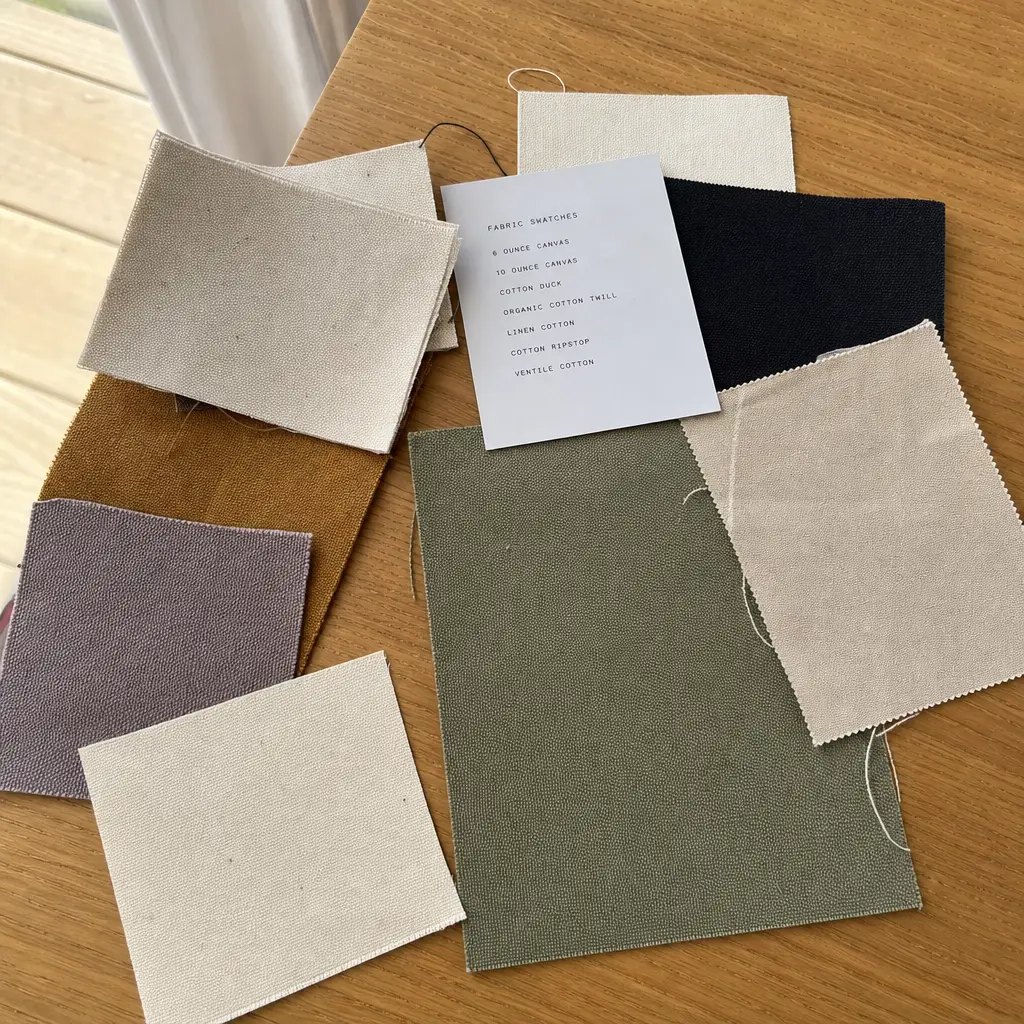
Finish and composition also need to be named. Natural cotton canvas has a warmer off-white tone and visible texture. Bleached canvas gives a cleaner white but may show handling marks more easily. Dyed canvas can support a brand color, yet it introduces shade tolerance, crocking, dye-lot MOQ, and lead-time questions. Cotton-poly, recycled cotton, and organic cotton may be valid choices when they match the sourcing policy, but they should be specified before the supplier builds the quote.
- 10 oz canvas: useful for cost-sensitive single-bottle giveaways and simple one-color branding.
- 12 oz canvas: a balanced option for stronger hand-feel, better structure, and common B2B event quantities.
- 14 oz canvas: suitable for premium gifts, distributor kits, and carriers intended for reuse.
- 16 oz canvas: substantial and durable-feeling, but check seam bulk, folding, divider stitching, and carton weight.
- Natural canvas: expect texture and shade variation; approve physical fabric before printing.
- Custom dyed canvas: request color tolerance, shade-lot approval, rubbing expectations, fabric MOQ, and added lead time.
- Certified material: ask whether documentation covers yarn, fabric, finished goods, transaction certificates, or only supplier claims.
Specify Construction, Not Just Style
Two factories can both quote a custom canvas wine carrier and still mean very different products. One may price a light body, basic handles, a simple divider, and overlocked seams. Another may include heavier fabric, reinforced handle stitching, a shaped bottom, cleaner seam finishing, and a woven side label. The RFQ has to separate style from construction so the quote comparison is fair.
Handles deserve special attention because a handle failure is immediate, visible, and hard to excuse. A filled 750 ml wine bottle commonly weighs around 1.2 kg to 1.5 kg depending on glass weight and contents. A two-bottle carrier can exceed 2.5 kg before any inserts, tasting cards, or accessories are added. The quote should state handle material, handle width, handle drop, attachment position, stitch type, and reinforcement method. Wording such as 'strong handle' is not enough for inspection or sourcing comparison.
The divider and bottom shape determine how the carrier behaves once it is loaded. A same-fabric divider may work for standard event use. A higher, padded, or reinforced divider may be better when bottles are heavier, wider, or likely to travel beyond the booth. A reinforced bottom can help presentation and standing stability, but it adds sewing steps, weight, and cost. Inside seam binding looks cleaner for resale; neat overlocking may be acceptable for a giveaway. Spell out the expectation so the supplier is not guessing.
- Define handle drop in millimeters and confirm whether it is measured from the top edge to the handle apex.
- Specify handle width, handle material, and reinforcement: X-box, bar tack, reinforced double stitch, or another named method.
- Set a stitch-density expectation or ask the supplier to state stitches per inch or centimeter for critical seams.
- State seam finish: overlock, bound seam, turned seam, French seam, or other construction.
- Define divider material, height, attachment points, padding need, and whether bottles must be separated through the body.
- Confirm whether the bottom is a simple gusset, reinforced base, insert base, or shaped standing bottom.
- Specify optional pocket size and use, such as tasting card, flyer, corkscrew, business card, or bottle note.
- Name all labels required: woven side label, care label, country-of-origin label, barcode label, hangtag, or no label.
Control Logo Method and Tolerances
Decoration is often where a clean sourcing plan becomes messy. Screen printing is usually the practical choice for solid event logos, winery marks, and sponsor artwork on canvas wine carriers. It can be efficient for one-to-three-color designs, but the RFQ should not stop at 'print logo on front.' Give print size, print side, Pantone references, number of colors, artwork version, and placement from the top edge or side seams.
Other logo methods have their place. Heat transfer can help with gradients, photographs, small sponsor lockups, or fine tonal detail, but it must be tested on textured canvas for adhesion, edge lift, gloss, stiffness, and fold behavior. Embroidery works best for small premium marks, not large filled blocks or tiny legal text. Woven labels, patches, and side tabs can create a quieter reusable look when the carrier should feel less like a temporary event giveaway.
Physical approval matters. Natural canvas changes perceived ink color, darker fabrics may need a white underbase, and a rough weave can soften edges. Folded packing can put pressure across the printed area, especially when cartons are tightly filled. The purchase order should define logo placement tolerance, commonly +/-5 mm from an approved centerline or edge reference for small to medium marks, unless the artwork needs tighter control.
- Send vector artwork with fonts outlined and linked images embedded or supplied separately.
- State Pantone references, number of colors, print dimensions, print side, and placement from top edge and side seams.
- For dark fabric, ask whether a white underbase is included and whether it changes hand-feel or price.
- Test QR codes, fine legal copy, sponsor marks, and thin lines at actual printed size before bulk approval.
- For screen print, approve ink color, opacity, registration, curing, edge sharpness, and rub behavior on final canvas.
- For heat transfer, check adhesion, edge lift, cracking after folding, gloss level, and stiffness.
- For embroidery, check puckering, thread density, small text legibility, backing, and thread color.
- Require a physical strike-off or pre-production sample using final fabric, final artwork, and final placement.
Build the RFQ as a Comparison Sheet
A useful RFQ makes supplier differences visible. The buyer should not have to guess whether a lower price comes from better production efficiency or from a smaller bag, lighter canvas, weaker handles, fewer logo colors, no divider reinforcement, or cheaper packing. Use one master specification sheet and ask each supplier to confirm the same line items or list deviations in writing.
Keep fixed charges separate from unit price. Screen charges, films, embroidery digitizing, woven label setup, sample costs, courier fees, bank fees, inspection fees, testing, carton upgrades, and documentation can all change the real cost of the program. At 500 pieces, setup charges can be a large part of landed cost. At 5,000 pieces, fabric yield, sewing efficiency, packing density, and freight volume may matter more.
Commercial terms need the same discipline as product specs. EXW, FOB, CIF, DDP, and delivered-to-warehouse quotes are not interchangeable. A low unit price can lose its advantage once freight, duties, destination handling, or show delivery are added. Ask for carton dimensions, pieces per carton, gross weight, net weight, and total CBM before final comparison so procurement can estimate the landed cost with fewer surprises.
- Use one master specification sheet and require every supplier to confirm, decline, or list a deviation for each line.
- Request price breaks at 500, 1,000, 2,500, and 5,000 pieces using the same construction and logo method.
- Separate unit price from setup charges, samples, courier, labels, testing, inspection, packing upgrades, and freight.
- Ask suppliers to show EXW, FOB, or delivered terms only when the freight assumptions are clearly stated.
- Request carton size, pieces per carton, gross weight, net weight, and CBM before final supplier comparison.
- Record quote date, quote validity, artwork version, sample version, fabric reference, and any supplier assumptions.
- Ask suppliers to price recommended alternates separately so a value-engineered option is not confused with the base RFQ.
Understand MOQ and Reorder Risk
MOQ is rarely just a factory preference. Natural canvas in a common weight may be available from stock and support a lower quantity. Custom dyed canvas may require a dye lot that produces more fabric than the first order needs. Woven labels, patches, and special trims can carry separate MOQs. Print setup can make small quantities look expensive even when the sewing itself is simple.
Trade show exhibitors should request practical quantity breaks instead of only the first event quantity. If the initial need is 700 pieces, quoting 500, 1,000, 2,500, and 5,000 pieces still helps procurement see where the economics change. The same carrier may later support regional shows, distributor meetings, tasting room promotions, or seasonal gifts. Asking for reorder pricing and minimum reorder quantities during the first RFQ saves time when the brand team comes back with a rush request.
Reorders need control points. Natural canvas can vary by lot. Dyed fabric needs a retained shade standard. Screens may be stored, remade, or charged again depending on supplier practice. Leftover woven labels may sit at the factory, but ownership and storage time should be clear. Retain the approved sample, fabric swatch, artwork file, print strike-off, carton mark layout, and inspection notes so a second order does not become a fresh sourcing project.
- Ask whether MOQ is driven by fabric, dyeing, printing, labels, cutting yield, sewing line setup, or packing.
- For custom dyed fabric, request the minimum dye lot and the estimated number of carriers it can produce.
- For woven labels or patches, ask label MOQ, leftover quantity, storage period, and ownership.
- For screen printing, ask whether screens are stored, remade, or charged again for repeat orders.
- For reorders, confirm whether the sealed sample, fabric swatch, print strike-off, and carton marks will be retained.
- Do not compare a low-MOQ quote unless it uses the same fabric weight, size, handle reinforcement, logo method, and packing as the main spec.
Use Samples to Remove Specific Risks
Sampling should answer specific procurement questions. A construction prototype checks bottle fit, body size, handle drop, divider position, gusset shape, seam finish, and general workmanship. A logo strike-off checks ink color, opacity, curing, edge detail, QR readability, and placement risk. A pre-production sample pulls the final fabric, final sewing, final decoration, labels, and packing direction into one approval piece.
Each shortcut leaves a different risk open. A blank sample does not prove print behavior. A digital mockup does not prove bottle fit or ink opacity on textured canvas. A supplier photo may hide dimensions, hand-feel, and divider performance. The RFQ should say which sample stages are required, how many rounds are included, who pays for sample and courier costs, and how quickly approvals must be returned.
Sample comments should be measurable. Instead of 'make the handle stronger,' write 'change handle attachment to X-box stitching and submit close-up photo.' Instead of 'logo is too low,' write 'move logo centerline 15 mm upward from current sample.' Once approved, the buyer and supplier should keep a sealed sample or a documented photo set tied to the purchase order, inspection plan, and production lot.
- Construction prototype: verify bottle fit, body size, handle drop, divider, gusset, seam finish, and basic workmanship.
- Logo strike-off: verify color, coverage, opacity, curing, registration, QR code readability, and hand-feel.
- Pre-production sample: verify final fabric, final sewing, final logo, final labels, and packing approach.
- Sealed approval sample: keep as the production and inspection reference.
- Correction log: record change request, measurement, photo, date, sample version, and approver.
- Sample schedule: include making time, courier transit, buyer review, sponsor approval, and one correction loop.
- Do not release bulk cutting until the sample approval states which version is approved and what minor deviations remain acceptable.
Plan QC Before Production Starts
Quality control works best when the acceptance criteria are written before fabric is cut. A factory cannot inspect consistently against phrases such as 'good quality' or 'same as photo.' The purchase order should define critical dimensions, tolerances, major and minor defects, inspection timing, and the reference sample. For custom canvas wine carriers, the core checks are usable bottle fit, handle security, divider performance, seam integrity, logo placement, print durability, fabric condition, and packing accuracy.
Tolerances should be practical and tied to function. Critical dimensions such as usable internal width, gusset depth, divider height, handle drop, and logo placement are often controlled around +/-5 mm when the construction allows. Less critical overall dimensions may allow around +/-10 mm. If the bottle fit is tight or the logo sits close to a seam, a few millimeters can matter, so write the tolerance before approving the sample.
Inspection should include both inline and final checks when timing allows. Inline review can catch wrong handle stitching, divider placement, seam finish, or logo setup before the full lot is complete. Final inspection should include random measurements, loaded bottle-fit photos, logo checks, rub or cure observations, packing counts, carton marks, and comparison to the sealed approval sample. With a fixed show deadline, inspection needs to happen while there is still time to sort, rework, or replace problem pieces.
- Write critical and non-critical dimensions with tolerances in the PO or inspection checklist.
- Require loaded bottle-fit testing with the largest approved bottle and two-bottle testing where relevant.
- Check handle reinforcement under load, not only by visual inspection.
- Inspect divider height, attachment, and ability to prevent bottle contact during normal carrying.
- Verify logo placement, size, color, opacity, curing, and rub behavior against the approved sample.
- Check seams for skipped stitches, broken thread, raw edges, fraying, needle cuts, and loose tails.
- Inspect fabric for oil stains, water marks, strong odor, unacceptable slubs, shade variation, and contamination.
- Require packing count, carton dimensions, gross weight, carton marks, and destination labels to match the shipping plan.
Lock Packing, Freight, and Show Delivery
Packing is part of the product experience and the landed cost. Handles, gussets, dividers, reinforced bottoms, and printed panels all affect how a canvas wine carrier folds and ships. Flat packing saves space, but heavy canvas can hold hard creases if compressed too tightly. Individual polybags reduce dust and print rub, while reduced-plastic or plastic-free packing may be preferred by some buyers. Either approach must still control moisture, abrasion, ink transfer, and carton damage.
Carton data belongs in the quote comparison, not only in the shipping stage. A two-bottle carrier in heavier canvas can raise both production cost and freight cost. Carton dimensions, pieces per carton, net weight, gross weight, and total CBM are needed for air estimates, ocean planning, truck delivery, warehouse receiving, and trade show drayage coordination. Without them, procurement can approve a strong unit price and still miss the real landed cost.
Trade show delivery needs cleaner labels than ordinary inventory delivery. Advance warehouses may require show name, booth number, exhibitor name, PO number, item code, carton count, pallet labels, and receiving deadlines. Confirm those details before cartons are printed or packed. Relabeling finished cartons near the ship date is avoidable work, and it introduces receiving risk at the exact moment the event team has the least room for delay.
- Confirm flat pack, folded pack, interleaving, tissue, individual polybag, master polybag, or plastic-free packing.
- Ask whether printed panels need interleaving or curing time before stacking to prevent ink transfer.
- Request carton dimensions, pieces per carton, net weight, gross weight, total CBM, and carton strength.
- Require photos of folded bags, inner packing, carton packing, carton marks, and pallet format where relevant.
- Include item code, PO number, quantity, color, destination, show name, booth number, and warehouse reference on carton marks as required.
- For urgent shipments, calculate freight by chargeable volume as well as gross weight.
- Confirm inspection date, ship date, export document timing, customs plan, domestic delivery window, and advance warehouse cutoff.
Specification comparison for buyers
| RFQ line item | Recommended specification detail | Best use case | Procurement risk to control |
|---|---|---|---|
| Bottle fit basis | Design around named bottle families and maximum dimensions: height, body diameter, base diameter, shoulder width, and neck clearance in millimeters | Single-brand wine programs, tasting kits, sponsor gifts, distributor meetings | Do not approve from flat measurements only; require usable internal dimensions and a loaded fit test with the largest approved bottle |
| Standard single-bottle fabric | 10 oz to 12 oz cotton canvas, about 340-407 GSM, natural or bleached, with shrinkage and color variation expectations stated | High-volume trade show giveaways, booth meeting gifts, winery partner events | A swatch may feel strong before sewing; check finished carrier stiffness, seam bulk, and handle stress after construction |
| Premium or resale fabric | 14 oz to 16 oz canvas, about 475-542 GSM, with cleaner seam finishing and reinforced stress points | VIP gifting, retail resale, hosted buyer packs, executive meeting sets | Heavier fabric can increase carton weight, create bulky divider seams, and make flat packing less tidy |
| Two-bottle divider | Same-fabric divider for standard use; padded, reinforced, or full-height divider for premium sets; divider height and attachment points named | Two-bottle wine gifts, glass-on-glass protection, sample kits with mixed bottle shapes | Divider must prevent bottle contact during normal carrying without slowing booth staff during loading |
| Handle construction | Self-fabric or cotton webbing handle with finished drop, width, reinforcement method, and stitch density stated; X-box or bar tack for loaded use | Any carrier expected to hold filled bottles through show halls or hotel delivery | A quote without handle reinforcement detail is not comparable; weak handles are a high-visibility failure |
| Decoration method | Screen print for solid artwork; heat transfer for gradients; embroidery, patch, or woven label for restrained premium branding | Event logos, sponsor marks, winery branding, private-label gifting | Approve physical logo output on final canvas; digital mockups do not verify color, opacity, texture, curing, or fold behavior |
| Dimensional tolerances | Critical dimensions such as usable width, gusset, divider height, and handle drop commonly controlled to +/-5 mm; non-critical overall height often +/-10 mm | Orders with fixed bottle fit, carton planning, or retail presentation needs | Write tolerances before sampling; vague standards such as 'same as sample' are hard to inspect at scale |
| Packing and carton data | Flat or folded pack with interleaving where needed; carton size, pieces per carton, net weight, gross weight, CBM, and carton marks listed | Trade show shipments, advance warehouse delivery, air freight estimates | Unit price can be misleading if carton volume, gross weight, and show receiving labels are missing |
| MOQ and price breaks | Quote 500, 1,000, 2,500, and 5,000 pieces on the same spec; separate fixed setup charges from unit price | Buyers comparing event quantity, reorder quantity, and regional show rollout | MOQ may come from fabric, dyeing, print screens, labels, or cutting yield; ask suppliers to identify the real constraint |
Buyer checklist before sampling
- Define the event use: booth giveaway, hosted tasting gift, distributor sample kit, retail resale item, sponsor package, VIP room drop, or sales meeting leave-behind.
- Provide the exact bottle type and maximum dimensions in millimeters: height, body diameter, base diameter, shoulder width, and any capsule or closure clearance.
- State whether the carrier must fit 750 ml Bordeaux, Burgundy, sparkling, spirits, olive oil, or a mixed bottle range; if mixed, design around the largest approved bottle.
- Specify finished outside size, usable internal width, gusset depth, total height, divider height, handle drop, handle width, and measuring method.
- Name the canvas composition and weight: cotton, cotton-poly, organic cotton, recycled cotton, 10 oz, 12 oz, 14 oz, 16 oz, GSM equivalent, finish, and acceptable shade variation.
- Confirm whether natural, bleached, stock dyed, or custom PMS dyed canvas is required, and ask whether fabric MOQ or dye lot affects the quote.
- Send vector artwork with fonts outlined, Pantone references, print size, print side, placement from seams, number of print colors, sponsor marks, QR codes, and legal copy.
- Choose decoration by artwork risk: screen print for solid colors, heat transfer for gradients, embroidery for small premium marks, woven label or patch for understated branding.
- Define construction details: handle reinforcement, stitch type, stitch density target, seam finish, bottom gusset, divider attachment, optional pocket, labels, and country-of-origin marking.
- Set measurable acceptance criteria for bottle fit, dimensional tolerances, handle strength, seam defects, skipped stitches, logo position, color variation, print curing, odor, packing count, and carton marks.
Factory quote questions to send
- What fabric composition, weave, weight in oz and GSM, yarn or finish description, and color are included in this quote, and is the fabric stock or made to order?
- What finished outside dimensions and usable internal bottle dimensions are quoted, and what measuring tolerance will you accept for width, height, gusset, divider height, and handle drop?
- Which bottle shape and size did you use for fit testing, and can you test our actual bottle or a dimensioned bottle drawing before sample approval?
- What seam allowance, gusset depth, divider height, divider attachment method, bottom construction, and inside seam finish are included in the pattern?
- What handle material, handle width, handle drop, stitch type, stitch density, and reinforcement method are included: single stitch, double stitch, X-box, bar tack, rivet, or another method?
- What maximum loaded weight do you recommend for this construction, and how will you check handle and seam performance during sampling and inspection?
- Which logo method is quoted, how many colors are included, what print size is assumed, and what is the minimum safe distance from seams, gussets, folds, and handle bases?
- For screen printing, are screens, films, underbase, curing, color matching, and strike-off included; for embroidery, is digitizing included; for woven labels, what is the label MOQ?
- Are sample cost, sample revisions, sample courier, bank fee, inspection cost, testing cost, carton cost, export documents, and any mold or tool charges included or listed separately?
- What is the MOQ for natural canvas, bleached canvas, stock dyed canvas, and custom PMS dyed canvas under the same construction and same logo method?
Quality-control points to confirm
- Finished width, total height, gusset depth, handle drop, handle width, divider height, pocket size, and logo placement measured against written tolerances; use +/-5 mm for critical bottle-fit and logo-placement dimensions unless the PO states otherwise.
- Usable internal bottle fit tested with the buyer's largest approved bottle; the bottle should insert smoothly without forcing, seam stress, divider distortion, or visible fabric tearing.
- Two-bottle carriers checked with both bottles loaded; bottles should remain separated during normal carrying, and the divider should not collapse below the main body contact area.
- Handle pull and lift check performed on loaded samples; reinforcement stitching must not pop, loosen, tear fabric, distort the top seam, or expose raw edges.
- Handle attachment inspected for X-box, bar tack, or specified reinforcement shape, with no skipped stitches, broken thread, needle holes outside the stitch path, or loose thread tails.
- Divider stitching checked for straightness, locked stress points, correct attachment to bottom or side seams, and no raw abrasive edges inside the bottle cavity.
- Bottom gusset inspected for symmetry, flat presentation, consistent seam allowance, and no twisting caused by panel mismatch or uneven folding.
- Seam finish checked against the approved construction: overlock, bound seam, turned seam, or other method; no open seams, fraying, needle cuts, or loose inner threads accepted beyond the agreed defect standard.
- Logo color, print size, registration, opacity, edge detail, and position matched to the approved pre-production sample; require a clear tolerance for placement, commonly +/-5 mm from approved centerline or edge reference.
- Screen print checked for cure, opacity, rubbing, tackiness, cracking, heavy ink bleed, ghosting, pinholes, blocked mesh marks, and transfer between stacked or folded bags.