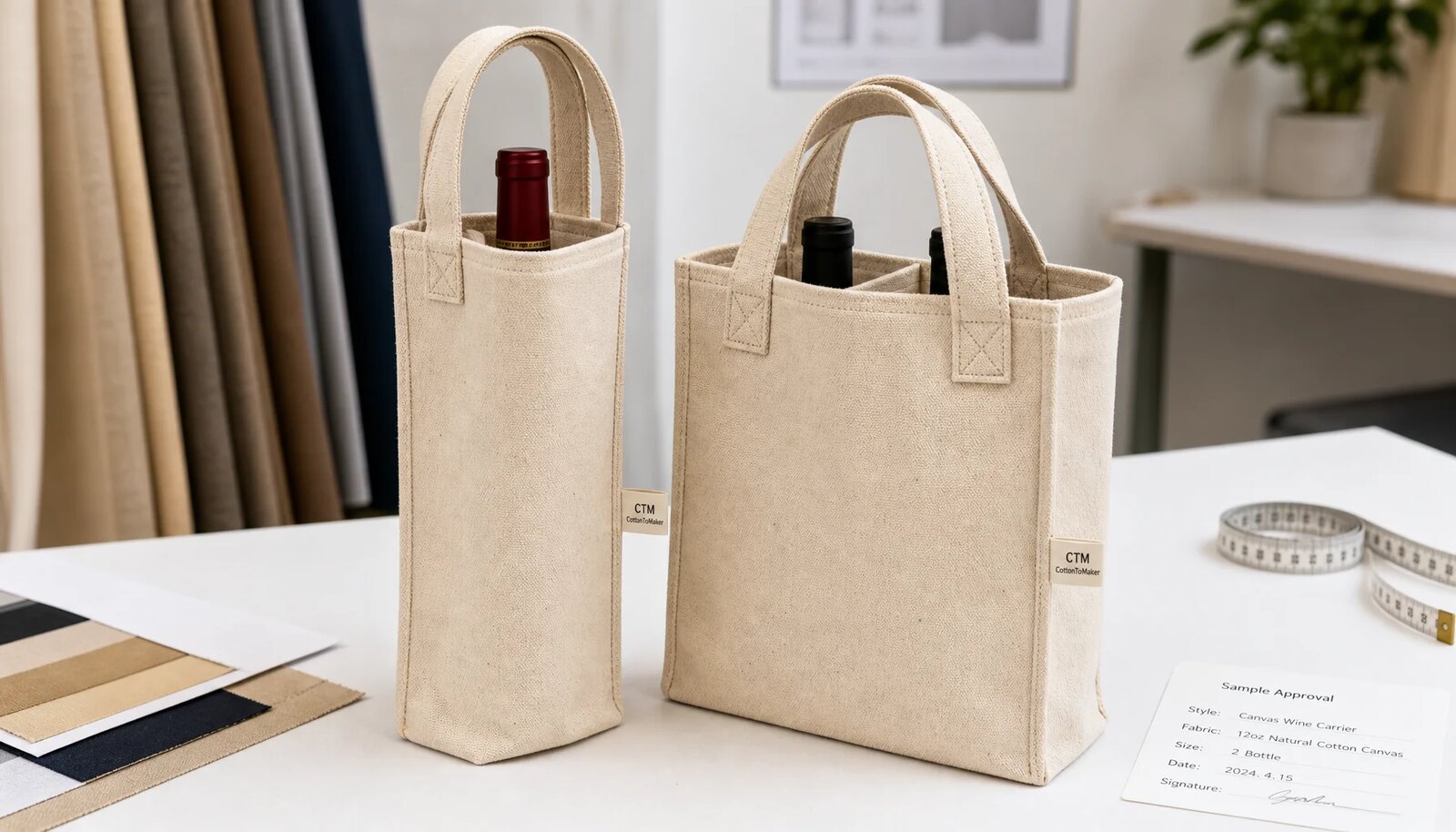
Start the RFQ with the bottle and selling channel, not the bag name
The phrase custom canvas wine carrier is too broad for a factory to quote accurately. A hotel gift shop selling one 750 ml local wine bottle has a different cost structure from a resort welcome amenity holding two bottles, a tasting card, and tissue wrap. Before requesting price, define the bottle format, retail use, expected load, and whether the carrier is part of a paid product or a free packaging item.
For hotel retail, the carrier often has to do more than hold a bottle. It needs to stand neatly on a shelf, support the brand image of the property, survive guest handling, and pack efficiently for import. A useful RFQ should make those commercial needs visible so suppliers do not reduce the quote by using weak fabric, short handles, or undersized cartons.
- State the bottle type: Bordeaux, Burgundy, Champagne, sparkling wine, spirits, or mixed assortment.
- Mention the sales setting: hotel shop, minibar upsell, vineyard partnership, conference gift, or distributor resale.
- Define whether guests will carry the bottle a short distance inside the property or travel with it after checkout.
- Clarify if the bag must stand empty on retail shelving or only function after a bottle is inserted.
Choose canvas weight by structure, print result, and retail expectation
Fabric weight is one of the first places quote differences appear. For wine carriers, 6 oz canvas may be acceptable for light promotional packaging, but it usually feels too soft for hotel retail. A more reliable starting point is 10 oz to 12 oz cotton canvas, roughly 340 to 410 GSM, because it gives better shelf presence and holds stitching more securely around handles and gussets.
Going heavier is not automatically better. A 14 oz or 16 oz canvas can look premium, but it increases material cost, carton weight, sewing difficulty, and fold marks. It can also make small wine carriers feel stiff if the pattern is narrow. If the brand wants a natural, relaxed canvas look, 10 oz to 12 oz is often the most balanced specification for repeat hotel retail orders.
- For basic gifting: 8 oz to 10 oz canvas can work if the handle reinforcement is strong.
- For paid retail: 10 oz to 12 oz canvas is the safer RFQ baseline.
- For premium bottle sets: 12 oz canvas with reinforced divider or base panel improves perceived value.
- For dark dyed canvas: inspect lint, shade consistency, and print opacity more carefully than on natural canvas.
Size the carrier around real bottles and seam allowance
Many wine bag problems come from quoting outside dimensions only. A finished carrier may look correct on paper but become tight after seam allowance, gusset folds, and internal divider stitching. Buyers should provide bottle diameter and height, or send a reference bottle drawing, so the factory can confirm usable internal space rather than guessing from a generic wine bag pattern.
For a single 750 ml wine bottle, the bag usually needs enough width for the widest bottle expected, plus clearance for easy insertion. Champagne and Burgundy bottles are often wider than standard Bordeaux bottles. If the carrier will hold mixed hotel retail bottles, the RFQ should specify the largest acceptable bottle size and request the factory to test fit the sample with that size.
- Include bottle diameter, bottle height, and neck height if the top of the bottle will remain visible.
- For two-bottle carriers, define whether both bottles must fit with tissue wrap or only bare bottles.
- Require a photo of the sample loaded with the target bottle type before approval.
- Avoid approving a sample using an empty plastic display bottle if the final product carries full glass bottles.
Decide the bottom, divider, and handle construction before comparing price
Two quotes can look similar until you inspect the construction. A wine carrier with a simple bottom seam, narrow handles, and a loose divider will be cheaper than one with a boxed bottom, reinforced handle stitching, and a divider caught into the base seam. The cheaper option may still be usable for a one-time giveaway, but it is risky for hotel retail where guests expect the bag to carry real bottles safely.
The handle area deserves special attention because most failures happen there. A clean box stitch or cross stitch spreads load better than a single straight line. Handle length also changes the user experience. Short handles may be fine for shelf display, while longer handles make the carrier easier to carry through a lobby or parking area.
- Single-bottle bags should have a stable bottom gusset or boxed base if shelf display matters.
- Two-bottle bags should have a divider attached securely at the bottom, not only floating between bottles.
- Handle width around 2.5 cm to 3 cm is common; very narrow handles can feel uncomfortable under load.
- For hotel retail, write a minimum loaded carry test into the RFQ instead of relying on visual approval only.
Match print method to artwork, fabric texture, and repeat order control
Screen printing is usually the most practical method for custom canvas wine carriers with one to three solid brand colors. It gives a durable result and predictable pricing for repeat orders. However, canvas texture affects fine lines. Small serif text, thin vineyard illustrations, and detailed hotel crests may fill in or break if the artwork is not adjusted for the fabric.
Heat transfer can handle more detailed or multi-color artwork, but buyers should consider handfeel, edge visibility, and long-term cracking risk. Embroidery gives a premium look for small logos but adds stitch cost and may distort narrow panels if the backing and hooping are not controlled. For hotel retail, the approved production sample should be the color and fabric actually used in bulk, not a print strike-off on a different material.
- Use screen print for bold hotel logos, simple wine brand marks, and repeat promotional programs.
- Use embroidery for small premium emblems, initials, or boutique property branding.
- Use heat transfer cautiously for detailed artwork and require wash or rub testing if reuse is claimed.
- Specify artwork size, placement from seams, Pantone colors, and acceptable print position tolerance.
Understand MOQ logic before assuming the lowest quantity is possible
MOQ is not only a factory policy. It depends on fabric availability, color, print setup, cutting efficiency, and whether the order combines multiple logo versions. Natural canvas stock fabric often allows a lower MOQ than dyed canvas. A custom dyed canvas may require fabric mill minimums, lab dips, and longer lead time, even if the final bag quantity seems modest.
For hotel retail buyers handling multiple properties, the best approach is to separate base bag quantity from logo version quantity. For example, a supplier may be able to produce one fabric color and one bag size across a larger total order, then print different hotel logos in smaller batches. This can reduce material waste, but it must be planned before cutting and printing.
- Ask for MOQ by fabric color, not only total order quantity.
- Ask for MOQ by logo version if multiple hotels or retail brands are involved.
- Clarify whether screen setup charges apply per artwork, per color, or per reorder.
- For custom dyed fabric, include lab dip approval and shade tolerance in the schedule.
Use quote data that supports landed-cost comparison
A useful quote is more than unit price. For imported hotel retail goods, carton quantity, carton size, gross weight, and CBM can change landed cost significantly. A slightly lower unit price may become expensive if the bags are loosely packed, over-cartoned, or shipped with unnecessary individual packaging. Buyers should collect logistics data at RFQ stage, not after purchase order approval.
The quote should also separate included and excluded items. Artwork setup, screen charges, sample fees, hangtags, barcode labels, inner polybags, carton marks, and inspection costs are often treated differently by suppliers. If these are not listed, quote comparison becomes unreliable and later change charges create internal budget problems.
- Request FOB port, carton dimensions, gross weight, net weight, and estimated CBM.
- Ask whether price includes screen charge, sample charge, labels, hangtags, and inner packing.
- Require carton quantity based on the actual folding method, not an estimated packing plan.
- For retail distribution, include barcode placement and carton marks in the RFQ.
Approve samples with functional checks, not only logo appearance
Sample approval should cover material, size, construction, logo execution, packing fold, and loaded performance. A clean logo on a weak carrier is not an approved product. For wine carriers, the buyer should insert the intended bottle, lift the bag repeatedly, set it on a shelf, and inspect whether the sides twist, the bottom sags, or the handle stitching stretches.
The approved sample should become the production reference. If the factory later changes fabric lot, handle tape, thread color, divider construction, or print ink, the buyer needs notification and approval. This is especially important for hotel retail programs where the carrier may sit beside other branded merchandise and visible differences are easy to notice.
- Measure finished width, height, gusset, handle drop, and logo placement.
- Load the carrier with a full bottle and hold it by the handles for a practical carry test.
- Inspect inside seams for trimming, loose threads, and divider attachment.
- Photograph the approved sample from front, back, side, inside, and bottom for production reference.
Set packing rules that protect the print and retail presentation
Canvas wine carriers are often damaged by careless packing rather than sewing defects. Deep folds across the printed logo, crushed handles, ink transfer, and dirty cartons can make otherwise acceptable goods look poor at retail receiving. If the bag will be sold as merchandise, the RFQ should specify whether it is packed flat, lightly folded, or individually bagged with hangtag and barcode.
Carton strength matters for export handling and distributor warehousing. Wine carriers are not fragile like glass, but overfilled cartons can compress the handles and create permanent creases. Underfilled cartons waste freight. The factory should provide a packing trial after the pre-production sample so carton data matches the final folded size and retail packing method.
- Flat packing is best for premium retail presentation but increases carton volume.
- Light folding can reduce freight cost if the fold line avoids the printed logo.
- Individual polybags protect against dirt but may not fit a plastic-reduction policy.
- For hotel retail, confirm hangtag, barcode, inner quantity, master carton quantity, and carton marks.
Build lead time around artwork approval, fabric status, and inspection
Lead time risk usually starts before production. Artwork revisions, lab dip delays, sample comments, and late barcode files can push a schedule more than sewing time itself. A realistic timeline separates artwork confirmation, material sourcing, sample making, sample approval, bulk cutting, printing, sewing, packing, inspection, and vessel booking.
Stock natural canvas with screen print is typically faster than custom dyed canvas with multiple logo versions, but buyers should avoid relying on verbal estimates. The RFQ should request lead time after deposit and sample approval, plus the latest date for artwork lock. If the goods are tied to a hotel opening, seasonal wine promotion, or event date, share the required delivery window early so the factory can flag risks.
- Separate sample lead time from bulk production lead time.
- Add time for lab dips if custom fabric color is required.
- Reserve time for third-party or buyer inspection before shipment.
- Do not release bulk production until size, construction, fabric, and print are approved together.
Specification comparison for buyers
| Spec decision | Recommended option | When it fits | Buyer risk to check |
|---|---|---|---|
| Fabric weight | 10 oz to 12 oz cotton canvas, roughly 340-410 GSM | Hotel retail, winery shops, welcome gifts, and reusable bottle packaging where structure matters | Very light 6 oz to 8 oz canvas may collapse when loaded and can look cheap beside premium wine |
| Bottle capacity | Single-bottle or two-bottle pattern with confirmed internal divider | Single bottle for gift shop sales; two bottle for tasting-room sets, room amenities, and retail bundles | A divider that is only top-stitched may tear under two full glass bottles; request construction photos |
| Handle construction | Self-fabric handles with reinforced box stitch or cross stitch | Most hotel retail programs where the bag must survive guest transport from shop to room or airport | Handles sewn into a shallow seam can pull out even if the fabric itself passes weight testing |
| Printing method | Screen print for solid logos; heat transfer only for detailed multi-color artwork; embroidery for small premium marks | Screen print fits most brand marks and repeat orders; embroidery fits boutique hotel or vineyard positioning | Heavy ink coverage on coarse canvas can crack or feel stiff; metallic and fine lines need sample approval |
| Lining or no lining | Unlined canvas for cost control; cotton lining or padded divider for premium retail | Unlined works for standard bottles; lining helps when selling as a gift item rather than a transport sleeve | Lining adds labor and can shrink differently after pressing or washing if materials are not matched |
| Color and dye choice | Natural canvas, black canvas, or dyed brand color with lab dip approval | Natural and black are faster and easier for mixed hotel programs; custom dye fits strict brand retail assortments | Custom dyed fabric raises MOQ and can shift shade between lots unless tolerance and lab dip process are written |
| Packing method | Flat pack or lightly folded pack with carton strength matched to export handling | Flat pack protects print face and avoids deep creases on premium retail goods | Tight folding may leave permanent handle marks or ink transfer, especially on dark print over natural canvas |
| Supplier route | Direct factory for repeat custom specs; trading partner only when consolidating mixed SKUs | Direct factory fits volume wine carrier orders with detailed QC; trading route fits small combined hotel retail assortments | A middle layer can hide subcontracting, fabric substitution, and unclear responsibility for failed samples |
Buyer checklist before sampling
- Define bottle type and size range: 750 ml Bordeaux, Burgundy, Champagne, spirits, or mixed hotel retail assortment.
- State target fabric clearly by oz or GSM, not only the word canvas.
- Confirm finished dimensions, gusset depth, seam allowance, and whether the carrier must stand when empty.
- Specify single-bottle, two-bottle, or multi-bottle layout and require divider construction details.
- List exact artwork size, color count, Pantone references, placement, and print method preference.
- Set acceptable logo tolerance for position, color variation, ink handfeel, and registration.
- Require handle length, handle width, stitching type, and minimum loaded weight test.
- State whether the carrier is for retail sale, hotel amenity, promotional giveaway, or distributor resale.
- Request sample photos showing inside seams, bottom gusset, divider attachment, and handle reinforcement.
- Define packing: pcs per polybag, folded or flat, carton quantity, carton marks, barcodes, and retail hangtag needs.
Factory quote questions to send
- What exact canvas weight are you quoting in oz and GSM, and is it stock fabric or custom woven/dyed fabric?
- What finished size do you recommend for our bottle type, and what is the actual usable internal width after seams and gusset?
- How is the bottom constructed: simple seam, boxed bottom, folded gusset, or reinforced base panel?
- For two-bottle carriers, how is the divider attached at the base and side seams?
- What handle length, width, and stitch pattern are included in the quote?
- Which print method is included, how many colors, and what is the maximum artwork size at that price?
- Does the quoted price include artwork setup, screen charge, sample charge, hangtag, barcode label, and inner packing?
- What is the MOQ by natural canvas, black canvas, dyed canvas, and printed logo version?
- What are your sample lead time, bulk lead time after approval, and latest date for artwork lock?
- What carton quantity, carton size, gross weight, and estimated CBM are used in the quote?
Quality-control points to confirm
- Finished dimensions should stay within the approved tolerance, commonly plus or minus 5 mm for width and height and plus or minus 3 mm for handle placement unless otherwise agreed.
- Fabric weight should match the approved sample and quoted GSM; obvious fabric thinning or loose weave should be treated as a major defect.
- A loaded carrier should hold the intended bottle weight without handle pullout, seam opening, or divider failure during a reasonable carry test.
- Print position should not drift beyond the approved tolerance, especially on narrow wine carrier front panels where a few millimeters is visible.
- Logo color should follow approved Pantone or signed production sample, with acceptable variation defined before bulk printing.
- Inside seams should be trimmed cleanly, with no loose threads that could catch on bottle labels or neck foils.
- Bottom corners should be symmetrical enough for the carrier to stand straight when loaded.
- Dark canvas should be inspected for chalk marks, lint, oil stains, and print smudging under normal retail lighting.
- Cartons should not be overfilled to the point that handles are crushed or print panels are permanently creased.
- Retail labels, hangtags, and barcode stickers should be checked against the packing list before final carton sealing.