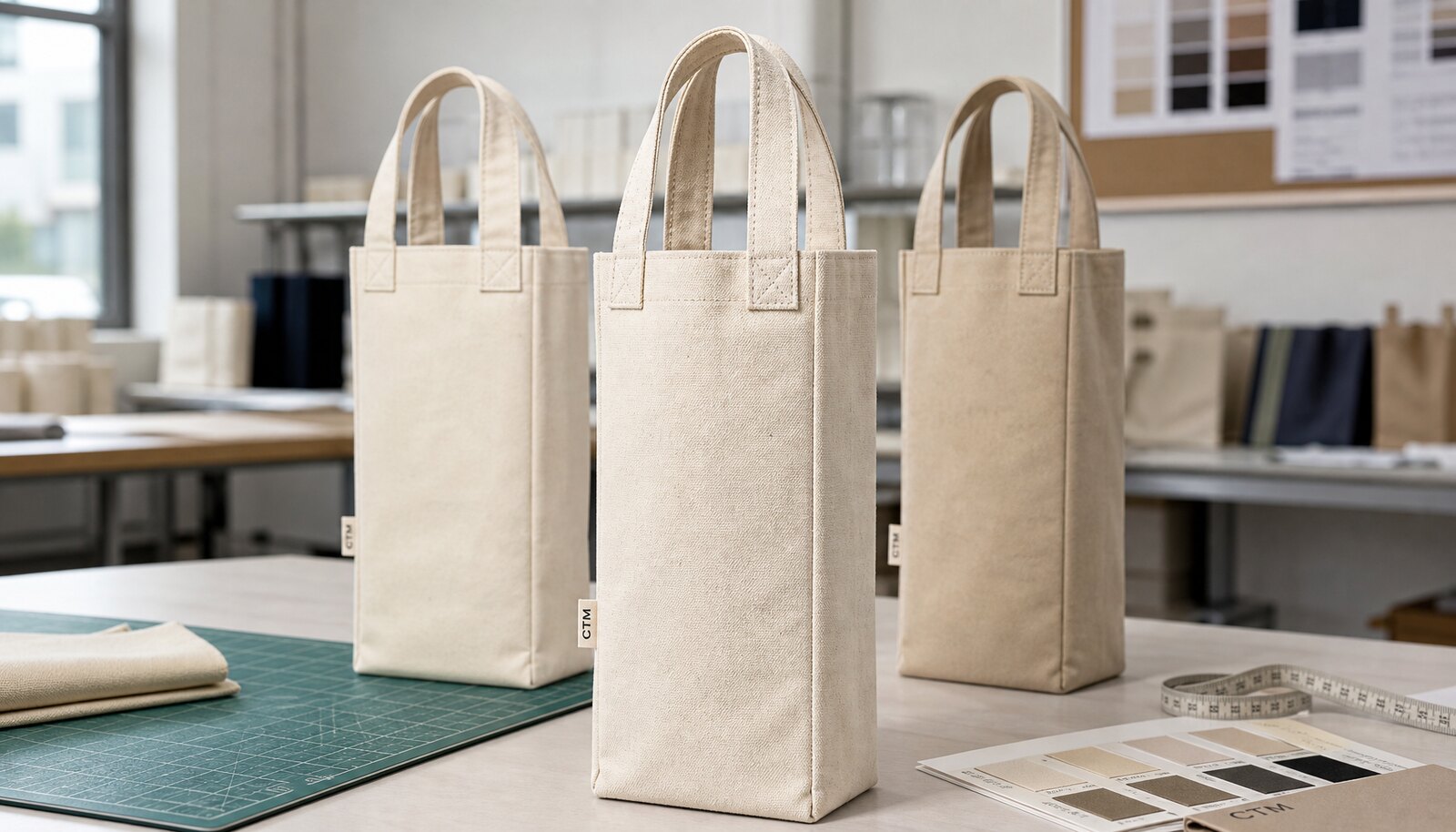
What gift shops actually need from a wine carrier
A gift-shop wine carrier is not just a small tote with a bottle inside. It has to look clean on a shelf, support a standard bottle without sagging, survive repeated handling by shoppers, and still feel premium enough to justify the margin. In a shop environment, the buyer is purchasing display quality as much as transport function. The carrier may sit near the register, move through multiple hands, and get compared side by side with higher-end gift items. That means the procurement standard is closer to a retail accessory spec than a basic promotional bag spec.
The first spec mistake buyers make is treating all 750 ml bottles as interchangeable. They are not. A round Bordeaux bottle, a wider Burgundy bottle, and a taller sparkling bottle each stress the carrier differently. Internal width, bottle base diameter, gusset depth, and top opening all affect whether the bag stands cleanly or collapses at the sides. For a typical gift-shop program, a natural canvas carrier in the 10–14 oz range, or roughly 280–420 GSM, is usually the sweet spot for structure and value. Lighter fabric can be acceptable for low-price souvenirs, but it often looks soft, creases easily, and loses the premium feel that gift-shop shoppers expect.
Buyers should also think about the retail moment, not only the shipping moment. If the carrier hangs on a hook, handle drop and top balance matter because a crooked or top-heavy bag looks unfinished. If the bag is displayed flat, the face panel must stay smooth enough to show the logo without distortion. For that reason, the spec should include the bottle type, the retail display method, and the visual standard all in one place. When those three items are written clearly, the supplier is far less likely to quote a product that works in transit but disappoints in the store.
- Use the actual bottle dimensions, not just the bottle volume, when defining the bag.
- Set the visual standard early: straight seams, no puckering, no odor, no visible stains, and clean logo placement.
- If the bag will hang on a retail hook, confirm handle drop and loaded balance with a filled sample.
- For seasonal gift sets, check that the bag still looks good after repeated folding, unpacking, and shelf restocking.
Define the construction before you compare price
The cheapest quote for a custom canvas wine carrier is often the quote with the weakest construction. Factories can lower price by reducing canvas weight, cutting down reinforcement, using a thinner handle, shrinking seam allowances, or simplifying the bottom build. If those points are not fixed in the RFQ, you are not comparing the same product across suppliers. You are comparing several different constructions that happen to carry the same name. That is why procurement teams should lock the build first and only then evaluate unit price.
A useful spec line might read: natural canvas at 12 oz/340 GSM, single-bottle body, reinforced top edge, reinforced handle attachment points, neat inside seam finish, and a bottom construction that keeps the carrier upright when filled. If the buyer wants a more premium shelf presence, moving to 14 oz/400–420 GSM often gives a firmer handfeel and better shape retention than trying to disguise a light fabric with a large logo. Canvas quality is visible immediately to end customers; no amount of branding can fully hide weak structure.
Buyers should also ask the factory whether the canvas is pre-shrunk or otherwise finished, because size drift is a common source of rework. If a bag is quoted at one size before finishing and arrives smaller after shrinkage, the carrier may no longer fit a wider bottle or may wrinkle around the seam line. The construction decision should therefore include fabric, reinforcements, finishing, and the intended retail presentation, not just the bag silhouette.
- Body fabric: 10 oz for entry-level, 12 oz for most retail programs, 14 oz for premium or reusable positioning.
- Handles: self-fabric looks cohesive; webbing usually gives better pull strength and more repeatable results.
- Bottom support: a structured base reduces tipping and improves shelf presentation.
- Ask whether the size quoted is before or after washing, finishing, or heat treatment.
Compare sourcing routes like a procurement buyer, not like a catalog shopper
A direct factory quote, a trading-company quote, and a local conversion quote can all look similar until you inspect who controls the process. A direct factory is usually the best choice when you need repeatable sewing quality, line-level accountability, and the ability to revisit the same spec for a reorder. A trading company can be useful when your order is small or you need multiple product categories bundled together, but the buyer should verify who actually owns the sewing, printing, and packing steps. A local converter may help when speed is critical, yet the blank carrier could be different from your original approved sample in fabric feel, fit, or seam behavior.
The most important sourcing question is not “Who is cheapest?” It is “Who can reproduce the approved version without drift?” For gift shops, repeat quality matters because buyers notice when the next shipment has a thinner bag body, a darker print, or a slightly shifted logo position. Seasonal programs are especially sensitive because the reorder may arrive after the shelf set has been planned. If the supplier cannot show how they control repeatability, you should treat low unit price as a warning sign rather than a benefit.
A good sourcing process asks the same questions of every route: who owns the production line, who inspects the goods, who stores the approved sample, and who signs off the carton pack. If a supplier cannot answer those questions clearly, the buyer may save a few cents and spend weeks resolving avoidable quality issues later.
- Direct factory: better for control, repeat orders, and process accountability.
- Trading company: useful for smaller programs, but require stronger spec documentation and proof of the real factory.
- Local converter: useful for speed, but verify the blank bag still meets your fabric, fit, and reinforcement requirements.
- Ask who holds the golden sample and how the supplier prevents silent substitution on reorders.
Read the quote line by line, not just the unit price
A useful quote for custom canvas wine carriers should break out the bag body, print, label, packaging, and delivery term. If the supplier gives only one price, there is no way to know whether the number includes the same material weight, the same print method, the same inner pack, or the same carton configuration as the other quotes you received. The practical buyer move is to normalize the spec first, then compare the same line items across all suppliers. That makes quote review much faster and avoids hidden surprises after the purchase order is placed.
MOQ logic matters here. The unit price may look attractive at 5,000 pieces because the supplier spreads setup costs across a large run, but the 300- or 500-piece order can be dramatically different once print setup, label tooling, carton changes, or waste allowance are added. Ask for pricing at several quantities so you can see how quickly the unit price drops and where the true economic break point sits. This is particularly helpful for gift shops that test a design in a few stores before committing to a larger seasonal program.
Also look for what is not said. A quote that mentions the print but not the ink type, or the packaging but not the carton dimensions, is incomplete even if the price looks attractive. If you do not receive a cost split, ask for one. Procurement teams should not have to infer important specification details from a vague unit rate.
- Make sure the quote separates body cost, print cost, label cost, and packing cost.
- Request price breaks at multiple quantities to see the true production threshold.
- Ask whether the quoted price includes waste allowance for cutting and print loss.
- Require the Incoterm and destination basis in writing so you can compare landed cost fairly.
Choose the print method for handling, not just appearance
Canvas wine carriers are handled in retail, moved into carts, stacked in cartons, and often touched before purchase, so decoration has to survive abrasion. Screen printing is usually the most practical option for simple logos and one- or two-color graphics because it offers good opacity on natural canvas and can be durable when cured properly. For smaller artwork or a more premium look, a woven label, embroidery, or stitched patch can work better than a large flood print. Heat transfer can be acceptable for short runs or detailed artwork, but it needs tighter control on adhesive, temperature, and curing or the edges may lift and crack after handling.
For gift shops, the print should support the product rather than dominate it. A large print can look busy, stiffen the face of the bag, and reveal fabric irregularities. In many retail programs, a smaller centered logo, a side placement, or a neatly finished side label creates a better balance between branding and presentation. The right decision depends on how the bag will be sold: as a premium gift accessory, a seasonal souvenir, or a low-price add-on item. The more the product is meant to feel giftable, the more important print finish and edge quality become.
The buyer should also ask for rub resistance proof. A logo that looks sharp in the sample room can still smear on the packing table if the ink is not cured correctly. Ask the supplier to show a dry rub test on the approved sample and, where relevant, a light wet rub test. That is one of the fastest ways to separate a production-ready print from a sample-room finish.
- Screen print: best for simple logos, strong opacity, and repeatability.
- Woven label or patch: useful for premium gift-shop positioning and lower ink coverage.
- Embroidery: premium look, but check thread tension and backing so the panel does not pucker.
- Heat transfer: acceptable for detailed art, but only if the supplier proves cure and adhesion.
Approve the sample like a production engineer
The sample stage is where most avoidable problems can be caught cheaply. Do not approve a sample just because the logo looks correct in a photo. Measure the body width, height, handle length, handle drop, and any gusset or base depth. Compare those numbers to the approved spec and record the actual measurement sheet. Then test the bag with the exact bottle shape you plan to sell. A sample that fits a generic bottle is not enough if your retail assortment includes wider or taller formats.
Inspect the sewing as carefully as the appearance. Look inside the bag for loose threads, skipped stitches, uneven seam allowance, and reinforcement that is either too short or badly positioned. Turn the bag inside out if the construction allows it. The inside finish is often where a factory’s real standard appears, because cosmetic inspection can hide weak sewing discipline. If the carrier includes a lining, insert card, or base board, test whether those parts stay in place after the bottle is inserted and removed several times.
The sample approval process should end with a sealed golden sample, a signed dimensional spec, and a defect note list. That gives the factory a reference for later production and keeps the reorder process from drifting. If the buyer has multiple stakeholders, get one person to own the final sample signoff so the factory does not receive conflicting feedback from different departments.
- Check dimensions against a written tolerance, not against an informal visual match.
- Test the exact bottle shape used in your stores, including wider or heavier bottles.
- Ask for a physical sample of the print, not only a digital proof.
- Seal one approved sample as the golden reference for bulk production and later reorders.
- If the program is seasonal, document which details cannot change on reorder: fabric, print placement, and trim color.
Put QC thresholds into the PO before bulk starts
A quality inspection checklist only works if the acceptance criteria are written into the purchase order or quality agreement before production begins. For a canvas wine carrier, the most useful thresholds are the visible ones that affect retail presentation and the load-bearing ones that affect function. This means size tolerance, stitch density, reinforcement quality, print cure, clean surface condition, and carton accuracy. If these are left vague, inspectors end up arguing with the supplier at the dock instead of confirming whether the lot is compliant.
A practical approach is to define defects by severity. Major defects include wrong size beyond tolerance, broken seams, missing reinforcement, print that rubs off, wrong logo placement, visible stains, strong odor, and carton count mismatch. Minor defects might include a thread tail that can be clipped, a small fold mark that does not affect appearance, or a slight seam variation that stays within spec. The important point is to define the boundary ahead of time. If your team waits until inspection day to decide what counts as rejectable, results become inconsistent and orders can slip.
It also helps to require first-off approval from the line. When the first few pieces come off the sewing or printing line, compare them to the golden sample before the run continues. That catches machine setup issues early, especially print alignment, handle placement, or seam tension. It is much cheaper to stop a line after 20 bad pieces than after 2,000.
- Typical checks: dimension, stitching, handle reinforcement, print cure, odor, stains, and carton count.
- Require the supplier to separate major defects from minor defects in the inspection report.
- Set written defect thresholds before production so the factory knows what is rejectable.
- If possible, inspect first-off samples from the line before the full run continues.
Use a visual inspection checklist that the factory can actually follow
A strong inspection checklist should be easy enough for a line leader, warehouse checker, and third-party inspector to use the same way. For custom canvas wine carriers, the checklist should start with identity checks: model, size, color, artwork, label, carton mark, and PO number. Then it should move to construction checks: seam straightness, stitch count, reinforcement, handle symmetry, and bottom shape. After that come cosmetic checks: stains, dust, misprints, loose fibers, and odor. Finally, the packout section should confirm count, insert cards, polybags, and carton sealing.
Do not bury the important checks in general language. Instead of writing “good quality stitching,” write “no skipped stitches, no seam opening, no loose thread longer than 10 mm after trimming, and no visible needle damage on the face.” Instead of writing “print should look clean,” write “logo placement within ±3 mm of approved position, no pinholes, no smudging, and no ink transfer on dry rub.” This kind of wording makes the checklist usable in the factory and on receipt inspection, because everyone knows what to measure.
If you work with multiple suppliers, keep the inspection form consistent. The goal is not to create a different checklist every time. The goal is to make one form that captures the same critical points for every order so defect data can be compared over time. That is especially useful for gift-shop programs where reorders may come from the same supplier but a different production line.
- Identity: PO, model, size, artwork, label, and carton marks.
- Construction: seam straightness, stitch count, reinforcement, handle symmetry, and bottom shape.
- Cosmetic: stains, dust, loose fibers, misprints, and odor.
- Packing: count, inner pack, insert, polybag fit, carton seal, and outer label accuracy.
- Use specific defect wording so inspectors do not interpret quality differently from one shipment to the next.
Inspect packing because gift-shop products are display items
A wine carrier can be structurally correct and still sell poorly if it arrives creased, dusty, or packed in a way that distorts the bag shape. For retail programs, flat packing is often the best choice, but only if the carrier opens without a permanent fold line or face distortion. Polybags should fit closely enough to prevent sliding and rubbing, yet not so tightly that they leave marks. If an insert card or hang tag is used, confirm it does not scratch the print, bend the body, or add visible bulk that changes shelf appearance.
Carton planning deserves the same attention as sewing. Ask for inner pack quantity, outer carton count, carton dimensions, carton strength, and whether the carton is double-wall or single-wall. For higher-value gift shop programs, moisture protection can be useful if the route is long or the destination climate is humid. You do not need elaborate packaging to protect a canvas carrier, but you do need packaging that prevents scuffing, dust, and unnecessary wrinkling. Receiving teams will also appreciate a clean count per carton because it reduces disputes and speeds up stock-in.
If you sell through distributors or multiple retail locations, confirm the carton label format early. The wrong carton mark can slow receiving even when the product itself is perfect. Packaging is part of quality because the customer often judges the product before the carrier is removed from the pack.
- Flat pack the carrier only if it still opens cleanly without a permanent crease.
- Keep inner pack sizes consistent so retailers can replenish display stock quickly.
- Confirm carton markings, quantity, barcode placement, and seal method before shipment.
- Use moisture protection when transit time, climate, or storage conditions justify it.
Plan lead time around samples, fabric, and repeat orders
Lead time on custom canvas wine carriers is usually driven by sample approval and material readiness more than by sewing speed. A straightforward order with stock fabric and a simple one-color print can move quickly once the spec is locked, but new development almost always takes longer than buyers first expect. That is because the supplier may need to source fabric, prepare print screens or plates, confirm label materials, and make revisions after the first sample. If the carrier includes custom dyed fabric, special trim, or a bespoke carton, the schedule becomes even more sensitive to early decisions.
For repeat orders, consistency is the real lead-time issue. If the supplier can reserve approved fabric or match a previous lot closely, your reorder is easier to approve. If not, the second shipment can look different even when it arrives on time. That is why a good procurement file should include the golden sample, the signed spec sheet, the approved artwork file, and a record of the exact packaging configuration. The reorder then becomes a controlled reproduction, not a fresh guess.
For seasonal gift-shop programs, ask the supplier to split the timeline into sample, approval, bulk production, packing, and dispatch. That makes it easier to see where a delay is likely to occur and whether the supplier is still on track before the ship date becomes urgent.
- Separate sample lead time from bulk lead time in every quote.
- Ask whether fabric can be reserved or rebooked for replenishment orders.
- Keep a spec archive so seasonal reorders do not drift from the original approved version.
- Request a production schedule that shows sample, bulk, packing, and dispatch milestones.
Specification comparison for buyers
| Spec decision | Recommended option | When it fits | Buyer risk to check |
|---|---|---|---|
| Fabric weight | 10–12 oz (280–340 GSM) natural canvas | Most gift shops need a balance of structure, cost, and a premium handmade feel | Confirm actual GSM or oz with a mill report or fabric swatch, not a verbal description |
| Fabric weight | 12–14 oz (340–420 GSM) heavier canvas | Retail programs where the carrier must stand upright and feel giftable | Heavier fabric can hide sloppy sewing less well; inspect seam neatness and folding consistency |
| Fabric finish | Pre-shrunk or finished canvas with stable handfeel | Programs that need repeatable sizing and less distortion after storage | Ask for shrinkage data and whether the quoted size is before or after finishing |
| Construction | Single bottle carrier with reinforced base and top edge | Standard 750 ml wine bottle retail programs | Check whether the base is structured enough to prevent tipping and whether the side seams bulge under load |
| Construction | Gusseted carrier with boxed bottom | Gift shops that want a more premium display shape | Watch for gusset symmetry, bottom squareness, and stitch consistency at corners |
| Handle style | Self-fabric handles with reinforcement | Branded gift-shop programs seeking a cohesive look | Check pull strength and whether the handle edge will fray or soften after repeated handling |
| Handle style | Webbing handles with bar-tacks or X-box reinforcement | When durability and repeatability matter more than a fully tonal look | Confirm the webbing width, color consistency, and stitch density at load points |
| Printing | One- or two-color screen print | Simple logos, high handling, and repeatable bulk production | Inspect ink opacity, registration, rub resistance, and curing on the approved sample |
| Printing | Woven label, embroidery, or patch | Premium positioning or smaller artwork that should not dominate the bag face | Check attachment strength and edge finish, since trims fail before the bag body does |
Buyer checklist before sampling
- Define the exact bottle type, not just the bottle volume: diameter, shoulder shape, base width, and overall height.
- Specify the carrier size in millimeters and include acceptable tolerance limits for width, height, gusset, and handle drop.
- State the target canvas weight in GSM or oz, plus whether that figure is before or after finishing.
- Write handle material, width, reinforcement method, and stitch pattern into the RFQ.
- Approve the logo placement, print method, print size, ink type, and color reference from a physical sample or strike-off.
- Require a pre-production sample, then a sealed golden sample signed and dated by both sides.
- Ask for a line photo set or short video showing cutting, stitching, printing, and packing if you cannot audit on site.
- Request carton count, carton dimensions, inner pack count, and moisture protection details before booking freight.
- Compare all quotes on the same basis: body fabric, print, label, packaging, tooling, and Incoterm.
- Set acceptance criteria for stitching, dimensions, handle pull strength, print rub resistance, stains, odor, and carton accuracy before production begins.
Factory quote questions to send
- What is the actual fabric weight in GSM or oz, and can you share a mill or fabric specification sheet?
- Is the canvas greige, dyed, or finished, and what changes after finishing in weight, shrinkage, or handfeel?
- What is the exact seam allowance, stitch density, and reinforcement method at the stress points?
- Do you print in-house, or is printing outsourced to another site? If outsourced, who owns the print QC?
- What is the MOQ for the bag body, the print setup, the woven label, and the custom carton separately?
- Can you hold or reserve approved fabric lots for repeat orders so the next replenishment matches the first order?
- What is the acceptable tolerance for body width, height, gusset, handle length, and handle drop?
- What is the expected handle pull strength target, and how do you test it before shipment?
- How are bags packed per inner pack and per export carton, and do you use moisture protection if needed?
- Which documents can you provide with shipment: packing list, carton count, inspection report, and production photos?
Quality-control points to confirm
- Measure body width, height, gusset, handle length, and handle drop against the approved spec. For gift-shop display consistency, keep size variance within ±3 mm on key visible dimensions and ±5 mm on non-critical dimensions unless your program requires tighter limits.
- Inspect canvas weight and weave density with a swatch, reference card, or test report. The material should feel firm enough to hold a bottle upright without collapsing sideways.
- Check stitch density on body seams, handles, and reinforcements. A practical target is 7–9 stitches per inch for most canvas carrier programs, with no skipped stitches, broken thread, or open seam segments.
- Inspect handle reinforcement carefully: bar-tacks, X-box stitches, or equivalent load-point reinforcement should be present, aligned, and secure. Any visible gap, loose thread cluster, or crooked reinforcement should be treated as a defect.
- Test pull strength on the handle attachment with a controlled sample test. If your product spec does not name a formal lab test, set a practical in-line threshold and require no failure when loaded with a bottle weight plus a safety margin during manual pull testing.
- Review print placement, registration, opacity, and cure. The artwork should not crack, tack, or rub off when handled. Run a dry rub test and a light wet rub test on the approved sample before bulk release.
- Check for odor, stains, oil marks, needle damage, loose lint, and stray threads. Gift-shop items are shelf-facing goods, so cosmetic defects matter as much as structural ones.
- Test bottle insertion and removal with the exact bottle shape used in stores. The carrier should not require force that deforms the seams or leaves the bottle unstable.
- Open cartons at the top, middle, and bottom of the lot to verify count, packing method, and condition. Confirm labels, inner packs, and inserts are correct and consistent.
- Record defects by type, location, and lot number. If defect data is not linked to a process step, the supplier cannot correct the root cause and repeat issues will continue.