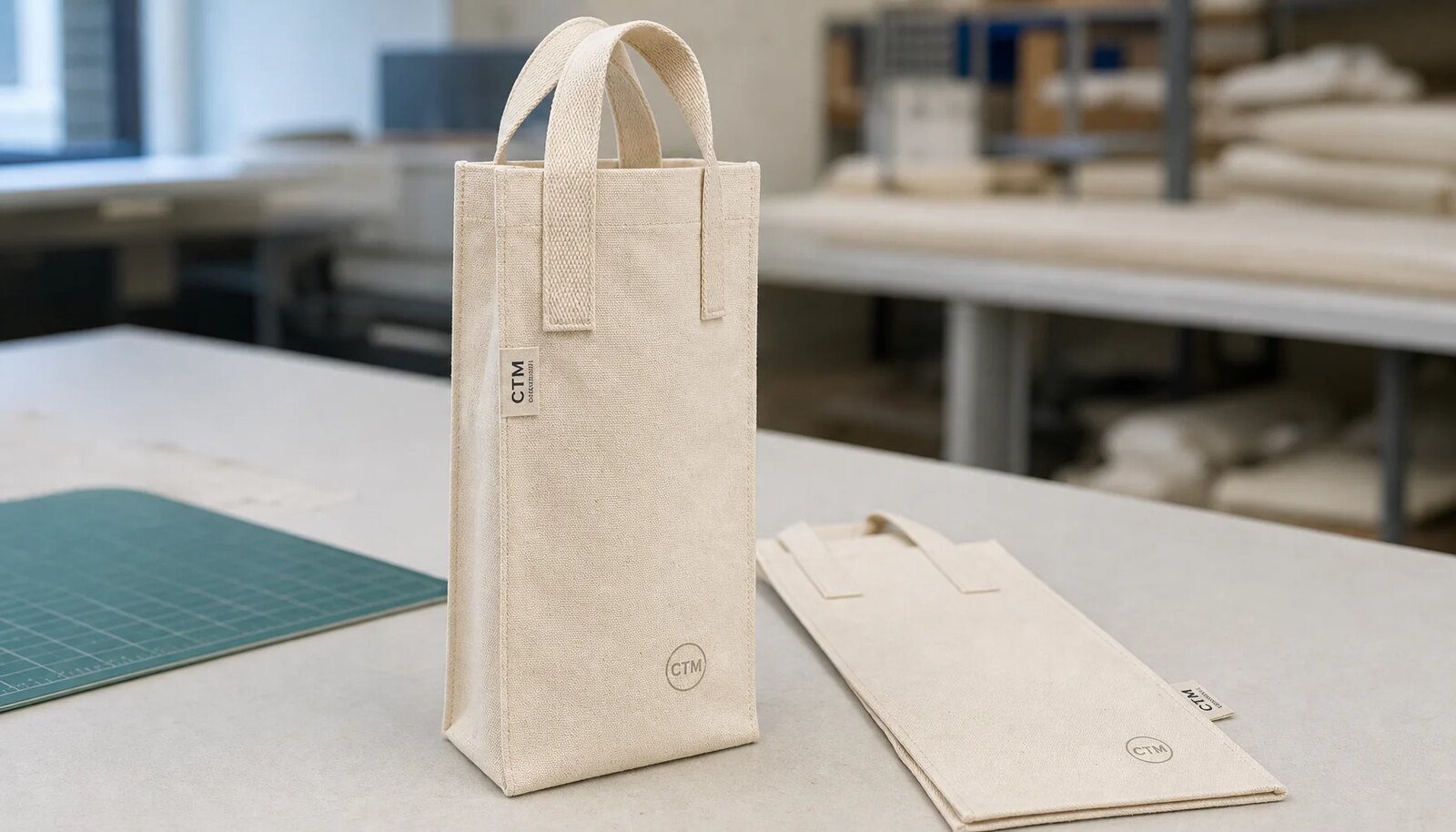
Start with the event risk, not the product photo
Custom canvas wine carriers look simple in a catalog. One bottle, two handles, a printed logo, maybe a divider. In real event use, they are more demanding. They hold dense glass, often over 1 kg when filled, and that weight exposes weak handle stitching, shallow gussets, poor balance, and fabric that looked fine only while empty.
For an event planner, a defect is not hidden in a warehouse. It shows up in front of a guest, sponsor, hotel manager, wine buyer, or VIP. A carrier that leans on a dinner table, smells musty in a welcome room, rubs ink onto tissue wrap, or tears at the handle is no longer just a product issue. It becomes an event operations problem.
A useful custom canvas wine carriers quality inspection checklist for event planners should connect the sourcing brief to the actual handoff. Will staff load bottles in a back room? Will guests pick the carrier up from a registration desk? Will the bag sit upright on a place setting? Will it ship directly to homes? Each scenario changes what matters most: speed, stability, presentation, packing protection, carton marks, or reusable strength.
The mistake to avoid is approving a sample because it looks attractive flat on a table. Test it loaded. Close it if it has a drawstring or snap. Lift it, set it down, reload it, inspect the seams, and look at the logo while the front panel curves around the bottle. The sample should earn approval as a working object, not just as a mockup.
- Treat the carrier as a loaded bottle-handling item, not only a printed promotional bag.
- Define the use case before pricing: table gift, hotel amenity, VIP kit, retail item, sponsor handout, tasting set, or direct shipment.
- Make the approved sample, spec sheet, artwork proof, and packing plan the inspection baseline.
- Build QC around bottle fit, handle strength, fabric consistency, logo accuracy, cleanliness, packing, and carton control.
Define bottle fit before discussing price
Bottle fit is the first technical decision. A 750 ml Bordeaux bottle, Burgundy bottle, Champagne bottle, sparkling wine bottle, olive oil bottle, and spirits bottle may all sound close enough in conversation. They are not close enough for pattern making. Height, base diameter, shoulder shape, neck width, and filled weight all affect the carrier.
Ask the supplier to work from measurements, not assumptions. Send total height, maximum base diameter, widest shoulder diameter, neck diameter, neck height, and filled weight. If the bottle will be wrapped in tissue, fitted with a neck tag, paired with a card, or packed with an accessory, measure the complete loaded combination. For mixed assortments, design around the largest and heaviest bottle that must fit.
Loading speed is part of fit. Event staff may need to load hundreds or thousands of units in a hotel service area, winery back room, fulfillment center, or temporary event office. A tight opening, floppy handle, short divider, or narrow gusset can add seconds to every unit. That sounds small until the event team is behind schedule.
Two-bottle carriers need a second layer of control. The divider should reduce glass-to-glass contact during normal carrying, while still allowing staff to insert bottles quickly. A divider that is too low is mostly decorative. A divider that is poorly attached may fold under weight. For premium gifting, check the loaded carrier from the front, side, and top so the presentation looks deliberate.
- Record bottle height, base diameter, shoulder diameter, neck diameter, neck height, and filled weight.
- State whether the carrier must hold one bottle, two bottles, or a bottle plus tissue, tag, card, food item, or accessory.
- Approve the sample using the actual bottle profile whenever possible.
- Check whether the loaded carrier stands upright for table placement, retail display, or pickup stations.
- For two-bottle styles, inspect divider height, divider attachment, and bottle contact during normal carrying.
Specify canvas in terms a factory can control
The word canvas is not enough. One supplier may quote 8 oz cotton canvas, another 10 oz, another 12 oz, and all three may describe the product as a custom canvas wine carrier. For many event, hospitality, and gifting programs, 10-12 oz canvas, roughly 340-420 GSM, is a practical starting range. It usually gives more structure than lightweight promotional fabric without making sewing and freight unnecessarily heavy.
Use both oz and GSM in the RFQ. Buyers, mills, and factories may rely on different measurement habits, and converting later can create confusion. Also ask whether the fabric weight is measured before or after washing, dyeing, coating, or pre-shrinking. Finishing can change stiffness, shrinkage, handfeel, lint, and how ink sits on the fabric.
Composition should be written plainly. If the program requires cotton, specify 100% cotton canvas. If a cotton-poly blend is acceptable, state the blend and understand how it may affect wrinkle resistance, sustainability messaging, print behavior, and touch. Canvas describes a fabric construction; it does not guarantee one fiber content.
Natural canvas shade deserves attention. It can read warm beige, cool off-white, cream, speckled, or slightly gray depending on yarn and lot. Dyed canvas adds color matching risk. The approved sample should become the reference, and buyers should define what level of shade variation is commercially acceptable across front panels, handles, dividers, and base pieces.
- Quote fabric weight in oz and GSM, with the measurement point before or after finishing.
- Confirm composition: 100% cotton, cotton blend, recycled content, organic cotton, or another stated material.
- Define finish: natural, dyed, washed, enzyme-washed, pre-shrunk, coated, laminated, or uncoated.
- Ask for expected shrinkage if the carrier may be washed, steamed, or stored in humid conditions.
- Inspect fabric rolls for weight, shade, handfeel, odor, stains, lint, and visible weaving defects before cutting.
Control the sewn construction, especially the handles
Construction is where a pretty bag becomes a reliable carrier. The purchase specification should include finished height, width, gusset depth, base size, handle drop, handle width, divider height, divider width, closure placement, and logo position. For critical sewn dimensions, +/-5 mm is often a useful discussion point, but the supplier should confirm what is realistic for the fabric, pattern, and production method.
Handles carry the highest functional risk. A full 750 ml glass bottle commonly weighs over 1 kg, and two-bottle styles can be much heavier. The quote should state whether handles are cotton webbing, self-fabric, rope, or another material. It should also define handle width, handle drop, stitch pattern, thread color, reinforcement length, and whether backing fabric is added inside the attachment area.
Avoid vague language such as reinforced handles unless the reinforcement is visible and inspectable. Ask for bar-tacks, box stitches, cross stitches, or another agreed construction. Then inspect bulk units against that method. Stable stitch tension matters. Skipped stitches, loose loops, broken thread, short bar-tacks, and unraveling at handle points are not cosmetic details.
Base construction affects both presentation and handling. A gusseted base helps the carrier stand and reduces twisting around the bottle. An insert bottom panel can improve display, but it adds cost, bulk, weight, and packing decisions. For table gifts and retail shelves, test upright performance on the real surface if possible. For fast handoff events, loading speed and handle strength may matter more than display stability.
- Specify finished dimensions and tolerances for all critical sewn points.
- Define handle material, width, drop, stitch pattern, reinforcement length, stitch density, and thread color.
- Inspect seam allowance and stitching at handles, side seams, top opening, base corners, and dividers.
- Use a gusseted base when the bag must stand upright or reduce bottle movement.
- Confirm closure placement so drawstrings, snaps, or ties do not slow loading or interfere with bottle labels.
Choose branding that works on textured fabric
A digital proof can make any logo look clean. Canvas is less forgiving. The weave has texture, slubs, absorbency, and shade variation. Thin strokes can soften. Small letters can fill in. Low-contrast ink may disappear on natural fabric. Before final art approval, ask the supplier what minimum line thickness and text size they recommend for the selected canvas.
Screen printing is often the strongest starting point for bold one-color or two-color wine carrier logos. It is practical for event quantities and can be consistent when artwork is simple. Each color and print position may add setup cost, so the quote should list screen charges and clarify whether color matching is exact, approximate, or based on the closest workable ink result on canvas.
Heat transfer can support more detailed or multicolor art, but it should be tested on the real fabric finish. Check handfeel, edge behavior, cracking, adhesion, and whether the transfer changes the premium impression of the bag. Woven labels, cotton labels, and sewn patches can look more retail-ready, but the sample must confirm label size, fold type, stitch color, placement, and comfort while carrying.
Logo placement should be measured from a defined reference point such as the top edge, bottom seam, side seam, centerline, handle attachment, or base fold. Review the carrier loaded, because the front panel curves around the bottle and can shift the visual center. For sponsored events, freeze co-branded artwork before production release; late logo changes can trigger new screens, new transfers, new samples, and a real lead-time problem.
- Provide vector artwork and state Pantone targets or approved closest-color expectations.
- Avoid tiny text, thin lines, complex gradients, and low-contrast artwork unless proven on production canvas.
- Measure logo placement from defined seams, edges, or centerlines.
- Approve decoration on the same fabric color and finish planned for bulk production.
- Confirm setup charges, revision fees, logo positions, color count, and artwork-change deadlines in writing.
Make quotes comparable before selecting a supplier
A low unit price is useful only when everyone is quoting the same item. With canvas wine carriers, cost can shift through fabric weight, fabric finish, handle material, reinforcement, logo method, packing, sample terms, inspection support, and carton labeling. A lighter bag with loose bulk packing may look cheaper, then create repacking work or event-quality complaints later.
A strong RFQ does not need to be complicated, but it must be complete. Ask each factory to quote the same bottle profile, same fabric weight, same dimensions, same construction, same logo method, same packing method, and same delivery terms. If one quote omits reinforcement, packing, setup charges, or sample cost, it is not yet comparable.
MOQ needs careful reading. A supplier may say the minimum is 1,000 pieces, but that minimum may apply per fabric color, per print design, per label, or per packing version. A 2,000-piece order split across four sponsors may behave like four 500-piece runs. Custom dyeing, special woven labels, multiple print sides, and destination-specific packing can all change the effective minimum.
For event procurement, landed cost is more important than ex-factory price. Ask for carton dimensions, units per carton, gross weight, total carton count, and pallet details if relevant. Canvas carriers are not fragile, but they can be bulky, especially with individual packing or base inserts. Freight, warehouse receiving, sorting, and venue handling should be part of the buying decision.
- Compare quotes only after fabric, dimensions, construction, logo method, packing, and inspection assumptions are aligned.
- Request price breaks at 500, 1,000, 3,000, and 5,000 pieces by artwork and color version.
- Confirm whether sample fees, setup charges, screens, labels, packing materials, carton marks, and inspection support are included.
- Ask for carton size, units per carton, gross weight, total carton count, and overrun or underrun tolerance.
- Evaluate total delivered cost and event handling effort, not only ex-factory unit price.
Use the pre-production sample as the approval standard
The pre-production sample is more than a nice object to show stakeholders. It is the physical reference for production, inspection, and dispute resolution. It should be made with production fabric whenever possible, using the intended handle reinforcement, thread color, divider construction, closure, decoration method, label placement, and packing fold.
Early development samples can use substitute materials, but they should be labeled as development samples. Do not treat a temporary logo, alternate fabric, or approximate handle as final approval. Once the order moves toward bulk production, the approved sample should match the purchased specification closely enough that inspectors can use it with confidence.
Sample review should be active. Load the actual bottle, lift the carrier by the handles, carry it briefly, set it down, remove the bottle, and repeat. Watch for twisting, seam strain, unstable base behavior, tight loading, closure interference, print distortion, and handle discomfort. If it is a two-bottle carrier, load both compartments and check for glass contact.
Document the sample like a contract tool. Measure finished width, height, gusset, base, handle drop, handle width, divider height, print size, print position, and closure location. Photograph the carrier flat, loaded, front, back, inside, handle attachment, divider, base, logo close-up, and packed condition. These records reduce arguments when bulk units are inspected.
- Require a production-spec sample before authorizing bulk production.
- Test the sample loaded with the exact bottle profile and any tissue, tag, card, or accessory included in the event kit.
- Measure critical dimensions and write tolerances on the approval record.
- Inspect handle reinforcement, base corners, divider seams, closure operation, loose threads, print quality, cleanliness, and odor.
- Keep signed sample photos and measurement records as the production and final inspection reference.
Inspect quality from fabric receiving to final packing
Final inspection matters, but many defects begin earlier. Shade variation starts with fabric rolls. Twisted bags start with cutting and sewing alignment. Weak handles start with stitch settings and rushed reinforcement. Print problems often appear in the first production run, long before cartons are sealed. Inline control catches issues while they are still fixable.
At fabric receiving, inspectors should verify weight, shade, handfeel, width, contamination, odor, and lot identification. At cutting, they should check panel dimensions, grain direction, and whether visible panels are kept consistent. At sewing, they should inspect seam allowance, stitch density, handle placement, bar-tacks or box stitches, divider alignment, top opening, base corners, and thread trimming.
Printing should be approved at the start of production, not discovered at the end. Check logo position, ink density, registration, drying, smudge risk, and color appearance under consistent lighting. On textured canvas, pinholes or uneven coverage may appear along the ridges of the weave. The first printed units should be compared against the approved sample before the full lot continues.
Defect classification helps everyone make consistent decisions. Critical defects include functional or safety failures such as broken handles, sharp hardware, severe contamination, or a carrier that cannot hold the bottle. Major defects include wrong dimensions, missing divider, crooked logo, weak reinforcement, visible stains, wrong artwork, or incorrect packing. Minor defects may include small thread ends or natural canvas variation inside the agreed tolerance.
- Check fabric lot, weight, shade, odor, and contamination before cutting.
- Measure cut panels and early sewn units before bulk sewing continues.
- Inspect handle reinforcement and divider attachment during sewing, not only after packing.
- Review first printed units before approving full print production.
- Use critical, major, and minor defect categories so acceptance decisions are consistent.
Add functional tests to the inspection checklist
A canvas wine carrier can look fine and still fail in use. Functional checks are necessary because the product carries glass, often in a public setting. The goal is not to create an unrealistic abuse test. The goal is to confirm that the carrier survives normal loading, lifting, carrying, setting down, and guest handling.
A practical load test uses the target filled bottle or an agreed equivalent weight. Randomly selected units should be loaded, lifted by the handles, held briefly, moved gently, set down, and checked for seam strain, handle distortion, fabric stress marks, and base stability. Two-bottle carriers should be tested with both compartments loaded.
Closure and divider tests should happen while the carrier is loaded. Drawstrings, snaps, ties, toggles, and flaps may feel smooth when empty but become awkward around a bottle shoulder or neck. Dividers should remain in position and reduce bottle movement. If staff must load quickly, the test should include opening and closing several units at a realistic pace.
Dimensional inspection should focus on points that affect function and presentation. Width, gusset, base, divider height, handle drop, and logo placement are usually more important than a harmless fold variation. If the logo must face guests on a table or shelf, inspect the carrier loaded and upright, not only flat.
- Run random load tests with the target filled bottle or agreed equivalent weight.
- Check handle seams after lifting for loose stitches, tearing, distortion, or fabric stress marks.
- Test closures and dividers while the carrier is loaded.
- Measure critical dimensions and logo placement against the approved sample.
- Request inspection photos, measurement sheets, defect counts, and load-test notes before shipment release.
Control packing, carton marks, and event distribution
Packing is part of quality control. Event teams rarely have time to fix messy receiving. A well-made carrier can arrive dusty, scuffed, deeply creased, miscounted, or mixed with the wrong artwork version if packing is vague. Approve the packing method at the same time as the product sample, especially when goods ship to hotels, venues, fulfillment centers, or multiple cities.
Individual polybags protect against moisture exposure, lint transfer, carton abrasion, and dirty handling, but they add cost and may conflict with sustainability preferences. Paper wrap, paper bands, bundle packs, or bulk folded packing may fit the brand better. The right answer depends on shipping path, storage time, guest presentation, and repacking plans.
The fold method matters more than buyers sometimes expect. If the print area is folded under pressure, the logo can crease or pick up marks. If the base insert is bent, the loaded carrier may not stand cleanly. If cartons are too loose, units can shift and counts can become unreliable. Ask for a packed sample or clear packing photo before bulk packing begins.
Carton labels should be readable by people who were not part of the purchase. Include PO number, item name, SKU, color, artwork version, quantity per carton, carton number, total carton count, gross weight, and destination when applicable. For multi-venue programs, destination sorting can save more operational effort than a small unit-price reduction.
- Approve individual polybag, paper wrap, bundle count, bulk fold, or other packing method before bulk production.
- Avoid folding methods that crease the logo, deform the base, or make the carrier hard to load.
- Use carton marks with PO, SKU, item name, color, artwork version, quantity, carton sequence, and destination.
- Request venue-specific or SKU-specific carton sorting for multi-location programs.
- Confirm carton dimensions, gross weight, total carton count, pallet needs, and receiving instructions before shipment.
Specification comparison for buyers
| Procurement decision | Recommended specification | Use this when | Inspection risk to control |
|---|---|---|---|
| Target bottle profile | Record bottle height, base diameter, shoulder diameter, neck diameter, filled weight, and allowance for tissue, tags, cards, or accessories | Wine dinners, winery gifting, hotel welcome programs, sponsor gifts, mixed bottle assortments, olive oil gifts, and retail bottle sets | A carrier approved with the wrong bottle can bulge, twist, fail to close, lean on display, or allow bottle contact |
| Finished dimensions | Specify width, height, gusset, base panel, divider height, handle drop, handle width, closure point, and logo position with confirmed tolerances; +/-5 mm is a useful starting point for critical sewn dimensions when the supplier agrees | Orders that must stand upright, fit cartons, load quickly, match a previous program, or present consistently on tables and retail shelves | Uncontrolled sizing causes slow loading, uneven presentation, poor bottle stability, and inconsistent branding placement |
| Fabric weight | Quote 10-12 oz canvas, roughly 340-420 GSM, and state whether weight is measured before or after washing, dyeing, coating, or pre-shrinking | Corporate gifting, hospitality events, winery merchandise, retail-ready carriers, and reusable bottle bags | Lighter fabric may collapse; heavier fabric can raise cost, bulk, sewing difficulty, carton size, and freight weight |
| Fabric composition and finish | Confirm 100% cotton or stated blend, natural or dyed shade, washed or unwashed finish, shrinkage expectation, odor standard, and cleanliness requirement | Programs with sustainability requirements, food-adjacent gifting, premium handfeel expectations, or brand color control | Unclear composition changes handfeel, print behavior, labeling accuracy, shade consistency, and buyer claims |
| Construction style | Choose gusseted single-bottle, two-bottle divider, drawstring-neck, snap closure, reinforced base, insert bottom panel, or tote-style construction based on loading and presentation needs | Venue handoff, table gifts, VIP kits, tasting sets, sponsor merchandise, winery retail, and direct-to-guest shipping | A generic flat tote pattern may not stabilize a glass bottle or survive repeated loaded handling |
| Handle reinforcement | Require cotton webbing or double-folded self-fabric handles with bar-tacks, box stitches, or cross stitches at stress points; define handle width, drop, stitch density, and thread color | Any carrier holding a full 750 ml glass bottle, multiple bottles, or a bottle plus accessories | Weak handle attachment is a functional defect and can turn an otherwise attractive bag into a failed event item |
| Decoration method | Use screen print for bold one- or two-color logos, woven label or sewn patch for a premium detail, and heat transfer only after testing handfeel, edge behavior, cracking, and adhesion on canvas | Sponsor logos, winery marks, hotel branding, seasonal gifting, retail merchandise, and co-branded event programs | Textured canvas can blur fine lines, shift color, reduce contrast, or make small typography unreadable |
| MOQ and price breaks | Ask for pricing at 500, 1,000, 3,000, and 5,000 pcs by fabric color, artwork version, construction type, label version, and packing version | Pilot events, annual programs, multi-city activations, sponsor splits, and replenishment planning | A total MOQ can hide separate MOQs for dye lots, print setups, woven labels, accessories, and destination packing |
| Packing method | Define individual polybag, paper wrap, bundle count, units per carton, carton marks, carton sequence, destination allocation, and pallet needs before production | Warehouse receiving, hotel delivery, event-kit assembly, retail distribution, and multi-location programs | Loose or unclear packing creates stains, deep creases, miscounts, mixed versions, repacking labor, and venue delays |
Buyer checklist before sampling
- Confirm the exact bottle range: 750 ml Bordeaux, Burgundy, Champagne, sparkling wine, olive oil, spirits bottle, or mixed assortment; record maximum height, base diameter, shoulder diameter, neck diameter, neck height, and filled weight.
- State whether bottles will be loaded bare, wrapped in tissue, fitted with a neck tag, paired with an insert card, or combined with accessories that affect clearance and balance.
- Define the event workflow: warehouse kitting, hotel loading, table placement, registration handoff, retail display, sponsor booth distribution, tasting room sale, or direct-to-guest shipping.
- Lock fabric weight in both oz and GSM, plus fabric composition, finish, shrinkage expectation, shade reference, and whether the fabric is washed, dyed, pre-shrunk, coated, laminated, or uncoated.
- Specify finished dimensions and tolerances for width, height, gusset, base, handle drop, handle width, divider height, divider width, closure placement, and print placement.
- Choose the construction: single-bottle open carrier, drawstring-neck carrier, snap closure, two-bottle divider, reinforced base, insert bottom panel, or retail-style bottle tote.
- Define handle reinforcement in visible terms: material, width, stitch pattern, bar-tack or box-stitch size, thread color, stitch density, and whether backing fabric is used.
- Provide vector artwork, Pantone or approved closest color target, print size, print position, number of colors, number of sides, and minimum acceptable edge sharpness on textured canvas.
- Request a pre-production sample made with production fabric, production decoration, intended handle construction, and the exact packing fold if presentation matters.
- Test the approved sample with the actual bottle profile: load, lift, carry, set down, remove, reload, close, open, and inspect for seam strain, twisting, or distortion.
Factory quote questions to send
- What exact canvas weight are you quoting in oz and GSM, and is that measurement taken before or after washing, dyeing, coating, or other finishing?
- What is the fabric composition, weave type, shade reference, expected shrinkage, and finish, and can you keep bulk fabric commercially consistent with the approved sample?
- Which bottle profile did you use to develop your standard pattern, and can you adjust the carrier for Bordeaux, Burgundy, Champagne, sparkling wine, olive oil, spirits, or mixed bottle dimensions?
- What finished-size tolerances do you allow for height, width, gusset, base, handle drop, handle width, divider height, closure placement, and logo placement after sewing?
- What reinforcement do you use at the handle attachments, side seams, base corners, divider seam, top opening, and closure point?
- What stitch density, thread type, thread color, bar-tack length, or box-stitch dimensions are included in the quoted construction?
- Which decoration method is included in the unit price, and what are the setup charges per color, per side, per screen, per label, or per logo position?
- What artwork file format do you require, and what minimum line thickness, small-text height, print registration tolerance, and color tolerance do you recommend for canvas?
- What is your MOQ by fabric color, print design, construction type, label version, and packing version, and how does pricing change at 500, 1,000, 3,000, and 5,000 pieces?
- Can you provide a pre-production sample made with production fabric, correct handle reinforcement, final logo method, and intended packing fold? What is the sample lead time?
Quality-control points to confirm
- Fabric weight matches the approved specification and tolerance across random rolls, not only the first roll opened for production.
- Fabric composition, weave density, shade, handfeel, and visible slub level remain commercially consistent across body panels, handles, dividers, and base pieces.
- Fabric is clean, dry, and free from oil marks, water stains, mildew odor, dye odor, heavy lint, shading bands, needle damage, and dirty handling marks.
- Finished dimensions fit the target bottle profile without stretching seams, squeezing the shoulder, pushing against the neck, or leaving excessive internal movement.
- Loaded carrier stands reasonably upright when that function is required for table placement, retail display, tasting room presentation, or guest pickup stations.
- Handles are symmetrical, aligned, securely attached, and pass the agreed loaded handling or pull test using the target bottle weight.
- Handle bar-tacks, box stitches, cross stitches, top seams, and side seams show stable stitch tension with no skipped stitches, loose loops, broken thread, or unraveling.
- Divider, base, and side gusset seams are straight and strong enough to reduce bottle movement and prevent glass-to-glass contact in normal carrying.
- Closure hardware, drawstrings, snaps, ties, or toggles operate smoothly and do not scratch the bottle, interfere with labels, or slow loading unacceptably.
- Print is centered, sharp, and consistent in ink density with no ghosting, smudging, pinholes, cracking, obvious ink buildup, or misregistration beyond the approved tolerance.