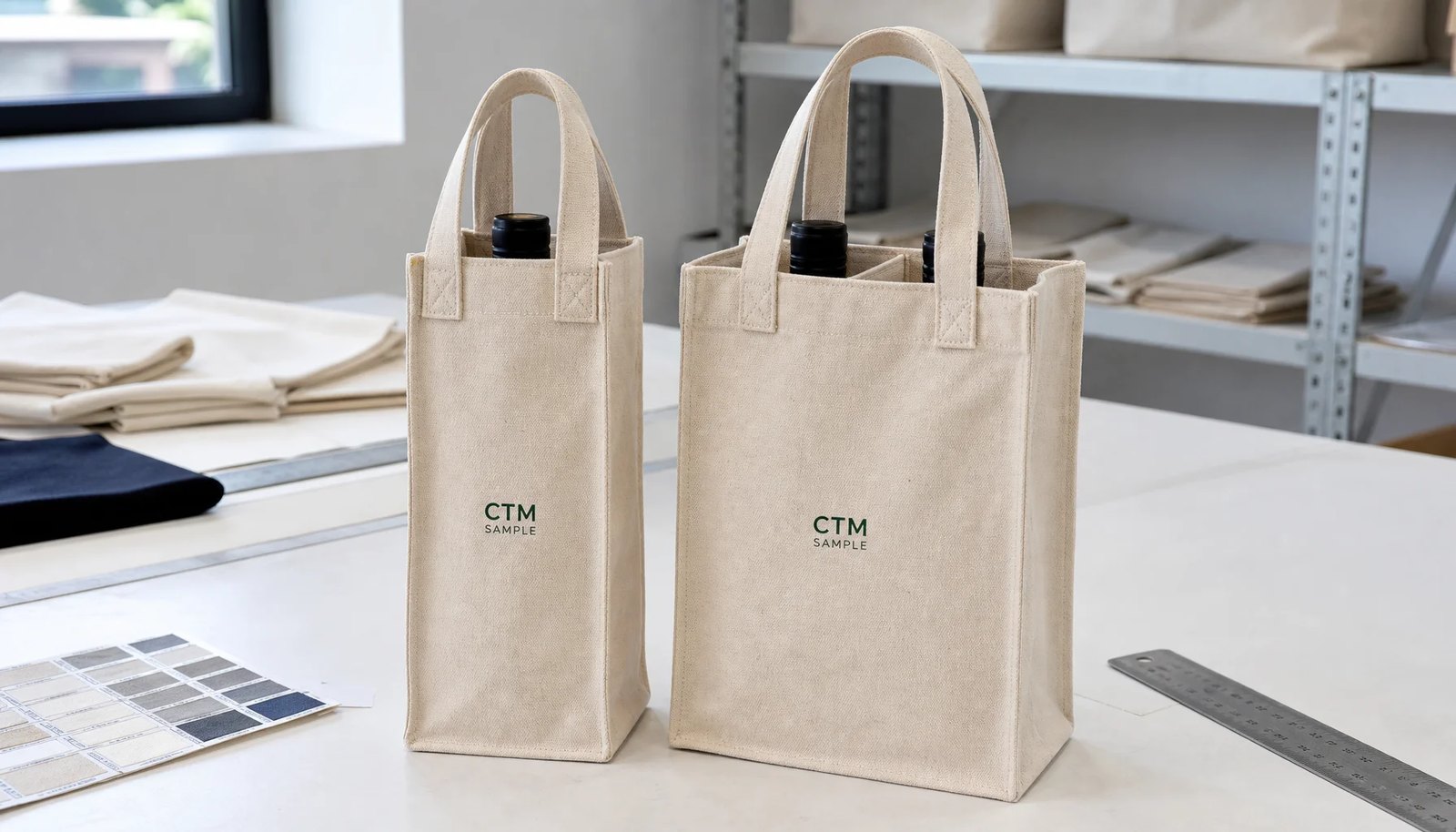
Start With The Bottle, Not The Logo
For custom canvas wine carriers, the first proofing mistake is treating the product like a small tote bag. Wine bottles are rigid, heavy, and inconsistent in shape. A 750 ml Bordeaux bottle, Burgundy bottle, Champagne bottle, and spirits bottle do not sit the same way inside the same carrier. If the bag is quoted only from a photo, the factory may build around the most common bottle shape and miss the real use case for your trade show.
Before the artwork proof is useful, the factory needs the bottle dimensions. Give height, widest diameter, shoulder shape if relevant, and target bottle weight. If exhibitors will hand out a wine bottle plus literature, corkscrew, tag, or tissue wrap, include those items in the fit requirement. A bag that looks correct when empty can become tight, distorted, or unstable once the actual bottle goes inside.
- Single-bottle carrier: usually easiest to print cleanly, but handle strength and bottom width still matter.
- Two-bottle carrier: needs divider structure, base stability, and enough room so bottles do not scrape the print side from inside.
- Six-bottle carrier: carton volume and load testing become more important than the print proof alone.
- Premium bottle formats: wider sparkling wine or spirits bottles should be named in the RFQ, not assumed.
Choose Canvas Weight By Structure And Print Result
Most trade show canvas wine carriers work well in the 10 oz to 12 oz range, roughly 340 to 410 GSM depending on the canvas construction. This weight gives the bag enough body to stand better on a booth counter while still accepting screen print without excessive ink build-up. Lighter canvas can reduce unit cost, but it often collapses around the bottle and shows wrinkles through the print.
Heavier canvas, such as 14 oz or above, can look more substantial but is not automatically better. Thick fabric increases sewing bulk at the side seams, handle joints, and bottom corners. It can also increase carton weight and freight cost. If the order is for a wine brand, distributor, or exhibitor gift where presentation is important, the practical target is not the heaviest fabric; it is the cleanest finished shape after printing, sewing, and packing.
- Quote fabric by oz and GSM when possible, because suppliers may use different local descriptions.
- For natural canvas, approve the shade range because cotton seed flecks and yarn tone can change between lots.
- For dyed canvas, confirm colorfastness and whether the MOQ changes due to dye lot requirements.
- For recycled or organic cotton, request documentation only if your sales channel needs it; otherwise it may add cost without buying value.
Proof Artwork On The Finished Bag Area
A print proof for a wine carrier should show the logo on the finished front panel, not only on a rectangular flat artwork layout. The side gusset, bottom fold, boxed base, seam allowance, and handle insertion all change how the print reads once the bag is sewn. A logo that is mathematically centered on the cut panel may appear low, high, or slightly off after the carrier is filled.
Trade show exhibitors often use sponsor logos, booth numbers, URLs, QR codes, or small regional marks. These details need minimum size rules. Cotton canvas is textured, so very fine lines can break and reversed type can close up. If the artwork has more than one logo, rank the marks by importance so the factory knows which element must be visually strongest if small compromises are needed.
- Supply vector artwork in AI, EPS, or PDF with fonts outlined.
- Set Pantone references, but allow a realistic tolerance on unbleached canvas.
- Keep small text large enough for the print method; avoid fine legal copy on coarse canvas.
- Require a proof showing print distance from top edge, side seams, bottom fold, and handle area.
- For QR codes, test scan after printing on fabric, not only from the digital file.
Match Print Method To Artwork Risk
Screen printing is normally the most practical option for custom canvas wine carriers used by trade show exhibitors. It is cost-efficient for solid logos, performs well on cotton canvas, and allows stable color control when the artwork is not too complex. The main cost drivers are screen setup, number of colors, ink coverage, and whether the print needs special handling before sewing.
Heat transfer can be useful for gradients, photo-like artwork, or many small colors, but buyers should not treat it as a universal upgrade. Transfers may feel less natural on canvas, especially over a large print area. Embroidery can look premium for small logos, but on a wine carrier it adds cost, may pucker lighter fabric, and is not suitable for fine text. Woven labels or side labels are good when the buyer wants a retail detail without printing a large front panel.
- Use screen print for one to three solid colors and medium to large logos.
- Use transfer print only when artwork complexity justifies the different hand feel.
- Use embroidery for compact marks, not large filled graphics.
- Use woven labels when the brand mark should survive repeated use with minimal print risk.
- Avoid large heavy ink blocks near folds because they can crease during packing.
Control MOQ Logic Before Comparing Quotes
MOQ for canvas wine carriers is not only one number. A supplier may have one MOQ for sewing, another for dyed fabric, another for custom labels, and another for print setup. If a quote only says 500 pcs MOQ, it may still change when you add a dyed canvas body, two print colors, individual packing, or a custom divider.
For trade show exhibitor orders, the buying risk is usually deadline and consistency, not only price. A lower MOQ can be useful for a small booth run, but it may come with limited fabric choices or higher setup cost per piece. A larger order can reduce unit cost, yet it increases the risk of overstock if the event message or sponsor list changes. The correct RFQ should separate what is fixed from what can be adjusted.
- State target order quantity and acceptable overrun or underrun tolerance.
- Ask whether MOQ changes for natural canvas, dyed canvas, organic cotton, recycled cotton, or custom labels.
- Separate screen charge, sample charge, and unit price so quotes can be compared cleanly.
- For multi-exhibitor programs, ask whether the factory can gang production with different prints on the same bag body.
- If the event date is fixed, avoid specifications that depend on uncertain dyeing or rare trims.
Use Physical Samples To Catch Expensive Errors
A digital proof is necessary, but it cannot prove bottle fit, handle strength, fabric shade, ink absorption, or divider behavior. The physical sample should be made as close as possible to the intended bulk production: same canvas weight, same print method, same handle construction, same divider design, and same packing fold. If the sample uses substitute fabric, mark that clearly and do not approve color or hand feel from it.
Sample review should be disciplined. Buyers sometimes approve a sample because the logo looks good in a photo, then discover that the bottle leans, the handle feels narrow, or the divider collapses. For trade show goods, unpacking experience also matters. The sample should be folded the way bulk pieces will be packed so the team can see whether the front logo gets a hard crease.
- Insert the intended bottle and lift the bag repeatedly by the handle.
- Place the filled carrier on a table and check whether it stands acceptably for booth display.
- Measure print location on the finished bag, not while the product is empty and flattened unnaturally.
- Review inside seams and divider attachment because these areas fail before the front panel does.
- Photograph the approved sample with a ruler and bottle inside for factory reference.
Set Acceptance Criteria For Bulk QC
A useful print proofing checklist should become the inspection standard. Without measurable acceptance criteria, the buyer and factory may disagree about what is acceptable when bulk goods are already packed. For canvas products, small natural yarn variations are normal, but stains, severe shade mixing, crooked prints, open seams, and weak handles should be clearly rejected.
The inspection plan does not need to be complicated, but it should cover the product risks that matter for wine carriers. AQL sampling can be used for larger orders, while smaller urgent trade show orders may use a tighter internal check at the factory before shipment. The key is to define which defects are critical, major, and minor before production starts.
- Critical defect: handle detaches or seam opens under reasonable loaded use.
- Major defect: print is visibly crooked, wrong color, badly misregistered, or placed outside tolerance.
- Major defect: carrier cannot fit the approved bottle size or divider blocks insertion.
- Minor defect: small thread end or natural canvas slub outside the main logo area.
- Rejectable condition: mildew odor, oil marks, wet cartons, or heavy creasing through the printed logo.
Plan Packing Around The Print Face
Packing is part of print proofing because the best logo can be damaged after sewing. Canvas wine carriers are often folded flat and stacked tightly. If the print face is pressed against another printed face before ink is fully cured, transfer marks can appear. If the fold line runs through a large ink area, the logo may arrive with a permanent crease before the exhibitor even opens the carton.
The packing method should match the event handling plan. Goods shipped to a warehouse can be bulk packed more efficiently. Goods shipped directly to a show site may need carton labels, inner bundles, or smaller cartons that booth staff can carry. Individual polybags protect against dirt but add labor, cost, and packaging waste. Tissue or paper interleaving may be enough for some screen printed natural canvas orders.
- Confirm pieces per carton, carton dimensions, gross weight, and net weight before booking freight.
- Keep the print face protected from heavy fold pressure and ink-to-ink contact.
- Use smaller cartons when show staff must move goods by hand from receiving to booth.
- Add carton labels with SKU, design, quantity, and event reference if multiple exhibitors share one shipment.
- Check destination rules because some trade show venues have strict receiving windows and labeling requirements.
Build A Realistic Lead Time Backward
Trade show orders have a hard failure date. A beautiful wine carrier delivered after booth setup has no practical value. Work backward from the date the cartons must be available at the booth or distributor warehouse, then add time for international freight, customs clearance, inland delivery, bulk production, sample revision, and artwork approval. The approval date is usually the most important date in the schedule.
Production lead time depends on fabric availability, printing complexity, order size, and packing requirements. Natural canvas with a simple one-color screen print can move faster than dyed canvas with custom labels and individual packing. Air freight can rescue some schedules, but wine carriers are bulky for their unit value, so air freight may change the economics quickly.
- Allow time for artwork cleanup before the first proof, especially when sponsor logos come from different sources.
- Do not start the bulk clock until sample approval and deposit or purchase order requirements are complete.
- Add buffer for public holidays, port congestion, customs exams, and show-site receiving windows.
- For urgent orders, simplify fabric color, reduce print colors, and avoid custom trims.
- Ask the factory for the latest approval date that still protects the ship date.
Compare Quotes By Landed Cost And Risk
The lowest unit price may not be the lowest landed cost. Canvas wine carriers have meaningful carton volume, especially two-bottle and six-bottle formats. A supplier that quotes a slightly higher unit price but packs efficiently and controls defects may be cheaper after freight, rework, and event risk are considered. Quote comparison should include carton data and Incoterms, not just product price.
For importers and distributors, the cleanest comparison is a quote sheet with the same specification sent to each supplier. Include fabric weight, dimensions, print method, color count, packing, sample requirements, inspection expectations, and delivery terms. If one supplier leaves out screen charges, sample charges, inland freight, or export carton data, the quote is incomplete rather than cheaper.
- Compare EXW or FOB terms consistently before adding freight estimates.
- Request carton dimensions early so volumetric weight can be calculated.
- Separate tooling, screen, label, sample, and unit costs.
- Include inspection cost or third-party QC cost for larger or high-visibility orders.
- Value a supplier's technical questions; silence can mean assumptions are being made on your behalf.
Specification comparison for buyers
| Spec decision | Recommended option | When it fits | Buyer risk to check |
|---|---|---|---|
| Canvas fabric weight | 10 oz to 12 oz cotton canvas for most trade show wine carriers | Good balance for one-bottle and two-bottle gifts where the logo needs a clean print surface and the bag must hold shape on a booth table | Below 8 oz can collapse around the bottle; above 14 oz increases sewing bulk, freight weight, and sample-to-bulk color variation |
| Bottle capacity | Single-bottle, two-bottle, or six-bottle format defined by actual bottle diameter and height | Single and two-bottle carriers suit VIP giveaways; six-bottle carriers suit retail packs and distributor samples | A bag approved around a Bordeaux bottle may fail with wider Burgundy, Champagne, or sparkling wine bottles |
| Print method | Screen print for solid logos; heat transfer only for fine gradients or small multi-color artwork | Screen print is usually the most stable option for natural canvas trade show quantities | Fine reversed text, metallic ink, and large ink coverage can crack, bleed, or feel stiff if not proofed on the actual fabric |
| Print position | Front panel print centered after sewing, with distance from side seams and bottom fold specified | Works for most exhibitor logos because the bag presents flat when placed on a booth counter | Artwork centered on the flat cut panel can look off-center after gusseting, boxing, or divider sewing |
| Handle construction | Self-fabric handles with reinforced cross-stitch or bar tack at stress points | Best for 750 ml bottles, repeated handling at events, and a natural retail look | Weak handle insertion is a common failure when the buyer only proofs the print and ignores load testing |
| Internal divider | Canvas or padded divider stitched into the base and side seam for two-bottle carriers | Needed when bottles may touch during transport or when gift presentation matters | Loose dividers twist in packing and can hide inside the bag, making the product look unfinished at unpacking |
| Packing method | Flat packed with tissue or divider alignment, 50 to 100 pcs per export carton depending on size | Keeps cartons efficient while protecting print faces from heavy creasing | Over-compressed cartons can create hard fold lines through the logo, especially on dark ink printed on natural canvas |
| Sample approval route | Digital artwork proof plus physical pre-production sample using bulk fabric and print method | Appropriate for exhibitor orders where logo accuracy and show deadline both matter | Approving only a digital proof leaves fabric shade, ink absorption, handle strength, and bottle fit unverified |
Buyer checklist before sampling
- Define bottle type before quoting: 750 ml Bordeaux, Burgundy, Champagne, spirits bottle, or mixed-use size range.
- State fabric weight in oz or GSM and whether the canvas must be natural, bleached, dyed, recycled cotton, or organic cotton.
- Provide finished bag dimensions, gusset, handle length, divider structure, and print area, not only a reference photo.
- Send vector artwork with Pantone references and minimum text height for all small type, QR codes, or sponsor marks.
- Require the print proof to show logo placement after sewing, not only on the flat fabric panel.
- Approve a physical pre-production sample made with the intended fabric, ink, divider, handle reinforcement, and packing fold.
- Set acceptance limits for print position, color tolerance, stitching defects, dirty marks, broken thread, and bottle-fit testing.
- Confirm carton quantity, carton size, gross weight, inner polybag policy, and whether show-site delivery labels are needed.
- Build the lead time backward from the booth setup date, including sampling, bulk production, inland trucking, customs, and final delivery.
- Compare supplier quotes using the same spec sheet, sample policy, packing method, and Incoterms.
Factory quote questions to send
- What canvas weight do you recommend for this bottle format, and what is the tolerance in GSM or oz from bulk roll to bulk roll?
- Can the quoted fabric support the requested print size without ink bleeding, puckering, or excessive stiffness?
- Will the print be applied before or after sewing, and how will the factory control final placement on the finished bag?
- What is the MOQ for the bag body, dyed fabric if required, screen setup, and each print color?
- Can you make the pre-production sample using the same fabric lot or confirmed bulk fabric quality?
- What bottle size will you use for fit testing, and can we provide our own bottle dimensions or sample bottle?
- How many pieces per carton will you pack, and how will the logo face be protected from crease marks or print transfer?
- What inspection standard do you use for stitching, print defects, stains, and dimensional tolerance?
- What is the sample lead time, bulk lead time after sample approval, and latest approval date to meet our trade show arrival date?
- Please quote EXW, FOB, and estimated carton data so our forwarder can calculate landed cost.
Quality-control points to confirm
- Finished dimensions within agreed tolerance, commonly plus or minus 5 mm for height and width and plus or minus 3 mm for handle placement on small wine carriers.
- Print position centered on the finished front panel within the agreed tolerance, not judged from the flat cut fabric only.
- Pantone match assessed under consistent light, with realistic tolerance for printing on natural or dyed cotton canvas.
- No obvious ink bleeding, pinholes, cracking, misregistration, ghosting, or transfer marks on the logo area.
- Handle attachment must pass a load test using the intended bottle weight, including short lift-and-hold testing rather than visual inspection only.
- Divider must remain upright enough for bottle separation and must be secured at the base or side seam as approved.
- Stitching should be clean at high-stress points, with no skipped stitches, loose thread nests, open seams, or broken bar tacks.
- Canvas surface should be free from oil marks, large slubs in logo areas, mildew odor, severe creasing, and unacceptable shade mixing.
- Cartons should match approved pack quantity and should not crush, distort, or permanently crease the printed front panel.