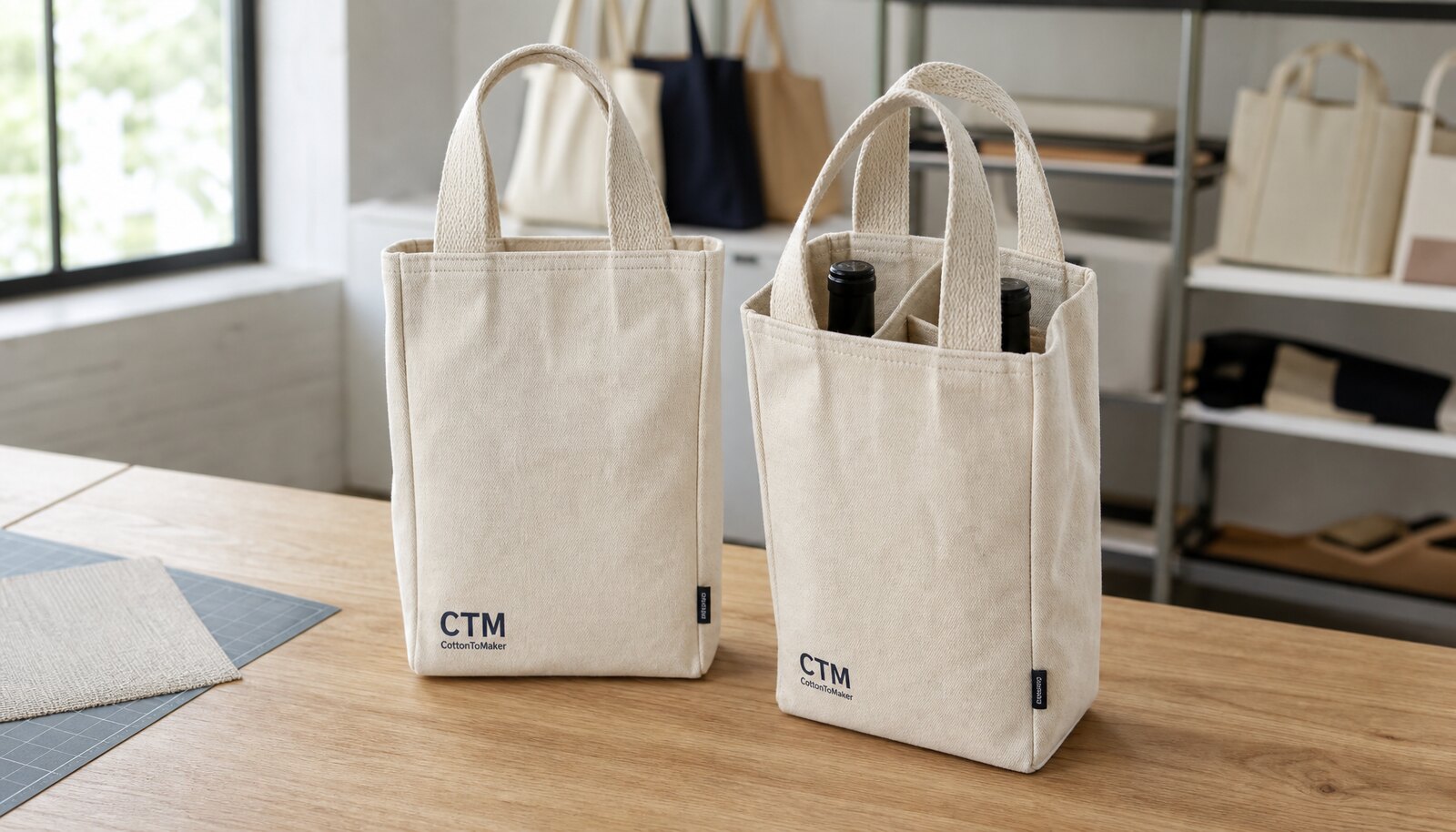
Start With The Use Case, Not The Artwork
A print proof for a canvas wine carrier only makes sense after the bag use case is fixed. A carrier for a tasting-room gift pack, a retail shelf add-on, and a shipping insert are three different products, even if the logo art is the same. The proof has to lock the carrier format, bottle count, fabric weight, print area, and how the bag will be packed. A centered logo on a flat mockup can shift once the panel is sewn, folded, and loaded.
For boutique wineries, the buying decision is usually commercial first and visual second. If the carrier is meant to be sold in a retail channel, the print needs to read cleanly from a short distance and survive repeated handling. If it is going into a gift program, the front panel can carry more brand detail, but the bag still has to close, sit flat in a carton, and keep the bottles protected. The spec should say whether the buyer needs a display item or a transport item.
- Lock bottle count and bottle diameter before artwork placement.
- State whether the carrier is fold-flat, semi-structured, or rigid.
- Measure logo placement from the same reference points every time: top edge, side seam, and handle stitch line.
- Separate decorative front-panel space from functional side-panel space in the spec sheet.
Lock The Carrier Build Before You Review Print
Fabric weight changes both the look of the print and the commercial position of the carrier. A 10 oz or about 340 GSM canvas is light and useful for simple promo programs, but it can feel too soft for premium retail. A 12 oz or about 407 GSM canvas is usually the practical middle ground for most 1-bottle and 2-bottle carriers. A 16 oz or about 542 GSM canvas gives more body, hides show-through better, and usually supports a cleaner premium presentation, but it also adds cost and makes folding and carton planning harder.
The build matters as much as the fabric. A single-bottle sling, a two-bottle divider carrier, and a six-bottle tote all change how the print lands across seams and folds. Handle length, gusset width, lining, base insert, and any closure details all affect the visual center of the logo. Once the construction is fixed, the proof becomes a real manufacturing document instead of a flat mockup that ignores the finished shape.
- 1-bottle gifting carrier: 10 to 12 oz canvas, simple print area, lighter handle reinforcement.
- 2-bottle retail carrier: 12 oz minimum, reinforced handles, divider or bottle cushion, stable base.
- Premium tasting-room carrier: 12 to 16 oz canvas, denser weave, cleaner edge finish, stronger structure.
- If the carrier folds, confirm folded thickness before carton planning starts.
Choose The Print Method With The Proof In Mind
Screen print is the default option for flat logos on cotton canvas because it gives good opacity and predictable unit cost at volume. It is the right starting point when the art uses one to three spot colors and the buyer wants a strong, solid brand mark. Heat transfer makes more sense when the design has gradients, very fine type, or a more photographic look, but the proof has to be judged for edge lift, surface feel, and long-term cracking. A method that looks good on a PDF can fail once it touches textured canvas.
Embroidery has a place, but usually on a side label, badge, or small crest rather than across a full wine carrier panel. It can add value when the buyer wants texture and a premium finish, yet it also introduces puckering risk around the stitching field. Woven labels and sewn patches can be better than direct decoration when the brand wants durability without a large ink field. The proof should show the actual method, not just the artwork.
- For solid logos on natural canvas, start with screen print.
- For gradients or small text, request a high-resolution transfer sample.
- For premium branding, consider a woven side label or sewn patch.
- Ask for curing, rub resistance, or handling notes if the bag will be used often.
What A Useful Proof Package Should Show
A good proof package has four parts: scaled artwork, placement drawing, material reference, and finish sample. The placement drawing should show the logo distance from the top edge, the side seam, the handle attachment, and the base fold. The material reference should name the exact fabric shade and weight because a warm natural canvas and a bright bleached canvas will change how the same ink color reads in production. If the supplier only sends a polished art mockup, the buyer still does not know what will be sewn.
Do not approve a new carrier from a PDF alone if the order has commercial risk. Start with a digital proof to catch spelling, size, and placement mistakes, then request a pre-production sample so the buyer can evaluate hand feel, print opacity, and stitch registration. The sample should be on the same fabric shade and use the same handle webbing. If the supplier skips the sample, the buyer owns the placement and color risk.
- The proof should state the final print size in millimeters or inches.
- The artwork file should name the color system or approved swatch.
- The sample should use the same fabric color, handle tape, and divider spec as the bulk order.
- Request a flat photo and a loaded photo so the print can be judged in real use.
MOQ, Price Breaks, And Quote Lines
MOQ is usually driven by setup, not by fabric cost alone. A new print screen, a fresh cutting marker, a different handle color, a divider change, or a custom carton can each create a small batch inside the larger order. That is why one quote can look cheap on the unit price and still be expensive once sample, setup, and packing are added. For comparison work, buyers should look at the finished landed cost rather than the bag price alone.
The cleanest quote breaks the order into separate lines: fabric, lining, handles, divider, print setup, print run, sample fee, carton, barcode label, and any overrun allowance. Once the quote is transparent, the buyer can see where the real cost sits and which extras are optional. That matters when the winery needs to hit a sell-through margin or a promo budget without changing the overall look of the carrier.
- Ask for MOQ by color, by print design, and by construction variant.
- Separate one-time setup charges from repeat-order unit cost.
- Confirm whether sample fees are deducted from the bulk invoice after approval.
- Ask whether spare units or overrun tolerance are included or billed separately.
Sample Approval Criteria That Prevent Rework
A print proof is only approved when the carrier still looks correct after sewing, folding, and loading. Measure the logo location after the bag is fully assembled, not just on a flat print panel. On a two-bottle carrier, the seam line can move the visual center enough to make a symmetrical design look wrong by eye even when the artwork file was technically correct. The sample has to match the real object the buyer will ship or sell.
Set acceptance criteria before the sample arrives. Treat the sample like a retail item, not a development toy. The buyer should judge color, stitch quality, odor, loose threads, ink coverage, and dimensional tolerance in the same review. If the carrier uses a divider or insert, load it with the actual bottle shape or a weight dummy, because the front panel drape changes once the bag is full.
- Color: match to the approved swatch or an agreed visual tolerance.
- Placement: keep the logo centered within the defined panel and away from seam distortion.
- Stitching: no skipped stitches, loose loops, or weak handle bar-tacks.
- Structure: carrier should stand or fold as specified after a full load test.
- Finish: no staining, strong odor, glue bleed, or visible oil marks.
Packing Details That Change Damage Rates
Packing changes the apparent quality of a wine carrier more than many buyers expect. A natural canvas bag shipped loose can pick up fold lines, lint, and pressure marks, especially when the print covers a large front panel or the carrier has a structured base. If the order is going into retail, protect the face of the print with tissue, a sleeve, or a clean polybag so the impression arrives ready to display. The fold line should stay away from the logo area whenever possible.
Carton planning has to use the final folded size, not the unfolded bag size. A carrier can be cheap to make and still expensive to ship if the fold pattern wastes space or if the cartons are overbuilt for the actual weight. Ask for carton dimensions, net and gross weight, carton count, and whether master cartons are lined or reinforced. For mixed SKUs, keep outer marks and barcode logic simple so the warehouse does not need to relabel by hand.
- Confirm whether each carrier goes in a polybag, tissue wrap, or master pack only.
- Ask for a carton loading photo with count, orientation, and dunnage visible.
- Set a maximum carton weight that your receiving team can handle without repacking.
- Protect printed faces from fold lines and strap impressions.
Lead Time And Schedule Risk
Print proofing can extend the schedule more than sewing does. The slow steps are screen making, color correction, sample courier time, and any rework after the first sample. If the supplier treats artwork as final before the proof is approved, a late change can push the order behind the season and force expensive air freight. For wine programs, that risk matters because launch dates are often tied to harvest, gifting, or event calendars rather than to a flexible warehouse window.
Build one change-freeze point into the schedule. After the proof is accepted, the buyer should not change logo size, Pantone, handle color, carton quantity, or closure style unless there is time for a second sample. A small late edit can trigger a new screen, a new cutting marker, or even a rework of the packing plan. The cost of the change is usually lower than the cost of the delay, which is why schedule discipline matters as much as unit price.
- Ask for a timeline with sample, approval, bulk, packing, and dispatch dates.
- Confirm what happens if the first proof is rejected on color or placement.
- Reserve time for a second sample if the order uses a new construction.
- Treat holiday season and harvest season as capacity risks, not just calendar notes.
Compare Supplier Routes By Landed Cost
The cheapest supplier route is not always the lowest landed cost. A direct factory with in-house print control often wins on repeat orders because the buyer avoids duplicate markup and reduces handoff errors. A domestic decorator can be faster for a small run, but the bag body may still come from a separate importer, which limits customization and pushes the per-unit cost up. The right route depends on whether the buyer values speed, control, or repeatability most.
Trading companies are useful when the buyer needs one contact for several product types, but the quote still has to show the real factory process behind the curtain. If the carrier is sold through a marketplace or a generic stock seller, the main risk is what is not shown: fabric weight, print setup, carton spec, and whether the sample truly matches the bulk run. A clear supplier comparison should expose those tradeoffs before the buyer spends time on revisions.
- Compare the same spec across every route, including packing and sample costs.
- Ask for production photos, not only catalog photos.
- Verify whether the supplier can repeat the same fabric shade on the next reorder.
- Use the first order to test proof discipline, not just unit price.
Build The RFQ So Quotes Are Comparable
A good RFQ makes proofing faster because the supplier cannot hide assumptions. The request should include the carrier type, bottle count, fabric weight, print method, logo artwork, target color, carton count, packing style, delivery term, and required sample stage. If the buyer leaves out the fabric or carton spec, the supplier will fill the gaps with its cheapest assumption and the quote will not be comparable across vendors. That is how a low quote becomes a surprise later.
For boutique wineries and distributors, the best RFQ is short but precise. It gives the factory one path to quote and one path to prove the decoration. That reduces back-and-forth, shortens sample cycles, and makes the landed cost easier to defend internally. The buyer is not trying to write a design brief; the buyer is trying to lock the manufacturing variables that affect margin and sell-through.
- Send vector artwork and a flat spec sheet with dimensions.
- State the approved print color system and any allowed variance.
- Include carton size or at least the maximum outer carton weight.
- Ask the supplier to quote sample, bulk, packing, and freight separately.
Specification comparison for buyers
| Spec decision | Recommended option | When it fits | Buyer risk to check |
|---|---|---|---|
| Direct factory with in-house screen printing | Best for 1 to 3 spot colors and repeat programs | When the logo is simple and you want the bag maker to control sewing and print in one flow | Confirm ink opacity on natural canvas and ask for dried print photos, not only art files |
| Factory that outsources print work | Use only if the factory owns the full QC flow | When the bag body is made in-house but decoration needs a specialist | Risk of color drift and late revisions; require named subcontractor details and proof dates |
| Direct factory with pre-production sample | Preferred for new artwork or premium retail carriers | When the first order is important and the print placement is not yet proven | Check sample lead time, sample fee policy, and whether the sample cost is credited back |
| Domestic decorator using imported blanks | Good for rush replenishment or very low MOQ | When speed matters more than unit cost and the blank bag spec is already locked | Higher landed cost and limited control over the base carrier; verify the same blank can be reordered |
| Trading company or sourcing agent | Useful for multi-category buying or weak supplier coverage | When you need one contact point and consolidated communication | Margin can hide the real process; require factory name, process photos, and packing evidence |
| Marketplace stock seller | Only for small tests or one-off promo runs | When price and speed matter more than deep customization | High risk of generic materials and unstable size or shade; verify actual manufacturing source |
| Dual-source route: blank carrier from factory, decoration locally | Useful for regional brands with in-house print control | When you can manage two vendors and inbound blanks | Artwork registration can drift between vendors; lock template, size, and carton spec before shipping |
| Full-service export factory with sample room and carton mockup | Best balance for steady programs | When you need repeatability and documented approvals | Ask for real sample room evidence, carton pack photos, and line inspection details, not only polished sales PDFs |
Buyer checklist before sampling
- Lock the bottle count, bottle diameter, and carrier style before approving artwork.
- State the fabric weight target in oz or GSM, not just cotton canvas.
- Specify the print method, logo size, and exact placement from seam and edge.
- Request a digital proof first, then a pre-production sample on the same fabric shade.
- Confirm whether the carrier needs a divider, insert, lining, or base board.
- Define the acceptable Pantone or swatch reference for brand colors.
- Ask for MOQ by color, by print design, and by construction variant.
- Separate setup charges, sample fees, unit price, and packing costs in the quote.
- Approve carton count, carton dimensions, and max gross weight before bulk starts.
- Set a change-freeze point after sample approval so late artwork edits do not reset the schedule.
Factory quote questions to send
- What exact fabric weight, weave, and color are included in the quote?
- Is the print done in-house or outsourced, and at what proof stage do you want approval?
- What is the MOQ per color and per print design, and does it change with handle or lining options?
- What are the sample fee, sample lead time, and refund policy after bulk approval?
- Which packing method is quoted: polybag, tissue, master pack only, or retail sleeve?
- What carton count, carton size, and gross weight are assumed in the price?
- What is the production lead time after artwork approval and deposit?
- What defects or rework are covered under your QC standard and replacement policy?
Quality-control points to confirm
- Fabric weight matches the agreed spec within the supplier's stated tolerance.
- Logo placement sits within the defined panel and does not drift into seams or folds.
- Print opacity is even, with no pinholes, smudging, ghosting, or edge lift.
- Stitching is straight, bar-tacks are secure, and handle attachment points are reinforced.
- Carrier dimensions after sewing match the approved sample, especially width and base depth.
- No strong odor, oil stains, lint contamination, or glue bleed on visible surfaces.
- Loaded carrier holds the intended bottle weight without seam distortion or handle strain.
- Carton counts, labels, and outer marks match the packing list and approved carton plan.