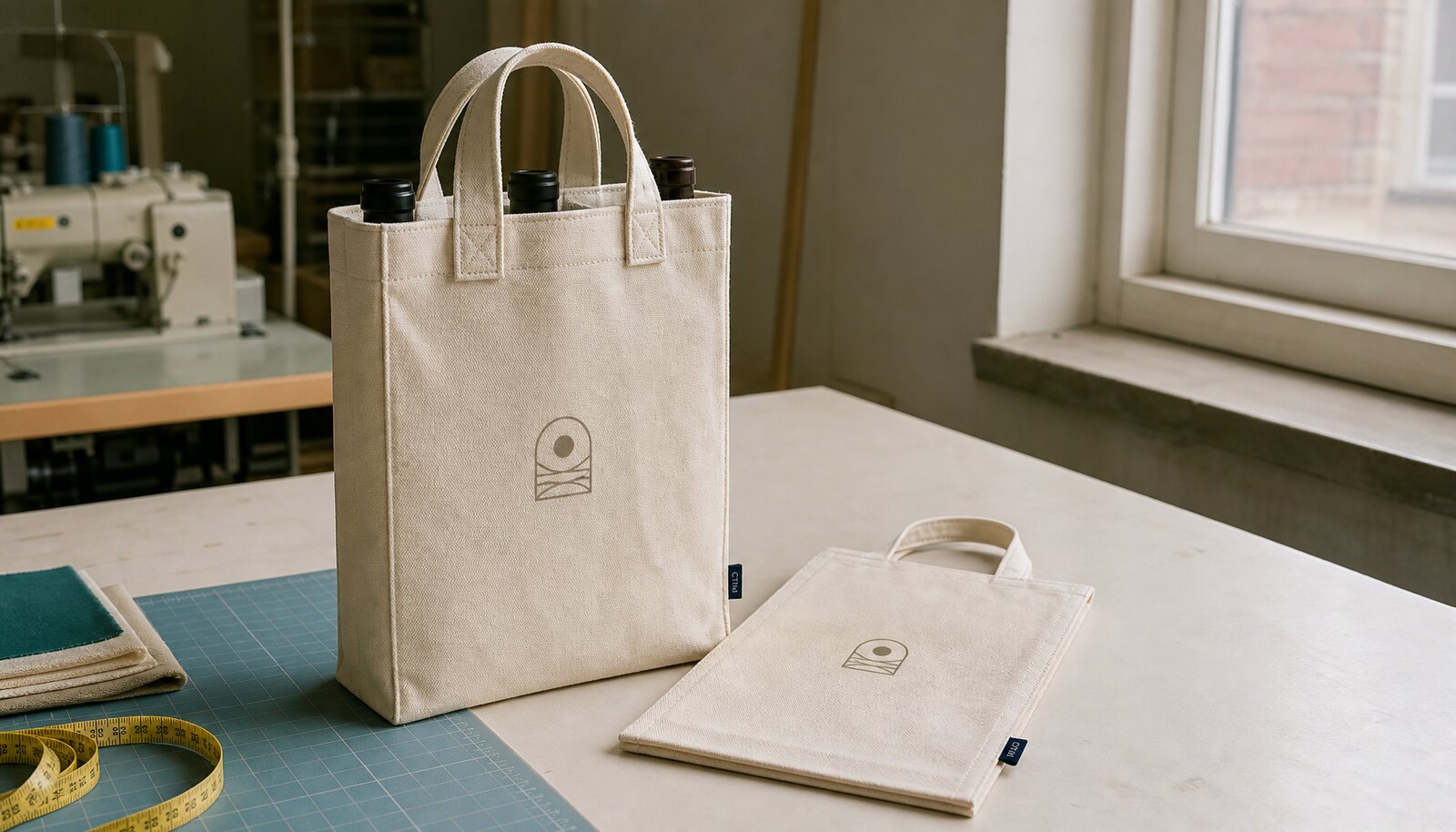
Start With the Bottle Fit, Not the Artwork
Most print problems on canvas wine carriers start before printing. The buyer approves a logo on a flat mockup, then discovers that the bottle compartment is too narrow, the divider is off-center, or the logo sits too close to a seam once the carrier is sewn. For gift shops, that is more than a cosmetic issue. The carrier has to look clean on a shelf, survive handling at checkout, and still hold a filled bottle without twisting or collapsing. If the structure is wrong, no print proof can fix it later.
That is why the first sourcing conversation should be about the bottle itself, not just the decoration. A standard 750 ml bottle is a useful reference, but buyers should still measure the real bottle or bottle set they intend to sell. Imported wine, local craft spirits, and souvenir bottles often vary in shoulder width, body diameter, and label height enough to change the required compartment size. If the carrier uses a divider or insert board, ask for a filled sample and check how the glass sits when the bag is lifted and turned sideways. An empty carrier tells you very little about retail fit.
For procurement teams, a useful starting point is a finished flat width that allows for the bottle plus seam allowance and a little handling margin. In many single-bottle canvas carriers, the flat body width is often designed around roughly 95-110 mm per bottle compartment when measured without tension, while dual-bottle carriers may need roughly 105-120 mm per compartment depending on divider thickness and fabric weight. Those are not universal sizes, but they are the kind of numbers worth asking suppliers to state clearly in the RFQ. The same applies to height: if the bottle shoulder sits too high, the carrier can look squat; if it sits too low, the bottle neck can lean or rub against a closure.
The best way to prevent expensive rework is to connect fit requirements to the sourcing sample. Ask the supplier to build the first sample around the real bottle, then measure the sample against a written spec sheet. Make sure the sample includes the exact handle style, seam construction, and any board or divider the finished order will use. Only then should the buyer sign off on print proof placement. In this category, the bag structure is part of the print system. If the structure changes, the proof changes with it.
- Measure the real bottle profile before issuing the RFQ, not after the mockup is approved.
- Ask the supplier to quote a finished size and a production tolerance, not just a generic bag dimension.
- Use a filled sample as the control sample for both fit and print placement.
Set a Realistic Spec for Fabric Weight and Hand Feel
Fabric weight is one of the fastest ways to change how a wine carrier is perceived in store. Buyers sometimes describe the item as “premium” or “rustic” without translating that into a usable material specification. On canvas carriers, the difference between 10 oz, 12 oz, and 14 oz is not simply cost. It affects drape, wrinkle resistance, shelf presence, print opacity, and the way the carrier feels when a shopper picks it up. A softer fabric can save money, but it can also make a branded carrier look like a promotional handout rather than a retail gift item.
For most gift shops, 12 oz canvas is a practical baseline because it is firm enough to stand up on a shelf, durable enough for repeated handling, and still economical enough to support margin. A 14 oz build makes more sense when the buyer wants stronger structure, heavier bottle support, or a more upscale unstructured tote appearance that needs to look substantial beside premium bottle gifts. If the program is very price-sensitive, 10 oz can be used, but only with eyes open: the logo may read through differently, the carrier may crease more easily in packing, and the product may feel too soft once folded flat in a display bin.
Construction should be specified with the same care as fabric. Canvas weight alone will not prevent failure if the stitch pattern is weak or the handle join is underbuilt. Ask the factory how the handles are attached, whether the side seams are double-needle or single-needle, and what reinforcement is used at high-stress points. If the carrier includes a bottom board, divider, flap, zipper, or snap closure, confirm whether that hardware changes the fold pattern or print area. The buyer should treat all of these items as part of the same approval set, because a structural change can move the print window by several millimeters or change how the front panel sits under tension.
One sourcing tactic that helps is requesting a physical swatch and a sewn mini-sample before you commit to bulk color. A swatch tells you little on its own, but a sewn piece reveals how the fabric behaves at seams, edges, and folded corners. That matters in retail, where buyers often judge value by first touch. A carrier that sits upright, has a crisp front face, and folds cleanly into a shipping carton tends to sell better than one that looks technically correct but feels limp in the hand.
- Use 12 oz canvas as the default comparison point unless the merchandiser has a clear budget or luxury position.
- Ask for the handle material, width, attachment method, and reinforcement detail in writing.
- Request a sewn sample or mini-prototype, not only a fabric swatch, before approving bulk material.
Choose the Print Method Based on the Art File and Reorder Plan
For custom canvas wine carriers, the print method should follow the art file and the reorder strategy, not the other way around. If the logo is a clean one- or two-color mark, screen print is usually the most controllable choice because it is durable, repeatable, and practical for proofing. It also gives procurement buyers a clearer path for future reorders since the supplier can keep screens, placement notes, and cure settings on file. That matters in gift shops, where seasonal restocks are common and the same design may need to be reprinted months later.
Water-based ink is often chosen when the buyer wants a softer hand feel and a more natural look on canvas. Plastisol can provide stronger opacity, especially on darker or uneven fabrics, but it may leave a slightly heavier print feel. Either can work if the factory is disciplined about mesh count, ink load, drying, and curing temperature. What the buyer needs is not a preference for one ink type in the abstract, but a clear statement of what the supplier is actually proposing and how they will verify it. Ask whether the print is cured through the full ink layer or only surface-dried, and ask how they check adhesion before bulk packing.
Heat transfer can be appropriate for artwork with more detail, but it deserves extra caution on textured canvas. A transfer may look crisp on the artwork sheet and still crack, edge-lift, or become glossy once the carrier is folded and handled. Embroidery and woven labels are useful for some premium lines, but they are not a substitute for a clean logo when the artwork includes fine text or tight brand spacing. Buyers should not accept a “similar” decoration method simply because it is easier for the factory. If the brand standard depends on line clarity, color accuracy, and visual simplicity, the decoration method needs to match that goal exactly.
When proofing print, the useful questions are practical: what is the minimum line thickness the factory can hold on canvas, what is the smallest text size they recommend, and how many color separations are included in the quoted price? If the artwork has a thin font or a small registration mark, insist on seeing a production-sized proof. Canvas is not paper. A line that looks elegant in a PDF can disappear once the weave, ink spread, and stitch distortion are added. For procurement buyers, this is where design intent and manufacturing reality need to meet before the purchase order is released.
- Match the decoration method to the logo complexity and reorder plan.
- Ask for the minimum line thickness and minimum text size the factory will guarantee.
- Require the supplier to confirm cure, adhesion, and print durability before bulk packing.
Read the Quote Like a Landed-Cost Buyer
A unit price by itself tells you almost nothing. One supplier may quote only the sewn blank, another may include one-side printing, and a third may bundle fold-and-pack labor but leave screen setup, barcode labels, or sample charges outside the line total. The procurement buyer needs the full structure of the offer, not just the bottom-line number. If the quote does not show what is included, it is impossible to compare suppliers fairly or calculate landed cost with any confidence.
For custom canvas wine carriers, the quote should clearly identify fabric weight, size, handle type, print colors, decoration area, packing method, and carton assumptions. It should also show whether the quoted price is for a blank carrier, a printed carrier, or a retail-ready finished unit. If the supplier gives volume breaks, make sure the break points apply to the exact decoration version you plan to buy. A blank price at 1,000 units and a printed price at 3,000 units are not comparable unless the setup structure is the same. Ask for the same format across all suppliers so the sheet can be compared row by row.
This is also where landed-cost thinking matters. Freight is affected by carton dimensions, folding method, and pack density, not only by the carrier price. A bag that saves a few cents at the factory but ships in a larger carton can cost more once ocean freight, domestic delivery, and warehouse handling are added. If the gift shop is buying for seasonal assortment, landed cost should include sample charges, any reproofing costs, and the cost of a late shipment if the seller misses the window. Procurement teams often focus on unit price because it is visible; the hidden cost is usually in the volume and rework.
A useful discipline is to ask for separate lines for blank body, decoration setup, sample, insert, label, packing, and cartonization. That makes it easier to spot inflated bundles and easier to negotiate the items that actually matter. If the factory can only give one lump price, ask them to break it out internally before you compare it against another quote. You do not need perfect accounting detail, but you do need enough visibility to tell whether a supplier is truly competitive or only looks competitive because important charges are buried elsewhere.
- Compare all suppliers on the same written spec and the same packing assumption.
- Ask for separate pricing lines for body, print, setup, sample, packing, and cartons.
- Calculate freight from carton size and gross weight, not only from piece price.
Use Sample Proofing as a Sequence, Not a Single Approval
The weakest sample process is the one that asks the buyer to approve everything at once. Artwork, structure, material, print placement, and packing each answer different questions, and they should not all be judged through one static proof. The better sequence begins with a flat artwork proof showing size, Pantone references, and print location. It then moves to a sewn prototype or blank sample if the structure is new. Finally, it ends with a pre-production sample that uses final fabric, final printing, final trim, and final packing. That is the sample that should carry the production sign-off.
This sequence matters because a wine carrier is not just a decoration surface. The seam lines, handle joins, divider placement, and folding pattern all affect how the art appears after sewing. If a logo sits too low on the front panel, it may disappear into the folded base or get interrupted by a seam. If it sits too high, it may be trapped near the handle stitches or visually crowd the bottle neck. A buyer who approves only the PDF proof is approving an image, not a product. The real product is the sewn and packed unit.
For gift shops, the sample should also reflect shelf behavior. A retail buyer may care about how the carrier stands on a table, how the canvas reflects light, and whether the printed panel still looks neat after the carrier has been folded in a carton and opened again. Ask the factory to send the sample with the actual fold method and the actual carton insert, if any. Then keep one signed sample as the control piece for bulk inspection. When the first carton arrives, compare it to that control under the same light and with the same bottle inside. That is far more useful than comparing it to a screen image stored on someone’s phone.
The approval record should include a few simple measurements: finished body width and height, handle drop, print position from top edge and side seam, and acceptable deviation in millimeters. Buyers sometimes postpone tolerances until production, but that is too late. If the supplier knows the limits in advance, the sample process becomes a real production gate instead of a polite exchange of opinions.
- Use three sample stages when the order is important: artwork proof, sewn prototype, and pre-production sample.
- Measure the sample against written tolerances before approving the PO.
- Keep one signed control sample and one signed packing reference for inspection.
Specify Packaging for Retail, Not Just for the Factory Floor
Packing decisions can make or break the economics of a gift-shop order. A canvas wine carrier may look better in a dust-protective polybag, but every extra layer adds labor, material, and carton volume. Tissue, insert boards, and retail hangtags can improve perceived value, yet they should be chosen for a reason. If the carrier is going to sit near a checkout counter or in a premium souvenir display, neat individual packing may justify the cost. If it is a simple value item sold in volume, heavy retail packaging often consumes margin faster than it adds sell-through.
The key is to connect packing to the retail environment. A shop with high-turn inventory may prefer compact bulk packing so the carrier can be displayed in bins or on shelves without the waste of excess packaging. A more curated gift store may need a cleaner individual presentation, especially when the carrier is sold with a bottle, gift card, or branded accessory. In either case, ask the supplier to show how the carrier folds and whether the fold line crosses the printed area. A cheap fold can crease the logo permanently and reduce the visual value of the product before it ever reaches the floor.
Freight planning is also part of packaging. Buyers often focus on the face of the bag and forget the carton. That is a mistake because the carton determines how many units fit in a shipping container, how easy the goods are to warehouse, and how much the route costs from the factory to the final destination. Ask for carton dimensions, gross weight, net weight, and pcs per carton before release. If the supplier changes the packing method later, the freight math changes with it. In procurement terms, packaging is not a finishing touch; it is a cost driver.
A practical rule for gift shops is to match the packaging to the expected sell-through channel. Tourist shops usually value shelf appeal and easy handling. Winery tasting rooms may value a more premium, minimal presentation. Wholesale gift buyers may prioritize carton density and lower freight cost. There is no one correct pack format, but there is one incorrect approach: choosing packaging before you know the channel economics. The right pack format is the one that preserves presentation while keeping landed cost within target.
- Choose packaging based on shelf use, route length, and labor cost.
- Check whether the fold line crosses the print area or creates a permanent crease.
- Request carton dimensions and gross weight early so landed cost can be estimated accurately.
Keep Lead Time Honest From Proof to Shipment
Lead time on custom canvas wine carriers is often underestimated because buyers count only production days. In reality, the clock starts when the artwork is final, the structure is approved, and the packing format is frozen. If the order needs screens, a sewn sample, packing labels, or a carton redesign, those steps should be planned separately. For seasonal gift-shop programs, the more important number is not the supplier’s promise date but the date by which the product must be in the receiving warehouse, priced, and ready for shelf deployment.
A realistic timeline usually includes artwork proofing, sample making, sample approval, production, quality inspection, packing, and shipping. Each stage can shift if the buyer changes a Pantone color, updates a barcode, or revises the carton label. Those changes might seem small internally, but they can affect the line schedule and delay the entire lot. One reason procurement teams get caught is that different departments approve at different speeds. Retail wants the item for a campaign, marketing wants to polish the artwork, and purchasing wants the quote locked. The factory only sees the final release date. If approvals are fragmented, the schedule becomes fiction.
To manage that risk, assign one owner to collect all approvals and one calendar date as the freeze point. After that date, changes should be treated as exceptions with a cost and schedule impact. Ask the supplier what happens if the sample requires a second round, whether their factory has peak season congestion, and how long shipping document prep takes after inspection. If the order is tied to holiday sales or tourist season, build a buffer. A product arriving late is often more expensive than a product that costs a little more but ships reliably.
The best lead-time questions are concrete: when can you send the first proof, how many days for a sample, how many days after sample approval until mass production starts, and what is the longest part of the process? These answers help buyers see whether the supplier is organized or simply optimistic. In gift retail, optimism does not reduce freight cost or save a missed season.
- Freeze artwork and pack details before the factory starts the final proof cycle.
- Ask about peak-season capacity and the likely bottleneck in the supplier’s process.
- Build a schedule buffer for revisions, inspection, and export document preparation.
Compare Sourcing Routes by Control, Not Only by Price
The right sourcing route depends on how much control the buyer wants over sewing, printing, and packing. Direct factory sourcing is usually the cleanest option when the order is repeatable and the buyer needs one team responsible for the entire product. That gives procurement a single point for fit, decoration, and carton control. A trading company can still be useful when the buyer wants help coordinating multiple materials or when the order is small and highly customized, but it adds another layer between the brand and the people doing the work. Local decoration on imported blanks can be useful for very simple jobs, yet it creates another handoff that can weaken color consistency and slow down reorders.
Regional sourcing tradeoffs also matter. Factories in China often offer a broad range of canvas weights, print capabilities, and carton options, which is useful when the buyer wants a detailed spec and repeatable production. The tradeoff is that communication, sample timing, and shipping distance must be managed carefully. Vietnam can be attractive for some sewn textile programs when buyers are balancing labor cost, factory capacity, and diversified sourcing, but the exact fit depends on the supplier’s actual sewing and decoration capabilities. India may be relevant for buyers seeking cotton canvas and certain textile finishes, but the buyer should verify print consistency, packaging quality, and export lead time before assuming equivalence. Domestic or nearshore production can shorten transit and improve responsiveness, though piece price may be higher. The important point is not to assume one country is always better; the right region depends on the product mix, the need for repeatability, and the tolerance for freight cost.
For procurement, the decision should be made on total landed cost and execution risk. That means comparing sample charges, setup charges, carton volume, inland transport, customs and duty exposure where applicable, and the cost of a second proof if the artwork needs correction. It also means understanding the supplier’s capability depth: do they sew in-house, do they print in-house, and can they own the packing specification? The more of those steps they control, the easier it is to hold them accountable. A lower factory price is not a better deal if the supply chain is fractured and the rework risk is high.
Ask each supplier to identify where the order physically moves. If fabric is cut in one place, printed in another, and packed in a third, the margin for error expands. If the same factory controls cutting, sewing, printing, and final inspection, the buyer can manage the program more cleanly. This is especially important for gift-shop assortments, where the product is judged on both presentation and repeat order consistency. A buyer who knows the sourcing route can choose the right compromise between cost, speed, and control.
- Compare suppliers by control of cutting, sewing, printing, and packing, not just by quoted unit price.
- Ask which country or region the product is actually made in and whether any step is outsourced.
- Add customs, duty, inland freight, and reproof cost into the landed-cost comparison.
Build a QC Plan That Catches Real Manufacturing Failures
A useful quality plan for canvas wine carriers should be based on measurable checks, not general impressions. The inspection should begin with first-article review when the first pieces come off the line, continue with an in-line check after the initial 30-50 units, and end with final carton verification before the shipment is sealed. That sequence catches print drift, stitch issues, and packing errors while correction is still possible. It is much cheaper to stop a line early than to reject an entire packed lot at the end.
A practical AQL framework is often the easiest way to make decisions with factories. Many buyers use AQL 2.5 for major defects and AQL 4.0 for minor defects unless the retail program is especially strict. In this category, major defects are issues that affect bottle safety, function, logo legibility, or shelf saleability: broken seams, badly off-center print, missing handles, odor, or mismatched carton labels. Minor defects are issues that are visible but do not break function, such as slight loose threads, small wrinkles, or minor fold marks. The buyer should define these categories in advance so the factory does not argue that a visible defect is “acceptable” simply because it does not stop the bag from holding a bottle.
There are also a few threshold tests worth asking for in writing. A filled-bottle lift test should be passed without seam failure or visible handle stretch. The print should not smear or transfer color to a dry white cloth after light rub testing. The finished carrier should not show unstable odor, heavy oil marks, or uneven cure finish. If the bag is sold as premium retail, the buyer may want a tighter color variance window and a stricter rub requirement. The point is not to build an overcomplicated lab program; it is to define a small set of tests that match how the product will actually be used.
One detail many buyers miss is the difference between visual acceptance and production control. A white-glove inspection on a finished carton is too late to correct a print shift or weak handle attachment. The factory should be checking process-critical points during production, not only at the end. Ask them to show the in-line check sheet and to record samples from the first run. If the supplier has no process record, the buyer has little evidence that the lot was ever controlled in the first place.
For a retail gift shop program, the QC target should also include appearance under normal display lighting. A carrier can pass a mechanical check and still look wrong if the canvas is marked, the print is glossy when it should be matte, or the fold line lands across the logo. The inspection standard should protect both function and shelf value, because that is what the customer sees at the point of sale.
- Use first-article, in-line, and final carton checks rather than relying only on final inspection.
- Define major and minor defects in writing before production starts.
- Ask for a filled-bottle lift test and a print rub test as part of process control.
Use Shelf-Merchandising Logic When You Buy for Gift Shops
Gift shops are not buying a wine carrier the same way a warehouse buyer would. The product is part packaging, part impulse gift, and part visual merchandising asset. That means the buyer should think about how the carrier will look beside bottles, gift tags, baskets, and seasonal décor. A carrier with a neat front panel, a stable base, and a clear print window can help a store create a more premium presentation. A sloppy fold, shiny transfer, or crooked logo can reduce perceived value immediately, even if the price is low.
Seasonality matters as well. Many gift shops buy more aggressively around holidays, winery events, weddings, and tourist peaks. In those periods, the assortment must look coordinated and arrive on time. That creates a different procurement job than buying year-round generic stock. Buyers should ask whether the carrier design can support seasonal color changes, small promotional runs, or matched accessory bundles. If the same carrier will be sold with different bottle types across the year, the fit tolerance should be broad enough to handle those variations without making the bag look oversized or underfilled.
Perceived value is closely tied to freight economics in retail. Shops want a product that feels giftable without carrying excessive shipping cost. That is why fold method, carton density, and material weight all matter. A thicker canvas may support a better shelf impression, but if the freight cost pushes the unit too high for the channel, the margin evaporates. Similarly, a more elaborate retail pack can improve the unboxing moment but reduce the number of units per carton. The right balance depends on the shelf price and the customer base, not on what looks good in a factory sample room.
Procurement buyers should also consider how the product is replenished. Gift-shop assortments often need small, repeatable reorders rather than one huge seasonal drop. Suppliers that keep screens, sewing patterns, and pack notes on file can support that rhythm better than suppliers that treat each order as a fresh project. If you expect repeat business, ask how they store art files, how they reference the approved sample, and whether they can keep carton marks stable across reorders. Small operational details like that save time at the next buying cycle.
The retail angle changes how you define quality too. For a gift shop, a carrier that technically functions but looks wrinkled, dusty, or slightly off-center is still a problem. Shelf value is part of the product spec, not a marketing afterthought.
- Evaluate the carrier as a retail display item, not only as a transport bag.
- Match the pack format to seasonal volume, shelf presentation, and reorder rhythm.
- Ask the supplier how they preserve artwork, sample references, and carton marks for repeat orders.
Specification comparison for buyers
| Spec decision | Recommended option | When it fits | Buyer risk to check |
|---|---|---|---|
| Sourcing route | Direct factory with in-house sewing and printing | Best when you need repeat orders, one accountable production owner, and controlled proofing across sewing, decoration, and packing | If printing is subcontracted, placement and color can drift without being obvious in the quote; ask who owns the final sign-off |
| Fabric weight | 12 oz canvas as the default; 14 oz for premium retail, rigid presentation, or heavier bottles | Works well for gift shops that want a structured look, better shelf stand-up, and less show-through around printed areas | Too-light canvas can wrinkle around the print and make the carrier feel lower value than the artwork suggests |
| Body dimensions | Target a finished body that fits a standard 750 ml bottle with allowance for label bulk and seam take-up; typically confirm around 95-110 mm flat width per bottle compartment for single carriers and 105-120 mm for dual compartments, depending on divider style | Appropriate when the assortment includes common table wines and souvenir bottles rather than irregular decanters | If the spec ignores bottle diameter and shoulder shape, the carrier may look fine flat but bind or twist when filled |
| Print method | 1-2 color screen print for most logo work | Best for clean proofing, repeatability, and durable branding on canvas | Fine lines, gradients, and very small text can fill in or shift if screen mesh, tension, and cure are not controlled |
| Logo placement | Front panel centered above the bottle shoulder line, clear of side seams and handle bartacks | Works when the carrier is sold as a retail gift item and the logo must remain visible in shelf display and at checkout | Artwork too close to seams or stitch lines can distort after sewing or disappear when the bag is filled |
| Handle build | Self-fabric or webbing handles with reinforced bartacks at stress points; typical handle width 20-30 mm for webbing or 25-40 mm self-fabric folds, with carry drop often around 120-180 mm depending on body height | Needed when the carrier is sold with full bottles and carried by shoppers for short distances | Weak handle ends and poor stitch density fail after a few retail cycles, not always during a visual check |
| Stitching detail | Double-needle side seams or equivalent reinforced construction; request bartack density and stitch per inch targets on high-stress points | Useful when the item will be lifted repeatedly, shipped flat, and later sold as a giftable retail product | A neat face can hide weak seams; if stitch density is not specified, suppliers may optimize for speed instead of strength |
| Decoration area | Reserve a clean print window with at least 10-15 mm clearance from seam lines and 15-20 mm from top edges, handles, and divider stitching where possible | Helps the logo stay readable after filling and reduces distortion during sewing and folding | If the print area is too close to edges, the logo can be cut off, compressed, or pulled off-center during assembly |
| Sample stage | Pre-production sample with final fabric, final print, final trim, and final packing | Use this when the order has retail shelf impact or the logo must match exact brand standards | Approving only a flat artwork proof hides fit, seam, and carton issues that appear later |
Buyer checklist before sampling
- Confirm the bottle profile before asking for price: bottle diameter, shoulder width, neck height, label bulk, and whether the carrier is for one bottle, two bottles, or a multi-bottle set.
- State the target finished dimensions in the RFQ instead of asking the supplier to guess from a photo. For standard 750 ml bottles, ask for the exact flat width, body height, and gusset or divider width needed to fit the actual bottle plus seam allowance.
- Decide whether the carrier is for display, gifting, or short-distance carry in a shop or tasting room. Shelf display needs a cleaner front panel and straighter structure than a budget promotional bag.
- Choose the canvas weight with the end use in mind: 10 oz for light promotional pricing, 12 oz for a balanced retail default, and 14 oz or heavier when the buyer wants a more structured premium feel.
- Specify handle material, width, length, and reinforcement style. Ask whether the supplier uses self-fabric handles, cotton webbing, or blended webbing, and how the handles are attached to the body.
- Provide artwork in vector format and specify Pantone references or approved color values before proofing starts. If the print is one or two colors, ask the factory to confirm the exact number of screens and setup steps.
- Define print size, print placement, and the minimum clearance from seams, top edge, bottom edge, and handles. A print that looks correct on a flat mockup can shift once the bag is sewn and filled.
- Ask for a pre-production sample made with final fabric, final print method, final trim, and final packing method. A printed paper proof is not enough for a retail buyer.
- Request written tolerances for body dimensions, handle length, print position, stitch position, and carton count. If the supplier will not put tolerances in writing, expect arguments at inspection.
- Specify packaging needs early: polybag, tissue, insert board, barcode label, hangtag, kraft band, or retail-ready sticker. Packaging affects freight volume as much as it affects presentation.
Factory quote questions to send
- What canvas weight, weave density, and fabric finish are included in the quoted price, and is shrinkage allowance already built in?
- Does the unit price include one-side print, two-side print, or a blank carrier with printing charged separately?
- How many colors, screens, setup charges, and proof rounds are included, and what happens if the artwork changes after proofing?
- Can you show the exact print placement in millimeters from the top edge, bottom fold, side seam, handle stitch line, and divider seam?
- What are the finished dimensions and production tolerance for body width, body height, handle drop, and bottle compartment width?
- Is the sample price refundable against the mass order, and how many sample rounds are included before production starts?
- What is the MOQ for the printed version, and does it differ from the MOQ for the blank carrier or for a second decoration color?
- What are the carton size, pcs per carton, gross weight, and packing method used to calculate freight volume and landed cost?
- Which parts of the order are done in-house and which parts are outsourced, such as printing, labels, inserts, or carton packing?
- What is the acceptable stitch specification for handle joins, side seams, and bottom seams, and do you track stitch per inch or bartack count?
Quality-control points to confirm
- Canvas weight matches the approved swatch and does not feel thin, limp, or excessively stiff compared with the signed sample.
- Finished dimensions are checked with a ruler or template against the signed sample. Measure body width, height, gusset or divider width, handle drop, and print position on a sample size set before the full lot is packed.
- Print registration is centered and the logo position stays within the agreed tolerance after the carrier is filled, folded, and lifted.
- Color match is checked under consistent lighting against the signed sample or approved Pantone target; reject obvious shifts in ink density, gloss, or cure finish.
- Seam strength at handle joins, side seams, and bottom seams is reviewed under a filled-bottle lift test. The carrier should not split stitches, pop bartacks, or show thread tunneling.
- Bottle fit is tested with the actual bottle profile. The bottle should sit snugly enough to avoid rattling but not so tight that the bag distorts or seams strain.
- Divider, board, or closure components stay aligned and do not twist when the carrier is lifted or set down several times.
- Surface cleanliness is verified for oil marks, loose threads, odor, and crease damage that would hurt shelf presentation or gift-shop merchandising.
- Carton count, carton marks, barcode labels, and outer pack dimensions match the approved packing sheet and shipping instructions.
- A practical factory inspection can be built around AQL 2.5 for major defects and AQL 4.0 for minor defects, unless the buyer’s retail program requires tighter control. Classify major defects as any issue that affects function, bottle safety, logo legibility, or retail saleability; minor defects include small loose threads, light wrinkles, or slight fold marks that do not hurt function or display.