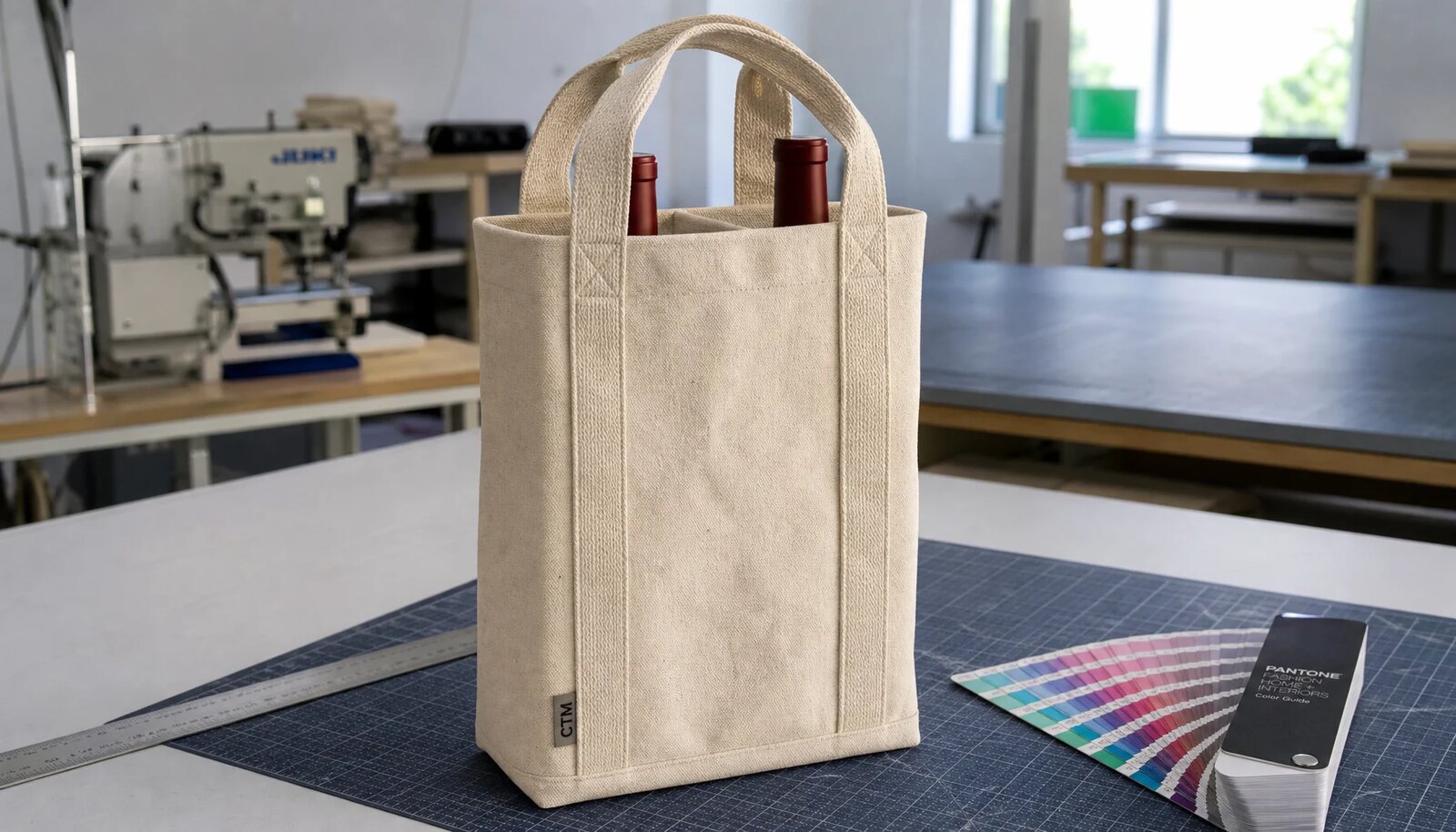
1. Why wine carrier proofing is not the same as tote bag proofing
A custom canvas wine carrier looks simple until it is filled. Then the panel curves, the handles pull upward, the gusset opens, and the divider starts doing real work. That movement matters for print proofing. A logo that appears centered on a flat mockup can look low, tilted, or squeezed when two bottles are inside the carrier.
This is why buyers should treat a canvas wine carrier as a shaped, load-bearing product, not as a flat tote with a logo dropped into the middle. The print area may sit close to side seams, handle bases, a center divider, bottom fold, or gusset. Any of those construction points can shift the way the logo reads.
For eco apparel brands, the carrier is often more than packaging. It may be a retail accessory, loyalty gift, holiday bundle, vineyard collaboration, employee gift, or premium add-on to an apparel order. The customer sees the material, the stitching, the label, the print, and the fold presentation together. If one part feels careless, the whole brand moment is weaker.
The safest rule is straightforward: approve the print and the product together. If the bag changes from 10 oz to 14 oz canvas, from natural to dyed fabric, from a one-bottle sleeve to a two-bottle divided tote, or from flat packing to retail banding, the earlier proof is no longer a complete production standard. Canvas texture, fabric tension, ink absorption, and fold pressure all change.
- Approve artwork on the actual carrier construction whenever possible, not only on a digital mockup.
- Review the logo near seams, gussets, handle bases, dividers, folds, and carton packing points.
- Expect coarse canvas to soften fine text, thin strokes, small QR codes, and tight multi-color registration.
- Check the logo on the carrier empty, loaded with bottles, and folded as it will ship.
- Do not release bulk production until fabric, construction, print method, curing, and packing are all stable.
2. Lock the carrier specification before approving the artwork
Many print disputes begin before ink touches fabric. The buyer approves a layout while the carrier is still loosely defined. Later, the supplier adjusts the gusset, divider height, handle base, or fabric weight. Suddenly the logo looks too low, too close to a seam, or visually off-center. The print may not be the root problem; the specification moved.
Start the RFQ with the physical format. Is it a single-bottle sleeve, one-bottle handled carrier, two-bottle divided tote, drawstring bottle bag, rigid insert, or gift set component? Then define the finished width, height, depth or gusset, handle drop, handle width, opening width, divider width or stitch line, bottom construction, label position, and packing method.
Soft sewn bags need tolerances, not vague promises. Many buyers use ±5 mm for critical dimensions related to logo placement or bottle fit, and ±10 mm for less critical overall dimensions. Those numbers are not automatic; they must be agreed with the supplier and written into the PO or spec sheet.
Fabric weight should also be stated in a way the factory can check. Canvas oz terminology is common, but actual GSM varies by weave and mill. A stronger specification might say: natural unbleached cotton canvas, target 12 oz / supplier-stated GSM, tolerance ±5%, plain weave, no coating, no wash, bulk shade to approved swatch. That is much clearer than “eco canvas wine bag.”
Structure is not decoration. Wine carriers hold glass bottles. A basic promotional sleeve may use lighter canvas, while a two-bottle divided carrier usually needs stronger seams, reinforced handle bases, and a more stable bottom. If the item will be sold as a premium accessory, add requirements for stitching, thread color, branded labels, fold presentation, and shelf-ready packing.
- Define format, dimensions, handle drop, gusset, divider, bottom, label, and packing before artwork approval.
- State canvas weight in GSM and/or oz, with the supplier’s actual target and tolerance.
- Confirm whether the supplier prints flat panels before sewing or finished carriers after sewing.
- Use fixed construction landmarks to define the print zone.
- Treat organic, recycled, undyed, low-impact, or plastic-free claims as specifications that need support.
3. Choose a branding method that fits the artwork and canvas
Screen printing is often the practical choice for custom canvas wine carriers. It works well for solid logos, simple typography, and repeat orders. On textured cotton, good results depend on the ink system, mesh, squeegee pressure, opacity, and curing. Ask how many colors and screens are included, whether an underbase is needed on dyed or dark canvas, and what registration tolerance the factory can hold.
Heat transfer can be useful for low-MOQ orders, detailed event graphics, multiple color versions, or short seasonal programs. It is not risk-free. Transfer edges may feel more noticeable on cotton canvas, and folded packing can stress the film. Test adhesion, cracking, hand feel, edge lift, and blocking on the final canvas weight and final fold method.
Digital printing gives flexibility for complex artwork and short runs. Still, natural or slubbed canvas will not behave like smooth paper or coated polyester. Gradients may look flatter, small type may lose sharpness, and the base fabric color can shift the printed shade. A screen proof or monitor proof is not enough for final approval.
Embroidery can support a premium look, but it is not automatically the best solution. Dense embroidery may pucker the panel, add backing inside the carrier, or create stiffness where the bag needs to fold. For small branding, a woven label, cotton label, or printed side label may be cleaner and more consistent.
Match the method to the job. A simple one-color apparel logo on natural canvas may be ideal for screen print. A limited event graphic may justify transfer or digital print. A premium retail carrier may combine a subtle front print with a branded woven label. The important point is to sample the exact method on the actual construction.
- Use screen printing for solid one- to three-color logos and repeatable brand marks.
- Use heat transfer only after checking adhesion, edge feel, cracking, and fold pressure.
- Use digital print for artwork flexibility, but proof color and legibility on the actual canvas.
- Be cautious with QR codes, fine legal text, small trademark symbols, and thin strokes.
- Ask whether panels or finished carriers are printed, because that changes registration and safe print area.
4. Turn brand preferences into measurable proof tolerances
A proofing checklist is useful only if it turns opinions into production rules. “Center the logo” sounds clear in a meeting, but it is weak on an inspection table. The supplier needs logo width, logo height, print side, distance from fixed landmarks, acceptable deviation, color standard, and defect limits.
For many canvas wine carriers, practical front-logo placement tolerances often fall around ±3 to ±5 mm, depending on panel size, sewing sequence, and whether printing happens before or after sewing. Logo size may be controlled within about ±2 mm for simple artwork. These are working references, not universal promises. If the brand needs tighter alignment, prove capability during sampling before committing to bulk.
Measure from stable points. Use the top edge, side seam, bottom seam, handle base, divider stitch line, or gusset fold. Avoid approvals based only on visual centering, especially on a flexible fabric panel that changes shape when loaded.
Color also needs a real-world standard. Natural canvas is not white; it can warm, dull, or darken ink. Dyed canvas may need an underbase. A Pantone number is useful, but the signed strike-off or pre-production sample should become the practical bulk reference. The PO should say whether shade is judged visually against the approved sample or by a defined instrument method if your company uses one.
Do not forget curing. Under-cured ink can feel tacky, transfer inside cartons, or crack after folding. Overheating can yellow natural canvas or change the hand feel. A photo can hide these problems. Handle the proof, fold it, rub it, and pack it the way bulk goods will be handled.
- Define logo width, logo height, print side, and print location in millimeters.
- Measure placement from top edge, side seam, bottom seam, handle base, divider seam, or gusset fold.
- Agree on a placement tolerance, such as ±3 mm, ±5 mm, or another factory-confirmed value.
- Approve color on the finished carrier or final canvas strike-off, not only on paper or screen.
- Include curing, dry rub, wet rub if required, cracking, tackiness, and packing pressure in approval.
5. Build a proof packet that every team can read
A good proof packet is not just a pretty front-view mockup. Procurement needs to understand cost assumptions. Design needs scale, color, and placement. QC needs measurable checkpoints. Logistics needs fold method, carton quantity, and label rules. If the file only contains a logo image, each team will fill in the missing details differently.
Use dimensioned photos of the real sample. Include front, back, side, top opening, inside divider, bottom, handle attachments, label position, print close-up, loaded bottle view, and folded packing view. Mark the logo width and height, distance from top edge, distance from side seam, and distance from the bottom seam or gusset. For a two-bottle carrier, show the panel with bottles inserted.
Control the artwork record as carefully as the sample. Save the file name, version number, date, print method, color reference, print size, print side, and any production edits. If the supplier converts text to outlines, thickens a fine line, removes a tiny trademark symbol, or approximates a Pantone color, the change should be visible in the approval history.
Eco apparel buyers should also connect the proof to claims. If the product will be described as organic cotton, recycled cotton, undyed cotton, plastic-free packed, or reusable, the sourcing file should show the basis for that wording. The point is not to collect paperwork for its own sake. The point is to keep unsupported language off product pages, hangtags, cartons, and customer-facing materials.
- Include dimensioned photos of the actual sample, not only flat digital artwork.
- Record artwork file name, version, logo size, color reference, print method, and approved location.
- Attach material specifications and claim-document requirements where relevant.
- Show the carrier empty, loaded with the intended bottle size, and folded for packing.
- Keep one sealed physical sample where practical and a dated digital proof packet for reorder control.
6. Proof bottle fit, handle strength, and construction details
A wine carrier can pass the logo review and still fail the program. If the handle twists, the divider collapses, or the bottom seam strains under load, the product is not ready for bulk production. Functional proofing belongs in the same approval path as print proofing.
Do not let the factory choose a convenient bottle. State the intended bottle height, body diameter, shoulder shape, and maximum acceptable size. Clarify whether the carrier is for standard 750 ml wine bottles, wider sparkling bottles, spirits bottles, or mixed bottle sizes. If the program is tied to a specific bottle or vineyard partner, share exact dimensions or send a physical bottle for testing.
For a two-bottle divided carrier, check more than capacity. Bottles should go in and come out without excessive force. The divider should keep bottles separated. The opening should not strain. The handle should remain comfortable when the bag is loaded. The printed panel should still look acceptable under normal loaded tension.
Handle construction should be specified, not assumed. Define handle width, handle drop, material, number of stitch rows, bar tack size or reinforcement pattern, thread color, and reinforcement patch if used. A buyer may request a loaded hang test using a weight above the expected bottle load, but the method and acceptance rule should be agreed before production.
Construction QC should check stitch density, seam allowance, divider alignment, top edge straightness, loose threads, raw edges, bottom support, and symmetry. Canvas hides some flaws at a glance, but uneven sewing is easy to spot on a retail-facing accessory.
- State intended bottle dimensions and maximum acceptable bottle size.
- Test the carrier loaded, not only empty on a table.
- Check divider height, divider stitching, neck clearance, bottom support, and ease of insertion/removal.
- Define handle width, handle drop, stitch pattern, bar tacks, thread, and reinforcement.
- Inspect for popped stitches, fabric tearing, seam strain, crooked top edge, and loose trimming after load testing.
7. Read the supplier quote like a production document
A quote that says “custom canvas wine bag with logo” is not a quote you can safely compare. It does not say whether the bag has a divider, what canvas weight is included, whether the logo is screen printed or transferred, whether a label is included, or how the goods are packed.
Ask the supplier to quote against the same specification you intend to approve: carrier format, finished size, fabric weight, fabric finish, print method, number of print colors, print size, printed sides, handle construction, divider, labels, hangtags, packing, carton data, lead time, Incoterms, and payment terms. If two suppliers quote different fabrics or packing methods, their unit prices are not comparable.
MOQ should be broken down by the real production constraint. Minimums may come from fabric purchase, dye lot, screen setup, label production, cutting efficiency, carton sorting, or supplier scheduling. Ask whether MOQ applies to the total order, each artwork, each fabric color, each print colorway, each size, or each packing format.
This matters for eco apparel brands that split one campaign across regional logos, seasonal colors, club tiers, or retail partners. A 1,000-unit order divided into five artworks may behave like five small runs for setup, sorting, and inspection. Confirm that before the marketing plan is locked.
Repeat-order terms are also part of the quote. Ask whether screen charges repeat, how long screens or artwork files are kept, whether a new Pantone color triggers a new setup, whether a new fabric color requires a new strike-off, and whether the same fabric source will be used on reorders.
- Separate unit price, sample fees, screen/setup charges, labels, packing, inspection, and optional upgrades.
- Request price tiers at MOQ, expected launch quantity, and likely reorder quantity.
- Clarify MOQ by artwork, fabric color, print color, size, label, and packing method.
- Confirm Incoterms, lead time, carton dimensions, gross weight, net weight, and price validity.
- Compare suppliers only after the quoted specification and packing method are equivalent.
8. Plan packing and print protection before bulk goods are folded
Packing is often treated as the final step. For printed canvas wine carriers, it should be part of proofing. Folding direction, inner pack quantity, tissue, bands, labels, polybags, and carton size can affect print appearance, freight cost, and customer presentation.
Eco apparel brands may also have packing standards. If the program avoids plastic, specify bulk packing, paper bands, FSC paper if required, tissue, or other approved materials early. If a retailer needs barcodes, suffocation warnings, routing labels, carton marks, or specific inner packs, include those requirements in the RFQ and proof packet before production starts.
Print protection is practical, not cosmetic. Freshly printed canvas should not be packed in a way that causes blocking, scuffing, pressure marks, or ink transfer. Ask how long printed goods rest after curing, whether printed faces touch each other, and whether separators are needed. Large solid prints, dark inks, and tight folds deserve extra attention.
Carton data should be requested before landed-cost comparison. Ask for units per export carton, carton dimensions, gross weight, net weight, inner pack quantity, carton material, and carton mark layout. A low unit price can become less attractive if bulky folding increases freight volume or weak cartons create receiving damage.
- Confirm fold method, inner pack quantity, export carton quantity, carton size, gross weight, and net weight.
- Avoid print-to-print contact unless blocking and abrasion have been tested.
- Include hangtags, barcode labels, paper bands, carton marks, and retail labels in the proof stage.
- Specify plastic-free or reduced-plastic packing in measurable terms.
- Inspect random cartons for count, fold direction, label placement, carton strength, and print protection.
9. Manage MOQ and lead time around actual approval steps
Lead time for custom canvas wine carriers is rarely just sewing time. Fabric sourcing, lab dips, strike-offs, screen making, sample revisions, curing, internal approval, inspection, packing, and freight booking all take calendar days. A schedule that begins after final artwork and material approval is more realistic than one based on the first quote date.
Break the timeline into milestones: RFQ clarification, material confirmation, blank construction sample, print strike-off, pre-production sample, approval, bulk cutting, printing, sewing or finishing, curing, trimming, inspection, packing, and shipment. If panels are printed before sewing, flat printing may support cleaner placement, but cutting and sewing must maintain alignment. If finished carriers are printed after sewing, alignment to the final product may be clearer, but safe print area near seams is reduced.
MOQ is a cost and process issue, not just a number to negotiate. A very low MOQ can help test demand, but it may raise unit price, limit fabric options, reduce custom packing flexibility, and make setup charges feel heavy. A higher MOQ may improve unit cost while increasing inventory risk. Ask for tiers so you can compare total project cost, not only first-unit price.
For multi-SKU campaigns, confirm how the split is treated. One thousand units across five artworks may require five setups, five sorting plans, and more inspection time. Align the assortment with production economics before committing to a launch date.
- Build the schedule backward from the required delivery date.
- Allow time for strike-off review, pre-production sample approval, and at least one correction round if needed.
- Ask whether MOQ is by total order, artwork, fabric color, carrier size, print colorway, or label.
- Compare pricing at MOQ, mid-volume, and expected reorder volume.
- Treat urgent lead times cautiously until artwork, fabric, construction, packing, and carton data are confirmed.
10. Choose the supplier by landed cost and QC risk, not opening price
The lowest quoted unit price is not always the lowest program cost. A complete comparison includes sample fees, screen charges, artwork correction, labels, packing, carton volume, inland freight, international freight, duty, inspection, warehousing, sorting, and rework exposure. A supplier that saves a few cents per carrier can become expensive if cartons are inefficient or print defects need sorting.
Calculate landed cost after the construction, print method, and packing method are approved. Before that, carton size and freight volume are only estimates. If the buyer changes from 10 oz to 14 oz canvas, from bulk pack to individually banded retail pack, or from one-color print to multi-color artwork, the cost picture changes.
Quality risk has a business cost. Misplaced logos, cracked ink, handle failures, divider collapse, unsupported eco claims, or late shipment can affect launch timing and brand presentation. The print proofing checklist is therefore not only a design sign-off form. It is a sourcing control tool.
A practical supplier scorecard should evaluate quote completeness, sample accuracy, print capability, construction quality, material documentation, corrective-action speed, packing discipline, lead-time realism, and reorder support. The best supplier is the one that can meet the specification repeatedly while reducing avoidable risk.
- Compare unit price, setup charges, samples, labels, packing, carton volume, freight, inspection, and rework exposure together.
- Use approved carton dimensions and gross weight for freight estimates.
- Score suppliers on proof accuracy, documentation, QC response, and repeat-order control.
- Include the cost of extra sample rounds if the supplier misses the standard.
- Give process reliability more weight when the carrier is tied to a launch, retail program, or gifting deadline.
Specification comparison for buyers
| Spec decision | Recommended option | When it fits | Buyer risk to check |
|---|---|---|---|
| Direct cut-and-sew factory with in-house screen printing | Best for repeat programs that need one accountable production chain for fabric, cutting, sewing, printing, curing, inspection, and packing | Use for stable artwork, repeat reorders, and programs where the same supplier should own both construction and print quality | Verify the print is truly in-house for this SKU. Ask where screens are made, what curing equipment is used, whether panels or finished bags are printed, and who signs the sealed print standard. |
| Bag factory using an external print shop | Acceptable when the sewing factory is strong and the print shop brings specialist capability | Fits complex artwork, higher-color logos, or programs where the supplier can coordinate transport and QC between sewing and printing | Put responsibility in writing for print defects, panel distortion, ink curing, and shade drift. Confirm whether the approved sample is kept at the sewing factory, print shop, or trading office. |
| Trading company coordinating multiple factories | Useful when buyers want to consolidate wine carriers, totes, drawstring bags, garment bags, labels, and packaging under one PO | Fits mixed-category sourcing where supplier management and documentation matter as much as unit cost | Watch for vague answers on factory identity, screen counts, fabric mill source, material documents, and who pays if bulk goods fail print or bottle-fit inspection. |
| Low-MOQ workshop or sample studio | Useful for launch tests, event gifting, pop-ups, influencer kits, or regional promotions | Fits first orders where demand is unproven and the buyer accepts a higher unit cost for flexibility | Confirm the sample run and bulk run use the same canvas weight, thread, handle tape, reinforcement, ink, folding method, and carton packing. Small runs still need measurable approvals. |
| Compliance-ready export factory | Best when carriers will be sold through retailers or packed into documented gift programs | Fits buyers needing carton labels, barcode readiness, material declarations, inspection records, restricted-substance files, and audit-friendly paperwork | Check that documents apply to the exact canvas, dye, ink, label, and finished carrier, not only to the factory site or a generic cotton fabric. |
| Regional stock-and-custom supplier | Useful when lead time is more important than custom construction | Fits urgent events or replenishment where a standard blank wine carrier is acceptable | Buyer control is limited over GSM, weave, handle strength, divider dimensions, safe print area, and carton efficiency because blanks may already be sewn. |
| Integrated bag maker with small print line | Practical for standard one- or two-color logos at moderate volumes | Fits programs needing balanced cost, speed, and control without premium retail engineering | Check curing capacity, registration accuracy, rub-test results, and whether the print line can maintain placement within the agreed tolerance on the chosen canvas weight. |
| Multi-material promotional supplier adapting tote-bag patterns | Can work when the buyer needs several canvas bag SKUs in one sourcing lane | Fits multi-SKU programs where supplier consolidation matters more than engineered bottle protection | Tote construction does not automatically translate to bottle support. Verify divider height, neck clearance, bottom strength, handle pull resistance, and loaded standing stability. |
| Premium retail bag factory | Appropriate when the carrier is a paid accessory, high-value gift component, or retail-facing brand item | Fits eco apparel brands requiring clean stitching, stronger fabric hand, branded labels, controlled folding, and shelf-ready presentation | Confirm the quote includes structural requirements such as reinforced handle bases, bottom support, stitch density, and bottle-fit testing rather than only decorative upgrades. |
Buyer checklist before sampling
- Confirm the carrier format before artwork approval: single-bottle sleeve, one-bottle handled carrier, two-bottle divided tote, drawstring bottle bag, rigid insert, or gift set component. Each format changes pattern pieces, safe print zone, carton loading, and bottle-fit testing.
- State finished dimensions with tolerances: width, height, gusset/depth, handle drop, divider width, bottom panel, and opening width. For soft cotton bags, many buyers use ±5 mm for critical small dimensions and ±10 mm for non-critical overall dimensions, but the PO should state the agreed tolerance.
- Lock fabric weight in GSM or oz before approving art. Common canvas references include about 8 oz, 10 oz, 12 oz, 14 oz, and 16 oz; approximate GSM varies by mill construction, so request the supplier’s actual GSM target and tolerance rather than relying only on oz terminology.
- Define the fabric precisely: natural unbleached cotton canvas, bleached canvas, dyed canvas, recycled cotton blend, organic cotton canvas, washed canvas, coated canvas, or cotton/poly blend if applicable. Each option affects shade, shrinkage, ink absorption, hand feel, and claim documentation.
- Require material claim support where relevant. If the product is described as organic, recycled, undyed, low-impact dyed, or plastic-free packed, request the certificate, transaction document, supplier declaration, or packaging specification appropriate to the market and claim.
- State print method, number of colors, artwork size, print side, print location, ink type where relevant, and color target on the finished carrier. Do not approve a color only on a paper drawdown if the final surface is natural canvas.
- Define print tolerances before the pre-production sample. Typical working targets for canvas wine carriers may include placement within ±3 to ±5 mm for simple front prints, logo size within ±2 mm, and visible color judged against an approved strike-off under consistent light; tighter standards require factory confirmation.
- Request a pre-production sample made with bulk-intended fabric, thread, handle tape, reinforcement, label, final print method, curing process, fold method, and packing. A digital mockup, paper proof, or flat fabric swatch is not sufficient for final bulk approval.
- Measure print placement from fixed landmarks such as top edge, side seam, bottom seam, handle base, divider stitch line, or fold line. Avoid approvals based only on visual centering on a flexible fabric panel.
- Confirm the bottle used for fit testing. State maximum bottle body diameter, bottle height, shoulder shape, and whether one or two loaded bottles must fit without forcing, divider collapse, or seam strain.
Factory quote questions to send
- What exact carrier format are you quoting, and what are the finished dimensions, handle drop, gusset, divider details, and measurement tolerances?
- What canvas weight are you quoting in GSM and/or oz, and what tolerance will bulk production follow? Can you provide a fabric record or mill specification for the approved material?
- Is the canvas natural unbleached, bleached, dyed, washed, recycled-content, organic cotton, conventional cotton, or blended? What documentation supports any organic, recycled, or other eco-related claim?
- Will the fabric be pre-shrunk, washed, enzyme-washed, coated, or untreated? If the fabric is dyed, what shade tolerance and dye-lot control will apply?
- Which print method will you use: screen print, heat transfer, digital print, embroidery, woven label, or another process? Will you print panels before sewing or finished carriers after sewing?
- For screen printing, how many screens are included, is an underbase required on dyed or dark canvas, what ink system will be used, and how will curing temperature/time be controlled?
- What is the maximum safe print area for this exact carrier, measured from side seams, top edge, handle bases, divider seam, bottom fold, and gusset?
- What print placement tolerance can you hold on bulk production for this structure and print size? Can you commit to ±3 mm, ±5 mm, or another measurable tolerance?
- How will finished print color be approved: Pantone reference, lab dip, strike-off, signed sample, or visual standard? What lighting condition will be used for comparison?
- What rub, scratch, wash, or abrasion checks do you recommend for this ink and canvas combination? Can you perform a dry rub and wet rub test or provide your internal method?
Quality-control points to confirm
- Verify canvas weight against the approved specification using supplier records and spot checks. If the PO states GSM, define the acceptable tolerance; a common commercial range may be ±5% unless the buyer requires tighter control.
- Check fabric shade, weave density, slubs, stains, oil marks, odor, moisture, coating consistency, and hand feel against the approved swatch or sealed sample before printing begins.
- Confirm cut panels or finished carriers are not skewed. Distorted panels can make a correctly printed logo appear crooked once the carrier is sewn or filled.
- Inspect print registration, edge sharpness, opacity, pinholes, ink coverage, sawtooth edges on text, and underbase show-through where applicable.
- Compare finished print color to the approved strike-off or signed sample under consistent lighting. If Pantone matching is specified, judge on the finished canvas, not only on paper or monitor proof.
- Check print placement from fixed landmarks: top edge, side seam, bottom seam, handle base, divider seam, or gusset fold. Record deviations in millimeters and apply the PO tolerance consistently.
- Perform a dry rub check after curing and, if required, a wet rub check. Look for ink transfer, tackiness, cracking, peeling, gloss inconsistency, or blocking when printed faces contact each other.
- Review curing quality. Under-cured ink may feel tacky, transfer in cartons, or crack after folding; over-heating can yellow natural canvas or distort fabric hand.
- Check whether seams, folds, handle attachments, divider stitching, bottom reinforcement, or carton pressure marks distort the logo beyond the approved sample standard.
- Measure finished dimensions: width, height, gusset/depth, handle drop, divider width, opening width, and bottom support. Use the agreed tolerance rather than subjective visual judgment.