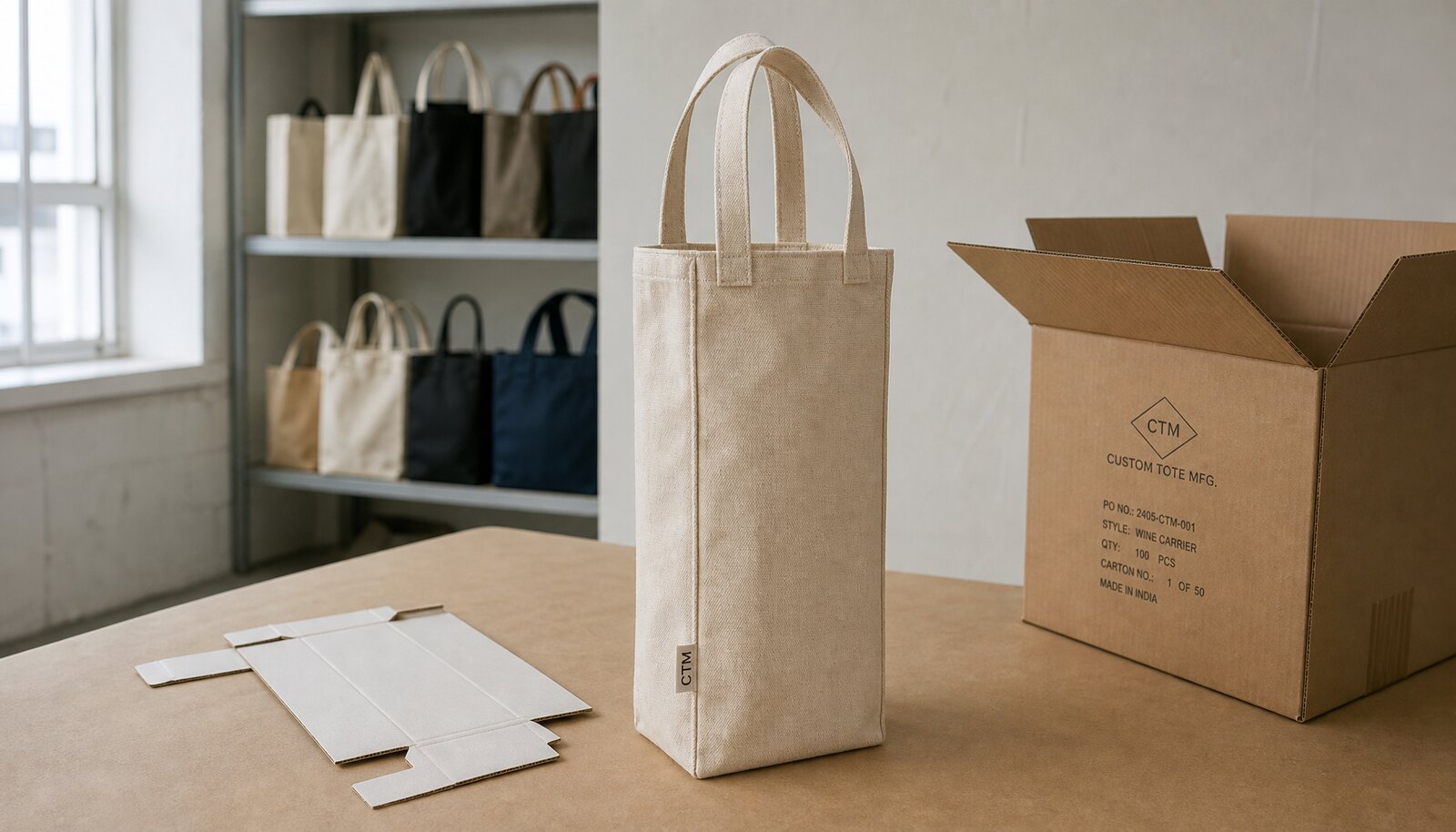
Start With The Carton Problem, Not The Bag
For corporate gifting, the bag itself is only half the job. The real sourcing problem is how the carrier moves through production, packing, warehouse handling, and final delivery without scuffing the print, crushing the handle fold, or wasting carton space. If the carton plan is vague, the supplier will usually default to whatever is easiest on the line, not what is safest for your program.
A useful RFQ starts with the end use. Is the carrier going into a gift bag set, a wine box, or a direct ship carton? Will it ship as a flat blank, a folded finished bag, or pre-packed with tissue and an insert board? Once those details are fixed, the supplier can quote the right fabric weight, carton count, and outer box size instead of guessing.
- State the bottle format first: 750 ml standard, magnum, or another size.
- Define whether the carrier is for presentation, transport, or both.
- Tell the supplier if the outer carton must be retail clean or warehouse rough.
Choose The Build Before You Quote The Carton
Canvas wine carriers are usually quoted in 8 oz, 10 oz, or 12 oz canvas, and that choice changes everything else. An 8 oz canvas is lighter and cheaper, but it looks softer and can feel too casual for a premium corporate gift. A 10 oz build is the common middle ground because it holds shape well, takes print cleanly, and still packs efficiently. A 12 oz carrier gives a more substantial hand feel, but it adds sewing load, higher material cost, and more carton weight.
Do not stop at the fabric weight. Ask about the weave density, handle material, stitch density, bottom reinforcement, and whether the carrier needs a board insert or side gusset to stop bottle lean. If the bottle has a broad shoulder or heavy glass, a flat canvas sleeve is not enough. The bag should hold the bottle upright, close the top without strain, and survive repeated handling at event venues and warehouse docks.
- Use 10 oz canvas for most corporate gifting orders unless the bottle is unusually heavy.
- Add a 2 to 3 mm bottom board or E-flute insert when the bottle base needs stabilization.
- Ask for reinforced bar-tacks where the handle joins the body, not just a plain seam.
Print Method Changes Yield, Lead Time, and Risk
The print method should match both the artwork and the packing plan. Screen printing is usually the best choice for one or two solid colors because it gives strong coverage on natural canvas and keeps unit cost under control. Heat transfer or digital transfer can work for smaller runs or more detailed graphics, but buyers should expect a different feel on the fabric and should test how the print looks once the bag is folded into the carton. Embroidery can look premium, but it adds thickness and may print a visible bump through the carton stack.
For corporate gifting, the main risk is not whether the logo looks good on screen. The risk is whether it still looks clean after sewing, folding, carton compression, and warehouse handling. Keep the art away from seams and fold lines, and define the placement in millimeters. Ask the factory for Pantone guidance, rub resistance, and a sample that shows the logo on the exact canvas color you will buy, because natural canvas tones vary enough to change the appearance of the same artwork.
- Use screen print for simple corporate logos and stable reorder programs.
- Use transfer print only if the artwork needs fine detail or more colors than screen print can handle economically.
- If you want a woven or side label, specify size, stitch position, and whether it replaces or supplements the front logo.
MOQ Logic: What Actually Drives The Minimum
MOQ on custom canvas wine carriers is rarely about one single number. It is usually driven by fabric width, print screens, sewing setup, handle cutting, insert die-cutting, and carton packing labor. A single-color print and one carrier size can often sit at a lower MOQ than a program with multiple artwork versions or mixed sizes. If you need several event names, several retail regions, or a different logo on each version, expect the supplier to reset the setup each time and price accordingly.
The cleanest way to compare suppliers is to ask for the price at three volume points and to separate the hidden costs. Ask what changes the unit price, what does not, and what is charged once per artwork. That usually means getting line items for blank bag, print, insert board, inner wrap, master carton, and any special packing labor. A good quote shows where scale helps and where it does not, which is what procurement needs for a proper sourcing decision.
- Request separate pricing for one-color, two-color, and mixed-artwork runs.
- Ask for overrun or underrun tolerance in writing, not verbally.
- If the supplier offers mixed-color cartons, confirm how that affects picking accuracy and pack speed.
Compare Sourcing Routes Before You Compare Price
A low unit price can hide a weak sourcing route. If you buy direct from a factory with in-house sewing and print, you usually get better control over packing, artwork placement, and carton labeling. If you buy through a trader, you may get faster quote collection and easier communication, but you also need to verify that the trader is not changing factories between samples and bulk. For a corporate gifting order, that inconsistency can cause brand variation and carton mismatch even when the price looks attractive.
Other routes can make sense, but only for specific needs. A stock blank plus local print is fast for urgent events, but it can create fabric shade drift and uneven carton quality. An integrated gift-set supplier is useful when the wine carrier must ship with tissue, tags, or a bottle box, because one party owns the full pack plan. The right route depends on whether you value speed, control, or consolidation more than the lowest visible factory price.
- Direct factory: best for control and repeat orders.
- Trader: best for admin simplicity, but verify factory identity and packing details.
- Stock plus local print: best for urgent runs, with higher risk of mismatch.
Sample Approval Should Test Fit, Not Just Appearance
A sample is only useful if it proves the bag can survive the real bottle and the real packing method. Send the actual bottle or a dummy bottle with the same diameter, height, and shoulder shape. The carrier should close cleanly without stretching, and the bottle should sit straight after the bag is folded into the carton. If the sample needs force to fit, production will be less consistent and the carton pack will look uneven.
A good approval process uses one golden sample and a short checklist. Check seam alignment, handle symmetry, print placement, label position, and whether the bottle neck clears the top comfortably. Also check the appearance after the carrier has been folded, packed, and reopened once or twice, because corporate gifting buyers often care about presentation at first unboxing, not just on the production table.
- Approve the sample with the same bottle you will use in the order.
- Keep a marked golden sample for sewing, print, and packing reference.
- Reject samples that look good flat but lose shape once folded into the carton.
Packing Plan: Protect The Print, Preserve The Presentation
For canvas wine carriers, the packing plan should reduce abrasion and keep the carton count easy to handle. The most common method is to fold the carrier in a fixed direction, place a board insert if needed, and pack a fixed quantity into a master carton with the same orientation every time. If the surface print is delicate, add a thin tissue layer or a simple polybag so the printed panel does not rub against a zipper pull, handle webbing, or another carrier in transit. If the destination is humid or sea freight is involved, a moisture barrier or desiccant pack may be worth the small cost.
The carton should be sized to the carrier, not the other way around. Oversized cartons waste cubic space and invite movement, while undersized cartons compress the bag and leave fold marks on the face panel. Keep gross carton weight reasonable for manual handling, and label each carton with style, color, quantity, carton number, and destination code if the order has split deliveries. That sounds basic, but it prevents the most expensive warehouse errors, especially when one purchase order contains several artwork versions.
- Keep all carriers facing the same direction in the master carton.
- Use a board insert or divider if the bottle shape tends to lean.
- Print carton labels clearly with SKU, quantity, and carton sequence.
Lead Time Risk Lives In The Details, Not The Sewing Floor
Lead time usually stretches because of artwork approvals, carton proof changes, sample rework, or a late change in bottle dimensions. A factory can often sew a simple carrier on schedule, but the job slows down when the packing spec is uncertain or the customer keeps moving the logo. The cleanest schedule is one where the sample is approved once, the artwork is frozen, and the carton label is approved before bulk cutting starts.
For planning purposes, buyers should treat the sample stage, bulk sewing, print setup, carton production, and final packing as separate milestones. Even if the sewing is fast, carton printing and packing can become the bottleneck if the supplier has to wait for material or recheck label data. Add buffer time before the gifting date, especially if the order lands near a peak period, a holiday shutdown, or a shipping cut-off that could push the cargo into the next vessel or truck slot.
- Freeze artwork before the sample is signed off.
- Approve carton artwork and label data before bulk materials are cut.
- Keep a schedule buffer for rework, not just production.
Quote The Landed Cost, Not Only The Unit Price
A useful RFQ asks for the whole landed picture. The bag price alone does not tell procurement enough, because carton size, pack quantity, insert boards, inner wraps, and freight efficiency all change the final number. A cheaper carrier in a bulky carton can cost more than a slightly higher unit price in a tighter pack. That is why buyers should ask for unit weight, carton dimensions, gross weight, carton count per pallet or container estimate, and the packing method used to calculate the quote.
The best quote is transparent about what is included and what is not. Ask whether the supplier is quoting FOB, EXW, or another trade term, and ask them to list any tooling, sample, artwork setup, or special packing charges separately. If you are comparing suppliers, ask each one to quote the same packing plan, not their preferred version, otherwise you are comparing different logistics assumptions instead of real commercial value.
- Request line-item pricing for bag, print, insert, carton, and packing labor.
- Ask for carton dimensions and estimated CBM, not just a unit price.
- Compare suppliers on the same trade term and the same packing spec.
Specification comparison for buyers
| Spec decision | Recommended option | When it fits | Buyer risk to check |
|---|---|---|---|
| Direct factory with sewing and packing | Best for the cleanest control over bag spec, carton count, and print placement | When you need a repeatable corporate gifting program with one or more artwork versions | Confirm the factory actually owns the sewing line and carton packing area, not just a trading desk |
| Trader or sourcing agent | Useful if you need multiple factories compared under one RFQ | When internal procurement wants one contact for price collection and document control | Watch for hidden factory changes, vague packing details, and no visibility on overrun tolerance |
| Stock blank plus local print | Fastest route for small events or last-minute campaigns | When the bottle carrier shape is standard and artwork is simple | Check fabric shade mismatch, print adhesion, and whether local print adds visible seam distortion |
| Integrated gift-set supplier | Best if the wine carrier ships with tissue, tags, inserts, or a bottle box | When presentation matters more than lowest unit price | Verify who owns each component, because mixed sourcing can create delays and carton mismatch |
| Factory with in-house print | Preferred for Pantone control and lower handling loss | When you need one or two print colors and consistent placement across batches | Ask for print method, screen count, and wash or rub resistance before approval |
| Factory sewing only, print outsourced | Acceptable if the supplier is honest about the extra handoff | When the design is complex but volume is moderate | Outside print can add lead time, extra shrink risk, and higher rejection if the artwork shifts |
| FCL export direct from origin | Strong option for larger replenishment orders with stable forecasts | When your cartons fill a container efficiently and you want the lowest freight cost per unit | Check pallet height, carton compression strength, and destination warehouse receiving rules |
| Mixed SKU carton plan | Good for campaigns with several bottle carrier colors or variants | When the brand wants one shipment but multiple store or event allocations | Make sure each carton is labeled by SKU and that mixed packs do not create picking errors at destination |
Buyer checklist before sampling
- Confirm bottle size, bottle weight, and whether the carrier must fit a single 750 ml bottle or a different format.
- Choose canvas weight before quoting: 8 oz for promo use, 10 oz for standard corporate gifting, 12 oz for a heavier premium feel.
- Lock the print method, color count, and placement in millimeters before sample approval.
- Define whether the bag needs a bottom board, side gusset, lining, or reinforced handle attachment.
- Specify carton pack quantity, master carton size, and whether the pack must be retail-ready or bulk only.
- Request a pre-production sample with the actual bottle or a dummy bottle of the same diameter and height.
- Ask for lead time by stage: sample, bulk sewing, printing, packing, and final loading.
- Get the supplier to quote overrun or underrun tolerance, carton labeling, and any insert or tissue pack costs.
Factory quote questions to send
- What canvas weight, weave density, and finish are you quoting, and what alternatives can you price for comparison?
- Which print method will you use for this artwork, and how many colors are included in the quoted price?
- What is the MOQ per colorway, per artwork version, and per size if we need more than one carrier format?
- Can you quote the bag, print, insert board, inner wrap, master carton, and palletization as separate line items?
- What carton pack quantity and master carton dimensions do you recommend for safe transit and efficient CBM use?
- Can you provide a pre-production sample with the actual bottle fit and the final carton label layout?
- What are your overrun and underrun tolerances, and how do you handle replacements for damaged cartons or print defects?
- What is the realistic lead time after sample approval, and which steps are on the critical path?
Quality-control points to confirm
- Check stitch density, bar-tacks, and handle attachment points on both sides of the carrier.
- Verify bottle fit with the actual bottle size, including shoulder width, cap height, and any neck collar or label clearance.
- Inspect print registration, color tone, and placement against the approved artwork within a tight visual tolerance.
- Confirm that edges are trimmed cleanly, no loose threads remain, and no oil, dust, or needle marks show on the face panel.
- Measure carton count, carton labels, and SKU separation to avoid mixed-pack picking mistakes.
- Check that the master carton closes flat, resists corner crush, and protects the printed surface from scuffing.
- Review the inserted board, divider, or tissue wrap for consistent position and no folding that presses into the fabric.
- Approve one golden sample and keep it tied to the packing spec so production cannot drift during bulk run.