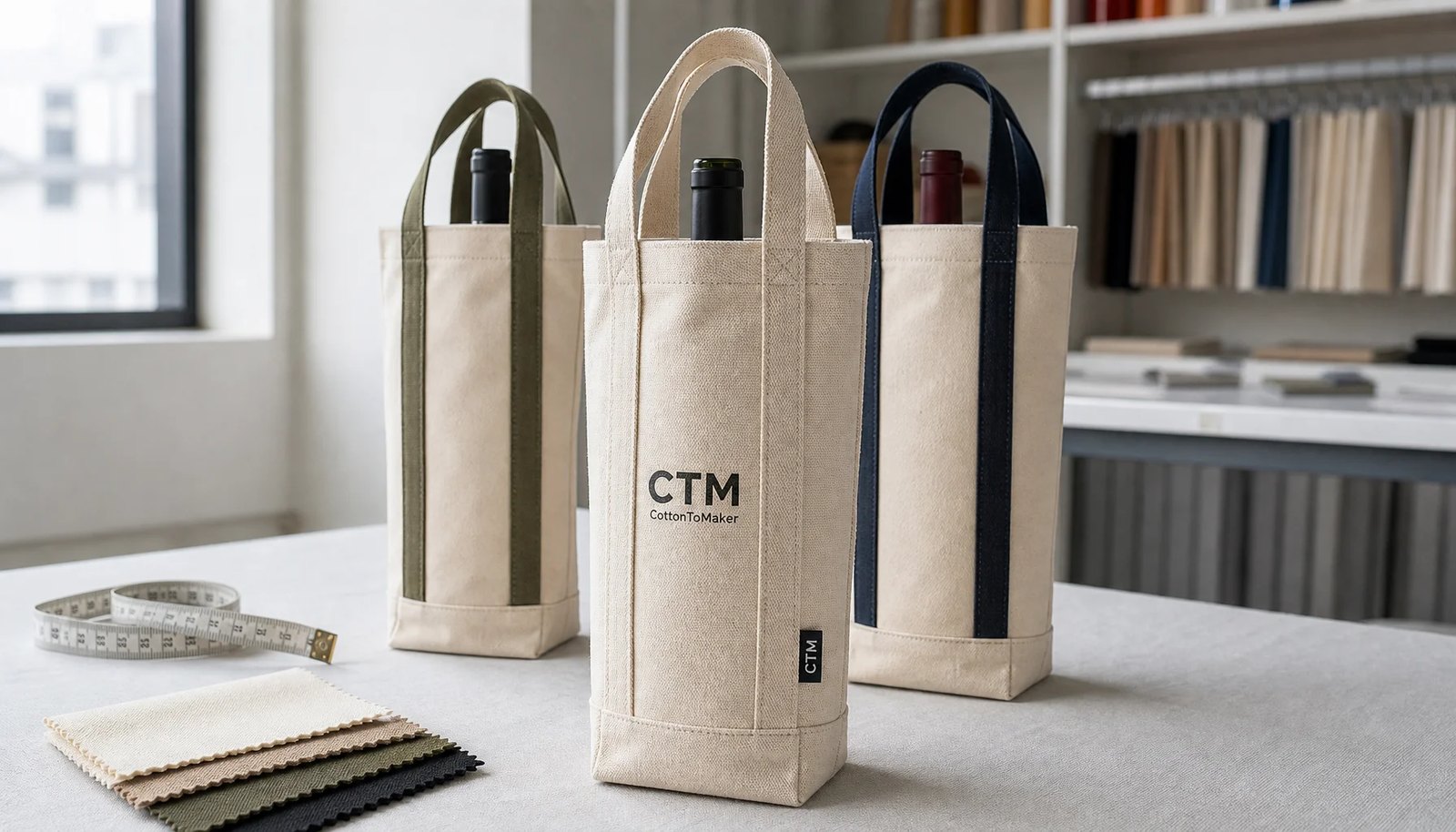
Start with the bottle, not the minimum
MOQ negotiation goes wrong when a canvas wine carrier is treated like a generic tote. It is a sewn load-bearing item with a narrow use case: hold a bottle securely, look presentable on a booth table, and survive handling by visitors, staff, and freight teams. The factory is not only pricing fabric and labor. It is pricing pattern work, cutting yield, reinforcement, decoration setup, packing labor, and the chance that a small change forces rework. If the order is only judged on unit price, the buyer can save a few cents and still end up with a bag that collapses around the bottle or arrives too late for the event.
The better starting point is the bottle geometry. State whether the carrier must fit a standard 750 ml bottle, a sparkling bottle with a wider base, a spirits bottle, or a two-bottle gift set. Height, diameter, shoulder shape, and label width all affect the pattern. A bag that is too tight creates seam stress and loading friction. A bag that is too loose lets the bottle swing and makes the product look underdeveloped when it is handed out at the show.
Write the finished dimensions into the RFQ and include a tolerance. For a small sewn item, many buyers use plus or minus 0.25 in or 6 mm on width and height unless the fit needs to be tighter. If the handle drop matters to the booth team, specify it. The point is to make the carrier measurable. If it is measurable, it can be compared, approved, and inspected. If it is not, the factory will fill in the gaps with its own assumptions, and MOQ will become a guess instead of a negotiation.
- Send the actual bottle dimensions or a dimensional template with the RFQ.
- Specify finished size and tolerance, not only a target size.
- Treat fit as a functional requirement, not a cosmetic detail.
- Ask the factory to test the sample with the bottle before bulk cutting.
Choose the build that matches the event job
The right construction depends on how the bag will be used at the trade show. A simple open-top, one-bottle carrier with cotton webbing handles is the lowest-friction starting point for booth giveaways. It keeps sewing simple, reduces trim parts, and gives the supplier more room to quote a lower MOQ. If the bag is meant for VIP gifting, distributor relations, or a premium bottle handoff, you may need a stronger base, a lined interior, a divider, or a closure. Each added feature raises labor and inspection time, so the question is not whether the feature is nice. The question is whether the feature earns its cost in the event environment.
Canvas weight should match the bottle and the brand position. For many trade show programs, 10 to 12 oz canvas, roughly 340 to 407 gsm, is the most practical range because it gives enough structure for a bottle to stand upright without making the bag too heavy or too stiff. An 8 oz fabric can work when the order is a low-cost giveaway or a short-use handout, but it is easier for the carrier to sag and show bottle edges. Heavier canvas increases body and usually feels better in hand, but it also adds freight weight and can make sewing slower if the factory is not set up for it.
Decoration should stay simple unless the brand program truly needs more. A single-color screen print on a flat front panel is usually the easiest route to a manageable MOQ. Woven labels, embroidery, foil, or multiple print locations can look better, but they also move the order into a more complex setup. The first order does not need every embellishment if the priority is to get a dependable carrier into the show schedule.
- Use 10-12 oz canvas as the default planning range for most branded wine carriers.
- Keep the first decoration simple if MOQ and lead time matter more than premium embellishment.
- Name every accessory separately: divider, base board, lining, closure, hangtag, or label.
- If the carrier has a two-bottle divider, treat it as a different product, not a small variant.
Know what actually moves MOQ and unit price
MOQ is usually a cost-recovery tool, not an arbitrary wall. The factory is trying to recover setup time and protect production efficiency. On a simple natural-canvas build with one print color and bulk pack, the minimum can be relatively low because cutting, sewing, and packing are straightforward. When the order adds custom dyeing, multiple colorways, a divider, woven labels, individual polybags, or a closure, the minimum rises because each extra variable adds materials, checks, and labor. The supplier is not trying to be difficult; it is trying to keep the line efficient enough to make the order worth running.
Useful pricing bands help procurement see the leverage. As a planning heuristic, a straightforward 300-500 pc run with natural canvas, one-color screen print, and bulk pack often sits in the lowest commercial band. At 500-1,000 pcs, unit price commonly improves by roughly 8%-15% because setup gets amortized. At 1,000-2,500 pcs, price tends to flatten unless the spec is still complex. Adders are where the economics move: dyed canvas often adds $0.15-$0.40 per unit, a woven label $0.08-$0.25, a divider $0.20-$0.55, a closure $0.10-$0.30, and individual polybagging $0.05-$0.18. Those numbers are not universal quotes, but they are useful for sorting a real factory offer from a guess.
Packing is part of the cost structure. Bulk pack usually keeps labor and carton volume down. Individual packing, barcode labels, tissue, insert cards, or retail-ready presentation can all increase the landed cost even when the sewn bag is unchanged. If the supplier quotes one unit price for two different pack formats, the quote is not yet comparable. Ask for a clean split so the commercial tradeoffs are visible.
- Expect MOQ to rise when you add dyeing, extra decoration, dividers, closures, or retail-ready packing.
- Use pricing bands to test whether the quote is commercially plausible.
- Compare quotes only after the pack method is fixed.
- Treat one-time setup charges separately from recurring unit cost.
Compare supplier models before you quote
The lowest-risk supplier is not always the factory with the lowest factory price. A direct cut-and-sew factory is usually the best fit when the carrier needs custom dimensions, repeatable bulk quality, or a pattern that has to be held consistently from sample to production. A trading company can still be useful when the buyer is sourcing several booth items at once, needs one point of contact, or wants a faster coordination layer. The tradeoff is cost and control. Trading companies often add an 8%-15% margin and may not own the pattern, which matters when the order needs technical discussion around fit or reinforcement.
There is a second decision inside the supplier choice: stock blank plus logo versus fully custom build. Stock can reduce MOQ to 100-300 pcs and save time, which makes sense when the event is close and the bag only needs to function as a branded carrier. Fully custom becomes the better choice when the bottle is unusual, the brand wants a premium feel, or the program will repeat and justify the tooling and sampling effort. The right answer is the one that fits the use case, not the one that sounds more impressive in the quote.
When comparing suppliers, look beyond the unit price. Ask who owns the pattern, how quickly they turn a revised sample, whether they can show a production photo of the first bulk pieces, who signs off on QC, and whether they can explain why MOQ changes when the spec changes. A supplier that can answer those questions clearly is usually easier to manage than one that simply repeats a number.
- Direct factory sourcing usually gives better technical control on custom dimensions and reinforcement.
- Trading companies can work when you need multi-item coordination or a single buying point.
- Stock blanks are useful for speed; custom builds are better for repeatable brand programs.
- Ask who owns the pattern, sample, QC report, and production sign-off.
Build a quote the factory can price cleanly
A usable RFQ reads like a compressed manufacturing brief. Include the bottle type, finished size, tolerance, canvas weight, fabric color, handle construction, reinforcement, decoration method, logo size, logo placement, packing format, carton marking, shipping destination, Incoterm preference, and event date. If those pieces are missing, every supplier fills the blanks differently. One quote may assume 8 oz canvas and bulk pack; another may assume 12 oz canvas with a woven label and individual polybagging. Those numbers are not directly comparable, and the buyer ends up negotiating the wrong thing.
Ask for tiered pricing at realistic breakpoints. For trade show buyers, 300, 500, 1,000, and 2,500 pcs are often enough to see where the real cost curve bends. Also ask for one-time charges separately: sample making, screen setup, plate setup, artwork adjustment, label setup, packing labor, carton printing, and any rework fee if approval changes. That matters because a low unit price can be outweighed by setup charges at a small run. If the supplier will not separate setup from recurring cost, procurement cannot tell whether a lower MOQ is actually a better commercial deal.
Landed cost should be negotiated as a formula, not a guess. Example: 1,000 pcs at $1.72 FOB = $1,720. Add $85 setup, $100 cartons, $280 ocean freight, roughly $112 duty if the duty rate applies to the goods value, $120 destination fees, and $90 domestic delivery. That puts the landed total near $2.35 per unit before sample cost. If the same order moves by air instead of ocean, landed cost can easily rise by $0.60-$1.40 per unit depending on weight and route. The lesson is simple: freight mode can erase a small unit-price win.
- Use one RFQ package for every supplier so the quotes are comparable.
- Request tiered pricing and all setup charges in the same response.
- Separate FOB or EXW pricing from freight, duty, and destination charges.
- Test air versus ocean freight before you lock the offer.
Negotiate with tradeoffs, not pressure
The best MOQ conversation is specific. Instead of asking whether the supplier can simply go lower, ask what has to change to reach a target quantity. A factory can often reduce MOQ if you accept natural canvas instead of dyed canvas, one print color instead of two, bulk pack instead of retail-ready packing, a standard handle instead of a custom strap, or no closure. That makes the negotiation feel like engineering, not pressure. More importantly, it shows which lever actually creates the minimum and which one is cosmetic.
Use a realistic pilot strategy if there is repeat potential. Do not invent demand, but do explain whether the carrier may become part of an annual event kit, a distributor gift, or a recurring tasting program. A supplier is more open to a lower first run when the spec is stable and the second order is plausible. The key is to keep the first run simple enough that the pattern, print screen, and carton plan can be reused later. That is where the buyer earns better terms over time.
Watch for low-MOQ offers that quietly downgrade the product. Some suppliers hit a lower number by thinning the canvas, reducing handle width, simplifying the stitch path, or swapping to a stock blank that only looks similar on paper. That may be acceptable if the tradeoff is visible and signed off. It is not acceptable if the quote implies the original spec and the delivered product is different. Any lower-MOQ option should be written as a separate alternate build so procurement can compare it honestly.
- Ask what spec changes would lower MOQ and by how much.
- Trade complexity for quantity: one color, one size, bulk pack, standard handle.
- Use repeat potential honestly, but do not overstate volume.
- Treat a downgraded build as a separate alternate, not as a silent substitution.
Use samples to prove fit and finish
Sample approval should prove function, not just appearance. Put the actual bottle into the sample, lift it repeatedly, set it on a flat surface, and check whether the bag stands upright without leaning or collapsing. Look at the handle attachment points, the base corners, the inside seams, and any divider or closure. A carrier can photograph well and still fail when loaded. If the bag is going to be handed out in front of customers, the sample is where the real risk has to surface.
Print approval needs measurement, not just visual judgment. Check logo placement against the approved reference, confirm that the print is level, and inspect whether the ink holds over the canvas texture without filling in small details. If the decoration method is embroidery or a woven patch, inspect thread trimming, attachment straightness, and whether the decoration distorts the panel. For screen print, ask how cure is controlled. Under-cured print can smear, crack, or transfer during packing and transit.
Once the sample is approved, turn it into a control standard. Keep one sealed gold sample with the PO, revision date, and approved notes. Require the factory to keep a matching reference. If there is any later change in fabric, handle tape, thread color, print color, logo position, divider, closure, or packing method, the supplier should get written approval before bulk continues. That prevents quiet substitutions and gives both sides one physical standard to inspect against.
- Approve a physical pre-production sample, not just photos.
- Test the sample with the actual bottle and handling motion.
- Measure logo placement and inspect print cure, alignment, and coverage.
- Seal one gold sample and use it as the bulk standard.
Set QC thresholds before bulk starts
Quality control should focus on the points that make the bag usable. Critical defects include wrong bottle fit, handle pull-out, open seams, missing reinforcement, wrong logo, wrong material, or unsafe hardware if any closure is used. Major defects include crooked print, weak bartacks, inconsistent handle length, obvious shade variation, poor base shape, or dirty packing. Minor defects might include small thread tails or normal canvas variation inside the agreed look. The point of defining those categories before production is to stop late arguments about what counts as acceptable.
Agree the inspection method in advance. A practical standard for many B2B sewn-goods programs is AQL 2.5 for major defects and 4.0 for minor defects, with zero tolerance for criticals, unless your internal standard is stricter. That does not replace common sense, but it gives the supplier a target and gives procurement a defensible basis for hold-or-ship decisions. If the order is small and the deadline is tight, a factory final inspection may be enough. If the order is higher risk, third-party inspection is worth the extra fee.
The acceptance thresholds should be concrete. Finished dimensions within plus or minus 0.25 in or 6 mm. Logo placement within 1/8 in to 3 mm of the approved reference. No skipped stitches across the load seam. No loose thread tails longer than 1/4 in or 6 mm. Load seams stitched cleanly, with 7-9 stitches per inch or a documented equivalent. Carton count, gross weight, and destination marks should match the shipping instruction. Those thresholds are the difference between a subjective review and a purchase standard.
- Classify defects before production begins: critical, major, and minor.
- Use AQL or your internal standard consistently across the run.
- Check fit, stitching, print placement, and carton data against written thresholds.
- Hold shipment if the bulk product no longer matches the sealed sample.
Pack for receiving, not just for shipping
Packing is part of the buying decision because trade show freight has its own path. Goods may go to an advance warehouse, direct-to-show receiving dock, company office, distributor location, or a kit packer. Each route has different labels, timing windows, and handling risks. A supplier that packs neatly but labels vaguely can still create a receiving problem. The carton mark should include exhibitor name, booth number if known, PO number, item description, quantity, carton number, and any warehouse instructions. If the receiving team cannot identify the carton quickly, the schedule becomes fragile.
Bulk pack is usually the best option for internal event use. It keeps labor lower, reduces carton volume, and simplifies the quote. Individual polybags make sense when the bags are being distributed through multiple teams, stored for a long time, inserted into retail kits, or protected from dust. But that choice has a cost: more material, more labor, more volume, and usually more carton count. The pack format should be fixed before the price is finalized, because changing it later can alter the freight estimate enough to matter.
Avoid over-compressing structured carriers. Bags with dividers, base boards, or stiff seams can deform if they are stacked too tightly or packed with handles crushed flat. Ask how the bags will be folded or nested, whether the handles are protected, and what carton weight the warehouse can actually move. A practical ceiling for many event teams is under 30 lb or 14 kg per master carton unless the receiving site says otherwise. The bag should arrive looking like a product, not a flattened component bundle.
- State the destination type clearly: advance warehouse, direct booth, office, DC, or kit packer.
- Approve carton marks, carton count, unit orientation, and gross weight target.
- Fix the pack method before final pricing is accepted.
- Keep cartons manageable for the people who will actually move them.
Work backward from move-in and freeze changes
Trade show timing is unforgiving because the real deadline is not the factory completion date. The goods still have to clear production, inspection, packing, freight booking, transit, customs if applicable, destination delivery, warehouse intake, and final receiving. A supplier can finish sewing on time and still miss the show if the carton labels are wrong, the inspection is booked too late, or the receiving window closes before delivery. Procurement should build the schedule backward from move-in and include buffer for sample revision and freight disruption.
The production timeline should include artwork finalization, sample making, sample transit if needed, sample review, revision time, bulk material preparation, cutting, sewing, printing, finishing, final inspection, packing, and shipping. The most common schedule damage comes from late artwork changes, late pack changes, and delayed approval of the pre-production sample. Once the sample is approved, freeze the spec. If the artwork, fabric color, closure, or label changes after approval, update the lead time instead of pretending the schedule is unchanged.
When timing is tight, simplify the product before forcing a rush. Natural canvas, one-color print, standard handles, and bulk pack are easier to move quickly than dyed, lined, two-bottle builds with woven labels and individual packaging. Air freight can help with transit, but it does not fix late approvals or unclear specs. The fastest program is usually the one with fewer variables and one clean approval path.
- Work backward from show move-in or advance warehouse deadline.
- Freeze artwork, construction, and pack method before bulk starts.
- Add buffer for sample revision, inspection, freight booking, and receiving delays.
- Simplify the build when timing matters more than premium features.
Specification comparison for buyers
| Spec decision | MOQ impact | Typical price effect | Lead-time impact | Buyer risk to check |
|---|---|---|---|---|
| Direct factory vs trading company | Simple builds often sit around 300-800 pcs direct from a cut-and-sew factory; trading companies may quote the same MOQ or 500-1,500 pcs with more margin and fewer technical details | Direct sourcing is usually 8%-15% cheaper on the same spec; trading companies can price higher but sometimes bundle more services | Direct factory handoff is usually faster once the sample is approved; trading adds one more communication layer | Confirm who owns the pattern, sample, QC report, and production accountability |
| Stock blank plus logo vs fully custom build | Stock blanks can drop the practical MOQ to 100-300 pcs; fully custom bags usually start around 300-1,000+ depending on features | Stock is cheaper to launch because setup is lower; custom is better value when the same program will repeat | Stock can save 1-3 weeks because the body is already sewn | Check bottle fit, print area, canvas feel, and whether the blank looks generic on the booth table |
| 8 oz canvas vs 10-12 oz canvas | Light canvas may reduce MOQ by 10%-20% at some factories because it sews faster and uses less material | About $0.10-$0.25 less in material cost, but the bag can feel less premium and collapse around the bottle | Usually little difference in calendar time unless the factory is fully booked | Verify structure under load, seam stability, and whether the base still stands upright |
| Natural canvas vs dyed canvas | Natural usually carries the lowest MOQ; dyed canvas often pushes MOQ 1.5x-3x higher because of dye setup and shade control | Dyed fabric commonly adds $0.15-$0.40 per unit and may require a lab-dip fee or color approval charge | Add 1-2 weeks for dye approval, shade matching, and possible rework | Check shade banding, lot consistency, and whether future reorders can match the same color |
| Screen print vs embroidery vs woven patch | Screen print often works at 300-500 pcs; embroidery and woven patches often need 500-1,000 pcs or more to amortize setup | Screen print is usually lowest cost; embroidery or woven patch often adds $0.20-$0.60 per unit | Decoration setup can add 3-7 days, especially if artwork is being separated into screens or thread files | Check registration, hand feel, logo edge sharpness, and whether the decoration interferes with seams |
| Bulk pack vs individual polybag | Bulk pack usually keeps MOQ stable; retail-ready individual packing may require 10%-20% more quantity to absorb labor and materials | Individual pack often adds $0.05-$0.18 per unit plus more carton volume | Adds 1-3 days and often increases carton count by 20%-40% | Check receiving method, carton weight, sustainability restrictions, and whether the pack format matches the event workflow |
| One-bottle carrier vs two-bottle divider | Two-bottle builds usually raise MOQ 20%-50% because the divider, dimensions, and reinforcement create more sewing and inspection points | Expect a meaningful cost step-up from extra fabric, stitching, and larger cartons; the divider itself often adds $0.20-$0.55 per unit | Production and packing are slower because the carrier is larger and needs more alignment checks | Check handle load, divider stability, and whether the bottles rub against each other in transit |
Buyer checklist before sampling
- Identify the exact bottle type first: standard 750 ml wine, sparkling, spirits, or a gift set with collateral.
- Write finished dimensions into the RFQ and include an allowed tolerance, usually plus or minus 0.25 in or 6 mm for small sewn items unless bottle fit requires tighter control.
- State canvas weight in oz or gsm, plus finish preference such as natural, dyed, washed, lined, or unlined.
- Define reinforcement clearly: handle material, handle width, handle drop, stitch pattern, bartack location, top hem, base construction, and whether any divider or base board is included.
- Fix decoration details before requesting a price: method, size, placement from seam edges, color count, and whether the logo appears on one side or both.
- Separate MOQ by variable: fabric color, bag size, decoration method, label type, closure, divider, and packing format.
- Specify packing format, units per carton, carton label content, gross weight target, pallet needs if any, and whether the goods go to an advance warehouse or direct booth.
- Share the trade show move-in date, latest ship date, and the last approval date that still protects the schedule.
- Require a physical pre-production sample or sealed gold sample before bulk cutting.
- Build a landed-cost worksheet that includes sample charges, setup fees, bulk unit price, packing, inland freight, ocean or air freight, duty, and destination fees.
Factory quote questions to send
- What exact canvas weight, weave, finish, shrinkage allowance, and fabric source will you use for the sample and for bulk production?
- What is the MOQ by total order, and which parts of the spec change that MOQ: fabric color, print method, label type, divider, closure, or pack format?
- What is your best price at 300, 500, 1,000, and 2,500 pcs for the exact same spec?
- Which charges are one-time setup fees and which charges are built into the unit price: sample making, screen or plate setup, artwork adjustment, label setup, packing labor, carton marking, and carton labels?
- What handle width, handle drop, stitch pattern, thread type, seam allowance, and reinforcement method are included in the quoted construction?
- What print method do you recommend for this artwork on canvas, what is the maximum clean print area, and what color tolerance will you use?
- Can you confirm bottle fit with our actual bottle or a dimensional template before bulk cutting, and what clearance do you expect at the base and shoulder?
- What is the sample lead time, revision lead time, bulk production lead time, and the exact production start point after written approval?
- Which Incoterm is the quote based on, what port or city is used, and which origin, destination, customs, or local delivery charges are excluded?
- How will the goods be packed inside the carton, how many units per master carton are included, and what are the estimated carton dimensions and gross weight?
Quality-control points to confirm
- Critical defects should be zero tolerance: wrong bottle fit, handle pull-out, open seam, missing reinforcement, wrong logo, wrong material, or unsafe hardware if any closure is used.
- For most B2B programs, use an agreed inspection standard such as AQL 2.5 for major defects and 4.0 for minor defects, unless your internal standard is stricter.
- Finished dimensions should stay within the agreed tolerance, commonly plus or minus 0.25 in or 6 mm on small sewn items.
- Load seams should show clean stitching with no skipped stitches across a visible load point; a practical control is 7-9 stitches per inch on the main load seam unless the factory uses a documented equivalent.
- Bartacks or box-x reinforcements should be fully closed, with no loose thread tails longer than 1/4 in or 6 mm.
- Print placement should stay within 1/8 in to 3 mm of the approved reference on key edges or seams, and the logo should not drift across panels.
- Ink coverage should be even, cured, and free of cracking, smear, or tackiness when rubbed lightly against a clean cloth.
- Canvas should be checked for stains, oil marks, mildew, odor, excessive slub variation, discoloration, or dirt transfer before packing.
- Carton count, fold method, unit orientation, gross weight, carton label, and destination marks should match the written shipping instruction exactly.
- If the carrier uses a divider or base board, verify that the insert does not shift, warp, or create abrasion inside the bag when the bottle is loaded.