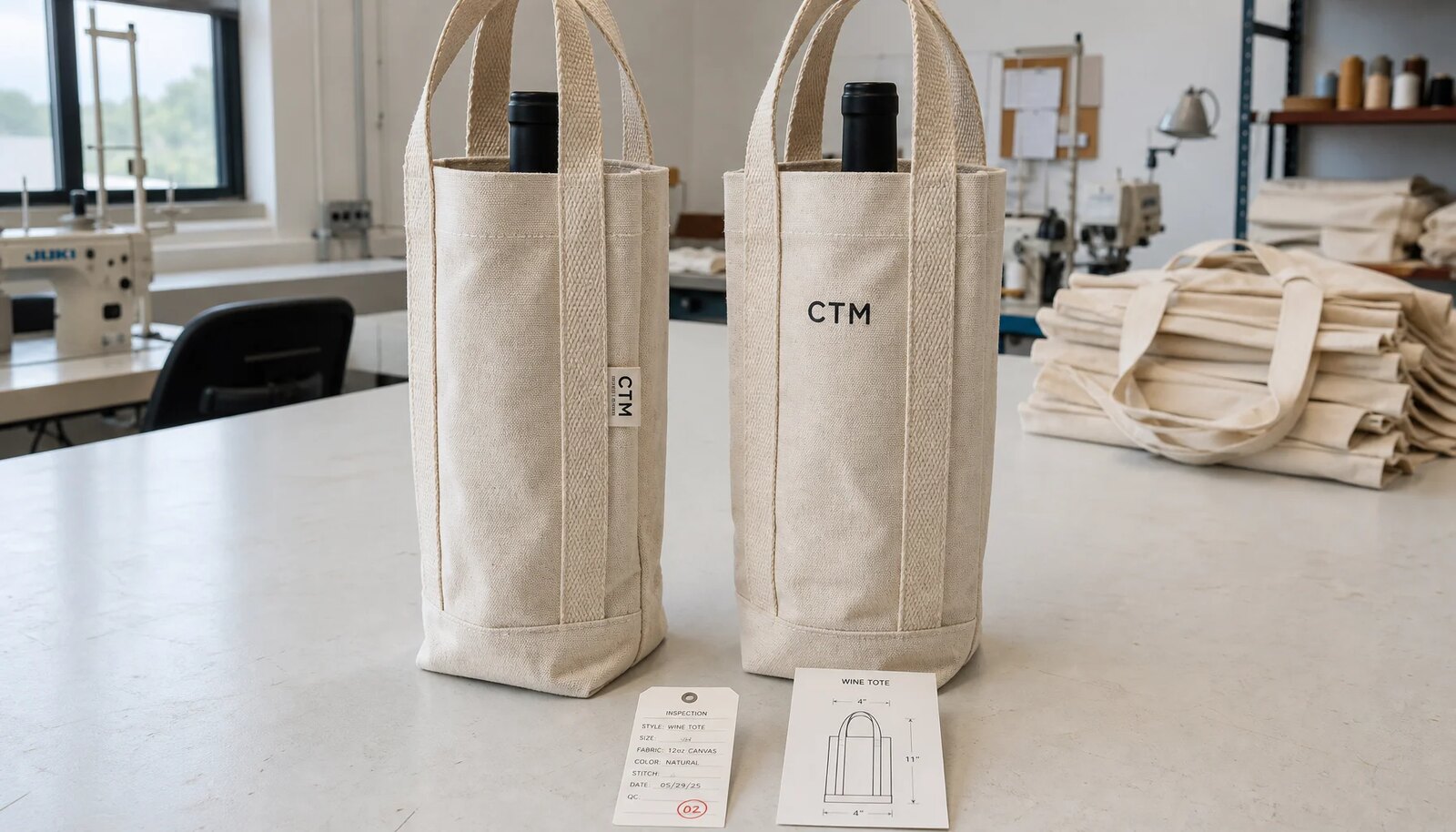
Why MOQ matters more for a market seller than for a generic merch buyer
MOQ on custom canvas wine carriers is not just a factory threshold. For a farmers market vendor, it is a cash-flow decision, a storage decision, and a sell-through decision. The same 500-unit minimum that feels normal to a larger retail brand can be too much inventory for a seller who moves product on weekends, by season, and with no guaranteed foot traffic. If the carrier is a gift add-on or an impulse item beside local wine, the real question is not whether the factory can make it. The question is whether the stock will turn before it becomes dead weight in a van, a garage, or a booth crate.
That is why procurement buyers in this channel need to separate the manufacturing minimum from the business minimum. The factory is thinking about fabric roll usage, print setup, sewing line efficiency, and packing labor. The vendor is thinking about holiday weekends, tourist traffic, weather risk, and how much money can sit in inventory without hurting the next wine purchase or market fee. A useful MOQ negotiation starts with the vendor's sell-through window, then works backward to the number that keeps the business liquid. If the supplier understands that context, the quote is more likely to reflect the real production problem instead of a generic bag order.
- Tie the first order to one season, one bottle format, and one artwork version so the line stays simple.
- Use your market calendar to time the purchase around harvest events, holiday traffic, or tourist peaks.
- Ask which part of the quote is the real minimum: fabric, decoration, packing, or total order value.
Start with the bottle and the way the carrier is actually used
A wine carrier that works in a sample room can still fail on market day. The vendor needs a bag that stacks cleanly, shows well on a folding table, survives repeated handoffs, and is easy for a customer to carry from stall to car. That means the first spec decision is not decoration. It is fit. A single-bottle carrier is usually easier to source and cheaper to replenish, but it only works if it fits the actual bottle mix the vendor sells. A two-bottle or three-bottle carrier raises basket value, but it also creates more risk around bottle clearance, divider placement, and handle load.
The use case matters just as much as the bottle size. If the bag is a reusable packaging item that the customer takes home and reuses, the carrier needs stronger handles, cleaner finishing, and a shape that holds up after repeated use. If it is a resale SKU displayed next to the wine, the presentation has to do more of the selling and the pack format has to look tidy out of the carton. If the bag is mainly for transport between the van and the table, structure and stackability matter more than premium decoration. Buyers who name the use case in the RFQ usually get a more useful quote because the factory can price the real job instead of a generic tote.
- Measure the bottles you actually sell, including label bulge, shoulder shape, and closure height.
- Choose a carrier size that works with your crate, shelf, or booth storage system.
- Keep the first run to one canvas weight, one handle style, and one decoration method unless you have the volume to support variation.
Compare sourcing routes before you ask for a price
Not every supplier setup solves the same problem. A direct factory using stock canvas is usually the cleanest route when you need a repeatable launch spec, a lower minimum, and a clear reorder path. A factory with custom-dyed canvas makes sense only when a branded color is part of the sell-through story, because the minimum and lead time usually rise with the dye commitment. A trading company can be useful when the order includes labels, inserts, cartons, and other accessories, but the extra handoffs can hide where the actual capacity lives. Domestic decoration can be excellent for a test run, but it is usually a speed play, not a long-term economics play.
The right comparison is not which supplier sounds cheapest. It is which route keeps the spec intact at the smallest workable order. A low-MOQ supplier might still be the best choice if you are validating a new holiday SKU and want to test whether customers buy a one-bottle carrier with a woven label instead of a printed logo. A larger factory may be the better fit if you already know the bag sells and you need reliable repeat orders with the same fabric and reinforcement. Buyers get better results when they compare the same size, same fabric, same decoration, and same packing format across every quote. Anything less turns the process into guesswork.
- Normalize every quote to the same fabric, same decoration method, same pack count, and same carton format before you compare pricing.
- Ask for repeat-order pricing, not only launch pricing, because farmers market vendors usually care more about replenishment than a one-time order.
- If the quote changes because the supplier is using a different blank bag or outsourced decoration, note that separately rather than treating it as the same offer.
Write the RFQ so the supplier can quote one real spec
A strong RFQ for custom canvas wine carriers should read like a production brief, not a shopping message. The supplier needs the exact bottle dimensions, carrier style, canvas weight, handle width, seam preference, decoration placement, and the target first-order quantity. If those details are missing, the supplier fills the gaps with its own assumptions, and then the quote becomes hard to compare because every factory is quoting a different product. The goal is not to overengineer the brief. The goal is to make the quote defensible.
For farmers market vendors, the RFQ should also explain how the carrier will be sold. A gift add-on beside a tasting table is not the same as a retail SKU on a shelf. If the carrier is meant to be part of a market bundle, the packing and presentation can stay simple. If the bag has to sit on display and sell itself, cleaner print alignment, a better label, and a more stable shape may matter more. That context helps the supplier choose the right construction without padding the quote with unnecessary features.
- Attach a dimensioned sketch or tech pack, artwork files, and a photo of the target bottle.
- State whether the canvas must be stock or whether a custom color is acceptable, because custom dye changes MOQ and timing.
- Call out the pack-out target in the RFQ, since bulk packing, retail packing, and gift-ready packing all change labor and freight.
Use price breaks and setup charges to negotiate like a buyer
MOQ negotiation gets easier when you stop asking only for a lower minimum and start asking for a better structure. For a first run, the supplier usually has three cost drivers: fabric, decoration setup, and handling. If you simplify one of those, the minimum can often move. That is why a stock canvas in a neutral color is the most negotiable starting point. It removes dye lead time, reduces color risk, and makes a smaller launch order more realistic.
A buyer should also benchmark the quote in a way that exposes where the money goes. For example, if a 300-unit run lands at $2.60 ex-works, add $0.25 for labels, $0.20 for a polybag or insert, $0.40 for inland freight, and $0.15-$0.35 for receiving or handling, and the landed cost is already closer to $3.60 before any duty or local distribution. At a retail price of $9.99, the gross margin may look healthy on paper, but market fees, card fees, waste, and markdowns can erase the comfort quickly. The real question is not whether the carrier is cheap. It is whether the unit cost still leaves enough room for a seasonal sell-through.
- Ask the factory to separate unit price, setup, packaging, and freight so you can see what changes if MOQ moves.
- Request first-run pricing and repeat-run pricing on the same specification.
- Use a landed-cost cap, not a target unit price, to keep the negotiation tied to your retail math.
Plan samples, lead times, and reorder economics before you place the PO
Sample timing is where many small buyers lose the season. A blank sample is for fit and construction. A decorated sample is for print placement, label look, and finish. A packed sample is for carton count, compression, and retail presentation. If you skip one of those stages, you are usually moving risk downstream into bulk production. That is expensive when the product is seasonal because a mistake in October can still be sitting in inventory in January.
Lead times also change with the sourcing path. A domestic decorator with blanks on hand may ship in one to three weeks. A factory with stock canvas often needs three to five weeks after approval. Custom-dyed canvas can stretch beyond that because the dye lot and shade approval add friction. For a vendor who sells by season, the reorder question matters as much as the first order. If demand is real, a smaller initial buy with a clear repeat path is often better than forcing a bigger first order just to chase a lower ex-works price.
- Budget sample fees in the planning stage: blank samples are often modest, decorated samples usually cost more, and packed samples cost the most because they consume real packing labor.
- Ask how many revisions are included before the sample count resets.
- Set a reorder trigger before launch so you can buy again while the spec is still fresh and the factory still has the approved materials.
Define QC so the factory can pass or fail the bag without guessing
Quality control on canvas carriers should be written to the point where the factory does not need to interpret it. Visual checks are not enough because a bag can look good while still failing under load. The first pass should be a fit test against the real bottle SKU. The second should be a structural check at the handle joins, side seams, and base seams. The third should be a load and handling test that reflects how the carrier is actually used at market. If the bag includes a divider or insert, that piece needs its own test because a good outer shell can still hide a weak internal layout.
A practical buyer standard is to define the acceptable load, the test duration, and the failure modes in writing. For example, you can require no seam opening, no handle slippage, and no stitch break when the filled bag is lifted at 2x intended weight for 60 seconds. You can require logo placement within a defined millimeter window and no obvious skew at arm's length. You can require the first packed cartons to be free of moisture, odor, and crushed corners. The exact numbers are yours to set, but the point is the same: the supplier should know how the product will be judged before bulk sewing starts.
- Approve the carrier against the actual bottle, not a generic silhouette.
- Write the load test, print placement tolerance, and defect classes into the PO or quality appendix.
- Treat decoration failure, broken stitching, and packing damage as separate defects, because they have different causes and different fixes.
Pack for crates, vans, and quick restocks
Packing is not a back-office detail for a market seller. It affects how the vendor stores stock, how fast they can restock a table, and whether the bags arrive looking sharp or scuffed. Bulk pack is usually the cheapest path, but only if the canvas can handle rubbing and the buyer does not need retail presentation. Retail-ready packing can improve perceived value, but it adds labor, carton volume, and often more handling damage. For many farmers market vendors, the best answer is clean bulk packing with simple folding, clear carton marks, and a count that is easy to receive and move by hand.
Think about the product's life between deliveries. The cartons may live in a van, a garage, a storage closet, or under a booth table. If the boxes are too large or the gross weight is awkward, the receiving team will hate the shipment before the bags are even sold. If the pack format makes the canvas crease badly or rub against hardware, presentation suffers at the exact point where the customer decides whether the bag looks giftable. Good packing protects the bag, but it also protects the seller's time on market day, which is usually the scarcer resource.
- State whether the carrier should be folded flat, lightly stuffed, or packed with dividers in place before carton loading.
- Set a carton size and weight that one person can move without improvising a second trip or a cart.
- Approve carton marks early so the receiving team can identify product, count, and destination without opening every case.
Negotiate MOQ without cutting the product spec
The best MOQ negotiation usually reduces complexity instead of weakening the product. If you want a lower entry quantity, keep the same fabric, same size, same decoration, and same pack format. That preserves the supplier's line efficiency and makes the order more likely to land on time. A lower MOQ that comes with thinner canvas, weaker handles, or a different carton format is not a real saving if it creates quality problems or forces a redesign on the reorder.
When the supplier pushes back, move the conversation to structure. Ask for a launch order and a repeat order on the same spec. Ask whether stock canvas can replace custom dye. Ask whether the order can split into a small launch release and a follow-up release after sell-through proves demand. For seasonal buyers, that is often better than forcing one oversized order. If the supplier offers a lower MOQ with a surcharge, make sure the surcharge is explicit and that the lower minimum does not hide a cut in reinforcement or material quality. The right outcome is a smaller but honest order, not a cheaper bag that behaves like the wrong product.
- Offer the factory a simpler spec before asking it to lower quantity.
- Use reorder intent or a second-release plan to justify better pricing on the same approved construction.
- If a lower MOQ is funded by weaker reinforcement or lighter fabric, treat it as a different product and compare it that way.
Time the buy to the market calendar, not just to the quote
Farmers market vendors do not buy into a flat demand curve. They buy around harvest events, holiday foot traffic, tourist peaks, and weather risk. That means the best MOQ is the one that matches the season you can actually sell through. If your best weeks are clustered, you may want a smaller launch order that turns quickly and then a second order when the season proves itself. If your demand is steady year-round, you can carry more inventory and chase a better factory price. Both models are valid. They just require different order sizes and different reorder triggers.
A simple margin test helps here. If your all-in landed cost on a carrier is $3.40 and your market price is $10.00, you have room on paper. But if market fees, payment fees, spoilage, and slow-moving stock consume $2.00 of that spread, the business case changes fast. That is why a buyer should model not just gross margin but turn rate. A smaller order that sells out is often more profitable than a larger order that looks cheaper per unit and sits in storage for three extra months. Procurement only works when it respects cash cycle as much as unit price.
- Match the first order to one selling season instead of trying to cover the full year on day one.
- Use sell-through data from your booth, tasting room, or online orders to set the reorder point.
- If your demand is uncertain, choose a smaller MOQ route and pay for speed rather than overcommitting inventory.
Specification comparison for buyers
| Sourcing option | Best use case | MOQ / lead-time impact | Cost tradeoff | Buyer risk to check |
|---|---|---|---|---|
| Direct factory with stock canvas | Best when you need a repeatable launch spec, a clean reorder path, and a simple first run. | Typical launch MOQ is often 200-500 units; sample approval to shipment is commonly 20-35 days when fabric is already in stock. | Usually the best unit economics at 300+ units. Screen setup is often $50-$150 per color, with simple labels or one-color print adding little once the line is set. | Confirm the quote uses the same fabric weight, handle width, seam reinforcement, and pack count across every line item. |
| Direct factory with custom-dyed canvas | Use when brand color is part of the product story or retail display, not just the artwork. | MOQ often moves to 500-1,000+ units because dye lot planning and shade approval add time. Lead time commonly stretches to 35-60+ days. | Higher unit price plus dye setup, color approval, and more working capital tied to inventory. Dye setup is often $80-$300 per color, sometimes more for tighter shade control. | Check whether the dye commitment is separate from the bag MOQ and whether a small shade shift is acceptable on reorders. |
| Domestic decorator using imported blanks | Good for short-run validation, holiday tests, or artwork trials when speed matters more than unit cost. | MOQ can be as low as 25-100 units, with 7-21 day lead times if blanks are on hand and decoration is local. | Fast and flexible, but the per-unit cost is usually higher. Blank bags, print, and handling can add enough cost that the economics only work for tests or small seasonal drops. | Confirm blank quality, print durability, and whether the same blank can be reordered later without spec drift. |
| Small regional cut-and-sew shop | Useful when you want a local story, easier sampling, or a premium handmade feel for a smaller run. | MOQ may sit around 50-200 units, with 2-6 week lead times depending on labor capacity and trim availability. | Piece price is often higher than offshore production, but setup can be modest and revisions are easier. | Make sure the bag is priced as a wine carrier, not as a generic tote with a bottle cutout that misses the load requirement. |
| Trading company or sourcing office | Helpful when you want one contact for sewing, labels, inserts, cartons, and shipment coordination. | MOQ looks flexible on paper, but the actual floor usually follows the underlying factory, often 300-1,000 units. | Convenient, but margin can be embedded in the unit price or added as service fees. Ask how the quote is split between factory cost and coordination cost. | Verify who actually owns sewing, decoration, packing, and final inspection before you compare the quote to a factory direct offer. |
| Supplier bundling wine carriers with a tote line | Best when you already buy canvas bags and can share fabric rolls, print setups, or carton formats. | MOQ may improve if the same material and trim are shared across SKUs, but the carrier should still be quoted as its own construction. | Can lower setup friction, but only if the wine carrier spec does not inherit a generic tote construction that weakens fit or load support. | Check that bottle clearance, base support, and handle attachment are not compromised by the shared production path. |
| Low-MOQ supplier with a surcharge | Best for market tests, seasonal launches, or a first order when sell-through is not proven yet. | MOQ can drop below normal factory floors, but lead time often stays similar because manual handling and smaller batches are less efficient. | Useful if the lower minimum protects cash, but the surcharge should be explicit. If the quote is much cheaper than the market, inspect the fabric and reinforcement carefully. | Make sure the low MOQ is not funded by thinner canvas, weaker handles, or fewer quality checks. |
| Factory outsourcing embroidery or specialty patches | Use when the design needs a premium tactile finish and the decoration is part of the value proposition. | MOQ can rise because the decoration step becomes the bottleneck, and approvals usually take longer than a simple print. | Higher decoration cost and more inspection points, especially if placement is fussy or thread colors are custom. | Ask who controls stitch quality, placement tolerance, and defect handling if the decoration step is outsourced. |
Buyer checklist before sampling
- Measure the actual bottle SKU first, including height, diameter, shoulder shape, neck finish, and label bulge. Approve the carrier against that bottle, not a generic wine bottle drawing.
- Define the use case in one sentence: resale SKU, gift add-on, or working market transport bag. The use case changes the right fabric weight, decoration level, and packing method.
- Set a target landed-cost ceiling before you request quotes. That keeps the negotiation tied to your retail margin, not to a number that looks good in isolation.
- Ask for MOQ by color, by artwork, by pack format, and by total order value. A supplier can have one low threshold and three hidden ones.
- Request a blank sample, a decorated sample, and a packed sample if carton presentation matters. Most quote errors show up in one of those stages, not in the first mockup.
- Choose one decoration method for the first run unless volume is high enough to justify more complexity. One-color screen print, woven label, or simple patch is usually enough for a launch.
- Compare first-run pricing and repeat-run pricing on the same spec. For farmers market vendors, reorder economics matter more than the launch number.
- Write down the reorder trigger before the first shipment lands. If sell-through is seasonal, set a point where you reorder or stop, rather than guessing after the market rush starts.
Factory quote questions to send
- What is the MOQ by color, by artwork, by pack format, and by total quantity, and does any of those numbers change if we keep the same size and trim?
- Is the quoted canvas the finished fabric specification, and what tolerance do you allow on weight, weave, and shade?
- What are the one-time setup charges, which charges repeat on every order, and which costs can be credited back after bulk approval?
- Can you quote a blank sample, a decorated sample, and a packed sample separately, and how many sample rounds are included before new charges apply?
- What is your lead time after sample approval, and what events extend it: artwork changes, fabric substitution, trim shortages, or carton changes?
- Which parts are made in-house and which parts are outsourced, including print, embroidery, labels, inserts, and final packing?
- How are the handle joins, side seams, and base seams reinforced, and can you show the same construction on a real production sample?
- What load test do you use for the carrier, and what result counts as a pass or fail?
- What inspection standard do you accept, and will you work to our defect definitions if we provide them in the purchase order?
- What packing format is included in the quote: bulk pack, polybag, insert card, barcode label, carton mark, palletization, or a retail-ready carton?
Quality-control points to confirm
- Fit-test the bag with the real bottle SKU and not a display dummy. The bottle should slide in without forcing, with enough clearance that the seams are not stressed by label bulge or shoulder shape.
- Define a static load test in writing. A practical buyer standard is to hang or lift the filled carrier at 2x the intended loaded weight for 60 seconds with no seam opening, handle slippage, or stitch break.
- Check handle attachment with the bag loaded and lifted from a single handle point. Any visible tearing, pulled stitches, or loosened bartacks is a fail.
- Measure seam and print placement against the approved sample. A simple working threshold is within 5 mm for logo placement and no obvious skew that a customer would notice at arm's length.
- If the bag uses embroidery, patchwork, or woven labels, inspect edge finish, thread tension, and placement consistency across the first carton. Loose threads are a minor defect; shifted placement or frayed decoration is a major defect.
- If you use a rub or adhesion test for decoration, define the method and the pass/fail threshold before bulk starts. The supplier should know whether you are checking for color transfer, edge lift, cracking, or all three.
- Use an AQL rule if your team already buys that way, and put the sampling plan and defect classes in the PO. A common planning point is AQL 2.5 for major defects and 4.0 for minor defects, with critical defects at zero, but adjust to your risk tolerance.
- Inspect the first packed cartons for odor, moisture, scuffing, broken polybags, and crushed corners. Canvas can be sewn correctly and still arrive in poor sellable condition.
- Count carton labels, inner pack counts, and outer carton counts against the approved packing list. Receiving errors are expensive because they slow restocking and create avoidable labor.
- If the carrier includes a divider or insert, verify that it stays upright under movement and does not collapse when the bag is carried by the handles or set down repeatedly.