Start With the Procurement Use Case, Not the Artwork
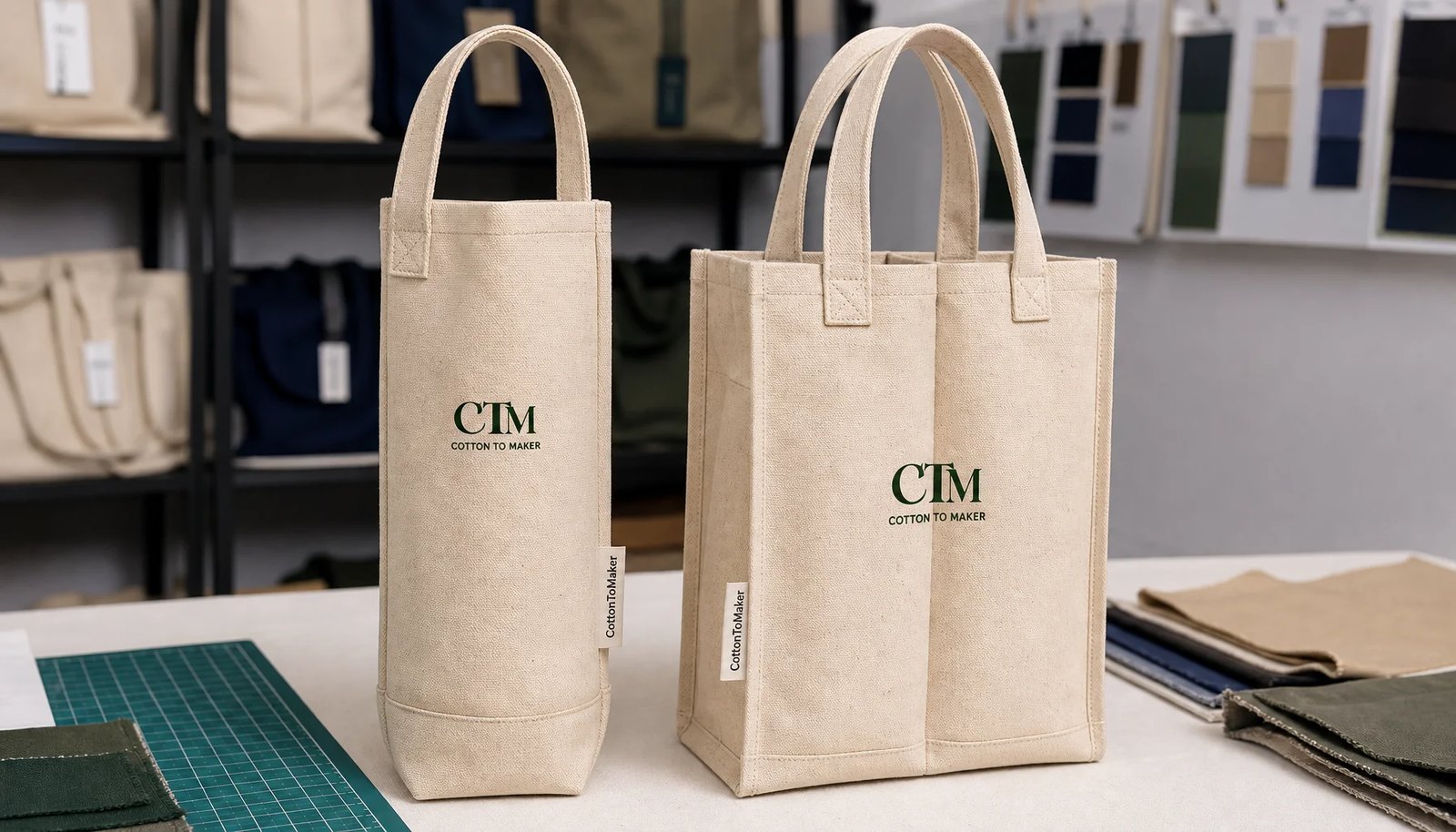
A custom canvas wine carrier for a university bookstore is not just a small tote with a campus logo. It is retail packaging, a gift component, and a loaded carrier for glass. It may be sold as a bookstore SKU, bundled with alumni merchandise, used at donor receptions, handed out at tasting events, or shipped through a distributor to several campus retail locations. Each scenario points to a different material choice. A low-cost event sleeve can be lighter and simpler than a two-bottle alumni carrier that needs to look polished on a holiday display and carry glass safely through a parking lot.
Many sourcing issues start with an RFQ that says only custom canvas wine carrier with logo. One factory may quote 8 oz cotton. Another may quote 12 oz canvas. A third may reduce the price with a shallow divider, narrow handles, or minimal reinforcement. On paper, the quotes look comparable. In production, they are different products. B2B procurement teams need a specification that makes the item measurable: canvas weight, bottle fit, pocket dimensions, divider construction, handle reinforcement, print method, packing, and inspection tolerances.
University bookstores also tend to have more stakeholders than a typical promotional order. Licensing teams care about logo color, clear space, and mark usage. Retail operations care about shelf presentation, carton labeling, barcode handling, and how fast staff can unpack the item. Finance cares about landed cost and reorder predictability. Event teams care about delivery dates. A material-first specification gives all reviewers the same reference before bulk cutting starts, which is far less painful than discovering gaps after production is underway.
- Classify the order as retail merchandise, alumni gifting, event packaging, or replenishment stock before requesting price.
- Use measurable construction terms so suppliers quote the same carrier, not different interpretations of canvas bag.
- Record the final approved specification in the purchase order and inspection checklist, not only in email comments.
- Treat bottle load, divider safety, and handle strength as required product functions, not optional upgrades.
- Include licensing and retail operations early if logo placement, hangtags, or shelf display affect the design.
Canvas Weight, GSM, Weave, and Finish
For university bookstore wine carriers, 10 oz to 12 oz cotton canvas is usually the practical sourcing range. In metric terms, that is approximately 340 to 407 GSM, although exact conversion depends on weave, finish, and supplier measurement method. This range gives the carrier enough body for a reusable retail product while keeping it sewable, printable, and efficient to pack. A 6 oz to 8 oz fabric may work for a very simple promotional sleeve, but it can look limp around a bottle and may collapse on a shelf.
Heavier canvas, such as 14 oz to 16 oz, can feel rugged. It is not automatically the better procurement choice. Heavy canvas creates thicker seams, more needle stress, tighter thread tension requirements, and heavier cartons. Folded corners can become bulky, especially where handles, dividers, and gussets overlap. A well-engineered 12 oz carrier with proper handle reinforcement can be more reliable than a heavier bag with weak load points.
Ask suppliers to state both oz and GSM because fabric naming is not always consistent. The RFQ should also ask whether the material is plain weave canvas, duck canvas, washed canvas, brushed canvas, unbleached natural canvas, or dyed canvas. Natural canvas may show cottonseed flecks, slubs, and slight shade variation. That can suit a campus bookstore aesthetic, but it should be approved up front. Dyed canvas offers a more uniform field and stronger brand color direction, but it adds shade-lot control and crocking checks.
- State fabric weight as 10 oz, 12 oz, or another target plus the approximate GSM range.
- Agree a bulk fabric weight tolerance, commonly around ±5%, and check production fabric, not just the sample.
- Ask for a swatch from the intended fabric source before approving artwork color.
- Define whether natural slubs, seed flecks, and shade variation are acceptable or must be limited.
- Do not choose heavier canvas only because it sounds stronger; seams, handles, and dividers carry the actual load.
Bottle Fit and Finished Dimension Specification
Bottle fit is the technical detail that makes or breaks a canvas wine carrier. A 750 ml wine bottle is not one universal shape. Bordeaux-style bottles, Burgundy-style bottles, tall Riesling bottles, sparkling wine bottles, cider bottles, olive oil bottles, and specialty gift bottles can vary by height, shoulder shape, diameter, punt depth, and loaded weight. If the pocket is too narrow, the bottle can distort the bag, pull the front print out of shape, stress the side seams, or make gift assembly slow for bookstore staff.
The RFQ should define finished dimensions after sewing, not flat cut-panel dimensions. For a single-bottle carrier, specify overall finished height, pocket width, gusset depth, base shape, and handle drop. For a two-bottle carrier, add pocket width for each side, divider height, divider attachment method, and finished bottle gap. The supplier should confirm whether the carrier is built around the largest approved bottle or only a narrow sample bottle. If the bookstore might sell more than wine, list the maximum bottle size the program must support.
A standing test is worth adding, especially for retail merchandising. Some samples look fine when empty but lean once a heavy glass bottle is inserted. If the carrier will sit on checkout counters, alumni gift tables, end-cap displays, or pick-up tables, the base needs enough structure to stand. A gusseted bottom with reinforced seams is usually more dependable than a narrow flat sleeve. Removable bottom boards can improve presentation, but they add cost, assembly steps, packing thickness, and material review questions.
- Provide actual bottle diameter, height, shoulder style, and loaded weight per bottle.
- Measure and approve finished pocket width, gusset depth, overall height, and handle drop after sewing.
- For two-bottle carriers, require a divider height high enough to reduce shoulder contact during carrying.
- Test the sample with the largest bottle expected in the bookstore program.
- Confirm the loaded carrier stands upright on a flat surface with handles relaxed.
- Avoid relying on supplier standard size unless the supplier confirms it against your nominated bottle.
Divider Construction for Two-Bottle Carriers
The divider is one of the biggest differences between a cheap-looking two-bottle bag and a retail-ready wine carrier. A minimal divider saves fabric and sewing time, but it may allow bottle shoulders to knock together when a customer walks. A full or higher self-fabric divider uses more material, yet it gives better separation and a more structured handfeel. Procurement buyers should specify the divider in detail instead of accepting a vague two-pocket description.
Stronger divider designs are usually anchored into the side seams, bottom seam, or both, depending on the pattern. A loose insert may reduce cost or make packing flatter, but it can shift during use and create uneven pockets. A sewn divider has its own risk: it must be placed accurately. If it is off-center by several millimeters, one pocket may feel tight while the other is loose. That affects bottle fit, shelf appearance, and the customer’s perception of quality.
During sample review and final inspection, the divider should be checked with real bottles or an approved bottle gauge. The inspector should confirm that each pocket accepts the target bottle, the bottles remain separated, and the bag does not twist under load. If the divider is also expected to support the base, that function should be built into the pattern and verified before the pre-production sample is approved.
- Specify divider material, height, width, seam attachment points, and whether it is fixed or removable.
- Use a self-fabric divider for a consistent canvas look, or specify reinforcement if extra body is required.
- Check that the divider prevents normal bottle-to-bottle contact during a short carry simulation.
- Set a tolerance for divider centering and pocket width after sewing.
- Do not approve a two-bottle sample using empty bottles only; test loaded bottles.
Handle Material, Reinforcement, and Load Testing
Handle failure is one of the clearest preventable risks in wine carrier sourcing. A full 750 ml wine bottle commonly creates a load of roughly 1.2 kg to 1.7 kg when glass weight is included, depending on bottle type. A two-bottle carrier may carry approximately 2.5 kg to 3.5 kg before tissue, tags, or small gift accessories are added. The handle system has to be designed for that load, not simply for a clean appearance in a sample photo.
Folded canvas handles, self-fabric handles, and cotton webbing handles can all work if the attachment is engineered. Common handle widths for a comfortable reusable carrier are around 25 to 38 mm. Very narrow handles save material but can dig into the customer’s hand under load. Long shoulder-style handles are often unnecessary for bottle carriers and may allow more swinging, which increases stress at the handle roots. A shorter hand-carry drop usually controls the load better and presents more neatly on a retail shelf.
The RFQ should call out the reinforcement method. Box-X stitching, bar tacks, reinforced patches, or handle ends captured into a folded seam are stronger than a single straight stitch line. Load testing does not need to be complicated, but it does need to be defined. State the nominated bottle weight, test duration, and pass/fail criteria: no seam tearing, no broken stitches, no handle detachment, and no excessive distortion at the attachment point.
- State handle width, handle drop, material, attachment length, and reinforcement pattern.
- Use box-X stitching, bar tacks, reinforced patches, or equivalent approved construction at stress points.
- Define a loaded hanging test using the intended total bottle weight plus an agreed safety margin.
- Inspect handle roots for broken threads, skipped stitches, fabric tearing, and poor back-tacking.
- Do not reduce handle reinforcement to lower unit price on two-bottle carriers.
- Approve handle comfort by carrying a loaded sample, not by visual review only.
Logo Printing, Licensing Accuracy, and Artwork Limits
Most university bookstore canvas wine carriers use one to three solid colors, so screen printing is often the most practical production method. It works well for bold university names, bookstore logos, alumni marks, and event graphics. It is also repeatable for reorder programs when screens, ink references, and placement measurements are controlled. Still, canvas has texture. Thin rules, small type, and tight details that look sharp on a digital proof may soften or break on fabric.
Heat transfer can help when artwork includes gradients, small sponsor marks, detailed illustrations, or many colors. The tradeoff is handfeel and adhesion risk. Transfers may sit on top of the canvas, show an edge, lift at corners, or crack if the material and curing process are not matched correctly. Embroidery can look premium for small marks, but dense stitching may pucker canvas and usually costs more. The safest method is not always the fanciest one; it is the one that reproduces the licensed mark accurately and survives normal handling.
University licensing requirements should be translated into production instructions. Provide vector artwork, Pantone references, final print size, logo clear space, and placement from finished seams or finished edges. Do not approve logo color from a monitor alone. A print strike-off on the final canvas color is the best working reference. The specification should also state minimum line width, smallest text height, and whether minor texture show-through is acceptable on natural canvas.
- Use screen print for bold one-color, two-color, or three-color university artwork.
- Use heat transfer only when detail or color complexity justifies extra adhesion and edge-lift checks.
- Measure print placement from finished seams or edges, with an agreed tolerance such as ±3 mm to ±5 mm where achievable.
- Avoid placing critical logo details across gussets, folded seams, or high-bulk corners unless tested.
- Approve Pantone color on the final canvas color and under consistent lighting.
- Keep one sealed printed sample as the reference for licensing and final inspection.
Color Selection: Natural, Stock Dyed, or Custom Dyed Canvas
Natural canvas is popular for university bookstore wine carriers because it feels reusable, straightforward, and campus-store appropriate. It usually supports lower MOQ and faster replenishment than custom dyed fabric. It also prints well with dark green, navy, black, burgundy, and other bold university artwork. Even so, natural canvas should not be treated as defect-free white fabric. Some flecks and slubs are normal; water stains, oil marks, mildew odor, severe shade mixing, and visible contamination should not be accepted.
Stock dyed canvas is a good middle ground when the bookstore wants a color close to campus branding without developing a custom fabric. Navy, black, forest green, burgundy, and similar shades can create a strong shelf presence. The main print issue is opacity. White or light ink on dark canvas may need additional ink passes, an underbase, or a different print system. The strike-off should show whether the logo is bright enough and whether the print feels too heavy on the bag.
Custom dyed canvas should be reserved for programs with the volume, schedule, and approval process to support it. It requires lab dips, shade approval, dye-lot control, and an agreed tolerance for acceptable variation. Rejected lab dips can add days or weeks, and small orders may not meet mill minimums. Dark dyed canvas also needs crocking review so the fabric does not rub visible color onto white tissue, light packaging, apparel, or neighboring merchandise.
- Choose natural canvas for simpler MOQ, faster sampling, and classic bookstore presentation.
- Choose stock dyed fabric for campus color alignment without full custom dye development.
- Choose custom dye only when volume and timeline justify lab dips and shade control.
- Approve body fabric color and printed logo color as separate checkpoints.
- Check dark dyed canvas for dry rubbing and visible color transfer.
- Ask whether repeat orders will use the same dye lot or a new lot requiring approval.
Cost Drivers, MOQ, and Quote Comparison
MOQ is usually controlled by the least flexible input in the product, not by sewing alone. Natural canvas with one-color screen printing can often be sourced at lower quantities than custom dyed canvas with woven labels and complex retail packing. Special webbing, removable base boards, individual sleeves, multi-color transfers, and licensed hangtags can each raise MOQ or add setup costs. If supplier quotes vary widely, first check whether they are quoting the same fabric, divider, handle, print, and packing specification.
A useful B2B quote separates the unit price from development and setup charges. Screen fees, sample charges, lab dips, pattern development, custom label weaving, packing materials, testing, export documentation, and inland freight should be visible line items. Ask for carton dimensions, gross weight, and CBM as well. A carrier that saves a few cents in fabric can still cost more landed if it packs inefficiently or requires heavy inserts.
Price tiers are helpful only when the specification stays constant. If 500, 1,000, 3,000, and 5,000 pieces are relevant to bookstore demand or event forecasts, request those tiers with the same construction. Require the factory to disclose any specification change at lower quantities. For repeat programs, ask whether screens, patterns, labels, and approved strike-off references can be reused, and whether repeat lead time is shorter after the first production run.
- Compare natural canvas, stock dyed canvas, and custom dyed canvas as separate quote options.
- Request all setup, sample, label, packing, and documentation costs as separate lines.
- Ask for FOB or EXW price plus carton CBM and gross weight to estimate landed cost.
- Require the same fabric weight, divider, handle, and packing across quoted price tiers.
- Confirm whether reorders can reuse screens, patterns, and approved artwork placement.
- Do not lower cost by removing load-bearing reinforcement or essential inspection points.
Sample Approval Workflow for Bookstore Teams
A disciplined sample workflow prevents expensive late changes. The first construction prototype should confirm the overall shape, bottle fit, divider concept, handle length, and logo area. It does not need to be perfect, but it should answer functional questions. A revised sample may be needed if pockets are tight, the base leans, the divider is shallow, or the handle feels uncomfortable. The pre-production sample should then use final fabric, final color, final trims, final logo process, final stitching, and final packing method.
University bookstore projects often require input from procurement, retail operations, licensing, alumni relations, and event teams. Those reviewers should not be evaluating different samples or incomplete digital proofs. Use one approval sheet that lists measurable points: fabric weight, fabric color, print color, print size, print placement, finished dimensions, handle test, divider test, packing, and carton marks. This keeps feedback specific and protects the production schedule.
Bulk cutting should not begin until the pre-production sample is approved in writing. If the order is tied to graduation, football season, alumni weekend, holiday gifting, or a donor event, build in time for sample shipping and reviewer response. One approved sample should stay with the factory, and one should be kept by the buyer or inspection team. If production changes material lot, ink, webbing, divider construction, or packing after approval, that change should be re-approved.
- Approve fabric swatch, print strike-off, prototype, and pre-production sample as separate stages when needed.
- Measure finished dimensions and photograph print placement with a ruler from fixed seam references.
- Load the actual target bottles and check pocket fit, divider separation, standing stability, and handle comfort.
- Use a written approval form for procurement, licensing, and retail operations comments.
- Seal one buyer sample and one factory sample before bulk production.
- Freeze fabric, construction, logo, and packing before bulk cutting and printing.
Quality Control, Tolerances, and Final Inspection
Quality control for custom canvas wine carriers should be written before production, not negotiated after defects appear. The inspection checklist should cover bulk fabric, cutting, printing, sewing, handle reinforcement, divider alignment, finished dimensions, stains, odor, packing, and carton condition. Inline checks are especially useful because handle stitching, divider placement, and print alignment are difficult to repair once the lot is complete.
For dimensions, specify finished measurement tolerances. Soft sewn goods cannot be held like machined parts, but the factory should still work within an agreed range. Depending on the design, common tolerances might be ±5 mm for print placement and smaller features, and ±10 mm for larger finished dimensions, if the construction allows it. Confirm these values with the factory before ordering. Fabric weight should be checked against the agreed oz or GSM range, often using a practical tolerance such as ±5% from bulk fabric.
Functional inspection should include load testing. For a single-bottle carrier, test against the nominated bottle weight. For a two-bottle carrier, test the total load with both pockets filled. Pass criteria should include no handle detachment, no seam tearing, no broken reinforcement stitches, no severe distortion, and no divider failure. Print inspection should confirm color, placement, adhesion, smudging, pinholes, registration, and curing. Natural canvas inspection should separate acceptable cotton character from unacceptable defects such as oil marks, water stains, mildew odor, and dirty yarn contamination.
- Set finished dimension tolerances for width, height, gusset, pocket width, divider height, base width, and handle drop.
- Check bulk fabric weight and shade before cutting large quantities.
- Inspect handle reinforcement pattern against the approved sample, not only by general appearance.
- Use real bottles or a bottle gauge to verify pocket fit and divider alignment.
- Reject mildew odor, oil stains, water stains, severe shade mixing, tacky ink, cracked print, and weak handle stitching.
- Confirm final inspection sampling method, defect classifications, and rework process before shipment.
Specification comparison for buyers
| Spec decision | Recommended option | When it fits | Buyer risk to check |
|---|---|---|---|
| Main fabric weight | 10 oz to 12 oz cotton canvas, approximately 340 to 407 GSM; agree a bulk fabric tolerance such as ±5% | Best balance for campus bookstore retail, alumni gifts, event merchandise, and reusable bottle packaging | Do not accept the word canvas alone. Below 8 oz may collapse under load; above 14 oz can add seam bulk, carton weight, needle breakage risk, and freight cost. |
| Bottle capacity | Single-bottle or two-bottle style with confirmed finished pocket width, gusset depth, and divider height | Single-bottle fits tasting counters, add-on gift purchases, and lower retail price points; two-bottle fits alumni bundles, donor gifts, holiday merchandising, and premium bookstore SKUs | A 750 ml wine bottle is not one fixed shape. Wider sparkling bottles and taller bottles can distort pockets, stress seams, or prevent stable standing. |
| Interior protection | Self-fabric divider sewn into side and/or bottom seams; optional reinforced base or removable bottom board | Useful where customers carry glass bottles through parking lots, hotel lobbies, campus events, checkout queues, or gift pick-up areas | A shallow or loose divider may allow bottle shoulders to hit. Foam or board inserts add labor, carton volume, material declarations, and recycling questions. |
| Handle construction | Cotton webbing or folded canvas handles, commonly 25 to 38 mm wide, with box-X stitching, bar tacks, or equivalent reinforcement | Needed for reusable carriers where shoppers may carry one or two full bottles plus tissue, tags, or small accessories | One straight stitch line at each handle end is not suitable for loaded glass. Define load test weight and duration before production. |
| Print method | Screen print for 1 to 3 solid colors; heat transfer for fine detail or gradients; embroidery only for small premium logos | Screen print suits university marks, bookstore names, alumni artwork, and bold event graphics | Canvas texture can break fine lines. Require strike-off approval, minimum line width, print placement tolerance, rub check, and adhesion review. |
| Finished dimensions | Measure finished bag width, height, gusset, pocket width, divider height, and handle drop after sewing | Required for fair factory comparison and for fit with approved bottles, cartons, displays, and gift assembly | Cut-panel dimensions are not inspection dimensions. Shrinkage, seam allowance, turning, and pressing change the finished size. |
| Base structure | Gusseted base with reinforced bottom seam; optional folded canvas reinforcement or removable board for premium standing display | Useful for checkout counters, end-cap displays, gift tables, alumni events, and shelf-ready presentation | No base support may cause leaning, crushed bottom corners, poor presentation after unpacking, and unstable two-bottle loading. |
| Color choice | Natural canvas or stock dyed black, navy, burgundy, forest green; custom dye only when volume and approval time support it | Natural and stock colors support faster sampling, lower MOQ, and easier reorder planning; custom dye supports strict brand programs | Custom dye requires lab dip approval, shade tolerance, lot control, and crocking review. Dark fabrics need opacity checks for light ink. |
| Trim and labels | Minimal trims; optional woven side label, hangtag, barcode sticker, care/content label, or licensed merchandise label if required | Helpful for bookstore SKU control, retail storytelling, and licensed campus presentation | Extra labels, metal parts, cords, and specialty trims can raise MOQ, add compliance checks, and delay sampling. |
Buyer checklist before sampling
- Define the commercial use first: paid bookstore retail SKU, alumni gift, donor event item, holiday bundle, tasting event carrier, or distributor replenishment item. The target use changes fabric weight, divider structure, packing, and acceptable price point.
- Specify fabric in measurable terms: cotton canvas weight in oz and GSM, weave type if known, natural or dyed finish, acceptable slub level, shrinkage expectation if washing or finishing is involved, and bulk fabric tolerance such as ±5%.
- Provide actual bottle data instead of saying standard wine bottle: diameter, height, shoulder shape, punt depth if relevant, loaded weight, and whether the carrier must fit only 750 ml wine or also sparkling, cider, olive oil, spirits, or campus-branded bottles.
- State finished dimensions after sewing: total width, height, gusset depth, pocket width, divider height, base size, handle drop, handle width, seam allowance expectation, and acceptable dimensional tolerance for inspection.
- Define the divider precisely for two-bottle styles: full-height or partial-height, fabric weight, whether sewn into side seams, bottom seam, or top edge, and the minimum separation needed to prevent bottle-to-bottle contact during normal carrying.
- Set handle construction requirements: canvas or webbing, width in mm, handle drop in cm, attachment length, stitch pattern, thread type if specified, and loaded hanging or carry test weight. Do not leave reinforcement to supplier assumption.
- Provide vector logo files, Pantone references, print size, print location from finished seam or edge, color count, smallest text height, minimum line width, and whether licensing approval is required before production.
- Request staged samples: fabric swatches, color lab dips if custom dyed, print strike-off on final fabric, construction prototype, revised sample if needed, and final pre-production sample made with bulk fabric, trims, stitching, print, and packing.
- Ask for stock color MOQ, custom dye MOQ, print MOQ, woven label MOQ, and total production MOQ separately. Many quote differences come from fabric mill minimums or trim setup, not sewing capacity.
- Require quote separation for unit price, sample charges, screen or transfer setup, custom label cost, packing cost, testing cost if applicable, inland freight, export documentation, tooling or pattern charge, and shipping terms such as EXW, FOB, CIF, or DDP.
Factory quote questions to send
- What exact main fabric will be used: cotton canvas weight in oz and GSM, weave type, finish, color source, and bulk fabric weight tolerance? Is it stock natural, stock dyed, or custom dyed fabric?
- What are the separate MOQs for natural canvas, each stock dyed canvas color, custom dyed fabric, woven labels, heat transfer labels, and special trims? Which MOQ controls the final order minimum?
- Can you quote single-bottle and two-bottle versions as separate line items with the same fabric grade, including fabric consumption, divider construction, handle construction, packing quantity, carton gross weight, and CBM for each?
- For our nominated bottle diameter, height, and loaded weight, what finished pocket width, gusset depth, bag height, and handle drop do you recommend? What production tolerance will you hold after sewing?
- How is the two-bottle divider constructed? Is it sewn into the side seams, bottom seam, top edge, or inserted separately? What divider height and bottle gap will the finished sample provide?
- What handle material and reinforcement will be used: folded canvas, cotton webbing, box-X stitch, bar tack, reinforced patch, or other method? What loaded hanging test weight and duration can the sample pass?
- Which print method do you recommend for our artwork and canvas color? What are the minimum line width, smallest text height, maximum ink coverage concern, color registration tolerance, and print placement tolerance?
- Can you provide a print strike-off on the exact bulk canvas or equivalent approved fabric before production? How long does screen drying, transfer curing, or embroidery sampling require before reliable adhesion review?
- What sample stages are included in the price and schedule: fabric swatch, lab dip, print strike-off, first prototype, revised sample, pre-production sample, sealed production sample, and packing sample?
- What inspection process do you use for incoming fabric, cutting, print placement, sewing, handle reinforcement, divider alignment, stains, odor, carton packing, and final random inspection? Can you share the checklist before production?
Quality-control points to confirm
- Fabric weight should be checked from bulk production fabric, not only from the approved sample. A practical canvas tolerance is often agreed around ±5%, but the purchase order should state the accepted range in oz or GSM.
- Finished dimensions should be measured on a flat table after sewing and cooling/pressing. Set tolerances for overall width, height, gusset, pocket width, divider height, base width, and handle drop; common soft-goods tolerances may be ±5 mm to ±10 mm depending on the dimension and construction complexity.
- Handle attachment should use the approved reinforcement pattern, such as box-X stitch, bar tack, reinforced patch, or folded seam capture. Inspect stitch density, back-tacking, thread breaks, and fabric tearing at handle roots after load testing.
- Loaded performance should be verified with nominated bottle weight or a defined test weight. For a two-bottle carrier, the test should reflect the total expected load plus a reasonable safety margin agreed by buyer and factory.
- Divider alignment should be checked using real bottles or an approved bottle gauge. The inspection should confirm pocket symmetry, sufficient bottle separation, stable standing, and no bottle-to-bottle contact under normal hand carry movement.
- Print placement should be measured from fixed finished edges or seams, not from unsewn panel edges. Set a placement tolerance, for example ±3 mm to ±5 mm for straightforward screen prints when construction allows it.
- Screen print adhesion should be checked after proper drying or curing. Reject tacky ink, poor coverage, pinholes beyond the approved standard, smudging, transfer edge lift, cracking on normal folds, or obvious color mismatch against the approved strike-off.
- Natural canvas should be inspected for oil marks, water stains, mildew odor, severe slubs, dirty yarns, shade mixing, loose yarns, and visible contamination. Define acceptable natural flecking so normal cotton character is not confused with defects.
- Dyed canvas should be checked for shade consistency within the lot and for crocking risk, especially black, navy, burgundy, and forest green. Dark fabric should not transfer visible color to white tissue or adjacent light packaging under reasonable rubbing.
- Seams should be reviewed for skipped stitches, broken threads, loose thread tails, uneven topstitching, puckering, insufficient back-tacking, poor seam allowance capture, and exposed raw edges where the approved construction requires finished seams.