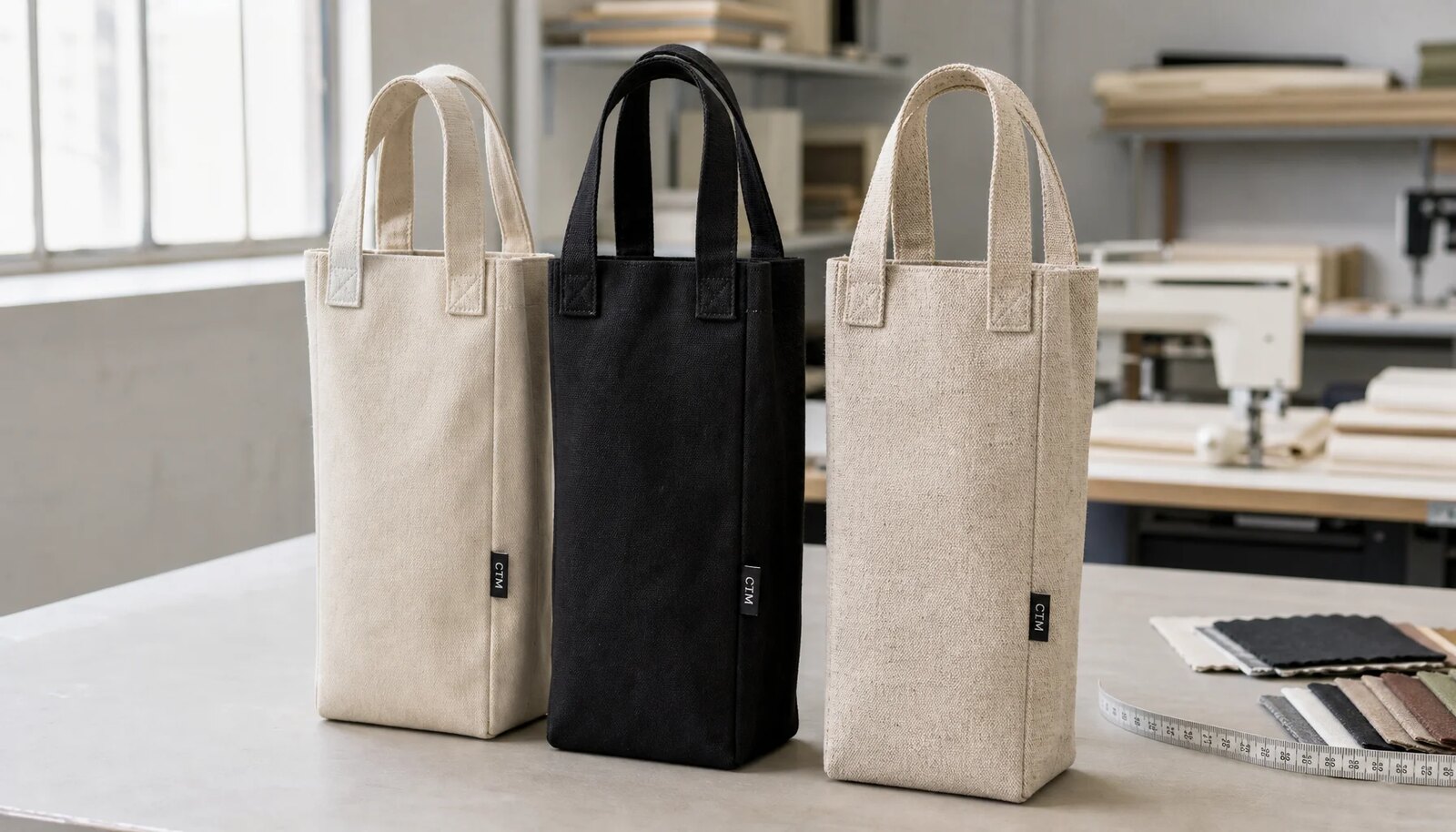
1. Set the sourcing goal before choosing fabric
A custom canvas wine carrier is not just a small bag with a logo. For an eco apparel brand, it may sit beside totes, garments, gift kits, and retail packaging, so the material needs to support both the brand story and the physical job of carrying glass bottles. The strongest sourcing brief starts with use case, bottle type, channel, and sustainability claim before selecting GSM or artwork.
The aim is not to buy the heaviest canvas available. The aim is to specify a carrier that fits the bottles, feels aligned with the brand, holds weight safely, prints cleanly, packs efficiently, and can be inspected objectively. This custom canvas wine carriers material selection guide for eco apparel brands focuses on those procurement decisions rather than decorative mockup choices.
A quote is only comparable when every supplier is pricing the same construction. Fabric weight, lining, divider, reinforcement, branding method, labels, packing, and inspection requirements all affect unit cost. If one supplier includes reinforced handles and another quotes a plain unlined sleeve, the lower price is not a real saving.
- Define the bottle range and channel before requesting pricing.
- Treat GSM, composition, reinforcement, branding, and packing as PO specs.
- Approve construction before final artwork placement because seams, handles, and gussets limit the safe logo area.
- Keep one sealed approval sample at the factory and one buyer-side reference sample for receiving inspection.
2. Start with bottle geometry and load
The bottle controls the pattern. A Bordeaux bottle, Burgundy bottle, Riesling bottle, and Champagne bottle can differ in base diameter, shoulder shape, height, and glass weight. A carrier that looks correct on a standard 750 ml bottle may be tight on sparkling wine or loose on a slimmer bottle. Mixed-bottle programs need the widest and tallest realistic bottle approved before cutting.
Fit is a balance. Too little allowance stresses side seams, damages paper labels, and makes insertion awkward. Too much allowance lets the bottle lean, weakens presentation, and can make the carrier feel like a generic sack. For two-bottle formats, the divider and bottom reinforcement must be tested under load, not only checked visually with empty bottles.
Buyers should document bottle dimensions in the tech pack. Include base diameter, shoulder width, total height, capsule height, label position, and whether the loaded carrier must stand upright for retail display. If a drawcord, tie, flap, snap, or button is used, test clearance around the bottle neck and foil capsule.
- Measure real bottles instead of relying on category names.
- Test Champagne and sparkling bottles separately because they are often wider and heavier.
- For two-bottle carriers, use two full bottles or weighted dummies during sample review.
- Record top opening, base depth, divider position, and finished measurement tolerances.
- Confirm whether the product is one-time gift packaging or a reusable retail accessory.
3. Choose canvas weight by GSM, not vague terms
Canvas weight is a major cost and performance driver. Suppliers may describe material in ounces, GSM, or casual terms such as heavy canvas. Procurement teams should request both GSM and ounces per square yard where possible. As a reference, 12 oz canvas is roughly 407 GSM, 14 oz is roughly 475 GSM, and 16 oz is roughly 542 GSM when ounces per square yard is the basis, before finishing and mill variation.
For many retail-quality custom canvas wine carriers, 12 oz to 14 oz is a practical working range. It gives enough body for presentation, usually supports clean branding, and can be sewn efficiently when handles and seams are designed correctly. Lighter 10 oz to 11 oz canvas may suit promotional sleeves but can feel soft or underbuilt. Heavier 15 oz to 16 oz canvas can feel premium but increases sewing bulk, fabric cost, carton weight, and fold-crease risk.
The purchase order should state the approved GSM and tolerance. A common commercial approach is to write the exact accepted range, such as 475 GSM +/-5%, instead of asking for heavy cotton canvas. If the supplier cannot state how weight will be controlled, the buyer should not treat the quote as final.
- 10 oz to 11 oz: lighter promotional use, lower cost, softer structure.
- 12 oz to 13 oz: balanced for most retail gifting and apparel-brand merchandise.
- 14 oz: stronger hand feel for premium or reinforced formats.
- 15 oz to 16 oz: consider only when seam bulk, freight, and sewing capability are acceptable.
- Request an approved swatch and GSM record before bulk fabric booking.
4. Compare cotton, recycled cotton, organic cotton, and blends
Material language needs to match the brand claim. Conventional cotton canvas is often the simplest and most predictable route for natural, black, navy, and other common colors. It can be the right choice when the buyer values repeatability, print clarity, and straightforward pricing over a specific certification claim.
Recycled cotton canvas can support a stronger sustainability position, but only when the recycled percentage and documents are clear. Recycled content may affect surface texture, shade consistency, yarn strength, and print behavior. Buyers should ask whether the claim is supported by GRS, RCS, or similar documentation where applicable, and whether the scope covers the material, supplier, and transaction.
Organic cotton is useful when the carrier is part of an organic apparel program or certified merchandise range. Documentation may include GOTS, OCS, scope certificates, and transaction certificates depending on the claim and supply chain. Cotton/poly blends can improve cost or dimensional stability, but they may not fit a natural-fiber brand story. The final material choice should align with the label language, customer expectation, and compliance review.
- Ask for composition by percentage, not only a material name.
- Confirm whether certification covers fabric only or finished goods.
- Request production-lot documents your compliance team can retain.
- Test recycled cotton for shade variation, surface hairiness, print clarity, and seam strength.
- If using blends, confirm hand feel, labeling language, and brand fit.
5. Decide lining, dividers, bottom structure, and seam finish
Construction details can change the product more than the front-view photo suggests. An unlined carrier with a folded top hem is very different from a lined carrier with bound seams, a fixed divider, reinforced base, and internal labels. Buyers should write these details into the tech pack so suppliers are not pricing different assumptions.
An unlined body can be cost-effective and visually honest for natural canvas programs, especially if internal seams are neat. A lining creates a cleaner inside finish and can reduce abrasion, but it adds material, labor, and shrinkage-control risk. If the lining and outer canvas behave differently after pressing or humidity changes, the finished carrier can twist or pucker.
For two-bottle carriers, the divider is structural. It should remain upright, stop bottles from clanking, and stay attached when the loaded carrier is lifted. Bottom reinforcement can be an extra canvas layer, a sewn-in board, or a removable board. If the brand wants to avoid plastic or certain stiffeners, define the board material before quotation.
- Specify unlined, lined, or bound-seam construction.
- Define divider height, attachment points, stitch pattern, and base connection.
- State bottom reinforcement material and whether it is removable or sewn in.
- Choose seam finish based on cost, appearance, and bulk: overlock, bound, folded, or French seam.
- Check inside finish during sample review, not only the outside view.
6. Engineer handles as load-bearing parts
Handles are a high-risk area because failure is immediate and visible. A filled 750 ml bottle can commonly weigh more than 1.2 kg depending on glass and fill, and two-bottle or sparkling formats increase the load quickly. Handles should be specified as structural components, not decorative trim.
Self-fabric handles create a matching look, while cotton webbing is often easier to sew consistently and can feel stable in hand. Handle widths commonly fall around 25 mm to 38 mm, but the right width depends on the bottle count, style, and comfort target. Handle drop affects both presentation and balance; short drops look neat, while longer drops may suit shopping-style carry but can change the silhouette.
Reinforcement should be visible in the technical specification. Box-X stitching, bar-tacks, multiple stitch rows, or reinforcement patches are common options for reusable carriers. During sampling, load the carrier, lift it repeatedly, and inspect for handle twisting, seam slippage, stitch breakage, and panel distortion.
- Define handle material, width, finished length, drop, position, and tolerance.
- Use reinforced stitching for reusable or two-bottle carriers.
- Confirm whether reinforcement patches are visible, hidden, or sandwiched between layers.
- Check stitch density, thread quality, backstitching, and skipped stitches.
- Run a buyer-defined load test before approving bulk production.
7. Select branding after construction is approved
Canvas texture affects every branding method. Screen print edges can soften, fine lines can fill in, embroidery can pucker, and heat transfers can fail if adhesion is not tested. Artwork should be placed after the pattern, seams, handles, gussets, and fold lines are confirmed because the usable print zone is smaller than a flat mockup suggests.
Screen printing is usually the most practical option for bold one-color or two-color logos. It is cost-effective at volume and works well on cotton canvas when artwork is not too fine. Buyers should approve a strike-off on the final fabric, checking ink color, opacity, edge quality, placement, and cure.
Embroidery can give an apparel-style premium mark, especially for small logos, but it may stiffen or pucker the panel. Woven labels, cotton labels, and patches are controlled options when subtle branding is preferred. Heat transfer can support detailed artwork, but it should be approved only after peel, rub, fold, and heat-mark checks on the final canvas.
- Screen print: best for bold artwork and repeatable volume production.
- Embroidery: best for small premium marks; test puckering and backing.
- Woven label or patch: useful for apparel-brand consistency and subtle marks.
- Heat transfer: test adhesion, rub resistance, folding, and heat marks.
- Set logo placement from fixed reference points with a numerical tolerance.
8. Build MOQ and price comparisons around real cost drivers
MOQ is driven by fabric, color, trims, branding setup, certification route, and packing format. Stock natural canvas is usually easier than custom-dyed fabric. One logo version is easier than several. A plain open top is easier than a flap, snap, tie, or drawcord. Every added variation can split the production run and raise cost.
Ask suppliers for price breaks at the same specification. A price at 500 pieces, 1,000 pieces, 3,000 pieces, and 5,000 pieces is only useful if fabric weight, construction, branding, labels, and packing remain unchanged. A cheaper quote that removes lining, reduces GSM, or weakens reinforcement is not a true comparison.
The quotation should state what is included. Screens, embroidery digitizing, lab dips, strike-offs, sample freight, woven labels, barcode labels, hang tags, bottom boards, individual packing, export cartons, and carton marks are frequent sources of quote mismatch. Buyers should also confirm overrun and underrun policy, especially for launches with exact allocation needs.
- Separate MOQ by fabric color, size, logo version, trim color, certification route, and packing version.
- Request price breaks using the identical specification.
- Ask whether stock fabric is available or a mill lot must be booked.
- Confirm setup charges, sample fees, labels, and packing costs.
- State whether overrun or underrun is acceptable.
9. Use sampling to prevent bulk surprises
A prototype can confirm pattern direction, but it should not be treated as the final production control sample if it uses substitute fabric or unfinished trims. The pre-production sample should use final canvas, final shade, final reinforcement, final branding, final labels, and final packing. That sample becomes the bulk reference.
Sampling should be functional. Insert the real bottle or an accurate weighted dummy, lift the carrier, set it down, remove the bottle, and check whether the seams, handle, top opening, and base behave properly. For retail display, confirm that the loaded carrier stands acceptably upright. For closures, check that ties, flaps, snaps, or drawcords do not interfere with the neck or capsule.
The sample file should include measurements and photos. Record front, back, side, bottom, inside, handle close-up, divider, print close-up, label, and packed view. Written sample comments reduce disputes later because the factory, inspector, and receiving team are working from the same standard.
- Approve a prototype first, then a final pre-production sample.
- Use real bottles or weighted dummies with matching dimensions.
- Measure body height, width, depth, bottom, top opening, handle drop, divider, and logo placement.
- Do not release bulk cutting until shade, fabric, trims, branding, and packing are approved.
- Keep signed comments and photos in the purchase file.
10. Plan QC, packing, cartons, and receiving before shipment
Packing is part of the specification. Canvas can crease, printed panels can scuff, and natural fabric can attract lint if cartons are overcompressed or folding is careless. Retail programs may require hang tags, barcode labels, tissue, paper bands, individual bags, or SKU stickers. Warehouse programs need clear carton quantities and carton marks.
The packing method should match the brand's sustainability position and the sales channel. Polybags protect against moisture and dirt, but some brands prefer paper bands, tissue, glassine, or bulk inner packing to reduce plastic. If screen printing is used, the fold line should avoid heavy pressure across the logo. If a bottom board is included, cartons should not crush the structure.
Before shipment, request a finished measurement report, load-test evidence, branding close-ups, barcode scan confirmation, packed-product photos, and master-carton photos if these are part of the agreed QC process. For larger orders, define inspection sampling and AQL before goods are finished. Receiving is smoother when carton quantity, SKU separation, net weight, gross weight, and mixed-carton rules are already written into the PO.
- Approve fold method and folded dimensions.
- Define polybag, paper band, tissue, glassine, bulk packing, or insert-card requirements.
- Confirm barcode label size, data, placement, and scan readability.
- Set carton quantity by SKU and avoid mixed cartons unless the warehouse approves.
- Check measurements, load test, branding, carton marks, and carton count before shipment.
Specification comparison for buyers
| Canvas route | Best fit | Commercial advantages | Buyer risks to check |
|---|---|---|---|
| Conventional cotton canvas, natural or dyed | Retail wine carriers, apparel collaborations, gift programs, and repeatable stock-color orders | Usually the simplest route for sampling, color availability, screen printing, and cost comparison. Natural canvas can support a clean, low-waste visual direction without custom dyeing. | Confirm GSM, shrinkage, dye route, shade band, and whether natural canvas has acceptable slubs or seed flecks. Do not let suppliers substitute a lighter canvas after approval. |
| Recycled cotton canvas or recycled cotton blend | Eco-positioned launches, recycled-material capsules, wine-and-apparel bundles, and programs needing a documented recycled-content story | Supports a stronger material narrative when the recycled percentage and chain-of-custody documents are clear. Surface texture can feel more characterful and less generic. | Ask for exact recycled percentage, source type, composition, and supporting documents such as GRS, RCS, or transaction certificate scope where applicable. Test shade variation, tensile feel, print clarity, and seam strength. |
| Organic cotton canvas | Brands aligning wine carriers with certified organic apparel, organic cotton tote programs, or higher-compliance sustainability claims | Can align with existing organic cotton sourcing and brand language when certification coverage is valid for the order. | Check whether GOTS, OCS, or other certification applies to the fabric, the processing, and the finished goods supplier. Expect possible higher MOQ, longer lead time, and stricter documentation review. |
| Cotton/poly canvas blend | Cost-sensitive programs, heavier-use carriers, dimensional-stability needs, or darker colors where pure cotton is not mandatory | May improve stability, reduce some shrinkage risk, and offer practical durability at a controlled price point. | The material story may not fit brands promoting natural fibers. Confirm composition labeling, hand feel, recyclability language, print adhesion, and whether the blend conflicts with customer expectations. |
| Heavy 14 oz to 16 oz canvas | Premium reusable carriers, two-bottle formats, heavier sparkling bottles, and structured retail presentation | Better body, improved shape retention, and a more substantial hand feel when sewn correctly. | Higher fabric cost, seam bulk, carton weight, and sewing difficulty. Check handle attachment, needle damage, fold creasing, and whether the supplier can maintain consistent stitching through thick layers. |
| Midweight 12 oz to 13 oz canvas | Most custom canvas wine carriers for retail, gifting, apparel-brand merchandise, and wine club accessories | Often the best balance of structure, printability, cost, and sewing efficiency. Works for many single-bottle and some reinforced two-bottle designs. | Still requires real bottle testing. Specify GSM tolerance, handle reinforcement, bottom construction, and whether the finished carrier must stand upright when loaded. |
| Light 10 oz to 11 oz canvas | Short-term promotional gifting, low-cost seasonal inserts, and lighter single-bottle sleeves | Lower unit cost, lighter cartons, faster sewing, and a softer relaxed look. | Can collapse around the bottle, show label outline, and feel underbuilt for premium eco apparel brands. Check load performance, print show-through, and perceived value. |
Buyer checklist before sampling
- Measure the actual bottle range before pattern approval: base diameter, shoulder width, total height, neck height, capsule height, and label position. Include Champagne or sparkling bottles only if they are truly part of the program.
- Record finished measurements for body height, body width, side gusset or depth, bottom width, top opening, handle drop, divider position, and logo placement. Add numerical tolerances instead of using words such as standard or approximate.
- Specify fabric weight in GSM and, if used, ounces per square yard. Clarify whether the quoted GSM is based on mill specification, supplier estimate, or incoming fabric check.
- Choose the canvas route in writing: conventional cotton, recycled cotton blend, certified organic cotton, cotton/poly blend, natural, stock dyed, custom dyed, washed, or preshrunk.
- Request swatches from the same fabric route intended for bulk. Keep an approved swatch labeled with date, supplier, fabric code, composition, color, finish, weight, and tolerance.
- Define construction details: single bottle or two bottle, divider height, lining, seam finish, bottom reinforcement, closure, handle material, handle width, handle drop, reinforcement patch, and stitch pattern.
- For two-bottle carriers, test with two full bottles or weighted dummies. A realistic two-bottle load can vary by bottle type, so define the test weight rather than relying on a category name.
- Lock artwork size, branding method, color standard, placement reference point, safe distance from seams or folds, and placement tolerance before the pre-production sample is made.
- Ask whether the quotation includes screens, embroidery digitizing, lab dips, print strike-offs, prototype samples, pre-production samples, woven labels, hang tags, barcode labels, bottom board, inner cartons, export cartons, and carton marks.
- Set objective QC requirements for GSM tolerance, shade approval, finished dimensions, stitch density, print placement, barcode scan, load test, carton quantity, and inspection sampling plan.
Factory quote questions to send
- What is the exact outer fabric weight in GSM and ounces per square yard, and what production tolerance will you control? Can you provide a mill specification or incoming fabric weight report?
- What is the exact composition by percentage, including recycled content if any? Is the quoted material conventional cotton, organic cotton, recycled cotton blend, cotton/poly blend, or another construction?
- Which certification documents can apply to this order, if any: GOTS, OCS, GRS, RCS, mill certificate, scope certificate, or transaction certificate? Does the certificate cover fabric only or finished goods?
- Is the fabric natural, stock dyed, custom dyed, piece dyed, pigment dyed, washed, or preshrunk? What shade approval step is included: swatch, lab dip, bulk lot approval, or cutting approval?
- What bottle dimensions did you use for the pattern? Please confirm maximum diameter, base width, total height, shoulder clearance, top opening, and whether Champagne or sparkling bottles are included.
- Does the unit price include lining, divider, bottom reinforcement, closure, handle reinforcement, woven label, hang tag, barcode sticker, retail packing, export carton, and carton marks?
- Which branding method is included? What are the separate setup charges for screen printing by color, embroidery digitizing, heat-transfer tooling, woven label MOQ, artwork revision, and repeat orders?
- What MOQ applies by fabric color, size, logo version, trim color, packing version, and certification route? How does pricing change at 500, 1,000, 3,000, and 5,000 pieces under the same specification?
- What finished measurement tolerances will you apply for body height, body width, side depth, bottom width, handle drop, divider position, and print placement?
- Which sample stages are available: material swatch, prototype, print strike-off, embroidery trial, fit sample, pre-production sample, sealed approval sample, and packed sample?
Quality-control points to confirm
- Fabric GSM matches the approved swatch and purchase order tolerance. If the approved material is 475 GSM +/-5%, state that range numerically on the PO and inspection checklist.
- Fabric composition, weave, color, and finish match the approved material record. No unauthorized substitution to lighter canvas, different blend, different dye route, or different recycled-content percentage is acceptable.
- Certification or sustainability documents match the claim being made. Check whether documents cover the production lot, fabric supplier, finished goods factory, and transaction scope where applicable.
- Shade is consistent across visible panels and cartons within the approved shade band. Natural canvas may show minor character, but obvious panel mismatch, dye streaking, stains, or side-to-side contrast should be rejected.
- Canvas surface is free from severe slubs, thin bars, holes, broken yarns, oil marks, water stains, mildew smell, smoke odor, heavy lint, or print contamination inconsistent with the approved sample.
- Finished dimensions fit the approved bottle range. Check base width, side depth, total height, top opening, shoulder clearance, bottom shape, and whether bottle insertion strains seams or scuffs labels.
- Handle drop, width, position, and symmetry match the approved sample. When loaded, the carrier should hang reasonably straight without one handle taking most of the load.
- Handle attachment uses the approved reinforcement: box-X, bar-tack, multiple rows, or reinforcement patch. Inspect skipped stitches, loose threads, broken thread, needle cutting, seam slippage, and weak backstitching.
- Load testing is performed on representative samples using the intended filled-bottle weight plus a buyer-defined safety margin. Two-bottle carriers should be tested with two full bottles or equivalent weights.
- Divider panels remain centered and secure when loaded. Divider stitching should not pull away from the base or side seams, and bottles should not knock together excessively.