Start With the Bottle Program, Not the Bag Sketch
The quickest way to create rework is to ask for a wine carrier quote before defining the bottles. A sample built around a standard Bordeaux-style 750 ml bottle may look perfect in a supplier photo, then struggle with a wider Burgundy bottle, sparkling wine bottle, cider bottle, olive oil bottle, or specialty spirits bottle. For procurement teams, bottle geometry is not a detail. It drives finished width, gusset depth, divider spacing, handle balance, seam stress, carton loading, and loading speed at the booth.
Capacity alone will mislead you. Two bottles can both be 750 ml while having different diameters, shoulder heights, base shapes, and glass weights. A common still wine bottle may be around 74-78 mm in diameter, while some Burgundy and sparkling bottles are wider. A filled 750 ml bottle often weighs roughly 1.2-1.4 kg, and a two-bottle carrier can exceed 2.5 kg before tissue wrap, tasting cards, corkscrews, gift foods, or retail packaging are added.
Craft fair use is also broader than a single-brand bottle sleeve. One carrier may need to serve wineries, tasting rooms, farmers market vendors, importers, distributors, event merchandise tables, and gift sellers. That does not mean one pattern should pretend to fit every bottle perfectly. It means the RFQ should define a primary bottle, an acceptable secondary range, and excluded bottle types. The factory can then pattern for real use instead of guessing.
Think about speed, too. A carrier that fits only when a sample maker angles the bottle carefully may frustrate staff when customers are waiting. Give enough clearance for quick insertion, but not so much empty space that bottles knock together or the bag looks oversized on a display table. If the carrier will be sold as a pre-packed gift set, measure the complete bundle, not just the bottle.
- Request bottle dimensions in millimeters: maximum diameter, height, shoulder height, base diameter, neck diameter, and filled weight.
- Classify bottle fit as primary, acceptable, or excluded before the supplier makes the pattern.
- For standard 750 ml still wine, confirm actual bottle diameter instead of assuming all bottles are the same.
- For Burgundy, sparkling, or Champagne-style bottles, test real shoulder shape because the widest point may sit higher than the divider opening.
- For two-bottle carriers, check whether both bottles can be inserted quickly by booth staff, not only by the factory sample maker.
- For four-bottle carriers, prioritize weight distribution, handle reinforcement, bottom seams, and divider anchoring over appearance alone.
Choose Canvas Weight for Body, Sewability, and Load
Canvas weight is usually stated in ounces per square yard or GSM. For craft fair wine carriers, 10 oz to 12 oz cotton canvas, approximately 340-410 GSM, is a practical starting range. It gives more structure than a thin promotional tote while keeping sewing time, unit cost, and carton weight under control. This range often suits winery merchandise, tasting-room add-ons, craft fair gift bundles, and single- or two-bottle reusable carriers.
An 8 oz canvas can lower cost, but it is usually too soft for a reliable paid wine carrier. It may collapse around the bottle, show wrinkles more clearly, and make the printed front panel look less controlled. It can still be acceptable for very basic single-bottle giveaway programs where the carrier is not expected to stand upright or handle repeated heavy use. If two quotes are far apart, confirm whether both suppliers priced the same fabric weight and composition.
A 14 oz canvas feels more substantial and can improve table presentation. Still, heavier is not automatically better. It adds seam bulk at top hems, gussets, divider intersections, and self-fabric handles. It can reduce usable internal space after sewing and may require stronger machines, larger needles, slower stitching, and more careful tension control. On rougher weaves, small logo details may not print as cleanly.
If upright display matters, fabric weight is only part of the answer. A stable carrier depends on gusset geometry, bottom panel construction, divider stiffness, top hem design, and possible base reinforcement. A well-patterned 12 oz bag with a reinforced bottom may stand better than a poorly patterned 14 oz bag. Ask for sample photos empty, loaded, front view, side view, and top view so you are not judging from the best angle only.
- 8 oz canvas: economical, but usually best only for basic single-bottle promotional use.
- 10 oz canvas: practical entry point where cost, printability, and freight weight matter.
- 12 oz canvas: stronger body and better hand feel for many craft fair and winery retail programs.
- 14 oz canvas: premium feel, but higher sewing cost, heavier cartons, and greater seam bulk.
- Lined canvas: better interior finish and structure, but adds fabric, labor, inspection points, and sample time.
- Reinforced bottom panel: often a more targeted fix than increasing the entire bag weight when stability is the main issue.
Specify Composition, Color Route, and Shade Control
Natural cotton canvas is popular for craft fairs because it supports an artisan, winery, farm shop, handmade, or rustic retail story. It also avoids the extra development work of custom dyeing. The tradeoff is shade variation. One lot may look creamier, greyer, yellower, or more speckled than another. That may be acceptable, even desirable, for a handmade look. It should still be stated in the purchase specification instead of becoming a dispute after delivery.
Dyed canvas creates a more controlled retail look and supports brand colors such as black, navy, burgundy, bottle green, or seasonal holiday shades. Stock dyed canvas is usually simpler than custom dyeing. Custom dyed canvas can require lab dips, buyer approval, mill minimums, and added time before cutting starts. If the buyer wants a specific brand shade, say whether a close commercial shade is acceptable or whether formal lab dip approval is required.
Black canvas works well at craft fairs because it hides table dust and repeated handling. It brings its own issues, though. Lint, chalk marks, and contrasting thread are more visible. Light ink on black canvas may need an underbase or multiple print passes to reach the desired opacity. Approve a print strike-off on the actual black canvas rather than relying on a digital proof.
Recycled cotton, organic cotton, and cotton-poly canvas may also be considered, but the quote must state composition clearly. Recycled cotton may show more shade and slub variation unless controlled. Organic cotton should be specified only if certification and chain-of-custody documentation are required and budgeted. Cotton-poly canvas can improve dimensional stability and may reduce shrinkage, but it may not match the hand feel or product story of 100% cotton.
- Natural cotton canvas: suitable for rustic craft fair branding, simple printing, and lower material complexity.
- Black canvas: hides dirt but requires lint control, print opacity testing, and careful thread selection.
- Stock dyed canvas: useful for brand presentation with less risk than custom dyeing.
- Custom dyed canvas: requires lab dip, shade tolerance, and lead time planning.
- Recycled cotton canvas: useful for sustainability positioning only when documentation and quality variation are reviewed.
- Cotton-poly canvas: may be stable and cost-efficient, but confirm whether the hand feel fits the brand claim.
Lock the Pattern Measurements and Tolerances
A canvas wine carrier is a sewn product, so small dimensional differences are normal. B2B buyers should not expect rigid plastic-level precision, but they should define realistic tolerances. For standard canvas wine carriers, a practical tolerance is around +/-5 mm for finished width, height, gusset, and print placement. Complex styles, heavy fabrics, and multi-bottle constructions may need wider allowances unless the factory confirms tighter control.
Internal fit matters more than flat measurement alone. A finished gusset can look correct on paper but lose usable space because of seam allowances, heavy canvas thickness, divider attachment, lining, or bottom reinforcement. When the bottle diameter is close to the design limit, a few millimeters decide whether booth staff can insert the bottle smoothly. Real bottle testing belongs in both sample approval and final inspection.
Check the opening width separately from the finished panel width. Some patterns narrow near the top because of handle attachment, top hem tension, seam bulk, or divider construction. If the opening is tight, the bottle may scrape the print, deform the top hem, or require awkward insertion. At a craft fair, that slows service and makes the product feel less polished.
Your tech pack should include finished dimensions, measurement points, and tolerance notes. Marked photos are often clearer than long descriptions. If the supplier changes fabric weight, lining, divider material, or handle construction after approval, ask them to reconfirm internal dimensions before bulk cutting.
- Measure finished width at the front panel, not only the paper pattern.
- Measure gusset depth at the bottom and opening if the bag shape tapers.
- Measure opening width because it determines insertion speed.
- Measure divider width and height from inside reference points, not only from the outside panel.
- Use +/-5 mm as a practical starting tolerance for standard sewn dimensions, then adjust if the factory advises otherwise.
- Require fit testing with real bottles or verified dummy bottles during sample approval and final inspection.
Treat Divider Design as Bottle Protection, Not Decoration
For a single-bottle carrier, the main questions are fit, balance, and how the bottle sits in the gusset. For two-bottle and four-bottle carriers, divider construction becomes a functional requirement. Without a proper divider, the item is closer to a narrow tote than a true bottle carrier. Customers may carry it through crowds, place it under a table, hang it from a stroller, or put it in a car with other purchases. A low or loose divider can let bottles knock together even when the exterior looks strong.
Divider construction varies widely. A basic two-bottle style may use one vertical divider sewn into the side seams. A stronger option anchors the divider into the bottom seam so bottles remain separated near the base. Four-bottle carriers may use cross dividers or multiple stitched panels. Loose inserts are cheaper and easier to replace, but they shift during use and can feel unfinished. The right choice depends on selling price, bottle value, reuse expectations, and acceptable risk.
Divider height should be written into the specification. Too low, and the lower bottle bodies may separate while shoulders or necks still hit. Too high, and the divider may slow insertion or add bulk at the opening. Sparkling and Burgundy bottles may need different divider geometry than slimmer still wine bottles. If the carrier is meant for mixed bottles, test against the widest and heaviest approved bottles.
Divider material also matters. Using the same 12 oz canvas as the body gives a consistent look and firmer feel, but it increases seam bulk. A lighter canvas divider reduces thickness, yet it may fold or twist. Felt or padded dividers can suit premium gift carriers, though they add labor and inspection points. Whatever construction you choose, inspect with bottles inside the bag, not only with the bag lying flat.
- Specify divider height in millimeters and define the measuring point from the inside bottom or finished outer panel.
- State whether the divider is sewn into side seams only or also anchored into the bottom seam.
- Confirm divider material: same canvas, lighter canvas, felt, nonwoven, padded material, or removable insert.
- For two-bottle carriers, check whether bottles remain separated when the bag is lifted and lightly moved.
- For four-bottle carriers, inspect cross-divider alignment, bottom anchoring, and loaded balance.
- Approve divider spacing using real bottles or dummy bottles with verified diameter, height, and weight.
Write Handle and Seam Strength Into the QC Plan
Wine carriers usually fail at handle attachments, bottom corners, divider seams, or gusset seams before the flat body fabric fails. A single filled 750 ml bottle often weighs around 1.2-1.4 kg. A two-bottle carrier can exceed 2.5 kg, and a four-bottle carrier reaches a load where comfort and reinforcement are essential. If you are packing gift bundles, add the weight of tissue, cards, food items, accessories, or retail packaging.
Self-fabric handles create a clean retail look because they match the body. Cotton webbing handles are efficient, consistent, and often better for repeated carrying. Either can work if the attachment method matches the load. Straight stitching alone is risky for bottle carriers. Bartacks, box stitching, box-X stitching, or reinforcement patches distribute load over a wider area and give inspectors something specific to check.
Handle width and drop deserve written specifications. Handles around 25-38 mm wide are commonly considered for bottle carriers, depending on design and load. Narrow handles may twist or cut into the hand. A very short drop can be awkward when lifting from a table, while a long drop can make heavy bottles swing against the leg. Craft fair customers are often carrying several purchases, so comfort is not a luxury feature.
Do not ask vaguely whether the handle is strong. Define the test weight, hold time, sample quantity, and failure criteria. As a practical starting point, a single-bottle carrier may be tested at at least 2.0 kg, a two-bottle carrier at 4.0-5.0 kg, and a four-bottle carrier at 8.0-10.0 kg, depending on the intended product. Align the final standard with real load conditions and the supplier's test setup.
- State handle material, width, finished length, handle drop, thread color, and reinforcement method.
- Use bartack, box stitch, box-X, or reinforcement patches at load points instead of straight stitch only.
- Define loaded test weight, hold time, number of samples, and failure criteria before production.
- Inspect for stitch breakage, fabric tearing, handle distortion, seam ripping, and visible stress after testing.
- Check handle comfort with the loaded carrier, not only the empty sample.
- Confirm handles do not cover, crease, or distort the printed logo when the bag is filled and carried.
Match the Print Method to Canvas Texture and Artwork
Screen printing is usually the most practical print method for custom canvas wine carriers for craft fairs. It works well for solid winery logos, event graphics, importer names, and simple one- to three-color artwork. Once screens are prepared, it is efficient for repeat production and gives a familiar look on cotton canvas. The limitation is fine detail. Rough canvas texture can break thin lines, small text, delicate illustrations, and fine serif type.
Heat transfer can help with lower quantities, multicolor artwork, gradients, or designs that would require many screens. Review the hand feel, edge appearance, flexibility, and durability after folding. Some transfers look glossy or plasticky on natural cotton canvas, which may fight the craft or winery positioning. If transfers are used, simulate the intended packing fold to check cracking, blocking, or sticking.
Embroidery can look premium on heavier canvas, especially for small marks, monograms, or side labels. It is usually less suitable for large front-panel graphics. Dense embroidery can pucker thinner canvas and becomes expensive as stitch count rises. Digital printing may be possible depending on factory capability, but it needs closer control of pretreatment, curing, color consistency, and rub performance.
Print specifications should include artwork file type, Pantone references, print size, print location, placement tolerance, minimum line thickness, and whether the design can be simplified for canvas texture. A common placement tolerance for standard sewn canvas items is around +/-5 mm, but agree it in writing. For white ink on black canvas, metallic inks, fine text, or distressed artwork, approve a strike-off on the actual fabric before bulk production.
- Provide vector artwork rather than low-resolution JPG files.
- Avoid fine lines below the supplier's recommended minimum for the selected canvas weave.
- Place artwork away from seams, thick hems, divider stitching, gusset folds, and heavy slub areas.
- For light ink on dark canvas, request opacity review and confirm whether an underbase is included.
- Set print placement references from top edge, side seam, or centerline.
- Confirm curing before folding and stacking to reduce ink blocking, sticking, or surface marking.
Understand MOQ, Price Drivers, and Landed Cost
MOQ is not only a sales rule. It is shaped by fabric availability, mill minimums, cutting efficiency, print setup, sewing complexity, trim sourcing, artwork versions, and packing requirements. A natural canvas single-bottle carrier made with stock 10 oz or 12 oz fabric is usually easier to quote at a lower minimum than a custom dyed, lined, embroidered, four-bottle carrier with individual retail packing. Ask which specification element is driving MOQ instead of assuming the factory is being inflexible.
For craft fair programs, a sensible first order often uses stock fabric, standard dimensions, and custom printing. This keeps development risk manageable while still creating a branded product. Once sell-through is proven, the buyer can upgrade the canvas weight, add a reinforced bottom, revise divider construction, introduce a dyed fabric, or improve packaging. Customizing every element in the first RFQ can make the order expensive and slow before demand is proven.
Artwork versions are a frequent hidden cost driver. A distributor may request ten winery logos across one total order. From the buyer's side, that feels like one wine carrier program. From the factory's side, it may mean ten print setups, ten approvals, ten packing separations, and ten chances for carton mix-ups. If volume is limited, consider one shared event logo, blank carriers with hangtags, or fewer artwork versions.
Unit price should be evaluated with freight and packing. Heavier canvas raises carton gross weight. Lining and reinforced bases can reduce pieces per carton. Individual polybags add labor and volume. Barcode labels, hangtags, retail cartons, and destination sorting all affect handling. The procurement goal is not the cheapest unit price in isolation; it is the specification that delivers required quality at the lowest landed cost and lowest execution risk.
- Stock natural canvas lowers material risk and usually samples faster than custom dyed fabric.
- Custom dyed fabric can add lab dips, mill minimums, shade approvals, and longer lead time.
- Multiple print colors increase setup and approval work even when sewing labor is unchanged.
- Many logo versions can increase unit price, inspection complexity, and packing error risk.
- Individual polybags, barcode labels, hangtags, and carton segregation should be quoted separately.
- Two-bottle and four-bottle carriers add divider labor, reinforcement requirements, slower sewing, and more QC points.
Approve Samples Using Final Material and Construction
A sample made from substitute fabric can help review rough size, but it is not enough for production approval. Fabric weight changes how the carrier stands, folds, stitches, and prints. A 10 oz prototype may look acceptable, while 14 oz production fabric may create bulky seams and reduce internal space. A sample without the final divider cannot prove bottle protection. A sample with a placeholder logo cannot prove print clarity or curing.
The pre-production sample should use actual canvas weight, final handle material, actual divider construction, actual print method, and proposed packing fold whenever the order value justifies it. If the supplier cannot use final bulk material for the first sample, label it as a fit sample or construction sample only. Do not treat it as the production approval sample. Request a final approval sample before bulk cutting.
Sample review should be physical and practical. Insert intended bottles, carry the loaded bag, place it on a flat table, inspect whether the bottom twists, and check whether bottles touch in multi-bottle styles. Bend the printed panel gently and rub with a dry cloth to look for undercured ink or weak transfer edges. Measure finished dimensions after sewing, not only pattern dimensions.
When corrections are needed, avoid comments such as make stronger or slightly bigger. Update the specification with numbers. If the opening is tight, state how many millimeters to add. If the logo is too low, state the revised distance from the top edge. If the handle is short, state the revised handle drop. Keep one signed or sealed approved sample as the reference for production and final inspection.
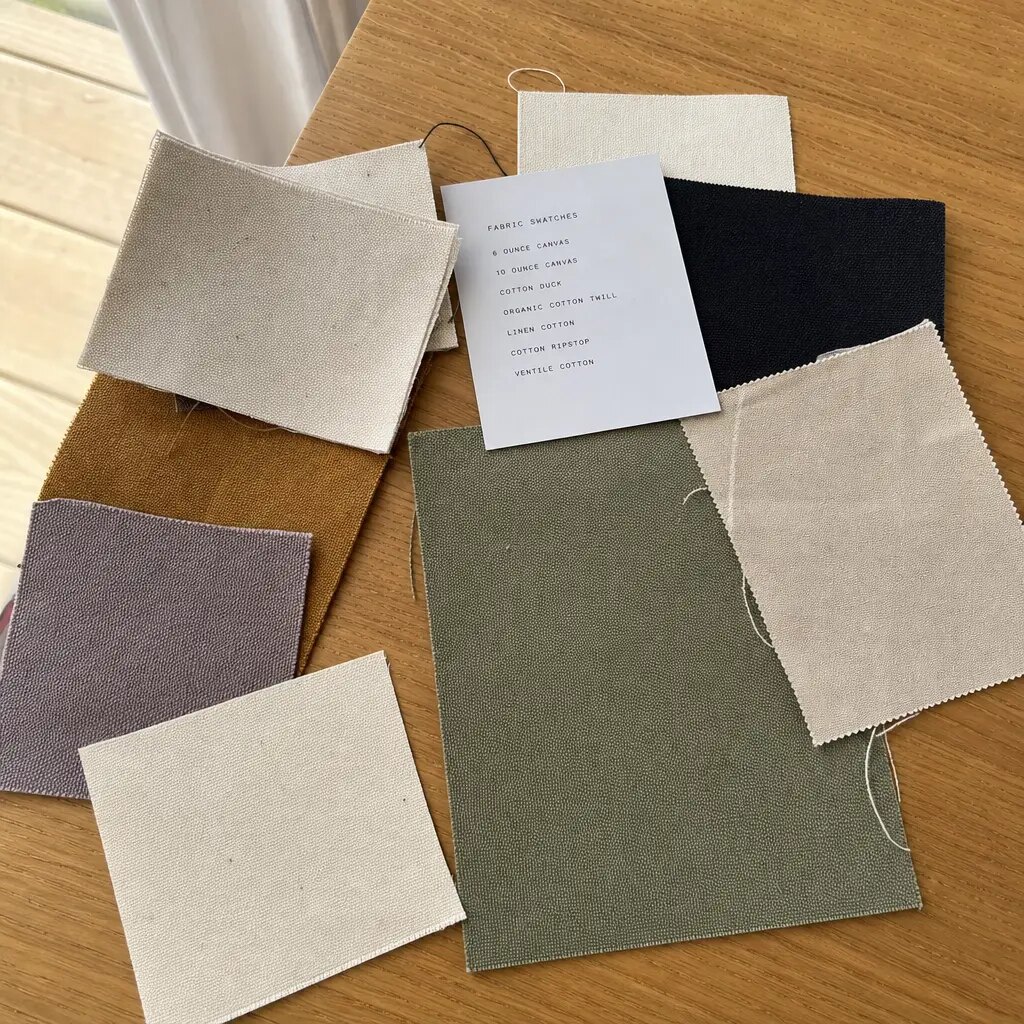
- Approve fabric swatch for weight, composition, shade, texture, and slub level before final sampling.
- Approve print strike-off when artwork has fine detail, white ink, metallic ink, dark fabric, or tight brand color requirements.
- Use real filled bottles where possible; otherwise use dummy bottles with verified dimensions and weight.
- Record finished dimensions: width, height, gusset, opening width, divider width, divider height, handle length, and handle drop.
- Keep one signed approval sample for production comparison and final inspection.
- Issue one controlled revision sheet so purchasing, marketing, and the supplier work from the same document.
Plan Packing for Creasing, Freight, and Booth Handling
Canvas wine carriers are often flat-packed to reduce carton volume. That is efficient, but the fold should not damage the print, deform the divider, or create hard creases that make the bag look used when unpacked at a craft fair booth. Heavy canvas may need looser stacking. Coated prints and heat transfers need enough curing time and, in some cases, tissue separation before bulk stacking.
Individual polybags are not always necessary for craft fair orders. They add plastic cost, packing labor, carton volume, and possible compliance questions in markets with packaging restrictions. For direct event use, inner bundles in export cartons are often faster to unpack and easier for booth setup. For wholesale distribution or retail stores, barcode stickers, hangtags, individual packaging, and carton-level labels may be required. Tell the factory the sales channel before they quote packing.
Packing affects arrival quality. Over-compressed cartons can flatten gussets, crease top hems, mark prints, and deform divider panels. Loose cartons can let bags shift, wrinkle, or collect lint. For two-bottle and four-bottle carriers, ask how the divider will be folded or supported so the bag is not crushed into a shape that slows loading.
Request carton dimensions, gross weight, pieces per carton, and inner bundle count before final purchase order release. These details affect freight quotation, warehouse receiving, pallet planning, and transport to craft fair locations. Confirm carton marks, PO numbers, item numbers, destination labels, country-of-origin marking, and barcode placement before packing starts.
- Define flat-pack direction so the print is not folded across heavy ink coverage or transfer edges.
- Use inner bundles to control count and simplify booth unpacking.
- Request carton dimensions, gross weight, and pieces per carton before final freight quotation.
- Specify carton marks, PO number, item number, country-of-origin marking, barcode labels, and destination labels as needed.
- Avoid individual polybags unless required by retail, warehouse, barcode, or channel handling rules.
- For heavier carriers, confirm carton strength so lower cartons are not crushed during stacking and transit.
Specification comparison for buyers
| Spec decision | Recommended option | When it fits | Buyer risk to check |
|---|---|---|---|
| Fabric weight for standard single-bottle carrier | 10 oz to 12 oz cotton canvas, approximately 340-410 GSM, verified by cut-and-weigh test | Craft fair giveaways, winery merch tables, tasting-room add-ons, local retail bundles, and single-bottle gift programs that need more body than a thin tote without excessive freight weight | Canvas below 8 oz may collapse around the bottle, wrinkle heavily, and print less evenly; canvas above 14 oz can create seam bulk, slower sewing, higher carton weight, and added cost |
| Fabric weight for premium retail carrier | 14 oz cotton canvas, 12 oz canvas with lining, or 12 oz canvas with reinforced bottom panel | Gift shops, cellar door retail, holiday wine sets, premium craft fair bundles, and reusable carriers where hand feel and upright display matter | Heavy canvas can reduce usable internal space, make top hems bulky, require wider seam allowances, and soften fine screen-print edges on rough weave |
| Finished size tolerance | Typical sewn tolerance: +/-5 mm for width, height, gusset, and print placement on standard canvas styles; tighter only if the factory confirms capability | Repeat B2B orders where different lots must fit the same bottle range and display consistently | No tolerance sheet leads to disputes: one lot may fit Burgundy bottles while another is too tight after sewing, lining, or shrinkage |
| Bottle capacity structure | Single-bottle, two-bottle, or four-bottle with divider geometry matched to actual bottle diameter, height, shoulder shape, and filled weight | Single-bottle works for impulse purchases; two-bottle is common for gift sets; four-bottle fits wine clubs, farmers markets, distributors, and mixed bottle programs | Loose, low, or unanchored dividers let bottles knock together; confirm divider height, width, bottom anchoring, and insertion speed at a busy booth |
| Handle construction | Cotton webbing or self-fabric handles, 25-38 mm wide, with bartack, box stitch, or box-X reinforcement at all load points | Webbing is efficient for heavier repeat use; self-fabric gives a cleaner retail look on natural canvas styles | Thin handles twist or cut into the hand; require loaded pull or hang testing on real bottle weight, not only visual approval |
| Load test target | Test at intended load plus safety margin: for one bottle usually at least 2.0 kg; for two bottles at least 4.0-5.0 kg; for four bottles at least 8.0-10.0 kg, held for a defined time | B2B orders where the carrier will be sold, gifted with bottles, or used by multiple booth staff members and customers | If the test weight, hold time, sample quantity, and failure definition are not written, factories may only do a quick informal check |
| Print method | Screen print for solid 1-3 color logos; heat transfer for small multicolor runs; embroidery for small premium marks on heavier canvas | Screen print is usually the most practical choice for craft fair branding, winery logos, event marks, and distributor programs | Printing over seams, rough slubs, or thick hems causes broken edges; white ink on dark canvas, metallic ink, and fine serif text need strike-off approval |
| Color and dye route | Natural canvas, black stock canvas, dyed stock canvas, or custom dyed cotton canvas with shade tolerance stated | Natural canvas suits artisan positioning; black hides dirt; dyed canvas supports seasonal or brand-specific programs | Natural cotton shade varies by lot; dyed canvas needs lab dip approval, rubbing checks, and colorfastness review; custom dye can raise MOQ and lead time |
| MOQ logic | Start with stock canvas, standard dimensions, one print size, and limited artwork versions to reduce MOQ pressure | Wineries, importers, distributors, event organizers, and craft fair sellers testing sell-through before a larger seasonal order | Custom dyed fabric, lining, special webbing, many logos, special hangtags, and individual retail packing can each increase MOQ, setup cost, or packing complexity |
Buyer checklist before sampling
- Define the bottle program before quoting: standard Bordeaux 750 ml, Burgundy, sparkling, Champagne-style, tall Riesling, cider, spirits, olive oil, or mixed bottle range.
- Measure actual bottle diameter, height, shoulder profile, base diameter, neck diameter, and filled weight; do not rely only on nominal 750 ml capacity.
- Rank bottle fit as primary fit, acceptable fit, and excluded fit so the factory knows which bottle should drive the pattern.
- Select fabric weight by use case: 10-12 oz for practical craft fair sales, 14 oz or lined canvas for premium retail, and 8 oz only for very basic low-load programs.
- State whether the carrier must stand upright when empty, when loaded, on a booth table, during photography, or only when carried.
- Specify finished width, height, gusset depth, opening width, seam allowance, bottom shape, divider height, divider anchoring, and target clearance around each bottle.
- Use dimensional tolerances in the tech pack, such as +/-5 mm for most sewn dimensions unless a different tolerance is agreed.
- Specify handle material, handle width, handle length, handle drop, reinforcement method, thread color, and expected loaded weight per carrier.
- Require a loaded handle test with test weight, hold time, sample quantity, and pass/fail definition, especially for two-bottle and four-bottle carriers.
- Provide production-ready vector logo artwork with Pantone references, print size, placement measurements, minimum line thickness, and whether artwork can be simplified for canvas texture.
Factory quote questions to send
- What canvas weights are available from current stock, and what are the approximate oz/sq yd, GSM, weave, shrinkage expectation, and surface slub level?
- Is the quoted fabric 100% cotton canvas, cotton-poly canvas, recycled cotton canvas, organic cotton canvas, or another blend, and can the composition be documented?
- What fabric weight tolerance do you control in production, for example +/-5% or another agreed range, and how do you verify it?
- For our selected bottle dimensions and filled weight, what finished bag width, height, gusset depth, opening width, and seam allowance do you recommend?
- What clearance do you recommend around each bottle for fast insertion without making the carrier look oversized?
- Will the carrier stand upright when empty and when loaded, or does it require heavier canvas, lining, a reinforced base, or revised gusset construction?
- Which print method is included in the quote, and are setup charges, screen charges, artwork cleanup, strike-off costs, and color matching charges listed separately?
- For screen printing, what minimum line thickness and smallest readable text size do you recommend on the selected canvas?
- What is the MOQ for natural stock canvas, black stock canvas, dyed stock canvas, custom dyed canvas, lined construction, and multiple artwork versions separately?
- Are dividers sewn into side seams, bottom seams, top hems, or made as loose inserts, and what fabric weight is used for dividers?
Quality-control points to confirm
- Fabric weight verified by cutting and weighing a known area, with tolerance agreed before production rather than judged by hand feel only.
- Fabric composition, weave, shade, surface slub, lint level, and shrinkage expectation compared with the approved swatch or approved pre-production sample.
- Finished carrier size measured at width, height, gusset, opening width, handle length, handle drop, divider width, divider height, and bottom panel size against a tolerance sheet.
- Typical sewn dimension tolerance controlled at +/-5 mm for standard canvas wine carriers unless a different tolerance is approved in writing.
- Loaded handle test performed with target bottle weight plus safety margin for a defined hold time; inspect stitch breakage, bartack failure, handle tearing, fabric distortion, and seam ripping after the test.
- Stitch density checked on handles, gusset seams, divider seams, top hem, bottom corners, and reinforcement patches; loose threads trimmed before packing.
- Print adhesion and curing checked by dry rub, light scratch, fold review, and stacking simulation where coated inks or transfers are used.
- Print position tolerance controlled from top edge, side seam, and centerline, especially for front-panel winery logos, event marks, and retail-facing graphics.
- Divider alignment inspected by inserting real bottle samples or verified dummy bottles, not by measuring the flat bag only.
- Bottle insertion test repeated by more than one inspector or operator to confirm the bag can be loaded quickly without forcing seams.