Start With The Loaded Carrier
A custom canvas wine carrier for a wellness studio is not always used for wine. It may hold non-alcoholic botanical drinks, olive oil, kombucha-style beverages, wellness tonics, candles, spa products, retreat gifts, or boutique retail bundles. That mix matters. Logo placement cannot be finalized from a flat mockup because the carrier changes shape as soon as glass, tissue, brochures, or gift inserts are added.
A bottle pushes the front panel outward. A boxed bottom expands. Side seams pull slightly toward the load. In a two-bottle carrier, the divider and bottle spacing can create a shallow valley across the center panel. A logo that looked centered in a digital proof can sit too low, curve around the base, or disappear when the bag stands on a table.
The RFQ should describe the real contents, not a generic bottle. Include bottle diameter, bottle height, filled weight, neck exposure preference, and the widest or tallest non-bottle item in the set. A standard 750 ml wine bottle is different from a sparkling bottle, a botanical beverage bottle, an oil bottle, or a candle jar. If the program includes multiple products, quote against the largest and heaviest realistic load.
Use case also changes the right branding choice. A retreat welcome gift may need visible event branding and fast packing. A boutique studio product may need quieter branding, cleaner stitching, and stronger retail presentation. A distributor serving several wellness locations may need one shared construction with separate logo versions, hangtags, and carton marks.
- Measure the largest real item in the set, not only the nominal bottle size.
- State maximum loaded weight, including liquids, glass, inserts, paper collateral, and protective materials.
- Confirm whether the carrier must stand upright on a table, hang comfortably by hand, or pack flat for event distribution.
- Request loaded photos from front, side, three-quarter, and carried views before production approval.
- If alcohol is not part of the brand, specify bottle carrier or beverage carrier wording for artwork and packing documents.
Specify Canvas Beyond The Catalog Name
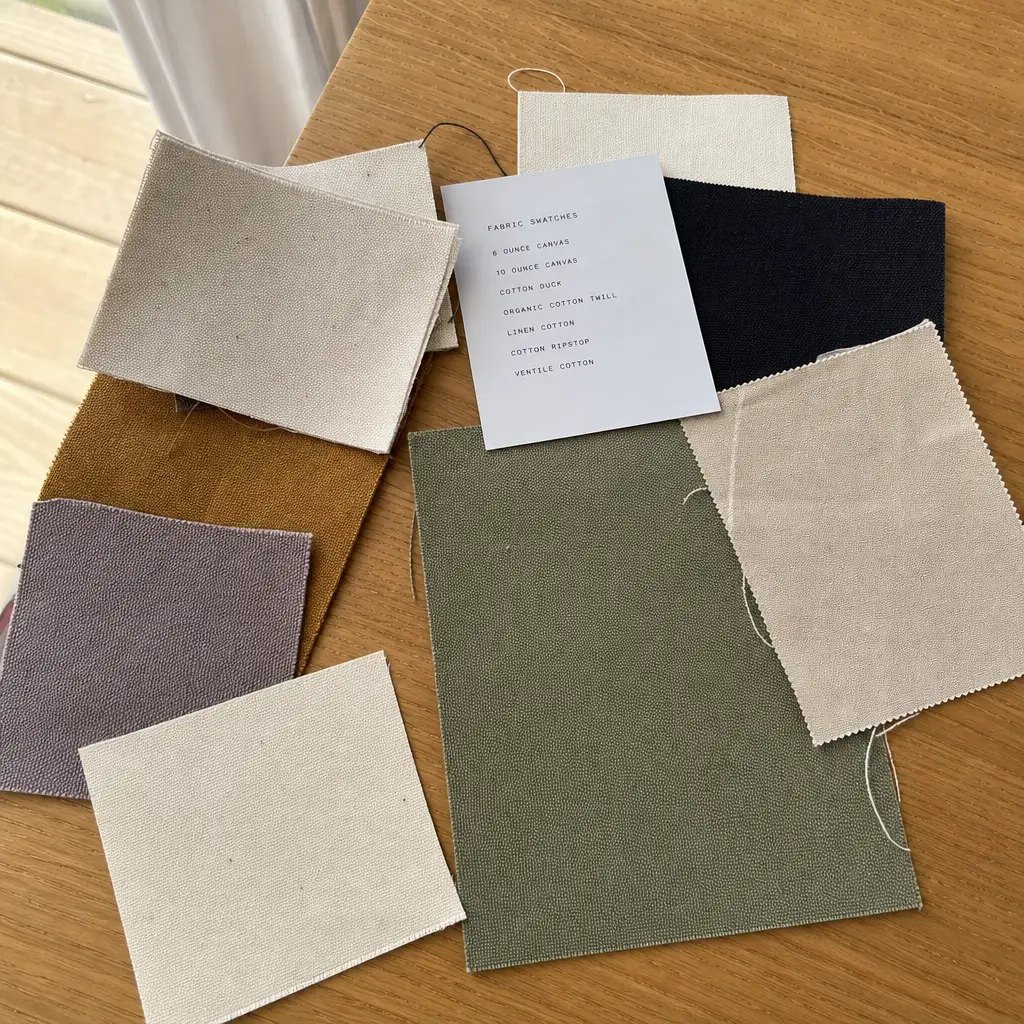
The word canvas is too loose for a purchase order. Buyers should define composition, weight, weave or hand-feel, color, shrinkage expectation, pre-wash status, and shade range. Ask suppliers to quote the fabric weight in both oz/yd² and GSM. Different factories may use different conventions, so the approved range should be written into the PO and matched to a physical swatch.
For structured reusable carriers, 10-12 oz canvas is a common sourcing range, usually around 340-410 GSM depending on weave. Lighter 6-8 oz canvas can work for simple presentation bags or lower-load event packaging, but it may wrinkle more around glass and feel less durable in hand. Heavier 14-16 oz canvas can create a premium reusable feel, yet it also increases seam bulk, carton weight, needle stress, and crease risk near the printed panel.
Natural canvas fits many wellness brands because it looks tactile and understated. It also brings shade variation, slubs, and small flecks. These are not automatically defects, but they must be managed. A spa retail program may need tighter limits for visible slubs, oil marks, dark flecks, weaving defects, and shade changes than a casual retreat giveaway.
Fabric selection also affects the logo zone. Thin fabric can shift during printing. Heavy fabric can resist folding but may not lie perfectly flat around a boxed bottom or handle reinforcement. Before artwork is approved, the supplier should provide finished dimensions, seam allowances, fold lines, and the planned production sequence: print before sewing, print after sewing, or insert labels during sewing.
- Specify canvas in oz/yd² and GSM, with composition and color name or reference.
- Use 8 oz only when low cost, light loading, and easy foldability matter more than structure.
- Use 10-12 oz for most reusable one-bottle and two-bottle studio carriers.
- Consider 14 oz only after checking seam bulk, print smoothness, fold creasing, and freight impact.
- Keep an approved swatch card for repeat orders and multi-location programs.
Map The Front Logo Safe Zone
The front panel is the most visible branding area, but it is also where mistakes show first. The lower part may become a boxed bottom or expansion area. The upper part may include handle stitching, bartacks, reinforcement patches, or stress points. The safest logo area is usually the flat usable panel between the bottom fold and the handle stitch line.
For many single-bottle carriers, a centered front logo around 70-100 mm wide is easier to control than a large panel print. Small marks often feel more premium and reusable, which suits yoga studios, spas, recovery lounges, and boutique wellness brands. Larger artwork can still make sense for retreats, sponsor events, and photo moments, but the buyer should test it on a loaded sample before approving bulk production.
Do not approve placement with phrases like centered, balanced, or as mockup. Use measurements. A production drawing should show logo width, logo height, distance from top opening, distance from left and right side seams, distance from bottom seam or fold line, and distance from the handle stitch line. If the carrier has a boxed bottom, the fold line should be visible in the drawing.
Two-bottle carriers need a stricter review. Two loaded bottles and a divider can change the panel shape more than expected. A wide logo may stretch visually, bow between the bottles, or look uneven from a three-quarter view. Approve the pre-production sample while it is loaded with two real bottles or equivalent weights, not while it is lying flat on a table.
- Keep the logo above the boxed-bottom fold or expansion zone.
- Keep the logo below handle stitching and reinforcement patches.
- Keep fine type and thin botanical artwork away from seams and curved panel edges.
- Use fixed measurement points and a placement tolerance of ±3 mm or ±5 mm as appropriate.
- Approve loaded sample photos before bulk cutting, sewing, or printing.
Choose A Wellness-Friendly Brand Hierarchy
Wellness buyers often want branding that feels calm, giftable, and reusable. A large front print can work for a launch event, corporate wellness kit, retreat sponsor, or retail shelf display. The same logo may feel too loud for a meditation studio, spa, yoga studio, recovery lounge, or premium boutique. Decide early whether the carrier is a marketing item, a paid retail product, or a premium gift package.
Subtle options include an upper-panel icon, tone-on-tone screen print, woven side label, printed cotton tab, inside label, hangtag, or a small low-contrast wordmark. A side seam label is useful when the front panel should stay clean. It also makes the bag feel more like a lifestyle accessory, which can improve repeat use after the first gift moment.
Labels need early approval because they are usually inserted during sewing. Confirm artwork, label material, fold type, orientation, exposed length, seam allowance, and insertion tolerance before cutting begins. If label artwork changes after assembly starts, the factory may need to pause production, reopen seams, or split the order into separate batches.
For multi-location studios, one shared body is often the cleanest sourcing path. The canvas, handle, divider, dimensions, and packing format stay the same, while the front print, side label, hangtag, or carton mark changes by location. This can improve consistency, but each version still needs artwork approval, setup control, sorting, and inspection separation.
- Use front screen printing for event visibility, sponsor recognition, and retail shelf impact.
- Use woven or printed side labels for subtle reusable branding.
- Use tone-on-tone ink only after checking visibility under studio lighting and photography.
- Use hangtags for temporary event messaging that should not remain on the reusable carrier.
- Avoid combining too many brand elements unless the design hierarchy is clearly approved.
Match Decoration To Artwork Risk
Screen printing is usually practical for cotton canvas wine carriers when the logo uses one to three solid colors. It is familiar, scalable, and often gives the matte look buyers expect on natural canvas. Its limitation is detail. Cotton texture can soften edges, fill narrow negative spaces, and reduce the readability of tiny reversed text.
As a working rule, avoid very small reversed text, hairline botanical drawings, and strokes under about 1 mm unless the supplier proves the result with a strike-off on the actual canvas. A logo that looks crisp on a smooth tote mockup may not print the same way on a narrow wine carrier panel with seam bulk close by.
Heat transfer can reproduce gradients, multicolor illustrations, and detailed seasonal artwork. The tradeoff is surface feel and edge appearance. On natural canvas, a transfer may sit on top of the fabric instead of blending into it. It can be useful for short campaigns or colorful artwork, but approve flexibility, edge lifting risk, and hand-feel before production.
Digital print can help with complex artwork or lower quantities, but color strength and rub performance should be tested. Embroidery can look premium for small marks on heavier canvas, though large embroidery may pucker a narrow panel. Woven labels are often the safest choice for tiny type, location names, or quiet side branding.
- Choose screen print for clean one- to three-color logos and simple wellness icons.
- Choose woven labels when small text or subtle side branding matters.
- Choose heat transfer only after approving edge appearance, flexibility, and hand-feel.
- Choose embroidery for small premium marks, not large detailed front-panel artwork.
- Require a strike-off for fine lines, low-contrast colors, dyed canvas, or multicolor registration.
Plan MOQ, Versions, And Quote Scope
MOQ is rarely just one total number. It may apply to fabric purchasing, dyeing, cutting, print screens, label production, packing versions, and carton marks. A natural canvas carrier with one-color screen print usually has fewer setup points than a dyed canvas carrier with woven labels and five studio logos. Ask how MOQ applies per bag body, fabric color, logo version, print color, and label version.
For multi-location wellness groups, event agencies, and distributors, a shared carrier body is easier to manage than several similar bodies. It can reduce cutting and sewing complexity. Still, each logo may require its own screen, strike-off, packing segregation, carton label, and inspection sample. Those costs should be visible before the PO is issued.
A comparable quote separates the base product from decoration and logistics. Base product cost includes fabric, dimensions, handles, divider, thread, reinforcement, and sewing. Decoration cost includes print method, artwork size, number of colors, screens, labels, color matching, and sampling. Packing cost includes folding, inner protection, polybag or polybag-free packing, paper interleaving, carton strength, carton marks, and mixed SKU sorting.
Also ask what is excluded. Common omissions include sample courier fees, screen charges, label mold or setup fees, color matching fees, inspection fees, inland freight, customs documentation, special carton marks, and storage if shipping instructions are delayed. A low unit price is not useful unless the scope is complete.
- Ask for MOQ per body style, fabric color, print color, logo version, label version, and packing version.
- Request line-item setup charges instead of accepting one bundled price.
- Confirm whether versions can share cutting and sewing or must run separately.
- Ask whether mixed cartons are allowed and how carton-level packing lists are produced.
- Check quote validity because cotton fabric, dyeing, and freight costs can move between RFQ and PO.
Build A Sample Approval Path
A good approval process moves in stages: material first, decoration second, full product third. The fabric swatch confirms weight, shade, texture, and hand-feel. The print strike-off confirms logo size, ink color, edge sharpness, opacity, and detail on the actual canvas. The pre-production sample confirms bottle fit, handle drop, divider construction, loaded shape, logo placement, stitch quality, and packing fold.
A digital proof is helpful for layout, but it cannot prove how the logo behaves on loaded canvas. Review the pre-production sample standing on a table, hanging by the handles, and loaded with the intended contents. If tissue, hangtags, brochures, candles, oils, or inserts are part of the final presentation, include them in the sample check.
Approval notes should be precise about what is accepted and what remains open. A buyer may approve fabric shade but reject logo height, approve print color but request higher placement, or approve construction while waiting for final carton marks. Written approvals prevent confusion when production begins.
If the schedule is tight, approvals can be split, but the risk must be clear. Bulk cutting before print strike-off approval is risky when logo placement is close to a seam. Ordering labels before final artwork is risky when studio names, location names, or legal marks may change. Put gating approvals and dates directly into the production schedule.
- Approve a fabric swatch before sampling if shade, texture, or weight is brand-critical.
- Approve a print strike-off before bulk printing on textured, dyed, or low-contrast canvas.
- Approve a loaded pre-production sample before mass production when logo placement is critical.
- Keep a sealed duplicate sample or signed photo set for factory and inspection reference.
- Record all approvals in writing with measurements, photos, and required corrections.
Set QC Criteria Before Production
Quality control should focus on the defects that create real buyer complaints: unsafe handles, crooked logos, dirty canvas, poor bottle fit, weak dividers, wrong logo versions, and cartons sorted incorrectly. A generic textile checklist may catch loose threads but miss the problems that matter at a retreat table, boutique counter, or corporate gifting event.
Logo placement is especially important because a wine carrier has a narrow print panel. A 5 mm shift can be obvious when a small mark is centered. Inspectors should measure from fixed finished edges, seams, the top opening, or the approved fold line. If the logo is centered, inspection should check both horizontal centering and vertical distance from the specified reference point.
Handle and seam performance are safety-related. The carrier may hold glass and liquid, so weak handle stitching should be treated as a major defect. The inspection plan should include loaded hang checks using the buyer’s target contents or an agreed equivalent weight plus a safety margin. Inspect handle stitch pattern, skipped stitches, broken thread, reinforcement tearing, seam popping, and divider failure.
Defect classification should be specific to this product. Wrong logo, wrong version, wrong print color, severe stain, unsafe handle, broken seam, missing divider, incorrect size, and wrong carton mark should normally be major defects. Small thread ends, slight approved canvas shade variation, minor creases away from the logo, or tiny specks outside the brand mark may be minor if retail presentation is not affected.
- Measure finished dimensions flat and compare them with agreed tolerances.
- Measure logo placement from seams or finished edges, not by visual judgment.
- Check loaded fit, standing stability, handle comfort, divider function, and logo visibility.
- Inspect print for skew, pinholes, bleeding, ghosting, blocked details, and color variation.
- Treat unsafe handles, wrong versions, severe stains, and missing dividers as major defects.
Control Packing, Cartons, And Receiving
Canvas wine carriers are often flat packed to reduce freight volume, but the fold direction matters. A hard crease through the printed logo can become permanent, especially on heavier canvas or in over-compressed cartons. Packing should be reviewed during sample approval so the supplier knows whether the logo panel may be folded, rolled, interleaved, or kept flat.
Individual polybags are not always needed and may not fit a wellness studio’s sustainability positioning. Bulk packing can work if cartons are clean, dry, strong, and not overfilled. Paper interleaving is useful for dark ink on light canvas, premium retail presentation, or long transit routes where abrasion and compression are concerns.
Carton specifications belong in the RFQ. Request pieces per carton, carton dimensions, net weight, gross weight, carton board strength or construction, shipping marks, and photos of the packed carton. If the receiving warehouse has a maximum carton weight, state it before quoting instead of after packing is complete.
For multi-location programs, carton control is as important as product quality. Each carton should identify style, fabric color, logo version, quantity, PO number, destination, and carton number. Mixed cartons can support event distribution, but they increase sorting risk. A carton-level packing list reduces receiving errors.
- Define fold direction and avoid hard fold lines through the logo where possible.
- Use paper interleaving when dark prints could scuff or transfer onto natural canvas.
- Confirm whether polybags are required, prohibited, or replaced with carton liners.
- Request carton photos, dimensions, NW/GW, and piece count before shipment release.
- Require carton-level packing lists for mixed logos, destinations, or studio locations.
Manage Lead Time And Critical Path
Production lead time starts after required approvals are complete, not when the first inquiry is sent. The critical path may include artwork cleanup, fabric sourcing or dyeing, label development, screen preparation, sampling, courier transit, sample review, bulk cutting, printing, sewing, trimming, inspection, packing, and export handover. Any delay in approvals can move the ship date.
The most common schedule risks are late artwork changes, unavailable fabric shade, delayed label approval, unclear logo placement, slow sample feedback, and changes after the pre-production sample. Wellness studios often work around fixed retreat dates, seasonal launches, corporate gifting windows, and event calendars, so internal brand approval should happen before the supplier commits to shipment.
Dyed canvas, woven labels, multiple print colors, and separate packing by location add time. Natural canvas with one-color screen print is simpler, but physical sample approval is still important when placement matters. Emergency air freight may protect an event date, yet canvas carriers are bulky, so air cost can quickly erase the savings from a rushed order.
A practical schedule separates buyer responsibilities from supplier responsibilities. The buyer controls artwork, approvals, deposit timing, shipping instructions, inspection booking, and final payment. The supplier controls material purchasing, sample making, screens, sewing, packing, and export readiness. Clear ownership reduces last-minute disputes.
- Lock logo size, color, placement, and version list before pre-production sampling.
- Add time for dyed fabric, woven labels, multicolor printing, and destination sorting.
- Return sample comments with photos, measurements, and yes/no decisions.
- Book inspection before final payment and before goods leave the factory or consolidation warehouse.
- For event orders, compare early ocean planning against the cost of late air freight.
Specification comparison for buyers
| Sourcing decision | Procurement specification to request | Typical target or tolerance | Buyer risk to control |
|---|---|---|---|
| Front-panel logo safe zone | Centered artwork measured from finished side seams, top opening, handle stitch line, and bottom fold line | Logo width often 70-100 mm for single-bottle bags; placement tolerance ±3 mm for small marks or ±5 mm for larger prints | Artwork placed too low can curve around the bottle base, cross a boxed-bottom fold, or disappear when the carrier stands on a table |
| Quiet upper-panel mark | Small icon or wordmark placed in the upper third of the front panel, below handle reinforcement | 45-70 mm wide, with at least 15-20 mm clearance from stitching where panel size allows | Marks too close to handle bartacks or box stitching can look cramped, skewed, or partially distorted |
| Side seam label | Woven or printed cotton label inserted into side seam with fold, seam allowance, and orientation defined | Common label width 25-35 mm; confirm finished exposed length and ±2 mm insertion tolerance | Late label approval can delay cutting and sewing because labels are normally inserted during assembly |
| Canvas weight | Specify fabric weight in both oz/yd² and GSM, fabric color, composition, shrinkage, and approved shade range | 10-12 oz canvas, about 340-410 GSM depending on weave, is common for structured reusable carriers; 8 oz is lighter and more promotional | Fabric described only as canvas may vary widely in hand-feel, thickness, shade, print clarity, and load performance |
| Print method | Match artwork to screen print, heat transfer, digital print, woven label, printed label, or embroidery after strike-off testing | Screen print suits 1-3 solid colors; fine reversed text should generally avoid strokes under about 1 mm on textured canvas | Fine lines, botanical details, low-contrast ink, and small serif type can fill in or lose sharpness on cotton texture |
| Handle construction | Specify self-fabric or cotton webbing handles, handle drop, stitch pattern, thread, and reinforcement size | Handle drop often 120-160 mm for hand carry; stress points should use box stitch, cross stitch, bartack, or reinforced multi-row stitching | Handle failure is a high-severity defect because carriers may hold glass bottles and premium gift contents |
| Two-bottle divider | Define fixed or removable divider, divider height, seam placement, and bottle clearance | Divider should separate bottles through the main body height, with enough clearance for loading and label protection | Divider too low allows glass contact; divider too tight slows packing and can scuff bottle labels |
| Version planning | Use one shared body size when possible, with controlled logo, label, hangtag, or carton-mark variations | Ask MOQ per body, fabric color, logo version, print color, label version, and packing version | Combined quantity may not reduce setup, sampling, sorting, or inspection cost if each version needs separate control |
| Packing method | Flat pack with fold direction defined; add tissue or paper interleaving where print transfer or presentation risk exists | Carton gross weight should match warehouse limits; request pieces/carton, carton size, NW/GW, and packing photos | Over-compressed cartons can create hard creases across logos; damp or weak board can soil natural canvas |
Buyer checklist before sampling
- Confirm the real contents before quoting: bottle count, bottle diameter, bottle height, filled weight, gift inserts, tissue, brochures, candles, oils, or wellness products.
- State the intended use: retreat welcome gift, member appreciation item, boutique retail carrier, corporate wellness kit, distributor program, or reusable paid merchandise.
- Specify finished bag dimensions, gusset or boxed-bottom construction, divider requirement, neck exposure preference, and whether the loaded carrier must stand upright.
- Define canvas by composition, color, weight in oz/yd² and GSM, shrinkage expectation, shade range, pre-wash status, and any documented material claim requirement.
- Provide vector artwork and specify logo width, logo height, print color, Pantone or closest color reference, and measurement points from finished edges or seams.
- Mark the logo safe zone on a technical drawing, including bottom fold line, side seams, top opening, handle stitch line, divider seam, and any reinforcement patch.
- Choose the decoration hierarchy: visible front print, upper-panel quiet mark, side seam label, tone-on-tone branding, hangtag, inside label, or a combination.
- Confirm handle material, handle drop, stitch type, reinforcement area, thread color, and loaded-use requirement for one-bottle, two-bottle, or mixed gift bundles.
- Require a fabric swatch, decoration strike-off, blank fit sample if needed, and pre-production sample made with the actual fabric, print method, handles, divider, and packing fold.
- Set written acceptance criteria for finished size, logo placement, print color, print defects, seam strength, handle strength, divider function, shade variation, stains, and carton packing.
Factory quote questions to send
- What is the exact canvas composition, fabric weight in oz/yd² and GSM, weave description if available, shrinkage range, and approved shade range included in this quote?
- Is the fabric natural cotton canvas, dyed canvas, bleached canvas, recycled cotton blend, organic cotton, or another composition, and what documentation supports any material claim?
- What finished dimensions, gusset width, seam allowance, boxed-bottom construction, divider design, and handle drop are included in the unit price?
- Is the quoted logo method screen print, heat transfer, digital print, woven label, printed label, embroidery, hangtag, or a combination, and what setup charges apply to each?
- What is the recommended maximum logo size for this panel before distortion appears near the bottom fold, side seam, divider seam, bottle curve, or handle stitch area?
- Can you provide a placement drawing showing logo distance from the top opening, left and right side seams, bottom seam or fold, handle stitch line, and gusset fold?
- What tolerance will you hold for finished bag size, handle drop, logo placement, label insertion, print registration, and carton quantity?
- What MOQ applies per bag body style, fabric color, print color, logo version, woven label, printed label, hangtag, and packing or carton-mark version?
- Which samples are included in the quote: fabric swatch, blank fit sample, print strike-off, label proof, pre-production sample, loaded photo sample, or duplicate sealed approval sample?
- What sample lead time, production lead time, and shipping handover date apply after artwork approval, deposit, material approval, and pre-production sample approval?
Quality-control points to confirm
- Finished bag size should be measured flat from fixed finished edges. A practical tolerance is often ±5 mm for main body width/height and ±10 mm for handle drop unless the buyer sets a tighter retail specification.
- Logo placement should be measured from seams, top opening, bottom fold, or other fixed references, not judged visually. Common placement tolerance is ±3 mm for small labels or small marks and ±5 mm for larger front prints.
- Print registration should be checked for each color layer. Reject obvious skew, double image, ghosting, major pinholes, ink bleeding, heavy ink build-up, blocked fine details, or color layers outside the approved registration tolerance.
- Print color should be compared with the approved strike-off under consistent lighting, with the agreed understanding that natural canvas shade and texture can affect the apparent ink color.
- Printed areas should pass the agreed rub review after full ink curing. Dark ink on light natural canvas should be checked for transfer risk during stacked or folded packing.
- Handle attachment should be checked for skipped stitches, broken thread, uneven bartacks, fabric tearing, loose reinforcement, and stitch density that differs materially from the approved sample.
- Loaded hang testing should use the buyer’s target contents or an equivalent test weight plus an agreed safety margin, with no seam popping, handle detachment, or visible fabric tearing.
- Divider seams should be straight, secure, and high enough to prevent bottle contact. Inspect for loose threads, raw edges, lint, or rough seams that could scuff bottle labels or gift packaging.
- Natural canvas should be inspected against the approved shade range. Reject oil marks, dirt, severe weaving defects, dark slubs outside the approved range, needle damage, and stains visible in retail presentation.
- Bulk inspection should include loaded carriers, not only flat pieces, so the buyer can confirm logo visibility, standing shape, bottle fit, handle comfort, divider performance, and front-panel distortion.