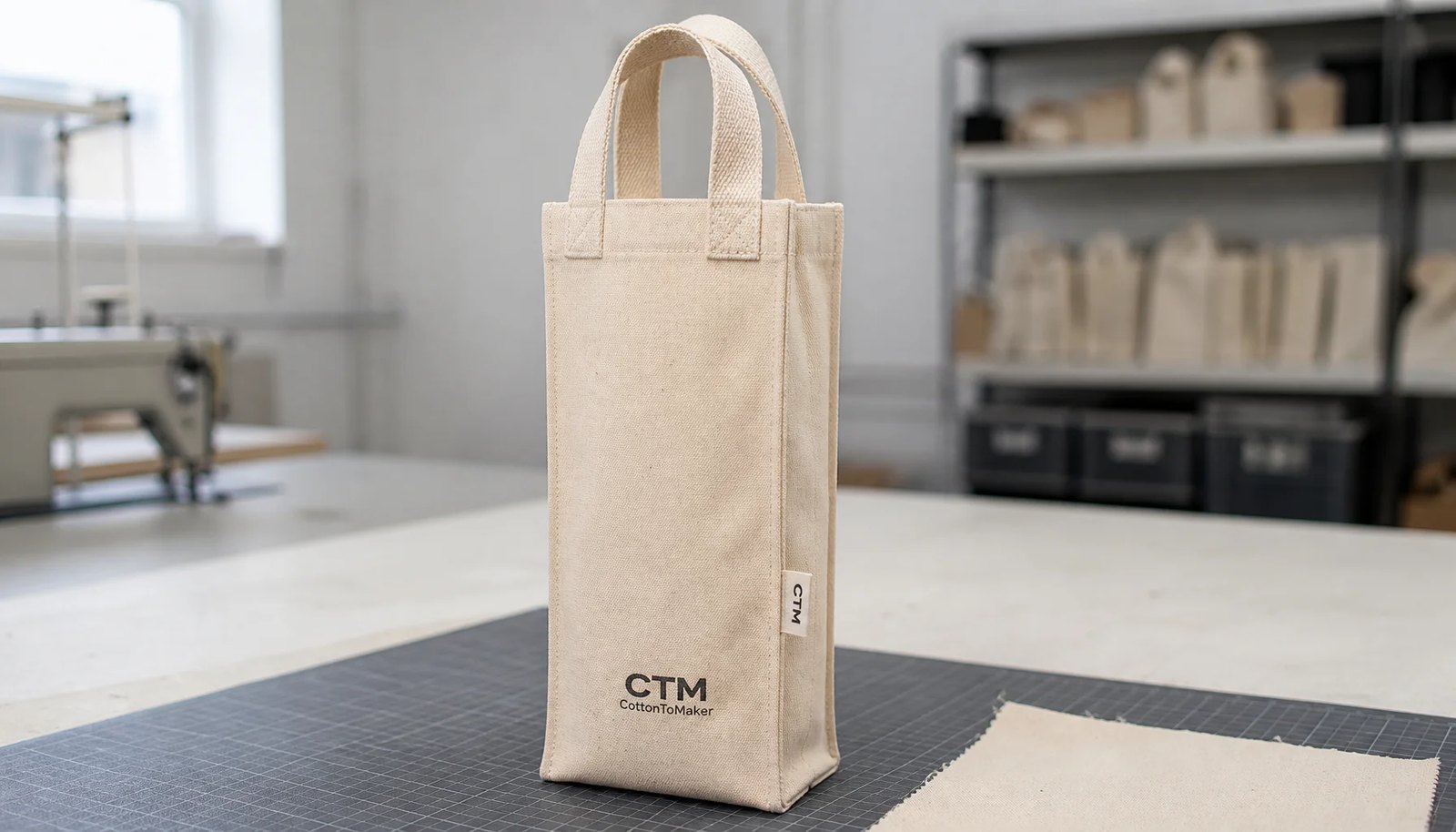
Start With the Trade Show Job
A custom canvas wine carrier does more than hold a bottle. At a trade show, it may sit on a booth counter, move through a hotel drop, travel in a distributor’s tote, or appear in photos before anyone tastes the wine. That makes logo placement a production decision, not a last-minute artwork note.
Start by naming the main job of the carrier. A high-volume giveaway can use a clean one-color logo, economical canvas, and simple packing. A VIP appointment gift may need heavier canvas, a woven label, a lined interior, or tighter placement control. A tasting kit may need a divider or literature pocket more than a large front logo. These choices affect the pattern, the decoration method, the carton count, and the inspection plan.
Also decide how the logo must be seen. A mark that looks centered in a flat PDF can sit too high once the handle is pulled, too low when the bag stands on a table, or too close to a seam after the bottle rounds the panel. If the carrier will be photographed in rows, handed out by booth staff, or used in post-show sales calls, the brand mark should stay readable from the real viewing distance.
- Define whether the logo must read on a tabletop, while carried by the handle, in social photos, or inside a gift kit.
- Record the bottle type, filled weight, maximum diameter, shoulder profile, and height before the supplier confirms size.
- Separate giveaway, VIP gift, tasting sample, and post-show sales use cases because they call for different durability levels.
- Give the supplier the event date, delivery window, receiving address, and show-hall constraints before the quote is finalized.
Lock Bottle Fit Before Artwork
Bottle fit drives both safety and logo appearance. A standard 750 ml Bordeaux bottle is often slimmer than a Burgundy or sparkling bottle. Champagne-style bottles can have wider bases, heavier glass, and more pronounced shoulders. If the factory sizes the carrier around a generic 750 ml bottle, the actual show bottle may be tight at the base, tight at the shoulder, or too heavy for the handle construction.
For a useful RFQ, send the bottle height, maximum body diameter, shoulder shape, neck diameter, and filled weight. If the program includes mixed bottles, specify the largest bottle that must fit, not the most common bottle. Ask the factory to confirm internal clearance after sewing. Flat pattern width is not enough because canvas thickness, lining, seam allowance, divider stitching, and shrinkage all reduce usable space.
Choose the carrier structure before approving the artwork. A single-bottle sleeve usually gives the cleanest front print area. A two-bottle divider carrier adds weight and a central stitch path. A drawstring bottle bag gathers near the neck, which limits the safe upper logo zone. A tote-style wine carrier adds reuse value, but the face panel may curve under load. The pattern should lead the logo placement, not the other way around.
- Request finished dimensions and tolerances for width, height, gusset, handle drop, divider width, and opening width.
- Allow extra internal room for sparkling, Champagne-style, Burgundy, or irregular gift bottles compared with slim Bordeaux bottles.
- Confirm whether the loaded carrier must stand upright; if yes, base construction and canvas stiffness matter.
- Keep divider seams, handle bartacks, closure channels, and literature pockets out of the primary logo zone.
Specify Canvas Weight and Finish
Canvas weight should be quoted in both ounces and GSM. International suppliers may use either term, and the same marketing label can vary by weave and finish. As a rough procurement reference, 8 oz canvas is about 270 GSM, 10 oz is about 340 GSM, 12 oz is about 410 GSM, and 14 oz is about 475 GSM. The purchase order should still state the agreed tolerance rather than relying on a generic fabric name.
For many trade show wine carriers, 10 oz to 12 oz canvas is a practical starting range. It has more body than very light cotton, yet it normally keeps cost, carton bulk, and freight weight manageable. For premium gifting or carriers that must stand neatly on a booth counter, 12 oz to 14 oz canvas may improve hand feel and print stability. The tradeoff is higher material cost, heavier cartons, more folding bulk, and sometimes slower sewing.
Finish changes the result. Natural unbleached canvas may show seed flecks and shade variation, which can be attractive for an eco-style program but should be approved against a physical sample. Dyed canvas needs shade-lot control and colorfastness checks. Washed or pre-shrunk canvas may reduce later shrinkage, but it can soften edges and add surface variation. Coated or laminated canvas can affect ink adhesion, heat transfer bonding, and stitch behavior.
- State canvas as oz plus GSM and ask for the factory’s GSM tolerance, often expressed as a percentage or range.
- Approve a physical fabric swatch or sample as the shade and hand-feel standard for natural or dyed canvas.
- Ask whether the fabric is pre-shrunk, washed, coated, lined, laminated, bleached, dyed, or reinforced.
- Check whether heavier canvas changes MOQ, sample timing, sewing speed, carton gross weight, and freight cost.
Map Safe Logo Zones
A good logo placement guide separates safe zones, caution zones, and avoid zones. Safe zones stay relatively flat after sewing, loading, and packing. Caution zones may work for small marks, narrow labels, or simple one-color artwork, but they need a physical proof. Avoid zones include handle bartacks, drawstring channels, top hems, divider seams, bottom folds, gusset edges, and areas that crease tightly inside cartons.
On a standard one-bottle canvas carrier, the safest main mark is often centered on the front panel and placed slightly below the vertical midpoint. That position keeps the logo away from the top hem and handle pull while keeping it visible when the carrier stands upright. On a two-bottle carrier, the logo must avoid the divider stitch path and any tension created by the heavier load. Side gussets are better for vertical secondary marks, woven tabs, small event names, or repeat branding.
Do not approve vague instructions such as center front logo unless the order is very small and the risk is acceptable. A production-ready instruction is more specific: front panel, logo width 80 mm, top of logo 95 mm below top hem, centered between side seams, minimum 15 mm seam clearance, tolerance plus or minus 5 mm. Also confirm whether the factory measures the empty finished carrier, the loaded carrier, or the flat panel before sewing.
- Keep main artwork at least 12 mm to 15 mm from major seams unless the sample proves a smaller clearance works.
- Keep fine text away from bottom folds, side gussets, handle bartacks, drawstring channels, and divider stitch lines.
- Use side tabs, woven labels, or compact vertical marks when branding must remain visible on curved side panels.
- Measure the approved sample empty and loaded because bottle weight can round the front panel and shift visual center.
Choose Decoration by Risk
Screen printing is a common choice for custom canvas wine carriers because it suits bold logos, solid text, and one- to three-color artwork. It is also straightforward to inspect in bulk. The main risks are ink bleeding into textured yarns, broken fine lines, multi-color registration shift, ghosting, pinholes, and cracking if heavy ink sits on a fold line.
Heat transfer is useful for full-color artwork, gradients, small details, or short-run personalization. It can simplify setup when a trade show program has many logo versions. The buyer should still approve edge adhesion, dry rub performance, heat marks, and fold behavior. Transfers placed near corners, hard folds, or high-pressure packing areas are more likely to show lifting or pressure marks than transfers on a stable front panel.
Embroidery, woven labels, cotton labels, and sewn patches can create a more premium look, but they need the right carrier structure. Embroidery can pucker light canvas and distort small lettering. Woven labels work well for small brand marks or side tabs because they remain legible on slightly curved surfaces. Patches work best when the canvas is heavy enough to support stitching or attachment without panel distortion.
- Use screen print for bold logos on stable front panels when repeatability and inspection speed matter.
- Use heat transfer for multi-color artwork only after approving adhesion, rub, fold, and packed-sample performance.
- Use embroidery for small premium marks on heavier canvas, not dense graphics near seams or folds.
- Use woven labels or side tabs for durable secondary branding where a large front logo is not needed.
- Request a strike-off or decorated sample on the actual canvas instead of judging decoration on a generic swatch.
Write an RFQ Suppliers Can Follow
A strong RFQ keeps the sewn carrier specification separate from the decoration specification. The sewn carrier section should cover bottle fit, finished size, canvas weight, fabric finish, lining, divider, handle type, handle drop, stitch color, closure, base construction, and packing method. The decoration section should cover artwork file type, logo size, print side, decoration method, number of colors, Pantone references, label dimensions, and placement tolerance.
Trade show logistics belong in the quote stage, not after production. A supplier cannot price or schedule accurately without knowing whether goods ship to a forwarder, distributor warehouse, third-party fulfillment center, hotel, convention center, sales office, or advance warehouse. Carton marks, pallet labels, mixed-SKU separation, and delivery-window rules can add handling time and cost.
Ask for line-item pricing. A useful quote separates blank carrier cost, decoration setup, per-unit decoration, sample fee, packing cost, carton label cost, inspection cost if any, and freight estimate if requested. This makes supplier comparison easier and shows what changes when logo size, color count, packing method, or artwork versions change.
- Attach bottle dimensions, carrier structure, canvas GSM, finished size, handle details, closure, and packing requirements.
- Attach vector artwork, Pantone colors, logo size, print side, fixed placement measurements, and tolerance.
- Ask whether multiple logo versions require separate setup charges, separate MOQs, or separate sample approvals.
- Request written assumptions so the quote becomes a production record, not just a price estimate.
Set Tolerances and Proof Standards
Most placement disputes start with soft approvals. A digital mockup is helpful for visual review, but it does not control production by itself. A physical sample may look acceptable, but if the measurements are not recorded, the factory has no clear boundary for bulk variation. The safest approval package combines a dimensioned production proof, a decorated pre-production sample, and a written tolerance.
Placement tolerance should match the structure and decoration method. On a flat one-bottle carrier with a simple front screen print, plus or minus 5 mm is a common commercial target to discuss. Premium programs or smaller controlled runs may ask for plus or minus 3 mm, but only if the supplier confirms the sewing and printing process can hold it. Gusset marks, embroidery, patches, drawstring bags, and decoration applied after sewing may need more practical tolerances because the surface is harder to fixture.
The proof should identify front, back, top, bottom, left, right, logo reading direction, fixed measurement points, and whether measurement happens before or after sewing. For two-sided printing, state whether both panels match exactly, mirror each other, or carry different artwork. If the carrier includes a side label, show which side the label appears on when the front logo faces the viewer.
- Approve a dimensioned proof and a physical pre-production sample before authorizing bulk production.
- Use numeric tolerance, such as plus or minus 5 mm, instead of subjective phrases like visually centered.
- Record whether placement is measured on the finished empty carrier, loaded carrier, or flat pre-sewn panel.
- Keep the signed proof, approved sample photos, supplier comments, and QC checklist in the purchase order file.
Approve Samples Like Controls
Sampling should prove the final product, not just the idea. A blank sample can confirm size and bottle fit. A print strike-off can confirm ink, color, and line quality. The pre-production sample should bring everything together: final canvas, final structure, final decoration method, final logo position, and intended packing fold whenever possible. That sample becomes the practical standard for bulk inspection.
Review the sample the way the event team will use it. Inspect it empty and standing upright. Load the intended bottle and check whether the logo curves, hides, skews, or appears off-center. Carry it by the handle and look for panel distortion. Fold it as it will be packed and confirm that the crease does not cut through fine artwork. If cartons will be tight, check whether patches, embroidery, or transfers leave pressure marks.
Avoid approving samples with unresolved verbal notes. If the logo must move down 10 mm, the revised measurement should appear on the new proof. If a Pantone color is commercially acceptable but not exact on natural canvas, record the approved physical standard. If stitch color, handle drop, label side, or carton packing differs from the final requirement, write the correction into the approval record before bulk starts.
- Inspect sample fit with the exact bottle or a matched dummy bottle of the same size and filled weight.
- Measure logo position from fixed points instead of judging by eye from a front-facing photo.
- Check print clarity, color, alignment, handle strength, stitch tension, seam security, and fold impact in one review.
- Require a corrected proof or revised sample when changes affect logo location, construction, color, or packing.
Control Bulk Production and QC
Bulk control depends on when decoration is applied. If panels are printed before sewing, the factory must control cutting, seam allowance, and sewing alignment so the logo lands correctly on the finished carrier. If decoration is applied after sewing, the factory needs a stable jig, fixture, or printed template to hold the carrier flat and register the logo from the same reference points each time.
First-article approval is useful for show-critical orders. Ask for early production photos showing the logo measured from fixed points, the carrier loaded with the intended bottle, close-up decoration quality, handle bartacks, side seams, and first carton packing. This can catch a drift in placement, a shade issue, or a packing problem before the full run is printed or sewn.
Final inspection should combine measurement, workmanship, function, and packing. A logo can be within tolerance and still look poor if the carrier is twisted, the print is tilted, the seam pulls the panel out of square, or the bag fails to stand cleanly. Define major defects clearly: wrong logo, upside-down print, missing decoration, severe color mismatch, failed handle, unusable bottle fit, or placement outside the approved tolerance.
- Ask how the factory controls registration: panel marks, sewing guides, print jigs, templates, or measurement fixtures.
- Request first-article photos before full production continues, especially when the event deadline is tight.
- Inspect multiple cartons and production times to catch placement drift, color drift, or operator variation.
- Classify wrong artwork, incorrect placement beyond tolerance, weak handle anchoring, and failed bottle fit as major defects.
- Keep nonconforming units separated and require written rework, replacement, or acceptance decisions before shipment.
Pack and Schedule for the Show
Packing can protect the logo or damage it. Screen prints may rub if decorated panels face rough seams. Transfers can show pressure marks if folded sharply. Embroidery and patches can leave impressions on adjacent carriers in compressed cartons. The fold pattern should keep the primary logo away from hard creases, and inner packing should reduce abrasion between decorated faces when the risk justifies the added cost.
Trade show receiving requirements should be finalized before cartons are sealed. Goods may ship to an advance warehouse, convention center dock, hotel, distributor, sales office, or fulfillment partner. If the order includes multiple artwork versions, each carton should identify PO number, SKU, style, logo version, quantity, destination, and event name when required. Mixed-logo cartons are a common source of receiving and booth-setup mistakes.
Lead time should include artwork review, proof revision, blank sample, decoration sample, pre-production approval, bulk material booking, production, inspection, packing, shipment booking, customs clearance if applicable, and final delivery. A low unit price does not help if the carriers arrive late or need sorting at the booth. For tight deadlines, reduce variables: one structure, one canvas color, one main placement, one decoration method, and clearly separated logo lots.
- Define fold direction so the main logo is not creased through fine text or pressed against seams, patches, or hardware.
- Use interleaving, individual bags, or controlled stacking when dark prints, transfers, embroidery, or patches need protection.
- Label cartons by PO, SKU, artwork version, quantity, destination, and event requirement before shipment release.
- Request packed-unit, inner-pack, master-carton, and sealed-carton photos for show-critical orders.
- Compare suppliers by inspected, event-ready landed cost rather than factory unit price alone.
Specification comparison for buyers
| Sourcing route | Recommended use | Specification control needed | Buyer risk to verify |
|---|---|---|---|
| Factory-direct canvas bag maker | Best for repeat trade show programs that need consistent panel dimensions, controlled sewing, and repeatable logo placement | Finished size, canvas GSM, seam allowance, decoration method, placement tolerance, sample approval standard, and carton packing | Confirm whether cutting, sewing, printing, and final inspection are done in the same facility or subcontracted |
| Trading company or sourcing agent | Useful when one contact must coordinate wine carriers, inserts, export documents, mixed SKUs, and event deadlines | Written technical sheet, factory name, decoration site, approval workflow, corrective action process, and inspection responsibility | Ask who controls the print jig, who signs off the pre-production sample, and who pays if placement is outside tolerance |
| Local print shop on imported blanks | Fits urgent small runs when blank carrier structure is already acceptable and the event date is close | Blank lot consistency, decoration area after sewing, handle strength, fabric shade, and bottle fit | Blank carriers may vary by lot; logo placement can drift if panel size, fold line, or seam position changes |
| Integrated wine packaging supplier | Works when the carrier must fit a bottle plus brochure, tissue, divider, gift box, or shipping carton system | Carrier dimensions, insert dimensions, load orientation, carton count, retail presentation, and protection requirement | Standard logo positions may be fixed; custom placement, side labels, or special packing may carry extra charges |
| Private-label supplier with design support | Good for new exhibitor programs that need artwork cleanup, placement mockups, and production-ready files | Vector artwork, Pantone references, logo size, print direction, fixed measurement points, and proof revision record | Design mockups must become dimensioned production drawings; visual approval alone is not enough |
| Sample-first low-MOQ route | Useful for testing a new winery gift program, distributor event, or trade show giveaway before scaling | One structure, one canvas color, one decoration method, one logo placement, and one packing method | Low MOQs usually mean higher unit cost; too many logo versions slow approval and increase setup fees |
| Regional nearshore supplier | Appropriate for last-minute launches, shorter transit, smaller replenishment batches, or venue-delivery pressure | Canvas weight equivalency, color standard, stitch construction, logo tolerance, packing count, and landed cost | Nearshore and offshore specs may not match unless GSM, dimensions, seam allowances, and approval samples are aligned |
| Dual-source program | Best for brands that reorder often, supply multiple regions, or need continuity if one factory is fully booked | One master spec sheet, one approved sample set, one placement drawing, and equivalent inspection criteria at both factories | If tolerances and fixtures differ, the same logo may appear higher, lower, or off-center between suppliers |
| Blank carrier plus separate decorator | Can fit complex artwork, specialty inks, domestic compliance needs, or personalization after import | Blank finished dimensions, decoration window, flatness, press access, material compatibility, and claim responsibility | Responsibility can be unclear if placement fails because the sewn blank is out of square or difficult to fixture |
Buyer checklist before sampling
- Confirm the exact bottle format: standard 750 ml Bordeaux, Burgundy, Rhône, sparkling, Champagne-style, half bottle, or mixed samples; record maximum diameter, shoulder height, bottle height, and filled weight.
- Define the use case before artwork: booth tabletop display, staff handout, VIP appointment gift, tasting kit, distributor follow-up, hotel-room drop, or post-show sales call.
- Select the carrier structure first: single-bottle sleeve, two-bottle divider carrier, drawstring bottle bag, tote-style wine carrier, padded carrier, carrier with literature pocket, or carrier inside a gift box.
- State the finished size and acceptable dimensional tolerance for width, height, gusset, handle drop, divider width, and internal bottle clearance.
- Specify canvas in both oz and GSM; common procurement ranges include about 8 oz / 270 GSM for light giveaway use, 10 oz / 340 GSM for standard promotional use, 12 oz / 410 GSM for sturdier trade show carriers, and 14 oz / 475 GSM for premium structure.
- Clarify whether the fabric is natural, bleached, dyed, washed, unwashed, pre-shrunk, laminated, coated, lined, or reinforced; ask whether GSM tolerance is plus or minus 5 percent or another agreed range.
- Provide vector artwork and a dimensioned placement sheet showing logo size, print side, distance from top hem, side seams, bottom fold, gusset edge, handle bartack, divider stitch line, and closure channel.
- Define placement tolerance before quoting; many standard sewn canvas programs use plus or minus 5 mm for main-panel decoration, while tighter plus or minus 3 mm control should be confirmed by sampling and may cost more.
- Request a pre-production sample using final fabric, final sewing construction, final decoration method, final logo position, and intended fold or packing method.
- Inspect the sample empty, loaded with the intended bottle, standing on a tabletop, carried by the handle, folded as packed, and viewed from the expected trade show distance.
Factory quote questions to send
- What finished carrier size do you recommend for my bottle dimensions, and what internal clearance will remain after sewing and shrinkage?
- What canvas weight will you use in oz and GSM, what GSM tolerance applies, and will the fabric be natural, dyed, washed, pre-shrunk, lined, coated, or laminated?
- What is the safe decoration area after sewing for the front panel, back panel, side gusset, pocket, or label tab, and how does it differ from the flat fabric area before assembly?
- Which logo placement do you recommend for this structure, and what specific risks are you avoiding: handle bartacks, top hem, side seams, bottom gusset, divider seam, fold line, or bottle shoulder curve?
- What minimum clearance do you require between artwork and seams, hems, bartacks, drawstring channels, bottom folds, divider lines, and high-abrasion corners?
- Which decoration method is included in the base quote, and how do setup cost, MOQ, lead time, and inspection steps change for screen print, heat transfer, embroidery, woven label, cotton label, or sewn patch?
- Will decoration be applied before sewing or after sewing, and what jig, registration mark, sewing guide, or inspection template controls the final logo position?
- What is your standard placement tolerance for this exact carrier and method, and can you hold plus or minus 3 mm or plus or minus 5 mm on the approved measurement points?
- Can you provide a dimensioned production proof showing logo size, print direction, front/back orientation, distance from fixed points, and the approved tolerance before sample production?
- What sample stages are available, what are the fees, what is refundable against bulk, and does pre-production sample approval lock the bulk standard?
Quality-control points to confirm
- Finished carrier size, gusset width, handle drop, divider width, and bottle clearance match the approved technical sheet and pre-production sample.
- Canvas weight, weave, color, shrinkage behavior, finish, stiffness, and hand feel match the approved standard within the agreed commercial tolerance.
- Logo position matches the signed placement drawing and stays within the agreed tolerance from top hem, side seams, handle bartacks, gusset edge, divider seam, and bottom fold.
- Print is level and visually centered when the carrier is empty, standing upright, and loaded with the intended bottle, not only when the panel is flattened on a table.
- Artwork size, reading direction, front/back orientation, and side-label position match the approved production proof across all logo versions.
- Screen print edges are sharp with no unacceptable bleeding, ghosting, pinholes, smearing, cracking, color break, registration shift, or heavy ink buildup on canvas texture.
- Heat transfer decoration shows acceptable edge adhesion, no visible lifting, no scorch marks, no bubbling, and no transfer outline beyond the approved standard.
- Embroidery, woven labels, cotton labels, or patches are aligned, secure, and free from puckering, loose threads, needle damage, or pressure marks that affect presentation.
- Decoration color matches the approved Pantone, strike-off, or physical standard with no obvious shade drift between cartons, production lots, or print runs.
- Stitching does not cut through artwork, distort the logo zone, pucker the front panel, pull the bag out of square, or create visible tension across the decoration.