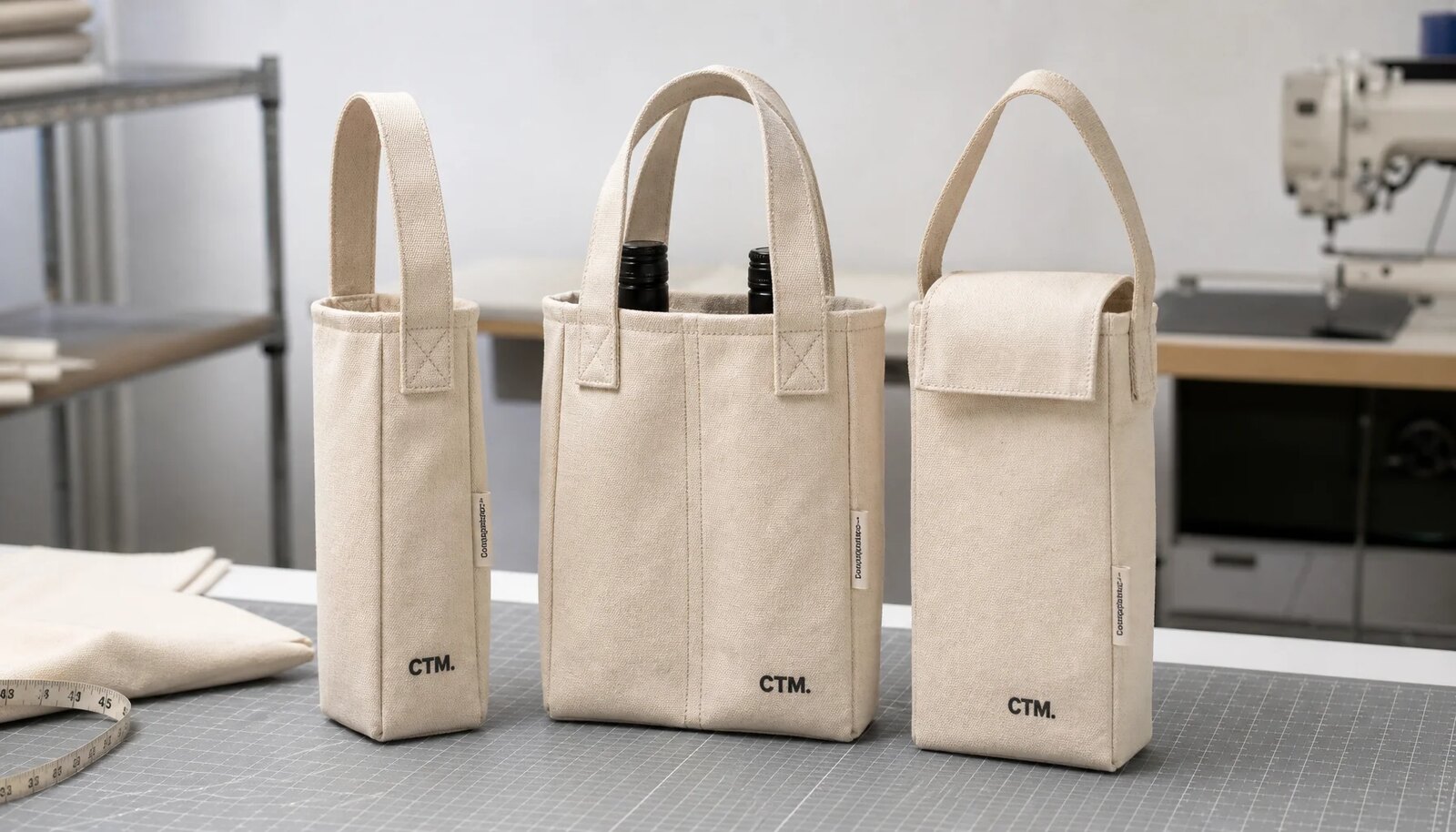
Start With the Craft Fair Selling Scenario
A custom canvas wine carrier has more than one job at a craft fair. It may sit on a table as a display prop, sell as a paid add-on, carry a sponsor mark through the aisle, or turn a single bottle into a giftable purchase. That is why logo placement cannot be judged only on a flat artwork proof. Once a bottle is inserted, the front panel curves. Once the bag is folded, the print may sit on a crease. Once tissue, ribbon, hang tags, or bottle neck labels are added, the upper panel may disappear from view.
Start by defining how shoppers will actually see the carrier. A table-display item needs a logo readable from roughly 1-2 meters. A carrier hanging from a peg board needs enough handle drop and a stable top opening so the front panel does not collapse. A giveaway bag may only need a clean one-color mark and reliable handles. Paid merchandise needs a better hand feel, cleaner packing, and tighter stitch control because customers judge it as a product, not as packaging.
This early decision keeps procurement conversations grounded. Otherwise, suppliers may quote different fabric weights, different print zones, and different packing methods while appearing to quote the same item. A winery selling a reusable $8-15 holiday market carrier is not buying the same quality level as a sponsor ordering 1,000 lightweight event handouts. Put the commercial role in the sourcing brief: lowest unit cost, retail feel, upright display, fast event delivery, strong logo visibility, or flexibility for multiple vendor logos.
- State the primary viewing mode: upright on table, hanging by handles, carried by shopper, or stacked flat.
- Send booth photos or sketches if logo visibility from the aisle is commercially important.
- List anything that may cover the front panel, including tissue, ribbon, neck tags, hang tags, or price labels.
- Request sample photos with the intended bottle inserted and photographed from shopper height.
- Do not approve final logo placement from a flat proof alone when the filled carrier shape affects visibility.
Measure the Bottle and Product Bundle First
Many wine carrier problems start with one quiet assumption: that every bottle is the same. It is not. A 750 ml Bordeaux bottle, Burgundy bottle, Riesling bottle, champagne bottle, sparkling wine bottle, tall spirits bottle, and olive oil bottle can vary in height, body diameter, shoulder shape, neck length, and filled weight. Those differences change the logo curve, seam stress, handle load, and how the carrier stands on a craft fair table.
For a single-bottle carrier, the internal width and gusset need enough room for the widest approved bottle without forcing the side seams. The bottle should slide in smoothly, stand without severe leaning, and lift without pulling the front panel upward into the handle stitch area. For two-bottle carriers, the divider must keep glass from contacting glass during normal carry. If a gift bundle includes a candle, opener box, tasting glass, gourmet item, or small carton, that accessory can bulge one side and make a centered logo look visually off-center.
Quote sheets should separate external finished size from internal usable size. External dimensions may include seam allowance, fabric thickness, and folded edges. Internal usable space is what the bottle actually occupies. Also state whether the carrier must stand upright when empty. That single requirement can change the recommended canvas weight, base construction, gusset depth, and packing method. If it is not stated, a supplier may quote a soft fold-flat bag that meets the measurements but fails the display need.
- Provide bottle height, maximum body diameter, shoulder diameter, neck diameter, neck height, and filled weight.
- Test the widest approved bottle, not only a common 750 ml bottle.
- For gift bundles, provide dimensions and weights for accessories that share the carrier.
- Confirm whether the carrier must stand empty, stand only when filled, or only function for hand carry.
- Ask the supplier to quote internal usable size and external finished size separately.
Specify Canvas Weight, Finish, and Construction
The phrase cotton canvas is too loose for procurement. Canvas weight affects unit cost, print behavior, sewing speed, carton weight, freight volume, and perceived value. An 8 oz canvas can work for budget promotions, but it may show the bottle outline and collapse when empty. A 10 oz canvas often gives a practical balance of cost, reuse, and printability. A 12 oz canvas gives better body for paid craft fair merchandise and gift bundles. Heavy 14-16 oz canvas can feel premium, but it increases seam bulk, needle demands, carton volume, and freight cost.
Oz and GSM are useful, but they are not perfect equivalents. Yarn count, weave density, finishing, and moisture can shift the result. As a practical sourcing reference, 8 oz canvas often sits around 270 GSM, 10 oz around 340 GSM, 12 oz around 400 GSM, and 16 oz around 540 GSM. Treat these as approximate ranges, then confirm by supplier swatch or material weight if the specification is strict. When comparing factories, ask for both the commercial oz description and the approximate GSM so quotes are easier to normalize.
Finish matters just as much as weight. Natural canvas gives a craft look and may avoid dyeing MOQ, but seed flecks, slubs, and shade variation are normal unless a tighter standard is approved. Bleached canvas creates a cleaner print ground but can show dirt quickly during handling. Dyed canvas supports brand colors, yet it brings dye-lot approval, shade tolerance, and crocking checks. If the carrier is promoted as recycled, organic, or made from a specific fiber blend, ask for composition documentation and any required certification before using that claim in sales materials.
- Use 8 oz canvas only when budget matters more than upright display stiffness.
- Use 10 oz canvas for balanced craft fair reuse, printability, and cost.
- Use 12 oz canvas for paid merchandise, better body, and premium gift bundles.
- Use 14-16 oz canvas only after confirming sewing capability, fold packing, and freight impact.
- Specify natural, bleached, dyed, recycled blend, organic cotton, or cotton-poly blend instead of writing canvas only.
Set a Production-Safe Logo Zone
The most reliable logo position on a single-bottle canvas wine carrier is usually the uninterrupted front-center panel. For many common single-bottle constructions, artwork around 80-100 mm wide and 90-120 mm high is easier to control than a large full-panel graphic. Wider logos can curve around the bottle and lose readability from the aisle. Tall artwork may compete with the bottle label, handle stitching, bottom seam, or packing fold. The final safe zone depends on finished width, gusset depth, canvas stiffness, and whether printing happens before or after sewing.
Do not rely on phrases such as centered, slightly lower, or same as mockup. A production-ready placement drawing should show distances from fixed references: top opening to artwork top, bottom seam to artwork bottom, side seam or gusset fold to artwork edge, and handle stitch box to logo. As a starting point, keep most artwork at least 20 mm away from side seams and keep the bottom of the print about 35-55 mm above the bottom seam where possible. Too low, and seam bulk can reduce print pressure. Too close to a fold, and heavy ink or transfer film can crease during packing.
The buyer also needs to decide what the carrier logo is supposed to do relative to the bottle label. For wineries, the bottle label may be the main selling message, so a restrained carrier mark can support the product without stealing attention. For a sponsor or event program, the logo may need to be more dominant. Either way, approve the placement on a filled sample viewed from shopper height. A flat PDF can confirm artwork size, but it cannot show how the mark behaves around a bottle.
- Use measured placement from top opening, bottom seam, side seams, gusset fold, and handle stitch area.
- Keep most front logos at least 20 mm away from side seams unless a sample proves otherwise.
- Keep the bottom of screen-printed artwork about 35-55 mm above the bottom seam where possible.
- Avoid thin serif type, reversed fine lines, and legal copy below about 4-5 mm text height on rough canvas.
- Confirm whether panels are printed before sewing or finished bags are printed after sewing.
Treat Two-Bottle Carriers as Separate Panels
Two-bottle canvas wine carriers are not just wider single-bottle bags. The divider changes both construction and branding. Artwork should normally stay on uninterrupted outer faces rather than crossing divider stitch lines. Printing across a divider can create broken ink, uneven pressure, pucker, and poor readability once bottles are inserted. Embroidery across the same area is riskier because stitch density and seam bulk can distort the logo and the divider at the same time.
Divider construction belongs in the quote, not in a later email. Some dividers are sewn into the base and side seams. Others are attached only at the sides or near the top. A divider secured into the base generally gives better bottle separation, although it adds sewing time and more stitch lines. A loose divider may reduce cost but can allow bottles to touch or clink during carry. At a craft fair, that sound can make the carrier feel less secure even if the seams are technically intact.
Many two-bottle carriers are used for mixed bundles rather than two identical wine bottles. A bottle plus candle, bottle plus opener box, or bottle plus gourmet item can create uneven bulging. The logo may measure correctly on a flat panel but appear pulled to one side after packing. If the buyer already knows the bundle, send exact product dimensions and ask the factory to review fit with that mix before approving logo placement.
- Keep logos off divider stitch lines unless a physical sample and print strike-off prove acceptable.
- Specify whether the divider is sewn into the base, side seams, top edge, or all three.
- Use separate front and back logo files if both sides will be viewed on a table or when carried.
- Test wine-plus-accessory bundles because uneven product size changes the filled silhouette.
- Inspect divider strength by lifting and lightly swinging a filled sample to check bottle contact.
Match Decoration Method to Artwork and MOQ
Spot-color screen printing is usually the cleanest option for simple custom canvas wine carriers. It suits one to three solid colors, clear logos, and repeat craft fair orders. Buyers should send vector artwork, Pantone references, target logo size, and any minimum line or text requirements. On textured natural canvas, ink can gain slightly and yarn texture can interrupt edges. Fine lines below about 0.4-0.5 mm, tiny reversed type, and delicate gradients should be avoided or tested before mass production.
Heat transfer and DTF can be useful when the artwork has gradients, sponsor blocks, many colors, or several small logo-version splits. They solve some screen setup issues but introduce their own quality risks. Film edges can look shiny on natural canvas. Large transfer areas may feel stiff. A print that looks good flat may crack, lift, or show fold lines after the carrier is packed or curved around a bottle. Approve these methods on the exact bulk canvas and at the final logo size, not on a generic smooth-fabric sample.
Embroidery, woven labels, cotton patches, leather patches, and faux-leather patches can push the item toward a more premium look. They also add lead time and placement risk. Embroidery can pucker on narrow soft panels when the stitch count is dense. Patches require cutting, edge finishing, and sewing. Woven side labels work well for subtle branding, but they must be inserted before the seam is closed. For many craft fair carriers, a modest front print plus a small woven side label is more production-safe than one oversized decoration.
- Use screen print for simple solid logos, repeat orders, and strong booth visibility.
- Request an ink drawdown or strike-off on bulk canvas before approving screen-print color.
- Use heat transfer or DTF only after checking edge lift, shine, fold cracking, rub resistance, and stiffness.
- Use embroidery for small premium marks, not oversized dense graphics on narrow panels.
- Confirm label or patch MOQ separately from bag MOQ because decoration components may drive the order minimum.
Write an RFQ Suppliers Can Price Accurately
A good RFQ reduces guessing. Include finished dimensions, internal usable bottle size, canvas oz and GSM, composition, finish, color, bottle type, gusset depth, base construction, divider detail, handle drop, handle width, reinforcement method, thread color, logo method, logo size, color count, placement drawing, packing method, carton marking, target quantity, delivery terms, and required delivery date. If a detail is undecided, ask for priced options instead of leaving the factory to choose silently.
Artwork control becomes especially important when a craft fair program includes several vendors, sponsors, or event logos. Each file should have a file name, version number, approval date, print color, final size, and placement rule. If one carrier construction is split into multiple logos, list the quantity per logo and ask for screen, setup, film, changeover, and packing costs by version. That is the only way to compare the real program cost, not just the lowest base unit price.
Packing and carton details should be requested early. Wine carriers can be bulky for their unit value, especially in 12-16 oz canvas. Flat packing can reduce freight volume, but folding through a large screen print or transfer may crease the decoration. Individual packing protects the carrier but adds material, labor, and carton space. Ask for estimated carton dimensions, gross weight, inner quantity, and how logo versions will be separated. Those details affect landed cost, warehouse receiving, and craft fair distribution.
- Attach a technical sheet covering size, material, construction, handle, logo, packing, and tolerances.
- Provide vector artwork with file version, Pantone reference, logo size, and intended placement.
- Ask suppliers to itemize sample, screen, setup, label, patch, packing, barcode, and carton costs.
- Request price breaks at realistic quantities such as 300, 500, 1,000, and 2,000 pieces.
- State Incoterms and delivery point clearly, such as EXW, FOB, CIF, DDP, or delivered warehouse.
Understand MOQ and Price Drivers
MOQ is not always controlled by the sewing line. For custom canvas wine carriers, it may come from fabric roll quantity, dyeing MOQ, printing setup, label weaving, patch production, transfer film preparation, carton printing, barcode labeling, or line changeover. A natural canvas bag with a one-color screen print may have a much lower practical MOQ than a dyed 12 oz carrier with woven label, multi-color transfer, retail paper band, barcode sticker, and individual packing.
Craft fair programs often need several logo versions. This can work well when the construction stays identical: same canvas, same size, same handle, same thread, same packing, and only the print changes. The factory can cut and sew one common product, then decorate in batches. Complexity rises quickly when each version changes fabric color, handle color, label type, or packing format, because those changes affect materials, line setup, and QC sorting.
When reviewing quotes, separate fixed costs from unit costs. A low unit price may exclude screens, samples, artwork setup, carton marks, or individual packing. A higher unit price may already include them. Procurement should compare total landed cost per sellable unit, including setup charges, inspection cost, carton volume, inland freight, export charges where applicable, duties where applicable, and repacking risk. A cheap quote is not attractive if it leads to late delivery, mixed logo cartons, or unsellable printed stock.
- Ask what drives MOQ: fabric, dyeing, print, label, patch, packing, carton, or sewing efficiency.
- Keep construction common when ordering multiple craft fair logos.
- Use natural stock canvas when schedule and MOQ are more important than custom fabric color.
- Separate one-time setup charges from repeat-order unit costs.
- Compare total program cost and delivery reliability, not only unit price.
Approve Samples With Measurable Tolerances
Photo approval is too thin for canvas wine carriers. Inspect the sample with the intended bottle inserted. Lift it by the handles, set it on a table, hang it from the expected display fixture, fold it according to the packing plan, and view it from the shopper side. Check logo position, color, edge sharpness, hand feel, print coverage, readability, fabric cleanliness, seam straightness, handle comfort, and whether the bottle inserts without stressing the seams.
Keep prototype approval separate from pre-production approval. A prototype may use available fabric, hand-cut panels, substitute thread, or temporary decoration. It is useful for reviewing shape and basic concept, but it may not represent bulk quality. A pre-production sample should use bulk fabric, bulk thread, bulk ink or transfer film, final label or patch, final handle reinforcement, and final construction. That approved sample should become the reference for mass production and inspection.
Tolerances prevent arguments later. Sewn canvas items move during cutting, printing, and stitching, so zero variation is not realistic. For straightforward front-panel logos, a practical placement tolerance is often ±5 mm. Finished size tolerance may be around ±5-8 mm depending on construction and fabric. Print size tolerance around ±3 mm may be reasonable for many logos. If tighter control is required, ask the supplier to confirm it during sampling and explain any effect on cost, lead time, or reject rate.
- Approve the sample with the intended bottle inserted and photographed from front, side, hanging, and carrying angles.
- Record logo placement tolerance, print size tolerance, finished size tolerance, color standard, and stitch standard in writing.
- Require bulk fabric and final decoration method for the pre-production sample whenever possible.
- Perform a practical handle-load check using the filled bottle weight plus a reasonable safety margin.
- Close all sample comments before bulk cutting, screen making, label weaving, or transfer production begins.
Control QC, Packing, and Event Timing
Final inspection should focus on what makes a unit sellable: correct logo version, readable print, accurate placement, clean fabric, strong handles, secure seams, working divider, proper bottle fit, and acceptable packing. Inspectors should measure logo placement from consistent sewn reference points and check each logo version, not only the largest batch. For printed items, review adhesion, dry rub, light wet rub, edge sharpness, registration, stains, skipped stitches, loose threads, and carton marks. For dyed canvas, add shade and crocking checks.
Packing choices should be locked before mass production. A hard fold through a large screen print or transfer can leave visible creases. Natural canvas can pick up carton dust, oil marks, or moisture odor if it is not protected. Individual polybags protect the product but may conflict with sustainability goals and increase carton volume. Paper bands, inner master bags, tissue sheets, or carton liners may be better for some programs, but they still need to keep the logo clean and the carrier dry. Cartons should be separated clearly by logo version, vendor, barcode, or ship-to location.
Craft fair orders are unforgiving on timing. A carrier that arrives after the event may be usable later, but it misses the sales window. Build the schedule by milestone: artwork approval, sample production, sample shipping, sample comments, fabric purchase, decoration, sewing, inspection, packing, export booking, transit, customs where applicable, and final distribution. If the schedule is tight, simplify the specification before sacrificing core quality. Stock natural canvas, one-color screen print, common construction, standard handles, and simple packing are usually easier to control than a complex rush order.
- Inspect logo placement, print adhesion, fabric cleanliness, handle reinforcement, seams, divider stitching, bottle fit, and carton labels.
- Separate and label cartons by logo version, event vendor, barcode, or destination.
- Avoid hard folds through heavy ink or transfer film unless the fold has been sample-approved.
- Use carton liners, inner bags, moisture control, or tissue protection when transit conditions require it.
- Request a milestone schedule with approval dates, production dates, inspection date, shipment date, and latest event-arrival date.
Specification comparison for buyers
| Procurement decision | Production-safe specification | Best use case | QC or sourcing risk to control |
|---|---|---|---|
| Single-bottle front logo zone | Common safe artwork area: 80-100 mm W x 90-120 mm H; place about 45-65 mm below top opening and at least 35-55 mm above bottom seam | Craft fair table display where shoppers view the filled carrier from 1-2 m away | Logo can curve around the bottle, drift after sewing, or lose readability if too wide for the front panel |
| Lower-front logo placement | Keep bottom of artwork at least 35 mm above bottom seam; keep minimum 20 mm clearance from side seams and gusset folds | Useful when tissue, ribbon, hang tags, or bottle neck labels cover the upper panel | Bottom seam bulk can reduce print pressure; packing folds can crease heavy ink or transfer film |
| Two-bottle outer-panel logo | Print only on uninterrupted outer faces; do not cross divider stitch line unless approved by sample | Wineries, gift sets, bottle-plus-accessory bundles, and multi-vendor craft fair packs | Divider stitching can break ink, pucker embroidery, and split the brand mark when bottles are inserted |
| Canvas for giveaway programs | 8-10 oz canvas, approx. 270-340 GSM depending on weave and finishing; reinforced handle stitching required | Lower-cost promotional carriers, sponsor giveaways, and higher-volume event orders | May collapse empty, show bottle outline, and feel less retail-ready if fabric is too soft |
| Canvas for paid merchandise | 10-12 oz canvas, approx. 340-410 GSM; 12 oz often gives better body for table display | Craft fair resale, winery club gifts, holiday bundles, and reusable retail items | Higher fabric weight increases unit cost, sewing time, carton weight, and freight volume |
| Premium heavy canvas | 14-16 oz canvas, approx. 475-540 GSM; confirm needle, thread, seam allowance, and fold packing | Premium merchandise where hand feel and upright presentation justify added cost | Thick seams create print-registration issues, needle marks, carton bulk, and higher freight cost |
| Spot-color screen print | 1-3 solid colors, vector art, PMS reference, minimum line width normally 0.4-0.5 mm on textured canvas | Most repeatable option for simple logos and 300-2000 pc craft fair programs | Ink gain on natural canvas can fill small reversed text; color must be approved on fabric, not paper |
| Heat transfer or DTF | Use for gradients, sponsor blocks, or many colors; approve edge, fold, rub, and hand-feel tests on bulk canvas | Small logo runs or complex artwork where screen setup is inefficient | Film edge may look shiny or plasticky; large areas may crack, lift, or feel stiff on curved panels |
| Woven label or patch branding | 25-35 mm folded side label, small cotton patch, faux leather patch, or genuine leather patch if compliance allows | Premium or minimalist branding when the front panel must show the bottle label or event artwork | Label MOQ, patch cutting, stitch holes, pucker, and late placement changes can affect cost and lead time |
Buyer checklist before sampling
- Identify the bottle format before quoting: 750 ml Bordeaux, Burgundy, Riesling, champagne, sparkling wine, tall spirits, olive oil, or mixed bottle-plus-gift bundle.
- Provide bottle height, maximum body diameter, shoulder diameter, neck diameter, neck height, filled weight, and whether the factory must test with a full bottle.
- State the selling function: free giveaway, paid craft fair merchandise, winery club gift, retail-ready pack, sponsor item, or reseller private-label product.
- Define the display requirement: stand upright empty, stand upright only when filled, hang from a booth peg, sit in a counter basket, or ship flat for handout.
- Specify canvas by weight and approximate GSM, composition, finish, color, weave type if known, and whether natural seed flecks or shade variation are acceptable.
- Lock finished dimensions: width, height, gusset depth, base style, divider size, handle drop, handle width, seam allowance, and internal usable bottle space.
- Provide logo artwork as vector files with Pantone or brand color references, final logo size, print direction, and measured placement from top, bottom, and side seams.
- Choose the branding system: front print, back print, two-side print, woven side label, cotton patch, leather patch, embroidery, hang tag, barcode label, or mixed branding.
- Confirm handle material, handle drop, handle reinforcement method, stitch pattern, thread color, and expected filled load before sample approval.
- Require a pre-production sample made with bulk fabric, bulk thread, bulk ink or transfer film, final labels or patches, and final sewing construction.
Factory quote questions to send
- What exact canvas weight is quoted in oz and approximate GSM, and what is the fiber composition and finish: natural, bleached, dyed, organic cotton, recycled cotton blend, or cotton-poly blend?
- Is the quoted fabric stock fabric or made-to-order fabric, and what are the roll MOQ, dyeing MOQ, shade-lot tolerance, and expected material lead time?
- What finished dimensions, seam allowances, gusset depth, base construction, handle drop, handle width, and divider construction are included in the unit price?
- What internal usable bottle size is the carrier designed for, and can you test it with our supplied bottle dimensions or a physical bottle sample?
- What is the maximum logo area you recommend on this exact carrier size before the artwork curves, crosses seam bulk, or becomes unreadable when filled?
- Can you provide a placement template showing distance from top opening, side seams, bottom seam, gusset fold, handle stitch box, and divider stitch line?
- Which decoration method do you recommend for our artwork, and what minimum line width, reversed text height, registration tolerance, and color-count limits apply?
- For screen print, what mesh, ink type, curing method, and color-approval process will be used on the selected canvas?
- For heat transfer or DTF, what film type, press temperature range, edge tolerance, wash/rub expectation, and fold-crack check will you perform?
- Can one common carrier construction be split into multiple logo versions, and what setup, screen, film, changeover, or packing cost applies per version?
Quality-control points to confirm
- Measure logo placement from fixed sewn references such as top opening, side seam, bottom seam, divider stitch line, or handle stitch box; do not measure from a stretched loose edge.
- For simple front-panel prints, a realistic placement tolerance is often ±5 mm; tighter requirements should be validated during pre-production because canvas can shift during cutting and sewing.
- Finished dimensions should be checked flat and with the intended bottle inserted; typical sewn-bag tolerance may be ±5-8 mm unless the supplier confirms tighter control.
- Screen print color should be approved against an ink drawdown or strike-off on the actual bulk canvas under consistent lighting, not only against a paper Pantone chip or phone photo.
- Print coverage should be checked for pinholes, ink bleeding, poor edge definition, misregistration, under-cure, heavy ink buildup, and unreadable small text.
- Dry rub and light wet rub checks should be performed before packing, especially on dyed canvas, coated canvas, dark fabric, heavy ink coverage, or transfer decoration.
- Heat transfer and DTF should be checked for edge lift, shine, hand-feel stiffness, cracking after folding, bubbling over textured yarns, and poor bonding near seams.
- Embroidery and patches should be checked for pucker, skipped stitches, uneven placement, thread trimming, backing visibility, patch edge lift, and needle damage.
- Handle attachment should use reinforced box stitch, cross stitch, bar tack, or equivalent reinforcement suitable for the filled bottle weight and expected repeated carrying.
- Side seams, bottom seams, and gussets should show consistent stitch density, secure back-tacking, no skipped stitches, no open seams, no needle cuts, and no loose thread at stress points.