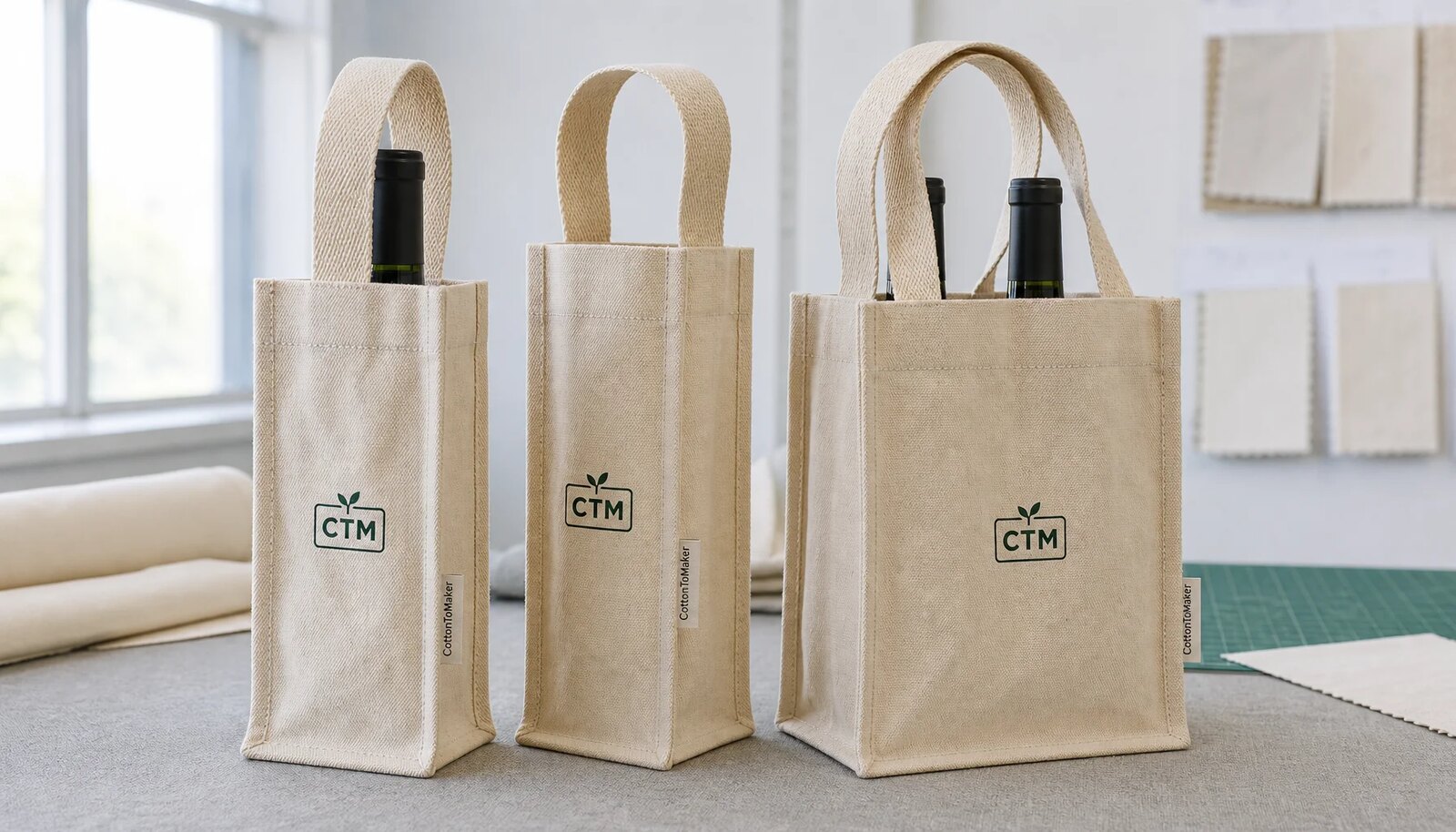
Buying Problem: A Wine Carrier Is Not Just a Small Tote
Custom canvas wine carriers for hotel retail need tighter control than ordinary promotional tote bags because the product carries glass, sits on a retail shelf, and often represents a premium hospitality brand. A hotel buyer may use the same carrier for gift shop resale, room welcome amenities, corporate events, and restaurant wine bundles. If the base is too narrow, the bottle leans. If the handle is under-reinforced, the bag may fail when a guest is walking through the lobby. If the logo is printed too low, it disappears behind the bottle curve when displayed upright.
The most common sourcing mistake is sending a simple request such as “canvas wine bag with logo” and comparing quotes only by unit price. Factories then quote different fabric weights, handle constructions, print methods, and packing styles. The lowest price may use thin 6 oz canvas, narrow handles, single-line stitching, and folded packing that creases the logo. A stronger RFQ defines bottle format, fabric GSM, sewing details, logo method, packing, inspection standard, and quote breakdown before the supplier calculates price.
- For hotel retail, treat the carrier as a load-bearing retail package, not only a giveaway bag.
- Build the RFQ around actual bottle dimensions and shelf presentation, not only the logo artwork.
- Compare quotes only after fabric weight, handle style, print method, packing, and inspection level are aligned.
- Use a physical bottle-fit sample before approving bulk production.
Fabric Weight and Canvas Construction
For hotel retail wine carriers, 10 oz to 12 oz cotton canvas, roughly 280-340 GSM, is usually the practical middle ground. It gives enough body for the carrier to stand better on a counter, supports the bottle weight, and still accepts screen printing cleanly. An 8 oz canvas can work for low-cost gifting or short-use events, but it usually feels soft around a full bottle and may wrinkle more during packing. A 14 oz canvas feels premium, but the extra weight increases fabric cost, makes seam turns thicker, and can raise air or courier freight for urgent launch orders.
The buyer should also define whether the fabric is natural cotton canvas, bleached canvas, dyed canvas, recycled cotton canvas, or organic cotton canvas. Natural canvas is often the most efficient option for MOQ and lead time because mills and bag factories commonly keep it available. Dyed canvas requires color lab dips, dye-lot control, and usually a higher fabric MOQ. Recycled or organic claims must be supported by the supplier’s material evidence, but the claim should not replace basic physical inspection for GSM, shrinkage behavior, surface marks, and smell.
- Typical hotel retail range: 10 oz to 12 oz canvas, about 280-340 GSM.
- Budget event range: 8 oz canvas, about 220-240 GSM, only if the bag is not expected to stand firmly.
- Premium heavy range: 14 oz canvas, about 380-420 GSM, useful only when the buyer accepts higher cost and thicker seams.
- Fabric tolerance should be agreed before production, commonly by GSM range and approved hand-feel sample.
Bottle Fit, Base Shape, and Divider Details
Bottle fit is the first functional inspection point. A wine carrier that fits a slim Bordeaux bottle may not fit a Burgundy bottle with a wider body, and it may fail completely with champagne or sparkling wine bottles. Hotel retail programs often sell mixed bottles from local wineries, restaurant selections, or minibar gift sets, so the buyer should nominate the largest bottle to test. If the carrier is for one named bottle, send exact bottle diameter, height, and filled weight. If the carrier is for general retail, specify the largest acceptable bottle format and require the factory to test with a matching dummy bottle.
For two-bottle carriers, the divider is not decorative. It prevents glass-to-glass impact, keeps bottles upright, and improves shelf appearance. A divider that is too low allows bottles to knock together near the shoulder; a divider that is too narrow pulls the side panels inward and causes seam stress. The base should be wide enough for the filled carrier to sit flat, especially if the hotel shop displays units pre-packed with bottles. A folded bottom without enough gusset may be cheaper, but it can create a rounded base that looks unstable on a retail shelf.
- Single-bottle carrier: define bottle diameter, bottle height, body height, gusset width, and handle drop.
- Two-bottle carrier: define center divider height, divider attachment method, compartment width, and bottom reinforcement.
- Sparkling bottle programs need wider diameter testing and stronger base stability checks.
- Acceptance criterion: filled carrier stands upright on a flat surface without severe leaning or seam strain.
Handle Strength and Sewing Acceptance Criteria
Handle failure is one of the highest-risk defects because the carrier holds glass. The handle choice must be part of the quote, not a detail left to the factory. Self-fabric canvas handles give a consistent look and suit hotel retail branding. Cotton webbing handles can be stronger and smoother to hold, but the color and texture may differ from the body fabric. Rope handles look gift-oriented, but they need grommets or strong attachment points and may not pack flat as cleanly.
For quality inspection, the buyer should define reinforcement before sampling. A simple single stitch at the handle base is not enough for a filled wine carrier. Box stitch, cross stitch, bartack, or a reinforced folded patch should be visible and consistent. Stitch density should be even, with no skipped stitches, loose thread tails, broken needle holes, or twisted handles. The inspector should lift a filled sample repeatedly by the handles and observe whether the attachment points distort, pull threads, or create tearing at the canvas edge.
- Recommended reinforcement: box stitch with cross stitch, bartack, or approved reinforced patch.
- Handle alignment tolerance: both handles should sit level and centered, without visible twisting.
- Practical load check: test with the intended filled bottle weight plus handling movement, not only static empty-bag inspection.
- Reject condition: loose handle threads, skipped stitches at stress points, or fabric tearing near the handle base.
Logo Printing for Hotel Retail Presentation
Screen printing is usually the most reliable and cost-effective method for cotton canvas wine carriers when the logo uses solid colors. It works well for hotel marks, restaurant names, winery collaborations, and simple retail graphics. The buyer should specify logo size, placement, Pantone references, ink type if needed, and whether the logo must be printed before or after sewing. Printing before sewing can improve print flatness, but position control must account for seam allowance. Printing after sewing avoids some placement drift, but seams and gussets may reduce pressure near edges.
Heat transfer can reproduce fine gradients, small text, or multicolor artwork, but it has different risks on canvas. Transfers may show edge film, shine, or stiffness, especially on coarse natural canvas. Embroidery gives a premium texture but can pucker lighter canvas and is often less practical for large front graphics. Woven labels or side labels are useful for subtle CottonToMaker-style branding, SKU identity, or hotel sub-brands, but they add material MOQ and lead time. The approval sample should show the final print on the final fabric, not a digital mockup or a print on substitute cloth.
- Screen print: best for one to three solid logo colors and repeat hotel retail orders.
- Heat transfer: useful for fine artwork, but require rub, scratch, and edge-lift checks.
- Embroidery: suitable for small premium marks, but inspect puckering and reverse-side threads.
- Woven label: good for side branding or SKU identity, but confirm label MOQ and sewing position.
MOQ Logic and Quote Comparison
MOQ for custom canvas wine carriers depends on more than the sewing line. A factory may accept a lower MOQ when using stock natural canvas and standard screen printing because the material is available and setup is simple. MOQ rises when the buyer requests dyed canvas, custom fabric weight, special lining, woven labels, retail hangtags, or multiple artwork versions. A hotel group ordering for several properties should clarify whether all units share one base fabric and only the printed property name changes, because that can reduce complexity compared with separate dyed fabrics or separate bag sizes.
A clean quote should separate cost drivers so procurement can compare suppliers fairly. Unit price alone is not enough. The buyer needs to see canvas specification, print color count, setup charge, sample charge, packing method, carton quantity, estimated carton size, lead time, and validity period. If one supplier quotes 12 oz canvas, reinforced handles, flat retail packing, and carton moisture protection while another quotes 8 oz canvas with folded bulk packing, the cheaper offer is not a comparable option. Align the specifications first, then negotiate.
- Low MOQ route: stock natural canvas, standard size, one-color screen print, simple export carton packing.
- Medium MOQ route: stock canvas with custom woven label, two to three print colors, retail hangtag, or barcode label.
- Higher MOQ route: custom dyed canvas, custom fabric weight, multiple sizes, special trims, or complex retail packaging.
- Quote data to request: fabric GSM, fabric color source, print setup, label MOQ, sample cost, packing cost, carton size, and production lead time.
Sample Approval Before Bulk Cutting
The approval sample should be treated as a production control document. It must use the intended canvas weight, thread color, handle material, reinforcement method, logo printing, label, and packing fold. If a supplier sends a quick sample made from substitute fabric, it may help confirm shape, but it should not be approved for bulk. For hotel retail, the buyer should place the actual bottle inside the sample, put it on a counter, carry it by the handle, and check the logo viewing angle from normal shelf distance.
A useful sample review does not need complicated lab language, but it needs measurable notes. Record finished width, height, gusset, handle drop, divider height, logo size, logo position, fabric weight, and packing result. Photograph the sample with a bottle inside and mark any changes directly on the image or tech sheet. If the handle must be longer by 20 mm or the logo must move upward by 30 mm, state the change numerically. Vague comments such as “make it more premium” create interpretation risk and may delay production.
- Approve only a sample made with production-intended fabric and logo method.
- Measure the sample flat and filled because the bottle changes the visible shape.
- Keep one signed approval sample with the buyer and one with the factory.
- Freeze artwork, size, fabric, handle, and packing after sample approval to protect the production schedule.
Final Inspection Checklist and Defect Thresholds
Final inspection should combine normal bag workmanship checks with wine-carrier-specific functional tests. Standard checks include dimensions, fabric stains, stitching, thread trimming, print quality, label position, packing, and carton marks. Product-specific checks include filled bottle fit, base stability, divider placement, handle reinforcement, and print durability after handling. AQL can be used for sampling quantity, but the checklist must tell the inspector what matters for this product. Otherwise, a shipment can pass a generic bag inspection while still failing at retail use.
Defect classification should be agreed before inspection. A broken handle, missing divider, wrong size that cannot fit the approved bottle, heavy oil stain, mildew smell, or incorrect logo color should be treated as major or critical depending on the buyer’s policy. Minor loose threads may be repairable if they are not at stress points, but skipped stitches at the handle base should not be accepted as minor. For hotel retail, visible front-panel defects deserve stricter control than hidden inner seam defects because the product is sold or gifted as a branded item.
- Critical concern: safety failure, handle detachment, glass-contact risk, mildew odor, or wrong product construction.
- Major concern: wrong GSM, wrong dimensions, poor bottle fit, visible print defect, seam failure, or incorrect packing.
- Minor concern: small trim thread away from stress points, slight natural slub within approved fabric standard, or small removable dust mark.
- Functional acceptance: carrier holds the approved filled bottle and remains stable during normal lifting, placement, and retail display.
Packing, Carton Marks, and Retail Handling
Packing can protect or damage the product. A wine carrier with a large front logo should not be folded sharply across the print unless the buyer has approved that fold on the sample. Flat packing gives the best retail appearance but increases carton volume. Folding once can reduce freight volume, but the fold line should avoid heavy ink areas, handles should not press into the logo, and tissue or paper may be needed for premium presentation. Individual polybags are not always required, but moisture protection inside the export carton is important for cotton canvas, especially in humid shipping seasons.
Retail buyers should also specify labeling and carton data early. Hotel groups, distributors, and retail buyers may need SKU labels, barcode stickers, property codes, country of origin labels, or carton side marks. If label placement is not defined, suppliers may put stickers on the printed face, over a folded edge, or in a position that retail staff must remove. Maximum carton weight should be practical for warehouse handling. Overpacked cartons can crush the base shape, create deep creases, and make the carriers look second-grade when opened.
- Premium retail: flat pack or gentle fold, tissue protection, barcode in approved position, clean carton lining.
- Bulk distribution: folded pack acceptable if the approved sample shows no logo crease or base distortion.
- Carton control: define units per carton, carton dimensions, gross weight, PO marks, SKU marks, and destination marks.
- Moisture control: use dry cartons, inner liner when needed, and avoid packing warm printed goods before ink is fully cured.
Lead Time and Schedule Risk
Lead time should be calculated from confirmed artwork, approved sample, material availability, and deposit or purchase order release, not from the first inquiry date. Stock natural canvas with one-color screen print can move faster than dyed fabric with custom labels, but even simple orders need time for artwork proofing, screen setup, cutting, sewing, curing, inspection, and packing. If the order is for a hotel opening, holiday retail set, wine festival, or corporate gifting season, the buyer should build in time for sample revision and inspection rather than assuming the first sample will be perfect.
The biggest schedule risks are late artwork, bottle-size changes, fabric dye approval, label production, and packing changes after sampling. A buyer may approve the bag body, then later add a hangtag, barcode, or individual carton requirement. Each change can affect material purchasing, sewing flow, and packing labor. For repeat hotel retail orders, keep the approved specification file and reorder against the same fabric and construction. For new property launches, lock the critical decisions first: bottle size, canvas color, logo method, and packing style.
- Fastest route: in-stock canvas, existing size, one-color logo, standard export packing.
- Longer route: custom dyed fabric, custom trims, multiple artwork versions, retail hangtags, or special carton labeling.
- Schedule buffer: allow time for sample review, sample correction, bulk inspection, and possible rework.
- Buyer-side delay to avoid: approving digital artwork but not approving the physical print color on canvas.
Specification comparison for buyers
| Spec decision | Recommended option | When it fits | Buyer risk to check |
|---|---|---|---|
| Canvas weight | 10 oz to 12 oz cotton canvas, roughly 280-340 GSM | Hotel retail shelves, wine club gifting, tasting-room resale, and duty-free style presentation where the bag must stand neatly | Too light below about 240 GSM can collapse around the bottle; too heavy can raise freight cost and make seams bulky |
| Bottle capacity | Single-bottle carrier for minibar gifts; two-bottle carrier with center divider for retail bundles | Single bottle suits premium welcome amenities; two bottle suits upsell packs, restaurant retail, and winery-hotel collaborations | Divider height, bottle diameter, and base width must match the actual bottle; Bordeaux, Burgundy, and sparkling bottles do not fit the same way |
| Handle construction | Self-fabric canvas handles with reinforced box stitch or bartack | Orders where guests may carry bottles from hotel shop to room, car, or airport transfer | Short handles look tidy but may be hard to grip; long handles can drag against the bottle neck if not tested with filled weight |
| Print method | Screen print for solid hotel logos; heat transfer only for detailed multicolor art with approved wash and rub tests | Screen print is usually best for repeat bulk orders with one to three colors and clear brand standards | Thick ink on coarse canvas can crack at folds; PMS matching must be judged on the final fabric, not only on a paper proof |
| Branding position | Centered front panel with minimum 20-25 mm clearance from side seams and bottom seam | Luxury hotel retail where the carrier is displayed upright and the logo must read cleanly on shelf | Printing too close to seams causes distortion, uneven pressure, and higher rejection during inline inspection |
| MOQ route | Stock natural canvas with custom print for lower MOQ; dyed canvas or custom woven label for higher MOQ | Stock fabric works for pilot launches and seasonal retail; dyed fabric fits chain-wide brand color programs | Different suppliers may quote different MOQ because dyeing, label weaving, and printing each have separate minimums |
| Packing method | Flat packed by unit or folded once with tissue, then export carton with moisture protection | Flat packing suits premium retail presentation; folded packing reduces volume for large distribution orders | Aggressive folding can crease print, distort the base, and make shelf staff steam or reshape bags before sale |
| Inspection level | AQL inspection with added product-specific load, seam, print adhesion, and bottle-fit checks | Importers, distributors, and hotel buyers who need consistent quality across cartons before shipment | Generic bag inspection may miss divider position, handle balance, ink rub, and bottle neck clearance |
Buyer checklist before sampling
- Define the exact bottle type: Bordeaux, Burgundy, champagne, half bottle, magnum, or mixed retail assortment.
- Specify finished dimensions with tolerance for width, height, gusset, divider, handle drop, and base construction.
- Choose canvas weight by use case: 8 oz for light gifting, 10-12 oz for hotel retail, 14 oz only when premium structure justifies cost.
- Confirm whether the fabric is natural, bleached, dyed, recycled cotton, organic cotton, or blended canvas.
- State print method, logo size, Pantone references, print position, and acceptable color variance on canvas.
- Require a pre-production sample using production fabric, production logo method, and real bottle-fit testing.
- Set acceptance criteria for seam strength, handle reinforcement, print adhesion, stain marks, fabric slubs, and dimensional tolerance.
- List retail packing requirements, barcode label position, carton marks, moisture protection, and maximum carton weight.
- Request quote data by line item: fabric, printing, label, packing, sample fee, tooling, carton quantity, and freight-ready carton size.
- Include inspection timing: material check before cutting, inline check during sewing, and final random inspection before shipment.
Factory quote questions to send
- What canvas weight in oz and GSM are you quoting, and is it in-stock greige, natural, bleached, or dyed fabric?
- What finished size and tolerance are included for each bottle format, including gusset, divider width, and handle drop?
- Is the quoted handle made from self-fabric, cotton webbing, or rope, and what reinforcement stitch is included?
- Which print method is quoted, how many colors are included, and what is the setup charge for screens or transfer plates?
- What is the MOQ for plain stock fabric with print, and what MOQ applies if we need dyed fabric or custom woven labels?
- Can you make the approval sample with the same fabric, thread, print ink, label, packing, and carton method planned for bulk?
- What load test, rub test, and bottle-fit test will your QC team run before final packing?
- How many units per export carton, what is the estimated carton size and gross weight, and will bags ship flat or folded?
- What production lead time starts after sample approval, and which materials could extend the schedule?
- Which quote items are excluded, such as artwork cleanup, barcode labels, retail hangtags, inner bags, third-party inspection, or freight?
Quality-control points to confirm
- Canvas GSM and fabric hand-feel match approved sample within agreed tolerance.
- Finished dimensions stay within the approved tolerance for body width, height, gusset, divider, and handle drop.
- Carrier fits the buyer-approved bottle without seam stress, neck obstruction, or unstable base lean.
- Handles are aligned, balanced, and reinforced with box stitch, cross stitch, or bartack as specified.
- Side seams, bottom seams, divider seams, and handle attachment points have no skipped stitches, loose threads, or broken yarns.
- Logo print is centered, clean-edged, color-consistent, and free of pinholes, ink drag, ghosting, or transfer shine.
- Print passes dry rub and light scratch checks after curing, especially near folded or handled areas.
- Fabric surface is free from oil marks, mildew odor, heavy slubs, stains, needle holes, and mixed dye lots.
- Packing method prevents crushed corners, print abrasion, moisture exposure, barcode damage, and carton deformation.
- Carton marks, PO number, SKU, quantity, country of origin label, and retail labels match the approved packing instruction.