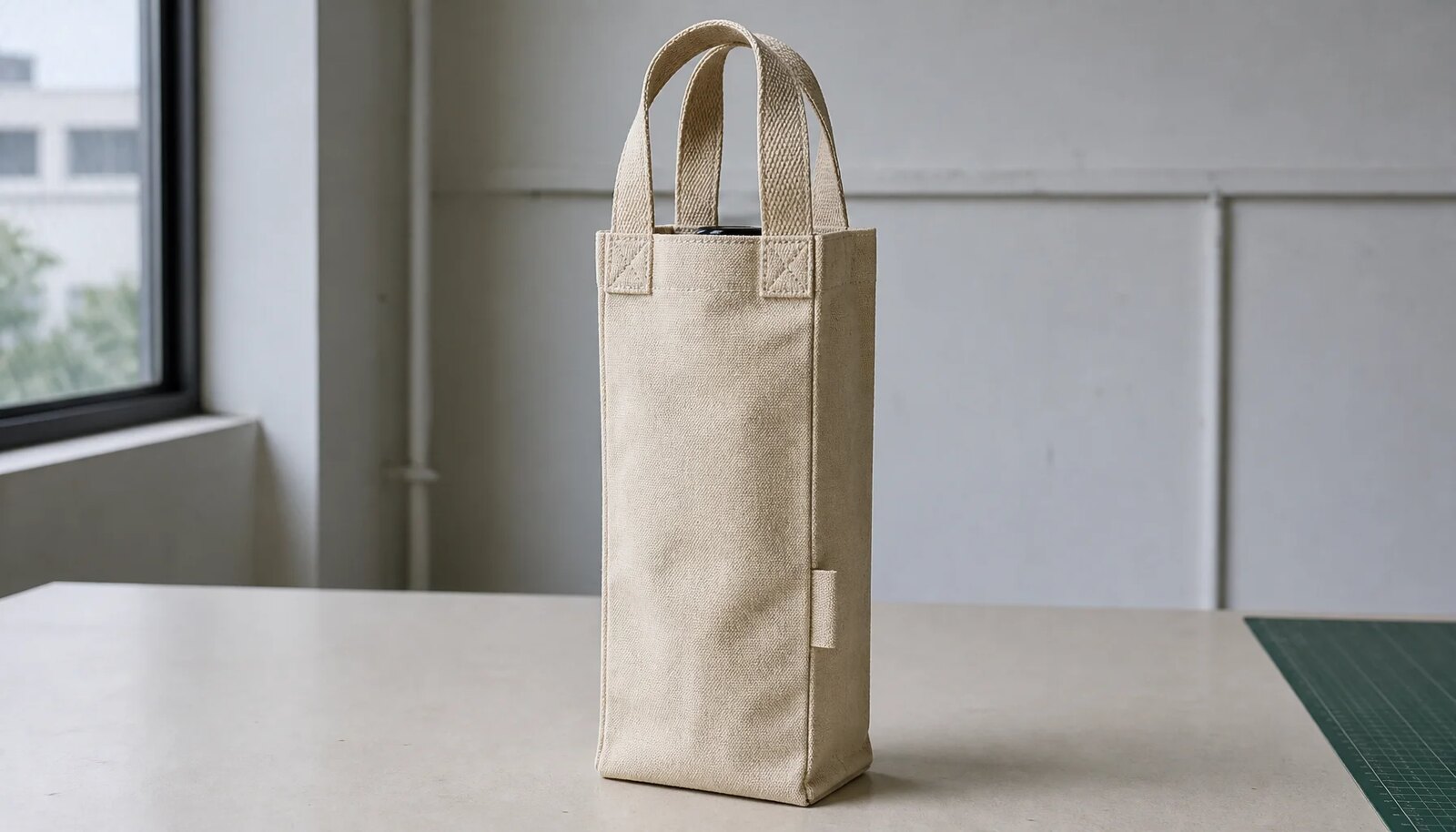
1. Start With the Bottle, Not the Bag
A custom canvas wine carrier can look like a simple sewn item until the order reaches the venue. Then the small decisions show up fast: a bottle that catches at the opening, a handle that pulls the front panel out of shape, a sponsor logo that curves awkwardly around the glass, or cartons that arrive with hard creases across the print. For B2B event buyers, fabric weight matters, but it should not be the first question. The first question is what bottle the carrier must hold and what route the carrier will travel before the guest sees it.
Ask the event team, winery, distributor, or gift-kit owner for bottle dimensions before the RFQ goes out. At minimum, collect diameter, total height, shoulder shape, neck height, and filled weight. A standard 750 ml still wine bottle often weighs roughly 1.2 to 1.5 kg when filled, but heavier glass, sparkling bottles, spirits, and larger formats can push the load higher. A Bordeaux bottle, Burgundy bottle, tall Riesling bottle, Champagne bottle, and many spirits bottles will not behave the same way in one pattern.
The route changes the build requirement. A tasting-table handoff for a short walk to a car is different from a sponsor gift staged in hotel rooms, a retail counter display, a winery club pack, or a welcome kit prepacked with other items. When staff must load hundreds of bags quickly, the opening size and base shape are operational details, not design preferences. When the carrier will be photographed, displayed, or handed to VIP guests, wrinkle control, logo placement, lint, and top-edge finish matter more.
Separate carry risk from presentation risk. Carry risk includes handle pullout, seam strain, bottle twisting, and base deformation. Presentation risk includes sagging panels, hard fold marks, uneven shade, lint, loose threads, and skewed branding. A heavier canvas can help, but it cannot rescue a narrow handle join or poor pattern. A lighter canvas can still work when the event route is short and the construction is clearly specified.
- List bottle diameter, height, shoulder profile, neck height, and filled weight before selecting canvas weight.
- Define whether the carrier is for handoff, hotel placement, sponsor gifting, retail resale, winery club use, or repeated reuse.
- Use the largest bottle profile in the range if one carrier must fit several SKUs.
- Treat upright display, pre-loading speed, and photo-readiness as sourcing requirements, not late-stage preferences.
2. Read Fabric Weight as a Range
Canvas weight is usually quoted in ounces, while many suppliers and QC teams also work in GSM. Use both. As a practical sourcing guide, 10 oz canvas is often around 280 GSM, 12 oz canvas is often around 340 GSM, and 14 oz to 16 oz canvas generally falls around 400 to 455 GSM. These numbers are helpful for comparing quotes, but they are not fixed laws. Mill standard, weave density, moisture, dyeing, washing, coating, pressing, and the point at which the fabric is measured can all shift the actual result.
For many custom canvas wine carriers, 12 oz canvas is the balanced baseline. It usually gives a one-bottle carrier enough body to feel intentional without the sewing bulk and carton weight that come with heavier construction. Event planners sourcing branded carriers often land here because it supports a clean hand feel, reasonable upright shape, and practical freight cost. It is not automatically premium, but it is rarely flimsy when the handle and base are specified well.
Ten ounce canvas can be the right answer for promotional programs where the route is short and budget matters. Think registration-desk handoffs, distributor promos, casual tasting giveaways, or high-volume events where the carrier is a branded convenience item rather than a reusable gift. The buyer risk is softness. Lighter fabric may show the bottle outline, sag under heavier glass, wrinkle after tight carton packing, or make a large logo look less controlled on the loaded panel.
Fourteen to sixteen ounce canvas is a better fit when structure and perceived value carry the brief. VIP gifting, retail resale, winery club presentation, sponsor packs, and reuse-focused programs can benefit from the heavier hand feel. The tradeoff is real. Heavier canvas may slow sewing, create bulky seams, show needle holes more clearly, resist folding, increase carton gross weight, and require more careful top-edge finishing. On a deadline-driven event order, those details affect cost and lead time.
- Use 10 oz canvas for cost-sensitive handouts with short carry routes.
- Use 12 oz canvas as the default starting point for balanced event quality.
- Use 14 oz to 16 oz canvas when structure, reuse, or retail presentation matters.
- Ask suppliers to state actual GSM tolerance and when the weight is measured in the production process.
3. Convert Weight Into a Real Specification
A fabric weight is only one line in the product spec. Two suppliers can both quote 12 oz canvas and deliver very different carriers because the weave, finish, pattern, handle width, thread, reinforcement, seam allowance, top binding, and packing are different. For procurement, the goal is not to buy a number. The goal is to create a repeatable product that can be sampled, costed, inspected, and received without argument.
Write dimensions around actual use. Include usable internal width and depth, finished height, base footprint, top opening, exposed neck height, and handle drop. Outside measurements alone can be misleading because seam allowance, fabric bulk, and base construction affect how easily a bottle slides in. A bottle may technically fit but still slow staff down if the opening is tight or the base collapses during loading.
Choose the base and top finish with the event route in mind. A boxed base helps the carrier stand and gives the bottle a more stable footprint. A flat construction may pack thinner but can look less structured when loaded. An open top with folded binding is common for events because it is simple, quick to use, and easy to inspect. A drawcord adds retention, but it also adds cord, channel sewing, possible hardware, and extra QC points.
Interior finish should also be named. Unlined canvas is economical and common, but inside seams should still be clean enough that the bottle label does not catch. A lining or bottom insert can lift the perceived value, especially for retail or VIP programs, yet it adds labor, thickness, MOQ pressure, and inspection complexity. Add tolerances before the PO. For many sewn textile orders, key dimensions around +/- 5 mm may be practical, with logo placement and GSM tolerances agreed separately based on method and supplier capability.
- Specify usable internal fit, not only outside measurements.
- Define base style, top finish, lining, insert, handle drop, and exposed neck height.
- Include tolerances for key dimensions, GSM, logo placement, and shade.
- Make the approved sample and written spec sheet the shared production standard.
4. Put the Load Where the Handle Can Take It
For a wine carrier, handle construction is where many weak specifications fail. A strong canvas body does not guarantee a strong carrier if the handle attachment is narrow, under-stitched, or placed where the loaded bottle pulls the fabric out of shape. The RFQ should name the handle material, handle width, handle drop, attachment length, reinforcement method, stitch density target, thread color, and load-test expectation.
Cotton webbing is a practical choice for many event programs because it is consistent, comfortable, and efficient to sew. Folded same-fabric handles can look more integrated, but they need careful construction so they do not twist, bunch, or become bulky at the join. Rope handles may suit some gift concepts, but they add questions about grommets, reinforced holes, knots, and pressure points. For most procurement-led orders, webbing or folded fabric handles with clear reinforcement are easier to compare across suppliers.
Ask for reinforcement in inspectable language. Bar-tacks, box stitching, and box-X stitching are more useful than a vague promise of reinforced handles. Attachment width matters because a narrow join concentrates stress. Stitch density matters because loose, uneven, skipped, or broken stitches can open after repeated lifting. Thread selection also matters, especially when heavier canvas and filled bottles are involved.
A practical carry check belongs in both sample approval and final QC. Use the intended filled bottle or a matched weight for the heaviest planned bottle. Lift the loaded carrier repeatedly, set it down, and inspect the handle joins, side seams, top edge, and base. The point is not to create an elaborate lab program for every event giveaway. The point is to catch visible strain, twisting, stitch loosening, fabric tearing, or base deformation before cartons leave the factory.
- Specify handle material, handle width, handle drop, attachment length, and reinforcement pattern.
- Ask for thread type, stitch density, and loaded-bottle test conditions.
- Inspect handle joins after carrying a loaded sample, not only in flat photos.
- Do not rely on heavier fabric to compensate for weak handle engineering.
5. Match Branding to Canvas Texture
Branding turns the carrier into a sponsor-facing product, and it is also where flat mockups can give buyers false confidence. Canvas has texture. It has seams, folds, slight shade variation, and a curved loaded shape. A logo that looks perfect on a PDF can lose fine detail on a heavy weave, sit too close to a handle join, rub during transit, or appear off-center once a bottle is inside.
Screen printing is usually the efficient default for simple one- or two-color marks. It can be clean, repeatable, and cost-effective at event quantities. Specify logo size, placement, color target, artwork format, and acceptable registration tolerance. Natural canvas is often easier for ink coverage than darker dyed canvas. On black, navy, burgundy, or other deep colors, opacity and underbase requirements may affect unit cost, setup cost, and sample timing.
Woven labels, printed labels, sewn patches, and fabric badges are useful when the brand needs a more premium finish or when the artwork is too detailed for reliable printing on textured fabric. These methods can reduce some print-cracking concerns, but they introduce different inspection points: label tilt, patch fraying, stitch security, placement drift, logo direction, and color matching between the label and the carrier. For retail resale or VIP gifting, that added control may be worth it. For a short-run giveaway, it may be unnecessary cost and MOQ pressure.
Set placement from the finished carrier, not just from a flat panel. Use reference points such as top edge, side seam, base fold, and handle attachment line. Keep branding away from heavy curvature and fold stress when possible. Ask for a photo of the logo on a loaded sample because the front panel changes shape around the bottle. This is especially important for large sponsor logos, centered crests, and marks with small type.
- Use screen print for simple logos, limited colors, and cost-sensitive event programs.
- Use labels or patches when premium appearance, fine detail, or long-life branding matters.
- Set logo placement from finished-bag reference points and inspect it on a loaded sample.
- Request a strike-off or branded sample when artwork detail, color matching, or fabric color creates risk.
6. Use Sampling to Prove the Order
A pre-production sample should answer the questions that a quote cannot. Does the bottle insert smoothly? Does the carrier stand? Does the handle feel secure? Does the logo stay visually centered when loaded? Does the fabric feel like the approved weight? Does the fold method create a hard crease across the front panel? Sampling is the buyer's last practical chance to correct these issues before bulk production starts.
The sample should use the intended fabric weight, handle material, thread, reinforcement, dimensions, branding method, and packing approach whenever possible. If the supplier must substitute material to speed up a sample, the substitution should be labeled clearly in writing. A 10 oz sample does not prove a 16 oz build. A natural canvas sample does not fully prove a dyed order. A blank sample does not prove logo opacity, print registration, label placement, or abrasion risk.
Test the sample the way staff will use it. Insert and remove the bottle several times. Carry it with the intended weight. Put it upright on the table. Fold it the way the factory plans to pack it. Open it again and check the front panel, top edge, base corners, handle joins, and interior seams. Look for lint, raw edges, loose threads, seam bulk, and any spot where the bottle label catches.
For larger or repeat orders, keep two sample references. One sealed golden sample should remain unchanged as the approval standard. A working sample can be measured, marked, photographed, and shared with the receiving or event operations team. Pair both with the written spec sheet, artwork approval, and packing instruction. That avoids the common problem where the buyer approves one physical bag, the supplier follows a slightly different drawing, and the destination team checks against a third interpretation.
- Do not release custom bulk production based only on a render or flat product photo.
- Test the sample with the actual bottle profile and filled weight.
- Label any sample substitution so it cannot become the accidental production standard.
- Keep a sealed golden sample and a working sample for inspection and receiving.
7. Compare Suppliers by What They Control
A lower unit price only helps when every supplier is quoting the same build. In practice, quotes change because suppliers adjust the fabric weight, weave, handle width, reinforcement, thread, lining, print setup, carton count, or packing material. Some changes may be acceptable. Hidden substitution is the problem. Procurement needs quotes that show exactly what construction decisions sit behind the price.
Ask who controls each stage: fabric sourcing, GSM verification, pattern making, cutting, sewing, printing, label attachment, trimming, inspection, packing, and shipment handover. A direct cut-and-sew factory can be useful for custom dimensions and repeat programs because sampling, bulk production, and QC sit closer together. A trading company can still be valuable for multi-category event kits, but the buyer should understand which factory is making the bag and how defects will be traced.
Unpack MOQ by component. Natural canvas with standard webbing and one-color screen print may support lower quantities than dyed canvas, custom woven labels, special patches, lined construction, bottom inserts, or individual retail packing. Instead of asking only for the minimum order quantity, ask which specification element drives the minimum. That gives the event team options: simplify the design, accept a setup charge, increase quantity, or preserve the premium detail.
Request price breaks in realistic bands. For many event programs, 300, 500, 1,000, 3,000, and 5,000 pieces are useful comparison points if those quantities match the business need. Separate unit price from screen setup, label setup, patch tooling, sample cost, individual packing, barcode labels, hangtags, carton marks, and inland handling. A clean quote reduces internal back-and-forth and makes tradeoffs easier to defend.
- Send the same written RFQ to every supplier so quotes describe the same build.
- Ask who controls fabric, cutting, sewing, branding, inspection, and packing.
- Identify MOQ drivers instead of treating MOQ as one fixed factory rule.
- Separate unit cost, setup cost, packing cost, and handling charges in quote comparison.
8. Make QC Criteria Visible Before Production
Quality control works best when the supplier knows the acceptance standard before production starts. For custom canvas wine carriers, inspection should cover material, dimensions, construction, branding, function, and packing. A general request for good quality leaves too much room for interpretation. A useful QC checklist connects directly to the approved sample and written spec sheet.
Material checks should happen before cutting. Confirm the production roll against the approved canvas weight, shade, weave, finish, odor, lint level, and hand feel. If GSM tolerance matters, ask the supplier to record the actual production-roll reading. Inspect for stains, oil marks, unexpected slubs, loose weave areas, and shade variation between rolls. Natural canvas can have small texture variation, so the buyer should distinguish acceptable fabric character from unacceptable defects.
Construction checks belong after sewing and before final packing. Measure usable width, depth, height, base footprint, top opening, exposed neck height, and handle drop. Inspect seam straightness, seam allowance, thread tension, skipped stitches, backstitching, handle reinforcement, top binding, base corners, lining placement, and bottom insert position if used. Then load the carrier with the intended bottle and check standing stability, insertion, removal, twisting, and handle strain.
Branding inspection should go beyond confirming that the logo exists. Check placement from agreed reference points, Pantone or approved color target, ink opacity, edge sharpness, registration, cracking, flaking, label tilt, patch stitching, and whether the logo still appears balanced when the carrier is loaded. For packing inspection, confirm fold method, inner quantity, carton count, gross weight, carton marks, logo-face protection, and whether packed samples develop hard creases or abrasion.
- Check fabric roll quality and GSM before cutting starts.
- Measure finished dimensions and handle drop after sewing, not only on paper patterns.
- Run a loaded-bottle fit and carry check before final packing.
- Inspect branding and packing as quality items, not afterthoughts.
9. Control Packing and Receiving
Packing determines how the carrier arrives, how quickly staff can stage it, and whether the logo still looks clean after transit. Canvas can collect lint, hold odor, crease under compression, and suffer print abrasion when logo faces rub together. A carrier can pass final inspection at the factory and still disappoint at the venue if fold direction, carton density, or carton labeling is wrong.
Bulk folded packing is often the most economical choice for event distribution. It can work well when the carrier is a practical giveaway and staff can do minor shaping before use. The buyer should still define fold direction, inner pack quantity, master carton quantity, carton size, and gross weight limit. If the printed logo is exposed to rubbing, ask about alternating folds, tissue, or another simple protective method depending on budget and visibility.
Premium programs may require individual polybags, tissue between logo faces, shaped packing, hangtags, barcode labels, or retail-ready carton organization. These details add cost and time, but they can reduce labor at the destination and protect sponsor presentation. If the bags are going to hotel rooms, VIP welcome kits, club shipments, or retail shelves, packing should be specified early enough for the supplier to source the materials and include them in the quote.
Carton details should match the receiving operation. Ask for carton dimensions, pieces per carton, gross weight, destination marks, PO numbers, SKU labels, barcode stickers, and mixed-carton rules if applicable. A carton that is too heavy can slow event staff. A carton packed too tightly can create hard creases. A carton packed too loosely can allow shifting and abrasion. Pre-shipment packing photos are a simple control for high-visibility or date-sensitive orders.
- Define fold method, carton quantity, carton size, and gross weight before production ends.
- Protect printed or labeled logo faces if presentation matters.
- Include warehouse labels, PO marks, and barcode requirements in the RFQ.
- Request packing photos for custom, premium, or time-sensitive event programs.
10. Build the RFQ Around Milestones and Acceptance
A strong RFQ makes supplier quotes easier to compare and reduces late-stage disputes. Start with the commercial facts: quantity, destination, target delivery date, fixed event date, trade terms, and whether the quote should include packing, labels, export cartons, documentation, inland handling, or only ex-factory product. Then define the carrier in enough detail that the supplier is not forced to guess.
The product section should include bottle profile, carrier dimensions, canvas weight in ounces and GSM, fabric type and color, handle material, reinforcement method, top finish, base construction, lining or insert, branding method, logo size, logo placement, artwork file type, packing method, carton requirements, and inspection expectations. If final artwork is not ready, describe color count, detail level, and expected print area so suppliers can quote setup and production risk more accurately.
Ask for a milestone schedule rather than one vague production lead time. Useful milestones include artwork review, sample production, sample transit, approval deadline, material procurement, cutting, sewing, branding, trimming, inspection, packing, and outbound handover. This helps buyers see which decisions protect the event date. Fabric procurement, dyeing, sample transit, and freight booking are often difficult to compress, while print simplification or standard packing may save time.
End with acceptance criteria. State that bulk production must match the approved sample and written spec sheet within agreed tolerances. Name the checks that matter: GSM, dimensions, bottle fit, handle reinforcement, loaded carry check, print placement, shade, stains, odor, loose threads, label position, fold method, carton marks, and pack count. When acceptance is visible before the PO, suppliers can price the real work and buyers can approve production with fewer surprises.
- Use one complete RFQ spec sheet for all suppliers.
- Request quantity breaks and separate setup charges.
- Ask for milestone timing with approval deadlines, not one vague lead time.
- Write acceptance criteria into the RFQ before issuing the purchase order.
Specification comparison for buyers
| Spec decision | Recommended option | When it fits | Buyer risk to check |
|---|---|---|---|
| Fabric weight baseline | 12 oz canvas, typically about 340 GSM before finishing | Most branded event wine carriers that need a clean hand feel, reasonable upright shape, and controlled freight cost | Ask for the quoted GSM range, actual production-roll reading, weave type, finish, and whether the weight is measured before or after washing, coating, dyeing, or pressing |
| Lightweight promo build | 10 oz canvas, typically about 280 GSM | High-volume giveaways, registration-desk handoffs, distributor promos, and programs where unit cost matters more than long-term reuse | Can sag around a 750 ml bottle, show bottle outline, wrinkle after tight carton packing, or look underbuilt if handle reinforcement is too small |
| Premium build | 14 oz to 16 oz canvas, typically about 400 to 455 GSM | VIP gifting, retail resale, winery club programs, sponsor packs, and bags expected to stand or be reused | Check sewing bulk, needle holes, top-edge waviness, carton gross weight, fold memory, and whether the heavier fabric slows production |
| Bottle fit standard | Spec around actual bottle diameter, height, shoulder shape, neck height, and filled weight | Orders that must fit still wine, sparkling wine, spirits, or mixed bottles without forcing | A standard 750 ml Bordeaux bottle is not the same as Burgundy, Champagne, Riesling, or many spirits bottles; confirm with dimensions or a physical bottle |
| Handle construction | Cotton webbing or folded same-fabric handles with bar-tack, box, or box-X reinforcement | Recurring event programs, guest take-home bags, and any carrier expected to hold a filled bottle confidently | Ask for attachment width, stitch density, thread size, handle drop, load-test method, and failure criteria after repeated lifting |
| Top and base construction | Open top with folded binding and boxed base for most events; drawcord only when retention matters | Tastings, hotel room drops, cellar-door sales, sponsor gifts, and staff-prepacked event kits | Drawcords add parts and sewing steps; undersized bases make bottles hard to insert and can make the bag lean or twist |
| Branding method | Screen print for simple logos; woven label, patch, or sewn badge for premium branding | One- or two-color sponsor marks, repeat artwork, club programs, retail resale, or brand-sensitive hospitality gifting | Verify print opacity, Pantone target, registration tolerance, abrasion, label tilt, placement from seams, and logo behavior on a loaded curved panel |
| Interior finish | Unlined with clean seam finishing for cost control; lining or bottom insert for premium presentation | Budget giveaways, reusable gift bags, retail-facing kits, and products where inside appearance affects perceived value | Unlined canvas can shed lint; linings and inserts increase labor, inspection points, MOQ, packing thickness, and replacement risk if poorly aligned |
| Packing route | Bulk folded pack for event distribution; individual polybag, tissue, or logo-face protection for premium gifting | Warehouse receiving, hotel drops, sponsor kits, retail display, and direct-to-venue delivery | Confirm fold direction, inner quantity, master carton count, carton size, gross weight limit, carton marks, rubbing risk, and whether hard creases are acceptable |
Buyer checklist before sampling
- Confirm the bottle profile before the RFQ: diameter, height, shoulder shape, neck height, punt depth if relevant, filled weight, and whether the same carrier must fit 750 ml Bordeaux, Burgundy, Riesling, Champagne, magnum, spirits, or mixed bottles.
- Define the use case in procurement language: short handoff, guest take-home, hotel room placement, sponsor gift, winery club shipment, retail resale, staff-prepacked kit, or repeated reuse.
- Lock the fabric weight in both ounces and GSM, and ask whether the supplier's stated weight is nominal, production-roll average, or finished-goods target after dyeing, washing, coating, pressing, or packing.
- Specify the canvas type and finish: cotton canvas or cotton-poly blend, plain weave or duck canvas, natural or dyed, soft hand or stiffer finish, washed or unwashed, and any odor or lint expectation.
- Provide exact carrier dimensions: usable internal width, depth, height, base footprint, top opening, exposed neck height, handle drop, and any divider, lining, or bottom insert requirement.
- Define dimensional tolerances that can be inspected, such as +/- 5 mm for key sewn dimensions on standard event orders, with tighter tolerances only where they are realistic and commercially justified.
- State handle material, handle width, attachment length, reinforcement pattern, stitch density target, thread color, and practical load test using the intended bottle weight.
- Decide branding before quoting: screen print, heat transfer, woven label, printed label, leather-like patch, cotton patch, embroidery, or sewn badge, plus logo size, placement, color count, and Pantone reference if applicable.
- Set artwork rules: vector file format, minimum line weight or small-type limits, print area from seams and folds, approval method, and whether a strike-off or branded sample is required.
- Set packing expectations: individual polybag or bulk pack, tissue or logo-face protection, inner pack quantity, master carton quantity, carton size, carton gross weight limit, carton marks, warehouse labels, and barcode stickers.
Factory quote questions to send
- What canvas weight are you quoting in ounces and GSM, and what tolerance will apply to the production roll, for example +/- 5% or another stated range?
- Is the fabric cotton canvas, cotton duck, cotton-poly canvas, or another blend, and is the quoted weight measured before or after dyeing, washing, coating, pressing, or finishing?
- Can you provide fabric inspection records or a production-roll GSM check before cutting starts, not only a showroom swatch or catalog description?
- What bottle dimensions did you use for the pattern, and can you test the sample with our supplied bottle dimensions or physical bottle before approval?
- Is the price based on direct factory production, or are fabric sourcing, cutting, sewing, printing, label application, or packing handled by separate subcontractors?
- Which part of the specification drives MOQ: fabric weight, dyed color, webbing, woven label, patch, screen print, lining, insert, custom carton, or individual packing?
- How does the unit price change at practical quantity breaks such as 300, 500, 1,000, 3,000, and 5,000 pieces, and are setup charges listed separately?
- What screen, label, patch, embroidery, thread color, carton, barcode, or sample setup costs apply, and are they one-time charges or repeated on future orders?
- Will the pre-production sample be made from the same fabric weight, handle material, thread, reinforcement pattern, print setup, dimensions, and packing method as bulk production?
- What dimensional tolerances do you recommend for width, depth, height, handle drop, logo placement, and base size on this construction?
Quality-control points to confirm
- Measure fabric weight from the actual production roll before cutting, using a repeatable method and recording the GSM result against the approved tolerance.
- Check fabric color, shade lot consistency, weave density, visible slubs, stains, oil marks, odor, lint level, hand feel, and whether the finish matches the approved sample.
- Confirm shrinkage or dimensional change if the fabric is washed, dyed, steamed, pressed, or otherwise finished before or after sewing.
- Verify carrier dimensions after sewing: usable internal width and depth, height, top opening, exposed neck height, base footprint, divider position, and handle drop.
- Test actual bottle fit with the intended bottle profile, checking insertion, removal, standing stability, top opening clearance, and whether the carrier twists when loaded.
- Inspect handle material, attachment width, stitch pattern, stitch density, thread tension, backstitching, bar-tacks or box-X reinforcement, and any skipped or broken stitches.
- Run a practical loaded-bottle carry check using the intended filled weight, then inspect for seam strain, handle pull, fabric tearing, stitch loosening, and base deformation.
- Inspect seam allowance, side seam straightness, base corner alignment, top binding, raw-edge control, lining attachment if used, and exposed thread ends.
- Verify print placement from agreed reference points, not from a flat mockup only; check color match, ink opacity, registration, edge sharpness, cracking, flaking, and coverage on textured canvas.
- Check woven labels, patches, or badges for centering, tilt, stitch security, frayed edges, color accuracy, logo direction, and consistent placement across cartons.