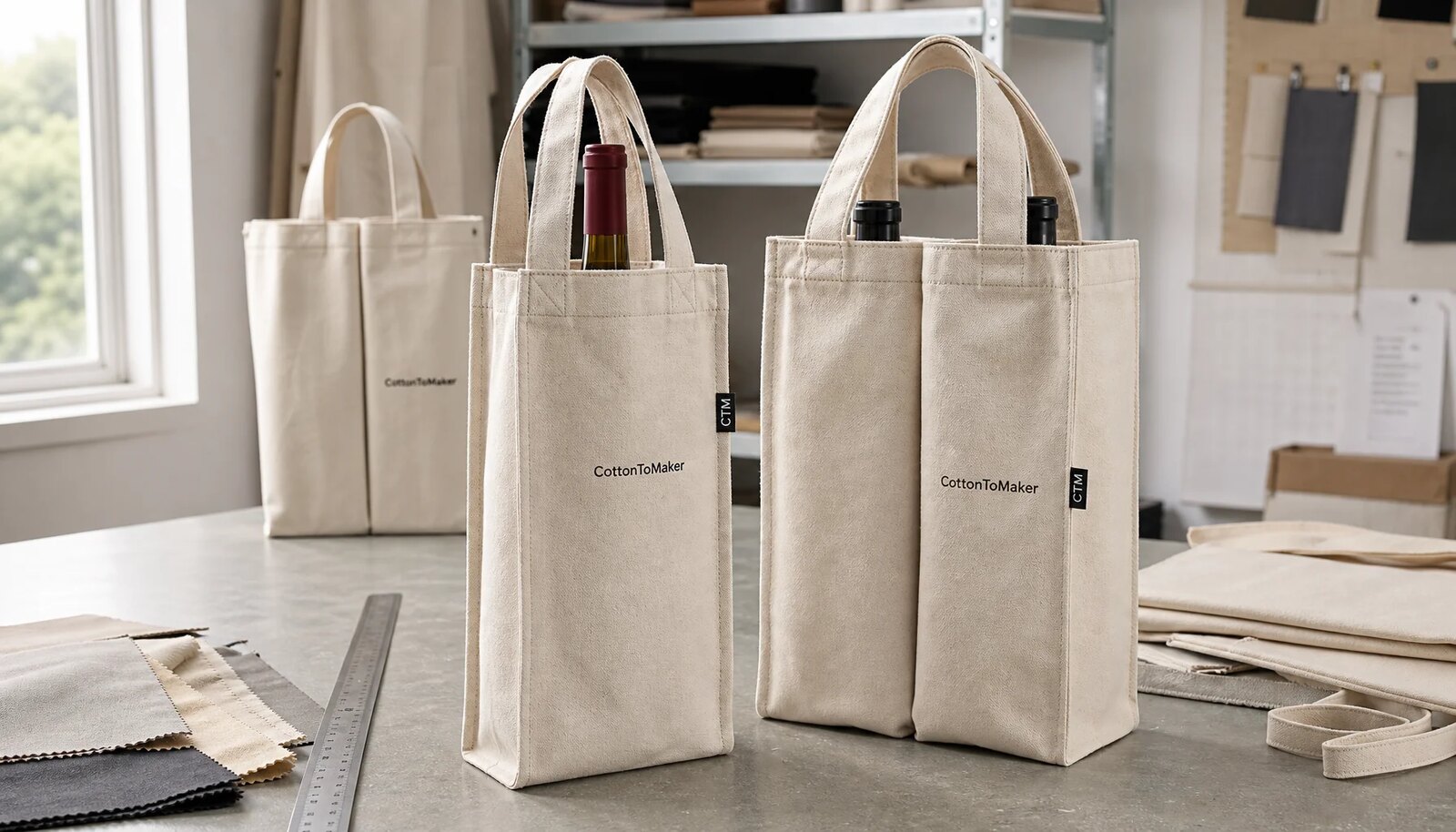
Start With the Buying Problem
A custom canvas wine carrier for craft fairs is a small product with very little room for vague sourcing. It carries a heavy glass bottle, presents a logo at eye level, and may be sold as a reusable add-on. If the RFQ only says heavy canvas wine bag or premium bottle carrier, each supplier will fill in the blanks differently. One factory may quote a light sleeve with simple topstitching. Another may assume reinforced handles, a boxed base, and retail packing. Both can sound correct on paper until samples arrive.
The first sourcing decision is not simply 10 oz versus 12 oz versus 14 oz canvas. Start with what the carrier must hold and how it will be used. A filled 750 ml wine bottle usually weighs about 1.2-1.6 kg, depending on glass weight and contents. Two bottles can put roughly 2.4-3.2 kg into a compact bag, and that load pulls hardest at the handle joints, top hem, side seams, base corners, and divider. Fabric weight matters, but it does not rescue weak construction.
Craft fairs add another layer of risk. Event dates do not move because a bag sample is late or a print is wrong. Defects are also visible to shoppers: permanent logo creases, twisted handles, a bag that will not stand, or an opening too tight for the featured bottle. The buyer's job is to convert the product idea into measurable specifications that a factory can price, a sample room can follow, and an inspector can verify before shipment.
- Define the carrier by load, bottle size, selling use, construction, and display expectation.
- Use canvas weight as one specification, not as a shortcut for strength.
- Treat the carrier as retail-facing packaging with functional load requirements.
- Give every supplier the same body size, fabric condition, print method, packing method, and QC plan.
- Approve a physical sample with the actual bottle before bulk production.
Fabric Weight: Oz, GSM, and Realistic Ranges
Canvas weight is usually stated in ounces per square yard or grams per square meter. Many U.S. buyers think in oz, while mills and factories may quote GSM. Put both in the RFQ. As practical sourcing references, 8 oz canvas is about 270 GSM, 10 oz is about 339 GSM, 12 oz is about 407 GSM, and 14 oz is about 475 GSM. These numbers are helpful, but they are not the whole story. Yarn, weave density, finishing, humidity, and washing can all affect the measured result and the way the fabric behaves in a sewn carrier.
For single-bottle craft fair carriers, 10 oz and 12 oz cotton canvas are usually the most practical starting points. Ten oz can balance cost, foldability, and printability when the handles and seams are reinforced. Twelve oz gives more body on the table and a more substantial handfeel, which helps when the carrier is sold rather than given away. For two-bottle carriers, 12 oz and 14 oz are safer starting points because the load is higher and bottle movement is harder to control.
Heavier canvas is not automatically the better buy. Sixteen oz canvas can feel premium, but it also increases seam bulk, sewing difficulty, carton volume, and freight impact. Thick fabric may create bulky handle joints, visible fold lines, and harder-to-control print surfaces. If the main risk is handle detachment, base sag, or divider movement, improved stitching and reinforcement often do more than adding another ounce of fabric.
The approved swatch should control production. If a supplier quotes 12 oz fabric, confirm whether that weight is measured before washing, after washing, after dyeing, or after coating. A production bag made from washed canvas can have a different handfeel, shade, shrinkage, and print surface than the original roll. Be precise now; it prevents arguments later.
- 8 oz, about 270 GSM: use only for decorative sleeves, light gift packaging, or short-use promotions.
- 10 oz, about 339 GSM: a good starting point for one-bottle carriers with reinforced handles.
- 12 oz, about 407 GSM: stronger retail feel for one bottle and entry point for two-bottle formats.
- 14 oz, about 475 GSM: useful for two-bottle carriers, premium gift sets, and upright booth display.
- 16 oz and above: specify only when the premium structure justifies sewing and freight tradeoffs.
- Control sample: approve fabric condition, shade, texture, handfeel, and print result, not only catalog weight.
Bottle Fit Comes Before Pattern Approval
Bottle fit is where many wine carrier projects fail. A supplier may make a clean sample around a slim Bordeaux bottle, while the buyer later packs Burgundy bottles, sparkling wine, cider, olive oil, syrup, vinegar, sauces, or mixed maker products. These bottles vary by diameter, shoulder shape, closure height, base width, and filled weight. A bag that looks right in a product photo can still reject the actual bottle at the booth.
The RFQ should name the largest bottle the carrier must accept. Provide maximum diameter or width, total height including cork, cap, or pourer, and filled bottle weight. For square, oval, or specialty bottles, include both width and depth at the widest point. If the carrier will be loaded with tissue paper, hangtags, recipe cards, ornaments, or gift inserts, give the opening enough clearance so staff can pack quickly without scuffing labels or forcing the bottle through the top.
Finished internal dimensions are what matter. Flat pattern measurements are useful for manufacturing, but they do not tell the buyer how much usable space remains after canvas thickness, seam allowance, gusset shape, divider seams, and top hems are sewn. A practical starting tolerance is +/-5 mm on key body dimensions and +/-10 mm on handle drop, but the right tolerance depends on bottle clearance. If the sample fit is already tight, normal production variation will make part of the order unusable.
For two-bottle carriers, fit also means separation and stability. Both bottles should load smoothly, stand evenly on a table, and stay apart while the shopper walks. A divider that is too short allows shoulder knock. A divider that is attached only at the top can twist. A divider that is too tight slows checkout. Test the pre-production sample with the widest and heaviest realistic bottle combination, not just the easiest pair to find.
- Provide bottle diameter or width, total height, closure height, and filled weight in the RFQ.
- Measure finished internal width, gusset depth, top opening, body height, divider height, and handle drop.
- Use the widest and tallest expected bottle for approval, not only a slim reference bottle.
- Allow clearance for tissue, tags, inserts, and bottle labels that must stay clean.
- For two-bottle carriers, test separation, table stability, and divider movement under real load.
- Reject patterns that only work when the bottle is forced into the carrier.
Construction Details That Control Strength
Wine carriers usually fail at stress points, not across the middle of the canvas panel. The handle attachment, top hem, side seams, bottom corners, divider seams, and base take the load. A 12 oz body with a narrow handle and one straight stitch line can look acceptable in a photo and still be a poor load-bearing product. Buyers should specify the build, not just the fabric.
A procurement-ready specification names the handle material, handle width, handle drop, attachment length, stitch pattern, thread color, thread type, and reinforcement method. Common handle widths for these carriers are roughly 25-38 mm, depending on style and load. Self-fabric handles give a matched look but add bulk where they enter the bag. Cotton webbing handles are efficient and strong, but the webbing color, weave, handfeel, and edge finish still need approval so the finished carrier feels intentional rather than patched together.
Box-x stitching, bar tacks, and reinforcement patches should be called out clearly. Decorative topstitching is not the same as load-bearing reinforcement. Ask the factory to show stitch pattern dimensions on the sample or measurement sheet. Stitch density also matters: too few stitches can open under load, while too many can perforate and weaken the canvas at the attachment point.
Do not overlook the base. A wine bottle has a narrow, rigid footprint; it is not soft cargo like a T-shirt. If the base seam is misaligned, the bottle tilts and the carrier looks unstable on a table. For two-bottle designs, the divider should be anchored at the base and sides so it actually separates the bottles during carrying. A floating divider can look fine when empty and fail as soon as the bag is loaded.
- Specify handle width, material, drop, attachment length, stitch pattern, thread, and reinforcement size.
- Require box-x stitching, bar tacks, or reinforced patches for filled-bottle use.
- Define seam allowance and top hem construction so cost reduction does not weaken edges.
- For two-bottle carriers, require divider attachment at the base and sides, not only the top edge.
- Check that heavy seams do not distort the printed panel or make the bag lean on display.
- Approve handle symmetry, top edge alignment, and bottom shape as part of retail appearance.
Canvas Finish, Color, and Material Claims
Fabric finish changes more than appearance. It affects cost, shrinkage, printing, handfeel, shade repeatability, and how the carrier packs. Natural unwashed cotton canvas is often a practical choice for craft fair wine carriers because it works with many logo colors, suits a handmade retail environment, and avoids separate dye-lot management. It also tends to keep panels crisper than washed canvas. The tradeoff is that natural canvas can show seed flecks, slubs, and shade variation, so the approved range should be clear.
Washed canvas gives a softer, more boutique handfeel, but it adds measurement risk. If fabric or finished bags are washed, final dimensions should be checked after washing, not before. Washed fabric may wrinkle more, shrink differently, and accept ink differently from unwashed fabric. A sample made in unwashed canvas is not enough to approve a washed production order unless the buyer accepts the change in size, surface, and handfeel.
Bleached and dyed canvas can strengthen the color story, especially for retail or winery programs with a fixed brand palette. They also add controls. Dark dyed canvas may need an underbase for light screen prints, which can raise cost and change handfeel. Bleached canvas may show handling marks during sewing and packing. Dyed fabric needs shade approval and a retained standard for repeat orders, because the next lot may not match without active control.
Sustainability claims need documentation. Organic cotton, recycled cotton, recycled blended yarn, low-impact dyes, and similar material choices can be valid procurement goals, but they should not be inferred from a natural canvas look. Ask what certificates, transaction documents, mill declarations, or material records are available before making claims on hangtags, product pages, or event materials. If documentation is not available, describe the material plainly.
- Natural unwashed canvas: efficient for mixed-logo programs, simple branding, and crisp panel shape.
- Washed canvas: softer handfeel, but approve shrinkage, wrinkles, shade, and final dimensions after washing.
- Dyed canvas: stronger color impact, but requires shade tolerance, colorfastness expectations, and repeat-lot control.
- Coated or water-repellent canvas: test odor, fold marks, print adhesion, and handfeel before bulk approval.
- Recycled or organic materials: request documentation before making any consumer-facing claim.
- Repeat orders: retain swatches and sealed samples for shade, handfeel, print opacity, and shrinkage comparison.
Print Method and Artwork Rules
Most custom canvas wine carriers for craft fairs use straightforward front-panel branding: winery names, farm marks, event artwork, maker logos, or seasonal graphics. Screen printing is usually the best starting point for one to three solid colors on cotton canvas. It is cost-effective at volume and can be durable when cured correctly. Still, coarse 10-14 oz canvas is not paper. Small type, thin lines, tight registration gaps, and delicate halftones can break up on the weave.
Heat transfer can handle gradients, photographs, and detailed full-color artwork, but it changes the surface feel and must be tested on the actual canvas finish. The wrong film or press setting can lead to edge lift, cracking, or a plastic hand. Embroidery can look premium for small crests, initials, or patches, but it becomes costly and bulky for large filled designs. Woven labels are useful when the front print changes by vendor or event but the buyer wants a consistent importer, retailer, or program identity.
Artwork placement should be measured from finished bag edges and the visual centerline. Cut-panel placement is not enough because gussets, seams, and top hems can shift the apparent center after sewing. For a typical front logo, buyers often use a print placement tolerance around +/-3 mm to +/-5 mm when the factory confirms it can hold that range. Keep artwork away from bulky seams, folded edges, and areas pressed by dividers or bottle corners.
Require a print strike-off or printed pre-production sample. It should use actual fabric, final ink or transfer material, final color standard, final curing method, and approved placement. Review opacity, edge definition, color match, rub resistance, fold behavior, and logo readability over seed flecks or slubs. For multi-vendor programs, price setup and screen charges by artwork version so design variety is visible in the total program cost.
- Screen print: best for bold one-color to three-color logos and event marks.
- Heat transfer: use for detailed graphics only after adhesion, edge lift, fold, and handfeel testing.
- Embroidery: suitable for small premium branding, not large filled artwork on flexible panels.
- Woven label: useful for permanent brand identity when front prints vary by vendor or event.
- Artwork limits: confirm minimum line width, smallest text size, registration tolerance, maximum print area, and safe seam distance.
- Approval: require a strike-off for color, opacity, placement, curing, rub resistance, and fold recovery.
MOQ, Quote Structure, and Cost Drivers
Craft fair procurement often includes variety: several vendor logos, seasonal graphics, regional artwork, or retailer-specific carton labels. The simplest cost structure is usually one body size, one fabric color, and multiple print designs. That allows the factory to consolidate fabric cutting and sewing while managing print setup separately. If each logo also changes the fabric color or body shape, MOQ and cost usually rise.
A useful quote separates the sewn body from decoration and packing. Ask suppliers to state the cutting and sewing MOQ, MOQ per print design, screen or plate charge per artwork, color change charge, label setup, sample cost, carton quantity, and packing upgrade cost. Otherwise, a low unit price may hide assumptions about weak construction, bulk packing, or expensive setup charges added later.
Main cost drivers include fabric weight, fabric consumption, handle length, divider construction, reinforcement operations, print size, number of print colors, labels, individual packing, carton volume, and inspection requirements. Moving from 12 oz to 14 oz can increase material cost and reduce units per carton. A two-bottle divider adds material and sewing operations. Individual polybags, paper bands, or vendor bundles add packing labor. These options should be priced visibly before the purchase order is issued.
For distributors, wineries, and event organizers, include a line-item matrix with the RFQ. List design name, artwork file, body color, print colors, quantity, label, hangtag, packing method, carton label, and required ship date. This reduces wrong-artwork risk and helps the supplier plan screens, cutting, sewing, and packing. It also gives procurement a better view of total program cost instead of a headline unit price.
- Lowest complexity: one size, one natural canvas body, one logo, one carton mark, and bulk packing.
- Controlled variety: one body with multiple print designs and separate setup charges by artwork.
- Higher complexity: multiple fabric colors, body sizes, labels, hangtags, and retailer packing rules.
- Quote fabric, sewing, print, label, packing, sample, inspection, and commercial terms as separate lines.
- Ask for option prices for heavier canvas, upgraded handles, divider changes, individual packing, and carton limits.
- Compare total program cost, including setup, inspection, packing, freight impact, and repeat-order charges.
Sample Approval and Pre-Production Testing
A showroom sample proves the style direction. It does not prove production readiness. For a canvas wine carrier, the approval sample should use the actual fabric weight, actual finish, actual handle material, actual reinforcement, actual divider, actual print process, actual label, and proposed packing fold. If the sample uses substitute fabric, blank panels, or temporary handles, record the substitution and require a corrected pre-production sample before bulk production.
Sample review should be physical and measurable. Measure finished internal width, gusset depth, body height, top opening, divider height, handle width, handle drop, print placement, and carton fold. Compare the results to the specification and tolerance. Load the sample with the target filled bottle or bottles and carry it by the handle. Then hang it for at least 30 minutes, or for the duration agreed in the buying spec, and inspect handle joints, seam opening, thread breakage, base sag, divider movement, fabric elongation, and print cracking.
Also test booth usability. Can staff insert bottles quickly without forcing? Does the carrier stand on a table when loaded? Does the handle feel comfortable enough for a shopper walking around a fair? Does the logo stay visible with the bottle inside? Does a two-bottle carrier lean outward or knock at the shoulders? These checks sound simple, but they catch problems that measurement alone can miss.
Packing should be approved at the sample stage. Fold or flat pack the sample the way the factory proposes, leave it under normal carton compression, and inspect the printed panel after 24 hours. Some folds create permanent creases through the logo or deform the divider. If individual packing is required, approve the bag size, warning text if applicable, barcode sticker, belly band, or carton separation method. Keep a sealed approved sample and measurement sheet for inspection.
- Approve actual production materials and methods, not substitute fabric or a generic blank sample.
- Measure finished dimensions and record tolerances before issuing the bulk purchase order.
- Load test with real filled bottles or equivalent weight, not empty glass bottles.
- Check booth function: loading speed, table stability, handle comfort, logo visibility, and divider behavior.
- Test packing for logo creases, handle twist, divider deformation, and carton sorting accuracy.
- Keep a sealed control sample, fabric swatch, strike-off, and measurement sheet for QC reference.
Production QC: Defects, Tolerances, and Tests
Quality control for canvas wine carriers should combine normal bag inspection with wine-specific function checks. Standard checks cover stains, shade variation, loose threads, skipped stitches, needle damage, print defects, wrong labels, incorrect carton marks, and quantity errors. Wine-specific checks cover bottle fit, loaded handle strength, base sag, bottle tilt, divider stability, and print damage after folding.
Agree on defect classification before production. Critical defects include handle detachment, seam opening under load, fabric tearing, or any condition that prevents the carrier from safely holding the intended bottle. Major defects include wrong fabric weight, wrong artwork, wrong print color, severe print misplacement, unusable bottle fit, broken divider, visible stains, or incorrect quantity by design. Minor defects may include small thread ends, slight wrinkles, small natural cotton specks, or alignment variation within the approved tolerance.
Inspection should use finished-goods tolerances, not pattern tolerances. A practical starting point is +/-5 mm for body dimensions, +/-10 mm for handle drop, and +/-3 mm to +/-5 mm for print placement where the factory confirms capability. Fabric weight tolerance should be agreed with the supplier and checked against the same finished fabric condition as the approved swatch. Natural canvas shade should be compared to an approved range, not judged from memory.
Functional tests need clear pass/fail rules. Define the bottle weight, number of bottles, hanging duration, sample size, and inspection points. After the loaded test, inspect handle stitches, reinforcement patches, top hems, side seams, base corners, divider seams, and fabric elongation. For print, use rub, tape, fold, or wash-related checks only when they match the print method and product claim. For packing, open cartons from different parts of the shipment and confirm fold method, design separation, moisture protection, carton marks, and count accuracy.
- Critical: handle fails, seam opens, fabric tears, or the intended filled bottle cannot be carried safely.
- Major: wrong GSM, wrong artwork, wrong color, severe print shift, broken divider, visible stain, or wrong design count.
- Minor: small thread end, slight wrinkle, acceptable cotton fleck, or small variation within tolerance.
- Measure finished carriers across cartons, colors, and artwork versions, not only top-of-carton samples.
- Run loaded bottle tests and inspect handles, seams, base, divider, and elongation after testing.
- Verify cartons for logo protection, design separation, carton marks, moisture exposure, and count accuracy.
Packing and Logistics for Event Deadlines
Craft fair programs are deadline-driven. A carrier that arrives late, crushed, or packed in confusing mixed cartons can miss the selling window even if the sewing is acceptable. Packing specifications belong in the RFQ, sample approval, and final inspection checklist. State whether carriers are bulk packed, individually packed, belly-banded, bundled by vendor, separated by artwork, or labeled for store or booth distribution.
Flat packing is usually efficient for canvas wine carriers, but it should not create permanent creases through the logo. Light folding can reduce carton volume, yet over-compression may crush dividers, twist handles, and make the product look shopworn. For two-bottle carriers, the divider should recover its shape after unpacking. If cartons will be stacked or palletized, define carton strength and moisture protection suitable for the shipping route.
Carton labeling matters when one order contains many designs. Each carton should show design name or code, quantity, color, PO number, and destination or event code if needed. Avoid mixed-design cartons unless the buyer approves a clear assortment plan. Wrong sorting can create urgent labor at the booth or leave one vendor without merchandise on opening day.
Break lead time into stages: fabric procurement, sample making, strike-off approval, bulk cutting, printing, sewing, finishing, inspection, packing, inland transport, export, and final delivery. Do not rely only on one total lead-time number. If the event date is fixed, build in time for sample corrections and final inspection. Rushing print curing, packing recovery, or carton labeling is an easy way to create defects right before the deadline.
- Define packing method, fold direction, logo protection, carton count, carton dimensions, and compression limits.
- Separate or clearly label designs by vendor, artwork code, body color, and purchase order.
- Avoid tight folds through heavy ink areas or across divider structures.
- Check carton recovery by opening packed samples and inspecting creases, handle twist, and divider shape.
- Break lead time into sampling, approvals, production, inspection, packing, and shipping stages.
- Reserve time for sample corrections before the craft fair delivery deadline.
Specification comparison for buyers
| Spec decision | Recommended option | When it fits | Buyer risk to check |
|---|---|---|---|
| Single-bottle fabric weight | 10 oz or 12 oz cotton canvas, approximately 340-407 GSM, verified on the finished fabric condition | Craft fair add-ons, winery checkout bags, bottle gifts, and branded retail packaging for one filled 750 ml bottle | Do not judge strength by GSM alone; confirm handle reinforcement, seam allowance, base construction, and loaded hanging performance |
| Two-bottle fabric weight | 12 oz or 14 oz canvas, approximately 407-475 GSM, with anchored center divider and reinforced handles | Wine pair bundles, holiday gift packs, tasting-room sets, craft beverage duos, and higher-value booth merchandise | A higher GSM will not prevent bottle knock if the divider is loose, too low, or attached only at the top edge |
| Lightweight economy option | 8 oz canvas, approximately 270 GSM, only for decorative sleeves or short-use gift packaging | Low-cost giveaways where the bottle is carried briefly and the bag is not sold as a durable reusable item | May collapse on display and show bottle shape; require buyer approval if the supplier proposes it as a cost-down alternative |
| Dimensional tolerance | Typical finished-goods tolerance of +/-5 mm for key body dimensions and +/-10 mm for handle drop, unless the design requires tighter control | Works for most cut-and-sew canvas wine carriers where natural fabric and sewing variation are expected | Tolerance must apply to finished usable dimensions, not cut panels; tight bottle fit needs a larger safety allowance |
| Handle construction | 25-38 mm cotton webbing or self-fabric handle with box-x stitching, bar tack, or reinforced patch | Repeated carrying of filled bottles and retail sale where the carrier must feel secure in hand | Single-row decorative stitching can fail under concentrated bottle load; ask for stitch pattern, thread type, and reinforcement size |
| Bottle fit | Size to the largest expected filled bottle, not only a slim Bordeaux reference bottle | Programs covering wine, cider, olive oil, vinegar, syrup, sauces, sparkling beverages, or mixed maker products | A carrier that fits a standard 750 ml Bordeaux bottle may reject wider Burgundy, sparkling, or square-shoulder bottles |
| Print method | Screen print for 1-3 solid colors; heat transfer for detailed artwork only after adhesion and fold testing | Craft fair logos, winery marks, farm names, event graphics, regional artwork, and simple retail branding | Small text, fine lines, and heavy ink coverage can break up on coarse canvas; require a strike-off on actual fabric |
| MOQ structure | Quote one body size and fabric color, then split by print design where possible | Multi-vendor craft fairs, distributors, event organizers, and seasonal programs with several logos | Separate sewn-body MOQ, print-design MOQ, screen charges, label setup, and packing costs; otherwise quotes are not comparable |
| Packing method | Flat pack or light fold with logo panels protected and dividers not crushed | Bulk craft fair sorting, booth-side unpacking, and carton-efficient shipping | Over-compression causes permanent logo creases, divider distortion, twisted handles, and shopworn presentation |
Buyer checklist before sampling
- Define the selling use: free giveaway, paid craft fair add-on, winery tasting-room item, retail resale carrier, or premium gift pack.
- State the bottle format: one 750 ml bottle, two 750 ml bottles, oversized sparkling bottle, olive oil bottle, syrup bottle, sauce bottle, or mixed bottle program.
- Provide actual bottle dimensions: maximum diameter or width, total height including closure, shoulder width if relevant, and filled bottle weight in grams.
- Specify canvas weight in both oz per square yard and GSM; avoid terms such as heavy duty, thick, premium, or market grade without numeric targets.
- Confirm fabric composition and finish: natural, bleached, dyed, washed, recycled cotton blend, organic cotton, laminated, coated, or water-repellent treated.
- Require finished dimensions: internal width, gusset depth, body height, top opening, divider height, handle width, handle drop, seam allowance, and tolerances.
- Set practical tolerances before sampling, such as +/-5 mm for body dimensions, +/-10 mm for handle drop, and +/-3 mm for print placement where feasible.
- Define handle material, width, length, attachment point, stitch pattern, bar tack or box-x size, reinforcement patch, thread type, and thread color.
- For two-bottle carriers, define divider height, divider material, base attachment, side attachment, top finishing, and acceptable bottle movement.
- Match artwork to print method: screen print for solid marks, heat transfer for detailed graphics, embroidery for small premium marks, and woven labels for permanent branding.
Factory quote questions to send
- What exact canvas weight is quoted in oz per square yard and GSM, and is it measured before washing, after washing, or after coating or finishing?
- What is the fabric composition, weave, yarn count or density if available, color, finish, and expected shrinkage range for the quoted material?
- Is the quoted fabric natural greige, bleached, dyed, washed, enzyme washed, recycled blend, organic cotton, laminated, coated, or water-repellent treated?
- What finished dimensions are included for internal width, gusset depth, body height, top opening, divider height, handle drop, and handle width?
- What production tolerance do you apply to finished body dimensions, handle drop, print placement, fabric weight, and carton quantity?
- Which bottle size and filled weight did you assume when quoting, and can you test the sample with our actual bottle dimensions or shipped bottles?
- What handle material, handle width, stitch type, stitch density, thread specification, reinforcement patch, and attachment method are included in the price?
- For two-bottle carriers, how is the divider attached at the base, side seam, and top edge, and what prevents bottle knock during carrying?
- Which print method is quoted, how many colors are included, what is the maximum print area, and what setup charge applies per artwork version?
- What artwork limitations should we follow for minimum line width, small text, halftones, gradients, registration, and distance from seams or folded edges?
Quality-control points to confirm
- Fabric weight is checked against the approved swatch and quoted tolerance using the same finished condition as production, such as unwashed, washed, coated, or dyed fabric.
- Finished dimensions are measured on completed carriers, not cut panels, including internal width, gusset, body height, top opening, divider height, handle drop, and handle width.
- Single-bottle carriers accept the approved bottle without side seam stress, top opening distortion, excessive base sag, or visible bottle tilt.
- Two-bottle carriers keep both bottles separated during loading, carrying, and table display, with no divider collapse, twisting, or pulling away from base seams.
- Handle reinforcement matches the approved sample in stitch pattern, bar tack or box-x size, stitch density, thread color, reinforcement placement, and attachment symmetry.
- Loaded hanging tests use filled bottles or equivalent weight for the agreed duration, with no stitch opening, thread breakage, fabric tearing, seam distortion, or excessive handle elongation.
- Print position is measured from finished edges and visual centerline, with agreed tolerance, because sewing and gusset shaping can shift the apparent center.
- Ink or transfer quality passes agreed checks for opacity, color match, adhesion, curing, edge definition, rub resistance, and appearance after folding.
- Natural canvas shade, seed flecks, slubs, and weave variation remain within the approved range and do not interfere with logo readability or retail appearance.
- Stains, oil marks, needle damage, skipped stitches, loose threads, puckering, uneven top edges, wrong labels, and wrong artwork are classified before production inspection.