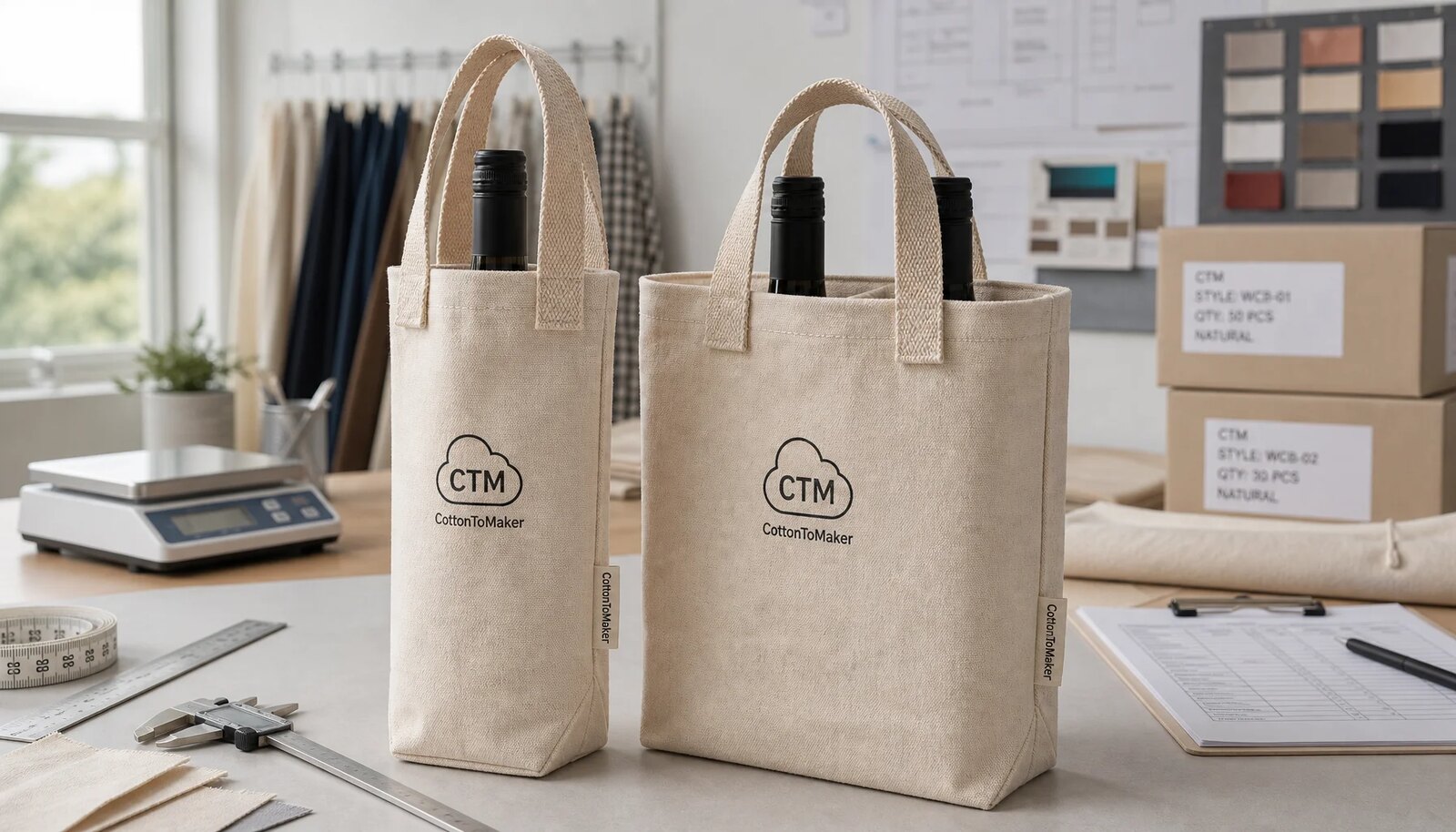
Start With the Real Buying Risk
Custom canvas wine carriers look straightforward, but they carry glass, weight, condensation risk, and a visible brand mark in a busy selling environment. At a craft fair, a weak handle, stained logo panel, loose divider, or awkward bottle fit is noticed immediately by booth staff and customers. For procurement, the goal is not simply to buy a nice-looking bag. The carrier must fit the selected bottle, hold the load, present the artwork cleanly, arrive before the event, and be packed so teams can distribute stock without extra sorting.
Most sourcing issues begin with loose product language. If the brief says only custom canvas wine carrier, suppliers may quote very different constructions. One may price 8 oz natural cotton canvas with a simple bottom seam. Another may quote 12 oz canvas, boxed corners, and a sewn divider. A third may assume a stock promotional tote with thin handles and flat packing. All can sound reasonable in email, but their costs and failure points are not comparable.
A supplier compliance checklist converts the product into measurable decisions: bottle dimensions, finished size, fabric weight, construction, decoration method, tolerances, packing, inspection, and approval gates. It also limits silent substitutions when material is short or the production calendar is tight.
- Use one approved reference bottle for fit and load testing.
- Quote single-bottle, two-bottle, champagne, and gift-set carriers as separate SKUs.
- Treat the craft fair delivery date as a production requirement, not a preference.
- Require written approval for changes to canvas, handles, dividers, artwork, labels, or packing.
- Keep a signed control sample with the buyer and a sealed matching sample with the supplier.
Define the Bottle Before the Bag
Bottle fit is the first specification. A carrier can stand neatly when empty and still fail when the real bottle is inserted. A standard 750 ml Bordeaux bottle is often about 300 mm high and 73 to 76 mm in body diameter, but shapes vary. Burgundy bottles are wider with sloped shoulders. Riesling bottles are taller and slimmer. Champagne bottles are usually wider, heavier, and more demanding on the bottom seam. Olive oil, spirits, and gift sets may add square shoulders, unusual bases, or outer cartons.
The supplier should not guess. Provide a physical bottle, drawing, or measurement table with total height, maximum body diameter, shoulder diameter, base diameter, and filled weight. Filled weight matters because a full 750 ml wine bottle often weighs about 1.2 to 1.5 kg depending on glass weight. A two-bottle carrier may therefore carry roughly 2.4 to 3.0 kg before any gift insert, tag, or sleeve is added.
Once the bottle standard is fixed, the bag dimensions can be checked with less ambiguity. The opening should accept the bottle without forcing. The gusset should support the base without rounded distortion. The height should match the presentation goal: mostly covered, neck-exposed, or gift-ready. For multi-bottle carriers, divider height and bottom attachment are fit requirements, not decorative details.
- List bottle height, maximum diameter, shoulder diameter, base diameter, and filled weight in the RFQ.
- Test champagne, sparkling wine, olive oil, and gift-set bottles separately from standard wine bottles.
- State whether the neck should remain visible for presentation or covered for protection.
- For two-bottle carriers, require a divider test using two filled bottles.
- Ask for fit-test photos with a ruler and the approved reference bottle before sample approval.
Write a Quote Sheet That Prices One Product
A good RFQ makes every supplier quote the same item. The sheet should include style name, SKU, bottle standard, carrier format, finished dimensions, canvas specification, handle construction, bottom construction, divider construction, decoration method, labels, packing, carton data, inspection expectations, delivery terms, and required event date. Each line should be written as a requirement or a supplier-confirmed option.
Finished dimensions need workable tolerances. Practical starting points for sewn canvas wine carriers are width ±5 mm, gusset ±5 mm, height ±8 mm, handle drop ±8 mm, and logo placement ±3 to 5 mm, depending on print method and construction. Tighter limits may be possible, but the factory should confirm before they appear on the purchase order. Cotton canvas moves during cutting, sewing, washing, pressing, and packing, so impossible tolerances create arguments instead of control.
The RFQ should also state what cannot change without buyer approval. Watch for thinner canvas, substitute webbing, adjusted handle drop, omitted reinforcement, altered divider attachment, changed ink, different labels, higher carton count, or a new fold method. A short no-substitution clause is often more useful than another page of general quality language.
- Core fields: bottle standard, finished dimensions, fabric weight, color, finish, handles, divider, print method, labels, packing, carton data, and delivery date.
- Commercial fields: MOQ, price breaks, setup charges, sample fees, screen charges, packing charges, carton data, and payment terms.
- Approval fields: artwork proof, fabric swatch, strike-off, pre-production sample, packing sample, in-line photos, and final inspection report.
- Tolerance fields: width, height, gusset, bottom width, handle drop, handle width, print position, logo tilt, and divider position.
- Substitution controls: require approval before changing material, trim, construction, decoration, label, carton count, or fold method.
Control Canvas Weight, Finish, and Color
Canvas affects cost, strength, hand feel, print quality, shape retention, and freight weight. For many reusable craft fair wine carriers, 10 oz to 12 oz cotton canvas is a practical starting range. An 8 oz canvas can work for lightweight giveaways, but it usually feels softer and less structured. For paid merchandise, premium gifts, or heavier sets, 14 oz to 16 oz canvas may be worth considering if the buyer accepts higher material cost, heavier cartons, and stiffer folding.
Ask for both oz/yd² and GSM. Fabric names are not consistent, and 12 oz style is not the same as a measured fabric record. As a rough conversion, 1 oz/yd² is about 33.9 GSM, so 10 oz is about 339 GSM, 12 oz is about 407 GSM, and 16 oz is about 542 GSM before finishing differences. Suppliers may quote greige weight, finished weight, nominal weight, or a mill style number. Procurement should ask when and how the weight is measured.
Finish and shade need approval. Natural canvas may show cotton seeds, slubs, and shade movement; that can suit a craft-fair look, but the acceptable limit should be visible in the signed swatch. Bleached or dyed canvas gives a cleaner brand color but may introduce dye-lot variation and higher MOQ. Washed canvas feels softer but can shrink or distort. Coatings or water-resistant finishes should be checked for odor and logo adhesion.
- Baseline option: 10-12 oz cotton canvas, about 339-407 GSM, for most reusable craft fair programs.
- Budget option: 8 oz canvas, about 271 GSM, for simple promotional giveaways where structure is less important.
- Premium option: 14-16 oz canvas, about 475-542 GSM, for heavier gift sets or stronger retail presence.
- Fabric approval should cover composition, nominal weight, measured GSM, finish, color, shade tolerance, shrinkage expectation, and swatch sign-off.
- Reject vague terms such as heavy canvas or premium cotton unless supported by measurable fabric details.
Specify the Load-Bearing Construction
A wine carrier is a load-bearing package, not a narrow tote with a print. The bottom and handle roots deserve close attention because they carry filled glass. A simple bottom seam may be acceptable for a low-cost single-bottle giveaway. A flat gusset improves standing stability and gives the logo panel a cleaner shape. Boxed corners or an added bottom layer can improve structure, but they also add material, sewing time, thickness, and packing volume.
Divider design is a major difference between a cheap two-bottle carrier and a reliable one. A divider sewn into the side seams and bottom seam gives stronger separation and reduces glass-to-glass contact during normal carrying. A divider attached only near the top can swing or fold, allowing bottles to meet at the base. A removable divider can help with flexible gift packaging, but it must be shaped, packed, and counted consistently.
Handles should be defined by material, width, drop, attachment length, and reinforcement. Cotton webbing is common because it is consistent and easy to inspect. Self-fabric handles can look integrated but require careful sewing. For hand carry, many buyers start with a handle drop around 100 to 150 mm, then adjust after testing the actual bottle and bag height. Reinforcement may include bartacks, box-and-cross stitching, back-tacking, folded webbing ends, or reinforcement patches.
- Bottom options: simple seam for low-cost use, flat gusset for better standing, boxed corners for structure, or extra bottom layer for heavier loads.
- Divider options: sewn-in divider for stable separation, removable divider for flexible gift sets, or no divider only when glass contact is acceptable.
- Handle specification: material, width, finished drop, attachment length, reinforcement stitch, thread color, and loaded-test requirement.
- Stitch standard: define seam allowance, stitch density, back-tack length, thread type, skipped-stitch limit, and trimming standard.
- Acceptance point: no tearing, open seam, handle pullout, divider detachment, or bottom failure after the agreed loaded test.
Approve Branding on the Actual Fabric
At a craft fair, the front panel sells the brand before anyone reads a tag. Decoration defects are commercial defects. Screen printing is often the most controlled option for solid logos, event names, and one- to three-color artwork on cotton canvas. It can give good coverage on textured fabric, but buyers still need to approve ink color, opacity, curing, hand feel, and placement on the selected canvas weight and shade.
Other decoration methods can work when the artwork requires them. Heat transfer may suit detailed graphics or short runs, but buyers should inspect edge visibility, gloss, stiffness, cracking, and adhesion. Digital print can carry more detail, though the weave may affect sharpness and saturation. Embroidery can look premium but may pucker lighter canvas and make small text hard to read. Woven side labels are useful when the same brand identity repeats across changing event artwork.
Artwork instructions should be measurable. Provide vector files, Pantone or brand color references, final print size, placement dimensions, color count, and a proof marked for orientation. Placement should be measured from a clear reference point: top edge, side seam, centerline, or bottom seam. If panels are printed before sewing, inspect printed panels before assembly; rejecting an off-position panel is cheaper than sorting finished carriers.
- Screen print: suitable for solid marks, event graphics, and most bulk cotton canvas wine carrier programs.
- Heat transfer: approve edge feel, gloss, stiffness, cracking, adhesion, and dry/damp rub performance.
- Embroidery: test for puckering, thread coverage, reverse-side finish, and readability on the chosen canvas weight.
- Artwork file requirements: vector file, Pantone targets, final print size, placement from reference points, minimum line width, and approved proof.
- QC checks: verify color, coverage, curing, tilt, centerline, edge distance, contamination, and dry/damp rub performance.
Normalize Cost, MOQ, and Lead Time
A quote is only useful when the assumptions are visible. MOQ may be driven by fabric roll size, dye lot, cutting efficiency, screen setup, handle tape, divider labor, label sourcing, and packing method. Natural canvas with one-color print may support a lower MOQ than custom-dyed canvas with embroidery and retail labels. Multiple artwork versions may share the same fabric, but they can still require separate screens, strike-offs, setup time, carton marks, and SKU separation.
Ask suppliers to separate unit cost from setup and variation cost. A low unit price may exclude screens, sample fees, hangtags, barcode labels, inner bags, carton labels, inspection support, upgraded cartons, or special folding. If those charges appear after sample approval, the program can exceed budget at the worst time. A standardized quote table keeps the decision grounded.
Compare landed event-ready cost, not only ex-factory price. Thicker canvas, sewn dividers, individual packing, retail bands, and loose carton packing can increase CBM and freight. Retail-ready packing may raise unit cost while reducing warehouse sorting and event allocation work. For craft fairs, a small unit-price saving is rarely worth a missed delivery window.
- Ask for price breaks at realistic quantities such as 500, 1,000, 2,500, and 5,000 pieces.
- Separate bag sewing, decoration setup, decoration unit cost, labels, hangtags, inner packing, carton labels, and inspection support.
- Request MOQ by fabric color, artwork version, print color count, carrier format, divider type, and packing method.
- Compare single-bottle and two-bottle styles separately because dividers affect labor, material, inspection, and carton volume.
- Confirm sample lead time, revision lead time, bulk lead time, material approval deadline, and final ship date in writing.
Ask for Order-Specific Evidence
Useful supplier evidence should connect directly to the order being quoted. Broad quality claims, old catalogue photos, and generic certificates do not prove that the supplier can control this carrier. Ask for current fabric swatches, measured GSM records or fabric cards, reinforcement photos, print strike-offs, sample-room photos, in-line production photos, final inspection reports, and packed-carton examples. The purpose is to confirm control over the material, construction, logo, and packing that will ship.
Outsourcing is common and not automatically a problem. Printing, embroidery, dyeing, washing, label production, or inspection may be handled by partners. The buyer needs to know who does what and who owns the result. One supplier-side party should be responsible for rework decisions, schedule recovery, and final quality if printed panels are off-position, handles fail testing, carton marks are wrong, or shipment is attempted without packing approval.
Documentation needs vary by channel. A small craft fair order may need an approved specification sheet, signed sample, production photos, packing list, and carton photos. Retail or corporate buyers may also require material declarations, label review, barcode rules, carton marks, restricted-substance testing according to internal policy, or third-party inspection. Any certificate or declaration should match the actual material, supplier, order period, and destination requirement.
- Request swatches, GSM confirmation, print strike-off, reinforcement photos, divider photos, in-line QC photos, final inspection report, and carton photos.
- Keep a traceability file with RFQ, quote, artwork proof, fabric approval, signed sample, packing approval, PO, inspection record, and shipping documents.
- Identify who handles printing, embroidery, dyeing, washing, labels, final QC, and carton packing.
- Assign one supplier-side owner for rework, replacement, sorting, and corrective action if agreed requirements fail.
- Reject generic certificates unless they are relevant to the actual fabric, order, supplier, and buyer requirement.
Use Sample Gates Before Cutting
A catalogue sample can show general workmanship, but it should not release bulk production. The pre-production sample should be made with intended bulk canvas, final handle material, final divider construction, selected decoration method, labels, and proposed packing fold. If the supplier cannot make a representative sample, the buyer cannot judge the final product with confidence.
Physical sample review is best when timing allows. Photos can show dimensions and general appearance, but they cannot prove hand feel, odor, handle comfort, stiffness, bottle balance, or print texture. If remote approval is necessary, request measurement photos with a ruler, loaded-bottle test photos, dry and damp rub photos, close-ups of stitching and reinforcement, and packing photos. Remote approval should be tied to written tolerances and clear approval notes.
After approval, the sample becomes the inspection standard. Mark and sign it, record any accepted deviations, and send a matching sealed sample or approved photo set to the factory. If anything changes after approval, such as handle drop, logo position, divider height, or packing fold, document the change before mass cutting.
- Sample must include final canvas, handle, divider, bottom construction, thread color, decoration, labels, and packing fold.
- Measure width, height, gusset, bottom width, handle drop, handle width, divider location, and logo placement on the sample.
- Test the sample with the approved filled bottle count and inspect handle roots, bottom seam, side seams, and divider after loading.
- Approve shade, slub level, odor, ink coverage, curing, label placement, trimming quality, and fold effect on the logo panel.
- Record the signed sample date, approved deviations, required corrections, and person authorized to release bulk production.
Inspect Before the Deadline Is at Risk
Inspection should follow production flow. Fabric checks before cutting stop stained, mildewed, badly shaded, or underweight panels from entering production. Printed-panel inspection before sewing catches off-position, tilted, under-cured, or contaminated prints before sewing labor is added. In-line sewing checks catch handle reinforcement, divider attachment, stitch density, and bottom seam issues while rework is still possible. Final inspection then confirms finished goods and packed cartons against the signed sample and specification.
Defect classification should be agreed before inspection starts. Critical defects may include unsafe foreign objects, severe handle failure during normal loaded use, or issues that create a reasonable glass breakage risk. Major defects may include dimensions outside tolerance, failed load test, open seams, missing divider, incorrect artwork, poor print curing, obvious front-panel stains, wrong labels, wrong SKU mix, or incorrect packing. Minor defects may include small loose threads or natural slubs within the approved standard.
AQL sampling can be used if it fits the buyer's internal policy, but the checklist must be specific to wine carriers. Generic bag inspections often miss bottle fit, divider separation, loaded handling, logo distortion when filled, and fold creases through the print. For higher-risk orders, require defect counts by severity with photos, measurements, carton numbers, and corrective action before shipment is released.
- Critical defects: unsafe foreign objects, handle failure, severe seam failure, or divider failure that creates glass contact risk under normal handling.
- Major defects: wrong dimensions, failed load test, poor print curing, incorrect logo, missing label, open seam, severe stain, wrong carton count, or wrong SKU mix.
- Minor defects: small loose threads, slight slub variation, or small appearance issues within the signed sample standard.
- Inspection stages: fabric before cutting, printed panels before sewing, in-line sewing checks, final finished-goods inspection, and packed-carton audit.
- Required evidence: measurement photos, load-test photos, print rub photos, reinforcement close-ups, defect log, and carton photos.
Specification comparison for buyers
| Supplier option | What to verify | Commercial advantage | Buyer risk to control |
|---|---|---|---|
| Direct sewing factory | fit-test photos with reference bottle, bottom reinforcement close-up, handle load proof, and final carton photo set | Better sample-to-bulk control and faster production feedback | May be weaker on export paperwork or branded packing unless checked early |
| Trading company | Factory name, production photos, trim-source proof, and who owns QC decisions | Can coordinate small mixed orders and extra services | Markup can hide real factory capability and slow defect decisions |
| Specialized bag workshop | bottle fit, bottom reinforcement, handle or cord strength, divider option, seam allowance, and upright stability | More practical for detailed construction, trims, and repeat programs | Capacity may be limited during peak seasons |
| Low-price general supplier | cotton canvas, jute, felt, nonwoven, or laminated paper sized to bottle diameter, weight, and condensation risk | Useful for simple promotional runs with loose specs | Material downgrades, weak packing, and vague inspection scope can erase savings |
| Retail-ready supplier | upright or flat packing, bottle-protection insert, carton count, moisture control, and retail display orientation | Can handle labels, SKU separation, carton marks, and receiving rules | Higher unit cost must be compared against reduced warehouse work |
| Compliance-focused supplier | Fabric records, labeling review, test plan, and production traceability | Safer for retail programs and repeat brand orders | Documentation claims need evidence, not only sales language |
| Local sample room plus bulk factory | Signed sample, bulk factory handoff, first-piece photos, and deviation owner | Good for complex branding before large production | Sample room quality may not match bulk line unless handoff is controlled |
Buyer checklist before sampling
- Define the bottle standard before quoting: 750 ml Bordeaux, Burgundy, Riesling, champagne, 375 ml split, 1 L bottle, olive oil bottle, spirits bottle, or mixed gift set.
- Provide bottle height, maximum body diameter, shoulder diameter, base diameter, neck diameter if relevant, and filled weight; do not rely only on nominal volume.
- Specify carrier format as single-bottle, two-bottle, three-bottle, flat tote-style, boxed-bottom, removable-insert, sewn-divider, or retail gift-pack style.
- State target finished dimensions and tolerances, such as width ±5 mm, height ±8 mm, gusset ±5 mm, handle drop ±8 mm, and print placement ±3-5 mm where feasible.
- Specify canvas by composition, ounce weight, GSM target, color, finish, and tolerance; ask whether weight is measured before or after dyeing, washing, or coating.
- Confirm shrinkage expectations for dyed, washed, or printed canvas, especially if carriers may face condensation, damp tables, or light cleaning.
- Define handle material, width, drop, attachment length, reinforcement method, stitch pattern, thread type, and loaded test requirement using filled bottles.
- Define bottom construction: simple bottom seam, flat gusset, boxed corners, double canvas layer, inserted board, or sewn reinforcement patch.
- Define divider construction for multi-bottle carriers: sewn into side seams and bottom seam, attached only at the top, removable, padded, or omitted.
- Provide logo artwork as vector files with Pantone references, print size, print location from seams or top edge, color count, and minimum line thickness if screen printed.
Factory quote questions to send
- Are you the sewing factory for this order, and which processes will be subcontracted: printing, embroidery, dyeing, washing, label making, inspection, or packing?
- What canvas options can you quote from current stock, including composition, oz/yd², GSM, width, color, finish, and weight tolerance?
- Is the canvas greige, bleached, dyed, pigment-dyed, washed, pre-shrunk, coated, or untreated, and how does that affect shrinkage, shade variation, and print adhesion?
- Is the quoted fabric weight measured before or after finishing, and can you provide a swatch, fabric card, or cut-panel GSM record?
- What is your MOQ by fabric color, carrier size, artwork version, print color count, divider type, label type, and packing method?
- What are your price breaks at 500, 1,000, 2,500, and 5,000 pieces, and which setup charges are separate from unit price?
- Can you make a pre-production sample with intended bulk fabric, final handle material, final divider, final logo method, and proposed carton packing before mass cutting?
- What are sample lead time, sample revision lead time, bulk production lead time, and the material approval date needed to meet our craft fair deadline?
- What tolerances can you hold for width, height, gusset, handle drop, divider position, logo placement, and logo tilt?
- What handle reinforcement do you recommend for one filled 750 ml bottle and for two filled bottles, and what internal load test do you use before shipment?
Quality-control points to confirm
- Measure finished width, height, gusset depth, bottom width, handle drop, handle width, divider height, divider position, and print placement against the signed sample and written tolerance table.
- Confirm fabric weight by approved swatch, supplier GSM record, or random cut-panel check; do not accept vague names such as heavy canvas, premium cotton, or 12 oz style without measurement context.
- Check fabric composition, weave consistency, shade, slub level, odor, mildew marks, oil stains, water marks, needle damage, and contamination before accepting cut or sewn pieces.
- Verify that natural canvas variation stays within the approved limit and that obvious defects are not placed on the front logo panel.
- Test loaded carriers with the intended bottle count and filled-bottle weight; inspect handle roots, bottom seam, side seam, divider seam, and fabric distortion after the test.
- For two-bottle styles, lift and set down the carrier several times to confirm bottles remain separated and do not strike each other through the divider.
- Inspect handle reinforcement for back-tacking, bartack, box stitch, cross stitch, folded webbing ends, stitch density, thread breaks, and consistent placement.
- Inspect stitch quality for skipped stitches, open seams, uneven seam allowance, loose threads, untrimmed ends, puckering, needle holes, and inconsistent thread color.
- Rub the printed logo dry and lightly damp to detect under-curing, ink dusting, tackiness, transfer edge lift, cracking, bleeding, color migration, or poor adhesion on textured canvas.
- Check logo alignment from approved reference points; reject pieces beyond agreed tilt, centerline, edge distance, or seam-alignment tolerance.