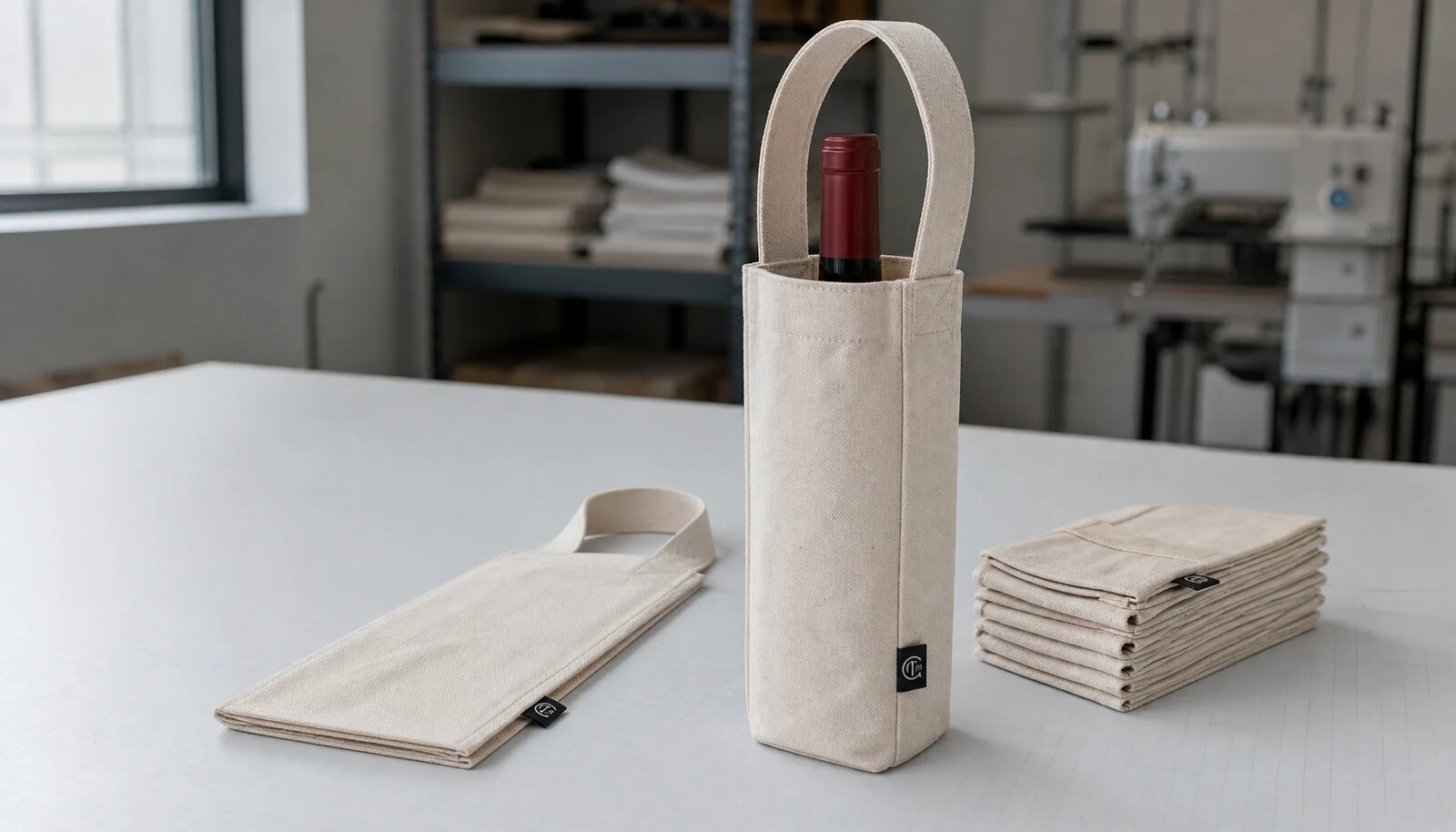
Why carton packing becomes the real spec
When event planners buy custom canvas wine carriers, the bag itself is only half the job. Carton packing decides whether the order arrives presentation-ready, whether the logo stays clean, and whether the pallet can move through a venue without repacking. If the event has multiple destinations, the carton spec also determines how fast the crew can distribute units on site.
A useful buyer brief separates product spec from packing spec: carrier size, bottle diameter, print area, folded thickness, carton count, carton label, and master carton weight. Most disputes happen when a supplier quotes only the bag and ignores how many pieces fit in a carton or whether the carrier ships flat with handles creased. For event work, that is not a small detail; it drives damage, labor, and cost.
- Treat the carton plan as part of the product, not a shipping afterthought.
- Write the pack count into the RFQ so every quote is built on the same assumptions.
- Use the event receiving process as the test: one person, one carton, one destination label.
Choose the right canvas build
For a single-bottle carrier, 12oz / 340-350 gsm cotton canvas is the practical base. It holds shape better than 10oz, still folds flat, and keeps carton weight manageable. If the carrier needs a premium retail feel or the bottle is heavy, 14oz to 16oz / 400-450 gsm gives a stiffer wall and cleaner standing shape, but it raises freight and can increase carton compression.
Define the bottle it must fit. A 750 ml Bordeaux bottle, an ice wine bottle, and a Champagne bottle need different gussets, handle drop, and bottom reinforcement. A buyer should specify bottle diameter range, inside height, and whether the carrier must hold a bottle insert or divider. Without that, the factory will quote a generic tote and you will get a nice-looking sample that fails at packing time.
- 340-350 gsm: best for cost control and flat shipping.
- 400-450 gsm: best for premium gifting or heavier bottles.
- Add bottom bar-tack or X-stitch at handle points.
- Set inside width to actual bottle plus 8-15 mm clearance, not catalog dimensions.
Print method and logo placement
Screen print is usually the default for canvas wine carriers because it is durable, cost-efficient, and readable on a textured surface. One- to two-color art is straightforward; fine gradients and tiny text are not. If the logo must feel premium, a woven side label, woven patch, or small embroidered mark works better than trying to force a full complex print onto rough canvas.
For event programs, the placement is often more important than decoration. A front-centered logo reads well in photos, but a side label is better when the carrier is stacked in cartons or paired with a wine gift set. Tell the supplier exactly what is visible when the bottle is inside, when the carrier is hanging, and when three units are lined up on a table. That prevents a sample that looks fine empty and disappears once loaded.
- Screen print for bold logos and repeat volume.
- Woven label for premium brand equity and low ink risk.
- Heat transfer only when the art has multiple colors and the fabric surface is smooth enough.
- Ask for ink adhesion and rub testing on the actual canvas GSM.
Compare sourcing routes before you quote
Buyers often compare only factory A versus factory B, but the sourcing route matters more. A factory-direct order gives you control over carton spec, artwork, and testing, while a trading company may be useful if you need mixed products in one shipment. Local decorators are fast, but the unit cost can jump once you add repacking, relabeling, and import handling.
For event planners, the real decision is usually between speed and packaging control. If the carriers go straight to a venue or to a fulfillment house, carton labeling and case counts matter more than a small unit-price difference. If the goods are only for a single branded event, a stock blank plus local print can be the safest route when the schedule is short and the brand team does not need a custom dieline.
- Route choice changes how much packing control you actually have.
- A low unit price is not useful if the cartons still need rework on arrival.
- Mixed-item orders are easier through a trading company, but QC visibility drops.
MOQ logic should follow the production method
MOQ logic for custom canvas wine carriers is driven by fabric roll usage, print setup, and carton configuration. If the body is one color with one simple logo, the factory may separate MOQ for bag body, print screen, and carton label. If you change body color, binding color, or handle length, the supplier often treats it as a new SKU because each variation affects cutting and packing efficiency.
A serious RFQ should ask for a quote by tier: 300, 500, 1,000, and 3,000 pcs. That exposes where setup cost spreads out and where freight starts to dominate. For event orders, a slightly higher MOQ can lower landed cost if it avoids re-screening or a custom carton run. The buyer should also ask whether the quoted MOQ is per color, per art file, or per carton configuration, because those are not the same thing.
- Ask for price breaks by quantity, not a single number.
- Separate bag cost, print cost, carton cost, inner pack cost, and freight-ready packing.
- Confirm whether multi-color art adds a second screen or a new MOQ bucket.
- If cartons are custom-printed, request the carton MOQ separately.
Sample approval should include fit and abuse
A good sample test starts with the bottle, not the bag. Insert the exact bottle shape that will ship most often, then move the carrier through the real handling sequence: load, lift, stack, and carton close. A sample that looks fine hanging on a rack may fail once the bottle shifts against the base seam or the handle pull distorts the mouth.
The sample should be signed off only after it passes simple abuse tests. A 1 kg to 1.4 kg load covers many wine bottles; heavier formats need more. Look for seam slippage, handle stretch, color transfer, loose threads, and print cracking after a few folds. If the product will sit in a gift box, test the combined height with tissue, inserts, or a hang tag so the carton and shelf pack do not conflict.
- Use the actual bottle, not a water bottle placeholder.
- Load test for 10-15 minutes, then inspect stitching and handle recovery.
- Rub the print with dry and slightly damp cloth.
- Verify the bag closes flat enough for the target carton count.
Build the carton plan around labor, not only volume
The most common packing mistake is choosing carton count by cubic volume alone. A carton that fits 80 flat carriers may still be a bad choice if the top layer crushes the handles or if the crew has to re-stack every carton at the venue. For event orders, 20-40 pcs per inner carton is often the usable zone when the carrier is folded flat, because it balances lift weight, damage risk, and counting speed.
Labeling should serve the receiving team. Put SKU, color, quantity, gross/net weight, carton dimensions, and destination label on the carton, plus a clear batch or lot code if the event is split across sites. If the order goes to a distributor or third-party logistics warehouse, ask for barcode placement and master carton marks before production starts. Re-labeling after packing usually costs more than printing the right case mark in the first place.
- Target a carton weight that one person can lift safely.
- Keep the folded handle path consistent so the top layer does not deform.
- Use moisture protection only if the route or storage is humid.
- If pallets are required, define pallet height limit and overhang tolerance.
Lead time is controlled by approvals, not just sewing
For a standard custom canvas wine carrier, sample development can take a few days, while bulk production often lands in the 25-40 day range after artwork, material, and carton approval. The schedule stretches when the buyer adds new print colors, nonstandard binding, or special packaging. If the shipment must hit a fixed event date, approval delays are usually more dangerous than sewing delays because the factory cannot buy fabric or reserve carton slots without final sign-off.
Build a calendar backward from the event, not from the PO date. Leave time for sample review, changes, production, inspection, and freight booking. If there are multiple venues, require a pre-shipment packing list that matches the route plan. A container or air shipment can be ready on time and still fail the event if the cartons are not labeled by site or if a mixed color assortment is packed without a count map.
- Reserve 3-7 days for sample review and internal sign-off.
- Add buffer for public holidays, fabric dyeing, and carton printing.
- Ask whether the factory can hold finished goods for staged release.
Read the quote as a landed-cost document
A useful quote tells you more than unit price. It should show fabric GSM, bag dimensions, print method, packaging count, carton size, carton weight, sample fee, tooling, and the shipping term used for the price. If the supplier only gives a per-piece number, you cannot compare vendors because one may include custom cartons and another may leave them out. For event planners, that gap becomes a surprise when labor or freight is added later.
Compare landed cost by carton, not by bag. For example, a lighter canvas carrier may look cheaper, but if it needs more cartons per pallet or extra protection, the cost per delivered unit can rise. The better decision is usually the one that lowers touchpoints: fewer repacks, fewer relabels, and a carton configuration the venue can receive without manual sorting. That is how a slightly higher ex-factory price can still win on total cost.
- Normalize quotes to the same carton count and shipping term.
- Include duty, inland delivery, and warehouse receiving fees in the comparison.
- Reject quotes that do not define what is included in sample or tooling.
Use a clean RFQ sequence
The cleanest way to source custom canvas wine carriers is to send the factory one decision packet: bottle dimension, logo file, target GSM, carton count, destination, and event date. That lets the supplier answer with a real production quote instead of a rough estimate. If you split the brief across emails, the quote usually fragments too, and the supplier will assume defaults you may not want.
Keep the order of decisions stable: fit, appearance, packing, then freight. That sequence prevents rework. A buyer who locks the carton plan before approving bottle fit often discovers the carrier is too large, the gross weight is too high, or the carton count creates an awkward pallet height. Solve the physical package first, then lock artwork and logistics around it.
- Send bottle dimensions with photos next to a ruler.
- Require one pre-production sample and one packed sample if the carton plan is special.
- Approve carton artwork last, after counts and lot coding are settled.
Specification comparison for buyers
| Spec decision | Recommended option | When it fits | Buyer risk to check |
|---|---|---|---|
| Factory-direct sourcing route | Best for a custom carton spec and repeat event programs | When the buyer needs control over fabric, print, and pack count | First sample may take longer, so approval timing must be built into the schedule |
| Trading company sourcing route | Useful when the order includes several event items in one shipment | When procurement wants one PO and a mixed gift package | Carton counts and QC details can be less transparent than a direct factory quote |
| Stock blank plus local print | Fastest route for simple branding and short lead times | When the event date is close and the logo is one or two colors | Fabric weight and print durability can vary if the blank source changes |
| 12oz / 340-350 gsm canvas | Balanced default for standard single-bottle carriers | When the carrier must ship flat, stay affordable, and still hold shape | May feel too soft for heavier bottles or premium retail presentation |
| 14oz-16oz / 400-450 gsm canvas | Stiffer build for premium gifting and heavier wine bottles | When presentation matters more than freight cost | Adds carton weight and can reduce pieces per carton |
| One- to two-color screen print | Most practical for bold logos and repeat orders | When the art is simple, readable, and needs good wash/rub resistance | Small text, gradients, and fine lines can blur on textured canvas |
| Woven label or side label branding | Best for subtle premium branding with lower ink risk | When the design needs to stay visible after the bottle is inserted | Label placement must not interfere with carton stacking or bottle fit |
| 20-40 pcs per inner carton, flat-folded | Good balance for event delivery and manual handling | When cartons must move through warehouse intake and on-site distribution | Wrong fold direction or weak handles can crush the top layer and slow receiving |
Buyer checklist before sampling
- Confirm the exact bottle shape, height, and maximum diameter, not just the volume.
- Lock the carrier size with real inside measurements and a target handle drop.
- Specify canvas GSM and whether the build should feel soft, structured, or premium-stiff.
- State the print method, number of colors, and logo placement on the loaded carrier.
- Define carton count per inner box and the maximum carton weight one person should lift.
- Request carton marks, SKU labels, lot code format, and destination labeling before production.
- Approve a loaded sample using the actual bottle that will ship in the event order.
- Ask for a quote split by bag, print, packaging, tooling, and freight-ready packing.
- Set a realistic production buffer for sample approval, carton printing, and freight booking.
- Confirm whether MOQ is per color, per artwork, or per carton configuration.
Factory quote questions to send
- What canvas GSM do you recommend for the exact bottle size I will ship, and what is the tolerance on the fabric weight?
- What is the inside width, height, gusset, and handle drop of the finished carrier, and can you show the measurement method?
- Which print method is included in the quote, how many colors are covered, and what changes the price if I revise the artwork?
- How many pieces fit in one inner carton without crushing handles or deforming the top layer, and what is the gross carton weight?
- Is the MOQ based on color, artwork, fabric roll usage, or carton specification?
- What sample stages do you provide before bulk production, and is there a charge for pre-production and packed samples?
- Can you quote the product with and without custom carton printing, barcode labels, and palletization?
- What is the estimated lead time after artwork approval, sample approval, and deposit, and what will extend it?
- What packing method do you use to protect print quality, stitching, and bottle fit during export transit?
- Can you separate ex-factory price, carton cost, inner packing cost, and shipping term so I can compare landed cost correctly?
Quality-control points to confirm
- Canvas GSM should match the agreed spec and stay within a practical factory tolerance for the order.
- Handle stitching should include reinforcement at the stress points, with no loose threads or skipped stitches.
- Loaded fit should hold a standard bottle without excessive play, twisting, or bottom sag.
- Print should stay legible after dry rub and light damp rub on the actual canvas surface.
- Carrier should fold flat in the same direction across all units so carton stacking stays consistent.
- Carton count should match the pack list exactly, with no mixed counts in a single case.
- Carton edges should stay intact after a warehouse-style stack load, with no crushed corners or lid bulge.
- Carton labels and case marks should match PO details, SKU coding, and destination routing.