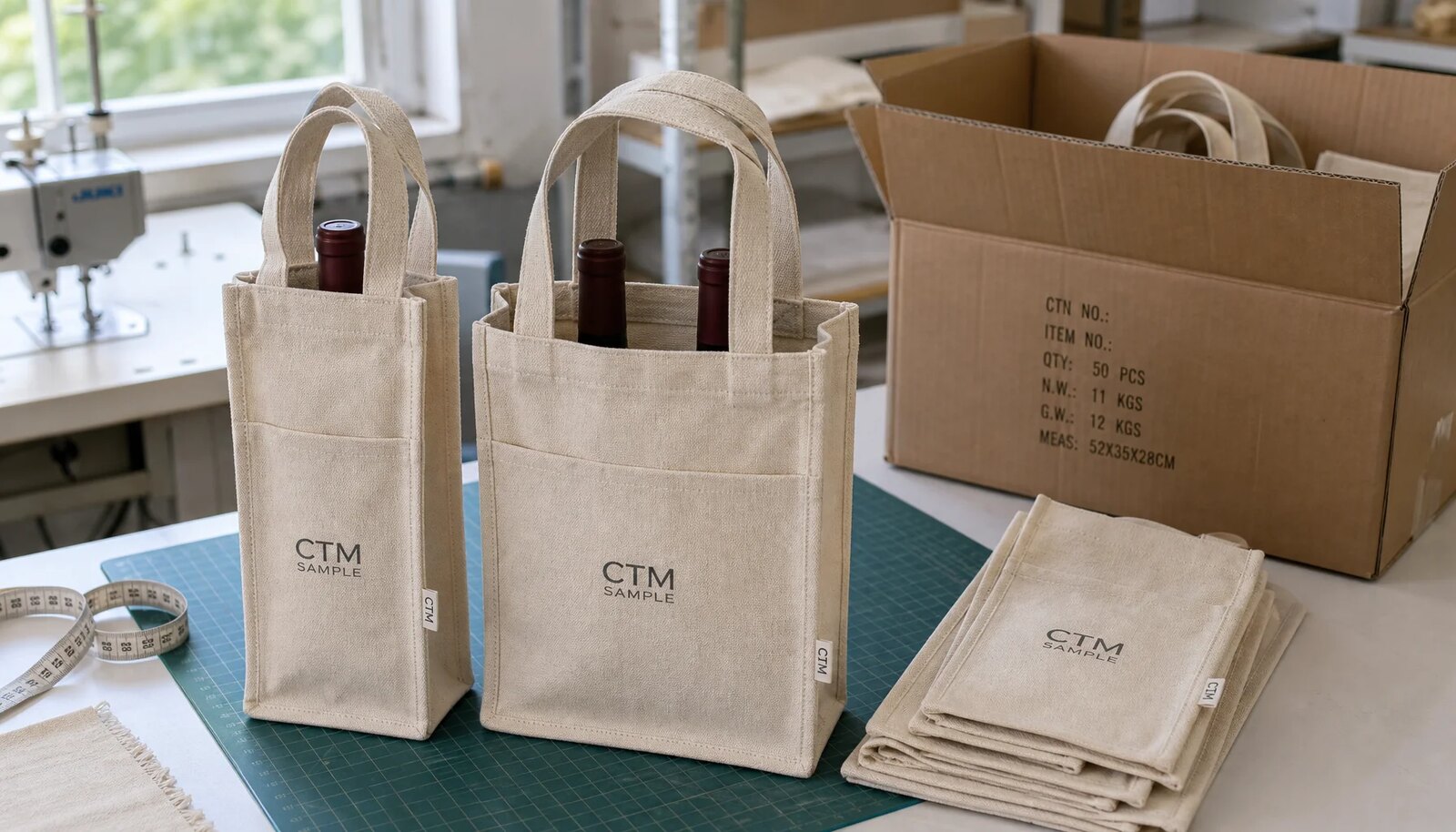
Start With the Distribution Plan, Not the Product Photo
A custom canvas wine carrier can look perfect in a sample-room photo and still cause problems at a craft fair. The real test starts after production: counting, allocating, moving, displaying, and sometimes repacking the carriers while teams are working quickly. If the printed panel arrives creased, the handles are crushed into hard folds, the two-bottle divider is bent, or the cartons are too heavy for booth staff, the product has already failed part of the brief.
Build the RFQ around the route the goods will travel. A winery may receive the full order at one tasting-room warehouse. A distributor may split inventory across regional craft fairs. A retail buyer may need single-SKU cartons by store. A brand team may want event kits that combine carriers with postcards, bottle tags, tissue paper, and shelf signs. Each route changes the best carton count, inner-bundle label, master-carton mark, carton numbering system, and final inspection method.
Quote the carton packing plan with the bag, not after finished goods are sewn. Ask the supplier to list pieces per inner bundle, bundles per master carton, carton size, gross weight, net weight, carton board strength, inner protection, and carton-marking layout. If barcodes, destination codes, or retailer routing labels are required, include them before bulk packing begins. Late label decisions often become manual relabeling, delayed handover, or incorrect allocation.
This matters even more when several artwork versions share one natural canvas body. At a distance, a Napa mark, a city craft fair logo, and a retailer co-brand can look almost identical. Single-SKU cartons are safest for receiving accuracy. Mixed cartons can work for event kits, but only when every inner bundle is labeled and the packing list shows exact SKU counts. The plan should let a warehouse worker identify the right item without opening every bag.
- State whether cartons ship to one warehouse, multiple craft fair sites, retail stores, or an event-kit fulfillment center.
- Confirm whether each master carton must be single-SKU, mixed-SKU by labeled inner bundle, or packed as a pre-built event allocation.
- Set a master carton gross weight limit; many buyers prefer carton weights under about 15-18 kg for manual event handling unless their warehouse approves more.
- Require carton data at quote stage: pieces per carton, carton L-W-H, gross weight, net weight, inner bundle count, and carton marking.
- Include PO, SKU, artwork version, quantity, carton number, destination code, and barcode requirement on the carton-label specification.
- Ask for a packed-carton photo or short video before shipment when the program includes heavy canvas, large print areas, dividers, or multiple destinations.
Define Bottle Fit With Measurable Inputs
Flat bag dimensions are not enough for a bottle carrier. Wine and specialty bottle shapes vary widely: a 750 ml Bordeaux bottle, Burgundy bottle, sparkling wine bottle, cider bottle, olive oil bottle, vinegar bottle, and spirits bottle may differ in base diameter, shoulder curve, total height, closure height, and filled weight. A carrier that works for one bottle can catch on another shoulder, tilt when loaded, or strain the side seam when staff insert bottles quickly at a booth.
Separate the finished outside size from the usable internal clearance. Canvas thickness, seam allowance, gusset shape, divider placement, and turning all reduce the space the bottle can actually use. A boxed bottom may give a good loaded shape, but the usable width may not equal the flat width. If the neck should show above the carrier, set the top edge height against the actual bottle and closure. If the bottle should sit mostly inside for gifting, allow enough clearance for easy insertion without wrinkling the top edge.
For mixed craft fair assortments, size around the most difficult item, not the most common one. Sparkling bottles can be wider and heavier. Olive oil bottles may be taller and narrower. Cider bottles can have different shoulders. If the buyer cannot send a real bottle, provide a dimensional drawing and ask for a dummy test. The dummy should match base diameter, maximum shoulder diameter, total height, closure height, and filled weight as closely as practical.
Two-bottle carriers need their own fit review. The divider should reduce bottle-to-bottle contact without stealing so much internal room that bottles tilt outward. A low divider may keep bases apart but do little at the shoulders. A tall or stiff divider can improve separation, yet it may add folded bulk and reduce pieces per carton. Approve the sample with front, side, top, and loaded carry-angle photos so the factory and inspector see the same standard.
- Provide bottle base diameter, maximum shoulder diameter, total height, closure height, and filled weight for each bottle type.
- Specify whether the neck should remain visible, the shoulder should be visible, or the bottle should sit mostly inside the carrier.
- Request usable internal dimensions after sewing, not only flat finished width, height, and gusset.
- For single-bottle carriers, confirm base fit, side gusset behavior, insertion ease, and bottle removal at the booth.
- For two-bottle carriers, confirm divider height, divider width, bottom attachment, and bottle contact during loaded movement.
- Approve fit using actual bottles whenever possible; otherwise use a dimensional dummy and record its measurements in the approval file.
Select Canvas Weight, Finish, and Lot Rules
Canvas weight changes more than hand feel. It affects structure, sewing efficiency, print appearance, folded bulk, carton quantity, and freight cube. For many custom canvas wine carriers used at craft fairs, 10 oz to 12 oz cotton canvas, approximately 340-410 GSM, gives a sensible balance: enough body for reusable use, but still practical to fold and carton. For short promotional programs, 8 oz canvas can reduce cost and cube, although it may look soft on a display table and show more of the bottle shape.
Heavier is not always better. A 14 oz or heavier canvas, often above about 450 GSM, can feel more premium, but it also creates bulkier seams, lowers carton count, raises needle and thread stress, and produces firmer fold lines. Large printed panels can show pressure marks if stacked too soon or packed too tightly. Use heavier canvas when the retail value, brand positioning, or structural need justifies the freight and packing impact.
Finish matters as much as weight. Natural canvas may show cotton flecks, slubs, seed specks, and shade variation. That character often suits wineries, farmers markets, and craft brands, but it must be approved. Bleached canvas gives a cleaner print base and may show dirt more easily. Dyed canvas introduces dye-lot control and often a higher material minimum. Washed canvas can feel softer while increasing shrinkage variation and making dimensional tolerance harder to hold.
Record fabric weight, finish, color reference, and accepted natural variation on the approved sample. If repeat orders are likely, ask whether the fabric is a stock canvas or a special lot. When several artwork versions use the same body fabric, the factory should keep roll usage traceable enough to avoid obvious shade differences inside one destination shipment. This is more useful than broad claims such as heavy duty or premium canvas.
- 8 oz canvas: lower cost and easier folding, but softer structure and lighter perceived value.
- 10 oz canvas: practical balance for single-bottle event carriers and efficient carton packing.
- 12 oz canvas: stronger retail hand feel, better shape retention, and still manageable folded bulk for many programs.
- 14 oz and above: premium structure, but higher sewing bulk, fewer pieces per carton, and greater crease or freight-cube risk.
- Natural canvas: approve flecks, slubs, shade range, and print opacity on actual fabric, not only on a digital proof.
- Dyed or washed canvas: confirm dye-lot MOQ, shrinkage, shade tolerance, repeat-order match, and lead time before comparing unit prices.
Engineer Handles, Bottoms, and Dividers for Loaded Use
A wine carrier is a loaded-use product. At a craft fair, a shopper may carry one or two glass bottles while walking through crowds, answering a phone, or holding other purchases. Construction therefore matters more than how clean the bag looks when flat. Before the pre-production sample, define handle material, handle width, handle drop, insertion depth, reinforcement method, stitch pattern, thread quality, seam finish, bottom shape, and divider construction.
Self-fabric handles match the body and keep the look simple, but they need reinforcement. Cotton webbing handles often improve grip and tensile strength, especially on two-bottle styles. Rope handles can look premium, although they may not pack flat and require secure end finishing. Handle drop should be stated in centimeters and checked on a loaded sample. A drop that looks elegant when empty can allow too much swing in a crowded aisle.
Handle attachment belongs in the QC plan. Box-X stitching, bartacks, reinforced patches, and seam-inserted handles can all work when executed consistently. The construction should be tested against the expected load. A filled 750 ml wine bottle often weighs around 1.2-1.5 kg depending on glass weight; sparkling bottles can be heavier. Two-bottle carriers should be tested with two equivalent filled bottles, not with a single light sample bottle.
The bottom design affects both display and packing. A gusset or boxed bottom can help the bag stand when loaded, but it changes the fold pattern and carton cube. If the carrier must stand upright while empty on a craft fair table, the supplier may need stiffer canvas, a structured base, or a different pattern. For two-bottle styles, the divider should be straight, centered, high enough for the approved bottle, and attached at the bottom so bottles do not push it aside during walking.
- Specify handle material, width, drop, insertion depth, reinforcement, thread color, and stitch pattern in the RFQ.
- Use box-X stitching, bartacks, reinforced patches, or seam-inserted handles for loaded glass bottle use.
- Test single-bottle carriers with the target filled bottle weight and observe handle strain, seam strain, twist, and user comfort.
- Test two-bottle carriers with two equivalent filled bottles and check swing, divider movement, and bottle-to-bottle contact.
- Define whether the bottom must stand empty, stand loaded, hang on a fixture, or only pack flat for storage.
- Inspect stress points: handle ends, top hem, side seam, divider top edge, divider base, and bottom corners.
Control Printing, Artwork Versions, and SKU Identity
Most custom canvas wine carriers for craft fairs use screen printing. Winery marks, market logos, sponsor names, and retail graphics are often solid-color or limited-color designs, and screen print is usually practical for that work. Still, do not approve print from a digital proof alone. Check ink color, opacity, edge sharpness, placement, curing, and hand feel on the actual fabric. Natural canvas flecks and slubs can change how a logo reads.
Heat transfer may be suitable when the artwork includes gradients, photographs, many colors, or fine detail that is not economical to screen print. It is not automatically more durable or more premium. Check edge adhesion, gloss level, flexibility, cracking, and resistance to fold pressure. Any decoration that sits on a fold line or under high carton compression needs extra review before bulk packing.
Tie artwork placement to the pattern. Critical text should stay away from seam bulk, handle bases, divider stitching, and sharp fold lines. Large ink coverage can stiffen the panel and may show pressure marks if bags are stacked face-to-face before the ink is fully cured. If the printed panel faces the customer on a retail table, request a packing orientation that protects it from abrasion and hard creases.
SKU identity is a real procurement control, not an administrative afterthought. One natural canvas body may carry different city names, event dates, winery sub-brands, retailer marks, or sponsor logos. Each version needs its own SKU, artwork proof, print-position approval, carton label rule, and packing list line. Even when the base bag is identical, mixing versions without clear bundle and carton control creates receiving risk. The quote should show setup cost, color change cost, and packing surcharge by version.
- Use screen print for solid logos, text, line art, and limited-color marks where repeatability and unit cost matter.
- Use heat transfer only when artwork complexity justifies testing edge adhesion, gloss, fold durability, and hand feel.
- Approve PMS or brand color on the selected canvas because natural fabric changes perceived color and opacity.
- Keep critical artwork away from seams, handle bases, divider stitching, and primary fold lines.
- Treat every logo, city, retailer, sponsor, or event date as a separate SKU for proofing, packing, labeling, and inspection.
- Require the quote to separate print setup, color matching, print strike-off, repeat-order screens, and artwork-version changeover fees.
Build MOQ and Quote Logic Before Comparing Prices
MOQ for custom canvas wine carriers usually comes from several places. Fabric purchasing, cutting efficiency, sewing setup, screen making, ink mixing, PMS matching, custom labels, hangtags, packing labor, and inspection can all affect the real minimum. A supplier may accept a low quantity on a stock natural canvas body, while five artwork versions at 300 pieces each still create meaningful setup and changeover cost.
Ask for a line-item quote instead of one blended unit price. Useful lines include blank bag unit cost, print unit cost, screen or setup charge, color-matching charge, sample charge, label or hangtag charge, inner-bundle requirement, destination-packing surcharge, and any testing or inspection support. This makes supplier comparisons cleaner. A higher unit price that includes screens may beat a lower unit price once setup charges appear after artwork approval.
Clarify whether multiple artwork versions can share one fabric lot and one cutting run. If the body construction is identical, shared cutting can reduce waste and cost, but print scheduling and carton allocation still need control. For dyed canvas, the dye-lot minimum may dominate the order. For custom woven labels, the label supplier's minimum may exceed the bag quantity. Mixed cartons may add only a small labor cost per piece, yet that cost matters when event allocation must be exact.
Do not ignore reorders. Ask whether screens are stored, how long they remain usable, whether screen remake fees apply, and whether repeat orders can use the previous approved color standard. Confirm whether the pattern, cutting templates, and sewing guides are retained. For seasonal craft fair programs, these answers can matter more than a small difference in the first-order unit price.
- Request price breaks by total order quantity and by artwork-version quantity so SKU-split cost is visible.
- Separate blank bag cost, print cost, setup charges, label cost, hangtag cost, sample cost, and special packing surcharge.
- Confirm whether artwork versions can share one fabric lot, cutting run, and production schedule.
- Ask for over/under shipment tolerance by SKU; event-specific logos often need tighter quantity control than generic stock.
- Clarify repeat-order rules for screens, patterns, color standards, labels, and carton labels.
- Do not compare quotes unless each supplier states fabric GSM, construction, print method, carton count, carton size, and gross weight.
Approve Samples in a Sequence That Reduces Rework
Sampling should answer the hard questions in the right order. Start with fit and function. A blank fit sample can confirm bottle clearance, insertion ease, gusset behavior, divider height, handle drop, bottom shape, and loaded balance before the buyer pays for print setup or the factory commits to bulk fabric. If the bottle is too tight or the divider is too low, this is the cheapest point to change the pattern.
Next, approve decoration. A print strike-off or printed sample should confirm artwork scale, placement, PMS target, opacity, ink hand feel, curing, and the way the print interacts with canvas texture. Natural cotton canvas has irregular fibers, so a few pinholes or flecks may be acceptable when they match the approved standard. Define acceptability with photos and notes, not vague phrases such as good quality or no defects. For heat transfer, fold and rub the sample to check edge behavior.
Then approve production readiness. The pre-production sample should represent final fabric, construction, label, print, trim, thread, and fold method. If a custom label or hangtag is included, verify spelling, SKU code, placement, and attachment method. The approval record should include sample version, sample date, reviewer, accepted deviations, bottle used for testing, measurements, and reference photos. That record protects both the buyer and the factory.
For higher-risk orders, add packed-carton approval. Ask the supplier to show inner bundle count, folding direction, printed-face orientation, handle compression, divider position, carton fill level, carton label, and carton sealing method. This step is especially useful for 12 oz or heavier canvas, two-bottle dividers, webbing handles, large logos, multiple artwork versions, destination labels, or courier shipments. It catches creasing and sorting issues before goods leave the factory.
- Blank fit sample: confirms bottle clearance, gusset, divider, handle drop, bottom shape, and loaded balance.
- Printed sample or strike-off: confirms artwork size, placement, PMS target, opacity, curing, ink texture, and canvas fleck acceptance.
- Pre-production sample: confirms final fabric, stitching, label, print, trim, thread, and fold method before bulk production.
- Packed-carton approval: confirms bundle direction, carton fill, logo protection, handle compression, and carton label accuracy.
- Approval record: include version, date, reviewer, accepted deviations, test bottle, measurements, and reference photos.
- Do not release bulk cutting until fit, handle construction, divider performance, and print placement are approved.
Specify Carton Packing With Receiving in Mind
Flat canvas wine carriers are often packed in inner bundles of 25 or 50 pieces, then loaded into master cartons. The right count depends on canvas weight, handle bulk, divider stiffness, print coverage, and carton weight limit. A 10 oz single-bottle carrier may pack efficiently at a higher count. A 12 oz two-bottle carrier with webbing handles and a center divider may need fewer pieces per carton to avoid crushed handles, bent dividers, or hard fold lines across the logo.
Carton data should be known before production approval. Buyers need carton length, width, height, gross weight, and net weight for freight quotes, landed-cost estimates, warehouse slotting, pallet planning, courier limits, and event allocation. If the order ships by parcel or LTL, carton weight and dimensional weight can change cost. If cartons go to stores or small booths, oversized cartons may be hard to move and store.
The packing method should protect the bag and simplify receiving. Printed panels should not be forced against rough carton walls or sharp fold pressure. Handles should be folded consistently instead of creating random lumps. Dividers should be flattened or supported according to the approved method. Inner bundles can be tied, paper-banded, or polybagged depending on buyer sustainability rules and moisture-protection needs. The chosen method should be visible in pre-shipment packing photos.
Carton labels should be designed for warehouse work, not only export marking. A useful label includes PO number, SKU, item description, artwork version, quantity, carton number such as 1 of 80, gross weight, net weight, carton dimensions, destination code, and optional barcode. If cartons are mixed by event kit, each inner bundle should also show SKU and quantity. Final inspection should open cartons and compare labels against contents, because a perfect bag in the wrong carton still fails the program.
- Use single-SKU cartons when receiving accuracy, store allocation, or event distribution is more important than maximum cube efficiency.
- Use mixed cartons only with labeled inner bundles, exact SKU counts, and a packing list that identifies every split.
- Keep printed panels protected from abrasion, hard fold lines, and face-to-face ink transfer where possible.
- Avoid over-compression that leaves permanent creases across logos, handle ends, or divider folds.
- Require carton labels with PO, SKU, artwork version, quantity, carton number, destination code, and optional barcode.
- Confirm final carton L-W-H, gross weight, net weight, and pieces per carton before booking freight or releasing shipment.
Write QC Standards for Sewn Canvas Goods
Quality control for canvas wine carriers should cover appearance, measurement, loaded use, and carton packing. A carrier can look tidy on a table and still fail once a bottle is inserted, lifted, and carried. Inspection should cover finished dimensions, usable bottle fit, handle strength, stitching, divider placement, print quality, fabric shade, label accuracy, carton packing, and carton marks. Put these points in writing before production starts so the factory knows what will be judged.
Use practical sewn-goods tolerances. Fabric products should not be judged like molded plastic or metal parts, but variation that affects use must still be controlled. Main width and height are often managed around +/-5 mm for standard constructions. Complex gussets, washed fabric, and thick dividers may require separate tolerances. Print placement is commonly controlled around +/-3 mm to +/-5 mm depending on panel size, seam bulk, manual screen setup, and fabric movement. The approved sample remains the core reference.
Loaded testing must be specific. A static hang test may use the target bottle weight plus a safety margin for a defined time. A repeated lift or light jerk test may better reflect craft fair use. Write the load, number of lifts, duration, and pass/fail criteria: no handle tearing, no seam opening, no visible stitch breakage, and no severe distortion. For two-bottle carriers, test with two equivalent bottles and check divider movement.
Carton-level QC is essential when goods ship to multiple locations. Random cartons should be opened to verify quantity per bundle, SKU mix, carton number, carton label, print condition, packing compression, and packing list accuracy. Inspectors should check that handles are folded neatly, printed faces are protected, dividers are not crushed, and carton gross weight matches declared data. Destination labels, routing marks, and barcodes are functional requirements, not decoration.
- Check finished dimensions against agreed tolerance and verify usable bottle clearance with the approved bottle or dummy.
- Inspect handles for material, width, drop, insertion depth, reinforcement, stitch alignment, and loaded-test performance.
- Inspect stitching for skipped stitches, broken thread, raw edges, loose tails, seam puckering, and weak stress-point reinforcement.
- Inspect dividers for centering, height, bottom attachment, top-edge finish, and ability to reduce bottle contact during movement.
- Inspect print for placement, color, opacity, curing, cracking, smudging, blocking, transfer marks, and unapproved ink bleed.
- Open cartons during inspection to verify quantity, SKU split, inner bundle labels, carton labels, carton condition, and packing list accuracy.
Plan Lead Time Around Buyer Decisions
Lead time depends on more than sewing days. Fabric availability, sample rounds, artwork approval, production queue, printing capacity, label preparation, packing, final inspection, and freight booking all affect the schedule. A natural canvas single-bottle carrier with one screen print is usually simpler than a dyed two-bottle carrier with custom labels, several artwork versions, and destination-specific cartons. Treat approved pre-production sample release as the real start of bulk production.
Craft fair calendars leave little room for late decisions. A bottle change can force pattern revision. Artwork changes can delay screen making or color matching. City allocations can alter carton labels, SKU splits, and packing lists. Once fabric is cut or printed, even a small change may create rework or leftover inventory. A decision-date calendar is more useful than a general delivery request because it shows which approvals protect the shipment date.
Ask the supplier for a timeline with visible gates: fabric confirmation, blank sample completion, printed sample or strike-off, approval cutoff, fabric purchase or cutting date, print date, sewing date, packed-carton approval, final inspection, shipping document preparation, and handover date. If goods must arrive for a fixed event window, add buffer for sample transit, inspection findings, customs clearance, domestic delivery, warehouse receiving, and booth setup.
For multi-location programs, packing decisions can take as long as product decisions. Destination codes, barcodes, retailer routing labels, carton numbering, and mixed-carton rules should be frozen before final packing. If allocations cannot be confirmed early, consider producing single-SKU master cartons first and building event kits at a domestic warehouse later. Local handling may cost more, but it can reduce the risk of wrong allocation at origin.
- Reserve time for artwork proofing, PMS review, sample shipping, bottle-fit testing, and packed-carton review before bulk release.
- Freeze bottle choice before pattern approval; freeze artwork before screen preparation; freeze destination labels before packing.
- Add buffer when cartons require barcodes, routing labels, destination codes, mixed-SKU bundles, or retailer-specific markings.
- Account for peak-season pressure on canvas supply, print capacity, sewing lines, inspection scheduling, and freight availability.
- Ask the supplier to identify the last safe date for changes to bottle size, artwork version count, carton labels, and shipment split.
- Use approval milestones rather than informal email comments so production and inspection teams work from the same reference standard.
Specification comparison for buyers
| Spec decision | Recommended B2B specification | When it fits | Procurement or QC risk to check |
|---|---|---|---|
| Fabric weight | 10 oz to 12 oz cotton canvas, approximately 340-410 GSM, with GSM tolerance and fabric finish recorded on the approved sample | Most winery, craft fair, cider, olive oil, and gift-bottle programs needing reusable structure without excessive folded bulk | Under about 280 GSM can collapse and telegraph bottle shape; over about 450 GSM can increase sewing bulk, carton cube, crease risk, and freight cost |
| Fabric finish | Natural, bleached, dyed, washed, or pre-shrunk canvas stated in the RFQ, with shade standard and lot-control rule | Important when repeat orders or multiple production batches ship into the same retail or event program | Natural canvas flecks and slubs are normal but must be approved; dyed or washed canvas may change shrinkage, tolerance, color matching, and MOQ |
| Carrier format | Single-bottle carrier for impulse sales; two-bottle carrier with stitched center divider and reinforced bottom for gift sets | Single style fits booth add-ons and tasting-room giveaways; two-bottle style fits holiday bundles, sponsor gifts, and paired product sets | A low divider may separate bases only; weak bottom attachment can allow bottles to knock together during walking |
| Bottle sizing basis | Specify usable internal clearance from actual bottle diameter, total height, shoulder profile, closure height, and desired neck exposure | Useful when one bag must fit wine, cider, spirits, olive oil, vinegar, or mixed craft fair products | Quoting only flat finished width and height can create tight fit, tilted bottles, seam strain, or slow bottle insertion at the booth |
| Handle construction | Cotton webbing or self-fabric handles with box-X, bartack, or reinforced seam insertion; handle drop stated in cm | Reusable event bags carried while shoppers walk, browse, and carry other purchases | Top-hem-only handles, weak bartacks, irregular stitch density, or short handle insertion can fail under loaded lift or jerk testing |
| Print method | Screen print for solid marks and text; heat transfer only when gradients, photographs, or high-color artwork justify it | Screen print is usually the most practical option for winery logos, market names, and sponsor marks on canvas | Large ink areas can crack, scuff, block, or show fold pressure if curing, stacking direction, and carton compression are not controlled |
| Packing quantity | Flat-packed by SKU and artwork version, commonly 25-50 pcs per inner bundle, with master carton gross weight normally kept below about 15-18 kg unless buyer approves otherwise | Best for distributors, wineries, retailers, and event-kit warehouses receiving multiple versions or destinations | Over-compressed cartons can crease printed panels, crush handles, distort dividers, and slow repacking or allocation at destination |
| Carton labeling | Master carton label with PO, SKU, artwork version, quantity, gross/net weight, carton number, destination code, and optional barcode | Useful when inventory is split by city, booth, retailer, sales rep, warehouse route, or event kit | Generic carton marks cause receiving errors when several artwork versions share the same natural canvas body |
| MOQ structure | Separate MOQ or cost driver for base fabric, cutting run, print setup, artwork split, custom label, dyed fabric lot, and special packing | Helps buyers compare suppliers fairly and combine multiple event logos without hidden charges | A low headline MOQ can hide screen charges, color change fees, fabric wastage, label minimums, or mixed-carton handling fees |
Buyer checklist before sampling
- Define the bottle program before quoting: 750 ml Bordeaux wine, Burgundy wine, sparkling wine, cider, 500 ml spirits, olive oil, vinegar, or mixed gift set.
- Provide bottle base diameter, maximum shoulder diameter, total height, closure height, filled bottle weight, and whether the neck should remain visible above the carrier.
- Specify usable internal size after seam allowance, gusset, divider, fabric thickness, and turning; do not rely only on flat finished bag dimensions.
- Choose canvas weight by structure and packing target: 8 oz for budget short-use programs, 10 oz for efficient event use, 12 oz for stronger retail hand feel, and 14 oz+ only when premium positioning justifies cube and sewing impact.
- State fabric finish clearly: natural, bleached, dyed, washed, pre-shrunk, laminated, or unlaminated, with acceptable shade variation and repeat-order matching rules.
- State whether the bag must stand upright when empty, stand only when loaded, hang from a display hook, or pack flat for warehouse storage.
- Lock handle drop, handle material, handle width, insertion depth, stitch pattern, and reinforcement method before the pre-production sample.
- For two-bottle styles, define divider height, divider material, bottom attachment, top finish, and whether any glass-to-glass contact is acceptable during loaded movement.
- Confirm print method, print size, number of colors, PMS or brand color reference, acceptable ink hand feel, and whether canvas flecks may show through the artwork.
- Separate artwork versions by SKU and confirm whether master cartons may mix designs or must remain single-SKU by event, city, retailer, or warehouse destination.
Factory quote questions to send
- What exact canvas weight are you quoting in oz and GSM, what tolerance applies to the fabric weight, and is the fabric natural, bleached, dyed, washed, or pre-shrunk?
- Is the quoted fabric a regular stock item, or does it require a mill MOQ, dye-lot MOQ, fabric booking, or special lead time?
- What are the finished outside dimensions, flat dimensions, gusset size, divider dimensions, handle drop, and usable internal bottle clearance after seam allowance?
- Can you test the sample with our actual bottle, or with a dimensional dummy matching our bottle diameter, maximum shoulder, height, closure, and filled weight?
- What handle material, handle width, insertion depth, stitch pattern, and reinforcement method are included in the quoted construction?
- What loaded hang, static load, lift, or jerk test can you perform on the approved sample, and what weight and duration will you use?
- For two-bottle carriers, what divider material, height, bottom attachment, and stitching method will reduce bottle contact during walking?
- Which print method is included, how many print colors are counted, what is the maximum print area, and what extra charge applies for larger coverage?
- Are screen charges, artwork setup, PMS matching, print strike-off, repeat-order screen storage, and screen remake fees listed separately or included?
- What are the MOQ rules for one shared body fabric with multiple logo versions, destination codes, retailer names, or craft fair city names?
Quality-control points to confirm
- Finished size tolerance should be agreed before production; for sewn canvas wine carriers, main width and height are often controlled around +/-5 mm when construction is standard, while gussets and dividers may need separate tolerances.
- Print placement tolerance should be stated on the artwork sheet, commonly around +/-3 mm to +/-5 mm depending on panel size, seam bulk, manual screen setup, and fabric movement.
- Bottle fit should be checked with the buyer's actual filled bottle or an equivalent dummy, including base diameter, shoulder profile, cap or cork height, and required neck exposure.
- Loaded balance should be checked by placing the target bottle weight in the carrier and confirming that the bag does not lean excessively, twist at the handle, strain the side seam, or push the divider out of position.
- Handle attachment should pass an agreed static hang, repeated lift, or jerk test using the target filled bottle weight plus a margin; test method, weight, and duration should be written into the inspection plan.
- Stitching should be even and secure, with no skipped stitches, broken thread, loose thread tails at stress points, raw seam exposure, sharp thread knots, or seam puckering that affects bottle fit.
- Handle ends should be checked for insertion depth, reinforcement location, bartack or box-X alignment, and consistency between left and right handles.
- Divider panels should be centered, straight, tall enough for the approved bottle use, finished at the top edge, and attached securely enough that bottles do not force the divider to one side.
- Print should be cured, aligned, and clean, with no unapproved bleeding, cracking, smudging, pinholes beyond approved canvas texture, heavy ink buildup, blocking, or transfer marks from stacking.
- Natural canvas shade variation should be controlled by lot, especially when different production batches, artwork versions, or replenishment orders ship into the same sales program.