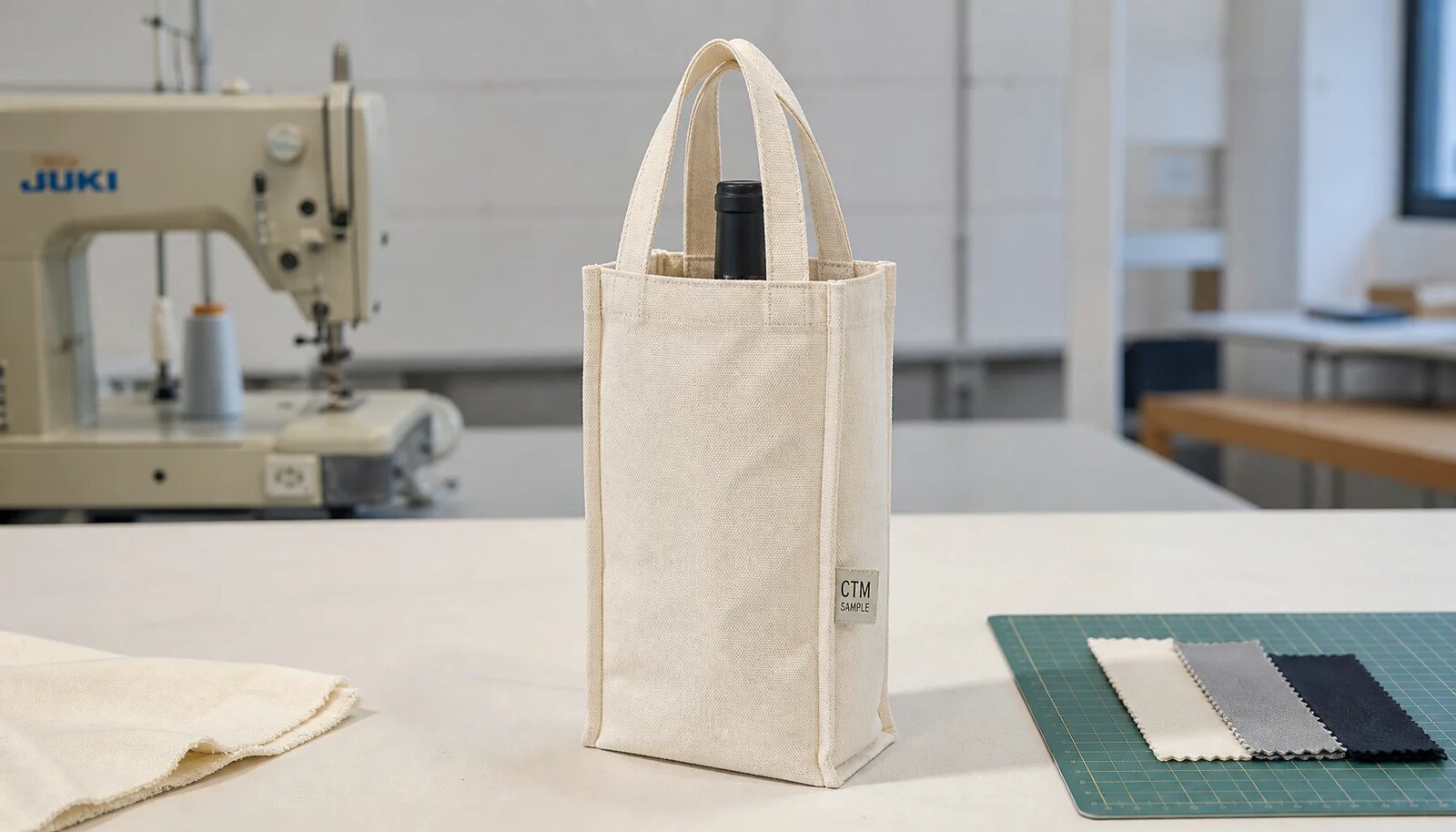
Price the event requirement, not a generic bag
A custom canvas wine carrier looks straightforward on a quote sheet. On an event floor, it has more jobs. It carries glass, protects the label area, presents a sponsor or host brand, survives quick staff handling, and arrives before an in-hands date that usually cannot move. The final price is shaped by fabric weight, pattern size, handle construction, divider details, logo method, packing, carton cube, freight terms, inspection, and the way the carrier will be loaded.
That is why a custom canvas wine carriers bulk pricing plan for event planners should start with the use case, not the target unit price. A VIP welcome gift at registration does not need exactly the same build as a two-bottle tasting set, a hotel-room amenity, a sponsor bundle, or a gift kit going through a fulfillment center. Some carriers must stand upright on banquet tables. Others must fold flat so staff can insert bottles quickly. Some need individual paper wrapping because they sit beside printed collateral. Each detail affects material, labor, packing, and risk.
For procurement, the useful number is landed cost per usable carrier. Unit price is only one line. The plan should also show sample fees, screen or label setup, decoration charges, bottom boards, hang tags, individual packing, carton labels, inspection, freight basis, duties, customs clearance, destination trucking, and any repacking labor. Once those costs are visible, the team can make sensible savings, such as choosing bulk packing or a smaller print area, without weakening bottle fit or handle strength.
- Define the event use before requesting unit prices.
- Compare landed cost per usable carrier, not only ex-factory price.
- Keep samples, setup, inserts, packing, inspection, and freight as separate quote lines.
- Treat bottle fit and handle strength as core requirements, not decorative upgrades.
Start with the bottle, then build the carrier
The first sourcing question is not bag size. It is bottle size. A 750 ml volume does not tell the supplier enough to build a reliable pattern. Bordeaux bottles are usually straighter and narrower. Burgundy bottles can have wider bodies and sloped shoulders. Champagne and sparkling bottles are often wider and heavier. Wax seals, neck tags, oversized labels, and specialty corporate bottles can change how the carrier loads and where the fabric rubs.
Procurement should send actual measurements with the RFQ: total bottle height, maximum body diameter, shoulder height, neck diameter, and loaded weight. If the program may use several wines, quote against the largest bottle and test the smallest one for movement. For hand-loaded event programs, an internal cavity that gives roughly 5-10 mm of body clearance is often a practical starting point, but the supplier should confirm it against the fabric thickness, seam allowance, and loading method. Two-bottle carriers need even tighter review because divider thickness, bottle diameter, seam allowance, and handle placement all affect balance.
If the wine has not been selected, add a bottle-spec freeze date to the buying calendar. Moving from a standard Bordeaux bottle to a Champagne bottle after sampling can require a wider pattern, longer handles, stronger divider, larger carton, and revised freight estimate. That is a product change, not a small artwork revision. Making the freeze date visible helps event, brand, and procurement teams understand the cost of late bottle decisions.
- Measure bottle height, maximum diameter, shoulder height, neck diameter, and loaded weight.
- Quote mixed-bottle programs from the largest bottle and test the smallest bottle for wobble.
- Ask for internal cavity dimensions in addition to finished outside dimensions.
- Freeze the bottle spec before approving the production sample.
Specify canvas by weight, composition, and finish
Canvas weight is one of the clearest cost drivers, but words like heavy, thick, natural, or premium are too loose for a buying document. A common practical baseline for event wine carriers is 12 oz, about 340 gsm cotton canvas. It gives a recognizable canvas texture and enough body for many single-bottle programs when the pattern and handle reinforcement are designed correctly. For a more substantial reusable gift, heavier bottle, or two-bottle format, 16 oz, about 450 gsm canvas, may be worth the added cost.
Heavier fabric does not only increase material cost. It can slow sewing, increase needle wear, create thicker folded areas, add carton weight, and affect freight. Lighter fabric can be efficient, but it may need better reinforcement or a different base design to present well when loaded. The right answer depends on the bottle, the event use, and whether the carrier is expected to be reused after the event.
The quote should state composition as well as weight. Cotton canvas, cotton-poly canvas, recycled cotton blends, dyed canvas, washed canvas, and coated canvas can behave differently in cutting, printing, shrinkage, odor, and handfeel. Natural canvas can vary in shade and flecking between lots. Dyed canvas needs color approval and may need dye-transfer checks, especially if it touches white packaging, table linens, printed inserts, or bottle labels. If a water-resistant or washable finish is requested, name the finish and test the logo method on that exact material.
Agree tolerances before production. For fabric weight, ask the supplier to state the mill tolerance they can actually control, often in a range such as +/-5% to +/-8% depending on sourcing. For sewn dimensions, identify which measurements affect fit and presentation, then set practical inspection tolerances for those points. Critical bottle-fit dimensions deserve more attention than a folded edge that does not affect function.
- Specify canvas in oz and gsm, plus composition and finish.
- Ask the supplier to state the actual bulk fabric tolerance.
- Approve a physical swatch before sample approval and again if the fabric lot changes.
- Separate critical fit dimensions from noncritical sewn variation.
Define construction before comparing prices
Two suppliers can both quote a canvas wine carrier and mean different products. One may include a reinforced folded base. Another may include a removable board. A third may quote a flat sleeve that cannot stand upright when loaded. The RFQ should name the format: single-bottle sleeve, two-bottle carrier, gusseted base, stitched divider, reinforced base, bottom board, lining, hang tag, or gift-kit-ready pack.
If the carrier must stand on a table, say so directly. Standing performance depends on base width, fabric weight, seam structure, and bottle shape. A carrier that looks clean when held by the handle may lean or twist when set down. The same issue appears with two-bottle versions: the divider may look fine empty but shift when both bottles are loaded.
Handles deserve careful language. The supplier should quote handle material, width, handle drop, attachment area, stitch type, and reinforcement. Self-fabric handles can look integrated. Cotton webbing may be efficient and strong. A box stitch with bar tack or reinforcement patch can be appropriate at stress points, but the exact method should be shown on the sample and confirmed for bulk production. For heavier bottles and two-bottle carriers, agree on a practical loaded pull or lift test before production begins.
Dividers and base inserts also change price. A two-bottle carrier needs a divider that stays centered under load and prevents glass contact. A base board can improve presentation, but it adds material, labor, and packing concerns. Confirm board material, thickness, edge finish, moisture sensitivity, and whether it is removable. If the carrier ships empty and is loaded later, the insert must survive transit without bending. If it ships with bottles, the insert must not create pressure points on labels or foil.
- State whether the carrier must stand upright, fold flat, or function only during handoff.
- Define handle material, width, drop, stitch method, and reinforcement.
- For two-bottle carriers, require divider fit and loaded balance checks.
- Confirm whether base boards, linings, and inserts are included or quoted as adders.
Choose branding that production can repeat
Decoration is where many quote gaps hide. A one-color screen print is often the most efficient base option for event carriers with simple logos, sponsor marks, or short-run brand graphics. It can be repeatable across bulk quantities, but only if the controls are clear: artwork file format, actual print size, ink color reference, placement from fixed edges, print cure, and acceptable placement tolerance. Fine lines, large solids, and artwork near seams need review because canvas texture and panel movement can affect the result.
Woven labels, patches, and side tabs create a more retail-style finish and can work well when the logo is small or subtle. They also bring label MOQ, tooling, color matching, sewing placement, and abrasion questions. Embroidery can suit premium programs, but dense stitching may distort canvas if the panel is not stabilized or if the design sits across a stress area. Heat transfers and specialty effects should be tested for adhesion and rub resistance against the actual fabric finish.
No logo method is automatically best. The right method matches the artwork, budget, handling environment, and timeline. For clean comparison, quote one base branding method and request optional adders. For example, use one-color screen print as the base, then ask for woven label, embroidered patch, hang tag, or individual paper wrap as separate lines. The sample should show decoration at actual size on actual fabric in the intended position. Digital mockups help creative approval, but they do not prove ink coverage, label edge behavior, stitch distortion, or how the logo reads once the bottle is inside.
- Provide vector artwork and actual-size logo dimensions.
- Measure logo placement from fixed edges such as top edge, side seam, bottom edge, or handle join.
- Ask for print or label placement tolerance before production.
- Quote decoration upgrades separately so the base price stays comparable.
Use order bands that match real event buys
Bulk pricing only helps when the quantity bands match how event planners actually buy. A one-city dinner may need 300 to 500 pieces. A conference series may need 1,000 to 3,000. A national gifting calendar may require 5,000 or more across staged releases. Asking for price breaks at 300, 500, 1,000, 3,000, and 5,000 pieces gives procurement a clearer view of where efficiency improves.
Factories may reduce unit cost at higher bands because cutting, print setup, label ordering, sewing line planning, and carton packing become more efficient. The specification must stay the same across every band. A lower price at 3,000 pieces is not meaningful if the supplier quietly changes from 16 oz to 12 oz canvas, removes the bottom board, switches from woven label to print, or assumes bulk packing instead of individual packing.
Reorder planning should be handled honestly. A supplier may hold pricing or reserve material if the buyer provides a credible forecast, but procurement should avoid promising unapproved future volume. Better language is to request first-order pricing, reorder pricing within a stated period, and the conditions for material reservation. If events ship to multiple cities, ask whether split cartons, city-specific carton marks, staged production, and separate documents are included. Split shipping can add handling even when total quantity is high.
- Quote the same specification at every quantity band.
- Ask for realistic price breaks such as 300, 500, 1,000, 3,000, and 5,000 pieces.
- Separate first-order pricing from reorder pricing and material reservation terms.
- Confirm whether split shipments change packing, labeling, handling, or freight cost.
Select the sourcing route by control needs
Factory-direct sourcing is usually strongest when the carrier itself is customized. It gives the buyer more direct control over pattern dimensions, fabric selection, sewing details, handle reinforcement, divider construction, and inspection. It also makes cost changes easier to understand because the supplier can explain the material, labor, and process impact of each revision. The buyer, however, must manage sample approvals, deposits, production timing, export documents, inspection, and freight coordination with discipline.
A trading company can be useful when the event kit includes several components: wine carriers, canvas totes, paper inserts, gift boxes, ribbons, tags, or destination packing. One account contact can simplify coordination, especially when shipments are split. The buyer should still ask who controls sampling, who owns the pattern, which workshop is sewing the carrier, and how revisions reach production. If the factory identity is not disclosed, the trading partner should document process controls and take responsibility for fit, quality, and delivery.
Local decorators are best when speed is the main need and a stock wine carrier already fits the bottle. This can work for late sponsor additions or small urgent runs. It is less suitable when the project requires custom dimensions, a sewn divider, special canvas weight, or repeat production consistency. A local decoration quote may not include blank sourcing risk, rush freight, inventory variation, rejected blanks, or replacement timing. Choose the route based on control, lead time, and accountability, not only the fastest quote to obtain.
- Use factory-direct sourcing for custom pattern work and repeat programs.
- Use a trading company when multi-item coordination creates real value.
- Use local decoration only when a stock carrier has already passed fit and quality checks.
- Ask every route who owns fit, decoration, packing, inspection, and delivery risk.
Write an RFQ that closes quote gaps
A strong RFQ makes every supplier quote the same product. Include event use, target delivery date, bottle dimensions, target carrier format, canvas weight and composition, fabric color, handle type, decoration method, artwork size, packing format, destination, quantity bands, and inspection expectations. If the event has a fixed in-hands date, ask the supplier for the latest sample approval date and production approval date they can support. This exposes schedule risk before the buyer commits.
Commercial lines should be separated. The quote should show unit price, sample charge, screen setup, label tooling, embroidery digitizing, insert cost, hang tag cost, individual packing, carton cost if unusual, inland freight, export handling, freight basis, payment terms, and validity period. Blended quotes make suppliers harder to compare and make later changes harder to evaluate. If the event team adds a woven patch or changes from bulk packing to individual packing, procurement needs to see the exact cost effect.
Ask suppliers to state assumptions. If a supplier recommends a different canvas weight, wider base, longer handle drop, or alternative logo method, quote that recommendation as an alternate rather than replacing the baseline. This lets procurement compare required pricing while still learning from factory experience. Good RFQs also request dimension diagrams, sample photos, packing photos, carton data, and a clear approval workflow. Those documents reduce interpretation errors between sales, sampling, production, and inspection teams.
- Include event use, bottle dimensions, fabric, construction, decoration, packing, destination, order bands, and in-hands date.
- Separate unit price from sample, setup, tooling, inserts, packing, inspection, and freight.
- Ask suppliers to quote alternates separately from the required baseline.
- Request diagrams or photos for dimensions, logo placement, handle drop, and carton pack-out.
Approve samples with production discipline
The sample stage should prove the production product, not just the idea. A useful pre-production sample uses the intended fabric weight, handle construction, decoration method, divider or base insert, and target bottle dimensions. A substitute-material mockup can help early design review, but it should not release bulk production unless the buyer knowingly accepts the risk. Before approval, load the actual bottle, check insertion speed, shoulder clearance, handle balance, loaded height, base stability, and logo appearance.
Review the sample in the way the event will use it. If carriers will sit on registration tables, check whether they stand neatly when loaded and whether the logo faces forward. If they will be placed in guest rooms, check whether the base sits flat and the handles fall cleanly. If they will be packed into gift boxes, check whether the handle folds without creasing the print and whether the carrier affects other items. For sponsor programs, inspect the logo while the bottle is inside because fabric tension can shift or distort artwork that looked fine when flat.
Approval should create a measurable reference. Record external dimensions, internal cavity dimensions, handle drop, logo size, logo placement, fabric shade, thread color, divider details, insert material, and packing method. Keep one approved sample sealed when possible and share approval photos with the supplier's sales, sampling, and production contacts. If the supplier changes fabric roll, handle tape, thread, label vendor, print ink, or packing method after approval, require written notice and decide whether a new sample or production photo approval is needed.
- Test the sample loaded with the actual bottle.
- Review loaded appearance, not only flat dimensions and digital artwork.
- Record measurements, fabric, decoration, handle, insert, and packing details.
- Do not approve bulk production from a substitute sample without documented risk acceptance.
Set QC around event-visible failures
Event teams notice practical failures first: handles tearing at check-in, bottles that do not fit, crooked sponsor logos, loose threads on tables, stained fabric, crushed inserts, and cartons with wrong counts. QC should be designed around those risks. Dimension checks should cover carrier height, width, base or gusset, internal cavity, divider position, and handle drop. Sewing checks should cover side seams, mouth opening, base corners, divider joins, handle attachment, stitch density, skipped stitches, open seams, loose threads, and trim quality.
Logo inspection should compare production to the approved sample and artwork at actual size. Define placement tolerance before production, such as how many millimeters of variation are acceptable from the top edge or side seam. Screen print checks should include ink coverage, edge clarity, registration, cure, and rub risk. Woven labels and patches should be checked for alignment, fraying, stitch consistency, color, and whether the label lies flat when the bottle is loaded. Defect definitions must be clear enough that the factory and inspector judge the same issue the same way.
Inspection timing matters. First production pieces should be checked before the full run is complete, especially for new patterns, new factories, new decoration methods, or tight event deadlines. A pre-shipment inspection should verify quantity, workmanship, bottle fit, logo placement, carton counts, carton marks, and pack-out. For larger orders or split production lots, sample each lot because fabric shade, operator changes, or decoration setup changes can create variation. If the buyer uses AQL, define critical, major, and minor defects in language specific to wine carriers instead of relying only on a generic sewn-goods checklist.
- Check bottle fit, handle strength, seam quality, divider alignment, logo placement, stains, and carton counts.
- Use the approved sample as the reference for fabric, construction, and decoration.
- Inspect early production pieces before the entire run is completed.
- Define critical, major, and minor defects for this product category.
Specification comparison for buyers
| Spec decision | Recommended option | When it fits | Buyer risk to check |
|---|---|---|---|
| Bottle reference | Quote from actual bottle dimensions, not only 750 ml volume | Needed for Bordeaux, Burgundy, Champagne, sparkling, magnum, wax-sealed, or mixed-bottle event programs | Confirm total height, max diameter, shoulder height, neck diameter, label area, and loaded weight before pattern approval |
| Fit tolerance | Internal cavity about 5-10 mm wider than bottle diameter for standard hand-loaded carriers | Useful when venue staff must load bottles quickly without forcing the opening or seams | Too much clearance causes wobble and poor presentation; too little clearance slows loading and stresses seams |
| Fabric weight | 12 oz / about 340 gsm cotton canvas, with supplier-confirmed bulk tolerance such as +/-5% to +/-8% | Balanced baseline for single-bottle event gifts, sponsor handouts, welcome amenities, and table presentation | Require swatch approval, fabric composition, shrinkage note, shade standard, and bulk weight tolerance |
| Fabric weight | 16 oz / about 450 gsm cotton canvas, with supplier-confirmed bulk tolerance such as +/-5% to +/-8% | Premium handfeel, stronger reuse value, heavier bottles, two-bottle formats, or upright display needs | Higher material cost, slower sewing, heavier cartons, and possible freight increase |
| Construction | Self-fabric or cotton webbing handles with box stitch plus bar tack at stress points | Appropriate for loaded glass bottles and repeated event handling by staff or guests | Ask for handle drop, handle width, reinforcement size, stitch density, and pull-test method |
| Base support | Reinforced canvas base, folded seam base, or removable board insert | Needed when the carrier must stand upright, protect presentation, or support a heavier bottle | Confirm board material, thickness, edge finish, moisture risk, removability, and whether it is included in unit price |
| Two-bottle format | Stitched divider fixed into base and side seams | Useful for paired gifts, tasting sets, sponsor bundles, and executive hospitality programs | Divider must prevent bottle contact and stay centered under load; check balance with both bottles loaded |
| Logo method | One-color screen print with properly cured ink | Cost-effective for simple logos, event marks, and larger quantities | Confirm print size, placement tolerance, ink color reference, cure quality, rub resistance, and seam clearance |
| Logo method | Woven label, woven patch, or side tab | Better for subtle brand marks, retail-style finish, and repeat gift programs | Check label MOQ, tooling, color matching, stitch position, edge fray, and abrasion during packing |
Buyer checklist before sampling
- Confirm the exact bottle or bottle range before quoting: Bordeaux, Burgundy, Champagne, sparkling, magnum, specialty corporate bottle, wax-sealed bottle, or mixed format.
- Measure total bottle height, maximum body diameter, shoulder height, neck diameter, label area if abrasion matters, base punt shape if relevant, and loaded bottle weight.
- State the target carrier format: single-bottle sleeve, two-bottle carrier, stitched divider, gusseted base, reinforced base, bottom board, hang tag, or gift-kit-ready version.
- Specify canvas composition and weight in both oz and gsm, with an agreed bulk tolerance such as +/-5% or the supplier's stated mill tolerance.
- Confirm whether the carrier must stand upright when empty, stand when loaded, fold flat for packing, or only function during handoff.
- Define handle material, handle drop, handle width, reinforcement patch if any, stitch type, and stress-point bar tack or box stitch requirement.
- Choose one base decoration method for quote comparison: screen print, woven label, woven patch, embroidery, heat transfer, hang tag, or combined treatment.
- Provide vector artwork, actual logo size, Pantone or other color reference, placement measured from fixed edges, and acceptable placement tolerance.
- Request order bands that match possible buys, such as 300, 500, 1,000, 3,000, and 5,000 pieces using the same spec.
- Ask suppliers to separate unit price, sample cost, setup charge, screen fee, label tooling, insert cost, packing cost, freight basis, inspection cost, and payment terms.
Factory quote questions to send
- What exact canvas composition, yarn style if known, weight in oz and gsm, and bulk tolerance are included in this quote?
- Will the quoted fabric be greige/natural, dyed, washed, coated, or finished, and can you provide a swatch from the intended bulk material?
- What are the finished external dimensions, internal bottle cavity dimensions, seam allowance, base width, gusset depth, mouth opening, and handle drop?
- Which bottle dimensions did you use to build the pattern, and what clearance do you recommend around the bottle body, shoulder, and neck?
- Does the price include a reinforced base, bottom board, divider, lining, hang tag, neck support, paper wrap, or any insert?
- What handle construction is quoted: self-fabric, cotton webbing, stitched fold, box stitch, bar tack, reinforcement patch, or another method?
- What practical load test can you perform on the loaded carrier, and what weight, duration, and pass/fail criteria will you use?
- Is the carrier cut and sewn in your own facility, or will any cutting, sewing, decoration, or packing be subcontracted?
- Can you quote the same specification at 300, 500, 1,000, 3,000, and 5,000 pieces with the same packing basis?
- Which logo method is included in the unit price, and what separate setup charges apply for screens, woven labels, embroidery digitizing, patches, or heat transfers?
Quality-control points to confirm
- Canvas weight is checked from production material against the approved oz/gsm and agreed tolerance, with fabric shade, weave, handfeel, and finish compared to the approved swatch.
- Finished external dimensions and internal bottle cavity dimensions match the approved sample within the agreed measurement tolerance, commonly defined before production as +/-3 mm to +/-5 mm for key sewn dimensions where practical.
- The actual target bottle inserts smoothly, sits at the intended height, and can be removed without forcing side seams, stretching the mouth opening, or scuffing the label area.
- Loaded carrier stands, folds, or presents as approved, without excessive twisting, leaning, base collapse, divider shift, or handle imbalance.
- Seams are straight and secure at side seams, base corners, mouth opening, divider attachment, and handle joins, with no skipped stitches, broken threads, or open seams.
- Handle attachment passes the agreed pull or lift test using the target loaded weight plus a reasonable safety margin, with no thread pop, tearing, bar-tack failure, or visible distortion.
- Divider panels, base boards, linings, and inserts stay aligned, have clean edges, and do not create bottle-to-bottle contact, sharp pressure points, or uneven weight distribution.
- Logo placement remains inside the approved artwork window, with print clarity, registration, ink cure, label alignment, stitch position, and color checked against the signed sample.
- Printed panels, woven labels, patches, and hang tags do not sit on high-stress folds, rub heavily against adjacent units, peel, fray, or distort when loaded.
- Edges are trimmed cleanly, loose threads are removed, and there are no oil marks, needle holes, stains, fabric tears, odor issues, or dye transfer concerns before packing.