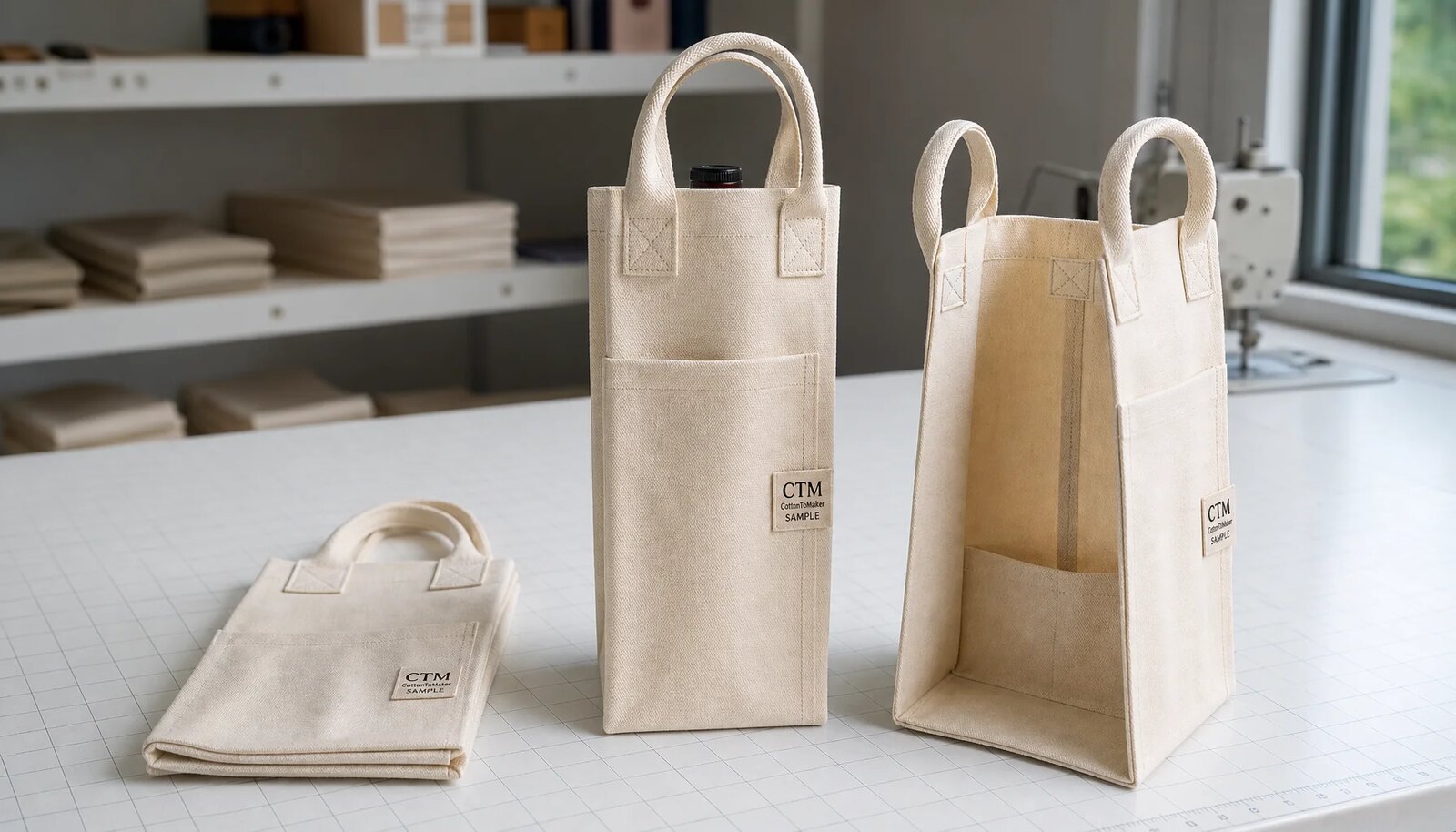
Price the selling role first
A custom canvas wine carrier earns its place at a farmers market only if it supports a clear sale. It may be a $10 to $18 retail accessory, a packaging line inside a two-bottle gift bundle, a branded upgrade at checkout, or a seasonal add-on for holiday markets. Each role sets a different ceiling for landed cost. A giveaway can be simple. A gift carrier that sits beside wine, cider, olive oil, flowers, or preserves needs better shape, cleaner stitching, and a front panel that displays well.
Start with selling math before contacting suppliers. If the carrier retails for $12 and the vendor wants a 55 percent gross margin on the accessory, the landed cost target is about $5.40 or less. If it is allocated into a $42 two-bottle bundle, the carrier might only be allowed $4.00 of cost unless the bundle price rises. If the carrier increases bottle attachment rate or makes premium gift sets easier to sell, it can justify stronger construction, but that value should be explicit.
Farmers market vendors also buy around constraints that larger retailers may not feel as sharply: booth storage, weekend transport, limited cash flow, weather exposure, and seasonal artwork. A lower unit price is not automatically better if it means holding 3,000 pieces through the off-season or unpacking wrinkled carriers before every Saturday market.
- Set a maximum landed cost for each selling role: resale, bundle, checkout, event, or gift program.
- Estimate normal weekend sell-through separately from holiday markets, harvest weekends, tourism peaks, and special tastings.
- Include storage space and handling time in the buying decision because canvas carriers are bulky for their unit value.
- Avoid using a 5,000-piece quote as the planning price unless sell-through and cash flow support that volume.
- Decide whether the carrier must create retail value or simply move bottles safely from booth to car.
Build a tiered pricing plan
A useful bulk pricing plan does not stop at the factory unit price. It shows how one-time charges, freight, packing, and reorder assumptions change at each quantity. For custom canvas wine carriers, practical quote tiers often include 300, 500, 1,000, 2,500, and 5,000 pieces. The exact tiers can shift, but every supplier should quote the same spec at the same quantities so the comparison is real.
Use sample math as a planning frame, not as a promise of market price. Suppose a 12 oz single-bottle printed carrier is quoted at $4.80 for 300 pieces, $4.35 for 500, $3.85 for 1,000, $3.45 for 2,500, and $3.20 for 5,000. Add setup charges, samples, inspection, freight, domestic delivery, duties where applicable, and payment fees. The landed cost may move from about $6.00 at 300 pieces to about $4.63 at 1,000 pieces and about $3.63 at 5,000 pieces before duty or tax, depending on carton cube and freight route.
The decision is not simply the lowest row. A 500-piece order may be smarter than 1,000 pieces if the vendor is testing a new logo, bottle mix, or retail price. A 1,000-piece order may be the best first custom run when the vendor has proven weekend demand and wants meaningful setup amortization. A 2,500-piece order may fit a winery that sells at markets, tasting rooms, and holiday events. The pricing plan should match how quickly the bags become cash again.
- Ask suppliers to separate sewn unit cost, decoration, retail packing, setup, sample charges, carton data, and Incoterm.
- Amortize setup across the first order, then calculate reorder cost without non-repeating charges.
- Compare landed cost per unit and cash tied up per order, not only percentage savings.
- Model storage by carton count, not just piece count.
- Keep one pricing worksheet for the base carrier and a separate one for premium two-bottle or gift versions.
Use margin math that fits markets
Farmers market pricing has to survive real booth behavior. Customers may buy one bottle, add a second bottle after tasting, or choose a ready gift bundle because it looks complete. A wine carrier can be profitable as a direct sale, but it can also be profitable if it raises the attachment rate of bundles. The buyer should decide which outcome matters before locking the order quantity.
Here is a simple worked example. A vendor buys 1,000 single-bottle carriers at a planned landed cost of $4.63. If the carrier retails alone at $12, gross margin is $7.37, or about 61 percent before booth labor and payment fees. If the carrier is included in a two-bottle gift bundle at $48, and the vendor allocates $5 of the bundle value to the carrier, the carrier still supports the offer. If customers resist the $48 price, the vendor may need a lower-cost build, a higher bundle price, or a smaller first order.
Attachment rate matters. If a vendor sells 80 bottles on a regular weekend and 20 percent of buyers add a carrier, that is roughly 16 carriers per weekend. At that pace, 500 carriers cover about 31 market weekends before holidays. If holiday events move 120 carriers in a month, the same stock disappears faster. This is why a custom canvas wine carriers bulk pricing plan for farmers market vendors should include sell-through scenarios, not just MOQ.
- Calculate retail accessory margin and bundle allocation separately.
- Track expected carrier sales per weekend, not only bottle sales.
- Estimate gift-bundle attachment rate for normal weekends and holiday events.
- Set a reorder trigger that covers production lead time plus peak-event demand.
- Use the first season to validate retail price, handle comfort, display appeal, and customer response.
Specify the carrier precisely
Wine carriers are not generic totes. Bottle diameter, bottle height, shoulder shape, neck clearance, and divider construction all affect the pattern. A still wine bottle, sparkling bottle, cider bottle, and specialty olive oil bottle may sit differently. If the vendor sells mixed products, the spec should be built around the largest and most awkward combination that must fit.
Canvas weight should be stated in both ounces and GSM. A 10 oz canvas, roughly 340 GSM, can work for economy single-bottle programs or promotional use. A 12 oz canvas, roughly 400 GSM, is often a practical starting point for retail-style farmers market carriers because it balances structure, cost, and booth presentation. A 16 oz canvas, roughly 530 GSM, can feel more premium, but it increases material cost, sewing effort, carton weight, and freight cube.
Construction changes cost as much as fabric. A sewn divider, reinforced base, contrast binding, folded handles, bartacks, lining, hangtag, woven label, or patch all add labor. Choose details that improve safety, display value, or customer use. For a market booth, comfortable reinforced handles may matter more than a decorative patch. For a gift bundle, front-panel alignment and neat hangtagging may matter more than lining.
- Specify finished width, height, depth, handle drop, pocket width, divider height, and base width.
- State whether the carrier must stand upright empty, stand upright loaded, or only carry bottles securely.
- Define handle construction: webbing, self-fabric folded handle, rope, cord, or stitched strap.
- Confirm base structure: no insert, double canvas layer, removable board, or sewn-in reinforcement.
- Include bottle measurements, bottle photos, and the heaviest loaded configuration in the RFQ.
Compare suppliers on equal terms
A confusing supplier comparison can make weak buying look precise. Keep sourcing route, material, construction, decoration, packing, and landed cost in separate layers. Factory-direct cut-and-sew, a trading-company-managed order, a domestic-decorated blank, and a stock carrier with a local label are different buying routes. A 10 oz single-bottle blank should not be ranked against a 16 oz two-bottle retail carrier as if both were the same product.
Factory-direct custom production fits repeat programs where bottle fit, private label details, dividers, and construction control matter. Domestic decoration on blanks can be useful for urgent replenishment, event tests, and very small programs. A staged path often works well: test the market with a stock or semi-custom carrier, collect booth feedback, then engineer a custom version once bottle fit and price point are known.
Use one base spec for supplier quotes. When suppliers suggest changes, label them as cost-down or premium alternates. That keeps the buyer from mixing lower fabric weight, missing dividers, smaller artwork, cheaper packing, or a different Incoterm into one misleading price ranking.
- Compare route first, then build, then decoration, then landed cost.
- Reject quotes that omit GSM, construction assumptions, packing method, carton data, or Incoterm.
- Ask whether subcontracting is used and who is responsible for inspection results.
- Require line-item costs for upgrades such as divider, reinforced base, lining, binding, bartacks, and retail tags.
- Compare booth handling: folding, display, handoff speed, carton size, and storage fit.
Send a focused RFQ
The RFQ should read like a production brief. Include buyer name, product use, target quantity tiers, target ship date, Incoterm request, and whether the order is a pilot, seasonal program, or repeat SKU. Then list finished dimensions, fabric weight, fabric color, handle construction, divider style, base structure, decoration method, artwork size, label or hangtag, packing, carton marks, and inspection requirement.
Ask for documents that reduce ambiguity: technical spec sheet, artwork proof, carton specification, production schedule, packing list draft, and inspection checklist. For materials, request documents suited to the selling channel, such as cotton content confirmation, azo-free dye statement, or restricted substance compliance if a retailer, marketplace, or local rule requires it. Broad certification language is less useful than naming the document and why it applies.
The best quote questions expose hidden cost. Ask whether MOQ applies by total order, fabric color, artwork, label, or carton mark. Ask whether one sample revision is included. Ask if production photos will be supplied at cut panel, print, sewing, divider, and packing stages. Ask what changes on reorder if the same body pattern is used with new artwork.
- Attach a dimensioned sketch or simple tech pack.
- Include actual bottle measurements and photos.
- Ask for excluded costs in writing: freight, duties, labels, sample revision, inspection, carton marks, and artwork changes.
- Require currency, payment terms, lead time trigger, Incoterm, carton dimensions, carton weight, units per carton, and estimated CBM.
- Request first-order and reorder pricing in the same quote.
Approve samples under load
Sample approval should happen with real bottles and real handling. An empty carrier can look clean on a desk and still fail at the booth. Load the sample with the heaviest expected bottle combination, carry it, set it down repeatedly, lift it from a packed carton position, and check whether the handles stretch, the body sags, the divider collapses, or bottles knock together.
Review the sample from the customer and staff point of view. Does it stand neatly on the display table? Does the logo face forward when loaded? Is the handle drop comfortable for a customer wearing a coat or carrying other purchases? Does the divider scrape bottle labels? Does the packed carrier fit the vendor's bins, crates, van shelves, or backroom storage?
Control the approval record. Sign and date the approved sample. Photograph the front, back, handle anchors, divider, base, logo, label, packing, and carton mark. Keep one sealed reference sample for disputes and one working sample for inspection. If changes are approved, update the spec sheet instead of relying on scattered email notes.
- Test largest bottle diameter, tallest bottle height, and heaviest expected combination.
- Check handle comfort, handle stretch, seam stress, divider position, and base stability.
- Rub and fold the decorated area to check curing, adhesion, and cracking.
- Confirm that the carrier recovers shape after unpacking.
- Release production only when approved sample, artwork proof, and spec sheet match.
Set measurable QC limits
Quality control language should be measurable. Instead of writing that bulk goods must match the approved sample, define inspection standard, defect classes, tolerances, and test methods. Many buyers use an AQL approach for sewn goods, often with critical defects at 0.0, major defects at 2.5, and minor defects at 4.0, adjusted to their sales channel. Because wine carriers may hold glass bottles, handle anchors, seam strength, divider position, and load performance need particular attention.
Dimensional tolerances belong in the purchase order. For many small sewn carriers, plus or minus 5 mm on body width and height may be practical; larger two-bottle styles may need plus or minus 8 mm. Handle drop should be measured separately. Logo placement, label position, divider centerline, and base width should also have tolerances because small shifts affect presentation and bottle fit.
Define a repeatable load test. Use the heaviest bottle configuration plus a safety margin, carry or suspend the loaded carrier for a defined period such as 30 minutes, then inspect handle stretch, seam opening, body distortion, divider movement, and print cracking near stress areas. Also inspect odor, mildew, lint, stains, crooked labels, carton crush, and count accuracy.
- Put AQL, defect classes, and tolerances in the PO or inspection booking.
- Classify safety issues, contamination, mildew, and wrong material as critical defects.
- Classify failed use, wrong dimensions, weak stitching, crooked logo, and obvious retail rejection as major defects.
- Check stitch density, bartacks, seam slippage, thread breaks, skipped stitches, and divider alignment.
- Inspect packed cartons as well as loose units.
Pack for booth operations
Packing affects margin because vendors often touch every unit themselves. If carriers arrive crushed, damp, or lint-covered, staff may spend time reshaping, steaming, lint rolling, or repacking before market day. If every unit is overpacked, cost rises and booth setup slows. The packing plan should protect shape, keep the logo clean, and support quick selling.
Choose packing based on the sales role. Bulk pack may work for backroom use. Paper banding or hangtags may fit gift presentation. Polybags may be useful for moisture protection or channel rules, but they add handling and waste. A resale carrier may need a barcode, care note, or hangtag. A bundle carrier may need front panels facing the same way so staff can assemble sets quickly during a rush.
Check carton design before production. Request units per carton, carton dimensions, gross weight, net weight, and packed carton photos. Structured carriers can suffer permanent creases if cartons are overfilled. Softer carriers can wrinkle if packed too loosely. Cartons of 25 or 50 units may be easier to receive, store, and bring to the booth than very large mixed cartons.
- Choose inner packing for the way the carrier is sold and handled.
- Approve hangtag, barcode, care note, and carton mark artwork before packing starts.
- Ask for packed carton photos before final freight booking.
- Check shape recovery after unpacking.
- Match carton count to storage shelves, transport bins, booth replenishment, and weekend sales volume.
Plan reorders around seasons
Farmers market demand rarely moves evenly. Spring openings, summer tourism, harvest weekends, holiday markets, winery events, and corporate gifting can create sharp spikes. A bulk pricing plan should include the first order and the reorder path. Ask what happens if the vendor reorders 300 or 500 pieces after an initial 1,000-piece run. Will the same fabric be available? Does the print screen stay on file? Does label MOQ create extra cost?
Build reorder triggers from sell-through and lead time. If the vendor sells 16 carriers on a normal weekend and 120 during a holiday month, the reorder point should cover supplier lead time plus expected peak demand. Imported custom production may require time for production, packing, and shipping. Domestic decoration on blanks may refill faster, but blank stock and color continuity can change.
Cash flow matters as much as unit price. A larger quantity break may reduce landed cost, but savings can disappear through storage, stale artwork, or tied-up cash. One practical structure is a stable evergreen carrier body with seasonal print, label, or hangtag changes. The body stays repeatable while the offer can refresh for harvest boxes, holiday bundles, or local gift sets.
- Ask for first-order and reorder pricing at 300, 500, 1,000, 2,500, and 5,000 pieces.
- Confirm how long pattern, fabric reference, thread color, screens, and label records are retained.
- Set reorder points using weekly sell-through, event spikes, supplier lead time, and freight timing.
- Use a stable base construction when possible, then vary branding details for seasonal offers.
- Do not commit to inventory that cannot sell before the next season, label update, or packaging refresh.
Specification comparison for buyers
| Quantity scenario | Typical use | Sample landed-cost planning method | Buyer decision |
|---|---|---|---|
| 300 pieces | Pilot run, first season, small winery or market vendor testing gift-bundle attachment | If unit production is $4.80, setup is $240, and freight plus domestic delivery is $360, landed cost before duty/tax is about $6.00 per unit: $4.80 + $0.80 setup + $1.20 freight. | Good for proof of demand, but setup and freight are heavy per unit. Use only if cash flow, storage, or design uncertainty matters more than unit cost. |
| 500 pieces | Small seasonal program, regular weekend booth, holiday market test | If unit production is $4.35, setup is $260, and freight plus delivery is $470, landed cost before duty/tax is about $5.46 per unit: $4.35 + $0.52 setup + $0.94 freight. | Often a useful bridge tier. Check whether 500 pieces fits booth storage and whether expected sell-through clears inventory before the next label or season change. |
| 1,000 pieces | Core farmers market SKU, repeat bundle carrier, stronger brand presentation | If unit production is $3.85, setup is $300, and freight plus delivery is $780, landed cost before duty/tax is about $4.63 per unit: $3.85 + $0.30 setup + $0.78 freight. | Often the first serious custom tier. Strong candidate when bottle fit and artwork are approved and the vendor can sell through within one or two peak seasons. |
| 2,500 pieces | Multi-location vendor, winery plus markets, corporate gifting or holiday program | If unit production is $3.45, setup is $350, and freight plus delivery is $1,550, landed cost before duty/tax is about $4.04 per unit: $3.45 + $0.14 setup + $0.62 freight. | Better unit economics, but inventory risk rises. Use when demand is proven and artwork can stay current across events. |
| 5,000 pieces | Established repeat program with stable branding and predictable sell-through | If unit production is $3.20, setup is $400, and freight plus delivery is $2,750, landed cost before duty/tax is about $3.63 per unit: $3.20 + $0.08 setup + $0.55 freight. | Lowest sample cost in this table, but only sensible when storage, cash flow, and reorder timing support the volume. |
| Reorder at 500 after first 1,000 | Top-up before harvest or holiday markets using approved pattern and artwork | If setup does not repeat, the reorder may land near $4.75 instead of $5.46, depending on freight and fabric availability. Confirm which charges disappear and which remain. | Model reorders separately. A repeat order can beat a first-order quote even at a lower quantity if screens, pattern work, and sampling do not repeat. |
| Two-bottle premium version | Gift sets with higher retail price, heavier bottles, divider, reinforced base, hangtag | Add estimated upgrades line by line: divider $0.35 to $0.80, reinforced base $0.25 to $0.60, heavier canvas $0.40 to $1.10, retail tag $0.08 to $0.25, then recalculate freight cube. | Do not compare against a single-bottle economy carrier. Price it as a separate bundle component with its own retail value and load-test requirement. |
| Domestic decorated blank | Fast pilot, urgent event replenishment, very small branded run | Unit cost may be higher, but freight, timing, and MOQ may be lower. Compare total landed cost, not overseas factory price alone. | Useful when speed or uncertainty is the main constraint. Less suitable when custom bottle fit, divider placement, or private-label construction matters. |
Buyer checklist before sampling
- Define the selling role before sourcing: resale accessory, gift-bundle component, checkout carrier, tasting-room packaging, promotional giveaway, or corporate gift add-on.
- Set target retail price, target bundle allocation, gross margin target, and maximum landed cost before requesting quotes.
- Estimate normal weekend sell-through, peak event sell-through, holiday demand, and how many cartons the booth or storage area can realistically hold.
- Confirm bottle count, bottle diameter, bottle height, shoulder shape, neck clearance, and whether the carrier must fit wine, sparkling wine, cider, olive oil, or mixed gift items.
- Specify finished dimensions, fabric weight in oz and GSM, handle drop, pocket width, divider height, base structure, lining, binding, and reinforcement details.
- State artwork size, print colors, logo placement, label location, hangtag needs, barcode needs, and acceptable color matching method.
- Request pricing at 300, 500, 1,000, 2,500, and 5,000 pieces, with unit production cost, decoration, packing, setup, sample cost, carton data, and Incoterm shown separately.
- Build a landed-cost worksheet that amortizes setup, freight, inspection, payment fees, domestic delivery, duties where applicable, and storage handling.
- Model first-order cost and reorder cost separately because screens, pattern charges, and sample charges may not repeat.
- Require quote basis by Incoterm, currency, payment terms, lead time trigger, carton size, carton weight, units per carton, and estimated CBM.
Factory quote questions to send
- Can you quote the same approved carrier spec at 300, 500, 1,000, 2,500, and 5,000 pieces with all assumptions listed separately?
- What is the unit price for the sewn carrier before decoration, and what is the separate cost for screen print, woven label, hangtag, barcode label, or retail packing?
- What are the pattern, screen, artwork, sample, and pre-production sample charges, and which charges do not repeat on a reorder?
- What canvas weight are you quoting in oz and GSM, and is that greige fabric weight or finished fabric weight after dyeing and finishing?
- What is the estimated fabric consumption per unit, including cutting loss, and does price change for natural, dyed, or printed canvas?
- What is the MOQ by total order, fabric color, print artwork, label design, hangtag, and carton mark?
- What are the separate upgrade costs for divider, reinforced base, lining, binding, folded handles, bartacks, contrast thread, snap, button loop, or zipper?
- How many units fit in each carton, what are the carton dimensions, gross weight, net weight, and estimated CBM at each quantity tier?
- What Incoterm are you quoting, what is excluded, and can you provide an estimated freight range or packed carton data for our forwarder?
- What documents will you provide before production: spec sheet, material declaration, artwork proof, production schedule, carton specification, packing list draft, and inspection checklist?
Quality-control points to confirm
- Use a written inspection plan, commonly General Inspection Level II with AQL such as 0.0 for critical defects, 2.5 for major defects, and 4.0 for minor defects, unless the buyer or sales channel requires another standard.
- Classify critical defects as unsafe handle failure, sharp or exposed components, severe contamination, wrong product, wrong material, mildew, mold, moisture damage, or chemical odor that makes the goods unsellable.
- Classify major defects as incorrect dimensions beyond tolerance, weak bartacks, open seams, severely crooked logo, wrong print color, divider misplacement affecting bottle fit, wrong carton count, failed load test, or obvious retail presentation failure.
- Classify minor defects as loose threads, light lint, slight washable marks, small print specks outside the logo area, or cosmetic stitching variation that does not affect use or retail presentation.
- Set dimensional tolerances before production, such as finished width and height within plus or minus 5 mm for small carriers or plus or minus 8 mm for larger two-bottle styles, with handle drop measured separately.
- Specify stitch density targets, such as 8 to 10 stitches per inch for standard canvas seams unless the factory proposes a more suitable construction for the selected fabric weight.
- Require bartacks, box stitching, or equivalent reinforcement at handle anchor points, and inspect thread breaks, skipped stitches, seam slippage, uneven tension, and loose backstitching.
- Run a load test using the heaviest expected bottle configuration plus a safety margin, carried or suspended for a defined duration such as 30 minutes, then checked for handle stretch, seam opening, body distortion, and divider movement.
- Check divider performance under load: bottle separation, label abrasion, neck clearance, base alignment, and whether the divider collapses when the carrier is lifted.
- Rub-test the print with dry and lightly damp white cloth, checking for transfer, cracking at fold lines, poor curing, ink build-up along canvas texture, and color inconsistency.