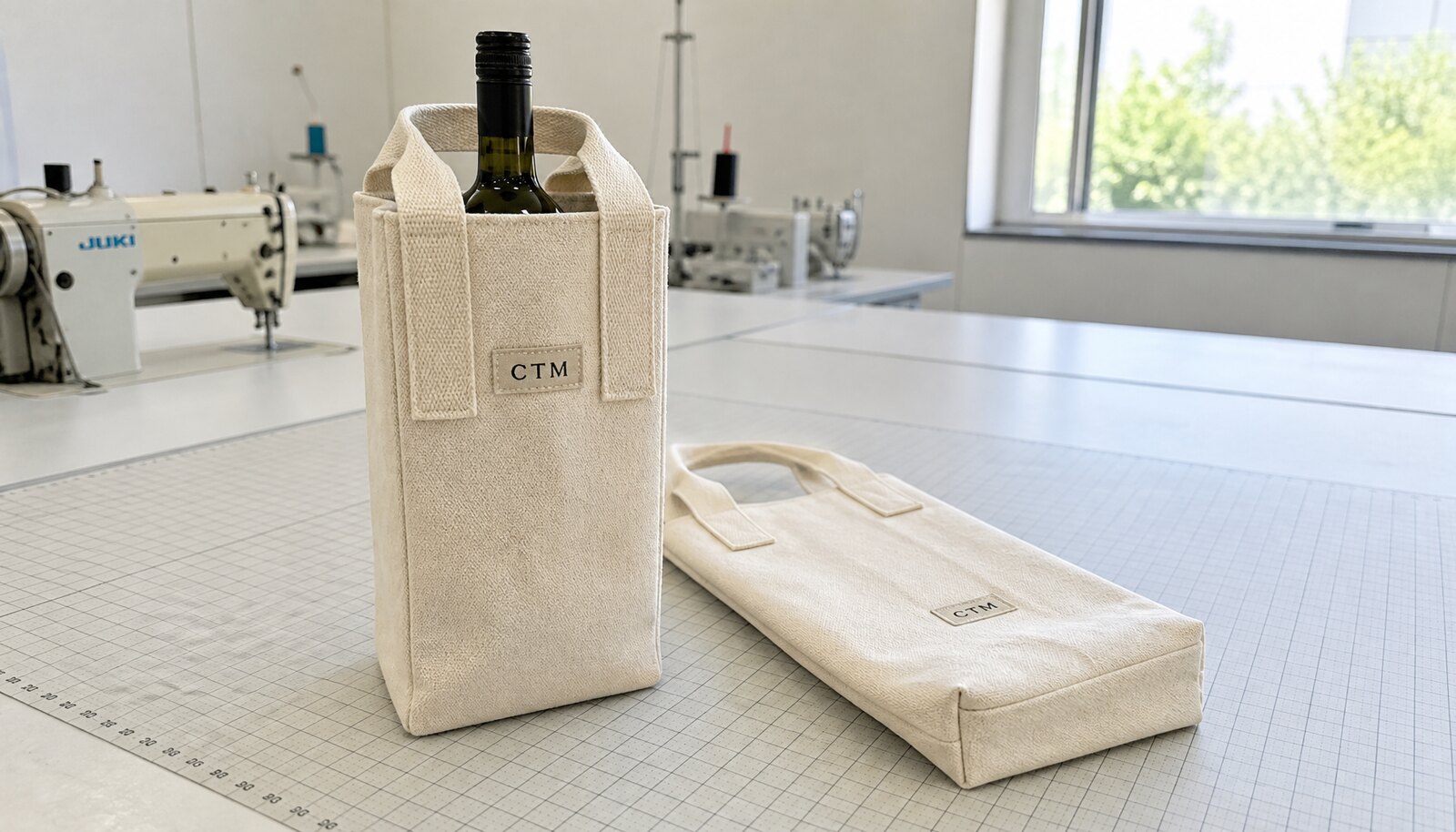
Why compliance matters for a wine carrier, not just the wine label
A canvas wine carrier looks simple, but it can fail your buying program in ways that are expensive to fix. If the fabric is too light, the bottle sits crooked and the carrier looks cheap on shelf. If the print ink rubs off, the packaging becomes a retail liability. If carton data is vague, the shipment can still move through production and then stall at receiving because the paperwork does not match what your team approved. That is why a supplier compliance checklist for boutique wineries should cover more than the logo and price. It should cover the material, the construction, the decoration method, the packing format, and the evidence the factory can actually provide.
For boutique wineries, the buying risk is usually not volume at the scale of a national brand. The risk is inconsistency. A small run for a tasting room, a holiday gift pack, or a club shipment often needs to match the previous batch exactly, even when the order is not large enough to get priority at a factory. The right checklist keeps the order from drifting into 'close enough' territory. It also helps procurement teams compare suppliers on the same basis instead of accepting different assumptions hidden inside each quote.
- Treat the carrier as a branded retail product, not only as a shipping accessory.
- Use the checklist to compare the same spec across every quote.
- Make the supplier prove what they will build before you approve bulk.
Start with the structure: fabric weight, hand feel, and bottle fit
The first spec to lock is the carrier structure. For most boutique winery programs, a 12 oz to 16 oz canvas is the practical range because it gives enough body for a clean retail look without turning the carrier into a rigid box. If the fabric is quoted in GSM, convert that into a usable comparison and do not rely on the word 'heavy' or 'premium.' Two suppliers can both claim canvas and still send very different materials. Ask whether the cloth is plain cotton canvas, poly-cotton canvas, or a recycled blend, because the weight alone does not tell you how the bag will drape or print.
Fit matters as much as fabric. A carrier for a standard 750 ml bottle should still be checked against the actual bottle profile you sell, including a Burgundy or tall Bordeaux shape if your program uses both. If the bottle slides around, the carrier will feel loose in hand and the bottle may lean in cartons. If it is too tight, staff will fight the packaging at packing speed and the bottom seams will take extra stress. The goal is a controlled fit: enough room for insertion, minimal internal movement, and a bottom panel that stays flat.
- Specify fabric weight in oz or GSM and keep the number in the RFQ.
- Send the factory the actual bottle dimensions, not just the nominal bottle size.
- Ask for a physical sample that uses the same fabric roll, not a substitute fabric.
Choose the decoration method by order size, brand style, and risk
Decoration choice drives both cost and failure rate. Screen print is the most common option for canvas wine carriers because it gives strong color, good opacity, and a familiar retail look. It works well when the logo is bold, the number of colors is limited, and the print area is not trying to capture hairline detail. Heat transfer or digital transfer can support smaller quantities or multi-color artwork, but buyers should inspect flexibility after folding and check whether the print surface can crack or shine in a way that clashes with the rest of the product. Embroidery or woven labels usually fit a more premium positioning, but they add setup time and can create bulk on a compact carrier.
The practical rule is simple: use the print method that matches how the product will be handled. If the carrier will be stacked in tasting room inventory or shipped flat to stores, the print needs to survive folding and unpacking without edge wear. If the carrier is meant for premium gifting, a woven label or subtle embroidery may look better than a large printed panel. A supplier that understands the use case will propose a method that balances look, cost, and production stability instead of defaulting to the cheapest process.
- Screen print suits bold logo work and repeat orders.
- Transfers can support smaller runs but need folding and abrasion checks.
- Premium branding is often better served by woven labels or embroidery than by more ink.
Use MOQ logic to control quote drift and hidden setup costs
MOQ is not just a production number. It is a cost structure. A factory may quote a low unit price for a higher quantity and a much higher unit price for a smaller run, but the real issue is often setup, sampling, and color separation fees. If you are buying for boutique wineries, you may need a small seasonal run, a club-exclusive carrier, or a test program for retail buyers. In those cases, the supplier should explain whether they are using blank stock, semi-custom stock, or a fully custom build. Each route has a different MOQ logic, different lead time, and different room for changes.
The most useful way to compare suppliers is to ask for pricing at two or three volume points. For example, request the quote at a sample run, a mid-volume retail run, and a replenishment run. That exposes how much of the cost is tied to setup rather than material. If the low-volume quote suddenly becomes expensive because the print screen, dye lot, or pattern charge is being spread across too few units, you can decide whether to simplify the artwork or switch the carrier structure. The point is not to chase the lowest MOQ in isolation. The point is to understand where the factory is placing the cost and whether that structure fits your launch plan.
- Ask for pricing at more than one order quantity.
- Separate setup charges from unit price in the quote.
- Treat semi-custom stock as a different sourcing route, not a minor variation.
Read compliance evidence like a buyer, not a compliance manager
A supplier compliance checklist should tell you what evidence is actually useful, not just what sounds impressive. For canvas wine carriers, the most relevant documents are usually material composition data, basic colorfastness or migration-related information where applicable, carton and packaging specifications, and a clear origin statement. Depending on destination market and sales channel, you may also need ink safety declarations or test reports tied to the decoration process. Do not accept a generic folder of certificates that do not match the product you are buying. A valid document for another item in the factory is not proof for your carrier.
The evidence should line up with the way the product will be used. If the carrier is going through retail, your concern is often stain transfer, odor, and appearance after handling. If it is being sold as part of a gift bundle, packaging cleanliness and carton integrity become more important. If the carrier is moving into the EU, US, or another regulated market, the buyer should understand what part of the compliance burden sits with the factory and what part sits with the importer of record. The supplier does not need to solve your regulatory program, but they do need to provide traceable production data that supports it.
- Reject generic certificates that are not tied to the actual carrier spec.
- Match compliance evidence to the target market and sales channel.
- Keep the material declaration, print process, and packing spec in one file.
Sample approval should test appearance, function, and repeatability
A sample is not only a visual check. It is a production proof. You need to inspect the same points that will create problems in bulk: dimension accuracy, fabric consistency, print placement, handle reinforcement, and how the carrier behaves when a bottle is inserted and removed several times. If the sample uses substitute fabric, a different ink batch, or a temporary label, it is not a real approval reference. Ask the supplier to mark the approved sample clearly and keep one copy on your side as the standard for the bulk order.
The sample review should also catch the mistakes that buyers often miss when the product looks clean on a table. Check if the bottle mouth sits too high and interferes with closure or fold lines. Check whether the bottom panel twists under weight. Check if the print sits too close to a seam or handle attachment point. For premium retail programs, even small issues in print registration or stitch alignment can make the product feel off-brand. The sample stage is where you decide whether the supplier can execute your spec with consistency, not just whether one unit looks acceptable.
- Approve only final-fabric, final-print samples.
- Test the carrier with the actual bottle shape used in the program.
- Keep one signed sample as the production reference.
Packing details can damage a good product before it reaches the buyer
Packing is often treated as a logistics note, but it changes the retail outcome. Canvas carriers can pick up dust, creases, moisture, or odor if they are packed carelessly. For boutique wineries, where presentation matters, a bag that arrives wrinkled or marked can create a receiving problem even when the product itself is correct. The quote should state how many pieces go into an inner pack, whether each piece is folded the same way, whether desiccant or moisture protection is needed, and how the master carton is reinforced. If the carrier is sold as a premium item, it may also need a clean insert or label position that stays visible when the box is opened.
Carton data matters because freight cost and warehouse handling depend on it. A supplier who can tell you the exact carton dimensions and gross weight is easier to work with than one who quotes only the unit price. If the carton is oversized or the packing count is inefficient, you pay more in freight and storage. If the cartons are packed too tightly, the bags develop hard fold lines that do not disappear on arrival. The best packing method is the one that protects appearance without wasting cube or adding unnecessary labor.
- Request unit fold method and pack count in writing.
- Confirm carton size and gross weight before freight booking.
- Use moisture protection if the route or season creates humidity risk.
Lead time risk is usually hidden in samples, not bulk sewing
When a factory gives one lead-time number, it rarely tells the full story. A realistic order has separate stages: artwork confirmation, sample development, sample approval, material booking, bulk production, packing, and pre-shipment inspection. If the factory says 25 days but that number excludes sample approval and material sourcing, the number is not useful for planning. Boutique wineries often need carriers tied to release dates, tasting room events, or holiday promotions, so the schedule should be broken into steps the buyer can control.
The most common delay points are artwork changes, fabric availability, and approval loops. If the artwork changes after the screen is made, the factory has to restart. If the fabric is not in stock, the supplier may switch to another roll with slightly different texture or shade. If the sample is not approved quickly, the bulk slot can slip. This is why procurement teams should ask for a schedule that shows the critical path and identifies which step is dependent on buyer response. A supplier that can explain the timeline clearly is usually more reliable than one that only gives a single delivery promise.
- Separate sample time from bulk time in the schedule.
- Identify approval deadlines that can move the ship date.
- Ask what materials are already in stock versus made to order.
Compare supplier routes with landed cost, not just ex-factory price
A low ex-factory quote can be misleading if the supplier route adds defects, delays, or extra freight volume. Compare direct factory sourcing, trading company sourcing, and stock-plus-custom sourcing on the same basis: material control, proofing speed, document quality, and carton efficiency. A direct factory may give better visibility into the build and packaging, while a trading route may be easier for smaller programs or mixed product orders. Stock-plus-custom can reduce lead time, but it can also limit your control over dimensions, material shade, and logo placement. The right route depends on how tightly the carrier has to match your brand standards.
For procurement teams, the real decision is landed cost and operational fit. That includes unit price, setup fees, sample fees, freight cube, inspection cost, and the risk of rework. If one supplier is slightly more expensive but gives cleaner documentation, better sample discipline, and a packing format your warehouse can receive without repacking, that may be the better choice. The lowest quote is only the best quote if it arrives complete, consistent, and on time.
- Compare total landed cost, not only ex-factory price.
- Weigh document quality and packing efficiency as part of cost.
- Choose the route that matches your control needs and launch timing.
What a usable quote should contain before you issue a PO
A complete quote for custom canvas wine carriers should read like a production plan, not a marketing sheet. It should state the fabric weight or GSM, the exact carrier dimensions, the decoration method, the MOQ, the sample timeline, the bulk lead time, the carton pack plan, and the document set available on request. If any of those items are missing, the risk is that each side is making a different assumption. That is how buyers receive a product that technically matches the invoice but not the retail need.
The strongest buying habit is to force clarity before the order is placed. Keep the quote questions, sample approval record, and packing spec in the same working file. If the supplier can answer those questions clearly and back them up with a sample, you are far less likely to get trapped in correction cycles after production starts. Boutique winery programs do not need complicated sourcing language. They need a supplier who can build a wine carrier to spec, document the build, and deliver it in the same condition the buyer approved.
- Use the quote as a spec control document, not only a price sheet.
- Do not release bulk until the sample and packing method are approved.
- Keep the buyer checklist attached to the RFQ and PO.
Specification comparison for buyers
| Supplier option | What to verify | Commercial advantage | Buyer risk to control |
|---|---|---|---|
| Direct sewing factory | fit-test photos with reference bottle, bottom reinforcement close-up, handle load proof, and final carton photo set | Better sample-to-bulk control and faster production feedback | May be weaker on export paperwork or branded packing unless checked early |
| Trading company | Factory name, production photos, trim-source proof, and who owns QC decisions | Can coordinate small mixed orders and extra services | Markup can hide real factory capability and slow defect decisions |
| Specialized bag workshop | bottle fit, bottom reinforcement, handle or cord strength, divider option, seam allowance, and upright stability | More practical for detailed construction, trims, and repeat programs | Capacity may be limited during peak seasons |
| Low-price general supplier | cotton canvas, jute, felt, nonwoven, or laminated paper sized to bottle diameter, weight, and condensation risk | Useful for simple promotional runs with loose specs | Material downgrades, weak packing, and vague inspection scope can erase savings |
| Retail-ready supplier | upright or flat packing, bottle-protection insert, carton count, moisture control, and retail display orientation | Can handle labels, SKU separation, carton marks, and receiving rules | Higher unit cost must be compared against reduced warehouse work |
| Compliance-focused supplier | Fabric records, labeling review, test plan, and production traceability | Safer for retail programs and repeat brand orders | Documentation claims need evidence, not only sales language |
| Local sample room plus bulk factory | Signed sample, bulk factory handoff, first-piece photos, and deviation owner | Good for complex branding before large production | Sample room quality may not match bulk line unless handoff is controlled |
Buyer checklist before sampling
- Confirm finished carrier dimensions against the exact bottle diameter and height you will ship, not just a generic 750 ml bottle reference.
- Specify fabric weight in oz or GSM, plus whether the carrier is plain canvas, cotton canvas, or a blend, so suppliers do not quote different structures under the same name.
- Lock the decoration method early: screen print, woven label, embroidery, heat transfer, or debossed patch, because each method changes setup cost and sample timing.
- Require a sample with final fabric, final thread color, final print placement, and final carton pack method before bulk approval.
- Ask for seam and handle reinforcement details in writing, including stitch type and whether stress points are bartacked or double-stitched.
- Request compliance evidence for materials, inks, and packaging that matches your sales channel and destination market.
- Review carton count, inner pack quantity, and master carton dimensions before the factory books freight space.
- Tie payment milestones to sample approval, bulk production start, and pre-shipment inspection if your order size justifies it.
Factory quote questions to send
- What fabric weight, construction, and tolerance are you quoting, and can you state the final GSM or oz weight on the proforma invoice?
- Which print method is included in the quote, what is the setup cost, and how many colors are covered before the price changes?
- What is your MOQ by style and by decoration method, and what extra cost applies if we split colors or sizes?
- Can you share the exact sample schedule, including strike-off, pre-production sample, and bulk approval timing?
- What compliance documents can you provide for fabric, ink, and carton materials, and which market standards do they cover?
- How will the carriers be packed per carton, and what are the carton dimensions and gross weight?
- What is your production lead time after sample approval, and what part of that lead time is vulnerable to capacity or material delays?
- What inspection points do you build into production, and will you accept third-party final inspection before shipment?
Quality-control points to confirm
- Fabric weight matches the approved range and the fabric does not show thin spots, weaving gaps, or visible contamination.
- Finished dimensions stay within the agreed tolerance so the bottle fits securely without excessive slack.
- Handle stitching is even, secure, and reinforced at load-bearing points with no skipped stitches or loose thread tails.
- Print registration, color density, and logo placement match the approved sample under normal lighting.
- Seams lie flat, corners are clean, and there is no puckering that would make retail presentation look uneven.
- Carton pack quantity, inner bag count, and outer marks match the packing list exactly.
- Smell, stain, dust, and moisture condition are acceptable on unpacking, especially if the carriers will go straight to retail or gifting.
- Material and carton documentation match the shipped goods, including country of origin and declared composition.