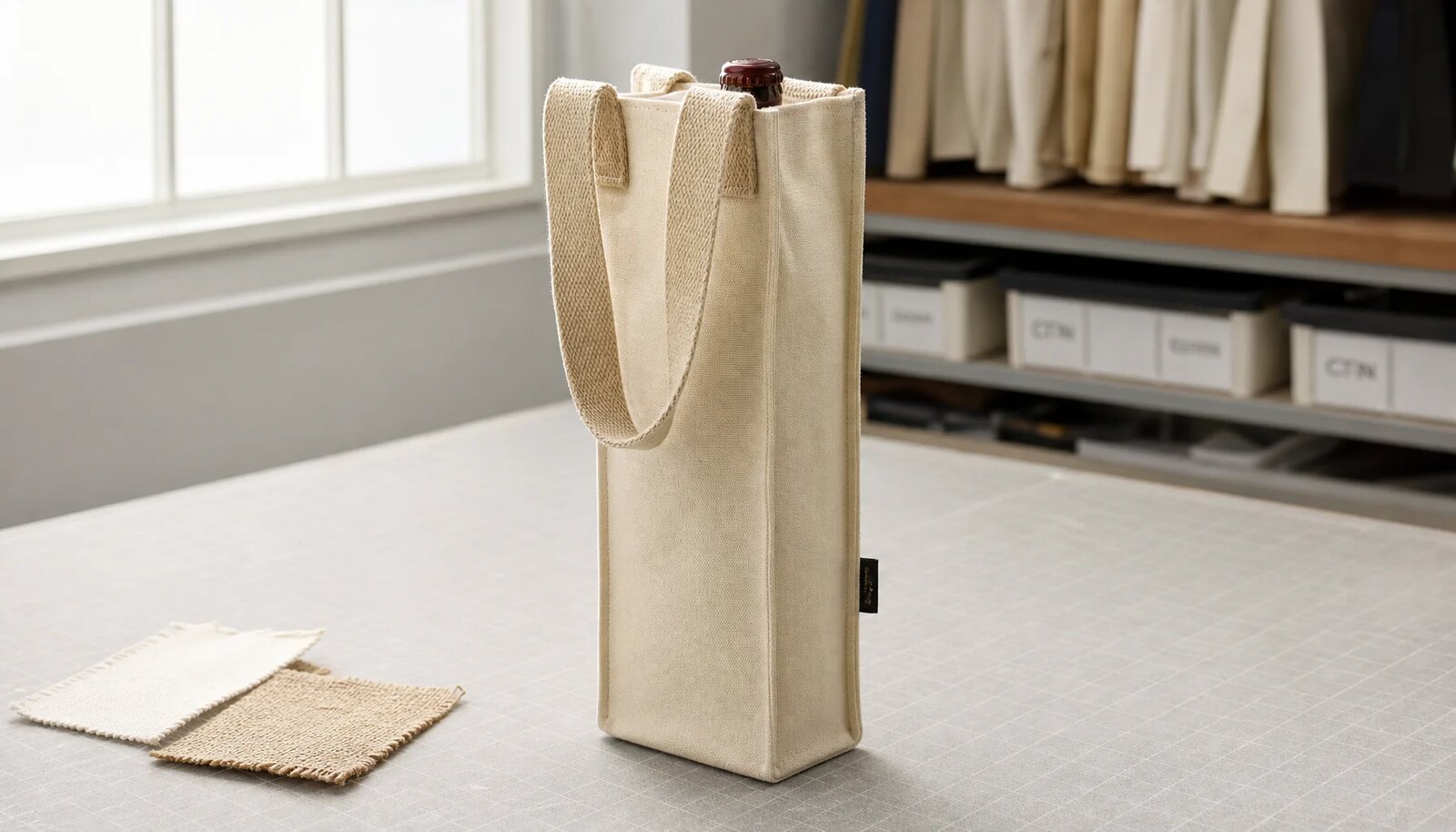
Start With the Bottle and Event Workflow
A custom canvas wine carrier should be specified around the bottle first and the artwork second. Event planners often work with a known wine list, sponsor label, venue setup plan, or gifting schedule, but many RFQs still describe the bag as a generic single-bottle holder. That creates avoidable risk because bottle height, shoulder shape, diameter, and filled weight are what drive the pattern, base strength, handle stress, and packing count.
A standard 750 ml still wine bottle is not the same sourcing problem as a sparkling bottle, a tall dessert wine bottle, or a magnum. Sparkling bottles are wider and heavier; tall bottles may protrude above the carrier; chilled bottles add condensation; mixed assortments require the pattern to fit the largest bottle without making smaller bottles look lost. If staff will load hundreds of bottles before an event, the opening also needs enough clearance for fast insertion without scuffing the print or straining the top hem.
The event workflow matters too. A carrier used as a table-place gift may need to stand neatly and photograph well. A carrier handed out at registration needs fast packing and easy carton identification. A carrier shipped to multiple venues needs labeling and count accuracy more than decorative complexity. The best buying brief connects the product to the actual use path: warehouse receiving, bottle loading, transport to venue, guest handoff, and post-event reuse.
- Measure bottle height, maximum diameter, shoulder width, and filled weight before asking for price.
- For mixed bottles, spec the carrier around the largest bottle and check the presentation of the smallest bottle.
- State whether bottles are loaded at the factory, at a warehouse, at the venue, or by a fulfillment partner.
- Decide whether the carrier must stand upright on a table or only function as a hand-carry gift bag.
Select Canvas by Fiber, Weight, and Finish
Canvas weight is important, but it is not the whole material decision. Buyers should specify fiber content, weave, finish, color process, and approximate weight. Suppliers commonly quote canvas in ounces while procurement teams compare GSM. As a rough working reference, 10 oz canvas may sit around 340 GSM, 12 oz around 400 GSM, and 16 oz around 540 GSM, but those conversions are approximate because weave density, coating, washing, dyeing, and finishing change the final number and hand feel.
Cotton canvas is the classic choice for a natural, tactile wine carrier. It accepts screen printing well, has a familiar reusable feel, and works for event gifting where the product should not look disposable. Cotton-poly canvas can improve dimensional stability, reduce shrinkage, or lower cost, depending on the blend, but it may feel less natural and can complicate sustainability claims. Natural greige canvas is popular, yet the buyer should approve shade variation because natural cotton can range from warm cream to grey-beige. Dyed canvas gives stronger brand alignment but introduces colorfastness and dye-lot control questions.
Washed or pre-shrunk canvas can reduce post-production shrinkage and produce a softer hand. It may also make the carrier less crisp when standing upright, so the sample must be judged filled with the bottle. Coated or laminated canvas can add water resistance or stiffness, which may help with chilled bottles, but coatings can create odor risk, alter print adhesion, and make the product less breathable. For procurement, the material spec should say what the finish is meant to achieve, not just name it.
For standard single-bottle event carriers, 10 oz to 12 oz canvas is often practical when the base and handles are properly reinforced. For premium gifting, two-bottle formats, sparkling bottles, or retail-style reuse, 12 oz to 16 oz is usually a better starting point. If the carrier includes a board insert, lined interior, or structured divider, the fabric may not need to do all the stiffness work, but the added components must be costed and sampled.
- Specify fiber content, such as 100% cotton canvas or a stated cotton-poly blend ratio.
- List weight in oz and approximate GSM, with the note that conversion varies by weave and finishing.
- Approve natural canvas shade range, dyed color standard, and any acceptable slub or weave variation.
- Ask whether the fabric is washed, pre-shrunk, coated, laminated, bleached, dyed, or untreated.
- For sustainability claims, request supporting documents instead of relying on broad phrases such as eco-friendly or recycled.
Match Construction to Load and Presentation
Construction is where a cheap-looking carrier and a durable event gift often separate. Two suppliers can quote the same fabric weight and still deliver very different products because seam allowance, stitch density, thread quality, handle tape, base shape, and reinforcement method all affect performance. A single-bottle sleeve with a simple folded handle is a different build from a boxed-base carrier with cotton webbing handles, lining, a divider, and reinforced X-box stitching.
For many canvas wine carriers, handle width in the 25 to 38 mm range gives a practical balance between comfort, appearance, and cost. Narrow handles may save material but can feel flimsy under a full bottle. Handle drop should match the use case: short handles can look neat for gift presentation, while longer drops may be easier for guests carrying several items. Reinforcement should be visible on the construction drawing. X-box stitching, bar tacks, seam-caught handles, or reinforced patches can all work if they are executed consistently and tested under load.
The base deserves more attention than it usually gets in an RFQ. A flat sleeve may be fine for a quick handout, but a boxed base or reinforced gusset helps the bottle sit more securely and improves table presentation. If the carrier must hold two bottles, the divider should be specified as sewn-in, removable, padded, or simple fabric separation. A loose divider can shift during loading; a rigid divider can improve presentation but increase packing volume and labor.
Construction also affects freight. A fully structured carrier may feel better, but it can be harder to pack flat and may create larger cartons. For large event programs, carton efficiency can matter as much as the unit price. The right construction is the one that survives the load, presents the bottle cleanly, and fits the packing and distribution plan.
- Define seam type, seam allowance, top hem, base reinforcement, and handle attachment method.
- Use a construction sketch for handle width, handle drop, body size, gusset, divider, and logo position.
- Ask for stitch density, thread type, and reinforcement details before approving a lower quote.
- Test the carrier filled, carried, set down, and folded as it will be handled in the event workflow.
Choose Branding That Works on Canvas
Branding should be selected for the texture of canvas, not just for the artwork file. Screen printing is usually the most efficient choice for simple logos, one- or two-color artwork, repeat orders, and strong unit economics. It performs best with bold shapes, adequate line thickness, and clear spacing. Fine reversed type, small sponsor marks, gradients, and detailed illustrations can lose sharpness because the ink interacts with the woven surface.
Heat transfer can provide sharper detail and multi-color graphics, but the buyer should check hand feel, edge lifting, film cracking, and wash or rub resistance. Embroidery can look premium on thicker canvas, though it may distort lightweight fabric, add cost by stitch count, and reduce readability for small text. Woven labels and sewn patches are useful when the brand mark must stay crisp or when the carrier is meant to feel retail-ready. Their risk is attachment quality: crooked labels, puckering, loose corners, and inconsistent placement quickly make the product feel careless.
Logo placement should be measured from stable reference points. For example, specify the logo center from the top edge and side seam, or define a print box on the front panel. On a filled carrier, fabric can curve around the bottle, so artwork placed too close to side seams or gussets may distort. If the carrier ships folded, confirm that the fold line does not cross the print or create transfer marks.
For event planners managing sponsors, brand committees, or venue partners, the safest process is to approve a strike-off and a complete pre-production sample. The strike-off proves color and print detail. The finished sample proves placement, fabric interaction, and appearance when the bottle is inside. Both are useful; neither replaces the other.
- Use screen print for bold logos, limited colors, and larger event quantities.
- Use woven labels, patches, or embroidery when crisp branding and reuse value matter more than decoration area.
- Set print placement tolerance in writing, often plus or minus 3 to 5 mm for simple front-panel logos.
- Avoid placing important artwork across seams, gusset folds, or high-stress handle zones.
- Approve decoration under realistic lighting and with the carrier filled, not only flat on a table.
Control MOQ, Variations, and Cost Drivers
MOQ is not a single rule in custom canvas wine carriers. It usually comes from several production constraints at once: fabric purchase minimums, dyeing minimums, screen setup, label or patch minimums, sewing line efficiency, and packing labor. A supplier may offer a low order quantity for natural canvas with one-color screen print, then require a much higher MOQ for custom dyed fabric, special webbing, or a woven patch.
Variation planning is where event buyers can save real money. Multiple city names, sponsor logos, or event dates may look like small artwork changes, but they can create separate screen setups, separate approvals, separate packing labels, and separate carton counts. If the base carrier can stay the same across all versions, the supplier can often run fabric cutting and sewing more efficiently, then split decoration later. If every version changes fabric color, handle color, and label, the order becomes several small production runs instead of one program.
Cost should be reviewed by component. Fabric weight affects material cost and carton weight. Decoration affects setup and reject risk. Construction affects sewing minutes. Packing affects labor, carton volume, and warehouse handling. A quote that is lower by a few cents may become worse if it uses thinner handles, lower stitch density, fewer cartons labels, or no approved sample stage.
Ask suppliers to quote a cost-optimized option and a stronger reusable option on the same bottle size. The comparison should list exactly what changes: canvas weight, handle tape, reinforcement, divider, decoration, packing, and sample cost. That gives procurement a clearer basis for budget approval than vague tiers such as basic, standard, and premium.
- Break MOQ down by fabric, color, print version, patch, handle, accessory, and packing method.
- Consolidate fabric and construction across event versions when only the logo needs to change.
- Ask which materials are stocked and which require special purchase or dyeing.
- Request price breaks at realistic quantities, not arbitrary volume steps that will not be ordered.
- Confirm whether unused fabric can be held for replenishment and for how long.
Use Sampling as a Procurement Control Point
Sampling is not a formality. It is the buyer's best chance to catch fit, structure, print, odor, and packing problems before the factory starts bulk production. A material swatch helps confirm color and hand feel. A print strike-off helps confirm logo color and detail. A fit sample proves the pattern. A pre-production sample should prove the whole product: final or approved equivalent fabric, handle, thread, decoration, trims, construction, and packing fold.
The sample should be tested the way the carrier will be used. Insert the actual bottle, lift it several times, check handle comfort, set it on a flat surface, inspect the base, and view the print when the bottle is inside. Fold it according to the proposed packing method and check whether the print creases or transfers. If the event involves chilled bottles, add a condensation check using a cold filled bottle so the buyer can see whether moisture changes the fabric feel or causes dye transfer.
Approval records matter. Keep the sealed sample, measured dimensions, photos, material notes, Pantone or color references, and any approved deviations. If the factory later substitutes fabric, changes handle tape, or uses a different decoration partner, the change should be written and reapproved. This is especially important when the event date is fixed because there may not be time for a full remake if the bulk order diverges from the approved sample.
A sample that looks good but is not made from final materials should be labeled honestly. It can help with early design decisions, but it should not be treated as production approval. The purchase order should say whether bulk production can begin after artwork approval, material approval, fit approval, or full pre-production sample approval.
- Approve the sample filled with the target bottle, not only empty.
- Record finished dimensions, handle drop, print size, and print placement on the approval sheet.
- Require a revised sample or written variance approval if core materials change after sign-off.
- Keep one sealed approved sample for inspection and one working sample for packing or event operations.
Specify Packing for Freight and Venue Distribution
Packing is part of the product specification because it affects freight cost, receiving speed, product appearance, and event execution. Flat-packed bulk cartons are usually efficient for canvas wine carriers, but they must be folded consistently so the logo area is not damaged. Individual polybags protect against moisture and dirt, yet they add plastic, labor, and unpacking time. Paper bands or grouped inner bags may be a better fit for some event programs, but they need enough protection for the chosen shipping route.
For natural cotton canvas, moisture control is important. Damp cartons can create odor, mildew risk, wavy fabric, or print transfer. Long sea freight, humid warehouses, and rainy delivery windows increase the need for carton liners, desiccants, moisture checks, or tighter storage instructions. If the product has a coating or heavy ink deposit, odor should be checked before packing and again after a closed-carton hold period.
Carton design should match warehouse handling. A master carton that is too heavy slows receiving and increases damage risk. For many event distribution programs, carton labels are as important as carton strength. Labels should show item code, color, artwork version, quantity, carton number, purchase order, and destination or venue code if applicable. When goods are split across cities, mislabeling can become a bigger problem than a small unit defect.
If the carrier has a divider, insert, or structured base, packing must prevent crushing without creating excessive empty space. Ask for a packing photo during sample approval and again before shipment. A supplier may quote one packing method and use another unless the RFQ and purchase order are specific.
- Define individual packing, inner count, master carton count, carton dimensions, and gross weight limit.
- State whether plastic reduction is required and what protection may replace polybags.
- Use venue or version labels when cartons will be distributed to multiple locations.
- Request carton photos, pack-out photos, and carton marks before shipment.
- For export orders, agree on a carton drop-test method and moisture protection plan.
Build an RFQ That Makes Quotes Comparable
A useful RFQ removes interpretation. Instead of asking for a custom canvas wine carrier with logo, give suppliers the same measurable specification and require them to list assumptions. The RFQ should include target bottle measurements, finished carrier dimensions, canvas material, construction, decoration method, artwork files, sample requirements, packing, inspection level, delivery schedule, and shipping term. A reference photo is helpful, but it should not be the specification.
Quote comparison should separate the price into visible drivers. Ask for line items or notes for fabric, decoration, trims, inserts or lining, packing, sample fee, tooling or setup, inspection, and freight if applicable. Some suppliers bury setup costs in the unit price; others charge separately. Either can be acceptable, but procurement needs to compare the same total landed scenario.
Lead time should be split into stages: sample production, sample shipping, material booking, bulk cutting, printing or decoration, sewing, final inspection, packing, and export. This prevents a supplier from quoting an attractive total lead time that depends on instant approvals or unavailable fabric. Event planners should also build in approval time for sponsors and brand teams, because supplier lead time usually starts after final artwork and sample approval, not after the first conversation.
When quotes arrive, do not rank by unit price until technical equivalence is confirmed. A cheaper quote may be using 10 oz natural canvas while another uses 12 oz dyed canvas with reinforced handles and individual packing. A good comparison table should show differences clearly enough that a non-technical stakeholder can see why two prices are not the same product.
- Send the same spec sheet, artwork, packing rules, and deadline to every supplier.
- Ask each supplier to mark exceptions instead of silently changing the specification.
- Compare total program cost, including sample, setup, packing, inspection, freight, and rework risk.
- Require lead time by stage so approval delays and material bottlenecks are visible.
- Keep the final approved quotation attached to the purchase order.
Set QC Standards Before Bulk Production
Quality control works best when it is agreed before production, not argued after defects appear. For canvas wine carriers, the inspection plan should cover material, dimensions, construction, decoration, odor, packing, and carton strength. A practical starting point is AQL 2.5 for major defects and AQL 4.0 for minor defects, with critical defects requiring zero tolerance, but the exact standard should be agreed with the supplier and any third-party inspector before production starts.
Load testing should be specific. A common procurement approach is to test the filled carrier at 1.5 to 2 times the expected bottle weight for at least 60 seconds, then inspect handles, seams, base, and fabric for tearing, seam opening, thread breakage, or distortion. If the actual event bottle is heavy sparkling wine or a magnum, test against that weight rather than a generic 750 ml bottle. Handle testing should include both attachment points because failures often start at stitching rather than fabric.
Dimensional tolerances should also be measurable. For a single-bottle carrier, plus or minus 5 mm on key body dimensions is often a reasonable target, while handle drop may need a wider tolerance such as plus or minus 10 mm depending on construction. Print placement tolerance should be written, commonly plus or minus 3 to 5 mm for simple front-panel artwork. Stitch density can be set by the approved sample, with a practical range such as 7 to 10 stitches per inch for many canvas seams.
Material QC should include more than weight. Inspectors should check weave consistency, shade, stains, odor, dye transfer, coating tackiness, shrinkage risk, and moisture. For dyed canvas or dark handles, colorfastness and crocking checks matter because wine carriers may touch light clothing, table linens, or gift packaging. For natural canvas, some slub and shade variation may be acceptable, but the range should be approved during sampling.
Packing inspection closes the loop. Count accuracy, carton marks, barcode labels, folding direction, and moisture protection should be checked before shipment. A carton drop test can be agreed using drops on one corner, three edges, and six faces from the height appropriate to carton weight. After the test, the carton should remain closed enough for transport, and the carriers should not be crushed, stained, or shifted into an unusable condition.
- Define critical, major, and minor defects before inspection.
- Use the actual bottle or a measured gauge for fit and load testing.
- Set written tolerances for size, print placement, stitch density, and carton count.
- Check odor, moisture, and dye transfer before cartons are sealed.
- Treat wrong artwork, unsafe handle failure, mold, severe odor, and incorrect bottle fit as critical defects.
Specification comparison for buyers
| Decision area | Typical options to compare | Good buying threshold | Procurement risk to control |
|---|---|---|---|
| Sourcing route | Direct factory with cutting, sewing, and printing under one production plan | Best when you need consistent fabric, aligned samples, and one accountable QC owner | Confirm whether printing is truly in-house or managed by a named subcontractor |
| Sourcing route | Factory sewing plus outsourced decoration partner | Useful for complex decoration, specialty patches, embroidery, or tight brand color control | Require one supplier to own final defects, rework timing, and approval records |
| Sourcing route | Local decorator using imported blank wine carriers | Works for rush events, small runs, or last-minute personalization | Blank dimensions, fabric lots, and stitching quality may vary between replenishments |
| Material | Natural cotton canvas, dyed cotton canvas, cotton-poly canvas, washed canvas, coated canvas | Specify fiber blend, approximate oz/GSM, weave, shrinkage, finish, and colorfastness target | The same stated fabric weight can feel different after dyeing, washing, coating, or calendaring |
| Material | 10 oz to 12 oz canvas, approximately 340 to 400 GSM depending on weave and finish | Practical for standard 750 ml single-bottle event gifting when construction is reinforced | Too-light or loosely woven fabric may sag, twist, or show bottle corners after handling |
| Material | 12 oz to 16 oz canvas, approximately 400 to 540 GSM depending on weave and finish | Better for premium gifting, repeat use, two-bottle formats, or heavier sparkling bottles | Higher fabric weight raises unit cost, carton weight, needle requirements, and sewing time |
| Construction | Folded canvas handle, cotton webbing handle, reinforced X-box handle, bound seams, boxed base | Handle width usually 25 to 38 mm; stitch density often 7 to 10 stitches per inch for canvas goods | Weak handle anchoring, narrow tape, or thin thread can fail before the fabric does |
| Branding | Screen print, heat transfer, embroidery, woven label, sewn patch, leather-look patch | Match method to artwork detail, print size, order volume, and desired reuse value | Fine type, gradients, and tight registration are harder on textured canvas than on smooth synthetics |
| Packing | Bulk flat pack, grouped inner polybag or paper wrap, individual polybag, inner carton, master carton | Define count per inner, count per master, maximum carton weight, and barcode or venue label rules | Poor packing can create creases, print transfer, moisture odor, carton confusion, and event staging delays |
Buyer checklist before sampling
- Identify the exact bottle before quoting: standard 750 ml still wine, tall Riesling-style bottle, Champagne or sparkling bottle, magnum, mini bottle, or mixed assortment.
- Measure the target bottle height, maximum diameter, shoulder width, and filled weight; add clearance for the top opening, seam allowance, and easy insertion during event packing.
- Specify finished carrier size with tolerance, not only a reference photo. Include body width, depth or gusset, height, handle drop, divider size if used, and branding placement.
- Lock the material as fiber content, canvas weight in oz and approximate GSM, weave, color, dye method, finish, shrinkage target, and whether the fabric is washed, pre-shrunk, laminated, or coated.
- Choose the construction standard: seam type, base reinforcement, stitch density, thread type, handle width, handle attachment pattern, divider construction, lining, snaps, drawstring, or closure.
- Send vector artwork, Pantone or brand color references, print size, decoration method, and placement tolerance before requesting price.
- Request a pre-production sample made with the final or approved equivalent fabric, handle tape, thread, decoration, trims, and packing fold.
- Ask suppliers to quote MOQ by fabric color, print version, decoration method, accessory, and carton packing format so variation costs are visible.
- Define packing rules in the RFQ: individual polybag or plastic-free wrap, inner count, master carton count, maximum carton weight, carton marks, barcode labels, venue split, and pallet requirement.
- Compare quotes only after every supplier confirms the same fabric, construction, decoration, sample standard, packing count, inspection requirement, and shipping term.
Factory quote questions to send
- What exact canvas are you quoting, including fiber content, weight in oz and approximate GSM, weave, color process, shrinkage rate, and finish?
- Is the canvas greige/natural, bleached, dyed, washed, pre-shrunk, coated, laminated, or treated for water resistance, and can you provide documentation for the finish?
- For cotton-poly blends, what is the blend ratio, and how will it affect hand feel, print result, shrinkage, colorfastness, and recycling or sustainability claims?
- What bottle size did you use to calculate the pattern, and can you confirm the finished inside dimensions against our supplied bottle measurements?
- What handle material, handle width, handle drop, thread type, seam allowance, and stitch density are included in the quotation?
- How is the handle attached: straight bar tack, X-box, box stitch, seam-caught construction, or another method, and what load test do you use?
- Is the quoted logo cost based on screen count, ink color count, print area, heat-transfer film, embroidery stitch count, woven label setup, patch material, or sewing attachment labor?
- What is your MOQ by fabric type, fabric color, decoration method, artwork version, handle color, trim, and packing method?
- Will the pre-production sample use the same fabric lot, handle tape, thread, decoration process, sewing line, and packing fold as the bulk order?
- What tolerances do you hold for finished size, print placement, print color, stitch density, fabric weight, and carton pack count?
Quality-control points to confirm
- Bottle fit: finished carrier should accept the approved bottle without forcing, seam stress, top-opening distortion, or excessive looseness. Confirm using the buyer's actual bottle or a measured bottle gauge.
- Finished size tolerance: hold key dimensions within plus or minus 5 mm for single-bottle carriers unless a different tolerance is approved; handle drop should stay within plus or minus 10 mm.
- Fabric weight: verify against the approved swatch and stated tolerance. Because oz-to-GSM conversion varies by weave and finishing, check both weight and hand feel rather than relying on a conversion number alone.
- Fabric condition: reject visible slubs beyond approved natural variation, holes, thin spots, contamination, oil marks, dye streaks, severe shade variation, and odor that remains after airing.
- Shrinkage and washing risk: if the carrier is promoted as reusable or washable, test fabric shrinkage and print durability under the agreed care method before bulk approval.
- Stitch density: use a practical range such as 7 to 10 stitches per inch for many canvas wine carrier seams, then lock the actual approved range on the sealed sample.
- Seams and reinforcement: inspect side seams, bottom seams, gusset corners, dividers, top hems, and handle attachment for skipped stitches, loose threads, needle cuts, puckering, and uneven seam allowance.
- Load test: test a filled carrier at 1.5 to 2 times the expected bottle weight for at least 60 seconds, or use the buyer's agreed standard; handles and base seams should show no tearing, seam opening, or thread breakage.
- Handle pull test: check both handles and attachment points, not just the body fabric. Reinforcement stitching should remain flat and secure after loading.
- Print color and placement: compare to approved strike-off or sample under consistent light. Typical placement tolerance should be agreed in advance, often plus or minus 3 to 5 mm for simple logos.