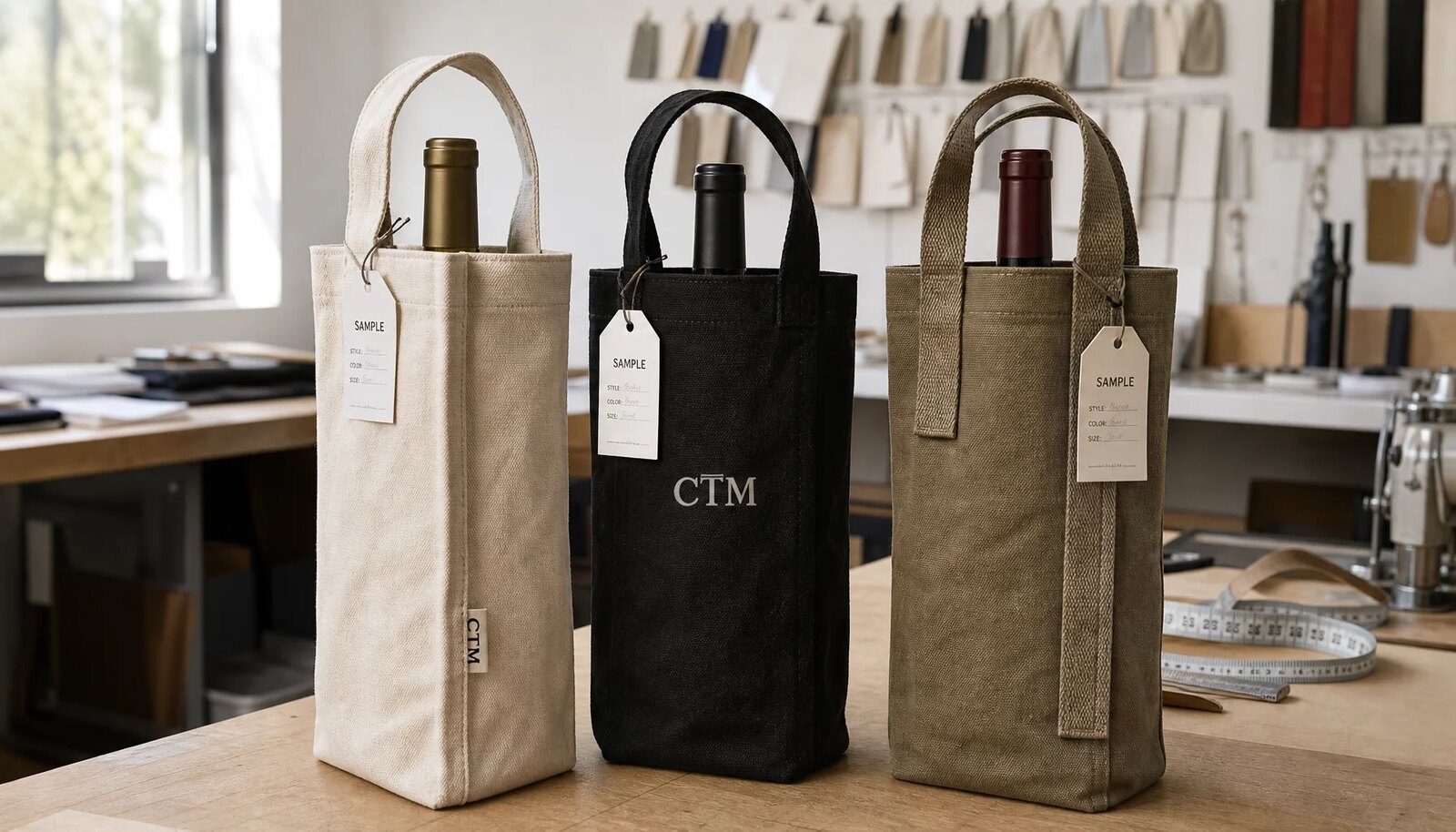
Start With the In-Hand Date, Not the PO Date
Most lead time mistakes on custom canvas wine carriers start with the wrong calendar. Buyers often anchor the schedule to the purchase order date, but the real deadline is the date the goods must be on site, sorted, and ready for the event. That schedule has to include artwork approval, sample approval, production, packing, freight, customs clearance, and final delivery.
For event programs, the useful planning question is not how long the factory says production takes in isolation. It is how much buffer remains after every handoff. A simple carrier with one-color decoration may move quickly, but only if the artwork is final, the fabric is already available, and the packing method does not require extra labor. When the event date is fixed, build backward and protect the approval windows first.
- Lock the in-hands date before you request quotes.
- Treat sample approval as a schedule gate, not a formality.
- Reserve extra buffer during peak gifting seasons and fourth-quarter congestion.
- Keep one backup sourcing route ready if the first supplier slips.
Choose a Spec That Matches the Calendar
Fabric weight matters because it changes sewing time, print result, and freight volume. For most custom canvas wine carriers, 10-12 oz canvas, roughly 340-410 gsm, is the standard range. It gives enough structure for a bottle carrier without overbuilding the product. If the order is aimed at premium retail or needs a heavier hand feel, 14-16 oz canvas, roughly 475-540 gsm, is more appropriate, but it usually adds sewing time and transport cost.
Decoration choice also affects lead time more than many buyers expect. One-color screen print on a flat panel is usually the fastest custom option. Woven labels, embroidery, debossed patches, or multiple print locations can look better, but they add setup and extra component sourcing. If the order is for an event giveaway, do not drift into a retail-grade build unless the schedule and margin justify it.
- Use 10-12 oz canvas for standard branded event programs.
- Use 14-16 oz canvas only when the product needs a premium feel or extra structure.
- One-color screen print is usually the safest route when the date is tight.
- Confirm the bottle diameter and any divider requirement before you approve the pattern.
Compare Sourcing Routes Before You Quote
The fastest route is not always the cheapest route, and the cheapest route is rarely the safest route for an event deadline. Direct factory sourcing works well when you need custom size, custom fabric weight, and controlled unit cost on a larger run. A local decorator using blank stock can be faster for urgent orders because the blank carrier is already available and only decoration remains. A trading company can help when the order needs multiple product lines or consolidated shipping, but it adds another handoff to manage.
Choose the route based on the failure point you can tolerate. If the event date is fixed and the order is modest, blank stock plus local print may be the lowest-risk choice. If the same design will repeat across campaigns, or if you need custom packaging and more control over the build, a direct factory is usually the better long-term solution. The correct sourcing route is the one that reduces schedule surprises, not the one with the lowest first quote.
- Direct factory: best for custom builds and cleaner long-term pricing.
- Local decorator: best for rush decoration on available stock.
- Trading company: best when you need one contact for multiple factory outputs.
- Ask where the slowest step sits so you know which supplier can actually miss the date.
Send an RFQ That Produces Comparable Quotes
A useful RFQ gives the factory enough detail to price the right product once. Include finished carrier size, bottle diameter, canvas weight, handle length, seam style, print location, number of colors, packing method, destination, and the delivery window. If those fields are vague, each supplier will fill the gap differently, and the quote set will not be comparable.
Make the factory separate recurring unit cost from one-time charges. Screen setup, plate fees, woven labels, sample charges, and carton printing should be visible on the quote. Ask for lead time from sample approval, not from order receipt, because the approval date is the real start line. That single change makes supplier comparison more accurate and reduces false optimism.
- Specify the actual bottle size the carrier must hold.
- Give canvas weight in oz or gsm, not just a marketing term like heavy duty.
- State the print method and the number of logo colors.
- Name the packing format and the destination terms so freight is comparable.
Use Sample Approval as a Schedule Gate
The sample is more than a visual check. A wine carrier can look acceptable when it is flat, then fail once a bottle is inserted. Check the fit with the actual bottle, the handle comfort in the hand, the seam behavior at the bottle base, and the print position on the finished shape. If the sample feels too tight, too soft, or too narrow, the bulk run will inherit the same problem.
For custom orders, the pre-production sample should freeze the build before cutting starts. If the supplier changes fabric lot, print process, trim, or stitching after approval, treat it as a new approval event. The fastest projects are the ones that avoid rework after the sample stage. A clean sample signoff is the cheapest insurance a buyer can buy on a fixed event schedule.
- Test with the real bottle, not a paper mockup.
- Check print clarity, placement, and color against the approved artwork.
- Inspect handle length, handle attachment, and seam alignment.
- If the supplier changes any component, require a revised sample or written approval.
Budget Time for Packing, Cartons, and Labeling
Packing is a lead time driver because it adds labor and extra checks. Bulk packing in master cartons is the fastest option and the easiest to control when the order is going straight into event kits or distributor inventory. Individual polybags, hangtags, barcode labels, retail inserts, or gift boxes all add steps, and those steps can be the point where the order slips if the line is busy or the labels arrive late.
Choose the packing format early, before the factory starts quoting. Event buyers often only need bulk packed units by style and color. Retail buyers may need unit-level barcode labels, inner boxes, and carton marks that match warehouse rules. If the packaging spec is not clear at the start, the factory may quote the wrong labor profile and the final schedule will be tighter than expected.
- Bulk master cartons are faster than individual retail packs.
- If barcodes are required, send the exact SKU structure and label format.
- Confirm whether carton marks must match a retailer's warehouse standard.
- Ask for carton dimensions and gross weight before freight booking.
Lead Time Risks That Show Up Late
The biggest schedule killers are often not the sewing lines. They are slow artwork approvals, unavailable fabric shades, print plate changes, custom trim sourcing, and late confirmation on packing details. If the factory has to match a Pantone color, source a specific woven label, or wait for a revised logo file, the production clock stops even if the sewing team is ready.
Build buffer around the parts that can move independently. A single-color logo on natural canvas with bulk packing has lower risk than a two-color print on dyed canvas with a custom label and retail sleeve. Every additional component is another schedule dependency. Buyers who keep the spec simple usually get the most reliable delivery, especially when the event date cannot move.
- Custom dyed canvas usually takes longer than natural canvas.
- Multiple logo colors increase setup and registration risk.
- Retail packaging adds labor and quality touch points.
- Peak season congestion can extend both production and freight timing.
Landed Cost Decisions That Affect the Schedule
Freight mode changes both cost and calendar. Air freight can save the event if the order is already late, but it changes landed cost sharply and is often hard to justify for lower-value giveaway packs. Sea freight is the better choice for larger orders, but it needs a firmer production finish date and more time for customs, inland delivery, and receiving at the destination warehouse.
Compare suppliers on the same terms or the price comparison will be misleading. A factory with a slightly higher unit cost may still be the better choice if it gives cleaner sample control, better packing discipline, and fewer rework cycles. Add freight, duty, local delivery, and the cost of a missed event window before you decide which quote is actually cheaper.
- Compare EXW, FOB, or DDP on the same basis.
- Include freight and import duty in the landed cost review.
- Ask for carton dimensions and gross weight before choosing transport.
- Count rework and delay risk as part of the total cost.
Plan Backward and Freeze the Critical Decisions
For a fixed event date, work backward from the day the goods must be on site. Reserve time for artwork signoff, sample approval, bulk production, packing inspection, and transit. If the order uses a new supplier or a new print method, add more buffer than the factory estimate suggests. The planning error usually comes from assuming every step will move at the average speed of the fastest step.
The best event programs freeze the critical decisions early. Finalize artwork, bottle fit, fabric weight, packing format, and delivery address before the order is released. Once production starts, small changes are not small anymore. They become new approval loops, new costs, or both. A clean lead time plan is mostly discipline: fewer variables, fewer handoffs, and one owner for each approval.
- Freeze the artwork before screens or labels are ordered.
- Lock bottle size and carrier dimensions before sampling.
- Set the packing format before production quotation.
- Assign one internal owner for sample signoff and one for freight release.
Specification comparison for buyers
| Spec decision | Recommended option | When it fits | Buyer risk to check |
|---|---|---|---|
| Sourcing route | Direct factory with in-house cutting, printing, sewing, and packing | Best for 1,000+ pcs, custom dimensions, and schedules that still have 8+ weeks of buffer | Confirm the factory does not outsource the slowest steps |
| Sourcing route | Local decorator using blank stock carriers | Best for rush event orders, smaller runs, or buyers who need the fastest possible decoration start | Check blank inventory, decoration queue, and rush fees before you rely on the quote |
| Fabric weight | 10-12 oz canvas, about 340-410 gsm | Works for standard event giveaways, branded hospitality sets, and buyers who want a clean print surface | Watch for thin yarn count or weak body if the supplier is quoting a low-cost canvas |
| Fabric weight | 14-16 oz canvas, about 475-540 gsm | Fits premium retail programs, heavier bottles, or customers who want a more structured hand feel | Expect longer sewing time, more freight volume, and a slightly slower production pace |
| Decoration method | One-color screen print on the main panel | Usually the fastest custom branding option for simple logos and event deadlines | Confirm artwork line thickness and registration tolerance before approving the screen |
| Decoration method | Woven side label plus a small print mark | Best for premium branding, repeat programs, or buyers who want a more retail-ready finish | Extra label sourcing can add lead time and a separate minimum order |
| Packing route | Bulk master cartons by style and color | Best for distributors, importers, and event kits that will be repacked later | Verify carton count, carton strength, and whether palletization is required |
| Packing route | Individual polybag with barcode or hangtag | Best for retail shelves or warehouse receiving rules that require unit-level identification | Labor for labeling and bagging can add time and increase packing errors |
| Sample route | Pre-production sample before bulk cutting | Best for new suppliers, new print methods, or any order with a fixed event date | Freeze all components at approval so the bulk run matches the signed sample |
Buyer checklist before sampling
- Event date, in-hands date, and the latest acceptable delivery window
- Bottle size, bottle diameter, and whether the carrier needs a divider or insert
- Finished carrier size, canvas weight in oz or gsm, and handle length
- Print method, print location, artwork files, and approved Pantone reference if color matters
- MOQ by color, print version, and packaging format
- Sample type required, sample approval deadline, and who signs off internally
- Packing format, carton count, carton marks, barcode rules, and whether individual bagging is needed
- Freight mode, destination, and whether the supplier is quoting EXW, FOB, or DDP
Factory quote questions to send
- What work is done in-house, and what steps are outsourced?
- What canvas weight and yarn count are you quoting, not just the finished bag size?
- What is the MOQ by color, artwork version, and packing method?
- What is the sample lead time, and does the sample use the same fabric, print method, and trim as bulk?
- How many days do you need after sample approval to start bulk production?
- Are screen setup, plate fees, woven labels, or packaging charges separate from the unit price?
- What carton size, carton quantity, and gross weight should we use for freight planning?
- What quality checks do you run during cutting, printing, sewing, and packing?
- Which part of the order is the most likely schedule risk, and what backup material would you use if it slips?
- Can you confirm the quote basis as EXW, FOB, or DDP so we can compare suppliers on the same terms?
Quality-control points to confirm
- Fabric weight matches the approved spec and does not come in with mixed lots unless the buyer signs off first
- Stitching at handle bases, seams, and stress points is even, secure, and free of skipped stitches or loose thread
- Bottle fit is checked with the actual bottle diameter, not only a flat pattern or paper template
- Print position, color, and opacity match the approved sample, with no blurring, ghosting, or visible misregistration
- Carrier stands correctly and does not twist, collapse, or rub against the bottle neck in normal handling
- Carton counts, style labels, and packing marks match the packing list and the buyer's warehouse requirements
- Final packed units are clean, dry, and free of stains, broken needles, odor, or damage from compression