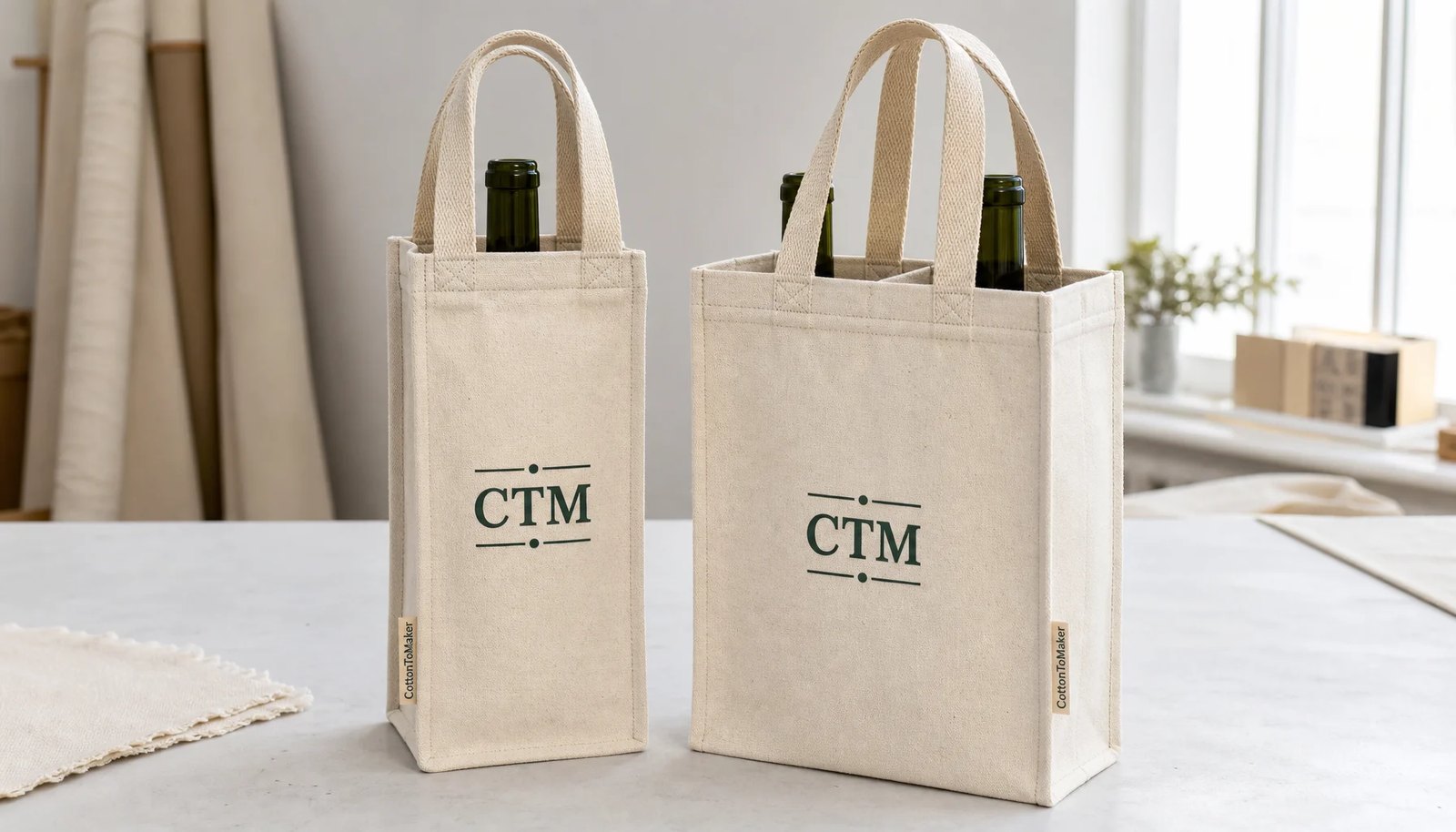
Buying Problem: Glass Weight Is Concentrated
A custom canvas wine carrier for a university bookstore is not a flat canvas tote with a narrower shape. The load behaves differently. Books and apparel spread weight across a broad tote base; a bottle carrier holds rigid glass in a small footprint, with most of the stress pulling into the handle roots, upper side seams, bottom corners, divider attachment, and logo panel. The same carrier may be handled by warehouse staff, bookstore associates, alumni customers, department event teams, and gift recipients before it reaches final use.
That chain of handling creates the core procurement risk: the product can look attractive while empty and still perform poorly when filled. A filled 750 ml wine bottle commonly weighs about 1.2-1.6 kg, depending on bottle shape and glass thickness. Sparkling wine and champagne-style bottles can be heavier. A two-bottle carrier can exceed 3 kg before anyone adds a greeting card, snack, corkscrew, ornament, or campus-branded add-on. If a handle tears, the safety issue is obvious. If the licensed mark cracks across a fold line, the problem becomes brand presentation as well as product quality.
The durability checklist belongs in the RFQ, not after samples disappoint. A request that says only “canvas wine bag with logo” invites suppliers to quote very different products: 8 oz event canvas, 12 oz retail canvas, 16 oz premium canvas, simple top stitching, reinforced box-X stitching, screen print, heat transfer, flat packing, or tight folded packing. Those offers are not commercially equal, even if the product name sounds identical. A better RFQ starts with real bottle use, then asks suppliers to price the same construction and the same tests.
- Start with loaded bottle use, not empty sample appearance.
- State whether the carrier is for resale, alumni gifting, donor events, department gifts, or seasonal display.
- Require visual approval and functional approval before releasing bulk production.
- Define bottle count, bottle shape, expected loaded weight, and safety margin before suppliers quote.
- Treat handle roots, bottom seams, divider seams, and logo folds as critical failure points.
Canvas Weight, Weave, and Finish
For most university bookstore retail programs, 12 oz to 16 oz cotton canvas is the practical range for custom canvas wine carriers. This commonly equals about 380-540 GSM, though the conversion changes with weave, yarn count, and finishing. A 12 oz canvas can work for a one-bottle carrier when the handle and seams are properly reinforced. For two-bottle carriers, premium alumni gift packaging, or reusable merchandise, 14 oz to 16 oz canvas usually gives better structure and shelf presence.
Lighter canvas is not automatically wrong. An 8 oz to 10 oz fabric may be suitable for a short-term event giveaway or low-cost sleeve, but it should not be treated as a retail default. Lightweight fabric can pass a photo review and still sag, wrinkle, or pull around handle roots under glass weight. Heavier canvas improves perceived value, yet it can also raise sewing difficulty, needle wear, carton weight, freight cost, and MOQ. It may require adjusted thread tension and pressing to avoid seam puckering.
Finish matters as much as weight. Natural unbleached canvas is popular because it looks reusable and campus-friendly, but it can show seed flecks, slubs, and shade variation. Buyers should define how much natural variation is acceptable instead of debating it during final inspection. Dyed canvas adds color matching risk and may require lab dips, higher fabric MOQ, and shade band approval. Washed canvas feels softer but can introduce more shrinkage and dimension variation. Ask for fabric weight in both ounces and GSM, the allowed tolerance, and confirmation that bulk fabric will match the approved sample lot.
- Standard retail baseline: 12 oz natural cotton canvas for one-bottle carriers with reinforced handles.
- Premium recommendation: 14 oz to 16 oz canvas for two-bottle styles or alumni gift packaging.
- RFQ detail: specify oz, GSM, color, finish, weave description where available, and fabric tolerance.
- Approval risk: reject vague terms such as “heavy canvas” or “good quality canvas” without measurable data.
- Inspection note: verify shade, slubs, stains, and GSM against the approved sample or mill report.
Bottle Fit and Load Rating
Durability testing starts with the bottle, not the bag drawing. A Bordeaux-style 750 ml bottle, Burgundy bottle, tall slim bottle, and sparkling bottle do not stress the carrier in the same way. A pattern that fits one bottle shape may stretch at the side seam, crowd the opening, or force the divider out of position with another. The RFQ should identify target capacity, approximate bottle diameter, height, and filled weight. If the bookstore sells mixed gift sets, the sample must be checked against the largest and heaviest expected bottle.
A useful load rating also has to account for real handling. Customers do not lift slowly every time. They grab one handle, swing the bag while walking, set it on counters, place it in cars, and carry it across parking lots or event venues. The test load should exceed normal use with a safety margin agreed by the buyer and supplier. One-bottle carriers should be tested with the required bottle plus additional weight when appropriate. Two-bottle carriers should be tested with both compartments loaded at the same time.
After testing, look for more than a clean pass-or-fail tear. A carrier can remain intact and still be unacceptable if the base bulges, side seams twist, handle roots pucker, or the print shows stress cracks. Review the sample immediately after testing and again after a rest period. Canvas can relax, but stitch damage and needle-hole tearing often remain visible. Record the test load, duration, method, and observations so production inspection uses the same standard.
- Define bottle format by capacity, shape, diameter, height, and approximate filled weight.
- Use real bottles or equivalent weighted bottle forms during sample testing.
- Test one-bottle and two-bottle carriers separately because dividers and bases change load behavior.
- Inspect handle roots, side seams, bottom corners, divider seams, and top opening after testing.
- Record pass criteria: no seam opening, torn fabric, broken stitches, excessive sagging, or unsafe bottle movement.
Handle Reinforcement and Seams
The handle area is often where a canvas wine carrier fails first. A low-cost sample may use self-fabric handles attached with a simple straight stitch. It can look tidy in a photo, yet concentrate the full bottle load on a small section of fabric. For bookstore retail, the handle root should usually include box-X stitching or an equivalent reinforcement pattern, supported by bartacks at stress points. A finished handle width of about 25-35 mm is a practical range for many loaded carriers because it spreads pressure better than a narrow strap.
Handle material should be named in the quote. Self-fabric handles match the body and create a natural retail look, but they need folded multi-layer construction. Cotton webbing can be stronger and more consistent, though it changes the appearance and may require color matching. The RFQ should state handle drop, handle width, handle material, number of layers, attachment position, stitch pattern, bartack count, thread color, and thread type. If the product will hang on a fixture, handle drop and stiffness also affect display.
Seam construction needs the same attention. Canvas can fray if seam allowances are too narrow or poorly finished. Bottom seams and side seams should be checked under load, not only while the sample lies flat. Two-bottle dividers add another stress line because bottles push in opposite directions during movement. Buyers do not have to specify every machine setting, but they should define unacceptable defects: skipped stitches, broken threads, loose bartacks, open seams, raw edges likely to fray, and reinforcement placed away from the stress point.
- Preferred handle root: box-X stitch or approved reinforcement supported by bartacks at stress points.
- Preferred handle width: usually 25-35 mm finished width for loaded carrying comfort.
- Critical seams: handle roots, upper side seams, bottom corners, divider attachment, and label insertion points.
- Inspection method: require close-up photos of stitching and compare production to the approved sample.
- Reject condition: skipped stitches, broken thread, weak reverse stitching, fabric tearing, or uneven handle placement.
Divider, Bottom, and Structure Tests
A two-bottle canvas wine carrier needs more than a fabric strip down the middle. The divider must keep bottles separated during normal movement, not just divide the bag when it is empty. A loose divider can allow glass-to-glass impact when a customer turns quickly, places the bag in a car, or carries it through a crowded alumni event. The divider should have a defined height, width, seam allowance, bottom attachment, and reinforcement. If the bottom is not anchored, the divider may float upward or shift under the bottle bases.
The bottom deserves its own test because the load transfers there every time the carrier is set down. A one-bottle carrier may perform well with a properly sewn single-layer base. Two-bottle and premium styles often benefit from a double-layer bottom panel, internal reinforcement patch, folded boxed base, or stronger bottom seam layout. The goal is not just preventing a tear. The loaded bag should stand cleanly on a shelf, gift table, or checkout counter without collapsing or bulging in a way that weakens perceived quality.
A simple structure test is useful and easy to repeat. Load the carrier with the intended bottle count. Place it on a flat surface and check whether it stands evenly. Lift it by the handles, move it gently side to side, and set it down again. Then inspect divider movement, bottom distortion, seam tension, and bottle contact. If the bookstore will sell gift sets, test the actual combination of bottle and filler items. Tissue, snacks, glassware, or small boxes can shift pressure inside the bag.
- Specify divider height, width, bottom anchoring, seam allowance, and reinforcement.
- Require a side-to-side movement test for two-bottle carriers to check bottle separation.
- Use bottom reinforcement for premium, reusable, or two-bottle products.
- Check whether the loaded carrier stands evenly on a flat surface after testing.
- Review divider seams and bottom corners as structural QC points, not cosmetic details.
Logo and Licensed Artwork Durability
University bookstore products often carry licensed marks, alumni graphics, department names, or event branding. The decoration has to look correct and stay presentable after handling, packing, and display. Screen printing is usually the strongest commercial choice for one to three spot-color graphics on canvas because it scales well, repeats consistently, and controls cost after setup. Heat transfer can work for short-run full-color designs, but it needs adhesion testing on textured canvas. Embroidery can look premium, but dense stitching may distort lighter panels and increase cost.
Artwork approval should go beyond a digital proof. Natural canvas absorbs ink differently than bleached or dyed canvas, and the weave can soften edges. Pantone matching should be judged on actual production fabric or a print strike-off, not on a monitor. The RFQ should state logo size, print location, color count, Pantone references, print method, placement tolerance, and whether the design may cross seams. For licensed marks, build in brand office or licensing review before bulk production.
Print durability testing should reflect bookstore handling and packing. Dry rub checks whether ink transfers with friction. Light wet rub can reveal weak curing or poor adhesion. Fold-line review is important if the bag will be folded across or near the logo. Dark ink on natural canvas may show cracking more clearly than light ink, while transfer edges may lift over uneven weave texture. The approved sample should include final decoration. If a temporary logo is used, it should be marked as reference only and should not authorize bulk printing.
- Screen print: best for repeat orders with simple university or alumni spot-color marks.
- Heat transfer: useful for short-run full-color designs, but check edge lifting and fold cracking.
- Embroidery: suitable for premium effects on heavier panels and moderate logo sizes.
- Artwork approval: verify Pantone color, size, placement, alignment, and print clarity on actual canvas.
- Print QC: include dry rub, light wet rub, fold-line inspection, and post-packing logo review.
MOQ, Cost Drivers, and Quote Comparability
MOQ depends on which parts of the carrier are truly custom. A standard body shape with a custom screen print may allow a lower MOQ because the factory can use existing cutting patterns and available natural canvas. A custom size, dyed fabric, special handle webbing, woven side label, custom divider, reinforced bottom, individual retail packing, or brand-specific hangtag may each raise MOQ. Ask suppliers to separate MOQ for the bag body, fabric, print, label, and packing components.
Cost comparison needs discipline. A lower unit price may exclude screen setup, sample remakes, Pantone ink mixing, barcode labeling, carton marks, or inspection support. Another quote may include stronger handles and flat packing, which increases unit price but lowers retail damage risk. Heavier canvas raises material cost and can raise freight cost because cartons become heavier and sometimes larger. Folded packing can reduce volume, but it can also damage the logo presentation if the fold line is not approved.
The best comparison is a controlled RFQ table where every supplier quotes the same construction and service scope. Ask for ex-factory price, FOB price if relevant, sample cost, sample lead time, bulk lead time, MOQ by component, setup charges, carton dimensions, gross weight, incoterm, payment terms, and quote validity. For bookstore groups, distributors, and importers, carton cube and gross weight can materially affect landed cost and warehouse handling.
- Major cost drivers: canvas GSM, dyed fabric, handle reinforcement, divider design, bottom reinforcement, logo method, and packing format.
- Common hidden costs: screen setup, artwork adjustment, Pantone ink, woven label MOQ, sample remake, barcode application, and inspection handling.
- MOQ reducer: use a standard body size and customize only the print, hangtag, or side label.
- Quote rule: compare suppliers only after fabric weight, reinforcement, logo method, and packing are equal.
- Commercial decision: choose the lowest landed cost for a carrier that passes durability and presentation tests.
Sample Approval Workflow
Sampling should move from concept confirmation to production approval. A first sample may confirm size, shape, handle feel, and general branding. A pre-production sample must confirm the actual order: production fabric, production print method, handle construction, divider, thread, label placement, bottom reinforcement, and intended packing fold. If a sample uses substitute canvas, temporary printing, or a simplified divider, label it as a reference sample and do not use it for bulk approval.
A written approval sheet protects both buyer and supplier. Record fabric weight, fabric color, finished body dimensions, gusset, handle drop, handle width, seam construction, divider size, bottom reinforcement, logo size, logo placement, print method, thread color, label details, packing method, carton layout, and accepted tolerances. Photos should show the front logo panel, handle roots, side seams, bottom corners, divider attachment, and packed condition. That record becomes the comparison standard during production and final inspection.
The sample should be tested loaded before deposit approval whenever the order is for resale, licensed graphics, or a fixed campus event. Load the carrier with the target bottle or equivalent weight, carry it, set it down, and inspect it again. Check handle comfort, seam strain, bottom shape, logo appearance, and divider stability. If defects appear, request a corrected sample or written corrective action before bulk production begins. Verbal promises are not enough when a late order could miss graduation, homecoming, or holiday selling windows.
- Approve visual appearance and loaded performance as separate checkpoints.
- Use actual fabric, thread, print method, divider, reinforcement, and packing for pre-production approval.
- Create a sample approval sheet with measurements, photos, materials, and accepted tolerances.
- Test the sample with the intended bottle size and safety margin before deposit release.
- Confirm all corrections in writing before the supplier starts cutting bulk fabric.
Inspection Plan and Defect Classification
A durability checklist becomes stronger when it turns into an inspection plan. Before production starts, agree how many units will be checked, which measurements will be taken, and how defects will be classified. Many B2B buyers use an AQL-based final inspection, but the specific level and acceptable limits should be agreed between buyer and supplier. Even when a third-party inspection is not used, the factory should know which issues are critical, major, and minor.
Critical issues are safety or brand failures that should not ship. Examples include handles pulling out under the agreed load, open bottom seams, divider failure that allows severe bottle collision, broken glass contamination, incorrect licensed artwork, or a logo printed in the wrong color family. Major defects can include off-center logos outside tolerance, weak bartacks, visible stains, severe shade mismatch, incorrect packing, or dimensions that prevent bottle fit. Minor defects might include small loose threads, slight natural flecks, or mild wrinkles if they remain within the approved sample standard.
Inspection should combine random checks with targeted checks at high-risk areas. Measure finished dimensions, handle drop, handle width, divider height, and logo placement. Load test a defined quantity from production, not only the development sample. Check print rub resistance and folded logo appearance if units are packed folded. Inspect cartons for correct SKU, quantity, gross weight, labels, and compression. The point is practical: prevent unsafe, off-brand, or unsellable merchandise from reaching the bookstore.
- Agree critical, major, and minor defect definitions before bulk production.
- Classify handle failure, open bottom seams, and incorrect licensed artwork as high-severity issues.
- Measure dimensions and logo placement against the approved sample and tech sheet.
- Load test production units, not only the original sample, when glass weight is the main risk.
- Check carton labels, SKU separation, quantity, and packing condition before shipment release.
Packing, Cartons, and Retail Receiving
Packing affects both durability and sell-through presentation. A well-made canvas wine carrier can arrive unsellable if the logo panel has a hard crease, the handles are crushed into awkward positions, or the canvas is stained during carton handling. University bookstores often display these products as gifts, so the customer sees the carrier before purchase. The packing specification should state whether carriers are flat packed, lightly folded, individually bagged, bundled, tissue wrapped, banded, or packed without plastic for campus sustainability reasons.
Flat packing protects logo appearance and keeps the carrier ready for retail display, but it increases carton volume. Folded packing reduces freight cube, but the fold line must be approved. Whenever possible, avoid folding across the printed logo. If folding across or near the print is unavoidable, pack the sample, compress it, reopen it, and inspect for cracking or permanent crease marks. Also confirm whether inner polybags require suffocation warnings, recycled-content requirements, or avoidance due to sustainability policies.
Request carton data before final supplier comparison. Ask for units per carton, carton dimensions, gross weight, net weight, carton marks, barcode or SKU labeling, and packing layout photos. Cartons should not be so heavy that bookstore or warehouse staff struggle with manual handling. If the order ships through distributors or campus receiving departments, clear carton marks reduce delays. A carton compression or handling review is especially useful when the product has a printed front panel, structured divider, or premium retail presentation requirement.
- Choose flat packing when logo presentation and retail shelf condition are top priorities.
- Choose folded packing only after approving the exact fold line and checking print durability.
- Specify inner packing: individual polybag, bundled polybag, tissue, banding, or no plastic.
- Request carton dimensions and gross weight early for freight and receiving planning.
- Inspect received cartons for compression, moisture, crushed handles, dirty canvas, and hard logo creases.
Specification comparison for buyers
| Spec decision | Recommended option | When it fits | Buyer risk to check |
|---|---|---|---|
| Fabric weight for bookstore retail use | 12 oz to 16 oz cotton canvas, commonly about 380-540 GSM depending on weave and finishing; request the quoted tolerance, often around ±5% for fabric weight | Alumni wine gifts, donor event packaging, holiday bundles, campus retail shelves, and reusable gift packaging | An empty sample can look fine while low-GSM fabric sags under bottle weight; verify the fabric report, sample cut weight, and loaded hang result |
| Bottle capacity and divider structure | One-bottle style for broad retail use; two-bottle style with sewn center divider, bottom anchoring, and divider height high enough to reduce bottle shoulder contact | One-bottle works for lower price points and compact displays; two-bottle supports premium alumni packs, gift baskets, and event merchandise | Loose or floating dividers allow bottle collision; specify divider height, bottom attachment, seam allowance, and post-test inspection criteria |
| Handle construction | Self-fabric folded handles or cotton webbing handles with box-X stitching and bartacks; finished handle width usually 25-35 mm for comfortable loaded carrying | Needed for 750 ml wine bottles, heavier sparkling bottles, and gift bundles with cards, snacks, corkscrews, or bookstore add-ons | Narrow handles or simple straight stitching concentrate load; quote must state handle material, layers, drop, width, stitch pattern, thread type, and bartack positions |
| Bottom reinforcement | Double-layer bottom, internal reinforcement patch, folded boxed base, or reinforced bottom seam for two-bottle and premium styles | Useful when bags stand upright on retail shelves, carry heavier bottles, or are marketed as reusable branded packaging | Flat product photos hide base distortion; require a filled-bottle standing test, bottom seam inspection, and shape recovery review after unloading |
| Logo decoration method | Screen print for 1-3 spot-color university marks; heat transfer for short-run full color; embroidery only on suitably heavy panels and moderate logo sizes | Screen printing usually balances repeat-order cost, brand color control, and durability for bookstore programs | Ink can crack on folds or rub from textured canvas; test dry rub, light wet rub, fold lines, placement tolerance, and Pantone match on production fabric |
| Licensed artwork control | Print strike-off or pre-production sample using approved logo size, color, placement, and actual production fabric | Required when university brand offices, alumni associations, sponsors, or licensing teams must approve the mark before production | Digital proofs do not show canvas absorption, weave texture, or shade shift; approve decoration on the same canvas construction used for bulk |
| MOQ logic | Lower MOQ for stock body plus custom print; higher MOQ for custom size, dyed canvas, woven labels, special dividers, reinforced bottom, or individual retail packing | Best for bookstores testing a new wine-and-gift category before graduation, homecoming, alumni weekend, or holiday replenishment | Unit price alone is misleading; compare setup charges, fabric MOQ, label MOQ, carton cube, inspection cost, freight basis, and landed cost |
| Sampling route | Pre-production sample using actual canvas weight, print method, handle construction, divider, thread, label, and packing fold | Needed before bulk approval for licensed graphics, resale products, and programs with fixed campus selling dates | Sales samples may use substitute canvas or temporary decoration; sample approval must lock the bulk production specification |
| Inspection tolerance | Finished dimensions commonly controlled around ±5 mm for small measurements and ±10 mm for larger panels when construction allows; logo placement often needs tighter visual approval | Useful for repeat programs where the bookstore expects consistent shelf presentation and barcode or hangtag alignment | Overly loose tolerances cause inconsistent bottle fit, off-center logos, and carton packing issues; record tolerances in the tech pack before cutting |
Buyer checklist before sampling
- Define the exact bottle format before quoting: 750 ml Bordeaux-style bottle, Burgundy bottle, sparkling bottle, tall bottle, or mixed program. Do not approve a carrier based only on flat dimensions.
- Specify fabric in both ounces and GSM, plus acceptable tolerance, weave description if available, fabric color, finish, shrinkage expectation, and whether the fabric is natural unbleached, bleached, dyed, washed, or printed canvas.
- Set the target load before sampling. A standard filled 750 ml wine bottle often weighs about 1.2-1.6 kg, while heavier sparkling bottles can approach or exceed 1.7 kg; test with a safety margin above expected use.
- Lock handle drop, finished handle width, handle material, number of folded layers, stitch pattern, bartack positions, seam allowance, thread color, and thread type on the approved sample.
- Require a written divider specification for two-bottle carriers: divider height, width, bottom attachment method, reinforcement, seam allowance, and whether bottles can touch during normal carrying.
- Decide whether the product is low-cost event packaging, reusable retail gift packaging, or premium alumni merchandise; that decision controls canvas weight, reinforcement, decoration, packing, and acceptable unit cost.
- State logo method, logo size, Pantone references, color count, ink or transfer type where applicable, print location tolerance, artwork approval route, and rub or fold-line testing expectations.
- Approve a loaded sample, not only a clean empty sample. Review sagging, handle comfort, side seam twisting, divider stability, bottom shape, print cracking, and post-rest recovery.
- Confirm retail presentation needs: hangtag, barcode sticker, care label, individual polybag, bundled packing, tissue, carton marks, SKU separation, and whether the front logo panel may be folded.
- Request carton data before comparing suppliers: pieces per carton, carton dimensions, gross weight, net weight, packing layout, carton ply, and whether carton weight suits bookstore or warehouse handling rules.
Factory quote questions to send
- What exact canvas weight are you quoting in ounces and GSM, and what tolerance will be accepted in bulk production?
- Is the body fabric natural, greige, bleached, dyed, washed, or printed canvas, and will finishing or shrinkage affect finished dimensions?
- What bottle size did you use when developing this pattern, and can the sample fit our required bottle diameter and height without stretching seams?
- What static load and dynamic carry test has this handle and seam construction passed, for how long, and what was inspected after unloading?
- Will the pre-production sample use the same fabric, thread, handle construction, divider, bottom reinforcement, print method, label, and packing as bulk production?
- For the university logo, which decoration method is included in the unit price, how many colors are included, and what screen, setup, or color-matching charges apply?
- What is the MOQ for the bag body, custom print, dyed canvas, woven label, custom divider, reinforced bottom, and any special retail packing?
- What are the finished dimensions and tolerances for body width, body height, gusset, base width, handle drop, handle width, divider height, and print placement?
- What seam construction will be used at the side seam, bottom seam, handle root, and divider attachment, and can you provide close-up sample photos before shipment?
- What thread type and stitch density will be used, and how will skipped stitches, broken thread, loose bartacks, and raw-edge fraying be classified during QC?
Quality-control points to confirm
- Fabric weight should be verified by a mill report and, when practical, by cutting and weighing a measured fabric area; hand feel is not enough for approval.
- Finished dimensions should be measured after sewing, trimming, pressing, and packing simulation. Practical tolerances may be around ±0.5 cm for smaller features and ±1.0 cm for larger panels, depending on construction.
- Loaded hang testing should use the intended bottle count plus a defined safety margin. Inspect handle roots, side seams, bottom seams, divider seams, and top openings before and after the test.
- Dynamic carry review should include lifting, short walking or swinging movement, setting down, and re-lifting; failures often appear after movement rather than during static hanging only.
- Handle pull review should confirm correct reinforcement, box-X or approved stitch pattern, dense bartacks, no skipped stitches, no broken thread, no loose reverse stitching, and no fabric tearing around needle holes.
- Bottom strength should be checked while bottles are standing inside the carrier. Look for seam strain, panel distortion, uneven standing, and corners that begin to pull open.
- Divider strength should be tested by inserting bottles and moving the carrier side to side. Bottles should remain separated enough to reduce glass-to-glass impact during normal carrying.
- Print adhesion should be reviewed by dry rub, light wet rub, fingernail scratch where appropriate, and fold-line inspection, especially for dark ink on natural canvas or transfer logos on textured fabric.
- Logo placement should be measured against the approved sample or tech sheet, including distance from top edge, side edge, bottom seam, and centerline alignment.
- Canvas appearance should be inspected for shade variation, oil marks, dirt, needle damage, weaving defects, loose threads, and heavy seed flecks outside the accepted standard.