Start With Real Event Use
A wine carrier for a trade show has a tougher job than a product photo suggests. It may be filled behind the booth, stacked under a counter, carried through a crowded aisle, set down on concrete or carpet, and taken home with catalogs or samples inside. The carrier is also holding glass, so buyers should treat it as a functional packaging item, not only a branded giveaway.
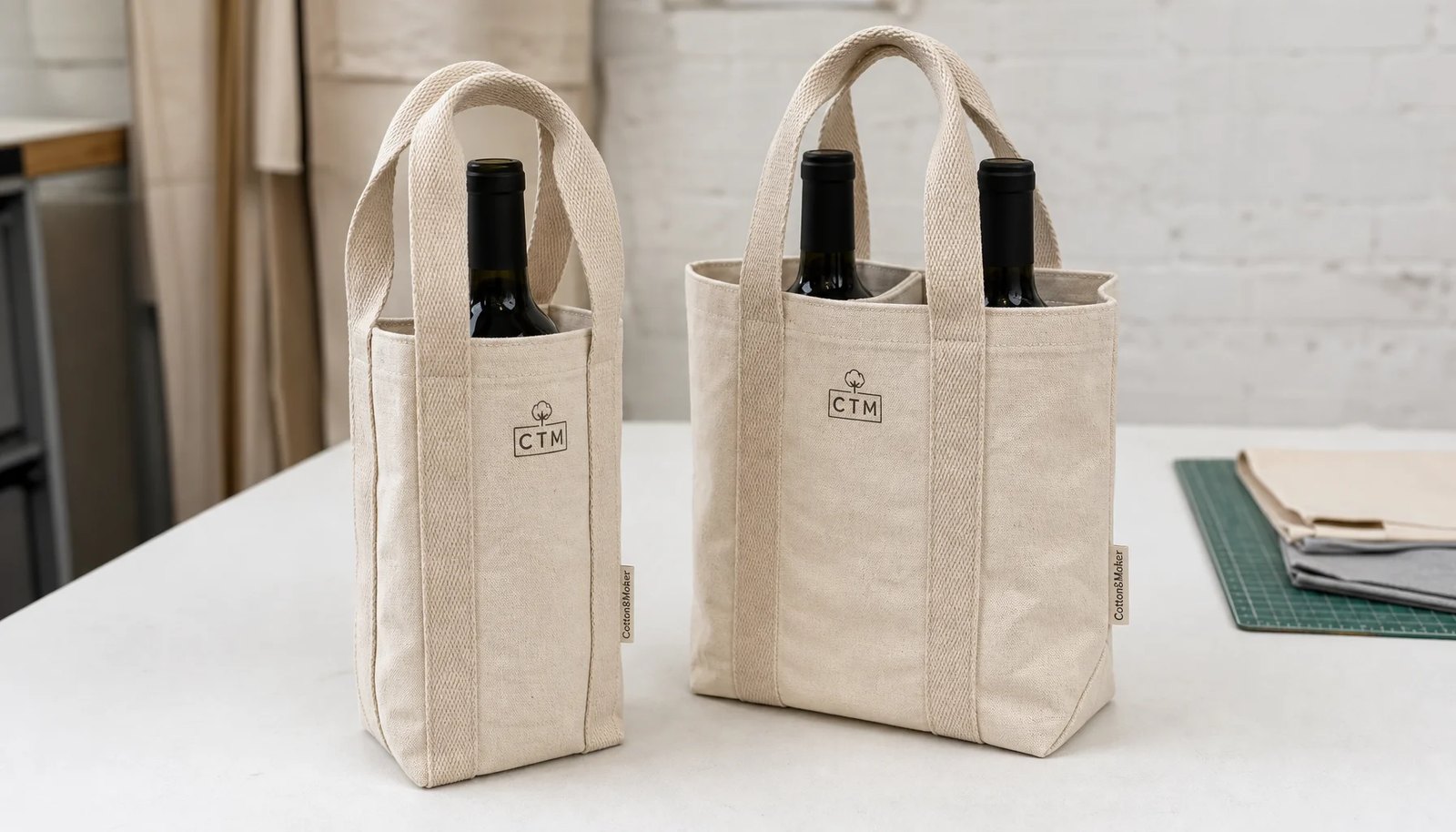
The first sourcing decision is the bottle program. A carrier designed around one slim bottle may not fit a wider Burgundy or sparkling bottle cleanly. A two-bottle version adds more load, more movement, and a divider that must actually prevent bottle contact. Before asking suppliers for price, define the bottle shapes, fill condition, gift inserts, and whether staff will pack the bags quickly during booth traffic.
This is where a custom canvas wine carriers durability testing checklist for trade show exhibitors becomes useful: not as a repeated keyword, but as a working order tool. The checklist should connect the event scenario to construction, sample approval, packing, and QC. That prevents the common mistake of approving a nice-looking sample that has never been tested under the way it will be used.
- List every bottle shape the carrier may need to hold, including the widest and heaviest version.
- Decide whether the bag must perform for a single handoff, a full day of carrying, or retail-style reuse.
- Confirm whether the recipient receives only the bottle or also catalogs, corkscrews, tasting cards, or sleeves.
- Set the approval standard around loaded use, not empty appearance.
- Make the event deadline part of the product specification, because rushed changes often weaken construction choices.
Compare Suppliers by Construction, Not Just Price
Unit price is important, but it can hide very different products. One quote may assume lighter canvas, simple straight stitching, a smaller print area, and basic export packing. Another may include reinforced handles, better carton planning, and a more realistic sample approval process. If those differences are not visible in the quote, the lowest price is not truly comparable.
Ask suppliers to identify what they are quoting as standard and what changes cost extra. This matters for canvas weight, fabric finish, handle material, divider height, seam finish, print size, color count, label placement, inner packing, and inspection support. The goal is not to overcomplicate the order. The goal is to avoid discovering after sampling that the quoted version was the weakest acceptable version.
A good supplier comparison should also include communication quality. Can the factory explain the handle construction clearly? Will they show inside seam photos? Do they flag risks with your bottle shape or artwork? Do they understand the show deadline and inspection window? These are practical signs that the order can be controlled.
- Request a line-by-line quote that separates fabric, logo method, special labels, packing, and setup charges.
- Ask whether the quoted construction is the factory standard or a buyer-specified upgrade.
- Compare carton quantity and estimated carton volume, because freight can change landed cost materially.
- Require sample photos from inside and outside the carrier before approving bulk production.
- Treat unclear construction language as a quote risk, not a minor wording issue.
Specify Canvas Without Guesswork
Canvas is not one material. Suppliers may use the same word for cloths that differ in weight, weave tightness, finish, shrinkage, color consistency, and hand feel. For procurement buyers, the specification should include a weight range, approximate GSM when the supplier can provide it, finish, color reference, and whether the fabric is stock or specially sourced.
For many trade show wine carriers, a midweight cotton canvas is the practical center because it balances body, printability, sewing efficiency, and carton volume. Very light canvas can look limp around a bottle and may put more stress on seams. Very heavy canvas can feel premium, but it may add cost, bulk, needle marking, and production difficulty. Instead of treating one number as universal, ask the factory to justify the fabric choice against the bottle load and carrier structure.
Finish also changes the product. Natural canvas can vary by lot and often has visible texture. Washed canvas can feel softer but may affect measurements and print texture. Dyed canvas may support brand color, but it adds shade approval and print contrast questions. If size stability matters, ask how the supplier controls shrinkage before cutting and whether the sample represents bulk fabric.
- Use fabric swatches from the intended production lot when shade or hand feel matters.
- Confirm whether handles and body panels come from the same fabric lot or different materials.
- Ask for the factory's normal tolerance for shade variation and visible slubs before production.
- Do not approve a print test on smooth substitute fabric if bulk will be textured canvas.
- Record fabric details on the purchase order, not only in email comments.
Make the Handle the Main Engineering Point
The handle is the part the recipient trusts first. It also carries most of the risk. A weak handle attachment can fail even when the fabric body looks substantial. Buyers should review handle construction before arguing about logo placement, because a carrier that feels unsafe will damage the gift experience more than a slightly imperfect print.
The specification should state whether the handle is cotton webbing or folded self-fabric, the handle width, finished handle length, drop height, reinforcement method, thread type, and stitch pattern. Cotton webbing is often dependable for volume orders because it is consistent and easy to inspect. Self-fabric handles can look integrated, but they need enough folded layers, seam allowance, and reinforcement to resist pull-out.
Inspection should include the inside of the attachment area. Front-facing sample photos often hide short stitch runs, loose thread ends, narrow seam allowance, or reinforcement patches that do not spread the load. For two-bottle carriers, the handle design should be reviewed as a load path: bottle weight moves through the base and body into the handle join. Decorative stitching alone is not a strength plan.
- Ask for close-up photos of the handle attachment before the pre-production sample ships.
- Confirm whether reinforcement stitching is included on both handle ends and both sides of the carrier.
- Check that the handle feels comfortable when loaded, not sharp, twisted, or too narrow.
- Reject samples where handle stitching pulls the fabric into severe puckers under load.
- Use the approved sample as the inspection reference for stitch pattern and reinforcement size.
Control Bottle Fit, Divider, and Base
Bottle fit is more than flat width. The bag must accept the bottle body, allow the neck and shoulder to clear the opening, keep the bottle stable, and let staff fill it quickly. A carrier that looks tidy when empty may become frustrating during booth setup if every bottle must be forced into place.
Two-bottle carriers need divider testing. A low divider can look acceptable on a flat sample but allow bottles to strike each other when carried. A divider that is too stiff or poorly attached can distort the opening or pull at the base seam. Buyers should test the widest approved bottle pair and watch how the carrier behaves while lifted, tilted, and walked.
The base should match the display plan. If the carrier only needs to be handed over with a bottle inside, a reinforced sewn base may be enough. If it must stand upright empty on a counter, an insert may help, but inserts add material, labor, packing decisions, and possible storage issues. The best base is the one that supports the actual handoff without adding hidden complexity.
- Measure internal clearance with real bottles, not only paper patterns or supplier drawings.
- Test the bottle opening speed with the staff member who will pack the bags at the event.
- For two-bottle designs, confirm the divider controls bottle movement above the widest body section.
- Inspect bottom seams after loaded set-downs, especially at corners and gusset transitions.
- Decide whether stand-up presentation is required before adding base inserts.
Choose Decoration for Wear, Not Just Artwork Approval
Canvas decoration needs physical approval. Natural cotton texture, weave variation, and absorbency can change line sharpness and color coverage. A logo that looks perfect in a PDF may lose detail on rough canvas, especially if it includes small reverse text, fine lines, gradients, or large solid blocks.
Screen printing is usually the practical choice for solid logos and clear trade show branding at volume. It can be durable and cost-effective when ink, mesh, and curing are handled correctly. Heat transfer may work for full-color or detailed designs, but buyers should check film edge lift, flex behavior, hand feel, and rub performance. Embroidery and woven labels can be attractive, but they are not automatic upgrades; each affects cost, texture, placement, and production consistency.
The sample approval should include the exact decoration method on the actual canvas. Ask to see the print after folding and packing simulation. A carrier may leave the sewing line looking good but arrive with rubbed ink, transfer edges catching, or visible creases across the logo. For trade shows, presentation at the booth is part of quality.
- Approve color and artwork on production canvas, not only on a digital proof.
- Avoid tiny text and fine reverse details unless the factory proves they reproduce cleanly.
- Set logo placement tolerance and print size in writing.
- Check dry rub and light damp rub after the ink or transfer has fully set.
- Ask how printed faces will be protected inside cartons.
Build an RFQ That Reduces Rework
A strong RFQ makes supplier assumptions visible. It should define bottle type, finished dimensions, canvas details, handle construction, divider structure, base style, decoration method, print area, packing, carton marks, sample requirements, inspection expectations, and deadline. This may look detailed, but it is shorter than the email chain required to fix a vague order.
MOQ should be discussed in context. A lower quantity may be possible with stock canvas, standard sizing, and simple one-color decoration. Custom dyeing, special handles, woven labels, complex print, or retail-style packing can raise minimums or setup costs. Buyers should ask which changes affect MOQ and which only affect unit price.
The RFQ should also separate must-haves from preferences. If the show date is fixed, stock fabric and a proven construction may be wiser than custom color matching. If the bag will be part of a VIP gift set, bound seams, a woven side label, or more controlled packing may be worth the extra lead time. The buyer's job is to choose the right risk level for the program.
- Include bottle photos or physical bottle dimensions with the RFQ.
- Attach logo artwork and state whether color matching is required or approximate.
- Ask suppliers to quote the base version and any requested upgrades separately.
- Request estimated carton dimensions early so logistics can estimate landed cost.
- Put the latest acceptable delivery date and inspection window in the first RFQ, not after sampling.
Approve Samples With a Written Record
A pre-production sample should prove repeatability. It should use the final fabric, final handle material, final divider, intended seam finish, and production decoration method. If the supplier uses substitute fabric or temporary printing for speed, mark the sample as a construction reference only and do not release bulk production from it.
Create a simple approval record. Measure the sample, photograph the stress points, record fabric and decoration details, check fit with real bottles, and note the functional test results. Keep one approved sample with the buyer and one sealed reference sample with the factory. This prevents subjective disputes later, especially around shade, stitch appearance, and print placement.
Packing should be reviewed during sampling as well. Ask how the carrier will be folded, whether printed panels will touch, whether inner packs are used, and how many pieces go into each export carton. A product can pass construction review and still arrive creased, dirty, or difficult to distribute if packing is treated as an afterthought.
- Measure and record width, height, gusset, handle drop, handle length, divider height, and logo placement.
- Photograph handle joins, base corners, divider seams, interior seam finish, and printed area.
- Test the sample with the actual bottle count and record what changed after loading.
- Label the approved sample with date, version, fabric, print method, and buyer approval.
- Require a new approval if the supplier changes fabric, handle material, print process, or divider construction.
Run Practical Durability Checks
Durability testing for trade show carriers does not need to imitate a laboratory program unless the buyer has a formal standard to meet. It should, however, be consistent, written, and based on real failure points. The most useful checks are loaded hang, repeated lifting, walking movement, set-down stress, divider control, print rub, and shape recovery after the load is removed.
Start with the intended bottle count plus an agreed margin. The margin should be chosen by the buyer and supplier based on the bottle weight, event use, and construction, not copied from a generic article. After hanging or carrying, inspect the handle joins, base seams, divider seams, and fabric around stress points under good light. Look for broken thread, seam opening, tearing, elongated handle holes, and severe distortion.
For two-bottle carriers, movement matters as much as static load. Insert the approved bottle pair, lift the bag, walk a short distance, turn, and gently move it side to side. If the bottles contact each other, the divider or body dimension needs review. For logo durability, perform dry rub and light damp rub after proper curing and compare against the approved sample.
- Loaded hang: use the approved bottle count and buyer-agreed margin, then inspect all stress points.
- Repeated lift: lift and set down the loaded carrier enough times to reveal stitch creep or handle distortion.
- Walking check: carry the bag through turns and normal hand movement, not only a straight static hold.
- Divider check: confirm bottles stay separated when the bag tilts or moves gently.
- Print check: test dry rub, light damp rub, cracking, smearing, and transfer edge lift.
- Recovery check: remove the bottles and confirm the carrier still hangs square enough for presentation.
Set QC and Lead Time Before Production
Quality control should be written before sewing starts. Define critical, major, and minor defects so the supplier, inspector, and buyer apply the same standard. Critical defects should include anything that creates bottle drop risk or unsafe contamination. Major defects should include wrong material, wrong size, failed handle attachment, wrong logo, severe stains, mildew odor, divider failure, or unacceptable print defects. Minor defects should be limited to issues that do not affect function or presentation.
Use sampling inspection when order size justifies it, but do not rely on visual review alone. Pull samples for functional checks: bottle fit, loaded handle area, base stress, divider movement, and logo rub. Also inspect packing. Cartons should be clean, correctly marked, not overfilled, and practical for event receiving. If the show team must sort, clean, or repack everything on arrival, the sourcing process has failed them.
Finally, protect the calendar. Work backward from the show date and include sample making, sample shipping, buyer review, corrections, production, inspection, rework time, export booking, customs, domestic delivery, and warehouse receiving. When the date cannot move, keep a fallback version using stock canvas, standard dimensions, simple decoration, and basic packing. That backup may not be the most customized option, but it can keep the booth supplied.
- Define critical, major, and minor defects in the purchase order or inspection document.
- Add functional checks to inspection instead of accepting a visual-only report.
- Confirm carton marks, pieces per carton, gross weight, and receiving requirements before shipment.
- Leave time for rework after inspection, especially on first orders or new constructions.
- Share the final specification with sourcing, marketing, quality, logistics, and the event owner.
Specification comparison for buyers
| Buyer choice | Option A | Option B | Tradeoff to confirm before approval |
|---|---|---|---|
| Fabric approach | Stock natural cotton canvas in a common midweight range | Custom dyed, washed, or heavier canvas | Stock canvas usually improves speed and MOQ flexibility; custom fabric improves brand match but can add dye-lot risk, shade approval steps, and longer lead time. |
| Carrier format | Single-bottle carrier with simple gusseted body | Two-bottle carrier with full-height divider and stronger base | Single-bottle styles are easier to pack and distribute in high-traffic booths; two-bottle styles feel more premium but need divider testing and higher handle confidence. |
| Handle construction | Cotton webbing handle with reinforcement stitching | Folded self-fabric handle integrated into the body | Webbing is consistent and easy to inspect; self-fabric can look cleaner but needs enough layers, seam allowance, and stitching density to avoid pull-out. |
| Handle reinforcement | Bartack or box-X stitching at stress points | Longer reinforced stitch runs with patch backing | Both can work when executed well; buyers should compare stitch length, thread quality, patch size, and inside seam finish rather than judging from front photos only. |
| Interior finish | Overlock plus topstitch for efficient volume production | Bound interior seams for a more finished retail look | Overlock plus topstitch often balances cost and function; bound seams improve presentation but can increase labor, bulk, and sewing consistency requirements. |
| Base structure | Folded box bottom with reinforced bottom seams | Added insert board or sewn-in base support | A reinforced sewn base is simpler for event handouts; inserts help the bag stand empty but add packing labor, material decisions, and possible warping or shifting. |
| Decoration method | Screen print for solid logos and clear brand marks | Heat transfer, woven label, or embroidery for special branding needs | Screen print is usually the practical volume choice; alternatives should be approved only after checking hand feel, edge durability, artwork detail, and production repeatability. |
| Supplier quote style | Supplier quotes their standard wine carrier with your logo | Supplier quotes against a written buyer specification | Standard quotes are faster but harder to compare; a written specification makes unit price, quality level, packing, and inspection responsibility clearer. |
| Inspection scope | Visual inspection for stains, size, logo, and packing | Visual inspection plus loaded functional checks on pulled samples | Visual inspection catches presentation defects; functional checks are needed for handle strength, divider control, base stress, and logo rub performance. |
Buyer checklist before sampling
- Confirm the exact bottle types before quoting: Bordeaux, Burgundy, Champagne, sparkling wine, spirits, or a mixed program.
- Ask suppliers to fit-test the widest and heaviest bottle expected, not only a standard slim bottle.
- Specify canvas by weight range, approximate GSM if available, weave feel, finish, and color reference instead of using only the word canvas.
- Clarify whether the sample uses production fabric or substitute fabric; approve substitute samples for construction only.
- State finished dimensions for width, height, gusset, handle drop, handle length, divider height, and print position.
- Require handle details in the quote: webbing or self-fabric, width, reinforcement method, thread type, stitch pattern, and inside finish.
- Define whether the carrier must stand upright empty, only when filled, or only during handout.
- Approve decoration on the actual canvas with the intended ink, transfer film, label, or embroidery thread.
- Check print performance after curing, folding, carton compression, dry rub, and light damp rub.
- Set functional sample tests that reflect real use: loaded hang, repeated lifting, walking, set-downs, and divider movement.
Factory quote questions to send
- What exact canvas will be used, including weight, approximate GSM if available, finish, color reference, and whether the fabric is stock or custom sourced?
- Is the quoted sample made from production fabric, and if not, what details are different from bulk production?
- Which bottle shapes and sizes has the factory tested in this carrier, and can you test our widest or heaviest bottle before approval?
- What are the finished measurement tolerances for width, height, gusset, handle drop, handle length, divider height, and logo placement?
- What handle construction is included in the unit price: cotton webbing, folded self-fabric, reinforcement patch, bartack, box-X, or another stitch method?
- Can you provide clear photos of the inside handle attachment, base seams, divider seams, and print surface on the pre-production sample?
- Which decoration method is quoted, how many colors are included, what print area is included, and what curing or setting process is used?
- What practical durability checks can be performed on pre-production or pulled production samples before shipment?
- What MOQ changes if we alter canvas color, canvas weight, handle color, woven label, print size, print color count, divider structure, or packing method?
- How many pieces fit per inner pack and export carton, what are the estimated carton dimensions, and how will printed panels be protected?
Quality-control points to confirm
- Bottle fit: test the approved bottle range for insertion speed, neck clearance, body clearance, and removal without forcing the opening.
- Loaded hang: suspend the carrier with the intended bottle count and agreed safety margin, then inspect handle joins, base seams, divider seams, and fabric distortion.
- Handle attachment: check reinforcement patches, bartacks, box-X stitches, or dense stitch areas for skipped stitches, short stitch runs, thread breaks, puckering, and needle damage.
- Base performance: place the loaded carrier repeatedly on a hard surface and inspect bottom corners, seam creep, fabric tearing, and loss of shape.
- Divider control: for two-bottle carriers, insert real bottles, lift and move the bag gently, and confirm glass does not contact glass above the divider.
- Print durability: perform dry rub and light damp rub after curing, then compare color loss, cracking, smearing, and edge lift against the approved sample.
- Dimensional control: measure finished width, height, gusset, handle drop, handle length, divider height, and print position on randomly selected pieces.
- Fabric condition: reject oil marks, mildew odor, severe logo-area creases, panel shade mismatch outside the approved range, and slubs or weaving flaws beyond the agreed standard.
- Stitch quality: inspect for skipped stitches, loose thread tails beyond the agreed limit, uneven seam allowance, seam pucker, broken thread, and unfinished stress points.
- Packing condition: confirm carton counts, inner packing, printed-panel protection, carton marks, carton strength, gross weight, and purchase order labeling.